
I/O psychology began in the early 1900s, when Walter Dill Scott (1903) and Hugo Münsterberg (1913) applied experimental psychology to advertising and to choosing workers. It grew through World War I army testing (1917), the Hawthorne studies (1924 to 1932) and World War II, added “organizational” to its name in 1973, and its society, SIOP, was incorporated in 1982.
This timeline is for students who need the history of industrial and organizational psychology for an exam, a first-week assignment or the introduction chapter of a thesis. It runs from 1900 to today in five eras, with the dates checked against the Society for Industrial and Organizational Psychology (SIOP), the original books and peer-reviewed histories. At the end you get a 10-mark answer plan and 10 practice MCQs.
One thing to know first: most textbooks (Landy and Conte, Aamodt, Levy) tell a mainly American story, with some British history. That is the story examiners expect, so it is the one told here, with a note on where South Asia fits at the end.
History of I/O psychology: the timeline at a glance
| Year | Event | Why it matters |
|---|---|---|
| 1903 | Walter Dill Scott, The Theory of Advertising | Psychology applied to business persuasion |
| 1911 | F. W. Taylor, The Principles of Scientific Management | Time study, selection and training of workers; the human side was missing |
| 1913 | Hugo Münsterberg, Psychology and Industrial Efficiency | First full programme of industrial psychology; tests matched to jobs |
| 1914 | Lillian Gilbreth, The Psychology of Management | Fatigue, motivation and the worker’s mind in the efficiency movement |
| 1915 | Carnegie Institute of Technology opens a Division of Applied Psychology (Walter Bingham) | First academic unit for applied and industrial psychology |
| 1917 | Journal of Applied Psychology first issue (March) | The field’s leading journal begins |
| 1917 | Army Alpha and Army Beta group tests | Showed that group testing could work at a huge scale |
| 1921 | Psychological Corporation (Cattell); National Institute of Industrial Psychology, UK (Myers); Bruce V. Moore’s doctorate at Carnegie Tech | Testing becomes a business; the UK gets its own institute; often called the first doctorate in industrial psychology |
| 1924 to 1932 | Hawthorne studies, Western Electric | Social relations and group norms enter the field |
| 1932 | Morris Viteles, Industrial Psychology | First broad textbook of the field |
| 1937 | American Association for Applied Psychology, Section D (Industrial and Business) | First professional home for industrial psychologists |
| 1945 | APA Division 14, Industrial and Business Psychology; Bruce V. Moore first president | The specialty gets a permanent place in the APA |
| 1954 | John Flanagan, the critical incident technique | Wartime research becomes a job analysis method |
| 1956 | AT&T Management Progress Study begins (Douglas Bray) | Assessment centres shown to predict managers’ careers |
| 1959 to 1968 | Herzberg (1959), McGregor (1960), Vroom (1964), Locke (1968) | The great age of motivation theories |
| 1962 | Division 14 renamed Industrial Psychology | “Business” dropped from the name |
| 1964 | US Civil Rights Act, Title VII | Selection tests must not discriminate |
| 1971 | Griggs v. Duke Power | Tests that screen out a group must be job-related |
| 1973 | Division 14 renamed Industrial and Organizational Psychology | The “O” side officially joins the name |
| 1977 | Schmidt and Hunter, validity generalization | Meta-analysis changes how test validity is judged |
| 1978 | Uniform Guidelines on Employee Selection Procedures | The four-fifths rule and validation duties |
| 1980 | Division 14 publishes the Principles for the Validation and Use of Personnel Selection Procedures (1980 edition) | The profession’s own technical standard for selection |
| 1982 | Society for Industrial and Organizational Psychology, Inc. incorporated | SIOP as we know it, still a division of the APA |
| 1986 | First SIOP conference separate from the APA convention (Chicago) | The field runs its own annual meeting |
| 1998 | O*NET replaces the Dictionary of Occupational Titles | Job analysis data goes online |
| 2001 | Job demands-resources model | Well-being and burnout research takes a central place |
| 2018 | SIOP Principles, fifth edition | Current technical guide for selection |
| 2022 | Sackett, Zhang, Berry and Lievens revise selection validities | Structured interviews rank highest; an open debate |
1900 to 1916: the founders
Industrial psychology came out of the new experimental psychology of the late 1800s, which measured how people perceive, react and learn. A few psychologists saw that the same methods could answer business questions.
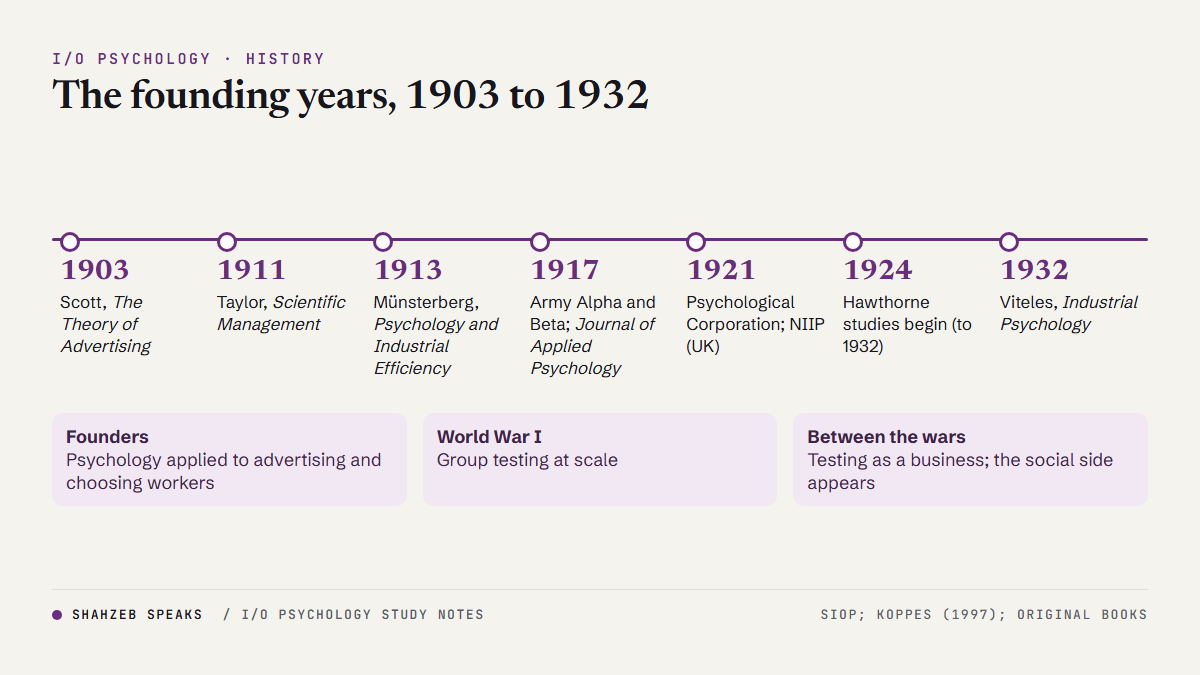
- Walter Dill Scott published The Theory of Advertising in 1903 and later worked on selecting salespeople and, in the war, soldiers. Many historians count him with Münsterberg as a founder.
- Frederick Taylor, an engineer, published The Principles of Scientific Management in 1911. He was not a psychologist, but his call to “scientifically select and then train” workers set up the questions psychologists would answer. The contrast with the later human relations approach is on the Taylor vs Mayo page.
- Hugo Münsterberg, a Harvard psychologist trained by Wilhelm Wundt, wrote Psychology and Industrial Efficiency (English edition 1913, German 1912). Its three parts, the best possible man, the best possible work and the best possible effect, map onto selection, training and consumer psychology. He tested streetcar motormen, ship officers and telephone operators. See Hugo Münsterberg’s contribution.
- Lillian Gilbreth brought fatigue and motivation into the efficiency movement with The Psychology of Management (1914). Koppes (1997) describes her among the early women pioneers of the field.
1917 to 1918: World War I and group testing
The field’s first big test came when the United States entered World War I in 1917. A committee of psychologists chaired by Robert Yerkes built two group intelligence tests: Army Alpha for recruits who could read English and Army Beta, a non-verbal test, for those who could not. Sources give different totals, from about 1.5 million to nearly 2 million men tested. The main lesson for I/O psychology was that tests could be given to large groups quickly and used to place people. Later critics showed the tests were culturally biased and were misused in debates on immigration, a warning about testing that the field still teaches.
Two other foundations date from these years. In 1915 Walter Bingham set up the Division of Applied Psychology at the Carnegie Institute of Technology in Pittsburgh. In March 1917 the first issue of the Journal of Applied Psychology appeared, founded by G. Stanley Hall, John Wallace Baird and Ludwig Geissler (Thomas, 2009).
1919 to 1939: testing grows up and the Hawthorne studies
After the war, testing became a business. James McKeen Cattell founded the Psychological Corporation in 1921 to sell psychological services and tests to companies. In Britain, Charles Myers founded the National Institute of Industrial Psychology, formally incorporated on 11 February 1921, which pioneered vocational guidance, personnel selection and test construction in the UK (British Psychological Society, History of Psychology Centre). In the same year Bruce V. Moore completed his doctorate at Carnegie Tech, often described as the first doctorate in industrial psychology.
The biggest change of the period came from a factory. The Hawthorne studies at Western Electric (1924 to 1932) started as lighting experiments and ended as studies of attitudes, supervision and group norms. Interviews with 21,126 employees and the observation of a 14-man work group showed that output depended on social factors as well as physical ones. This is where the organizational side of the field begins.
In 1932 Morris Viteles published Industrial Psychology, the first textbook to organise the young field around selection, training, fatigue, accidents and motivation. In 1937 applied psychologists formed the American Association for Applied Psychology, whose Section D (Industrial and Business) became the profession’s first real home (Koppes, SIOP history).
1940 to 1963: World War II and the post-war boom
World War II again pulled psychologists into selection, training and equipment design on a large scale, which gave rise to human factors and to new methods. John Flanagan’s work with aircrew selection led to the critical incident technique (1954), which collects real examples of effective and ineffective behaviour and is still used in job analysis and structured interviews.
In 1945 the American Association for Applied Psychology merged into a reorganised APA. Section D became Division 14, Industrial and Business Psychology, with Bruce V. Moore as its first president. Its members numbered 130 in 1945 and 734 by 1960 (Koppes, SIOP history).
The 1950s and early 1960s brought two lasting lines of work. In 1956 Douglas Bray began the AT&T Management Progress Study, which assessed new managers in multi-day assessment centres, kept the results from the company, and later showed the ratings predicted who advanced (Bray, 1964). And motivation theory took off: Herzberg’s two-factor theory (1959), McGregor’s Theory X and Theory Y (1960), Vroom’s expectancy theory (1964) and Locke’s goal-setting research (1968). These are covered in work motivation theories compared.
1964 to 1989: civil rights law and the “O” in I/O
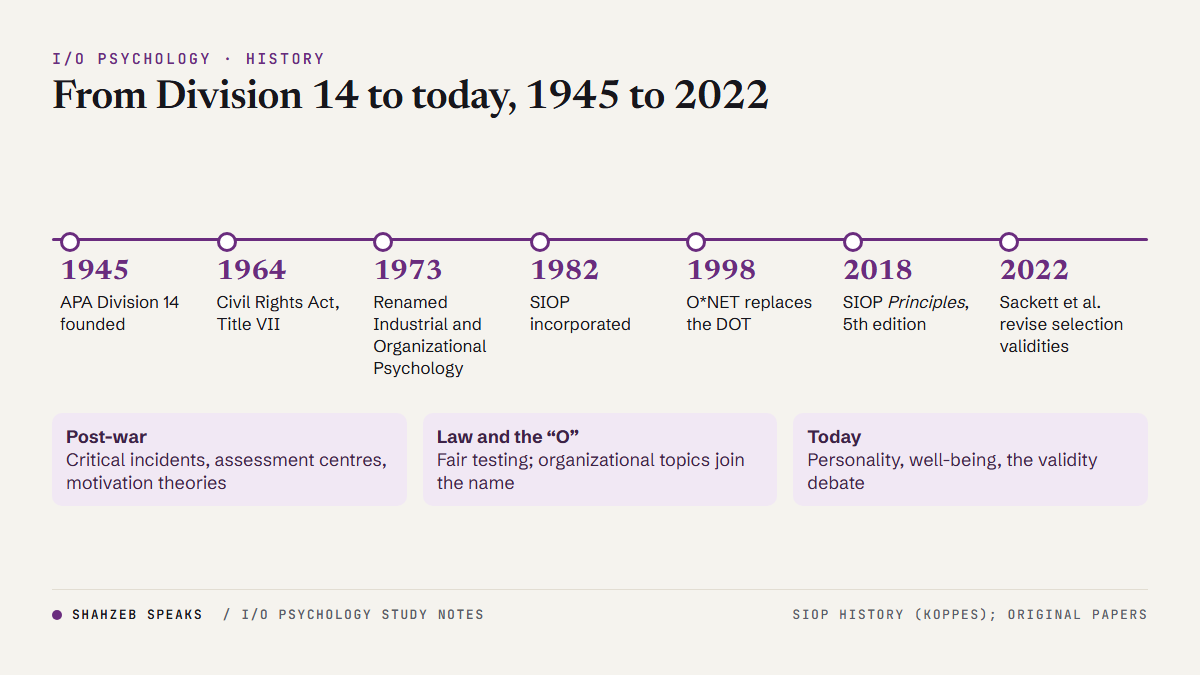
Two forces shaped this period. The first was law. Title VII of the US Civil Rights Act of 1964 banned employment discrimination. In Griggs v. Duke Power (1971) the Supreme Court held that a test or requirement that screens out a protected group must be shown to be related to the job. The Uniform Guidelines on Employee Selection Procedures (1978) set out the four-fifths rule of thumb for adverse impact and the duty to show validity. Selection research had to become far more careful, and I/O psychologists became expert witnesses. You can check adverse impact with the free adverse impact calculator.
The second force was the growth of the organizational side. The division dropped “Business” from its name in 1962 and became Industrial and Organizational Psychology in 1973 (Koppes, SIOP history). Research on attitudes, leadership, teams, culture and organizational change now stood beside selection and appraisal. The difference between the two sides is explained on industrial vs organizational psychology.
Methods changed too. Schmidt and Hunter’s work on validity generalization (1977) used meta-analysis to show that much of the variation in test validity across studies came from sampling error and other artefacts. In 1980 the division published an edition of its Principles for the Validation and Use of Personnel Selection Procedures, the profession’s own technical standard. In 1982 Division 14 incorporated as the Society for Industrial and Organizational Psychology, Inc., and in 1986 SIOP held its first conference separate from the APA convention, in Chicago.
1990 to today: personality, well-being and the validity debate
- Personality returns. Around 1990, research settled on five broad personality factors, and Barrick and Mount (1991) found conscientiousness predicted performance across jobs. Personality testing came back into selection. See personality tests at work.
- Job information goes online. In 1998 the US Department of Labor released O*NET, which replaced the Dictionary of Occupational Titles (DOT).
- Selection validities summarised, then revised. Schmidt and Hunter (1998) gave the standard summary of 85 years of selection research. Sackett, Zhang, Berry and Lievens (2022) argued earlier work had over-corrected for range restriction; their estimates put structured interviews highest. Other researchers have contested parts of their method, so this debate is live.
- Well-being and stress. The job demands-resources model (Demerouti et al., 2001) made burnout and engagement central topics.
- Standards. The Standards for Educational and Psychological Testing were revised in 2014 and SIOP’s Principles reached their fifth edition in 2018.
How the field’s name changed
| Year | Name of the professional body | What changed |
|---|---|---|
| 1937 | AAAP Section D, Industrial and Business | First organised group |
| 1945 | APA Division 14, Industrial and Business Psychology | Became part of the APA |
| 1962 | Division 14, Industrial Psychology | “Business” dropped |
| 1973 | Division 14, Industrial and Organizational Psychology | “Organizational” added |
| 1982 | Society for Industrial and Organizational Psychology, Inc. (SIOP) | Incorporated as a society, still an APA division |
Where do Pakistan, India and the Philippines fit?
Honestly, the standard histories say very little about South and Southeast Asia, and I have not found a peer-reviewed history of I/O psychology in Pakistan that I could cite here with confidence. What we can say is what students see in their own courses: universities now teach the field as part of psychology and management degrees, and their outlines start with exactly this history. Punjab University’s Industrial Psychology course, for example, opens with the definition and history of the field before moving to job analysis, selection, training, appraisal, motivation and leadership, using Landy and Conte and Aamodt as textbooks. For what the field looks like as a career today, see the scope of industrial psychology in Pakistan and the I/O psychology study guide.
10-mark answer structure (“Trace the history of industrial/organizational psychology”)
- Definition: I/O psychology is the scientific study of people at work; its history runs from about 1900 to today.
- Founders (1900 to 1916): Scott (1903), Taylor (1911, not a psychologist), Münsterberg (1913), Gilbreth (1914).
- World War I (1917 to 1918): Army Alpha and Beta under Yerkes; group testing at scale; Journal of Applied Psychology 1917.
- Between the wars (1919 to 1939): Psychological Corporation and NIIP (1921); Hawthorne studies (1924 to 1932); Viteles (1932); AAAP Section D (1937).
- World War II and after (1940 to 1963): wartime selection and training; critical incident technique (1954); Division 14 (1945); AT&T study (1956); motivation theories.
- Civil rights and the “O” (1964 to 1989): Title VII (1964), Griggs (1971), Uniform Guidelines (1978); renamed I/O (1973); SIOP (1982).
- Recent trends: Big Five, O*NET (1998), well-being, revised validities (2022).
- Critical point: early testing was biased and misused; the field’s standards grew partly in response.
- Conclusion: the field moved from fitting people to jobs (the “I”) to understanding people in organizations (the “O”), and now does both.
Model opening line: “Industrial and organizational psychology grew from early twentieth-century attempts to apply experimental psychology to advertising and worker selection into a field that studies every part of working life, from hiring to well-being.”
Practice MCQs: history of I/O psychology
Practice questions written to the published syllabus, not past-paper questions.
-
Who wrote The Theory of Advertising (1903)?
- Hugo Münsterberg
- Walter Dill Scott
- Frederick Taylor
- Morris Viteles
Show answer
B. Scott’s 1903 book applied psychology to advertising. Münsterberg’s key book came in 1913, Taylor’s in 1911 and Viteles’s textbook in 1932.
-
Army Beta was designed for which recruits?
- Officers only
- Recruits who could not read English
- Recruits with high scores on Alpha
- Navy pilots
Show answer
B. Beta was the non-verbal test for recruits who could not read English; Alpha was the written test. Neither was limited to officers or pilots.
-
In which year was APA Division 14 renamed “Industrial and Organizational Psychology”?
- 1945
- 1962
- 1973
- 1982
Show answer
C. “Organizational” was added in 1973. 1945 is the founding of Division 14, 1962 is when “Business” was dropped, and 1982 is SIOP’s incorporation.
-
Which event is most closely linked to the start of the organizational side of the field?
- Army Alpha
- The Hawthorne studies
- The founding of O*NET
- Taylor’s pig-iron study
Show answer
B. Hawthorne turned attention to attitudes, supervision and group norms. Army Alpha and Taylor’s work belong to the industrial side; O*NET is a job analysis database.
-
Which of these did NOT happen in 1921?
- The Psychological Corporation was founded
- The UK’s National Institute of Industrial Psychology was incorporated
- Bruce V. Moore completed his doctorate at Carnegie Tech
- SIOP was incorporated
Show answer
D. SIOP was incorporated in 1982. The other three all date from 1921, which makes it a favourite year for MCQs.
-
A US company’s aptitude test screens out far more applicants from one group, and it has never been checked against job performance. Which court case set the rule that this test must be shown to be job-related?
- Griggs v. Duke Power (1971)
- Brown v. Board of Education (1954)
- Roe v. Wade (1973)
- Marbury v. Madison (1803)
Show answer
A. Griggs held that requirements with adverse impact must be related to the job. The other cases are about schools, abortion and judicial review.
-
John Flanagan’s critical incident technique (1954) grew out of research on:
- Telephone operators
- Wartime aviation and aircrew selection
- The Hawthorne bank wiring room
- Advertising
Show answer
B. Flanagan developed the method from World War II aviation research. Telephone operators were Münsterberg’s subjects; the bank wiring room was Hawthorne; advertising was Scott’s field.
-
What did the AT&T Management Progress Study (begun 1956) help to establish?
- The two-factor theory
- The assessment centre as a predictor of managerial success
- The Hawthorne effect
- Time and motion study
Show answer
B. Bray’s study showed that assessment centre ratings, kept away from the company, predicted later advancement. The other options belong to Herzberg, Hawthorne and Taylor.
-
Who was the first president of APA Division 14?
- Hugo Münsterberg
- Elton Mayo
- Bruce V. Moore
- Walter Bingham
Show answer
C. SIOP’s history names Bruce V. Moore as the first president in 1945. Münsterberg died in 1916; Mayo was at Harvard Business School; Bingham founded the Carnegie division in 1915.
-
A student says, “Taylor was the first industrial psychologist.” What is the best correction?
- Correct, he wrote the first psychology textbook
- Taylor was an engineer; psychologists such as Scott and Münsterberg founded industrial psychology, though Taylor’s ideas shaped it
- Taylor was Wundt’s student
- Taylor founded SIOP
Show answer
B. Taylor was a mechanical engineer. Münsterberg was Wundt’s student (not Taylor), and SIOP came in 1982, long after Taylor’s death.
Practise on your phone
The free I/O Psychology Prep app has 410 explained
questions, flashcards and an exam countdown, and works offline. Get it on Google Play
· About the app
Want 25 more questions on this period? Try the history of I/O psychology MCQs, and meet each person on the I/O psychology theorists page.
Questions students ask
Who is the father of industrial psychology?
Hugo Münsterberg is most often named, for Psychology and Industrial Efficiency (1913). Walter Dill Scott is also called a founder because his work on advertising (1903) and selection came first.
When did industrial psychology begin?
Most histories place the start between 1903 and 1913, with Scott’s and Münsterberg’s books. World War I testing in 1917 turned it into a recognised applied field.
When did “organizational” become part of the name?
In 1973, when APA Division 14 was renamed Industrial and Organizational Psychology. The organizational side had been growing since the Hawthorne studies.
What is SIOP and when was it formed?
The Society for Industrial and Organizational Psychology. It began as APA Division 14 in 1945 and was incorporated as SIOP in 1982. It remains a division of the APA.
How did the world wars shape I/O psychology?
World War I proved group testing could work at scale (Army Alpha and Beta). World War II expanded selection, training and equipment design, and produced methods like the critical incident technique.
What is the history of industrial psychology in India and Pakistan?
There is no widely cited history for either country. The field is taught in university psychology and management programmes using the same Western textbooks, and courses open with the history covered on this page.
Practise on your phone
The free I/O Psychology Prep app has 410 explained
questions, flashcards and an exam countdown, and works offline. Get it on Google Play
· About the app
References
- Barrick, M. R., & Mount, M. K. (1991). The Big Five personality dimensions and job performance: A meta-analysis. Personnel Psychology, 44(1), 1–26. https://doi.org/10.1111/j.1744-6570.1991.tb00688.x
- Bray, D. W. (1964). The Management Progress Study. American Psychologist, 19(6), 419–420. https://doi.org/10.1037/h0039579
- British Psychological Society, History of Psychology Centre. (n.d.). The beginnings of occupational psychology: The National Institute of Industrial Psychology. https://bps.org.uk/blog/beginnings-occupational-psychology-national-institute-industrial-psychology
- Demerouti, E., Bakker, A. B., Nachreiner, F., & Schaufeli, W. B. (2001). The job demands-resources model of burnout. Journal of Applied Psychology, 86(3), 499–512. https://doi.org/10.1037/0021-9010.86.3.499
- Flanagan, J. C. (1954). The critical incident technique. Psychological Bulletin, 51(4), 327–358. https://doi.org/10.1037/h0061470
- Gilbreth, L. M. (1914). The psychology of management. Sturgis & Walton.
- Herzberg, F., Mausner, B., & Snyderman, B. B. (1959). The motivation to work. Wiley.
- Katzell, R. A., & Austin, J. T. (1992). From then to now: The development of industrial-organizational psychology in the United States. Journal of Applied Psychology, 77(6), 803–835. https://doi.org/10.1037/0021-9010.77.6.803
- Koppes, L. L. (1997). American female pioneers of industrial and organizational psychology during the early years. Journal of Applied Psychology, 82(4), 500–515. https://doi.org/10.1037/0021-9010.82.4.500
- Koppes, L. L. (n.d.). A brief history of the Society for Industrial and Organizational Psychology, Inc. SIOP Museum. https://www.siop.org/About-SIOP/SIOP-Museum/Koppes-History
- Landy, F. J. (1997). Early influences on the development of industrial and organizational psychology. Journal of Applied Psychology, 82(4), 467–477. https://doi.org/10.1037/0021-9010.82.4.467
- Locke, E. A. (1968). Toward a theory of task motivation and incentives. Organizational Behavior and Human Performance, 3(2), 157–189. https://doi.org/10.1016/0030-5073(68)90004-4
- McGregor, D. (1960). The human side of enterprise. McGraw-Hill.
- Münsterberg, H. (1913). Psychology and industrial efficiency. Houghton Mifflin.
- Roethlisberger, F. J., & Dickson, W. J. (1939). Management and the worker. Harvard University Press.
- Sackett, P. R., Zhang, C., Berry, C. M., & Lievens, F. (2022). Revisiting meta-analytic estimates of validity in personnel selection: Addressing systematic overcorrection for restriction of range. Journal of Applied Psychology, 107(11), 2040–2068. https://doi.org/10.1037/apl0000994
- Schmidt, F. L., & Hunter, J. E. (1977). Development of a general solution to the problem of validity generalization. Journal of Applied Psychology, 62(5), 529–540. https://doi.org/10.1037/0021-9010.62.5.529
- Schmidt, F. L., & Hunter, J. E. (1998). The validity and utility of selection methods in personnel psychology: Practical and theoretical implications of 85 years of research findings. Psychological Bulletin, 124(2), 262–274. https://doi.org/10.1037/0033-2909.124.2.262
- Scott, W. D. (1903). The theory of advertising. Small, Maynard.
- Taylor, F. W. (1911). The principles of scientific management. Harper & Brothers.
- Thomas, R. K. (2009). Ludwig Reinhold Geissler and the founding of the Journal of Applied Psychology. American Journal of Psychology, 122(3), 395–403. https://doi.org/10.2307/27784411
- Vinchur, A. J., & Koppes, L. L. (2011). A historical survey of research and practice in industrial and organizational psychology. In S. Zedeck (Ed.), APA handbook of industrial and organizational psychology (Vol. 1, pp. 3–36). American Psychological Association. https://doi.org/10.1037/12169-001
- Viteles, M. S. (1932). Industrial psychology. W. W. Norton.
- Vroom, V. H. (1964). Work and motivation. Wiley.
This post is part of the I/O psychology study guide. Read next: the Hawthorne studies, Hugo Münsterberg and Taylor vs Mayo.