
Fiedler’s contingency model (Fred Fiedler, 1964; 1967) says a group’s performance depends on the match between the leader’s style and the situation. Style is measured with the Least Preferred Co-worker (LPC) scale. Task-motivated (low-LPC) leaders do best in very favourable or very unfavourable situations; relationship-motivated (high-LPC) leaders do best in moderate ones.
This page is for psychology, management and HRM students who need Fiedler’s contingency theory for an exam, a presentation or an assignment. It explains the LPC scale (described, not reprinted, because the scale is published material), the three situational factors, the eight octants in one diagram and one table, how the model is used in practice, and what the research says. At the end there is a 10-mark exam answer plan and 10 practice MCQs with explanations.
What is Fiedler’s contingency model?
Fred E. Fiedler was an American psychologist who studied leaders in many kinds of groups: high school basketball teams (a 1954 study that led to his LPC score), bomber crews, army tank units, open-hearth steel shops and boards of directors. He noticed that the same leadership style worked well in some groups and badly in others. Earlier trait and behavioural research had looked for one best leader or one best style. Fiedler argued that there is no such thing: effectiveness is contingent, meaning it depends on the situation.
He first set out the model in a chapter titled “A contingency model of leadership effectiveness” (Fiedler, 1964) and then in full in his book A Theory of Leadership Effectiveness (Fiedler, 1967). It is usually called the first contingency theory of leadership (Seyranian, 2009). It has three parts:
- The leader’s style, measured by the LPC scale: task-motivated or relationship-motivated.
- Situational favourableness, also called situational control: how much the situation lets the leader predict and influence what the group does. It is built from leader-member relations, task structure and position power.
- The match: each kind of leader performs best in certain situations.
One idea makes Fiedler different from most other theories: he believed style is a fairly stable part of personality. A leader cannot simply switch from task focus to people focus when the situation changes. So the practical advice is to put the right leader in the right situation, or to change the situation, not to train leaders to be flexible. This is the opposite of path-goal theory and Hersey and Blanchard’s situational approach, which expect leaders to adjust.
The LPC scale: how Fiedler measured leadership style
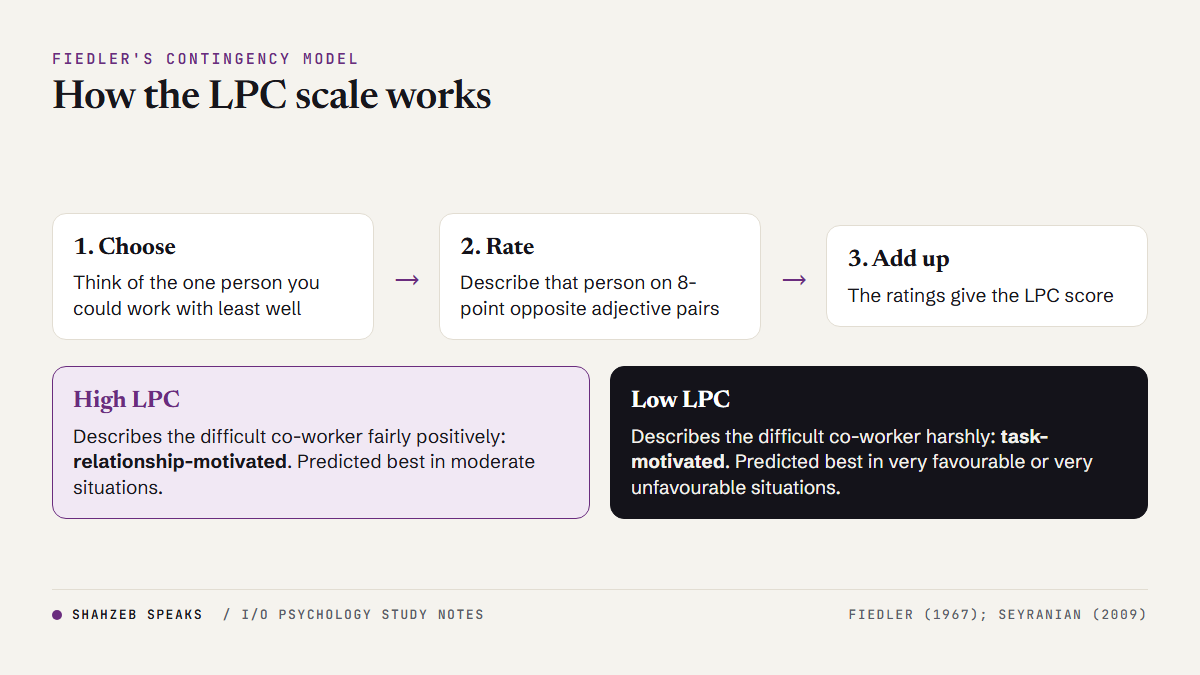
The Least Preferred Co-worker (LPC) scale is short and unusual. The leader is asked to think of all the people they have ever worked with and pick the one person they could work with least well. It does not have to be someone they dislike personally, only the hardest person to get the job done with. The leader then describes that person on a list of opposite adjective pairs (the kind of pairs that run from an unfriendly end to a friendly end), each rated on an 8-point scale (Seyranian, 2009). The ratings are added to give the LPC score. In the version printed in Northouse’s widely used leadership textbook there are 18 pairs.
What high and low LPC scores mean
- High LPC (relationship-motivated): the leader still describes the difficult co-worker in fairly positive terms. Fiedler read this as a person who separates the work problem from the person and draws satisfaction from good relationships.
- Low LPC (task-motivated): the leader describes the difficult co-worker harshly. Fiedler read this as a person who gets satisfaction mainly from getting the task done, and who judges people by whether they help with it.
Cut-off points differ between versions. One common textbook version treats 57 or below as low LPC, 58 to 63 as middle and 64 or above as high. Always quote the cut-offs in your own course book, and say in your answer that the score is a measure of motivation (what the leader values), not of observed behaviour.
What the LPC score really measures has been argued about for decades. Fiedler saw it as a stable motivational trait; Rice suggested it reflects the leader’s values and attitudes; others linked it to task versus relationship behaviour (Seyranian, 2009). If you are using LPC in a thesis, cite Fiedler (1967) for the scale, report the reliability in your own sample, and do not paste the adjective list into your appendix without checking the copyright terms of the source you took it from.
Situational favourableness: the three factors
Fiedler judged the situation by three factors, in this order of importance:
- Leader-member relations (good or poor): do the group members trust, respect and accept the leader? This matters most. A trusted leader can get things done without relying on formal authority.
- Task structure (high or low): is the job clear, with set procedures and a clear way to check whether it was done right? Assembling a product on a line is highly structured; designing a new marketing campaign is not.
- Position power (strong or weak): how much formal authority does the leader have to hire, fire, reward and discipline? A factory manager has strong position power; the elected convenor of a student society has weak position power.
The more of these that are in the leader’s favour, the more favourable the situation. Good relations, a structured task and strong power give the most favourable situation. Poor relations, an unstructured task and weak power give the least favourable one.
The eight octants of Fiedler’s model
Each factor has two levels, so there are 2 × 2 × 2 = 8 combinations, called octants. Fiedler ranked them from octant I (most favourable) to octant VIII (least favourable).
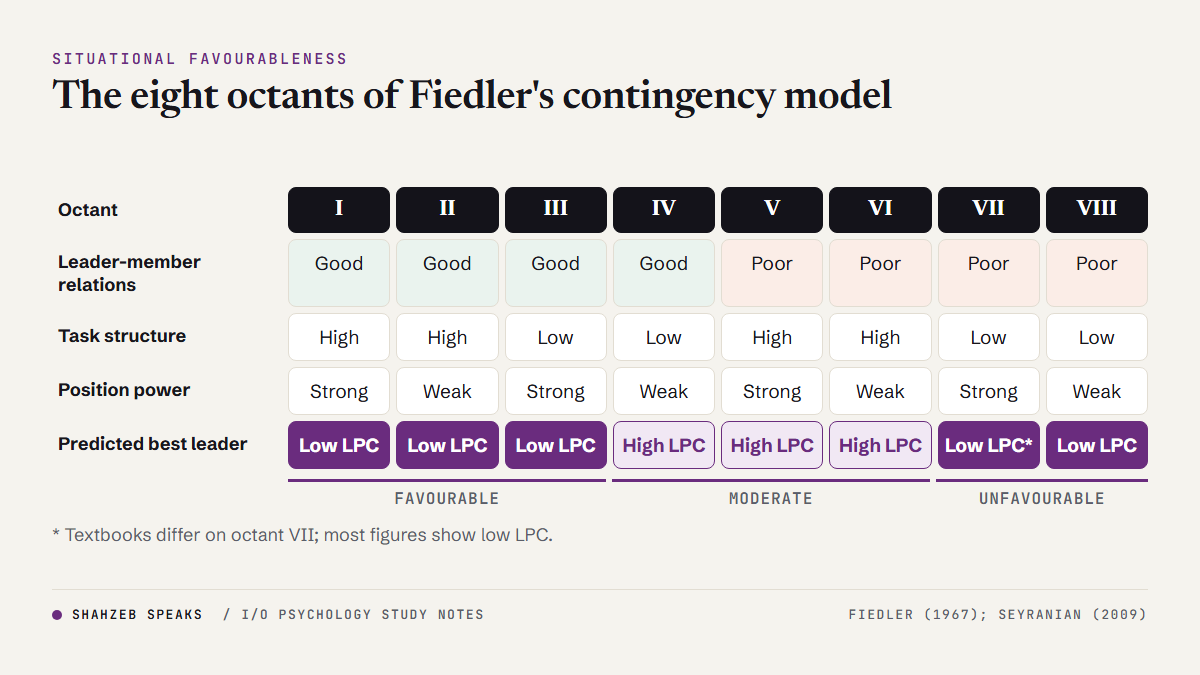
| Octant | Leader-member relations | Task structure | Position power | Favourableness | Predicted best leader |
|---|---|---|---|---|---|
| I | Good | High | Strong | Very favourable | Low LPC (task) |
| II | Good | High | Weak | Favourable | Low LPC (task) |
| III | Good | Low | Strong | Favourable | Low LPC (task) |
| IV | Good | Low | Weak | Moderate | High LPC (relationship) |
| V | Poor | High | Strong | Moderate | High LPC (relationship) |
| VI | Poor | High | Weak | Moderate | High LPC (relationship) |
| VII | Poor | Low | Strong | Unfavourable | Low LPC in most textbook figures; some place it in the moderate band |
| VIII | Poor | Low | Weak | Very unfavourable | Low LPC (task) |
Why does the task-motivated leader win at both ends?
Fiedler’s reasoning is easy to remember. In a very favourable situation, the group already trusts the leader and knows the job, so a leader who simply keeps attention on the task gets results; extra relationship work adds little. In a very unfavourable situation, the group is in trouble and nobody knows what to do, so someone has to take firm control of the task; spending time on relationships may come too late. In the moderate middle, something is missing, often good relations or a clear task, and a relationship-motivated leader can build the trust and cooperation that the situation lacks (Seyranian, 2009).
Three examples from South Asian workplaces
- Octant I: a respected shift supervisor in a Faisalabad spinning mill runs a standard production shift and can assign overtime and approve bonuses. The work is clear and the team trusts him. A task-focused supervisor who keeps the line moving fits well.
- Octant IV: a well-liked senior lecturer is asked to lead a committee to redesign a degree programme. The task is open-ended and she has no power over the other members. A relationship-motivated leader who can keep colleagues engaged fits better.
- Octant VIII: a manager is posted to a bank branch where staff resent the transfer, the branch has been told to “fix customer complaints” with no clear plan, and the manager cannot reward or discipline anyone without head office. Fiedler would predict that a task-motivated leader who takes charge of the problem does better here.
How is Fiedler’s model used in practice?
If style is fixed, there are only two ways to get a better fit: change the leader, or change the situation. Fiedler, Chemers and Mahar (1976) turned the second route into a self-paced training programme called Leader Match. Leaders learn to measure their own LPC and their situation, and then to “engineer” the situation to suit their style. For example:
- A task-motivated leader in a moderate situation can make it more favourable by adding structure: written procedures, clear targets, a checklist.
- A leader can raise or lower position power, for example by asking for authority over rosters, or by deliberately sharing decisions.
- Leader-member relations can be improved by spending informal time with the team or by changing who is in it.
Organisations can also use the model when they choose who leads a project: a relationship-motivated person for an uncertain team that needs building, a task-motivated person for a crisis or for a smooth, routine operation. In practice, this works best as a thinking tool, not a formula. Team development stages matter too, which links Fiedler to Tuckman’s stages of group development: a forming team and a performing team offer the leader very different relations and structure.
Fiedler later added cognitive resource theory (Fiedler & Garcia, 1987), which asks when a leader’s intelligence and experience actually help the group. Its best-known finding is that under low stress leaders draw on their intelligence, while under high stress they draw on their experience instead.
Evaluation: what did the research find?
Fiedler’s model is one of the most tested theories in leadership research. Three meta-analyses (Strube & Garcia, 1981; Peters, Hartke & Pohlmann, 1985; Schriesheim, Tepper & Tetrault, 1994) more or less support its predictions, though not equally for every octant (Seyranian, 2009). Schriesheim et al. (1994) found that comparisons drawn across octants were not supported, while the model’s predictions about how leader performance declines from octant to octant did hold up better than three rival models.
Strengths
- It was the first theory to state clearly that leadership effectiveness depends on the situation, which changed the field.
- It is testable and has a large body of research behind it.
- It gives practical options beyond “be a better leader”: choose leaders for situations, or change the situation.
- It does not blame a leader for failing in a poor-fit situation.
Criticisms
- What does LPC measure? The meaning of the score has been debated for decades, and critics say the adjective pairs do not obviously look like a measure of leadership style.
- Style is assumed fixed. Later theories and much training practice assume leaders can learn to adapt.
- Little help with a mismatch. If the leader cannot be moved and the situation cannot be changed, the model has little to offer.
- Cumbersome in practice. Scoring the three factors for a real job is harder than the textbook boxes suggest, and the model does not explain why high-LPC leaders do better in moderate situations in enough detail.
- Octant VII. Even textbook figures disagree on which leader fits octant VII.
Fiedler vs other contingency theories
| Point | Fiedler (1967) | Path-goal (House, 1971) | Hersey and Blanchard (1969) |
|---|---|---|---|
| Can the leader change style? | No, style is stable | Yes, four behaviours | Yes, four styles |
| Situation read | Relations, task structure, position power | Follower and task characteristics | Follower readiness (ability and willingness) |
| Measure | LPC scale | Leader behaviour questionnaires | Training instruments |
| Advice | Match leader to situation, or change the situation | Choose the behaviour that clears the path to the goal | Move from telling to delegating as readiness grows |
10-mark answer structure: “Explain Fiedler’s contingency model of leadership”
- Definition: Fred Fiedler (1964; 1967), first contingency theory; effectiveness depends on the match between leader style and situation.
- Leader style: the LPC scale (rate the least preferred co-worker on 8-point adjective pairs); high LPC = relationship-motivated, low LPC = task-motivated; style seen as stable.
- Situational favourableness: leader-member relations, task structure, position power, in that order of importance.
- The eight octants: draw the eight-column diagram; I-III favourable, IV-VI moderate, VII-VIII unfavourable.
- Predictions: low LPC best at both ends, high LPC best in the middle; give the reasoning.
- Application: Leader Match (Fiedler, Chemers & Mahar, 1976), changing the situation; one local example.
- Evaluation: three meta-analyses broadly supportive; criticisms of LPC, fixed style, octant VII.
- Conclusion: important as the first contingency theory; modern theories assume more flexibility.
Model opening line: “Fiedler’s contingency model (1967) holds that no leadership style is best everywhere: a group performs well when the leader’s LPC-measured motivation matches how much control the situation gives the leader.”
Practice MCQs: Fiedler’s contingency model
Practice questions written to the published syllabus of typical I/O psychology courses, not past-paper questions. More are on the leadership MCQs page.
-
In Fiedler’s model, a leader who describes their least preferred co-worker in fairly positive terms is:
- Task-motivated (low LPC)
- Relationship-motivated (high LPC)
- Laissez-faire
- Achievement-oriented
Show answer
B. A positive description gives a high LPC score, read as relationship motivation. Low LPC is a harsh description. Laissez-faire is from the full range model; achievement-oriented is a path-goal behaviour.
-
Which situational factor did Fiedler treat as the most important?
- Position power
- Task structure
- Leader-member relations
- Follower maturity
Show answer
C. Leader-member relations carry the most weight, then task structure, then position power. Follower maturity belongs to Hersey and Blanchard.
-
Good leader-member relations, a highly structured task and strong position power describe octant:
- I
- IV
- V
- VIII
Show answer
A. All three factors favour the leader, so this is octant I, the most favourable. Octant VIII is the reverse on all three.
-
According to the model, a relationship-motivated (high-LPC) leader is predicted to do best in:
- Very favourable situations
- Moderately favourable situations
- Very unfavourable situations
- All situations equally
Show answer
B. High-LPC leaders are predicted to do best in the moderate octants. Task-motivated leaders are predicted to do best at both extremes; no leader does equally well everywhere.
-
A popular team leader runs a routine data-entry unit and has authority over bonuses. Fiedler would predict the best fit is:
- A high-LPC leader
- A low-LPC leader
- A leader with a middle LPC score
- Any leader, since the situation does not matter
Show answer
B. Good relations, high structure and strong power make octant I, where a task-motivated (low-LPC) leader is predicted to perform best. The whole point of the model is that the situation matters.
-
Which statement is NOT part of Fiedler’s model?
- Leadership style is fairly stable
- The situation can be changed to fit the leader
- Leaders should switch between four styles as followers mature
- There are eight situational octants
Show answer
C. Switching styles as followers mature is Hersey and Blanchard’s idea. Fiedler assumed style is stable and suggested changing the situation, using eight octants.
-
The Leader Match programme (Fiedler, Chemers & Mahar, 1976) mainly teaches leaders to:
- Change their LPC score
- Change the situation to suit their style
- Become transformational
- Delegate all decisions
Show answer
B. Leader Match teaches leaders to diagnose their style and situation and then engineer the situation. Changing LPC goes against Fiedler’s view; the other two belong to other theories.
-
Position power in Fiedler’s model refers to:
- The leader’s personal charm
- The leader’s formal authority to reward, punish, hire and fire
- How clear the task is
- How much the group likes the leader
Show answer
B. Position power is formal authority. Charm and being liked relate to leader-member relations; clarity of the task is task structure.
-
Which is the strongest common criticism of Fiedler’s model?
- It has never been tested
- It ignores the situation
- It is unclear what the LPC score actually measures
- It was written after transformational leadership
Show answer
C. The meaning of the LPC score is the most debated point. The model has been tested many times, it is all about the situation, and it came before transformational leadership (Bass, 1985).
-
Fiedler’s later cognitive resource theory (Fiedler & Garcia, 1987) mainly asks:
- When a leader’s intelligence and experience help group performance
- How followers form in-groups
- How to score the MLQ
- Which of four path-goal behaviours to use
Show answer
A. Cognitive resource theory is about when intelligence and experience pay off, especially under stress. In-groups are LMX theory, the MLQ measures transformational leadership, and the four behaviours are path-goal theory.
Practise on your phone
The free I/O Psychology Prep app has 410 explained
questions, flashcards and an exam countdown, and works offline. Get it on Google Play
· About the app
Questions students ask
What is the LPC scale in Fiedler’s contingency model?
The Least Preferred Co-worker scale asks a leader to describe the person they could work with least well on a set of 8-point opposite adjective pairs. A fairly positive description gives a high LPC score (relationship-motivated); a harsh one gives a low score (task-motivated).
What are the three situational factors in Fiedler’s model?
Leader-member relations (good or poor), task structure (high or low) and position power (strong or weak). Together they decide how favourable the situation is for the leader. Leader-member relations matter most and position power least.
What are the 8 octants in Fiedler’s contingency model?
They are the eight combinations of the three factors, ranked from octant I (good relations, structured task, strong power) to octant VIII (poor relations, unstructured task, weak power). Low-LPC leaders are predicted to do best in octants I to III and VIII, high-LPC leaders in IV to VI; textbooks differ on VII.
What is the difference between Fiedler’s model and situational leadership?
Fiedler treats the leader’s style as fixed and changes the situation or the leader. Hersey and Blanchard’s situational approach expects the leader to change style (telling, selling, participating, delegating) to fit each follower’s readiness.
Is Fiedler’s contingency model still used?
It is still taught as the first contingency theory and still used to think about matching leaders to assignments. Most current research uses newer theories such as LMX and transformational leadership, which assume leaders can develop.
Can I use the LPC scale in my thesis?
It has been printed in Fiedler’s books and in textbooks, but printed does not mean free to reuse. Cite Fiedler (1967), check the copyright terms of the source you copy it from, and ask your supervisor. Our I/O thesis topics page lists scales with clearer licence terms.
For the people behind the theory, see I/O psychology theorists.
Revise leadership offline
The free I/O Psychology Prep app has 410 explained
questions, flashcards and an exam countdown, and works offline. Get it on Google Play
· About the app
References
- Bass, B. M. (1985). Leadership and performance beyond expectations. Free Press.
- Fiedler, F. E. (1964). A contingency model of leadership effectiveness. In L. Berkowitz (Ed.), Advances in experimental social psychology (Vol. 1, pp. 149-190). Academic Press.
- Fiedler, F. E. (1967). A theory of leadership effectiveness. McGraw-Hill.
- Fiedler, F. E. (1971). Validation and extension of the contingency model of leadership effectiveness: A review of empirical findings. Psychological Bulletin, 76(2), 128-148. https://doi.org/10.1037/h0031454
- Fiedler, F. E., Chemers, M. M., & Mahar, L. (1976). Improving leadership effectiveness: The leader match concept. Wiley.
- Fiedler, F. E., & Garcia, J. E. (1987). New approaches to effective leadership: Cognitive resources and organizational performance. Wiley.
- Hersey, P., & Blanchard, K. H. (1969). Life cycle theory of leadership. Training and Development Journal, 23(5), 26-34.
- House, R. J. (1971). A path goal theory of leader effectiveness. Administrative Science Quarterly, 16(3), 321-339. https://doi.org/10.2307/2391905
- Peters, L. H., Hartke, D. D., & Pohlmann, J. T. (1985). Fiedler’s contingency theory of leadership: An application of the meta-analysis procedures of Schmidt and Hunter. Psychological Bulletin, 97(2), 274-285. https://doi.org/10.1037/0033-2909.97.2.274
- Schriesheim, C. A., Tepper, B. J., & Tetrault, L. A. (1994). Least preferred co-worker score, situational control, and leadership effectiveness: A meta-analysis of contingency model performance predictions. Journal of Applied Psychology, 79(4), 561-573. https://doi.org/10.1037/0021-9010.79.4.561
- Seyranian, V. (2009). Contingency theories of leadership. In J. M. Levine & M. A. Hogg (Eds.), Encyclopedia of group processes and intergroup relations (pp. 152-156). SAGE.
- Strube, M. J., & Garcia, J. E. (1981). A meta-analytic investigation of Fiedler’s contingency model of leadership effectiveness. Psychological Bulletin, 90(2), 307-321. https://doi.org/10.1037/0033-2909.90.2.307
Fiedler’s model is one of several theories on the leadership theories in I/O psychology hub. Compare it with path-goal theory, LMX theory and transformational vs transactional leadership.