
Leadership MCQs follow the history of the field: trait theories (Stogdill’s 1948 review), behavioural studies (Ohio State, Michigan, Blake and Mouton’s grid), contingency theories (Fiedler 1967, House’s path-goal theory 1971, Hersey and Blanchard, Vroom and Yetton) and newer relational theories (LMX, transformational leadership from Burns 1978 and Bass 1985).
This set is for students revising the leadership chapter of an I/O psychology, organisational behaviour or management paper, a lecturer test or a board review. You get a one-page summary of the theories in the order they appeared, a comparison table, 25 practice questions with explanations, and a plan for the long question. These are practice questions written to the published syllabus, not past-paper or board items.
Leadership questions are easy to mix up because many theories use similar words: “relationship-oriented” in Fiedler, “consideration” at Ohio State, “employee-oriented” at Michigan, “concern for people” in Blake and Mouton. The questions below test which word belongs to which theory, then move to scenarios where you must pick the right style.
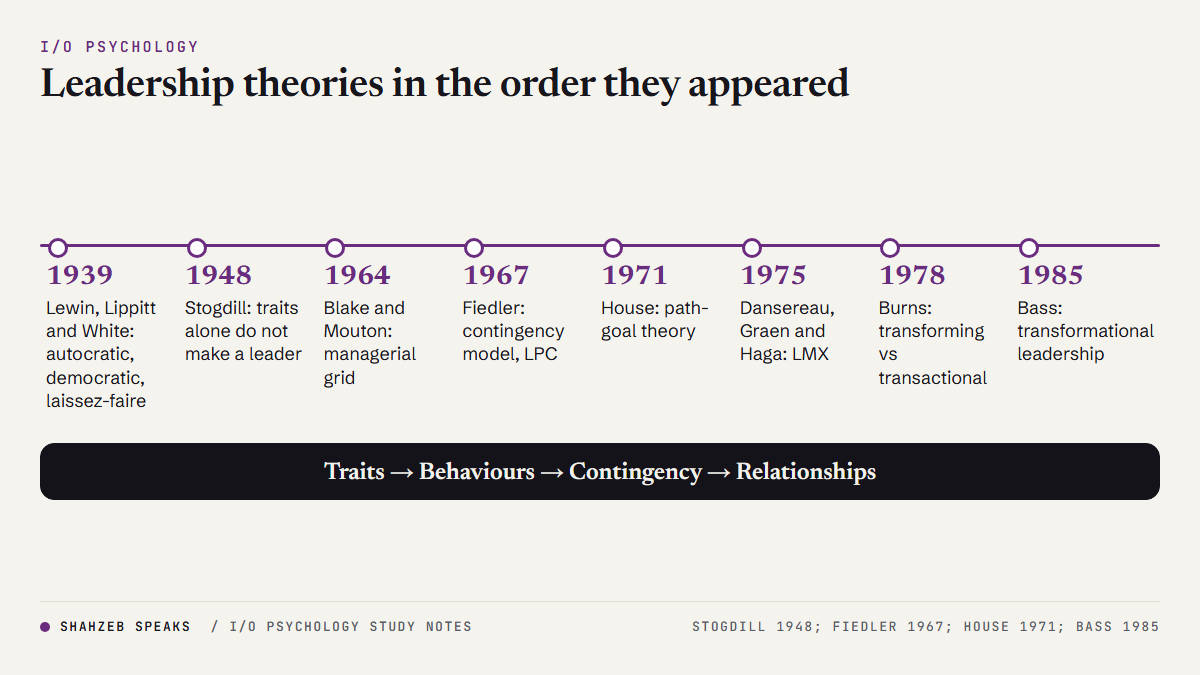
Leadership theories in one page
Trait approach. Early research looked for the traits that make leaders. Stogdill’s (1948) review found that traits alone did not predict leadership well and that the situation mattered, which pushed research toward behaviour. The trait view came back with better methods: Judge, Bono, Ilies and Gerhardt (2002) found extraversion was the most consistent of the Big Five correlates of leadership.
Behavioural approach. Lewin, Lippitt and White (1939) compared autocratic, democratic and laissez-faire climates in boys’ clubs. The Ohio State studies (Stogdill and Coons, 1957) described two independent dimensions, initiating structure (organising the work) and consideration (care and respect for followers). The Michigan studies, summarised by Likert (1961), contrasted production-oriented and employee-oriented supervisors. Blake and Mouton’s (1964) managerial grid crossed concern for production with concern for people and recommended the 9,9 “team management” style for every situation.
Contingency approach. These theories say the best style depends on the situation. Fiedler (1967) measured style with the least preferred co-worker (LPC) scale and defined situational favourableness by leader-member relations, task structure and position power. House’s (1971) path-goal theory, built on expectancy theory, says the leader should clear the path to goals; later versions name directive, supportive, participative and achievement-oriented behaviours (reviewed in House, 1996). Hersey and Blanchard’s situational approach matches telling, selling, participating or delegating to follower readiness. Vroom and Yetton (1973) offered decision rules for how far to involve subordinates in a decision. Kerr and Jermier (1978) added that some features of the task, team or organisation can act as substitutes for leadership, and others as neutralisers that cancel a leader’s influence.
Relational and “new” approaches. Leader-member exchange (LMX) theory began as the vertical dyad linkage model (Dansereau, Graen and Haga, 1975): leaders form different-quality relationships with each follower, creating in-groups and out-groups. Burns (1978) contrasted transforming with transactional leadership; Bass (1985) developed transformational leadership for organisations. Transactional leadership uses contingent reward and management by exception; laissez-faire is the absence of leadership. Greenleaf’s (1977) servant leadership puts followers’ growth first. For the full comparison, see leadership theories in I/O psychology.
Summary table: leadership theories compared
| Theory | Who, year | Approach | Key terms | Topic post |
|---|---|---|---|---|
| Trait review | Stogdill, 1948 | Trait | Traits alone do not make a leader | Leadership pillar |
| Ohio State studies | 1940s-1950s | Behavioural | Initiating structure, consideration | Leadership pillar |
| Managerial grid | Blake and Mouton, 1964 | Behavioural | Concern for people x production; 9,9 | Leadership pillar |
| Contingency model | Fiedler, 1967 | Contingency | LPC, leader-member relations, task structure, position power | Fiedler’s model |
| Path-goal theory | House, 1971 | Contingency | Directive, supportive, participative, achievement-oriented | Path-goal theory |
| Situational approach | Hersey and Blanchard, 1969 | Contingency | Telling, selling, participating, delegating | Leadership pillar |
| Normative decision model | Vroom and Yetton, 1973 | Contingency | How much to involve subordinates in a decision | Leadership pillar |
| LMX | Dansereau, Graen and Haga, 1975 | Relational | In-group, out-group, exchange quality | LMX theory |
| Transformational vs transactional | Burns, 1978; Bass, 1985 | New leadership | Four I’s; contingent reward; management by exception | Transformational vs transactional |
| Substitutes for leadership | Kerr and Jermier, 1978 | Contingency | Substitutes and neutralisers | Leadership pillar |
Practice MCQs: leadership theories
-
Which belief did Stogdill’s (1948) review of trait research do most to weaken?
- That a fixed set of traits makes a person a leader in every situation
- That leadership can be studied scientifically
- That followers matter
- That behaviour can be observed
Show answer
A. Stogdill found that the traits linked with leadership varied with the situation, so no universal list explained who leads. That pushed research toward behaviour and context; it did not reject science, followers or observation.
-
In Judge, Bono, Ilies and Gerhardt’s (2002) meta-analysis, which Big Five trait had the weakest overall link with leadership?
- Extraversion
- Conscientiousness
- Openness to experience
- Agreeableness
Show answer
D. Agreeableness had the smallest correlation (about .08). Extraversion had the largest (about .31), conscientiousness was about .28 and openness about .24; neuroticism was negative (about -.24).
-
The Ohio State leadership studies described two independent dimensions of leader behaviour. They were:
- Initiating structure and consideration
- Production-oriented and employee-oriented
- Concern for people and concern for production
- Task-motivated and relationship-motivated
Show answer
A. Ohio State used initiating structure (organising tasks and roles) and consideration (warmth, trust, respect). Option B is the Michigan studies, option C is Blake and Mouton’s grid, and option D is Fiedler’s LPC labels. Examiners mix these on purpose.
-
Which pair of terms comes from the University of Michigan studies?
- Initiating structure and consideration
- Telling and delegating
- Directive and supportive
- Production-oriented and employee-oriented supervision
Show answer
D. Michigan researchers compared supervisors who focused on output with those who focused on their people. Initiating structure and consideration are Ohio State, telling and delegating are Hersey and Blanchard, and directive and supportive are path-goal behaviours.
-
A head nurse sees her main job as helping her staff grow, listens first, and puts their needs and the patients’ wellbeing ahead of her own status. Which approach describes her best?
- Management by exception
- Initiating structure
- Servant leadership
- Laissez-faire leadership
Show answer
C. Greenleaf’s (1977) servant leadership treats leading as serving followers and helping them develop. Management by exception waits for problems, initiating structure is about organising tasks, and laissez-faire is the absence of leadership.
-
On Blake and Mouton’s managerial grid, a manager with very high concern for people but very low concern for production is described as:
- 9,9 team management
- 9,1 authority-compliance
- 1,9 country club management
- 1,1 impoverished management
Show answer
C. The grid writes concern for production first and concern for people second, so low production and high people is 1,9, the “country club” style. 9,9 is high on both, 9,1 is production only, and 1,1 is low on both.
-
Which of these is NOT a contingency theory of leadership?
- Fiedler’s contingency model
- House’s path-goal theory
- Hersey and Blanchard’s situational approach
- Blake and Mouton’s managerial grid
Show answer
D. Blake and Mouton argued that 9,9 team management is best in every situation, which is a universal (one-best-style) view. Fiedler, House, and Hersey and Blanchard all say the best style depends on the situation.
-
A leader describes the co-worker she worked with least well as “unpleasant, unfriendly and uncooperative” in every respect. Fiedler would classify her as:
- Task-motivated (low LPC)
- Relationship-motivated (high LPC)
- Laissez-faire
- Transformational
Show answer
A. A harsh description of the least preferred co-worker gives a low LPC score, which Fiedler read as task motivation. A kinder description signals relationship motivation. Laissez-faire and transformational come from other models.
-
A supervisor cannot reward good work because all pay rises are fixed by a union agreement, so her praise and promises have little effect. Kerr and Jermier (1978) would call the union agreement a:
- Substitute for leadership
- High-quality exchange
- Neutraliser of leadership
- Contingent reward
Show answer
C. A neutraliser stops the leader’s behaviour from having an effect without replacing it. A substitute makes the leader’s behaviour unnecessary (for example, professional training), a high-quality exchange is LMX, and contingent reward is what the agreement blocks.
-
According to Fiedler, task-motivated (low-LPC) leaders perform best when the situation is:
- Only moderately favourable
- Very favourable or very unfavourable
- Always unfavourable, never favourable
- Irrelevant, because style matters more than situation
Show answer
B. Fiedler predicted that low-LPC leaders do best at both extremes, and high-LPC leaders do best in the moderate middle. Option C keeps only half the prediction, and option D contradicts the whole idea of a contingency model.
-
A new bank officer is keen and willing but still lacks the skill for the job. Which style does Hersey and Blanchard’s situational approach suggest?
- Telling
- Selling (coaching): high direction and high support
- Participating
- Delegating
Show answer
B. A willing but unable follower needs clear direction plus encouragement and explanation. Telling suits followers who are unable and unwilling or insecure, participating suits able but hesitant followers, and delegating suits able and willing ones.
-
In Vroom and Yetton’s model, when subordinates’ acceptance of a decision is critical and they share the organisation’s goals, the model tends to favour:
- The manager deciding alone without telling anyone
- A more participative, group-based decision
- Delegating the decision to an outside consultant
- Delaying the decision indefinitely
Show answer
B. The model’s rules protect acceptance and quality; when commitment matters and goals are shared, involving the group is safe and builds acceptance. Deciding alone risks rejection, and the other options are not styles in the model.
-
A team lead sets challenging goals for an experienced, capable sales team, expects excellent performance and shows confidence that they will reach it. In path-goal theory this is:
- Directive behaviour
- Supportive behaviour
- Achievement-oriented behaviour
- Laissez-faire behaviour
Show answer
C. Achievement-oriented leadership sets high goals and expresses confidence in followers. Directive behaviour tells people how to do the work, supportive behaviour attends to well-being, and laissez-faire is not a path-goal behaviour. More in path-goal theory.
-
In Hersey and Blanchard’s situational approach, which style fits a follower who is both able and willing to do the task?
- Telling
- Selling
- Participating
- Delegating
Show answer
D. High readiness calls for low direction and low support: hand the task over. Telling suits unable and unwilling followers, selling suits unable but willing ones, and participating suits able but unwilling or insecure ones.
-
Which theory gives a manager decision rules for how much to involve subordinates in a decision, from deciding alone to letting the group decide?
- LMX theory
- Vroom and Yetton’s normative decision model
- Blake and Mouton’s managerial grid
- Trait theory
Show answer
B. Vroom and Yetton (1973) set out decision styles from autocratic to group-based and rules (often drawn as a decision tree) for choosing among them. LMX is about relationships, the grid about concern for people and production, and trait theory about personal qualities.
-
A clerk gets only what his job description requires: little contact with his manager, no extra responsibility and formal treatment. LMX theory places him in:
- The in-group
- The out-group, with a low-quality exchange
- A substitute for leadership
- Idealised influence
Show answer
B. Out-group members have contract-like relationships limited to the formal job. In-group members get more trust, support and interesting work. Substitutes and idealised influence come from other theories. More in LMX theory.
-
Gerstner and Day’s (1997) meta-analysis linked high-quality leader-member exchange with which of these?
- Lower satisfaction with the supervisor
- Higher satisfaction and organisational commitment
- More role ambiguity
- No outcomes at all
Show answer
B. Followers in high-quality exchanges reported more satisfaction and commitment and clearer roles. The other options run the wrong way or deny any link.
-
In Graen and Uhl-Bien’s (1995) “leadership making” view of LMX, a leader-follower relationship develops through which stages?
- Forming, storming, norming, performing
- Telling, selling, participating, delegating
- Unfreezing, changing, refreezing
- Stranger, acquaintance, mature partnership
Show answer
D. Relationships move from a formal stranger phase, through acquaintance, to a mature partnership based on trust and mutual influence. Option A is Tuckman’s group stages, option B is Hersey and Blanchard, and option C is Lewin’s change model.
-
The finding that transformational leadership predicts outcomes over and above what transactional leadership already predicts is known as the:
- Halo effect
- Augmentation effect
- Hawthorne effect
- Contrast effect
Show answer
B. Bass (1985) proposed that transformational behaviour augments, or adds to, the effect of transactional exchange. Halo and contrast are rating errors, and the Hawthorne effect is about being observed.
-
A university dean paints a clear, exciting picture of what the faculty could become and tells staff she is confident they can get there. Which component of transformational leadership is this?
- Individualised consideration
- Intellectual stimulation
- Inspirational motivation
- Contingent reward
Show answer
C. Inspirational motivation is communicating a compelling vision and high expectations. Individualised consideration is attention to each person, intellectual stimulation is encouraging new thinking, and contingent reward is a transactional exchange.
-
A hospital ward head asks her nurses to question the usual way of handing over patients and to suggest new methods, and she treats their ideas seriously. Which component of transformational leadership is this?
- Intellectual stimulation
- Contingent reward
- Inspirational motivation
- Management by exception
Show answer
A. Encouraging followers to challenge assumptions and think in new ways is intellectual stimulation. Inspirational motivation is about a compelling vision, while contingent reward and management by exception are transactional behaviours.
-
A quality supervisor watches every batch closely for deviations from standards and corrects mistakes as soon as she spots them. In the full range model this is:
- Active management by exception
- Passive management by exception
- Individualised consideration
- Laissez-faire
Show answer
A. Actively monitoring for errors and correcting them is the active form. The passive form waits until problems are reported, individualised consideration is about each person’s development, and laissez-faire avoids leading at all.
-
Judge and Piccolo’s (2004) meta-analysis of the full range of leadership found that, after controlling for the other dimensions, which two generally predicted outcomes?
- Laissez-faire and passive management by exception
- Only transformational leadership
- Transformational leadership and contingent reward
- Only active management by exception
Show answer
C. Both transformational leadership and contingent reward (a transactional behaviour) generally predicted the criteria, which shows that clear exchanges of reward for effort still matter. Laissez-faire is the absence of leadership, and neither “only” option matches the finding. See transformational vs transactional leadership.
-
In a teaching hospital, experienced surgeons with strong professional training and a close-knit team need very little direction from the head of department. Kerr and Jermier (1978) would call their training and team cohesion:
- Neutralisers that block all leadership
- Out-group exchanges
- Low position power
- Substitutes for leadership
Show answer
D. Substitutes are features of followers, tasks or the organisation (such as professional training or a cohesive group) that make some leader behaviour unnecessary. Neutralisers stop the leader’s behaviour having an effect, out-group is LMX, and position power is Fiedler.
-
In the full range leadership model, which style describes a leader who avoids decisions, delays responses and is absent when needed?
- Laissez-faire
- Contingent reward
- Inspirational motivation
- Directive leadership
Show answer
A. Laissez-faire is the most passive end of the model, often described as non-leadership. Contingent reward is active transactional behaviour, inspirational motivation is transformational, and directive leadership comes from path-goal theory.
Practise on your phone
The free I/O Psychology Prep app has 410 explained
questions, flashcards and an exam countdown, and works offline. Get it on Google Play
· About the app
Fiedler’s model: the question that needs a diagram
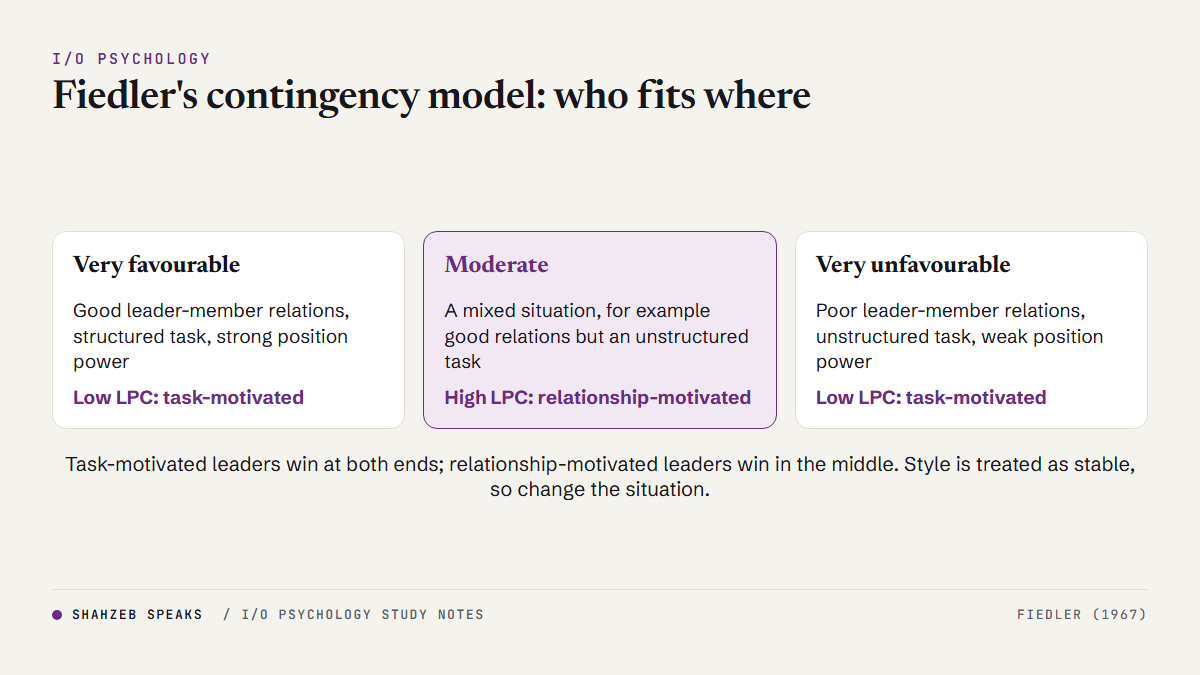
Fiedler’s predictions are the most common “apply the theory” question, and the easiest to reverse under exam pressure. Remember the shape: task-motivated leaders win at both ends, relationship-motivated leaders win in the middle. A situation is very favourable when leader-member relations are good, the task is structured and position power is strong; it is very unfavourable when all three are the opposite.
How to write a leadership answer in your exam
Long questions include “Critically discuss contingency theories of leadership”, “Differentiate transformational and transactional leadership” and “Which leadership style suits Pakistani organisations?” Use this plan and swap in the theories the question names.
10-mark answer structure
- Definition: leadership as a process of influencing a group toward shared goals.
- Show the development of the field in two lines: traits (Stogdill, 1948), behaviours (Ohio State, Michigan, Blake and Mouton, 1964), contingency (Fiedler, 1967; House, 1971), relational and transformational (LMX; Burns, 1978; Bass, 1985).
- Explain the theories the question asks for in detail, with the key terms and a small diagram (Fiedler’s favourableness, or the four I’s).
- Give a local example: a branch manager who clarifies targets for new staff (directive behaviour) but delegates to experienced officers.
- Evaluate: Fiedler’s LPC scale is hard to interpret; the grid’s “one best style” claim is weak; transformational and contingent reward both predict outcomes (Judge and Piccolo, 2004).
- Apply: which style fits which situation, and why a leader may need more than one.
- Conclusion: modern evidence favours a mix of clear exchanges and inspiring, individual attention, adjusted to the situation.
Model opening line: “Leadership is the process by which one person influences a group toward shared goals, and theories of it have moved from asking who leaders are, to what they do, to when a given style works best.”
Questions students ask
What is the difference between trait and behavioural theories of leadership?
Trait theories ask what kind of person becomes a leader, such as how extraverted or intelligent they are. Behavioural theories ask what effective leaders do, such as initiating structure and showing consideration. Behaviours can be trained; traits are harder to change.
Which leadership theory is best?
No single theory wins every exam answer. Transformational leadership and contingent reward have strong meta-analytic support (Judge and Piccolo, 2004), and contingency theories remind you that the situation matters. Say which outcome you mean: follower satisfaction, group performance or leader effectiveness.
How is Fiedler’s model different from Hersey and Blanchard’s?
Fiedler treats a leader’s style as fixed and changes the situation to fit it. Hersey and Blanchard expect the leader to change style to match the follower’s readiness. Fiedler’s situation has three parts; Hersey and Blanchard’s has one, the follower.
What are the four I’s of transformational leadership?
Idealised influence (acting as a role model), inspirational motivation (a compelling vision), intellectual stimulation (encouraging new thinking) and individualised consideration (attention to each person’s needs and growth).
Is transactional leadership bad?
No. Contingent reward, the clear exchange of reward for agreed performance, predicts outcomes well. The weaker forms are passive management by exception and laissez-faire, where the leader steps in late or not at all.
What is the in-group in LMX theory?
The followers with whom a leader has high-quality exchanges: more trust, more interesting work, more support and more influence. The out-group has a more formal relationship limited to the job description.
Practise on your phone
The free I/O Psychology Prep app has 410 explained
questions, flashcards and an exam countdown, and works offline. Get it on Google Play
· About the app
References
- Bass, B. M. (1985). Leadership and performance beyond expectations. Free Press.
- Blake, R. R., & Mouton, J. S. (1964). The managerial grid. Gulf Publishing.
- Burns, J. M. (1978). Leadership. Harper & Row.
- Dansereau, F., Graen, G., & Haga, W. J. (1975). A vertical dyad linkage approach to leadership within formal organizations. Organizational Behavior and Human Performance, 13(1), 46-78. https://doi.org/10.1016/0030-5073(75)90005-7
- Fiedler, F. E. (1967). A theory of leadership effectiveness. McGraw-Hill.
- Gerstner, C. R., & Day, D. V. (1997). Meta-analytic review of leader-member exchange theory: Correlates and construct issues. Journal of Applied Psychology, 82(6), 827-844. https://doi.org/10.1037/0021-9010.82.6.827
- Graen, G. B., & Uhl-Bien, M. (1995). Relationship-based approach to leadership: Development of leader-member exchange (LMX) theory of leadership over 25 years. The Leadership Quarterly, 6(2), 219-247. https://doi.org/10.1016/1048-9843(95)90036-5
- Greenleaf, R. K. (1977). Servant leadership: A journey into the nature of legitimate power and greatness. Paulist Press.
- Hersey, P., & Blanchard, K. H. (1969). Life cycle theory of leadership. Training and Development Journal, 23(5), 26-34.
- House, R. J. (1971). A path goal theory of leader effectiveness. Administrative Science Quarterly, 16(3), 321-339. https://doi.org/10.2307/2391905
- House, R. J. (1996). Path-goal theory of leadership: Lessons, legacy, and a reformulated theory. The Leadership Quarterly, 7(3), 323-352. https://doi.org/10.1016/S1048-9843(96)90024-7
- Judge, T. A., Bono, J. E., Ilies, R., & Gerhardt, M. W. (2002). Personality and leadership: A qualitative and quantitative review. Journal of Applied Psychology, 87(4), 765-780. https://doi.org/10.1037/0021-9010.87.4.765
- Judge, T. A., & Piccolo, R. F. (2004). Transformational and transactional leadership: A meta-analytic test of their relative validity. Journal of Applied Psychology, 89(5), 755-768. https://doi.org/10.1037/0021-9010.89.5.755
- Kerr, S., & Jermier, J. M. (1978). Substitutes for leadership: Their meaning and measurement. Organizational Behavior and Human Performance, 22(3), 375-403. https://doi.org/10.1016/0030-5073(78)90023-5
- Lewin, K., Lippitt, R., & White, R. K. (1939). Patterns of aggressive behavior in experimentally created “social climates”. The Journal of Social Psychology, 10(2), 269-299. https://doi.org/10.1080/00224545.1939.9713366
- Likert, R. (1961). New patterns of management. McGraw-Hill.
- Stogdill, R. M. (1948). Personal factors associated with leadership: A survey of the literature. The Journal of Psychology, 25(1), 35-71. https://doi.org/10.1080/00223980.1948.9917362
- Stogdill, R. M., & Coons, A. E. (Eds.). (1957). Leader behavior: Its description and measurement. Ohio State University, Bureau of Business Research.
- Vroom, V. H., & Yetton, P. W. (1973). Leadership and decision-making. University of Pittsburgh Press.
Next: return to the I/O psychology MCQs hub, read the leadership theories pillar, or try the work motivation MCQs. Leadership exams often include teams and culture too, so see Tuckman’s stages, Schein’s culture model and psychological safety at work.