
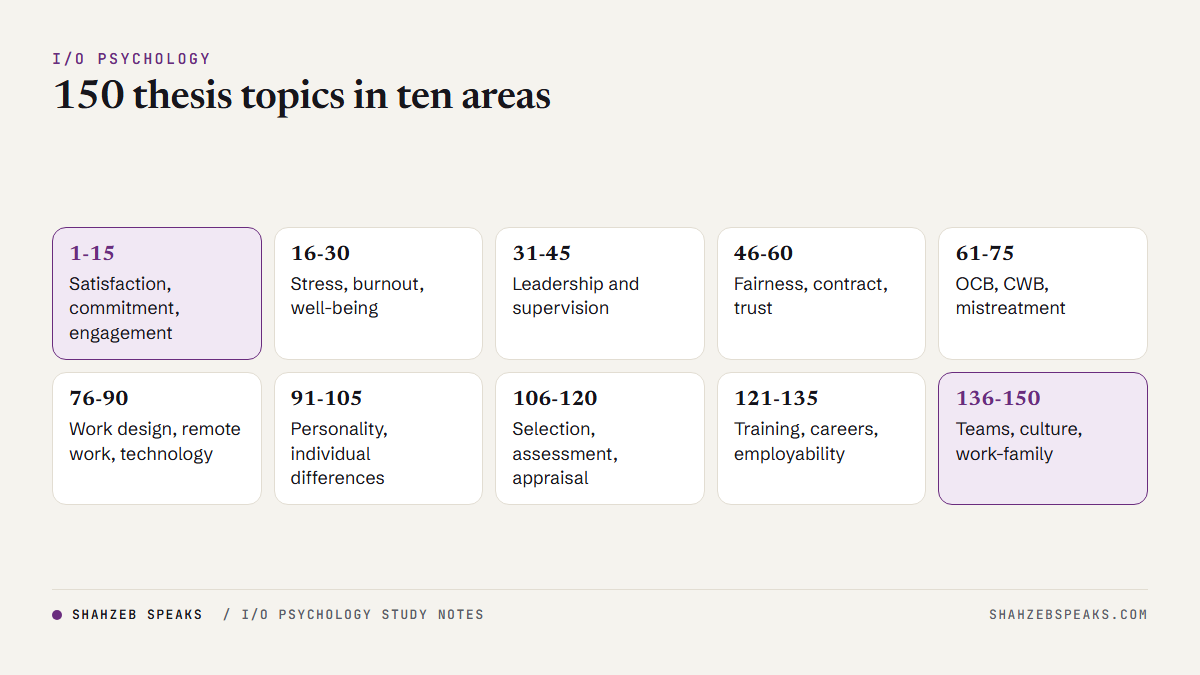
A good I/O psychology thesis topic links two or three variables you can measure with an established scale, in a sample you can actually reach, using an analysis you can run (correlation, regression, t-test or ANOVA, mediation or moderation). Below are 150 original topic ideas in ten areas, each with suggested variables, a measure family and the analysis.
This page is for BS, MS and MPhil students in psychology, HRM and management, in Pakistan, India, the Philippines and elsewhere, who need a thesis or research-project topic in industrial and organisational psychology. Every idea comes with the variables, a measure family (the kind of scale you would use, with named scales where a well-known one exists) and the analysis that answers the question. You can use any idea as it is, or swap the sample (nurses, teachers, bank officers, call-centre agents, garment workers) to make it your own.
Two warnings before you start. First, a scale named here is not automatically free: check its licence in the companion page on scales for I/O psychology theses, where I recorded what each owner’s site said on 3 November 2026. In the tables, “(check)” means I found no owner statement on permission, so ask the author or publisher first. Second, your department’s rules on length, sample and approval come first.
How to choose a feasible thesis topic
Many thesis plans run into trouble for practical reasons rather than because the idea was weak. Use these five tests:
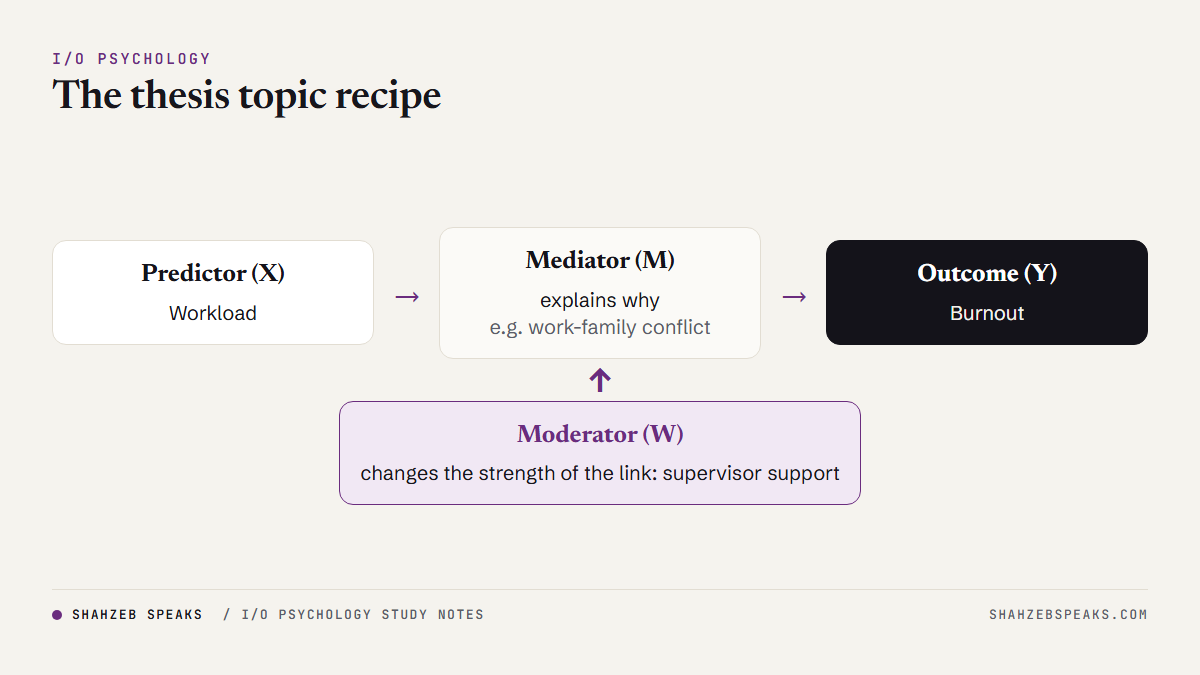
- Two to four variables. A predictor, an outcome and, at MS level, one mediator or moderator. Ten variables means ten weak chapters.
- A usable scale for each variable. An established scale with published reliability and clear permission beats a questionnaire you invent.
- A sample you can reach. If your uncle works in a bank, a bank sample is realistic; a sample of CEOs probably is not.
- An analysis you can run and explain. Your supervisor will ask why you chose it. The research methods guide shows how to match analysis to question.
- Something new. Newness rarely means a new theory. It usually means a known relationship tested in a new population, a new country, a new mediator, or with a better design (two sources, two time points).
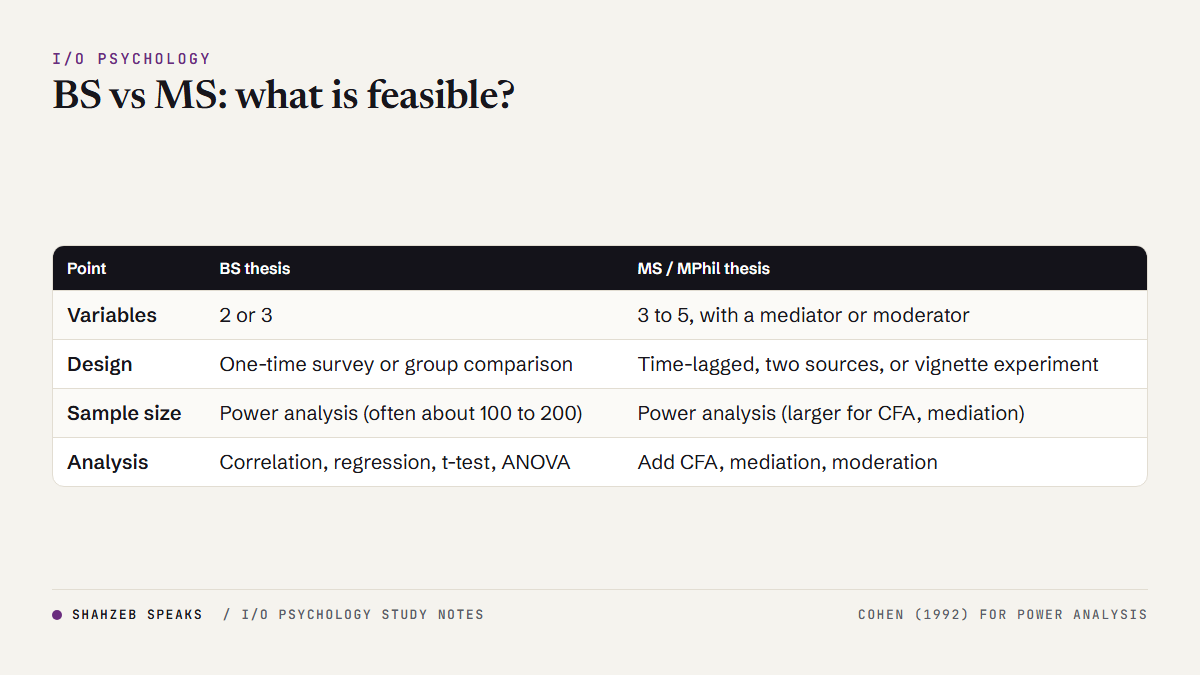
Feasibility for BS and MS students in Pakistan, India and the Philippines
| Point | BS / undergraduate thesis | MS / MPhil thesis |
|---|---|---|
| Variables | 2 or 3 (X and Y, maybe a group comparison) | 3 to 5, including a mediator or moderator |
| Design | One-time survey or group comparison | Time-lagged survey, two sources (employee and supervisor), or a vignette experiment |
| Sample size | Set by a power analysis; often around 100 to 200 for simple correlations | Set by a power analysis; larger for CFA and mediation models |
| Analysis | Correlation, regression, t-test, ANOVA | Add CFA, mediation with bootstrapping, moderation with simple slopes |
| Scales | Short, free scales (JSS facets, CBI, UWES-9, Mini-IPIP, PSS) | Same, plus a translation and adaptation if needed |
Country notes that matter in practice:
- Language. Many respondents in Pakistan, India and the Philippines answer more accurately in Urdu, Hindi, a regional language or Filipino. If you translate, follow the back-translation steps in research methods for an I/O thesis and get the owner’s permission to translate.
- Access. Sectors students can often reach: banks, hospitals, schools and universities, textile and garment factories, telecom and IT firms, government offices, and in the Philippines and India, call centres and BPO companies. Ask for a permission letter from HR before you collect data.
- Sensitive topics. Harassment, bullying, CWB and mental health need extra ethical care, anonymous collection and a statement of where to get help. Pakistani students working on harassment can read workplace harassment law in Pakistan for the legal background.
- Department rules. Required length, the approval route and whether a translated scale needs a separate pilot differ between universities. Check your handbook and your supervisor’s preferences before you finalise.
150 I/O psychology thesis topics, by area
Abbreviations: X = predictor, M = mediator, W = moderator, Y = outcome; TI = turnover intention. Scale names are explained, with licence status, on the scales page.
1. Job satisfaction, commitment, engagement and turnover (1-15)
| # | Topic | Variables | Measure family | Analysis |
|---|---|---|---|---|
| 1 | Job satisfaction and turnover intention among private bank officers | Satisfaction (X), TI (Y) | JSS; short TI scale | Correlation, regression |
| 2 | Pay vs work-itself satisfaction as predictors of quitting intention in call centres | JSS facets (X), TI (Y) | JSS facets | Multiple regression |
| 3 | Affective commitment between organisational support and TI in hospitals | Support (X), commitment (M), TI (Y) | SPOS (check); TCM (licence) | Mediation |
| 4 | Job satisfaction of public vs private school teachers | Sector (X), satisfaction (Y) | JSS or MSQ short form | t-test |
| 5 | Work engagement and self-rated performance in IT staff | Engagement (X), performance (Y) | UWES-9; performance scale (check) | Regression |
| 6 | Job resources and engagement in BPO agents (the JD-R motivational path) | Support, autonomy (X), engagement (Y) | COPSOQ scales; UWES-9 | Multiple regression |
| 7 | Engagement linking servant leadership and OCB | Leadership (X), engagement (M), OCB (Y) | SL-7 (check); UWES-9; OCB-C | Mediation |
| 8 | Commitment components and recorded absence in textile mills | TCM components (X), absence days (Y) | TCM; HR records | Multiple regression |
| 9 | Normative commitment in family-owned vs other firms | Ownership (X), normative commitment (Y) | TCM | t-test |
| 10 | Job satisfaction across career stages of university faculty | Career stage (X), satisfaction (Y) | MSQ short form | One-way ANOVA |
| 11 | Promotion satisfaction and TI among junior doctors | Promotion facet (X), TI (Y) | JSS promotion facet | Correlation |
| 12 | Meaningful work and engagement in NGO staff | Meaning (X), engagement (Y) | Meaningful work scale (check); UWES-9 | Regression |
| 13 | Perceived career growth and commitment of graduates in their first job | Growth (X), affective commitment (Y) | Career growth scale (check); TCM | Regression |
| 14 | Global vs facet satisfaction: which predicts TI better? | JIG, JDI facets (X), TI (Y) | JDI and JIG | Hierarchical regression |
| 15 | Single-item vs multi-item job satisfaction in nurses (a measurement study) | One item vs JSS total | JSS; one global item | Correlation |
Background: job satisfaction theories and measures and Meyer and Allen’s three-component model. Topic 15 can be compared with the meta-analysis of single-item measures by Wanous, Reichers and Hudy (1997).
2. Stress, burnout and well-being (16-30)
| # | Topic | Variables | Measure family | Analysis |
|---|---|---|---|---|
| 16 | Workload and work-related burnout in public hospital nurses | Workload (X), burnout (Y) | QWI; CBI | Correlation, regression |
| 17 | Supervisor support as a buffer between workload and burnout | Workload (X), support (W), burnout (Y) | QWI; COPSOQ support; CBI | Moderation |
| 18 | Effort-reward imbalance and perceived stress in bank employees | ERI (X), stress (Y) | ERI questionnaire; PSS | Regression |
| 19 | Demands, control and strain in factory workers (demand-control model) | Demands (X), control (W), strain (Y) | COPSOQ scales or JCQ (check) | Moderation |
| 20 | Organisational constraints and negative emotions at work in customer service | Constraints (X), emotions (Y) | OCS; JAWS | Correlation |
| 21 | Burnout in doctors, nurses and paramedics compared | Occupation (X), burnout (Y) | CBI | One-way ANOVA |
| 22 | Client-related burnout in teachers vs bank tellers | Occupation (X), client burnout (Y) | CBI client scale | t-test |
| 23 | Night shifts, perceived stress and sleep in call-centre agents | Shift (X), stress (Y) | PSS; sleep scale (check) | t-test, correlation |
| 24 | Psychological capital as a buffer of stress in police officers | Stress (X), PsyCap (W), well-being (Y) | PSS; PCQ (research permission); JAWS | Moderation |
| 25 | Self-efficacy and burnout in first-year teachers | Self-efficacy (X), burnout (Y) | GSE; CBI | Regression |
| 26 | Interpersonal conflict at work and physical symptoms | Conflict (X), symptoms (Y) | ICAWS; PSI | Correlation |
| 27 | Commuting time and stress in large-city employees | Minutes commuting (X), stress (Y) | PSS; one commute question | Regression |
| 28 | Work-family conflict linking long hours and burnout | Hours (X), WFC (M), burnout (Y) | Netemeyer WFC (check); CBI | Mediation |
| 29 | Contract vs permanent staff: affective well-being | Contract type (X), well-being (Y) | JAWS | t-test |
| 30 | Part-time work hours and burnout in university students | Hours (X), personal burnout (Y) | CBI personal scale | Regression |
Theory for this area: the job demands-resources model (Bakker and Demerouti, 2007), the demand-control model (Karasek, 1979) and effort-reward imbalance (Siegrist, 1996); see occupational stress models and the JD-R model. The free CBI calculator scores the Copenhagen Burnout Inventory.
3. Leadership and supervision (31-45)
| # | Topic | Variables | Measure family | Analysis |
|---|---|---|---|---|
| 31 | Ethical leadership and employee voice in banks | Ethical leadership (X), voice (Y) | Ethical Leadership Scale (check); voice scale (check) | Regression |
| 32 | Abusive supervision and CWB, with trait anger as moderator | Abuse (X), anger (W), CWB (Y) | Tepper scale (check); trait anger scale (check); CWB-C | Moderation |
| 33 | Abusive supervision and TI in hotels and restaurants | Abuse (X), TI (Y) | Tepper scale (check) | Regression |
| 34 | LMX quality and job satisfaction in sales teams | LMX (X), satisfaction (Y) | LMX-7 (check); JSS | Correlation |
| 35 | Servant leadership and OCB in schools | Leadership (X), OCB (Y) | SL-7 (check); OCB-C | Regression |
| 36 | LMX linking ethical leadership and affective commitment | Ethical leadership (X), LMX (M), commitment (Y) | Ethical Leadership Scale, LMX-7 (check); TCM | Mediation |
| 37 | Subordinates’ ratings of support from female vs male supervisors | Supervisor gender (X), support (Y) | COPSOQ support scale | t-test |
| 38 | Authentic leadership and nurses’ psychological capital | Leadership (X), PsyCap (Y) | ALQ, PCQ (Mind Garden research permission) | Regression |
| 39 | Empowering leadership and psychological empowerment | Leadership (X), empowerment (Y) | Spreitzer scale (check) | Regression |
| 40 | Close monitoring by supervisors and intrinsic motivation | Monitoring (X), motivation (Y) | WDQ autonomy (check); motivation scale (check) | Correlation |
| 41 | Ward-level psychological safety and error reporting | Safety (X), reporting (Y) | Edmondson scale (check) | Aggregation (rwg, ICC), correlation |
| 42 | Supervisor incivility and job satisfaction of young professionals | Incivility (X), satisfaction (Y) | Workplace Incivility Scale (check); JSS | Regression |
| 43 | Which leader behaviours Gen Z employees prefer (vignette study) | Vignette style (X), ratings (Y) | Vignettes the student writes | Repeated-measures ANOVA |
| 44 | Perceived supervisor fairness and trust in management | Fairness (X), trust (Y) | Colquitt justice (check); trust scale (check) | Regression |
| 45 | Leader emotional intelligence and team satisfaction | Leader EI (X), team satisfaction (Y) | WLEIS (check); JSS | Team-level correlation |
Background: leadership theories in I/O psychology, LMX theory and psychological safety at work. The MLQ is a common choice for transformational leadership, but it is sold per respondent, so budget for it or choose another construct.
4. Fairness, psychological contract and trust (46-60)
| # | Topic | Variables | Measure family | Analysis |
|---|---|---|---|---|
| 46 | Four justice dimensions and job satisfaction in government departments | Justice dimensions (X), satisfaction (Y) | Colquitt justice (check); JSS | Multiple regression |
| 47 | Procedural justice in appraisal and acceptance of ratings | Procedural justice (X), acceptance (Y) | Colquitt procedural (check) | Regression |
| 48 | Distributive justice of pay and CWB | Distributive justice (X), CWB (Y) | Colquitt (check); CWB-C | Correlation |
| 49 | Psychological contract breach and TI in IT firms | Breach (X), TI (Y) | Breach scale (check) | Regression |
| 50 | Breach, negative emotions and CWB | Breach (X), emotions (M), CWB (Y) | Breach scale (check); JAWS; CWB-C | Mediation |
| 51 | Transactional vs relational contract orientation in contract vs permanent staff | Contract type (X), orientation (Y) | Psychological contract inventory (check) | t-test |
| 52 | Perceived organisational support and OCB | Support (X), OCB (Y) | SPOS (check); OCB-C | Regression |
| 53 | Interactional justice and rudeness to customers in retail | Justice (X), customer-directed CWB (Y) | Colquitt (check); adapted items (check) | Correlation |
| 54 | Fairness of promotion decisions and civil servants’ commitment | Promotion fairness (X), commitment (Y) | Colquitt (check); TCM | Regression |
| 55 | Justice linking HR practices and engagement | HR practices (X), justice (M), engagement (Y) | HR practices scale (check); UWES-9 | Mediation |
| 56 | Pay transparency and pay satisfaction | Transparency (X), pay satisfaction (Y) | JSS pay facet; transparency items | Regression |
| 57 | Trust and commitment among layoff survivors | Layoff exposure (X), trust, commitment (Y) | Trust scale (check); TCM | t-test |
| 58 | Applicant fairness reactions to AI vs human CV screening (vignette) | Screening type (X), fairness (Y) | Adapted procedural justice items (check) | t-test |
| 59 | Organisational justice and nurses’ engagement | Justice (X), engagement (Y) | Colquitt (check); UWES-9 | Regression |
| 60 | Psychological contract fulfilment and teachers’ OCB | Fulfilment (X), OCB (Y) | Contract scale (check); OCB-C | Correlation |
Background: organisational justice, the psychological contract and layoff survivor syndrome. The justice dimensions follow Colquitt (2001); perceived organisational support follows Eisenberger et al. (1986).
5. Citizenship, deviance and mistreatment (61-75)
| # | Topic | Variables | Measure family | Analysis |
|---|---|---|---|---|
| 61 | Job satisfaction as a predictor of OCB-I vs OCB-O | Satisfaction (X), OCB-I, OCB-O (Y) | JSS; OCB-I/OCB-O scales (check) | Regression |
| 62 | Organisational constraints, negative emotions and CWB | Constraints (X), emotions (M), CWB (Y) | OCS; JAWS; CWB-C | Mediation |
| 63 | Self vs supervisor reports of CWB in a factory | Rater source | CWB-C (both versions) | Correlation, paired t-test |
| 64 | Workplace bullying and TI in hospitals | Bullying (X), TI (Y) | NAQ-R (contact the group) | Regression |
| 65 | Bullying and stress, buffered by co-worker support | Bullying (X), support (W), stress (Y) | NAQ-R; COPSOQ support; PSS | Moderation |
| 66 | Incivility and job satisfaction of women in banking | Incivility (X), satisfaction (Y) | Workplace Incivility Scale (check); JSS | Regression |
| 67 | Agreeableness, conscientiousness and CWB | Traits (X), CWB (Y) | Mini-IPIP; CWB-C | Multiple regression |
| 68 | When extra work feels compulsory: citizenship pressure and stress | Pressure (X), stress (Y) | Citizenship pressure scale (check); PSS | Regression |
| 69 | Are OCB and CWB opposites? A frequency-scale test | OCB with CWB | OCB-C; CWB-C | Correlation |
| 70 | Boredom and personal internet use at work | Boredom (X), cyberloafing (Y) | Published scales (check) | Correlation |
| 71 | Job satisfaction and withdrawal behaviour | Satisfaction (X), withdrawal (Y) | JSS; CWB-C withdrawal items | Correlation |
| 72 | Knowledge of anti-harassment law and willingness to report | Knowledge (X), reporting intention (Y) | Short knowledge test the student writes; intention items | Regression |
| 73 | Workplace ostracism and OCB | Ostracism (X), OCB (Y) | Ostracism scale (check); OCB-C | Regression |
| 74 | Team cohesion and individual OCB in project teams | Cohesion (X), OCB (Y) | Cohesion scale (check); OCB-C | Aggregation, correlation |
| 75 | Moral disengagement and unethical pro-organisational behaviour | Disengagement (X), behaviour (Y) | Published scales (check) | Regression |
Background: organizational citizenship behaviour (Organ, 1988) and counterproductive work behaviour (Robinson and Bennett, 1995), and toxic workplace signs.
6. Work design, remote work and technology (76-90)
| # | Topic | Variables | Measure family | Analysis |
|---|---|---|---|---|
| 76 | Core job characteristics and internal motivation in bank tellers | Characteristics (X), motivation (Y) | JDS or WDQ (check) | Regression; MPS |
| 77 | Autonomy and engagement in remote vs office workers | Autonomy (X), work mode (W), engagement (Y) | WDQ autonomy (check); UWES-9 | Moderation |
| 78 | Days worked from home and work-family conflict | Home days (X), WFC (Y) | Netemeyer WFC (check) | Correlation, ANOVA |
| 79 | Technostress and burnout in teachers | Technostress (X), burnout (Y) | Technostress scale (check); CBI | Regression |
| 80 | After-hours work messages and exhaustion | Message frequency (X), exhaustion (Y) | CBI; frequency question | Correlation |
| 81 | AI exposure, AI anxiety and job insecurity in banking and IT | Exposure (X), anxiety (M), insecurity (Y) | Published scales (check) | Mediation |
| 82 | Perceived control and well-being of delivery and ride-hailing workers | Control (X), well-being (Y) | WDQ autonomy (check); JAWS | Regression |
| 83 | Job crafting and engagement in nurses | Crafting (X), engagement (Y) | Job crafting scale (check); UWES-9 | Regression |
| 84 | Task significance and motivation of hospital support staff | Significance (X), motivation (Y) | WDQ (check) | Correlation |
| 85 | Electronic monitoring and trust in call centres | Monitoring (X), trust (Y) | Monitoring items; trust scale (check) | Regression |
| 86 | Open-plan vs closed offices and perceived distraction | Office type (X), distraction (Y) | Distraction items (pilot first) | t-test |
| 87 | Weekly hours and fatigue in garment workers | Hours (X), personal burnout (Y) | CBI personal scale | Correlation |
| 88 | Feedback from the job and sales results | Feedback (X), sales (Y) | WDQ feedback (check); sales records | Regression |
| 89 | Skill variety and boredom on assembly lines | Variety (X), boredom (Y) | WDQ (check); boredom scale (check) | Correlation |
| 90 | Digital skills training and older employees’ self-efficacy | Before vs after training | GSE | Paired t-test |
Background: the job characteristics model (Hackman and Oldham, 1976) and the Work Design Questionnaire (Morgeson and Humphrey, 2006). The free motivating potential score calculator works for topic 76.
7. Personality and individual differences (91-105)
| # | Topic | Variables | Measure family | Analysis |
|---|---|---|---|---|
| 91 | Big Five traits and supervisor-rated performance | Traits (X), ratings (Y) | Mini-IPIP or BFI-2 | Multiple regression |
| 92 | Conscientiousness and OCB | Conscientiousness (X), OCB (Y) | Mini-IPIP; OCB-C | Correlation |
| 93 | Emotional intelligence and rated leadership effectiveness | EI (X), effectiveness (Y) | WLEIS (check) | Regression |
| 94 | Proactive personality and early career success of graduates | Proactivity (X), career outcomes (Y) | Proactive Personality Scale (check) | Regression |
| 95 | Core self-evaluations and job satisfaction | CSE (X), satisfaction (Y) | CSE scale (check); JSS | Correlation |
| 96 | Neuroticism and burnout in doctors | Neuroticism (X), burnout (Y) | Mini-IPIP; CBI | Regression |
| 97 | Psychological capital and work engagement | PsyCap (X), engagement (Y) | PCQ (research permission); UWES-9 | Regression |
| 98 | Self-efficacy and job search behaviour of unemployed graduates | Self-efficacy (X), job search (Y) | GSE; job search scale (check) | Regression |
| 99 | Locus of control and perceived stress | Locus of control (X), stress (Y) | Locus of control scale (check); PSS | Correlation |
| 100 | Gender and negotiation self-efficacy in MBA students | Gender (X), self-efficacy (Y) | Adapted self-efficacy scale (check) | t-test |
| 101 | Extraversion and sales performance | Extraversion (X), sales (Y) | Mini-IPIP; sales records | Correlation |
| 102 | Openness and training test scores | Openness (X), scores (Y) | Mini-IPIP | Correlation |
| 103 | Grit and adjustment in the first job | Grit (X), adjustment (Y) | Grit scale (check) | Regression |
| 104 | Resilience and well-being of frontline health workers | Resilience (X), well-being (Y) | Brief resilience scale (check); JAWS | Regression |
| 105 | Faking on a personality test in a mock job application (experiment) | Honest vs applicant instructions (X), scores (Y) | Mini-IPIP | Independent t-test |
Background: personality tests at work and emotional intelligence at work. Mini-IPIP items are public domain (Donnellan et al., 2006), which makes area 7 the cheapest to run.
8. Selection, assessment and appraisal (106-120)
| # | Topic | Variables | Measure family | Analysis |
|---|---|---|---|---|
| 106 | Inter-rater reliability of structured vs unstructured interview ratings | Format (X), agreement (Y) | Interview rating forms | ICC |
| 107 | Content validity of a job knowledge test for bank tellers | Expert ratings of items | Expert panel form | CVR, Aiken’s V |
| 108 | Applicant fairness reactions to online tests vs interviews | Method (X), fairness (Y) | Adapted procedural justice items (check) | t-test |
| 109 | Halo in supervisor ratings across performance dimensions | Dimension intercorrelations | Appraisal forms | Correlation |
| 110 | Leniency in self vs supervisor appraisal ratings | Rater (X), rating level (Y) | Appraisal forms | Paired t-test |
| 111 | Item analysis of a company’s in-house aptitude test | Item difficulty, discrimination | Test data | Item analysis |
| 112 | Assessor agreement in a short assessment-centre exercise | Assessor ratings | Rating forms | ICC, rwg |
| 113 | Perceived fairness of 360-degree feedback and its acceptance | Fairness (X), acceptance (Y) | Adapted justice items (check) | Regression |
| 114 | Adverse impact of a screening test by gender | Selection rates by group | Applicant records | Four-fifths rule, impact ratio |
| 115 | Appraisal satisfaction and work motivation | Appraisal satisfaction (X), motivation (Y) | Appraisal satisfaction scale (check) | Regression |
| 116 | Test anxiety and psychometric test scores of job applicants | Anxiety (X), score (Y) | Test anxiety scale (check) | Correlation |
| 117 | University grades and first-year job performance | Grades (X), ratings (Y) | Records | Correlation, range restriction correction |
| 118 | Shortening a company engagement survey without losing reliability | Length (X), reliability (Y) | Survey data | Spearman-Brown |
| 119 | Rater training and rating accuracy (experiment with student raters) | Training (X), accuracy (Y) | Video rating task | t-test |
| 120 | Recruiters’ ratings of CVs with local vs foreign degrees (vignette) | Degree origin (X), hireability (Y) | CV vignettes | t-test or ANOVA |
Tools for this area: intraclass correlation, content validity ratio, Aiken’s V, item analysis, adverse impact, range restriction and Spearman-Brown. Background: validity in employee selection and performance appraisal errors.
9. Training, careers and employability (121-135)
| # | Topic | Variables | Measure family | Analysis |
|---|---|---|---|---|
| 121 | A training needs analysis in a hospital department (applied project) | Skill gaps by job group | Interviews plus a short survey | Descriptive statistics, t-test |
| 122 | Training reactions and learning gains | Reactions (X), test gain (Y) | Reaction form; pre and post test | Paired t-test, correlation |
| 123 | Supervisor support and transfer of training | Support (X), transfer (Y) | Transfer climate scale (check) | Regression |
| 124 | Motivation to learn and training performance | Motivation (X), scores (Y) | Motivation to learn scale (check) | Regression |
| 125 | Mentoring and career satisfaction of early-career women | Mentoring (X), satisfaction (Y) | Published scales (check) | Regression |
| 126 | Career adaptability and perceived employability of final-year students | Adaptability (X), employability (Y) | Published scales (check) | Regression |
| 127 | Internship quality and job search self-efficacy | Internship quality (X), self-efficacy (Y) | Internship items; GSE | Regression |
| 128 | Sense of calling and teachers’ engagement | Calling (X), engagement (Y) | Calling scale (check); UWES-9 | Regression |
| 129 | Perceived overqualification and TI | Overqualification (X), TI (Y) | Overqualification scale (check) | Regression |
| 130 | Satisfaction, fairness and intention to work abroad among young professionals | Satisfaction, justice (X), migration intention (Y) | JSS; Colquitt (check); intention items | Multiple regression |
| 131 | Self-efficacy of completers vs non-completers of online corporate courses | Completion group (X), self-efficacy (Y) | GSE | t-test |
| 132 | Coaching sessions and goal progress | Before vs after coaching | Goal attainment ratings | Paired t-test |
| 133 | Working students: hours, work-study conflict and grades | Hours (X), conflict (M), grades (Y) | Adapted WFC items (check) | Mediation |
| 134 | Learning goal orientation and feedback seeking | Orientation (X), feedback seeking (Y) | Published scales (check) | Correlation |
| 135 | Career plateau and commitment of mid-career bankers | Plateau (X), commitment (Y) | Plateau scale (check); TCM | Regression |
Background: training needs analysis and Kirkpatrick’s four levels of training evaluation.
10. Teams, culture, diversity and work-family (136-150)
| # | Topic | Variables | Measure family | Analysis |
|---|---|---|---|---|
| 136 | Team psychological safety and learning behaviour in hospital units | Safety (X), learning (Y) | Edmondson scales (check) | Aggregation (rwg, ICC), correlation |
| 137 | Conflict and satisfaction in student project teams | Conflict (X), satisfaction (Y) | Intragroup conflict scale (check) | Correlation |
| 138 | Diversity climate and inclusion of minority employees | Climate (X), inclusion (Y) | Published scales (check) | Regression |
| 139 | Gender and work-family conflict in dual-career couples | Gender (X), WFC (Y) | Netemeyer WFC (check) | t-test |
| 140 | Family-to-work conflict and absence among married teachers | FWC (X), absence (Y) | Netemeyer FWC (check); records | Correlation |
| 141 | Organisational culture type and job satisfaction | Culture type (X), satisfaction (Y) | Culture instrument (check); JSS | ANOVA |
| 142 | Cohesion and sales performance of bank branches | Cohesion (X), branch sales (Y) | Cohesion scale (check); records | Branch-level correlation |
| 143 | Communication quality and trust in virtual teams | Communication (X), trust (Y) | Published scales (check) | Regression |
| 144 | Workplace spirituality and engagement | Spirituality (X), engagement (Y) | Spirituality scale (check); UWES-9 | Regression |
| 145 | Collectivism and normative commitment | Collectivism (X), normative commitment (Y) | Individualism-collectivism scale (check); TCM | Correlation |
| 146 | Family-supportive supervision and work-family conflict | Supervision (X), WFC (Y) | Published scale (check); Netemeyer WFC (check) | Regression |
| 147 | Childcare load and TI among women employees | Childcare hours (X), TI (Y) | Background items; TI scale | Regression |
| 148 | Team size and social loafing in group assignments | Size (X), effort (Y) | Social loafing measure (check) | One-way ANOVA |
| 149 | Generational differences in work values | Generation (X), values (Y) | Work values scale (check) | One-way ANOVA |
| 150 | Onboarding experience and newcomer commitment three months later | Onboarding (X, time 1), commitment (Y, time 2) | Onboarding items; TCM | Regression (time-lagged) |
Background: Tuckman’s stages of group development, Schein’s culture model and employee onboarding in the first 90 days. Work-family conflict scales follow Netemeyer, Boles and McMurrian (1996).
Which analysis for which topic?
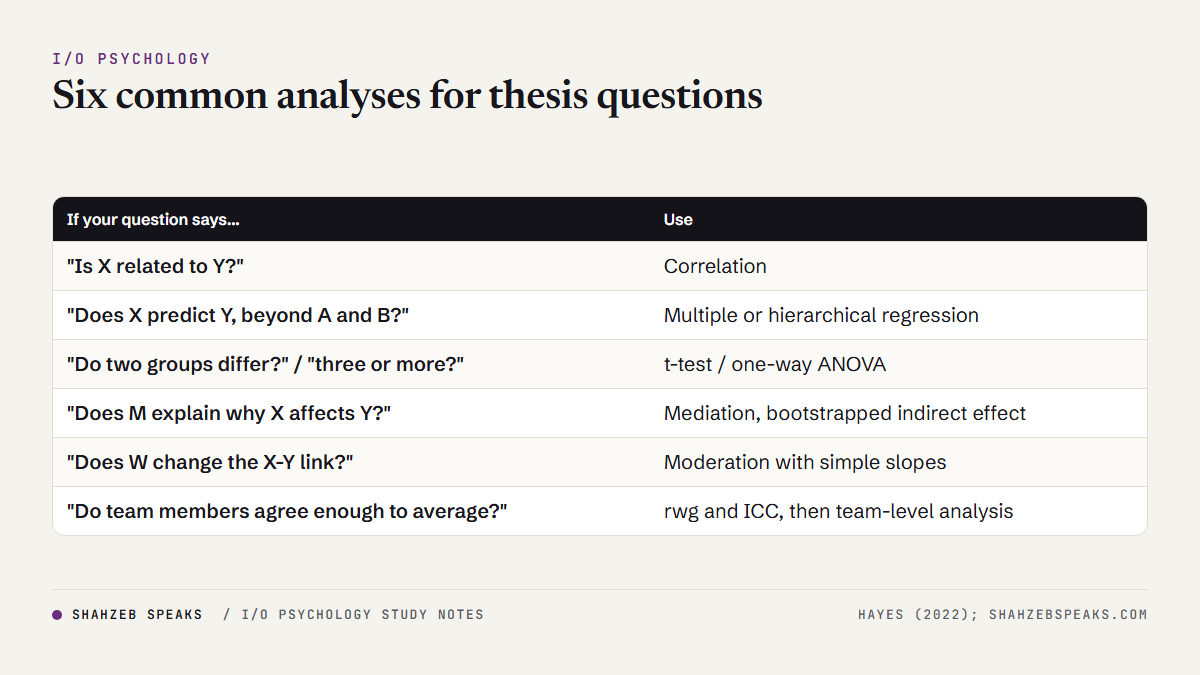
Most topics above use one of six common analyses (the selection topics in area 8 add CVR, item analysis and adverse impact). The table shows how to tell them apart from the wording of your research question.
| If your question says… | Use | Free tool or guide |
|---|---|---|
| “Is X related to Y?” | Correlation | Research methods guide |
| “Does X predict Y, beyond A and B?” | Multiple or hierarchical regression | Research methods guide |
| “Do two groups differ?” / “three or more?” | t-test / one-way ANOVA | Multiple comparisons calculator for many tests |
| “Does M explain why X affects Y?” | Mediation with a bootstrapped indirect effect (Hayes, 2022) | Research methods guide |
| “Does W change the X-Y link?” | Moderation (interaction) with simple slopes | Research methods guide |
| “Do team members agree enough to average?” | rwg and ICC, then team-level analysis | rwg and ICC calculator |
Whatever the analysis, report reliability for each scale in your own sample (Cronbach’s alpha or omega), and for MS theses run a CFA and report composite reliability and AVE with the composite reliability and AVE calculator. Plan the sample with a power analysis (Cohen, 1992), and reduce common method bias with two sources or two time points (Podsakoff et al., 2003). The full steps are in research methods for an I/O thesis, and the analysis questions examiners like are in the research methods MCQs.
The thesis and research guides in this series
- Free scales for I/O psychology theses (with licence notes): authors, items, dimensions and permission status.
- Research methods for an I/O thesis: design, sampling, back-translation, reliability, CFA, ethics and APA reporting.
- Meyer and Allen’s three-component model of commitment.
- Job satisfaction: theories and measures (JDI, MSQ, JSS).
- Organizational citizenship behavior (OCB).
- Counterproductive work behavior (CWB).
Free calculators for thesis numbers: composite reliability and AVE, intraclass correlation, item analysis, Spearman-Brown prophecy, Copenhagen Burnout Inventory and rwg and ICC. All tools are listed on the free tools page.
Thesis proposal structure (one topic from this list)
- Title: name the variables and the sample (“Workload and burnout among public hospital nurses: the role of supervisor support”).
- Background and gap (1 page): what is known, and what is missing for your population or setting.
- Theory: one framework that explains the links (for example, the JD-R model for topic 17).
- Objectives and hypotheses: one hypothesis per arrow in your model.
- Method: design, sample and power analysis, scales with permission status, translation plan, ethics.
- Analysis plan: the test for each hypothesis, plus reliability and (MS) CFA.
- Timeline and limitations, including common method bias if you use one survey.
Model aim sentence: “This study examines whether workload predicts burnout among nurses in public hospitals and whether supervisor support weakens this relationship.”
Practice MCQs: choosing and planning a thesis topic
Practice questions written to the published syllabus, not past-paper questions.
-
Which topic is the most feasible for a one-semester BS thesis?
- A ten-variable model of national culture across 20 countries
- Job satisfaction and turnover intention among bank officers in one city
- A five-year longitudinal study of CEO personality
- A new theory of motivation with a newly built 80-item scale
Show answer
B. Two variables, established scales and a reachable sample make it feasible. The others need too many variables, too much time, inaccessible participants or a new scale that itself needs a full validation study.
-
“Does work-family conflict explain why long hours lead to burnout?” Here work-family conflict is a:
- Moderator
- Mediator
- Control variable
- Dependent variable
Show answer
B. “Explain why” signals a mediator: hours affect conflict, which affects burnout. A moderator would change the strength of the hours-burnout link; burnout is the dependent variable.
-
A student compares burnout among doctors, nurses and paramedics. Which analysis fits?
- Independent-samples t-test
- One-way ANOVA
- Pearson correlation
- Mediation analysis
Show answer
B. Three or more groups on one continuous outcome call for one-way ANOVA with post hoc tests. A t-test compares only two groups; correlation and mediation answer different questions.
-
A student averages nurses’ ratings of ward psychological safety to get a ward score. What must be checked first?
- Within-ward agreement (rwg) and ICC
- The Spearman-Brown prophecy for each item
- Adverse impact by gender
- Nothing
Show answer
A. Aggregation needs evidence that members agree and that wards differ. Spearman-Brown predicts reliability for a different test length; adverse impact is a selection issue.
-
Which burnout measure on this page is free to use, according to its owner, with a citation?
- Maslach Burnout Inventory
- Copenhagen Burnout Inventory
- Multifactor Leadership Questionnaire
- GHQ-12
Show answer
B. Denmark’s NFA allows free use of the CBI with a citation. The MBI and MLQ are sold by Mind Garden (and the MLQ measures leadership, not burnout); the GHQ-12 needs permission.
-
“Abusive supervision leads to CWB, especially for employees high in trait anger.” Which analysis tests the “especially” part?
- Moderation with an interaction term
- Paired t-test
- Item analysis
- Chi-square
Show answer
A. “Especially for” means the strength of the link depends on a third variable, which is moderation. The other options do not test whether one relationship changes with another variable.
-
Which of these is NOT a good way to make a thesis topic new?
- Testing a known relationship in a new population
- Adding a mediator that explains the link
- Using two time points instead of one
- Copying a senior’s thesis and changing the city name
Show answer
D. Copying is plagiarism. A new population, a new mediator and a stronger design are all legitimate ways to add something new.
-
Topic 150 measures onboarding at the start and commitment three months later. This design is:
- Cross-sectional
- Time-lagged
- Experimental
- Qualitative
Show answer
B. Measuring the predictor and outcome at different times is a time-lagged design. It is not cross-sectional (one time point), not an experiment (no random assignment) and not qualitative.
-
Why are Mini-IPIP topics (area 7) the cheapest to run?
- The Mini-IPIP needs no reliability check
- IPIP items are in the public domain
- Personality does not need a sample
- Mind Garden gives it away free
Show answer
B. The IPIP site says its items are public domain, free for any use. You still need reliability checks and a sample, and the Mini-IPIP is not a Mind Garden product.
Free calculators for your thesis
Check reliability and agreement with the free composite reliability and AVE calculator, item analysis calculator, ICC calculator, rwg and ICC calculator, Spearman-Brown calculator and CBI calculator.
Questions students ask
What are good I/O psychology thesis topics for BS students?
Choose two or three variables with free scales and a sample you can reach: for example, job satisfaction and turnover intention in bank officers (topic 1), workload and burnout in nurses (topic 16), or Big Five traits and OCB (topic 92). Analyse with correlation, regression, a t-test or ANOVA.
What are I/O psychology research topics for an MS or MPhil in Pakistan?
Add a mediator or moderator and a stronger design to a known link: supervisor support as a buffer of workload in nurses (topic 17), negative emotions between constraints and CWB (topic 62), or engagement between servant leadership and OCB (topic 7). Plan a CFA and a power analysis.
Which thesis topics use free scales?
Topics built on the JSS, OCB-C, CWB-C, JAWS, OCS, QWI and ICAWS (free for non-commercial research if you share results), the CBI (free with citation), the Mini-IPIP (public domain), the UWES-9 (free academic use with data sharing) and the MSQ (Creative Commons non-commercial). See the scales page for the exact terms.
How do I know which analysis to use?
Read your question: “related” means correlation, “predict” means regression, “differ” means t-test or ANOVA, “explain why” means mediation, and “depends on” or “especially” means moderation. Team-level questions need agreement checks first.
Can I do a qualitative I/O thesis?
Yes, for example interviews on how bank managers handle harassment complaints, or a training needs analysis (topic 121). This page focuses on quantitative ideas; check whether your department accepts a qualitative thesis and what it expects.
How many participants do I need?
Use a power analysis based on the effect size you expect (Cohen, 1992), then add a margin for incomplete answers. The research methods guide shows the numbers for common analyses.
Practise on your phone
The free I/O Psychology Prep app has 410 explained
questions, flashcards and an exam countdown, and works offline. Get it on Google Play
· About the app
References
- Bakker, A. B., & Demerouti, E. (2007). The Job Demands-Resources model: State of the art. Journal of Managerial Psychology, 22(3), 309-328. https://doi.org/10.1108/02683940710733115
- Cohen, J. (1992). A power primer. Psychological Bulletin, 112(1), 155-159. https://doi.org/10.1037/0033-2909.112.1.155
- Colquitt, J. A. (2001). On the dimensionality of organizational justice: A construct validation of a measure. Journal of Applied Psychology, 86(3), 386-400. https://doi.org/10.1037/0021-9010.86.3.386
- Donnellan, M. B., Oswald, F. L., Baird, B. M., & Lucas, R. E. (2006). The Mini-IPIP scales: Tiny-yet-effective measures of the Big Five factors of personality. Psychological Assessment, 18(2), 192-203. https://doi.org/10.1037/1040-3590.18.2.192
- Eisenberger, R., Huntington, R., Hutchison, S., & Sowa, D. (1986). Perceived organizational support. Journal of Applied Psychology, 71(3), 500-507. https://doi.org/10.1037/0021-9010.71.3.500
- Hackman, J. R., & Oldham, G. R. (1976). Motivation through the design of work: Test of a theory. Organizational Behavior and Human Performance, 16(2), 250-279. https://doi.org/10.1016/0030-5073(76)90016-7
- Hayes, A. F. (2022). Introduction to mediation, moderation, and conditional process analysis: A regression-based approach (3rd ed.). Guilford Press.
- Karasek, R. A. (1979). Job demands, job decision latitude, and mental strain: Implications for job redesign. Administrative Science Quarterly, 24(2), 285-308. https://doi.org/10.2307/2392498
- Morgeson, F. P., & Humphrey, S. E. (2006). The Work Design Questionnaire (WDQ): Developing and validating a comprehensive measure for assessing job design and the nature of work. Journal of Applied Psychology, 91(6), 1321-1339. https://doi.org/10.1037/0021-9010.91.6.1321
- Netemeyer, R. G., Boles, J. S., & McMurrian, R. (1996). Development and validation of work-family conflict and family-work conflict scales. Journal of Applied Psychology, 81(4), 400-410. https://doi.org/10.1037/0021-9010.81.4.400
- Organ, D. W. (1988). Organizational citizenship behavior: The good soldier syndrome. Lexington Books.
- Podsakoff, P. M., MacKenzie, S. B., Lee, J.-Y., & Podsakoff, N. P. (2003). Common method biases in behavioral research: A critical review of the literature and recommended remedies. Journal of Applied Psychology, 88(5), 879-903. https://doi.org/10.1037/0021-9010.88.5.879
- Robinson, S. L., & Bennett, R. J. (1995). A typology of deviant workplace behaviors: A multidimensional scaling study. Academy of Management Journal, 38(2), 555-572. https://doi.org/10.2307/256693
- Siegrist, J. (1996). Adverse health effects of high-effort/low-reward conditions. Journal of Occupational Health Psychology, 1(1), 27-41. https://doi.org/10.1037/1076-8998.1.1.27
- Wanous, J. P., Reichers, A. E., & Hudy, M. J. (1997). Overall job satisfaction: How good are single-item measures? Journal of Applied Psychology, 82(2), 247-252. https://doi.org/10.1037/0021-9010.82.2.247
This is the hub page for thesis and research guides on Shahzeb Speaks. For the wider field, start with the I/O psychology study guide, the work motivation theories pillar and the I/O psychology MCQs. For careers locally, see industrial psychology in Pakistan.