
Almost every organisation in Pakistan is legally required to have a harassment inquiry committee, and most employees have never been told who sits on theirs. The law has been in force since March 2010. It was widened substantially in January 2022. And eight days before this article was written, Pakistan’s new Federal Constitutional Court reportedly narrowed how it is read. If you run a team, work in HR, or are dealing with harassment yourself, the rules have moved — and the research on what actually stops harassment points somewhere the law barely looks.
This guide does two things. First, it sets out what the Protection against Harassment of Women at the Workplace Act, 2010 actually requires, section by section, including what the 2022 amendment changed and what it did not. Second, it looks at the organisational-psychology evidence on prevention, because a committee that only reacts after the damage is done is the part of the system the evidence trusts least.
I am an Industrial and Organizational Psychologist in Karachi, not a lawyer. Every legal statement below is taken from the text of the Act, its 2022 amendment or the 2013 complaint rules, and the section number is given so you can check it. For a live case, take legal advice.
“Pakistan’s law tells an organisation what to do after someone complains. The research says the deciding factor is whether people believe a complaint would be taken seriously before anyone ever files one. A good committee is necessary. It is not the same thing as a safe workplace.”
— Workplace Psychology Analysis, ShahzebSpeaks
⚡ Chapter 1: The short answer — what every employer must do
Under the 2010 Act, every organisation it covers has three standing duties:
- Form an Inquiry Committee of three members, at least one of them a woman (section 3).
- Designate a Competent Authority — the person who imposes the penalty the committee recommends (sections 3(4) and 4(5)).
- Adopt and display the Code of Conduct in English and in the language most employees understand, “at conspicuous place in the organization and the work place” (section 11(2)).
An employer that fails to do this can be taken to the District Court by any employee and fined between Rs 25,000 and Rs 100,000 (section 11(3)). In Balochistan the provincial law sends that complaint to the Ombudsperson instead.
The Act covers far more than offices. Its definition of “organization” includes government bodies, educational institutes, medical facilities, registered civil-society groups and private companies, and since 2022 it has also included online businesses.
📜 Chapter 2: The law in one page
The Protection against Harassment of Women at the Workplace Act, 2010 (Act No. IV of 2010) received presidential assent on 9 March 2010 and came into force at once. It extends to the whole of Pakistan, although the provinces have since adapted it (Chapter 6).
The original 2010 definition of harassment, in section 2(h), was:
“any unwelcome sexual advance, request for sexual favors or other verbal or written communication or physical conduct of a sexual nature or sexually demeaning attitudes, causing interference with work performance or creating an intimidating, hostile or offensive work environment, or the attempt to punish the complainant for refusal to comply to such a request or is made a condition for employment”
Two details are often missed. First, even in 2010 a complainant could be “a woman or man” (section 2(e)) — only the title and preamble were written for women. Second, the Code of Conduct attached to the Act names three forms of harassment, and only one of them is the obvious one:
- Abuse of authority — a demand from someone with power over your job.
- A hostile environment — and “a single offensive incident” can be enough where it is “particularly severe, such as in cases involving physical contact”.
- Retaliation — which the Code says “may include limiting the employee’s options for future promotions or training, distorting the evaluation reports, generating gossip against the employee”.
That third one matters to anyone who manages people. A manager who quietly downgrades someone’s appraisal after they complained is, in the Code’s own words, harassing them.
🔄 Chapter 3: What changed in 2022 — and what did not
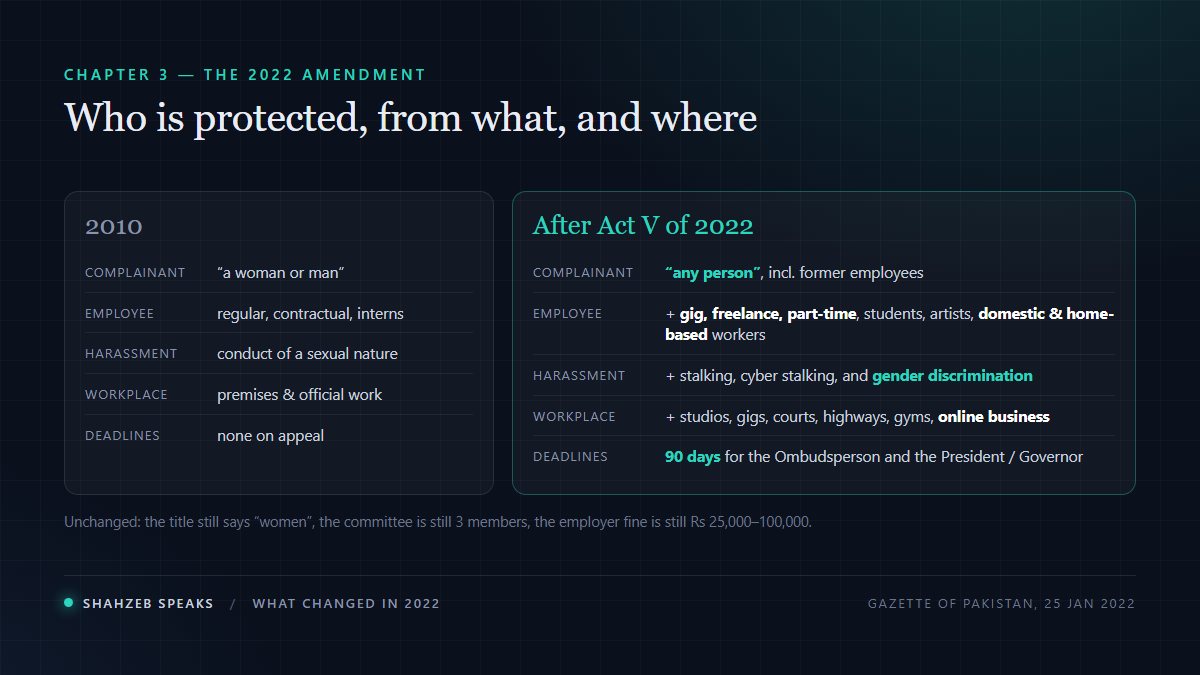
The Protection against Harassment of women at the Workplace (Amendment) Act, 2022 (Act No. V of 2022) received assent on 21 January 2022 and was published in the Gazette on 25 January 2022. It rewrote most of the definitions.
| What | 2010 | After the 2022 amendment |
| Who can complain | “a woman or man” | “any person”, including a former employee who was dismissed or resigned, and a parent or guardian for a minor |
| Who counts as an employee | regular or contractual staff, interns and apprentices | adds piece-rate, gig, temporary, part-time and freelance workers, students, performers, artists, sportspersons, trainees, domestic workers and home-based workers — “whether working for remuneration or not” |
| What counts as harassment | conduct of a sexual nature | adds stalking, cyber stalking, visual communication and derogatory gestures — and a second limb: “discrimination on basis of gender, which may or may not be sexual in nature” |
| Where | the premises, and situations linked to official work | adds educational institutions, gigs, concerts, studios, courts, highways, sporting facilities and gymnasiums |
| Deadlines for appeals | none for the Ombudsman or the President | the Ombudsperson must decide within 90 days; so must the President or Governor on representation |
| Retaliation | covered by the Code | adds: “Filing counter-blast suits for defamation etc. are also retaliation” |
Other changes: “Ombudsman” became “Ombudsperson”; suspension or cancellation of a professional licence was added as a major penalty; committees may now take audio and video evidence; and the Code now says that “a single incident having the effect of making a person uncomfortable or creating a sense of fear or panic at the workplace is also harassment.”
What did not change. The title and the preamble still refer to women — the Act was not renamed. The committee is still three members with at least one woman. The employer fine is still Rs 25,000 to Rs 100,000. And the false-complaint clause (Chapter 5) is unchanged.
⚖️ Chapter 4: What the courts have said — and the September 2026 judgment
The definition of harassment has moved back and forth in the courts. These are reported decisions; I have not read the full judgments, so the summaries below follow the reporting cited.
- July 2021 — Supreme Court, Nadia Naz v. President of Pakistan. As analysed by the Oxford Human Rights Hub, a three-judge bench read the 2010 definition as covering only harassment of a sexual nature.
- January 2022 — the amendment. Parliament added the gender-discrimination limb quoted in Chapter 3.
- March 2023 — Supreme Court review. As reported by Arab News and the Oxford Human Rights Hub, the court held on review that gender-based discrimination is a form of harassment and applied the standard of a reasonable woman.
- September 2026 — Federal Constitutional Court. According to the state news agency APP (28 September 2026), the court held in Usman Shahid v. Nadia Sarwar that “the presence of a sexual element is essential” for a complaint to be actionable under the Act, and that conduct without it is not for the Ombudsperson — although the organisation can still act under its own service rules. Commentary in The Friday Times reports that the underlying complaints dated from 2012–2013, before the 2022 amendment.
What this means in practice, as far as an employer is concerned: for conduct after 25 January 2022, the statute’s text expressly includes gender discrimination. How the courts will apply the September 2026 reasoning to post-2022 complaints is not yet settled. Nothing reported says the court struck down the amendment. If a complaint has no sexual element, get legal advice on which forum to use — and remember the organisation’s own service rules still apply.
🕐 Chapter 5: How an inquiry committee works
Who sits on it
Section 3(2): “The Committee shall consist of three members of whom at least one member shall be a woman. One member shall be from senior management and one shall be a senior representative of the employees or a senior employee where there is no CBA.” If an organisation cannot find three suitable people internally, members can be co-opted from outside, and a chairperson is designated from among the three. If a member is the subject of a complaint, they are replaced for that case (section 3(3)).
Balochistan is different. Its own Act of 2016 requires a five-member committee with at least two women, adds threats, blackmail and defamation “through modern techniques” to the definition, and requires the Code to be displayed in English with an Urdu translation.
The clock
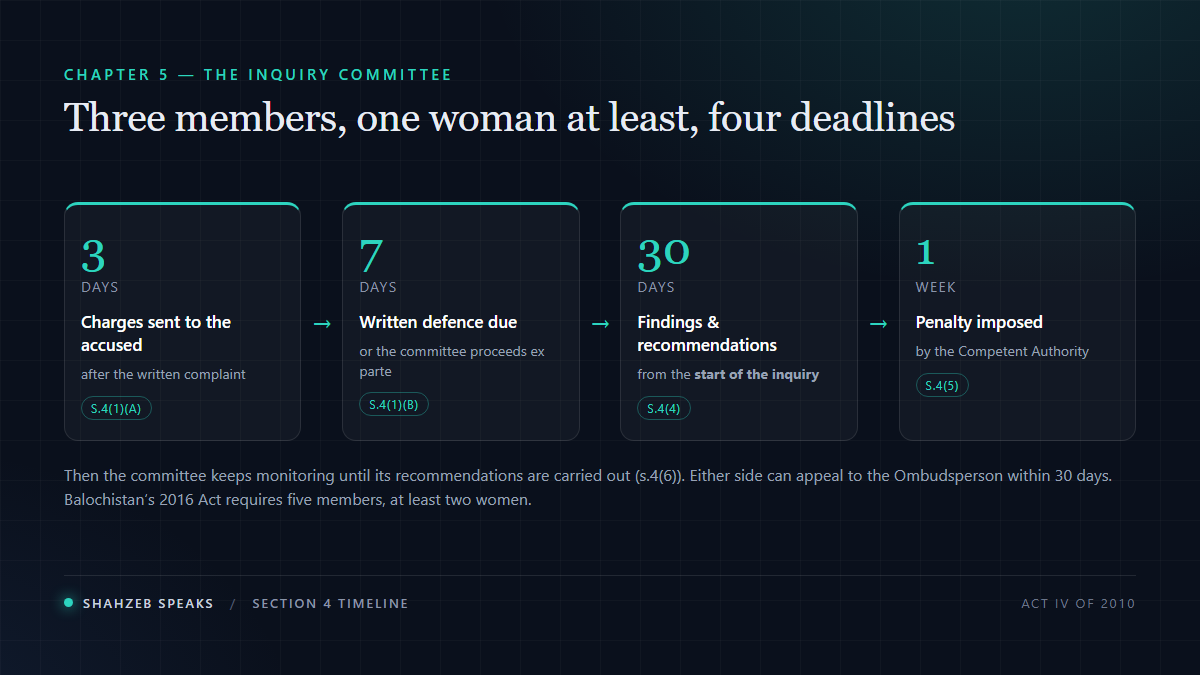
- Within 3 days of a written complaint, the committee sends the accused the charges and statement of allegations (section 4(1)(a)).
- Within 7 days of receiving them, the accused submits a written defence — otherwise the committee proceeds ex parte (section 4(1)(b)).
- Within 30 days of the initiation of the inquiry, the committee sends its findings and recommendations to the Competent Authority (section 4(4)).
- Within one week of receiving them, the Competent Authority imposes the recommended penalty (section 4(5)).
The committee does not disappear after that: section 4(6) requires it to “meet on regular basis and monitor the situation regularly” until its recommendations are implemented. It is an easy line to overlook, and — as Chapter 7 shows — it is the part of the Act most in line with the evidence.
The protections built into the process
Section 4(3) says evidence is confidential; both sides may bring a CBA representative, a friend or a colleague; “adverse action shall not be taken against the complainant or the witnesses”; and findings must be recorded in writing with reasons. The committee can summon people, take evidence on oath and require documents (section 5(1)). During the inquiry, the Code allows the employer to separate the parties — moving offices, removing a reporting line, or sending the accused on leave.
If the complainant is in trauma, section 4(7) says the organisation “will arrange for psycho-social counseling or medical treatment and for additional medical leave”.
The penalties
Section 4(4) lists them. Minor: censure; withholding promotion or increment for a period; stoppage at an efficiency bar; recovery of compensation from the accused’s pay. Major: reduction to a lower post or scale; compulsory retirement; removal from service; dismissal; a fine (part of which can go to the complainant); and, since 2022, suspension or cancellation of a professional licence. The Act sets no rupee amount for the fine penalty.
False complaints
The only provision is section 5(3): the committee “may recommend to Ombudsman for appropriate action against the complainant if allegations leveled against the accused found to be false and made with mala fide intentions.” It needs both falsity and bad faith, and it is a recommendation, not a fixed punishment. A complaint that simply could not be proved is not a false complaint under this clause.
🏛️ Chapter 6: The committee or the Ombudsperson — the two routes
Section 8(1), as amended: a complainant “shall have the option to prefer a complaint either to the Ombudsperson or the Inquiry Committee.” You do not have to go through your employer first.
| Step | Rule |
| Appeal against a committee decision | To the Ombudsperson within 30 days (section 6). Either side can appeal. |
| Direct complaint to the Ombudsperson | Show-cause notice to the accused within 3 days; written defence within 5 days (section 8(2)). Decision within 90 days (section 8(6), added 2022). |
| Against the Ombudsperson’s decision | Representation to the President or the Governor within 30 days, to be decided within 90 days (section 9). |
| Implementation | Management must implement the Ombudsperson’s orders within 14 days, under the 2013 complaint rules. |
Federal or provincial?
The Act says only that governments “shall appoint an ombudsman at the Federal and provincial levels”. In practice:
- Federal Ombudsperson Secretariat for Protection Against Harassment (FOSPAH), Islamabad, with regional offices in Karachi, Lahore, Peshawar and Quetta. Online complaints: complaints.fospah.gov.pk. Its annual reports show it receiving complaints from every province.
- Ombudsperson Punjab, Lahore (ombudsperson.punjab.gov.pk), under Punjab’s adaptation of the Act.
- Sindh, Khyber Pakhtunkhwa and Balochistan have their own provincial Ombudspersons. Khyber Pakhtunkhwa adapted the federal Act through amendments in 2018 and 2020; Balochistan has its own 2016 Act.
Courts have disagreed about which forum has jurisdiction in some cases — the Sindh High Court, for example, has held that a Karachi workplace belonged with the provincial Ombudsperson. If you are unsure, ask the office before filing.
How many people use it
FOSPAH reports registering 767 complaints in 2022-23, 823 in 2023-24 and 1,471 in 2024-25. These figures combine harassment and property-rights cases, which the office also handles. Between 2011 and mid-2023 it registered 3,571 cases, 2,716 of them from women and 855 from men. Some figures in FOSPAH’s latest report do not reconcile with each other, so treat them as a sign of rising use rather than a precise count.
For comparison: Pakistan has not ratified the ILO’s Violence and Harassment Convention, 2019 (C190), which had 56 ratifications as of October 2026. Bangladesh ratified it in November 2025 and Sri Lanka in April 2026.
🔬 Chapter 7: Why a committee alone does not prevent harassment
Pakistan’s Act is, almost entirely, a complaint-and-penalty system. Organisational psychology has studied harassment for three decades, and its findings are uncomfortable for any system built that way.
1. Most people never complain
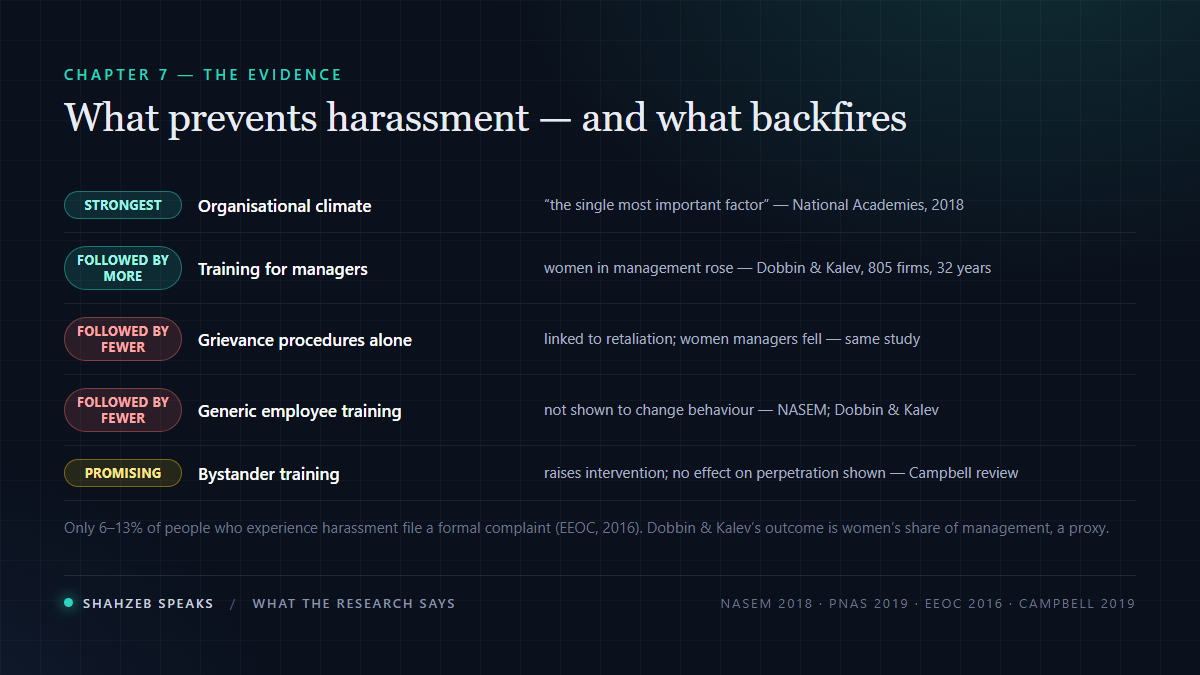
The US Equal Employment Opportunity Commission’s 2016 task force found that “roughly three out of four individuals who experienced harassment never even talked to a supervisor, manager, or union representative,” and that only “6% to 13% of individuals who experience harassment file a formal complaint.” A committee that has received no complaints has not proved anything. It may simply be the committee nobody trusts.
2. How you ask changes the answer
A meta-analysis of more than 86,000 respondents in 55 probability samples (Ilies and colleagues, 2003) found that on average 58% of women reported experiencing potentially harassing behaviours, but only 24% said they had experienced sexual harassment. Asking “have you been harassed?” produces far lower numbers than asking about specific behaviours. This is one reason Pakistani survey figures vary so wildly — and why an employer’s own survey should ask about behaviours, not labels.
3. The harm is measurable
Willness, Steel and Lee’s 2007 meta-analysis of 41 studies and nearly 70,000 respondents linked harassment to lower job satisfaction and commitment, withdrawal from work, poorer physical and mental health, and even symptoms of post-traumatic stress. It also found that organisational climate “figured prominently” in whether harassment happened at all.
4. Climate is the strongest factor
The US National Academies of Sciences, Engineering, and Medicine (2018) put it plainly: “Organizational climate is the single most important factor in determining whether sexual harassment is likely to happen in a work setting.” Climate here means one specific belief: whether people think the organisation tolerates harassment — whether a complaint would be taken seriously, whether the person complaining would be at risk, and whether anything would happen to the harasser. Earlier work by Fitzgerald and colleagues found harassment occurs less often where people believe upper levels “will not tolerate such behavior” and in more gender-balanced workgroups. If this sounds like psychological safety at work, it is a close relative.
5. Some programmes backfire
Frank Dobbin and Alexandra Kalev followed 805 US companies over 32 years (PNAS, 2019). Their outcome was the share of women in management — a proxy, not a direct measure of harassment — and the results were striking:
- Grievance procedures, which surveys show “incite retaliation without satisfying complainants”, were followed by decreases in women managers.
- Generic employee training, which signals that men are potential perpetrators, was also followed by decreases.
- Training for managers — teaching them to spot trouble and intervene — was followed by increases.
The National Academies reached a similar conclusion: harassment training “has not been demonstrated to prevent sexual harassment or change people’s behaviors or beliefs.” And Roehling and Huang’s 2018 review noted that there had never been a comprehensive attempt to evaluate whether harassment training works at all.
6. Bystander training is promising, not proven
The EEOC called bystander-intervention training promising. The strongest evidence comes from campuses, not workplaces: a Campbell systematic review of 27 high-quality studies (Kettrey and colleagues, 2019) found bystander programmes increase intervention but showed no effect on perpetration. Worth doing; not a cure.
None of this says the committee is useless. It says the committee is the last line of defence, and the evidence is about everything that should happen before it.
🧰 Chapter 8: What an employer should actually do
Here is how I would build a harassment system for a Pakistani organisation, starting from the legal minimum and adding what the evidence supports.
- Meet the legal minimum, visibly. Notify the committee’s names to every employee, display the Code in English and Urdu (or the majority language), and name the Competent Authority. A committee people cannot name is a committee people will not use.
- Choose members people trust, not just senior ones. The Act requires senior management and an employee representative. Trust is what decides whether anyone comes forward, so ask staff, quietly, who they would actually talk to.
- Protect against retaliation as hard as against harassment. The Code already names distorted evaluations and gossip as retaliation, and the 2022 amendment adds counter-blast defamation suits. Check the appraisals and assignments of anyone who has complained, and of their witnesses, for the next year. This is what Dobbin and Kalev’s results say grievance systems usually get wrong.
- Train managers first. Spend the training budget on teaching line managers to notice, intervene and escalate, not on an annual slideshow for everyone.
- Measure climate, not just complaints. Run an anonymous survey asking about specific behaviours and about trust: “If I reported harassment, it would be taken seriously.” “Someone who reported would not suffer for it.” Track it per department. A rising complaint count with improving trust scores can be good news; a silent department with low trust is the risk. This is the same discipline as a well-run employee engagement survey: anonymous, behaviour-based, and reported back to staff.
- Use the informal route, carefully. The Code allows informal resolution and mediation. It works for low-level conduct when the complainant chooses it. It must never be pushed on someone, and the Code is explicit that a formal complaint can be made “at any time”.
- Do the follow-up the law already requires. Section 4(6) obliges the committee to keep monitoring until its recommendations are implemented. Put it in the calendar.
🙋 Chapter 9: If you are being harassed — the steps
- Write things down as soon as you can: dates, times, what was said or done, who saw it. Keep messages, emails and screenshots. Since 2022, committees can consider audio and video evidence. The Code says “not reporting immediately shall not affect the merits of the case”.
- Choose your route. You can report informally to your supervisor or any committee member, make a formal written complaint to any member of the Inquiry Committee — who is then “obligated to initiate the process” — or go directly to the Ombudsperson.
- For a formal complaint, the 2013 rules ask for a full statement of facts, any documents, audio or video, names of witnesses, and your signature or thumb impression.
- With FOSPAH, you can file in person, by post, online at complaints.fospah.gov.pk, by email, or through its helpline, 0344 4367367, as listed on fospah.gov.pk.
- If the decision goes against you, you can appeal to the Ombudsperson within 30 days, and from there make a representation to the President or Governor within 30 days.
- Look after yourself. The organisation is required to arrange counselling or medical treatment if you are in trauma (section 4(7)). Ask for it.
❓ Questions I am asked most often
Is a harassment committee mandatory in Pakistan?
Yes. Section 3 of the 2010 Act requires each organisation it covers to constitute an Inquiry Committee, and section 11 requires the employer to adopt the Code of Conduct and display it. Any employee can petition the District Court against an employer that does not comply, and the fine is Rs 25,000 to Rs 100,000.
How many members must the harassment committee have?
Three under the federal Act, at least one of them a woman: one from senior management and one senior employee representative. Balochistan’s 2016 Act requires five members, at least two of them women.
Does the law protect men?
Yes. Even in 2010 a complainant could be “a woman or man”, and since 2022 the Act says “any person”. The title of the Act still refers to women.
Can I complain directly to the Ombudsperson without going to my employer?
Yes. Section 8(1) gives every complainant the option of the Inquiry Committee or the Ombudsperson.
How long does a harassment inquiry take?
The committee must send its findings within 30 days of starting the inquiry, and the Competent Authority must impose the penalty within one week of receiving them. The Ombudsperson must decide a case or appeal within 90 days.
Is gender discrimination harassment under Pakistani law?
The 2022 amendment says harassment includes “discrimination on basis of gender, which may or may not be sexual in nature”. In September 2026, the Federal Constitutional Court was reported to have held that a sexual element is essential for a complaint under the Act, in a case whose complaints pre-dated the amendment. How that applies to later complaints is not yet settled, so take legal advice for a non-sexual complaint.
Want to know whether your people would actually report?
I design climate and trust surveys and help organisations set up committees that people use. If you want an evidence-based look at your workplace, I am happy to talk it through.
More on my field and why it matters in Pakistani workplaces: industrial psychology in Pakistan. If you are weighing a career in this area, see I/O psychology vs HRM.
This article explains the law for general information as of 6 October 2026. It is not legal advice.
Sources
- Protection against Harassment of Women at the Workplace Act, 2010 (Act No. IV of 2010), text as published by the Federal Ombudsperson Secretariat for Protection Against Harassment (FOSPAH).
- Protection against Harassment of women at the Workplace (Amendment) Act, 2022 (Act No. V of 2022), Gazette of Pakistan, Extraordinary, 25 January 2022; and FOSPAH’s consolidated amended text.
- Protection Against Harassment of Women at the Workplace (Filing and Disposal of Complaints) Rules, 2013, in FOSPAH, Laws and Rules.
- Balochistan Protection Against Harassment of Women at the Workplace Act, 2016 (Act No. 01 of 2016).
- Khyber Pakhtunkhwa Protection against Harassment of Women at the Workplace (Amendment) Act, 2018 (Act No. V of 2018); KP Amendment Bill, 2019, passed 14 January 2020.
- FOSPAH Annual Reports 2022-23, 2023-24 and 2024-25.
- Associated Press of Pakistan. “Sexual element essential for harassment law to apply: Federal Constitutional Court.” 28 September 2026.
- Oxford Human Rights Hub, commentaries on Nadia Naz v. President of Pakistan (2021) and the Supreme Court’s 2023 review; Arab News, June 2023.
- Sindh High Court, C.P. No. D-6107 of 2020.
- International Labour Organization, NORMLEX: ratifications of C190 – Violence and Harassment Convention, 2019 (accessed 6 October 2026).
- U.S. Equal Employment Opportunity Commission (2016). Select Task Force on the Study of Harassment in the Workplace, report of co-chairs Chai R. Feldblum and Victoria A. Lipnic.
- National Academies of Sciences, Engineering, and Medicine (2018). Sexual Harassment of Women: Climate, Culture, and Consequences in Academic Sciences, Engineering, and Medicine. doi:10.17226/24994
- Ilies, R., Hauserman, N., Schwochau, S., & Stibal, J. (2003). Reported incidence rates of work-related sexual harassment in the United States. Personnel Psychology, 56(3), 607–631.
- Willness, C. R., Steel, P., & Lee, K. (2007). A meta-analysis of the antecedents and consequences of workplace sexual harassment. Personnel Psychology, 60(1), 127–162.
- Fitzgerald, L. F., Drasgow, F., Hulin, C. L., Gelfand, M. J., & Magley, V. J. (1997). Antecedents and consequences of sexual harassment in organizations. Journal of Applied Psychology, 82(4), 578–589; and Fitzgerald, Drasgow & Magley (1999), Military Psychology, 11(3), 329–343.
- Dobbin, F., & Kalev, A. (2019). The promise and peril of sexual harassment programs. PNAS, 116(25), 12255–12260.
- Roehling, M. V., & Huang, J. (2018). Sexual harassment training effectiveness: An interdisciplinary review and call for research. Journal of Organizational Behavior, 39(2), 134–150.
- Kettrey, H. H., Marx, R. A., & Tanner-Smith, E. E. (2019). Effects of bystander programs on the prevention of sexual assault among adolescents and college students. Campbell Systematic Reviews, 15(1-2).