
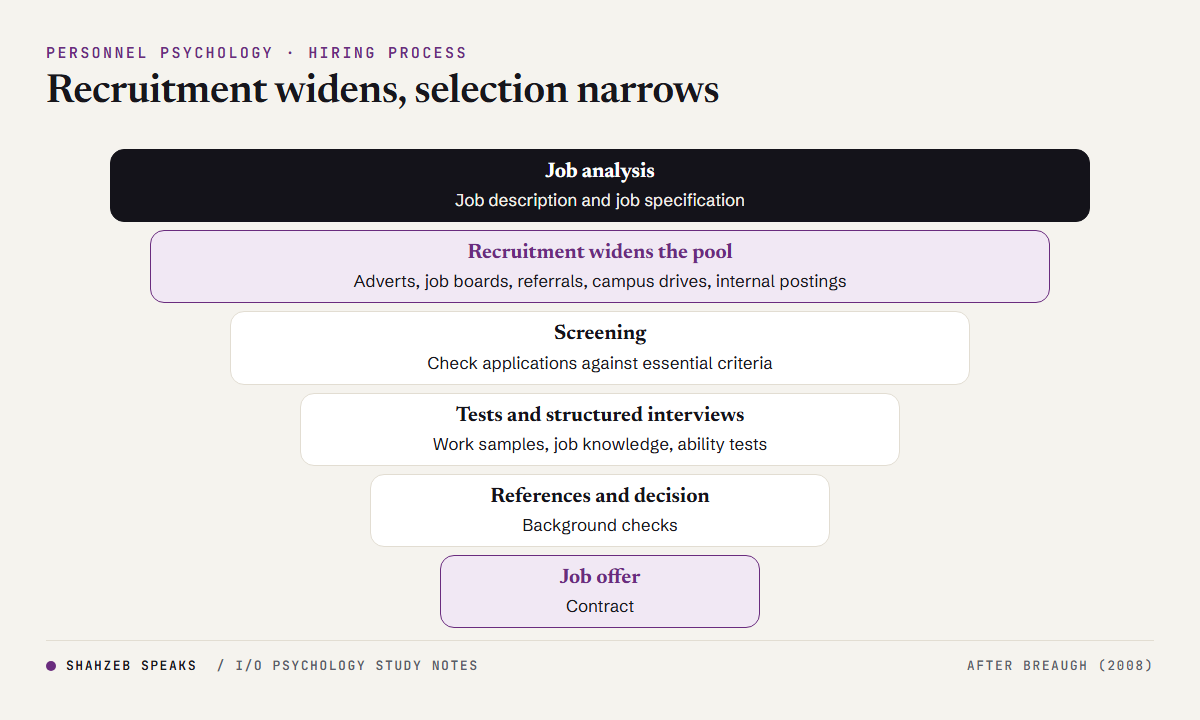
Recruitment is the process of attracting suitable people to apply for a job; it widens the pool. Selection is the process of choosing the best person from that pool using tests, interviews and other assessments; it narrows the pool. Recruitment always comes first, and both should rest on a job analysis.
“Differentiate between recruitment and selection” is a standard question in HRM, organisational behaviour and industrial psychology papers. Most pages that rank for it are HR software blogs with a short table. This page gives you that table, but also the process step by step, what the research says about each stage (with original citations), an example, an exam answer structure and practice MCQs.
What is recruitment?
Recruitment covers everything an organisation does to get the right people interested in a job. In James Breaugh’s review of recruitment research (2008), recruitment activities are the ones that affect whether people apply, whether they stay interested during the process, and whether they accept a job offer. Breaugh describes the process in four stages:
- Set recruitment objectives: how many people, with which KSAOs, by when.
- Develop a strategy: whom to target, where to find them, what message to send.
- Carry out recruitment activities: adverts, job boards, employee referrals, campus visits, social media.
- Evaluate the results: did the right people apply, and how many accepted?
Sources of applicants are usually split into internal (promotions, transfers, internal job postings) and external (job boards, referrals, universities, agencies). A recruiter’s job is to attract enough qualified applicants, not as many as possible: 2,000 unsuitable applications make selection slower and more expensive.
What is selection?
Selection is the process of deciding which applicants to hire. In I/O psychology, the key idea is validity: how well a selection method predicts later job performance. Typical steps are:
- Screening applications against the essential criteria in the job specification.
- Tests: ability, job knowledge, work samples, personality or situational judgement tests.
- Interviews, ideally structured (the same job-related questions and a scoring guide for every candidate).
- Reference and background checks.
- The final decision and the job offer.
Selection methods should measure what the job needs. That is why selection starts from the job description and job specification.
Recruitment vs selection: the differences in a table
| Point | Recruitment | Selection |
|---|---|---|
| Aim | Attract a pool of suitable applicants | Choose the best-fitting applicant(s) from the pool |
| Effect on numbers | Widens the pool | Narrows the pool |
| Often called | A “positive” process (invites people in) | A “negative” process (screens people out) |
| Order | First | Second, after applications arrive |
| Main methods | Adverts, job boards, referrals, campus drives, internal postings | Screening, tests, structured interviews, work samples, references |
| Key quality question | Did enough qualified people apply and accept? | Does the method predict performance (validity) and treat groups fairly? |
| Contract | No contract is formed | Ends with an offer and an employment contract |
| I/O research topics | Applicant attraction, recruitment sources, realistic job previews | Validity, reliability, adverse impact, utility |
What the research says about recruitment
Two findings are worth knowing for exams and for practice:
- What attracts applicants. Chapman and colleagues’ (2005) meta-analysis of recruiting outcomes found that applicant attraction was predicted by job and organisation characteristics, recruiter behaviours, how applicants saw the recruiting process, their perceived fit and their expectation of being hired. Recruiter demographics did not predict attraction. So a friendly, well-informed recruiter matters more than who the recruiter is.
- Realistic job previews (RJPs). An RJP shows applicants the good and the bad parts of the job before they accept, for example a call centre letting candidates listen to real calls. John Wanous tested this idea in the 1970s, and Premack and Wanous’s (1985) meta-analysis of 21 RJP experiments found that RJPs lowered new hires’ initial expectations, which is the mechanism thought to reduce early quitting.
What the research says about selection
The most cited summary of selection validity was Schmidt and Hunter’s (1998) review of 85 years of research, which placed general mental ability near the top. In 2022, Sackett, Zhang, Berry and Lievens re-analysed the evidence and argued that earlier corrections had overstated many validities. Their revised estimates, as summarised in SIOP’s newsletter TIP, put structured interviews at .42 (the highest, with a wide spread), job knowledge tests at .40, empirically keyed biodata at .38, work sample tests at .33 and cognitive ability tests at .31.
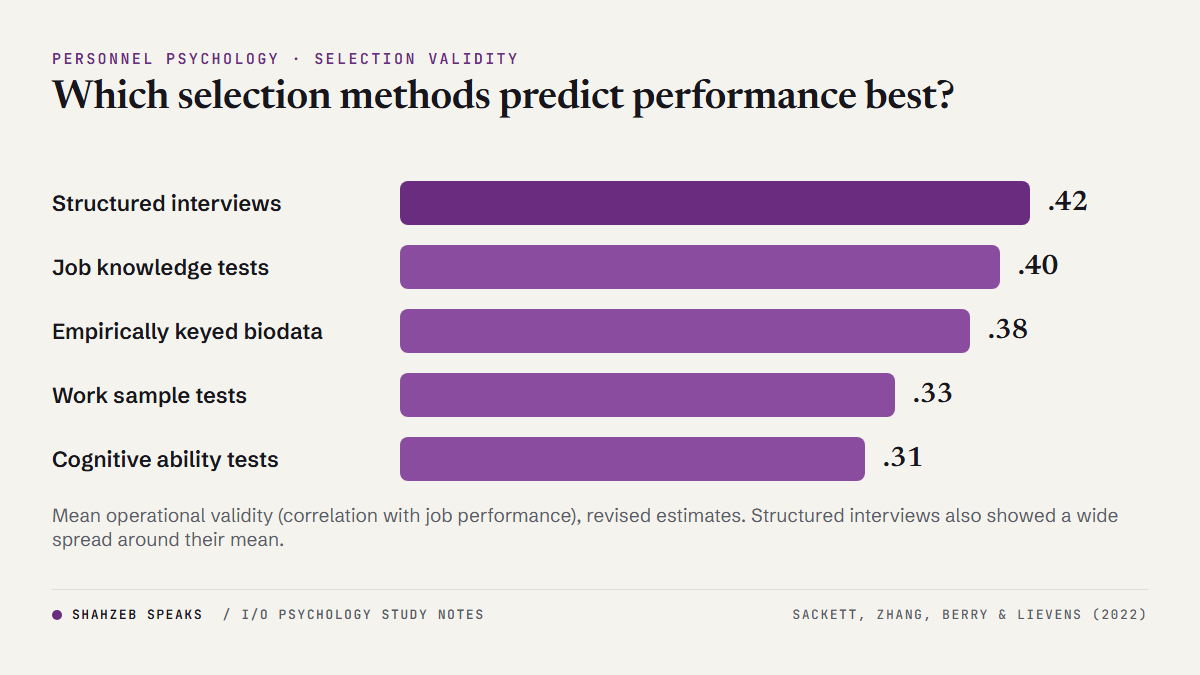
The lesson for students: a structured interview built from a job analysis is one of the strongest single tools, and it is something any organisation can afford. The structured vs unstructured interviews page shows how to build one, and validity in employee selection explains what a validity coefficient means.
Example: hiring call centre agents
Imagine a call centre in Lahore that needs 40 customer service agents for a new night shift.
- Recruitment: HR sets the objective (40 agents with fluent spoken English, able to work nights, within six weeks), chooses sources (university job fairs, employee referrals, job boards), and writes an advert that honestly mentions night shifts and call targets, which works as a simple realistic preview.
- Selection: applications are screened for the essential criteria; shortlisted candidates take a short typing and listening test and a role-play call (a work sample); then a structured interview scores everyone on the same questions; references are checked; offers go out.
If too few people apply, the problem is in recruitment. If the people hired leave or perform poorly, look at both: the preview (recruitment) and the validity of the tests (selection).
Common mistakes
- Using the two words as synonyms. In exams this alone can cost marks.
- Judging recruitment by the number of applications. The goal is qualified applicants who accept.
- Selecting on “gut feeling”. Unstructured chats are weaker predictors than structured interviews and tests.
- Ignoring fairness. A method can be valid and still screen out one group more than another. The free adverse impact calculator checks selection rates by group.
10-mark answer structure: “Differentiate between recruitment and selection”
- Define recruitment (attracting applicants; widens the pool) and cite Breaugh (2008) for the four stages.
- Define selection (choosing among applicants using valid methods; narrows the pool).
- Give a 6-8 row difference table (aim, order, positive vs negative, methods, outcome, contract).
- Explain that both start from job analysis (job description and specification).
- Add one research point for each: realistic job previews (Premack & Wanous, 1985) and selection validity (structured interviews .42 in Sackett et al., 2022).
- Give a short example (call centre, bank, hospital).
- Conclusion: recruitment decides who you can choose from; selection decides who you choose. Weakness in either lowers the quality of hire.
Model opening line: “Recruitment and selection are two linked but different stages of hiring: recruitment creates a pool of suitable applicants, and selection chooses the most suitable person from that pool.”
Practice MCQs: recruitment vs selection
Practice questions written to the usual HRM and I/O psychology syllabus.
-
Which activity is part of recruitment rather than selection?
- Scoring a structured interview
- Posting the vacancy on job boards and at a university job fair
- Giving a cognitive ability test
- Checking references
Show answer
B. Advertising attracts applicants, so it is recruitment. The other three choose among applicants, so they are selection.
-
Why is selection often called a “negative” process?
- It always rejects women
- It screens applicants out to reach the best fit
- It happens before recruitment
- It is illegal in some countries
Show answer
B. Selection narrows the pool by rejecting most applicants. It comes after recruitment and is not unlawful in itself; fairness is a separate issue.
-
A call centre lets candidates listen to real angry calls before accepting the job. This is:
- A realistic job preview
- A structured interview
- Job enrichment
- A cognitive ability test
Show answer
A. A realistic job preview shows the good and bad parts of the job. It is a recruitment tool, not an assessment or a job design change.
-
According to Chapman et al.’s (2005) meta-analysis, which factor did NOT predict applicant attraction?
- Recruiter behaviours
- Perceived fit
- Recruiter demographics
- Job and organisation characteristics
Show answer
C. Recruiter demographics did not predict attraction. Recruiter behaviours, fit and job and organisation characteristics did.
-
In Sackett et al.’s (2022) revised estimates, which method had the highest mean validity?
- Cognitive ability tests
- Structured interviews
- Work sample tests
- Interests
Show answer
B. Structured interviews, at about .42. Cognitive ability was .31, work samples .33, and interests .24.
-
A bank receives 3,000 applications for 10 posts, but almost none meet the essential criteria. Where is the main problem?
- Selection tests
- Recruitment targeting and messaging
- Performance appraisal
- Training
Show answer
B. Recruitment should attract qualified applicants, not just many. Better targeting and a clearer advert fix this; tests cannot create qualified applicants.
-
Which statement is correct about the order of hiring steps?
- Selection, then job analysis, then recruitment
- Job analysis, then recruitment, then selection
- Recruitment, then job analysis, then selection
- Selection and recruitment are the same step
Show answer
B. Job analysis defines what the job needs, recruitment attracts applicants, and selection chooses among them.
-
In Breaugh’s recruitment model, which is the LAST stage?
- Setting objectives
- Developing a strategy
- Carrying out activities
- Evaluating the results
Show answer
D. The model ends with evaluating whether the objectives were met. Objectives, strategy and activities come before it.
-
Which of these is NOT a selection method?
- Work sample test
- Employee referral scheme
- Situational judgement test
- Structured interview
Show answer
B. A referral scheme is a source of applicants, so it belongs to recruitment. The other three assess applicants.
Practise on your phone
The free I/O Psychology Prep app has 410 explained
questions, flashcards and an exam countdown, and works offline. Get it on Google Play
· About the app
Questions students ask
What is the main difference between recruitment and selection?
Recruitment attracts applicants and widens the pool; selection chooses among them and narrows the pool. Recruitment comes first, and selection ends with a job offer.
Which comes first, recruitment or selection?
Recruitment. You cannot select until people have applied. Both come after job analysis, which defines what the job needs.
Is recruitment a positive process and selection a negative process?
That is the usual textbook phrasing. Recruitment invites people in (positive); selection screens most of them out (negative). “Negative” here means rejecting, not harmful.
What are the steps of the selection process?
Screening against essential criteria, tests, interviews (preferably structured), reference and background checks, the decision and the job offer. Organisations may add an assessment centre or a medical check for some jobs.
What are internal and external sources of recruitment?
Internal sources are promotions, transfers and internal job postings. External sources include job boards, employee referrals, universities, recruitment agencies and social media.
Which selection method is the most valid?
In Sackett and colleagues’ 2022 re-analysis, structured interviews had the highest average validity (about .42), followed by job knowledge tests and biodata. Combining several valid methods usually works better than relying on one.
Practise on your phone
The free I/O Psychology Prep app has 410 explained
questions, flashcards and an exam countdown, and works offline. Get it on Google Play
· About the app
References
- Breaugh, J. A. (2008). Employee recruitment: Current knowledge and important areas for future research. Human Resource Management Review, 18(3), 103-118. https://doi.org/10.1016/j.hrmr.2008.07.003
- Chapman, D. S., Uggerslev, K. L., Carroll, S. A., Piasentin, K. A., & Jones, D. A. (2005). Applicant attraction to organizations and job choice: A meta-analytic review of the correlates of recruiting outcomes. Journal of Applied Psychology, 90(5), 928-944. https://doi.org/10.1037/0021-9010.90.5.928
- Wanous, J. P. (1973). Effects of a realistic job preview on job acceptance, job attitudes, and job survival. Journal of Applied Psychology, 58(3), 327-332. https://doi.org/10.1037/h0036305
- Premack, S. L., & Wanous, J. P. (1985). A meta-analysis of realistic job preview experiments. Journal of Applied Psychology, 70(4), 706-719. https://doi.org/10.1037/0021-9010.70.4.706
- Schmidt, F. L., & Hunter, J. E. (1998). The validity and utility of selection methods in personnel psychology: Practical and theoretical implications of 85 years of research findings. Psychological Bulletin, 124(2), 262-274. https://doi.org/10.1037/0033-2909.124.2.262
- Sackett, P. R., Zhang, C., Berry, C. M., & Lievens, F. (2022). Revisiting meta-analytic estimates of validity in personnel selection: Addressing systematic overcorrection for restriction of range. Journal of Applied Psychology, 107(11), 2040-2068. https://doi.org/10.1037/apl0000994
- O’Shea, P. G., & Fox Luscombe, A. (n.d.). Is cognitive ability the best predictor of job performance? The Industrial-Organizational Psychologist, 60(3). https://www.siop.org/tip-article/is-cognitive-ability-the-best-predictor-of-job-performance
Part of the Personnel Psychology Notes. Read next: Job description vs job specification, Validity in employee selection, Assessment centres and the selection and validity MCQs.