
A job description describes the job: its title, purpose, tasks, duties, reporting line and working conditions. A job specification describes the person who can do it: the knowledge, skills, abilities and other characteristics (KSAOs), qualifications and experience needed. Both are written from a job analysis; the description comes first.
This is one of the most common short questions in HRM and industrial psychology papers, and a frequent 5- or 10-mark question in BS and MBA exams. Students often lose marks because they mix the two, or because they cannot give an example. This page gives you a clear definition of each, a comparison table, a worked example from a bank branch, the link to job analysis, the legal reasons both matter, an exam answer structure and practice MCQs.
What is a job description?
A job description is a written statement of what a job involves. It is about the work, not the worker. A typical job description has these parts:
- Job title and department.
- Job summary or purpose: one or two lines on why the job exists.
- Main tasks and duties: written as action statements (“Processes cash deposits and withdrawals”, not “Good with numbers”).
- Reporting relationships: who the job holder reports to and who reports to them.
- Working conditions: hours, shifts, travel, physical demands, equipment used.
- Performance standards (in some organisations): what good work looks like.
In the language of job analysis, the job description comes from work-oriented (task-oriented) analysis: methods that list what is done on the job. Morgeson, Brannick and Levine’s textbook on job and work analysis separates these work-oriented methods from worker-oriented ones.
What is a job specification?
A job specification is a written statement of what kind of person can do the job well. It lists the human requirements, often grouped as KSAOs:
- Knowledge: facts and principles the person must know (for example, banking regulations).
- Skills: learned, measurable capacities (typing speed, using accounting software).
- Abilities: more general, stable capacities (numerical reasoning, attention to detail).
- Other characteristics: personality, licences, qualifications, experience, physical requirements.
In the UK the same document is usually called a person specification. The University of Essex’s HR guide describes it as a profile of the skills and aptitudes the role holder needs, derived from the job description, and used to shortlist and select candidates. It splits criteria into essential (the minimum you will accept on day one; candidates must meet these to be shortlisted) and desirable (useful, or learnable after appointment; used to narrow a long shortlist).
Job description vs job specification: differences in a table
| Point | Job description | Job specification |
|---|---|---|
| Focus | The job (work-oriented) | The person (worker-oriented) |
| Question it answers | What is done, how, where and under what conditions? | Who can do it: what KSAOs, qualifications and experience? |
| Contents | Title, summary, tasks, duties, reporting line, working conditions | Knowledge, skills, abilities, other characteristics; essential and desirable criteria |
| Order | Written first, from the task part of job analysis | Written second, derived from the job description |
| Main use | Job adverts, role clarity, appraisal standards, job evaluation for pay, training content | Shortlisting, choosing selection tests, interview questions, setting minimum qualifications |
| Typical wording | Action verbs: “prepares”, “checks”, “reports” | Attributes: “knowledge of”, “ability to”, “degree in” |
| Other names | Role profile, position description | Person specification (UK), KSAO profile, employee specification |
A simple memory line: description = duties; specification = suitable person.
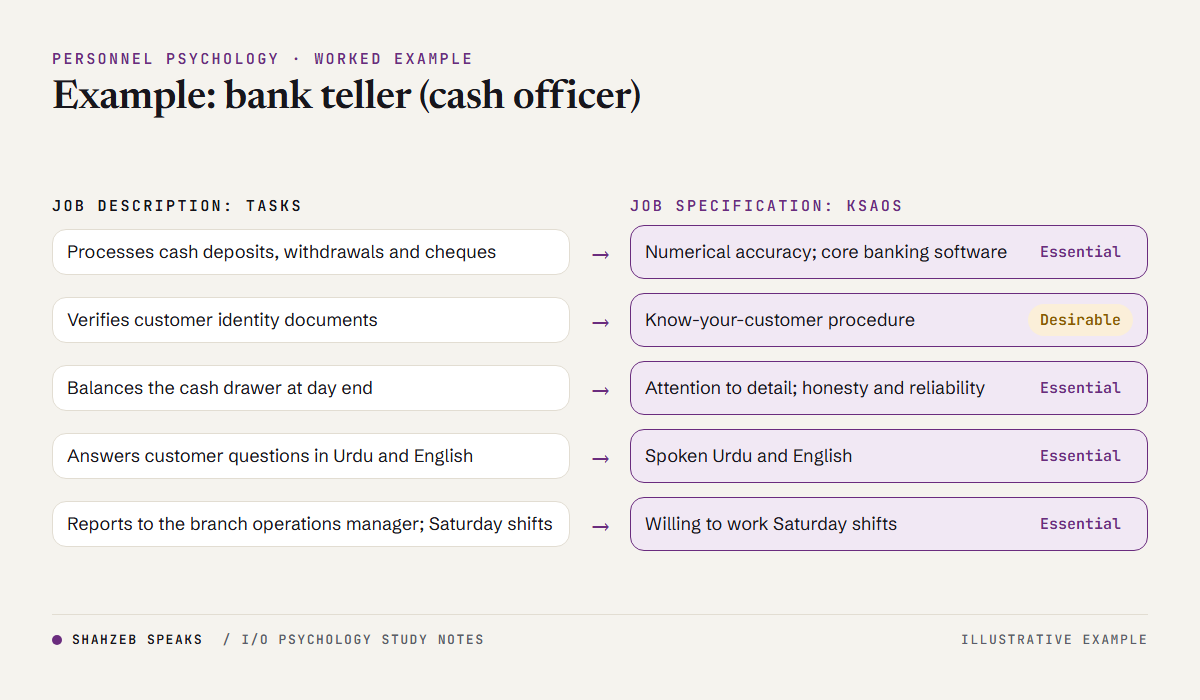
Worked example: a bank teller in a branch in Karachi
Here is a short, made-up example for a cash officer (teller) in a commercial bank branch. Notice how every item in the specification can be traced back to a task in the description.
| Job description (tasks) | Job specification (KSAOs) |
|---|---|
| Processes cash deposits, withdrawals and cheques at the counter | Numerical accuracy; skill with the bank’s core banking software (essential) |
| Verifies customer identity documents before transactions | Knowledge of the bank’s know-your-customer procedure (desirable: can be trained) |
| Balances the cash drawer at day end and reports differences | Attention to detail; honesty and reliability (essential) |
| Answers customer questions in Urdu and English | Spoken Urdu and English (essential); a regional language (desirable) |
| Reports to the branch operations manager; works 9 a.m. to 5 p.m. with Saturday shifts | Willing to work Saturday shifts (essential); bachelor’s degree (as set by the bank) |
How both come from job analysis
Job analysis is the process of collecting information about a job: interviews with job holders, observation, questionnaires, critical incidents and work diaries. Its results feed both documents. The task information becomes the job description; the human-requirement information becomes the job specification. The job analysis methods page explains each method.
The US O*NET database is organised the same way. Its Content Model has worker-oriented domains (Worker Characteristics, Worker Requirements, Experience Requirements) and job-oriented domains (Occupational Requirements, Occupation-Specific Information), plus a market domain (Workforce Characteristics). O*NET is a US Department of Labor resource; I mention it here only as a model of the structure.
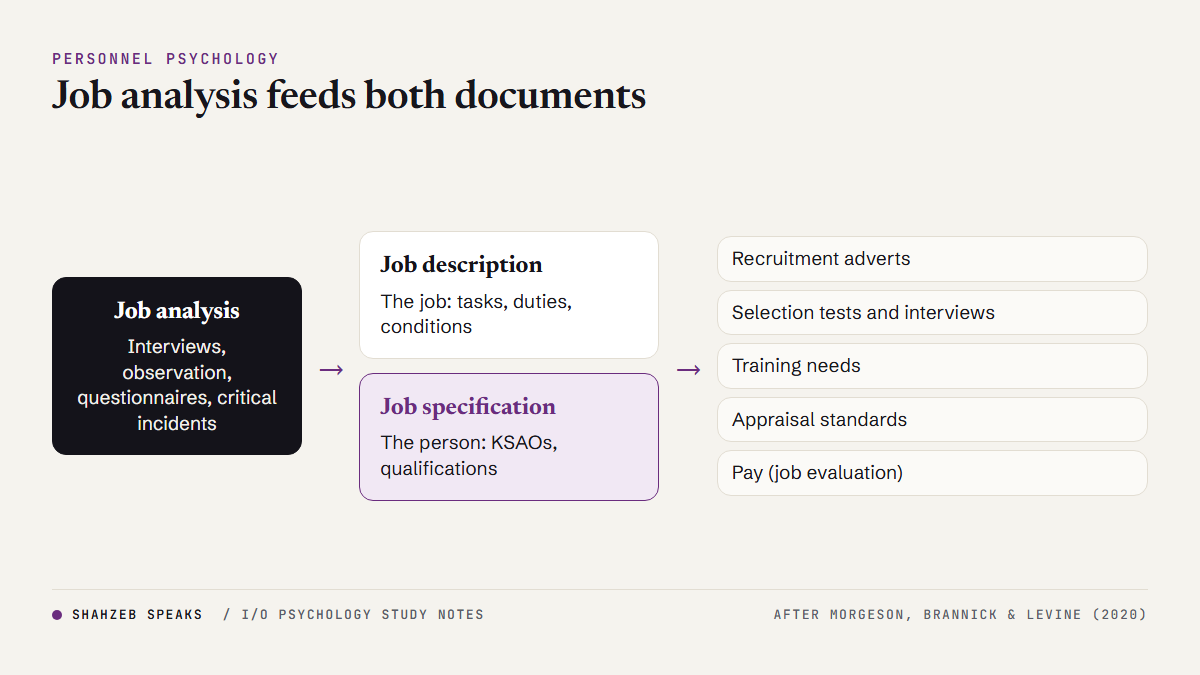
Once written, the two documents feed almost every other HR activity: recruitment adverts (see recruitment vs selection), selection tests and structured interviews, training needs analysis, and appraisal standards.
Why the two documents matter legally
Two US rules show why careful documents protect both the employer and the applicant:
- Under the Americans with Disabilities Act regulations (29 CFR 1630.2(n)(3)), evidence of whether a job function is “essential” includes “written job descriptions prepared before advertising or interviewing applicants for the job”. A vague or after-the-fact job description is weak evidence.
- The Uniform Guidelines on Employee Selection Procedures (29 CFR 1607.14) say that a content validity study “should” include a job analysis of the important work behaviours, and construct validity studies need one too. A selection test that is not linked to the job is hard to defend. The validity in employee selection page explains these study types.
Pakistan and India do not have identical rules, but the logic holds everywhere: if you reject someone for lacking a requirement, the requirement should come from the job.
Common mistakes students and HR teams make
- Putting worker traits in the job description. “Hard-working” is not a task. Move it to the specification, and make it measurable.
- Inflating qualifications. The Essex guide warns that a qualification that is unnecessary or too high for the post can deter good applicants and shrink the pool.
- Copying an old document. Jobs change; the guide calls the person specification a live document to review with the job description.
- Listing everything as essential. If every criterion is essential, the shortlist becomes arbitrary. Keep essential criteria to what is needed from day one.
10-mark answer structure: “Differentiate between job description and job specification”
- Define job analysis in one line, and say that both documents are its outputs.
- Define job description (the job: tasks, duties, conditions) with 4-5 components.
- Define job specification (the person: KSAOs, qualifications, experience), and mention the UK term “person specification” with essential and desirable criteria.
- Give a 5-6 row difference table (focus, contents, order, use, wording).
- Give a short example from one job, such as a bank teller or a hospital ward nurse.
- Explain their uses in recruitment, selection, training, appraisal and pay, and the legal reason (job-relatedness).
- Conclusion: the description comes first, and the specification must be traceable to it.
Model opening line: “Job description and job specification are the two written outputs of job analysis: the first describes the job, and the second describes the person who can perform it.”
Practice MCQs: job description vs job specification
Practice questions written to the usual HRM and I/O psychology syllabus.
-
Which item belongs in a job description rather than a job specification?
- Two years of sales experience
- Prepares the weekly stock report
- Ability to work under pressure
- Bachelor’s degree in commerce
Show answer
B. It is a task, written as an action. The other three are requirements of the person, so they go in the specification.
-
Both the job description and the job specification are outputs of:
- Job evaluation
- Job analysis
- Performance appraisal
- Job enrichment
Show answer
B. Job analysis collects the information. Job evaluation ranks jobs for pay, appraisal rates people, and enrichment redesigns jobs.
-
In the KSAO framework, “numerical reasoning” is best classed as:
- Knowledge
- Skill
- Ability
- Other characteristic
Show answer
C. An ability is a general, fairly stable capacity. Knowledge is facts, a skill is a learned capacity such as using software, and “other” covers traits, licences and similar.
-
A UK university advertises a post with a “person specification”. What is this?
- A job description
- The UK name for a job specification
- A performance appraisal form
- A job evaluation score
Show answer
B. It lists the criteria for the person, split into essential and desirable. It is not the task list, an appraisal form or a pay score.
-
Which of these is NOT usually part of a job description?
- Reporting relationships
- Working conditions
- Essential and desirable criteria for the candidate
- Main duties
Show answer
C. Essential and desirable criteria describe the person, so they belong in the specification. The other three describe the job.
-
A hospital lists “MBBS, valid registration, and 10 years’ experience” for a junior ward doctor post where 1 year is enough. What is the main risk?
- The job description becomes too short
- An inflated requirement shrinks the applicant pool and may be hard to justify
- It improves validity
- It removes the need for interviews
Show answer
B. Requirements should come from the job. Inflated requirements deter good applicants and are hard to defend; they do not improve validity or replace interviews.
-
Under the US ADA regulations, which document is listed as evidence that a function is essential?
- A job description written after the person was hired
- A written job description prepared before advertising or interviewing
- The applicant’s CV
- A reference letter
Show answer
B. 29 CFR 1630.2(n)(3) names job descriptions prepared before advertising or interviewing. A description written afterwards carries less weight, and CVs or references describe the person, not the job.
-
Which order is correct?
- Job specification, then job analysis, then job description
- Job analysis, then job description, then job specification
- Job description, then job analysis, then job specification
- Recruitment, then job analysis
Show answer
B. Analysis comes first, the task statement (description) next, and the person requirements (specification) are derived from it. Recruitment uses both, so it comes after.
-
A manager writes “must be a team player” in the duties list. What should an I/O psychologist advise?
- Keep it; it is a duty
- Move it to the specification and define it in observable terms
- Delete the duties list
- Replace it with a salary figure
Show answer
B. It is a worker characteristic, so it belongs in the specification, written as something you can assess (for example, “shares information with the shift team”).
Practise on your phone
The free I/O Psychology Prep app has 410 explained
questions, flashcards and an exam countdown, and works offline. Get it on Google Play
· About the app
Questions students ask
Is job specification part of job description?
Many organisations print both on one page, so it can look that way. Conceptually they are separate: the description covers the job, the specification covers the person. In exams, treat them as two outputs of job analysis.
What is the difference between job analysis, job description and job specification?
Job analysis is the process of studying a job. The job description and job specification are its two written products: the first records tasks and conditions, the second records the KSAOs and qualifications needed.
What is an example of a job specification?
For a bank teller: numerical accuracy, skill with core banking software, spoken Urdu and English, honesty and reliability, willingness to work Saturday shifts, and a bachelor’s degree if the bank requires one. Mark each as essential or desirable.
Who prepares the job description and job specification?
Usually the HR team with the line manager, using information from job holders and supervisors collected during job analysis. In larger organisations an I/O psychologist or job analyst may lead the process.
Is a person specification the same as a job specification?
Yes, in practice. “Person specification” is the common UK term, and it usually splits criteria into essential and desirable.
Why are job descriptions important in selection?
They tell you what to test for. Selection methods should measure the KSAOs that the tasks require, which is also what makes them valid and defensible.
Practise on your phone
The free I/O Psychology Prep app has 410 explained
questions, flashcards and an exam countdown, and works offline. Get it on Google Play
· About the app
References
- Morgeson, F. P., Brannick, M. T., & Levine, E. L. (2020). Job and work analysis: Methods, research, and applications for human resource management (3rd ed.). SAGE. https://doi.org/10.4135/9781071872536
- National Center for O*NET Development. (n.d.). The O*NET Content Model. https://www.onetcenter.org/content.html
- Equal Employment Opportunity Commission. (n.d.). Definitions, 29 C.F.R. § 1630.2(n). https://www.law.cornell.edu/cfr/text/29/1630.2
- Uniform Guidelines on Employee Selection Procedures. (1978). Technical standards for validity studies, 29 C.F.R. § 1607.14. https://www.law.cornell.edu/cfr/text/29/1607.14
- University of Essex, Human Resources. (2018). How to write a person specification. https://www.essex.ac.uk/-/media/documents/directories/human-resources/how-to-write-a-person-specification.pdf
Part of the Personnel Psychology Notes. Read next: Job analysis methods, Recruitment vs selection and Validity in employee selection. Before you turn a specification into interview questions, run them through the free interview question checker, which flags questions that are unlawful or risky in your country.