

A manager thanks the whole team in a meeting, and one person leaves feeling seen while another leaves feeling invisible — praised for work she did not do, while the work she did goes unmentioned. A company launches an “employee of the month” award, and within a quarter the award is a joke, the same faces rotate through it, and the quiet people who keep everything running stop trying. Employee recognition is one of the cheapest tools a manager has, and one of the easiest to get wrong — because what employees want is not more praise. It is praise that is true, specific, fair and close to the work itself.
This guide explains what employee recognition is in the research literature, what the evidence actually links it to, why it is suddenly in the news in October 2026, where the usual programmes backfire, and how to build a recognition habit that survives contact with a real team — without a points platform, and without pretending that a thank-you fixes pay, workload or a bad manager.
I am an Industrial and Organizational Psychologist based in Karachi. I have watched the same pattern repeat: an organisation buys a recognition platform, managers are told to “recognise more”, and nothing changes — because the recognition was generic, late, or handed out for the wrong things. Recognition is not a message. It is information: it tells a person what counted, who noticed, and whether the effort was worth repeating. When that information is missing or false, people do not always leave at once. They stop offering the extra effort first, and then, when the market allows, they go.
“A thank-you tells a person they were noticed. Recognition tells them what was noticed, why it mattered, and what to do again. Only the second kind changes behaviour.”
— Workplace Psychology Analysis, ShahzebSpeaks
⚡ Chapter 1: The short answer: employee recognition that works
Employee recognition is the acknowledgement of a person’s contribution at work — a behaviour, an effort, a result, or a quality of character — expressed in a way the recipient experiences as genuine. The research draws a sharp line between recognition and reward. A reward is usually tangible: money, a bonus, a gift. Recognition is usually social: attention, praise, acknowledgement, status. The two overlap — a bonus can carry recognition, and a public thank-you can feel like a reward — but they work through different mechanisms, and confusing them is the first mistake most programmes make.
The short answer to what works has four parts, and each is supported by evidence reviewed below. First, recognition must be specific: it names the behaviour and its effect, not just the person. Second, it must be close to the work: days, not quarters, after the event. Third, it must be fair: distributed by visible criteria, not by who is loudest or closest to the manager. Fourth, it must match the recipient: some people value public praise, others value a quiet word, time, learning, or a change in responsibility — and only about one in ten employees, in Gallup’s research as summarised by Workhuman, say someone at work has ever asked them how they like to be recognised. A programme that misses all four is not a weak version of recognition. It is a different thing: noise that teaches people their real work is not what gets noticed.
📈 Chapter 2: Why recognition is suddenly in the news
Two October 2026 surveys put recognition at the centre of the burnout conversation, and they point in usefully different directions. The first is solid. Aflac’s 2026–2027 WorkForces Report, conducted by Kantar among 2,001 employees and 1,000 employers in the United States in April and May 2026 and released on 13 October 2026, found an all-time high of 75% of employees experiencing workplace stress, up from 72% in 2025, and 39% saying they are experiencing burnout in their current roles — of whom 83% reported at least moderate burnout. The highest rate of at least moderate burnout was among Generation X (89%), followed by millennials (84%) and Generation Z (73%). Reporting on the same report put heavy workload first among stressors, cited by 34%, followed by long hours (26%) and insufficient salary (23%).
The second survey is weaker evidence and should be labelled as such. An Adecco Argentina survey, as reported on 24 October 2026 by the aggregator Adalytica — I could not locate the original Adecco release, so treat these figures as reported rather than confirmed — found 67% of workers feeling exhausted or burned out several times in the last month, 22% occasionally, and 11% never. The striking part is what workers blamed: lack of recognition or development was cited by 39%, ahead of workplace climate and relationships with managers and peers (38%), and far ahead of heavy workloads or tight deadlines (16%) and difficulty disconnecting after hours (7%). The contrast with Aflac is the point. In one survey, workload leads. In the other, feeling unrecognised and unable to grow leads. Both can be true at once: overload exhausts people, and invisibility makes the exhaustion feel pointless. For the wider evidence on how that exhaustion develops, see my guide to workplace burnout, and for why people stop speaking up long before they stop working, my guide to psychological safety at work.
🧩 Chapter 3: What recognition actually is — five pillars and four forms
Gallup and Workhuman, who have studied recognition jointly for several years, identify five pillars of what they call strategic recognition. Recognition is most effective when it is fulfilling, authentic, personalised, equitable and embedded in company culture. Fulfilling means the amount makes sense against expectations. Authentic means it is not a checklist exercise. Personalised means one size does not fit all — the form fits the person. Equitable means it is given fairly, without playing favourites. Embedded means it is integrated into day-to-day work, not bolted on at year-end. Most organisations fail on at least one pillar, and the research suggests the failure matters: employees receiving “great recognition” — the best experience across all pillars — were 20 times as likely to be engaged as employees receiving “poor recognition”, the worst across all pillars.
| Pillar (Gallup–Workhuman) | What it means | What failure looks like |
|---|---|---|
| Fulfilling | The amount and weight of recognition match expectations | A one-line email for a month of extra work |
| Authentic | Genuine, not a scripted or quota-driven gesture | The same praise, word for word, for everyone |
| Personalised | Fitted to how the individual likes to be recognised | Public praise for someone who hates the spotlight |
| Equitable | Given fairly, without favouritism | Only the visible, vocal team members ever win |
| Embedded | Part of everyday work, not an annual event | Silence for eleven months, then an awards dinner |
A second framework widens the lens. Brun and Dugas describe four forms of recognition at work, and a programme covering only one will miss most of what people value. Personal recognition acknowledges the person — care, respect, attention to who they are. Work-practice recognition acknowledges how the work is done — skill, creativity, quality of process. Dedication recognises effort and perseverance, including on work that failed. Results recognition rewards achievements and contributions. The diagnostic value is immediate: a sales team recognised only for results learns that effort on a lost deal counts for nothing; a support team recognised only for effort learns that outcomes do not matter. Check which forms your team ever sees, and the gaps will usually explain the cynicism. Herzberg’s classic two-factor theory makes the same point from another angle: recognition is a motivator, distinct from hygiene factors such as pay and working conditions. It can raise satisfaction, but it cannot compensate for hygiene factors that are broken — a distinction Chapter 6 returns to.
📊 Chapter 4: What the evidence actually shows
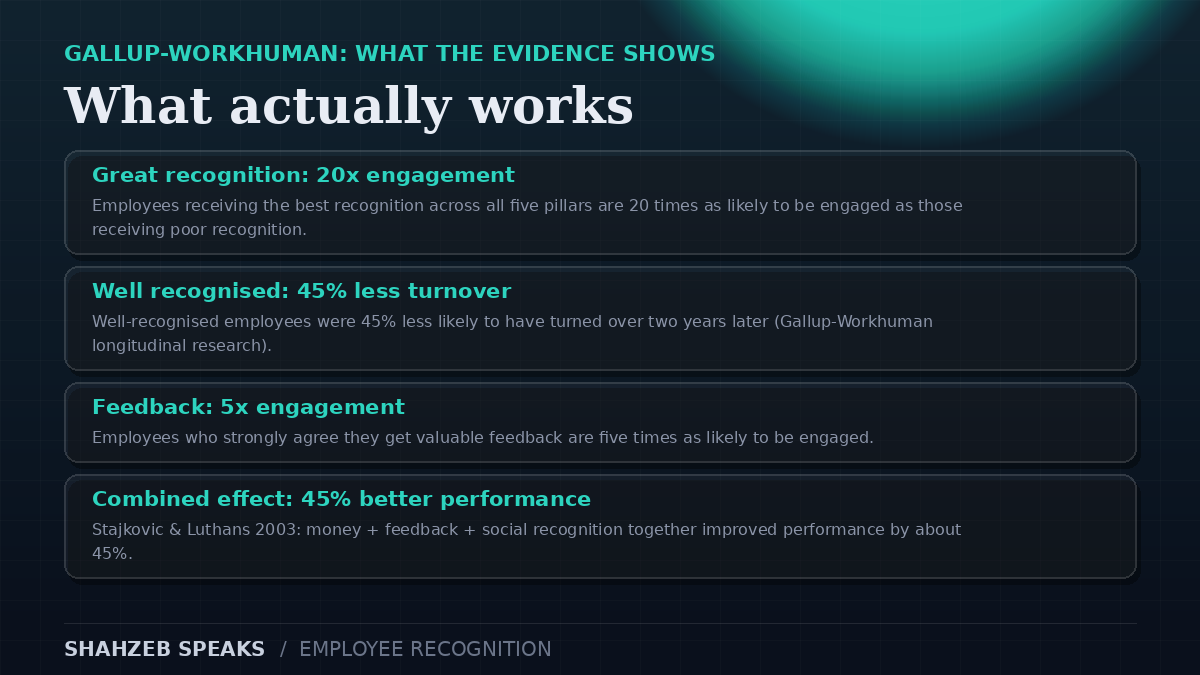
The strongest experimental-style evidence comes from a meta-analysis by Stajkovic and Luthans (2003), published in Personnel Psychology, covering 72 behavioural management studies in organisations. Money, feedback and social recognition each had a significant effect on task performance on their own, with an overall average effect size of d = 0.47, equivalent to about a 16% improvement in performance. The most interesting finding was the combination: used together, the three reinforcers produced the strongest effect — a synergistic result, greater than the sum of the parts. In the authors’ own later summary, social recognition alone produced about a 17% improvement, while the combination of money, feedback and social recognition produced about a 45% improvement. There is also a warning inside the same finding: recognition combined with money alone, without feedback, produced the weakest effect of the combinations — weaker than either alone. The mechanism the authors propose explains why: money fosters effort, feedback clarifies the task, and social recognition signals that the outcome is valued and predicts future outcomes. Remove the feedback — the information about what was good — and the money plus praise reads as buying approval rather than recognising work.
| Evidence | Finding | How to read it |
|---|---|---|
| Stajkovic & Luthans 2003 (72 studies) | Overall d = 0.47, about 16% performance improvement | Behavioural interventions in real organisations, not lab games |
| Money + feedback + recognition combined | About 45% improvement (authors’ summary) | Synergy, not addition — feedback is the ingredient that makes praise informative |
| Gallup–Workhuman longitudinal research | Well-recognised employees 45% less likely to have turned over two years later | Longitudinal association, not proof that recognition alone caused retention |
| Gallup–Workhuman culture finding | Recognition as important part of culture: 3.7x engagement, about half as likely frequent burnout | Culture-level association; engaged workplaces also recognise more |
| Gallup–Workhuman pillar comparison | Great recognition 20x engagement vs poor recognition | A contrast between extremes — most teams sit in between |
The survey evidence points the same way but needs the same honesty about its limits. Gallup and Workhuman’s longitudinal research found well-recognised employees 45% less likely to have turned over two years later, and employees who strongly agree they get valuable feedback from the people they work with five times as likely to be engaged. Employees who strongly agree that recognition is an important part of their organisation’s culture were 3.7 times as likely to be engaged and about half as likely to experience frequent burnout. These are associations from survey research, not controlled experiments: workplaces that recognise well also tend to manage well in other ways, and engaged employees may also notice recognition more. The meta-analysis is the better evidence for performance; the surveys are the better evidence for scale and retention. Together they support a moderate claim: recognition done well is associated with meaningfully better engagement and retention, and in controlled behavioural studies it improves task performance — especially when paired with feedback and fair pay, not when used as a substitute for either. One measurement detail is worth knowing: Gallup’s engagement survey asks whether, in the last seven days, the employee received recognition or praise for doing good work. Weekly recognition is the unit the research treats as normal, not annual recognition.
🚫 Chapter 5: Where recognition backfires
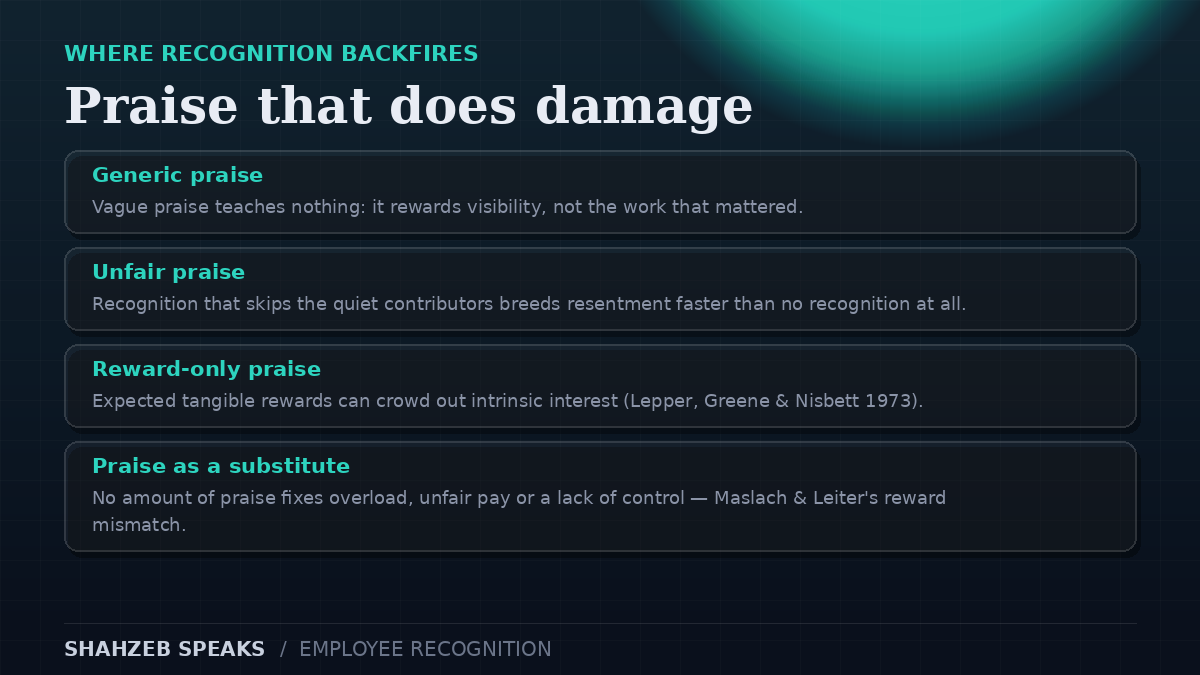
First, generic praise. “Great job, team” after a project tells nobody what was good, so nobody knows what to repeat — and the people who carried the work hear that their contribution is indistinguishable from everyone else’s. Generic praise also fails the authenticity test: when the same words go to everyone, they mean nothing to anyone. Second, favouritism, real or perceived. Recognition systems reliably drift towards the visible: the presenter, not the analyst; the person in the office, not the remote worker; the extrovert, not the quiet specialist. Once employees believe the system rewards visibility rather than contribution, the system does not merely stop working — it actively teaches people to perform visibility instead of work. Equity is not a fairness nicety here. It is the mechanism.
Third, public praise for people who do not want it. Personalisation is not a courtesy; it is a condition. For some employees, being singled out in a meeting is embarrassing, not rewarding, and the manager who insists on public praise for everyone is recognising their own preferences, not the employee’s. Asking how someone likes to be recognised — something only about one in ten employees in Gallup’s research, as summarised by Workhuman, say has ever happened to them — is the cheapest fix in this entire guide. Fourth, rewards that crowd out meaning. The classic overjustification effect, from Lepper, Greene and Nisbett (1973), shows that expected tangible rewards can reduce intrinsic interest in an activity: when people start doing something for the prize, the activity itself can feel less worth doing once the prize stops. Self-determination theory, from Deci and Ryan, explains the mechanism: rewards experienced as controlling undermine autonomy and competence, the very needs that make work feel worth doing. A bonus scheme that turns a craft into a points chase can therefore reduce exactly the motivation it was meant to buy. Fifth, recognition for the wrong behaviour. Reward speed and you get rushed work; reward hours and you get presenteeism; reward only results and you get corner-cutting. Every recognition system is also a statement of what the organisation actually values, whatever its values page says. Audit what got recognised last quarter, and you will learn what your team believes you value.
🔧 Chapter 6: Recognition is not a substitute for the basics
Maslach and Leiter’s areas-of-worklife model gives recognition its proper place. Burnout, in their framework, grows from mismatches between person and job in six areas: workload, control, reward, community, fairness and values. Recognition sits inside the reward area — and a mismatch there means insufficient recognition and reward for the work. But it is one area of six. A team drowning in workload, with no control over how work is done, managed unfairly, and asked to serve values it does not share, will not be saved by a better thank-you. The Adecco figures, reported rather than confirmed, make the same point from the other side: workers cited recognition and development together, as one complaint — feeling unseen and feeling stuck. Recognition without development is a pat on the back on a dead-end road.
The practical rule follows: fix the gates before polishing the praise. Pay must be fair for the role and the market — recognition layered over underpayment reads as manipulation, and employees are right to read it that way. Workload must be survivable — praise for heroic overwork teaches overwork. Process must be fair — recognition handed out by an unfair manager is experienced as favouritism. And the manager must be competent at feedback, because recognition without feedback is, as the meta-analysis showed, the weakest combination. For how broken feedback systems damage trust on their own, see my guide to why performance reviews fail. Recognition is a multiplier of a decent job. Multiplied by zero, it is still zero.
✅ Chapter 7: A playbook for recognition that works
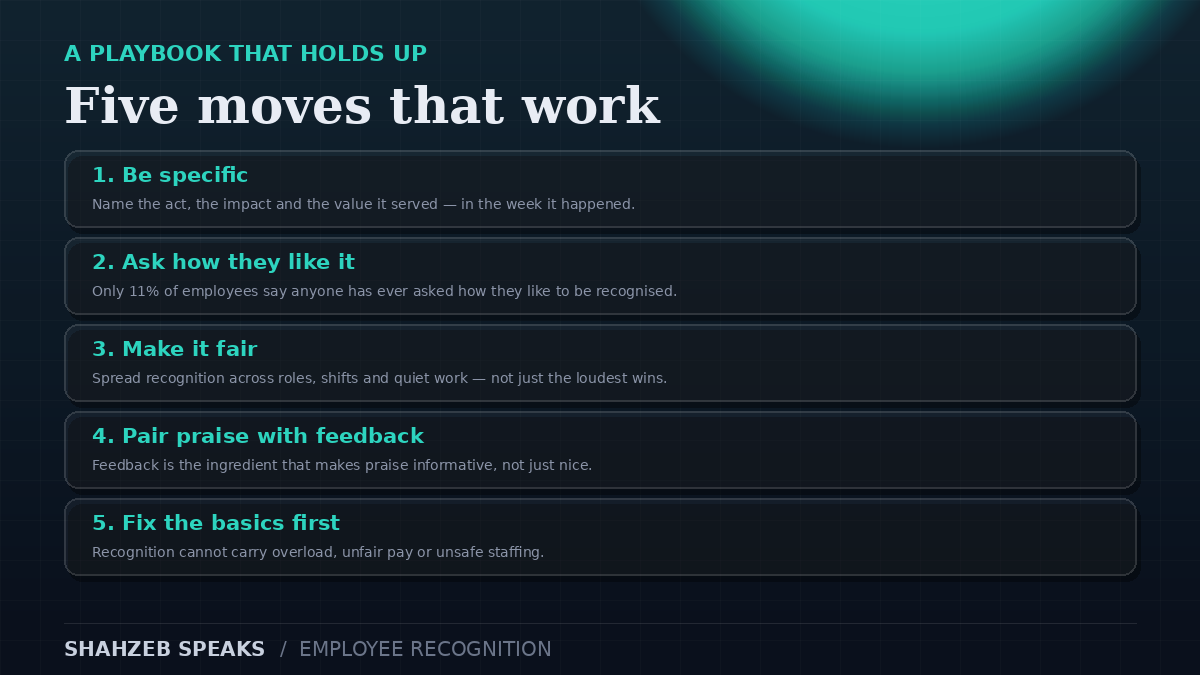
1. Name the behaviour and its effect. “Your rewrite of the onboarding document cut new-starter questions in the first week, and two managers mentioned it unprompted” is recognition. “Great work” is noise. The formula is simple: what they did, what changed because of it, and who noticed. 2. Give it close to the work. Weekly beats quarterly by an order of magnitude, because the link between behaviour and acknowledgement is what teaches. Build a small weekly habit — one specific recognition per team member per week is a realistic target for most managers, and far more valuable than an annual ceremony. 3. Ask how they like it. One question, asked once and remembered: “When you do good work, how do you like it to be acknowledged?” Record the answer. Public, private, written, spoken, time off, learning, responsibility — the menu is wider than a trophy cabinet. 4. Spread it by criteria, not by memory. At the end of each month, list who was recognised and for what. If the same names recur and whole roles never appear, your system has a visibility bias. Fix the criteria, not the ceremony: recognise effort, process and results, not only results. 5. Pair every recognition with feedback and, where fair, with money. The meta-analysis is clear that the combination outperforms any single lever. Praise tells a person they matter; feedback tells them what to repeat; fair pay tells them the organisation means it. Remove any one leg and the stool wobbles.
🚪 Chapter 8: When recognition cannot fix the job
Not every recognition problem can be solved with better praise. Some jobs are structured so that contribution is invisible by design: the compliance officer whose success is an absence of incidents, the carer whose work is intimate and unrecorded, the maintainer whose best outcome is that nothing breaks. In those roles, recognition systems built around visible wins will always misfire, and the honest fix is structural — different measures, different criteria, and managers who understand the work well enough to see it. Some organisations, meanwhile, use recognition language precisely to avoid paying for the work or fixing the workload. In those cases the research supports a different conclusion: cynicism about recognition is not ingratitude. It is accurate pattern recognition by employees who have learned that praise arrives exactly when a pay rise or a staffing request is refused.
The question to ask before redesigning a recognition programme is specific: is the problem that good work goes unnoticed, or that it goes unrewarded, unsupported, or unmeasured? Unnoticed work needs better observation — managers closer to the work, peer nomination, and criteria covering effort and process as well as results. Unrewarded work needs pay and progression decisions, not praise. Unsupported work needs staffing, tools and time. Unmeasured work needs new measures. Recognition fixes the first problem well, helps the second slightly, and fixes the last two not at all. A manager who can tell those four apart will waste far less goodwill than one who answers every retention problem with a louder thank-you. And an employee deciding whether to stay should ask the same question in reverse: if the praise stopped tomorrow, would anything else about this job still be worth it? If the answer is no, the problem was never recognition.
❓ Questions I am asked most often
What is employee recognition, exactly?
It is the acknowledgement of a person’s contribution at work — a behaviour, an effort, a result, or a quality of character — expressed so the recipient experiences it as genuine. It differs from reward: rewards are usually tangible, like money or gifts, while recognition is usually social, like praise, attention and status.
Does recognition really affect retention?
The association is strong. Gallup and Workhuman’s longitudinal research found well-recognised employees 45% less likely to have turned over two years later. That is an association, not proof of causation — well-run workplaces tend to recognise well and retain well — but the direction and size are consistent across their studies.
How often should managers recognise good work?
Weekly, in small and specific doses, rather than annually in large ones. Gallup’s own engagement survey asks about recognition in the last seven days, which reflects how the research treats frequency: close to the work, so the link between behaviour and acknowledgement stays visible and teachable.
Is public praise always better than private praise?
No. Personalisation is one of Gallup and Workhuman’s five pillars precisely because preferences differ. Some people value public acknowledgement; others find it embarrassing and prefer a quiet word, a written note, time, or learning. Asking each person how they like to be recognised is the simplest fix available.
Can recognition replace a pay rise?
No. The meta-analysis evidence shows recognition works best combined with feedback and fair pay, and recognition plus money without feedback was the weakest combination tested. Praise layered over underpayment is usually read as manipulation, and employees are generally right to read it that way.
What should I do if my own work is never recognised?
First, check whether the problem is visibility or value: make the work and its effect visible in a brief, factual update to your manager. Second, ask directly how your contribution is viewed. If good work is consistently ignored while others are praised, that is information about the manager and the system — and worth weighing alongside pay, growth and workload in any decision to stay.
📬 Want help building recognition that actually works in your organisation?
If your team hears plenty of praise and still loses good people, I can review which pillar of recognition is failing in your roles — and which change to the work itself, not the messaging, would fix it.
For context on the field behind this work, my writing on industrial psychology in Pakistan explains what an I/O psychologist actually does.
Sources
- Aflac (2026). 2026–2027 Aflac WorkForces Report (conducted by Kantar; 2,001 employees and 1,000 employers, United States, April–May 2026). Press release, 13 October 2026, PR Newswire.
- Adecco Argentina survey (2026), as reported 24 October 2026 by Adalytica. Original Adecco release not located; figures used as reported only.
- Brun, J.-P., & Dugas, N. (2008). An analysis of employee recognition: Perspectives on human resources practices. International Journal of Human Resource Management, 19(4), 716–730.
- Deci, E. L., & Ryan, R. M. (2000). The “what” and “why” of goal pursuits: Human needs and the self-determination of behavior. Psychological Inquiry, 11(4), 227–268.
- Gallup & Workhuman (2023). Empowering Workplace Culture Through Recognition.
- Gallup & Workhuman. Recognition in the Workplace research hub (45% retention finding; five-times feedback finding).
- Herzberg, F., Mausner, B., & Snyderman, B. (1959). The Motivation to Work. Wiley.
- Lepper, M. R., Greene, D., & Nisbett, R. E. (1973). Undermining children’s intrinsic interest with extrinsic reward. Journal of Personality and Social Psychology, 28(1), 129–137.
- Maslach, C., & Leiter, M. P. (2016). Understanding the burnout experience: Recent research and its implications for psychiatry. World Psychiatry, 15(2), 103–111.
- Stajkovic, A. D., & Luthans, F. (2003). Behavioral management and task performance in organizations: Conceptual background, meta-analysis, and test of alternative models. Personnel Psychology, 56(1), 155–194.
- Tilo, D. (2026). Workplace stress hits all-time high in 2026. Human Resources Director, 14 October 2026 (reporting on the Aflac report).