
To become an I/O psychologist you need a psychology degree and then a master’s in industrial-organizational (or occupational) psychology. After that the rules depend on the country: the UK needs BPS Stage 2 training and HCPC registration, South Africa needs HPCSA registration with a 12-month internship and a board exam, and most US states license only doctoral graduates.
This guide is for students choosing their next degree, writing a career plan for an assignment, or preparing for an admission interview. It covers the United States, the United Kingdom, South Africa, the Philippines, India, Pakistan and, briefly, Canada. For each country I checked the regulator’s own website or the law itself on 3 November 2026, and I say where I could not.
One idea runs through the whole page. “I/O psychologist” can mean two things: a person trained in the field, or a person legally allowed to use a protected title. In some countries these are the same. In others, such as India and Pakistan, there is no protected I/O title at all, and your degree, skills and job title do the work.
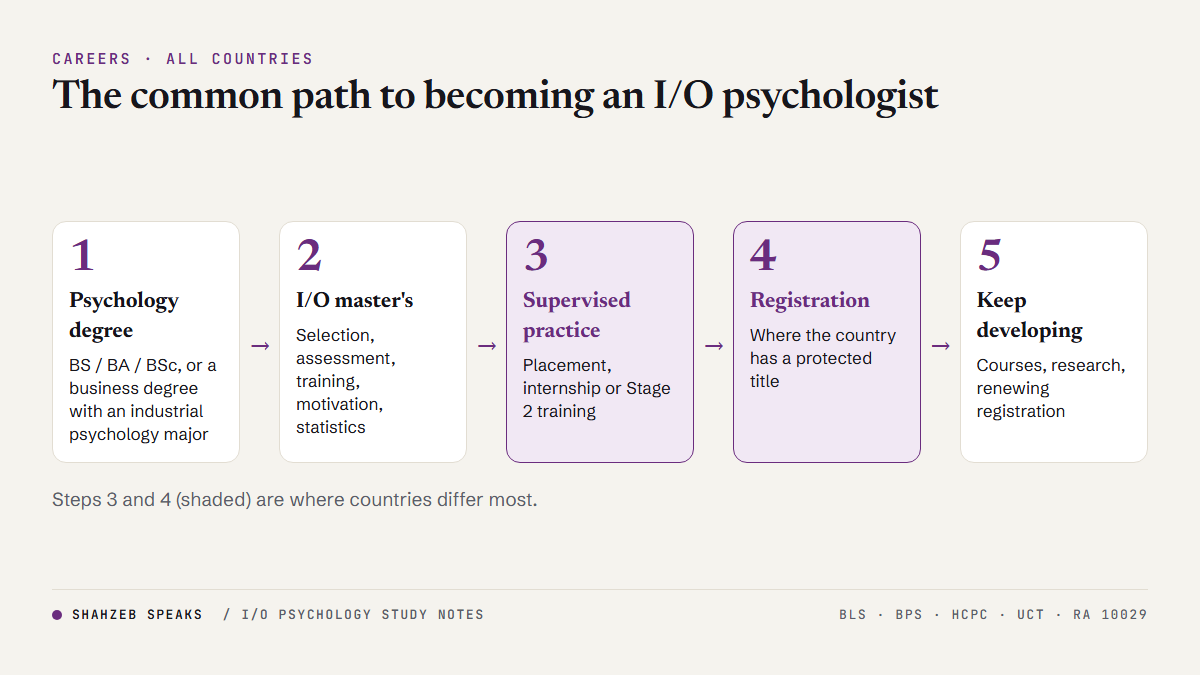
The common path in every country
The order of steps is almost the same everywhere:
- A first degree in psychology (or, in some countries, a business degree with an industrial psychology major).
- A master’s in industrial-organizational or occupational psychology. This is where you study selection, assessment, training, motivation, leadership, statistics and research design.
- Supervised practice. A placement, internship or structured training under a qualified psychologist.
- Registration or a licence, where the country has one.
- Continuing development: courses, research and keeping your registration current.
Country by country: the comparison table
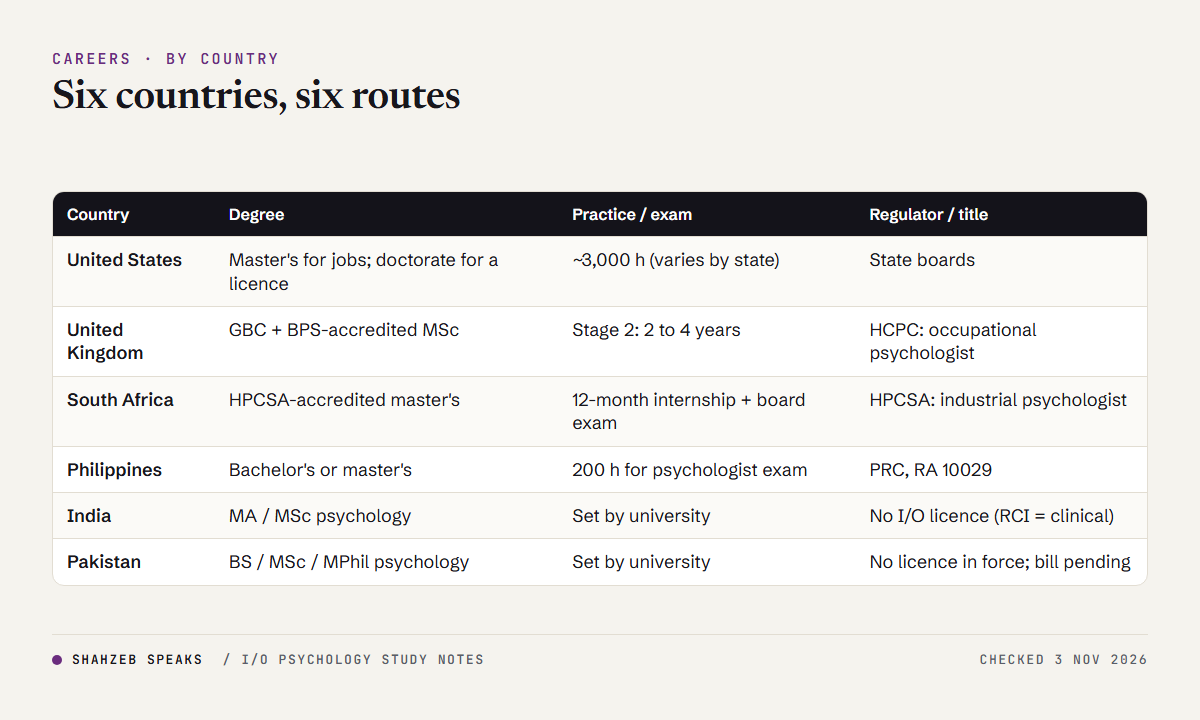
| Country | Degree needed | Supervised practice | Exam | Regulator and title |
|---|---|---|---|---|
| United States | Master’s is typical for I/O jobs; a doctorate for a state licence | Often around 3,000 hours for licensure (varies by state) | EPPP plus a state law and ethics exam, if you seek a licence | State boards; “psychologist” is restricted in most states |
| United Kingdom | BPS Graduate Basis for Chartered membership, then a BPS-accredited MSc in occupational psychology | Qualification in Occupational Psychology (Stage 2), 2 to 4 years | Assessed portfolio (no single national exam) | HCPC; “occupational psychologist” is protected |
| South Africa | HPCSA-accredited professional master’s in industrial psychology | 12-month HPCSA-approved internship | National Examination of the Professional Board for Psychology | HPCSA; registered “industrial psychologist” |
| Philippines | Bachelor’s (psychometrician) or master’s (psychologist) in psychology | At least 200 hours for the psychologist exam | PRC board exams for each licence | PRC Board of Psychology under RA 10029 |
| India | MA/MSc in psychology with an I/O or organisational focus | Set by the university | None for I/O | No I/O licence; RCI registers clinical psychologists |
| Pakistan | BS/MSc/MPhil in psychology, ideally with an I/O focus | Set by the university (internship or thesis) | None | No national psychologist licence in force (a council bill is pending) |
United States: master’s, PhD and the licence question
The US Bureau of Labor Statistics says industrial-organizational psychologists “typically need a master’s degree”, and that these programmes cover statistics, research design and workplace topics. Most I/O jobs in companies and consulting firms are open to master’s graduates.
A licence is a separate question. The Society for Industrial and Organizational Psychology (SIOP) explains that rules differ by state. In some states only health services (assessment, diagnosis, counselling or therapy) need a licence; others name I/O activities in their laws. Many states also have titling laws, so you may not call yourself a “psychologist” without a licence, although you can say you hold an advanced I/O degree. SIOP also notes that currently only graduates of doctoral psychology programmes meet states’ education requirements. Licensure usually also needs supervised experience (often around 3,000 hours), the Examination for Professional Practice in Psychology (EPPP) and a state jurisprudence and ethics exam.
So the practical choice is this: a master’s if you want to work in organisations, a PhD if you want research, university teaching, or a licence in a state that requires one for your work.
United Kingdom: BPS Stage 2 and HCPC registration
In the UK the field is called occupational psychology, and “occupational psychologist” is one of nine titles protected by the Health and Care Professions Council (HCPC). The HCPC says that the title “psychologist”, on its own, is not protected by law. Using “occupational psychologist” without HCPC registration is not allowed.
The route, from the British Psychological Society (BPS):
- Gain the Graduate Basis for Chartered membership (GBC), through a BPS-accredited psychology degree or conversion course.
- Complete a BPS-accredited MSc in occupational psychology.
- Complete the Qualification in Occupational Psychology (Stage 2). It takes 2, 3 or 4 years, you work in a paid or voluntary placement, and a Co-ordinating Supervisor who is a Chartered Psychologist and a registered occupational psychologist oversees you. The BPS calls it a doctoral-level qualification.
- Stage 2 makes you eligible for Chartered membership of the BPS and to apply for HCPC registration.
South Africa: HPCSA registration as an industrial psychologist
South Africa regulates “industrial psychologist” as a registration category of the Health Professions Council of South Africa (HPCSA), through its Professional Board for Psychology. The HPCSA website did not load for my tools, so the steps below come from the University of Cape Town’s guidance, which matches Stellenbosch University’s:
- An undergraduate degree majoring in industrial or organisational psychology, then an honours degree in the field.
- An HPCSA-accredited professional master’s. You register with the HPCSA as a student psychologist (UCT says within four months of starting).
- Register as an intern psychologist and complete a supervised, HPCSA-approved 12-month internship.
- Pass the National Examination of the Professional Board for Psychology.
Stellenbosch also describes a separate psychometrist route (a BPsych equivalent programme, a six-month internship and the board exam). Rules change, so confirm the current forms with the HPCSA before you apply.
Philippines: psychometrician vs psychologist under RA 10029
The Philippine Psychology Act (Republic Act No. 10029, approved 16 March 2010) creates two licences, both examined by the Professional Regulation Commission (PRC):
- Psychometrician: needs at least a bachelor’s degree in psychology to sit the exam. A psychometrician may administer and score objective and structured tests, interpret results, write reports and conduct intake interviews, but not projective or higher-level tests, and the law says this work must at all times be supervised by a licensed psychologist.
- Psychologist: needs at least a master’s degree in psychology and a minimum of 200 hours of supervised practicum, internship or clinical experience before the exam.
The PRC’s own psychometrician primer lists “business and industry as part of the HR Management team” among the places psychometricians work, always under a psychologist’s supervision. So a bachelor’s graduate can start in HR assessment with the psychometrician licence, then take a master’s in industrial or organisational psychology and the supervised hours needed for the psychologist exam. For exam preparation, see the psychometrician reviewer.
India: no I/O licence, and why RCI is not the answer
India has no licence for industrial-organizational psychologists. The Rehabilitation Council of India (RCI) registers clinical psychologists on its Central Rehabilitation Register, which is why clinical job ads ask for an RCI number. That registration is not needed for I/O work.
The National Commission for Allied and Healthcare Professions Act, 2021 (Act No. 14 of 2021) lists “Psychologist (Except Clinical Psychologist covered under RCI for PWD)” among the behavioural health professions in its Schedule. Watch for registration rules under that Act, but as of now an Indian I/O career is built on an MA or MSc in psychology with an organisational focus, a strong internship, and skills in assessment and data analysis. Many students also prepare for UGC NET if they want to teach; see the UGC NET I/O notes.
Pakistan: degrees, skills and the pending council bill
Pakistan has no national licence for psychologists in force that I could confirm. A Pakistan Psychological Council Bill, 2025 was introduced in the Senate by Senator Kamran Murtaza on 1 December 2025. On 17 June 2026 the Senate extended the time for the Standing Committee on Law and Justice to report on it by 60 days from 29 June 2026 (Senate debates, 362nd session). Earlier bills on the same idea did not become law, so check the Senate’s records before you rely on any news.
In practice, Pakistani I/O graduates hold a BS, MSc or MPhil in psychology and work under HR titles: talent acquisition, assessment, training and organisational development. My page on the scope of industrial psychology in Pakistan counts the actual job ads, and the psychometric tests for jobs in Pakistan page shows where assessment skills are used.
Canada, briefly
Psychology in Canada is regulated by each province. In Ontario, for example, you need a certificate of registration from the College of Psychologists and Behaviour Analysts of Ontario to practise psychology. Many I/O graduates work in HR and consulting roles that do not use the regulated title. Check your own province’s college.
How long does it take?
I give only the parts I could verify. The UK Stage 2 qualification alone takes two to four years after the MSc. South Africa’s internship adds 12 months after (or, at some universities, inside) the master’s. The Philippine psychologist exam needs a master’s plus at least 200 supervised hours. US licensure needs a doctorate and supervised hours that vary by state. Degree lengths differ by university, so read the programme page of each one you apply to.
“Why do you want to study I/O psychology?”
- Start with a specific moment: a workplace problem you saw (a high-turnover call centre, an unfair promotion, a weak interview process).
- Name the I/O idea that explains it: job analysis, selection validity, motivation or fairness.
- Show you know what the work involves: data, tests, surveys and statistics, not only “helping people”.
- Say what you want to do after the degree, and in which country and job title.
- Link it to the programme: a module, a supervisor’s research or a placement it offers.
Model opening line: “In my internship at a bank branch, three of the five new tellers left within six months, and nobody had looked at how they were selected. I want to learn how to build selection and training systems that are fair and actually predict performance.”
Practice MCQs: becoming an I/O psychologist
Practice questions written for this page from the sources listed below.
-
Which UK body keeps the register that allows someone to use the title “occupational psychologist”?
- British Psychological Society
- Health and Care Professions Council
- Chartered Institute of Personnel and Development
- Department for Education
Show answer
B. The HCPC protects the title. The BPS awards Chartered membership and runs Stage 2, but it is not the statutory register. The other two do not regulate psychologists.
-
Under RA 10029 in the Philippines, which statement about psychometricians is correct?
- They may administer projective tests alone
- They need a master’s degree to take the exam
- Their work must be supervised by a licensed psychologist
- They are licensed by the Rehabilitation Council
Show answer
C. The Act requires supervision by a licensed psychologist. Projective tests are excluded, the exam needs a bachelor’s, and the PRC (not a rehabilitation council) licenses them.
-
How long is the HPCSA-approved internship for an industrial psychologist in South Africa?
- 6 months
- 12 months
- 200 hours
- 3,000 hours
Show answer
B. Twelve months. Six months is the psychometrist internship, 200 hours is the Philippine psychologist requirement, and about 3,000 hours is a common US licensure figure.
-
According to SIOP, which graduates currently meet US states’ educational requirements for a psychologist licence?
- Bachelor’s graduates
- Master’s graduates
- Doctoral psychology graduates
- Anyone with an HR certificate
Show answer
C. Only doctoral graduates meet the education requirement. A master’s is enough for many I/O jobs, but not for a licence.
-
Sana has an MSc in psychology from Karachi and wants to work in employee selection in Pakistan. Which statement is true?
- She must pass a national psychologist licensing exam first
- She must register with RCI
- No national psychologist licence is in force; her degree and skills carry her
- She must complete BPS Stage 2
Show answer
C. A council bill is pending, but no national licence is in force. RCI is Indian, and BPS Stage 2 is a UK route.
-
Which of these is NOT a step in the UK route to occupational psychologist?
- Graduate Basis for Chartered membership
- BPS-accredited MSc in occupational psychology
- Qualification in Occupational Psychology (Stage 2)
- A 12-month HPCSA internship
Show answer
D. The HPCSA internship belongs to South Africa. The other three are the BPS steps that lead to HCPC registration.
-
In India, an RCI registration number is mainly needed for which role?
- Industrial-organizational psychologist
- Clinical psychologist
- HR business partner
- Management consultant
Show answer
B. RCI registers clinical psychologists on the Central Rehabilitation Register. There is no RCI licence for I/O, HR or consulting roles.
-
The HCPC says the word “psychologist” on its own is:
- Protected in all cases
- Not protected by law
- Protected only for Chartered members
- Protected only in Scotland
Show answer
B. Only the nine specific titles, such as “occupational psychologist”, are protected. “Chartered Psychologist” is a BPS membership grade, not an HCPC title.
-
What does BLS say is the typical entry education for US I/O psychologists?
- A bachelor’s degree
- A master’s degree
- A medical degree
- A doctorate in all cases
Show answer
B. BLS says I/O psychologists typically need a master’s. A doctorate is needed for licensure and most academic jobs, not for every role.
Practise on your phone
The free I/O Psychology Prep app has 410 explained
questions, flashcards and an exam countdown, and works offline. Get it on Google Play
· About the app
Questions students ask
How do I become an industrial psychologist in South Africa?
Complete an industrial psychology major and honours, then an HPCSA-accredited professional master’s while registered as a student psychologist. Next, register as an intern and complete a 12-month HPCSA-approved internship, then pass the Professional Board for Psychology’s National Examination.
Can I become an I/O psychologist with only a master’s?
Yes, in most countries you can do I/O work with a master’s. In the US you usually cannot use the title “psychologist” in states with titling laws unless you are licensed, and a licence needs a doctorate. In the UK you also need Stage 2 and HCPC registration to use “occupational psychologist”.
How do I become an I/O psychologist in India?
Take a BA or BSc in psychology, then an MA or MSc with an organisational or I/O focus, and build internship experience in assessment, training or HR analytics. There is no separate I/O licence, and RCI registration applies to clinical psychologists.
Do I need a licence to be an I/O psychologist in the Philippines?
To call yourself a psychologist or psychometrician, yes: RA 10029 requires a PRC licence. Many HR roles that use I/O skills do not require the licence, but the psychometrician licence is widely asked for in testing and assessment jobs.
Is there a licence for psychologists in Pakistan?
Not yet, as far as I could confirm on 3 November 2026. The Pakistan Psychological Council Bill, 2025 was still with the Senate’s law and justice committee in June 2026. Until a law passes, employers judge you on your degree, HEC-recognised university and skills.
Is a PhD worth it for I/O psychology?
A PhD is worth it if you want university teaching, research or a US licence. For most company roles a master’s is the usual entry level. The honest worth-it guide compares the two with salary survey data.
Practise on your phone
The free I/O Psychology Prep app has 410 explained
questions, flashcards and an exam countdown, and works offline. Get it on Google Play
· About the app
References
- U.S. Bureau of Labor Statistics. (2026). Psychologists: How to become one. Occupational Outlook Handbook. https://www.bls.gov/ooh/life-physical-and-social-science/psychologists.htm
- Society for Industrial and Organizational Psychology. (n.d.). Licensure for I-O psychologists. https://www.siop.org/Membership/Licensure-for-I-O-Psychologists
- British Psychological Society. (n.d.). Qualification in Occupational Psychology (Stage 2). https://www.bps.org.uk/qualification-occupational-psychology
- Health and Care Professions Council. (2023, January 16). Understanding the regulation of psychologists. https://www.hcpc-uk.org/news-and-events/blog/2023/understanding-the-regulation-of-psychologists/
- University of Cape Town, Faculty of Commerce. (n.d.). How do you become an industrial-organisational psychologist? https://commerce.uct.ac.za/node/126645
- Stellenbosch University, Department of Industrial Psychology. (n.d.). Professional bodies and internships. https://www.su.ac.za/en/node/11723
- Professional Regulation Commission. (n.d.). Psychometrician [career primer]. https://www.prc.gov.ph/sites/default/files/Psychometrician_PRIMER.pdf
- Republic Act No. 10029: Philippine Psychology Act of 2009. (2010). Approved 16 March 2010. https://lawphil.net/statutes/repacts/ra2010/ra_10029_2010.html
- The National Commission for Allied and Healthcare Professions Act, 2021 (Act No. 14 of 2021), Schedule. Government of India. https://www.indiacode.nic.in/handle/123456789/16824
- Senate of Pakistan. (2026, June 17). Debates, official report, 362nd session, Vol. XVII No. 05 (motion on the Pakistan Psychological Council Bill, 2025). https://senate.gov.pk/uploads/documents/debates/1782710053_324.pdf
Part of the I/O Psychology Study Guide. Read next: I/O psychology salary by country, Is I/O psychology worth it?, best books for I/O psychology and my homepage on industrial psychology in Pakistan.