Amazon Psychology Audit — The $638 Billion Habit Machine
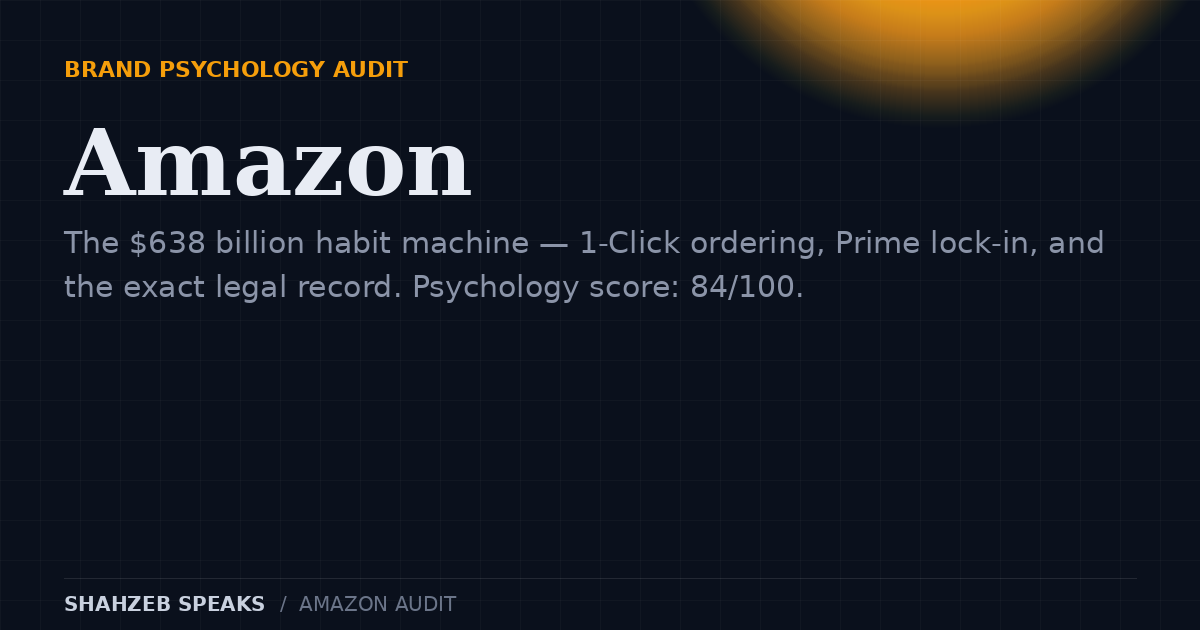
Amazon turned buying into habit: 1-Click ordering, a $139 Prime subscription, and social proof at planetary scale built $638B in FY2024 sales. This psychology audit examines the twelve documented mechanisms — and carries the brand's full legal record at its exact status, including a $2.5B FTC settlement.

84 / 100
Overall consumer behavior effectiveness
Brand Overview
- Brand nameAmazon
- Founded1994
- HeadquartersSeattle, Washington, USA
- IndustryE-Commerce
- Websitewww.amazon.com ↗
Psychology Techniques Identified
- 01Friction Elimination (1-Click Ordering)
- 02The Prime Flywheel (Commitment & Consistency)
- 03Sunk-Cost Lock-In (the $139 Annual Fee)
- 04Social Proof at Scale (Star Ratings, Reviews, Q&A)
- 05Price Anchoring (List-Price Strikethroughs)
- 06Default Power (the Buy Box as Pre-Selected Choice)
- 07Anticipatory Fulfilment (Pre-Positioned Inventory)
- 08Working Backwards (the Customer-Obsession Narrative)
- 09Reciprocity Priming (Free Shipping, Free Returns)
- 10Scarcity & Urgency Cues (Stock Alerts, Lightning Deals)
- 11Personalised Choice Architecture (Recommendations)
- 12Habit Looping (Subscribe & Save, Reorders)
Full Psychology Audit Report
In this audit
You search for a product. One click — no basket, no checkout form, no card details — and it is on its way, arriving tomorrow or tonight. You did not decide to buy so much as you failed to stop buying. That is not an accident of good web design. Amazon is a $638-billion machine for converting intention into habit: it removed every gram of friction from purchasing, then locked the resulting behaviour inside a subscription — and the psychology is as deliberate as the logistics.
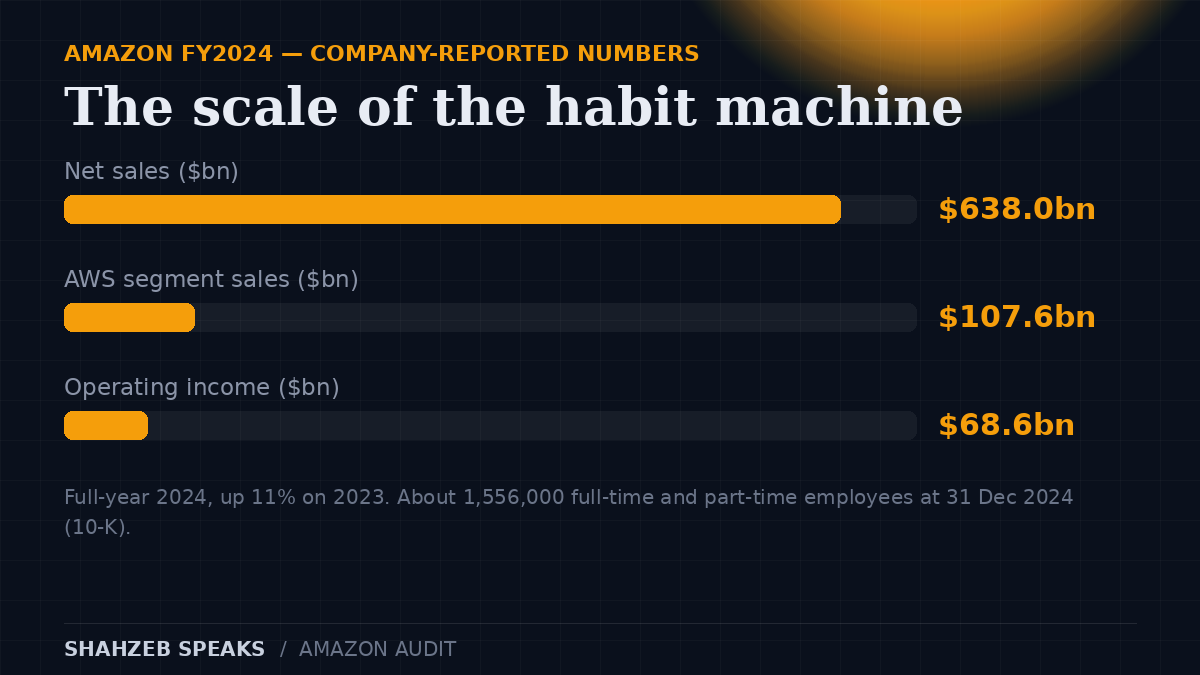
The numbers behind the machine, all from Amazon’s own filings: full-year 2024 net sales of $638.0 billion, up 11% on 2023; AWS segment sales of $107.6 billion; operating income of $68.6 billion, nearly double 2023’s $36.9 billion; and approximately 1,556,000 employees as of 31 December 2024. The last official Prime membership figure is 200 million+, disclosed by Jeff Bezos in his final shareholder letter of 15 April 2021 — Amazon has published no newer total. And the legal ledger is as large as the business: a $2.5 billion FTC Prime settlement, a pending FTC antitrust suit, and two European fines that are both, as of this writing, not final.
I am an Industrial and Organizational Psychologist in Karachi. I audit brands the way I study workplaces: by tracing behaviour back to the systems that produce it, and by refusing to confuse a company’s story about itself with the evidence. Amazon’s story is “customer obsession.” The evidence is twelve documented psychological mechanisms — and a court docket. Both are in this audit.
“Amazon did not win retail by selling things cheaper. It won by making buying thoughtless — and then charging $139 a year for the privilege of never thinking about it.”
— Brand Psychology Analysis, ShahzebSpeaks
📋 Brand Overview: Amazon at a Glance
| Attribute | Detail (verified) |
| Founded | 5 July 1994, Bellevue, Washington, by Jeff Bezos — incorporated as Cadabra, Inc.; amazon.com went live 16 July 1995 |
| Headquarters | 410 Terry Avenue North, Seattle, Washington; second HQ (HQ2) in Arlington, Virginia — Metropolitan Park opened May 2023 |
| Leadership | Bezos stepped down as CEO in 2021 (executive chairman); Andy Jassy CEO since |
| Employees | ≈ 1,556,000 full-time and part-time (31 Dec 2024, 10-K) |
| FY2024 net sales | $638.0 billion (+11%); AWS $107.6 billion (+19%); operating income $68.6 billion |
| Prime | 200M+ members (15 April 2021 — last official figure); US price $139/year since Feb 2022 |
| Website | https://www.amazon.com |
📜 Chapter 1: The History — From Cadabra to the Everything Store
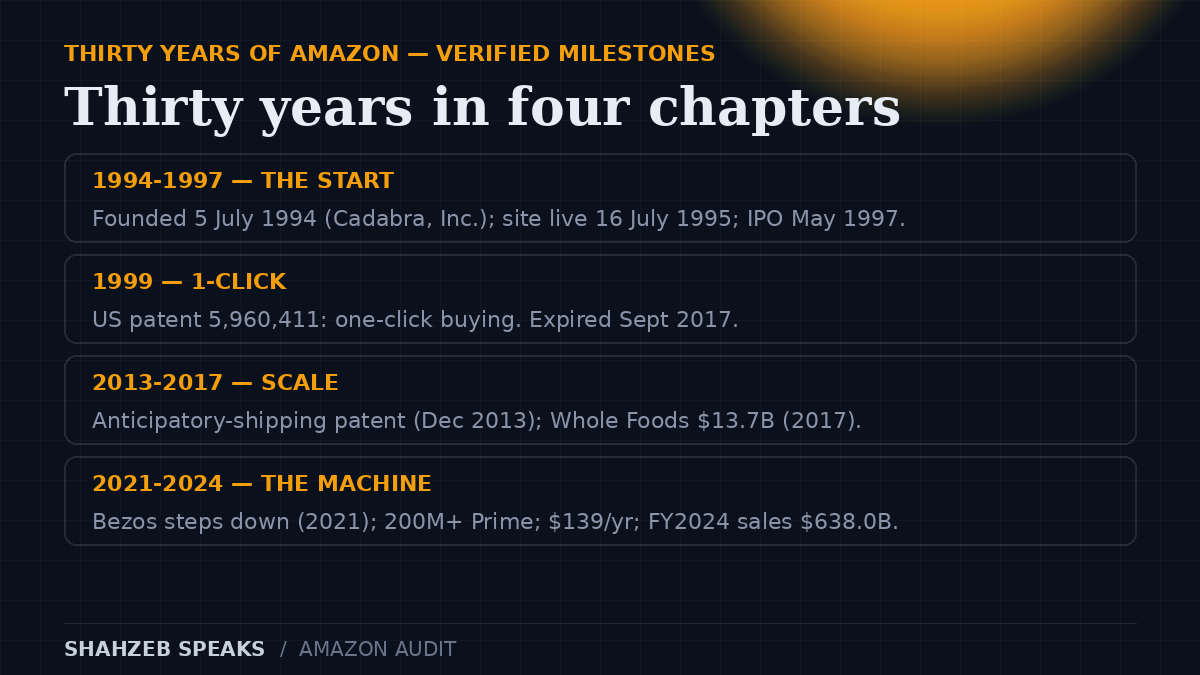
On 5 July 1994, Jeff Bezos founded an online bookstore in Bellevue, Washington, incorporating it under the name Cadabra, Inc. The website went live on 16 July 1995. The company went public in May 1997, valued at $300 million at IPO — a figure that reads as a rounding error against the $638 billion in 2024 sales.
Three moves built the psychology this audit dissects. In 1999, Amazon was granted US patent 5,960,411 for 1-Click ordering — buying with a single click using stored billing and shipping details. Apple licensed it in 2000; it expired in September 2017. The patent lapsed; the behaviour it trained did not. In 2013, Amazon was granted US patent 8,615,473 for “anticipatory package shipping” — note carefully what it actually describes: shipping packages toward a destination geographical area without a complete delivery address, finalised in transit. It is pre-positioning inventory at hubs, not sending unordered parcels to homes, whatever the headlines implied.
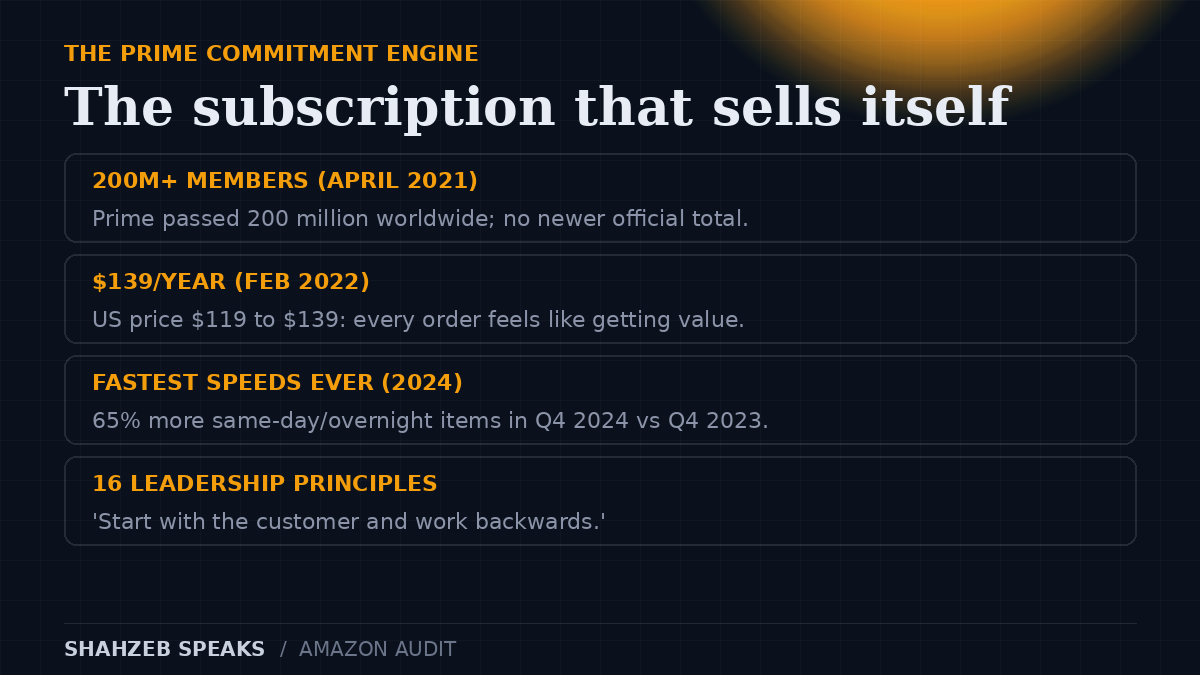
The expansion years: 2017 brought the $13.7 billion acquisition of Whole Foods Market — Amazon buying its way into physical retail and groceries. In November 2018 Amazon announced Arlington, Virginia as HQ2; Metropolitan Park opened in May 2023, and by August 2026 nearly 8,500 employees worked there. In 2021 Bezos stepped down as CEO (Andy Jassy took over) and disclosed, in his final shareholder letter that April, that Prime had surpassed 200 million members worldwide. In February 2022 the US Prime price rose from $119 to $139 per year. And in its Q4 2024 results, Amazon said it had delivered “at its fastest speeds ever for Prime members in 2024,” with over 65% more items delivered same-day or overnight to US Prime members than in Q4 2023.
⚡ Chapter 2: Technique 1 — Friction Elimination (1-Click Ordering)
The founding psychological insight of Amazon’s retail business is also its simplest: every click between desire and purchase is a chance to change your mind. The 1-Click patent (US 5,960,411, granted 1999, expired September 2017) collapsed the entire checkout — basket, forms, card entry, confirmation — into a single action using stored details. Psychologists call the underlying mechanism friction costs or cognitive ease: the less effort a behaviour requires, the more likely it becomes, because deliberation never gets a foothold.
Note the discipline of the design. 1-Click does not persuade you the product is good — the reviews do that (Chapter 5). It does not make the price attractive — the strikethrough does that (Chapter 6). It does one thing: it removes the interval in which second thoughts form. The patent expired in 2017 and competitors could copy the button; what they could not copy was a decade of stored payment credentials and delivery addresses across hundreds of millions of accounts. Friction elimination compounds: each stored detail makes the next purchase marginally easier, which is why Amazon fought so hard, in the FTC’s 2023–2025 Prime case, over how hard cancellation should be. Making buying effortless and un-buying effortful is not two strategies. It is one.
🔁 Chapter 3: Techniques 2 & 3 — The Prime Flywheel and Sunk-Cost Lock-In
Prime is the most successful subscription in retail history, and its psychology runs on two principles at once. The first is commitment and consistency (Cialdini, 2006): once you pay $139 a year, every subsequent purchase is framed — by your own mind — as “getting your money’s worth.” The fee does not just buy shipping; it buys a reason to prefer Amazon for the next purchase, and the one after that. Bezos’s April 2021 letter put the scale at 200 million+ members (up from 150 million in January 2020) — the last official total Amazon has published.
The second is the sunk-cost effect (Arkes & Blumer, 1985): money already spent tugs future choices toward the thing it was spent on, even when a rival offers a better price on a single item. Amazon’s own Q4 2024 release fed the loop deliberately: it reported delivering “at its fastest speeds ever,” with 65% more same-day or overnight items in Q4 2024 than a year earlier, and cited Profitero naming it the lowest-priced US retailer for the eighth straight year — online prices on average 14% less than other major US retailers. Each claim is company-reported, so read it as marketing; but the mechanism does not need the claims to be true. It needs the member to feel the membership working, monthly, in boxes at the door.
⭐ Chapter 4: Technique 4 — Social Proof at Scale
Amazon’s product page is a masterclass in social proof (Cialdini, 2006): the star rating sits directly beneath the product title — above the price — so consensus registers before cost does. Ratings counts run into the tens of thousands; the Q&A section answers the objections a salesperson would handle; and the review corpus, for all its well-documented problems with fake reviews, functions as the store’s sales staff.
The academic backing for the mechanism is direct: Chevalier and Mayzlin (2006), in the Journal of Marketing Research, showed that online book reviews move sales — the direction of reviews shifts purchasing, not just the volume. Amazon simply industrialised the finding across every category it sells. Nearly 2 million small and medium-sized businesses sell in Amazon’s store, making up almost 60% of retail sales (Bezos, April 2021 letter) — which means the social-proof engine is also a moat: sellers cannot leave without abandoning the review equity they built on Amazon’s pages. The psychology serves the platform twice — converting shoppers, then locking in suppliers.
🏷️ Chapter 5: Technique 5 — Price Anchoring
The strikethrough price — “List Price: $49.99, Our Price: $29.99” — is anchoring (Tversky & Kahneman, 1974) deployed at planetary scale. The first number sets the reference; the second feels like a victory regardless of what the item actually costs elsewhere. Amazon pairs the anchor with urgency-adjacent framing (“Save 40%”) so the shopper evaluates the discount, not the price.
Two honest notes. First, the anchors are not always what they seem: “list prices” on Amazon have drawn regulatory attention precisely because the reference price may never have been the real selling price — which is why the EU’s price-parity scrutiny (Chapter 10) matters to the psychology, not just the law. If the anchor is inflated, the technique shades from persuasion into deception. Second, Amazon’s counter-argument is documented: its Q4 2024 release cited Profitero’s finding that it was the lowest-priced US retailer for the eighth year running, with online prices averaging 14% less than other major retailers. Company-reported, again — but it shows Amazon knows the anchor game is played on perceived fairness, and it arms itself with third-party numbers.
🎯 Chapter 6: Techniques 6 & 7 — Default Power and Anticipatory Fulfilment
The Buy Box — the “Add to Cart” offer pre-selected on every product page — is a default (Johnson & Goldstein, 2003), and defaults are the quietest frames in psychology: most shoppers never look past the pre-selected seller. The FTC’s 2023 antitrust suit alleges, among other things, that Amazon manipulates Buy Box placement and punishes sellers who offer lower prices elsewhere — allegations, unproven, but they describe exactly why the default is valuable: whoever controls the pre-selected option controls the sale without persuading anyone.
Anticipatory fulfilment extends the same logic into logistics. Patent US 8,615,473 (granted 24 December 2013) describes moving packages toward a destination geographical area before the order is complete — pre-positioning, finalised in transit. The psychology is expectation-setting: when delivery windows shrink to “today” or “tonight,” waiting starts to feel like a defect. Amazon’s Q4 2024 claim of its “fastest speeds ever” is the marketing expression of a deeper mechanism — the company is training the reference point for what delivery should feel like, then selling Prime as the way to keep feeling it. Competitors are not just slower; they feel broken by comparison.
🧭 Chapter 7: Technique 8 — Working Backwards (the Customer-Obsession Narrative)
Amazon publishes 16 Leadership Principles on its jobs site — up from the original 14 — and the first, “Customer Obsession,” reads: “Leaders start with the customer and work backwards.” The company’s 10-K states it is “guided by four principles: customer obsession rather than competitor focus, passion for invention, commitment to operational excellence, and long-term thinking,” and seeks to be “Earth’s most customer-centric company.” This is corporate narrative as psychology: an identity that organises employee behaviour and customer expectations simultaneously.
The mechanism is narrative consistency: organisations that repeat a simple story about themselves create a reference point against which every decision is judged — by staff, by shoppers, and, usefully, by regulators. When the FTC alleges dark patterns in Prime cancellation, “customer obsession” becomes the standard Amazon is measured against, which is why the narrative is both an asset and a liability. A company with no stated values can disappoint no one; a company whose first principle is the customer has handed every critic the yardstick. I treat the “working backwards” product-development method carefully: it is well documented via former executives’ accounts, but I did not verify a company-stated description of the PR/FAQ process itself, so I describe only what Amazon’s own pages state.
🎁 Chapter 8: Techniques 9 & 10 — Reciprocity Priming and Scarcity Cues
Reciprocity (Cialdini, 2006) is the quiet engine of Prime’s free shipping and Amazon’s famously liberal returns: benefits received create a soft obligation to return the favour — with the next order. Free shipping is not a cost centre in this reading; it is a gift that keeps the relationship warm between purchases. The $139 fee then converts the warm feeling into a cold calculation (“use it or lose it”), which is why Techniques 2, 3 and 9 form a single system, not three.
Scarcity and urgency cues close the loop at the product page. Amazon’s interface shows “Only X left in stock” when inventory runs low and runs Lightning Deals with visible countdown timers and “% claimed” progress bars — time scarcity and quantity scarcity stacked together. The psychology is textbook (Lynn, 1991; Cialdini, 2006): scarce opportunities feel more valuable, and deadlines collapse deliberation. The honest caveat, documented in consumer reporting: urgency cues invite scepticism when shoppers suspect the scarcity is manufactured — countdowns that reset, “limited” deals that recur. Amazon’s cues are tied to real inventory and real timers, which is exactly why they work: credible scarcity persuades; theatrical scarcity trains distrust.
🧠 Chapter 9: Techniques 11 & 12 — Personalised Choice Architecture and Habit Looping
Amazon’s recommendation engine — “customers who bought this also bought,” personalised homepages, targeted emails — is choice architecture (Thaler & Sunstein, 2008): the environment is designed so the easy path and the profitable path coincide. “Frequently bought together” bundles are the purest expression — they raise average order value while feeling like helpful advice. The architecture learns: every click, purchase, and hover refines the next page, so the store rearranges itself around each shopper. The shopper experiences convenience; the platform experiences compounding data advantage.
Subscribe & Save closes the system into a habit loop. Launched in 2007 (per seller-industry reporting), it schedules recurring deliveries of household essentials: 5% off per subscription, rising to up to 15% when five or more subscriptions arrive in one auto-delivery. The psychology is the habit literature’s cue-routine-reward circuit, automated: the subscription is the cue, the delivery is the routine, the discount and the never-empty shelf are the reward. No willpower required, no decision repeated — which is precisely the point. Amazon’s deepest trick is not persuading you to choose it. It is removing the moment of choice entirely.
⚠️ Chapter 10: The Dark Side — The Real Legal and Regulatory Record
Amazon’s psychology operates inside one of the heaviest legal dockets in corporate history. Every item below is at its exact status as of October 2026. Nothing here is proven except where a final decision says so.
United States — antitrust: FILED, pending
On 26 September 2023, the FTC and 17 state attorneys general filed an antitrust lawsuit against Amazon in the US District Court for the Western District of Washington, alleging it illegally maintains monopoly power — including anti-discounting measures that punish sellers for lower prices elsewhere, Buy Box manipulation, and conditioning Prime eligibility on using Amazon’s fulfilment service. Amazon denies the claims. On 30 September 2024 the judge largely denied Amazon’s motion to dismiss, letting the federal claims proceed. Status: pending litigation — allegations, not findings. Trial scheduling has been in flux, with reported dates spanning 2026–2027.
United States — the $2.5 billion Prime settlement: SETTLED (2025), expanding
In September 2025 Amazon settled FTC allegations that it enrolled millions of consumers in Prime without consent and knowingly made cancellation difficult: up to $1.5 billion in consumer redress plus a $1 billion civil penalty — reported as the largest in FTC history — without admitting or denying the allegations. On 17 September 2026 the FTC announced a court-approved expansion: the maximum per-consumer payment rose from $51 to $200, eligibility extended to consumers who used 11–20 Prime benefits, and future payments made automatic. As of September 2026 Amazon had issued more than $845 million in redress. Status: settled; implementation ongoing. This is the direct legal price of the friction asymmetry in Chapter 2: buying effortless, cancelling effortful.
United States — Alexa and Ring privacy: SETTLED (2023)
In May–June 2023 Amazon agreed to a $25 million civil penalty to settle FTC/DOJ allegations it violated the Children’s Online Privacy Protection Act by keeping children’s Alexa voice recordings for years, and $5.8 million in customer refunds to settle FTC allegations over Ring privacy violations — including an employee spying on customers through cameras in 2017. Both settled without admitting or denying wrongdoing.
European Union — two fines, neither final
Italy: the competition authority (AGCM) fined Amazon €1.13 billion in December 2021 for alleged abuse of dominance in e-commerce logistics (favouring its own Fulfilment by Amazon). In September 2025 the Lazio court upheld the findings but ordered the fine recalculated; AGCM reduced it to €752.4 million in January 2026; on 14 January 2026 Amazon said it would appeal seeking complete exoneration. Status: NOT final — under appeal.
Luxembourg: the data-protection authority (CNPD) fined Amazon Europe Core €746 million on 15 July 2021 over targeted-advertising consent (GDPR). On 12 March 2026 Luxembourg’s Administrative Court annulled the fine in its entirety — ruling the CNPD had failed to assess fault and proportionality — while upholding the underlying violations and referring the case back to the CNPD. Status: NOT final — annulled, pending reassessment.
Digital Markets Act: the Commission designated Amazon a gatekeeper on 6 September 2023. As of September 2026 it was running a preliminary assessment of marketplace price-parity practices (evidence-gathering via seller questionnaires, per Bloomberg) — not a formal non-compliance decision. A cloud market investigation (AWS) opened November 2025, with a designation decision expected around November 2026 — undecided.
Labour — allegations and a certified union
On 15 December 2024 the US Senate HELP Committee (led by Senator Bernie Sanders) released an 18-month investigation accusing Amazon of extreme pace quotas and manipulating injury data — claiming warehouse workers were “nearly twice as likely” to be injured over seven years. Amazon rejected the findings as a “false narrative.” Status: allegations, not adjudicated findings. Separately, on 1 April 2022, workers at the JFK8 fulfilment centre on Staten Island voted 2,654 to 2,131 for the Amazon Labor Union — the first US Amazon warehouse union — certified by the NLRB in January 2023.
📝 Chapter 11: What Brands Should — and Shouldn’t — Copy
Copy the friction audit. Amazon’s founding discipline — find every click, form, and waiting period between desire and purchase, and delete it — transfers to any business. Map your own checkout, signup, or reorder flow and count the steps; each one is a small tax on conversion. The 1-Click patent expired in 2017. The idea is free.
Copy the commitment structure, not the dark pattern. Subscriptions that genuinely deliver value (Subscribe & Save’s scheduled essentials, Prime’s shipping) earn loyalty honestly. But the $2.5 billion Prime settlement is the price of the asymmetry: enrolment effortless, cancellation labyrinthine. Regulators on two continents now treat that asymmetry as the offence, not the business model. If your unsubscribe flow is harder than your signup flow, you are building a future settlement.
Copy the review infrastructure. Star ratings above the price, Q&A that answers objections, review counts as social proof — this is replicable for any retailer. What is not replicable overnight is the corpus: Amazon’s moat is millions of reviews deep. Start collecting structured feedback now; it compounds.
Don’t copy the anchor games. Strikethrough pricing only persuades while shoppers trust the reference price. The EU’s price-parity scrutiny shows where inflated anchors lead: from persuasion to enforcement action. If your “was” price was never your selling price, drop it.
Don’t copy the narrative without the substance. “Customer obsession” is a powerful organising story — until the FTC quotes it back at you in a dark-patterns case. A stated value is a standard you will be held to. Adopt one only if your cancellation flow, your data practices, and your warehouse quotas can survive it.
📊 Chapter 12: Amazon Psychology Audit Scorecard — Detailed Ratings
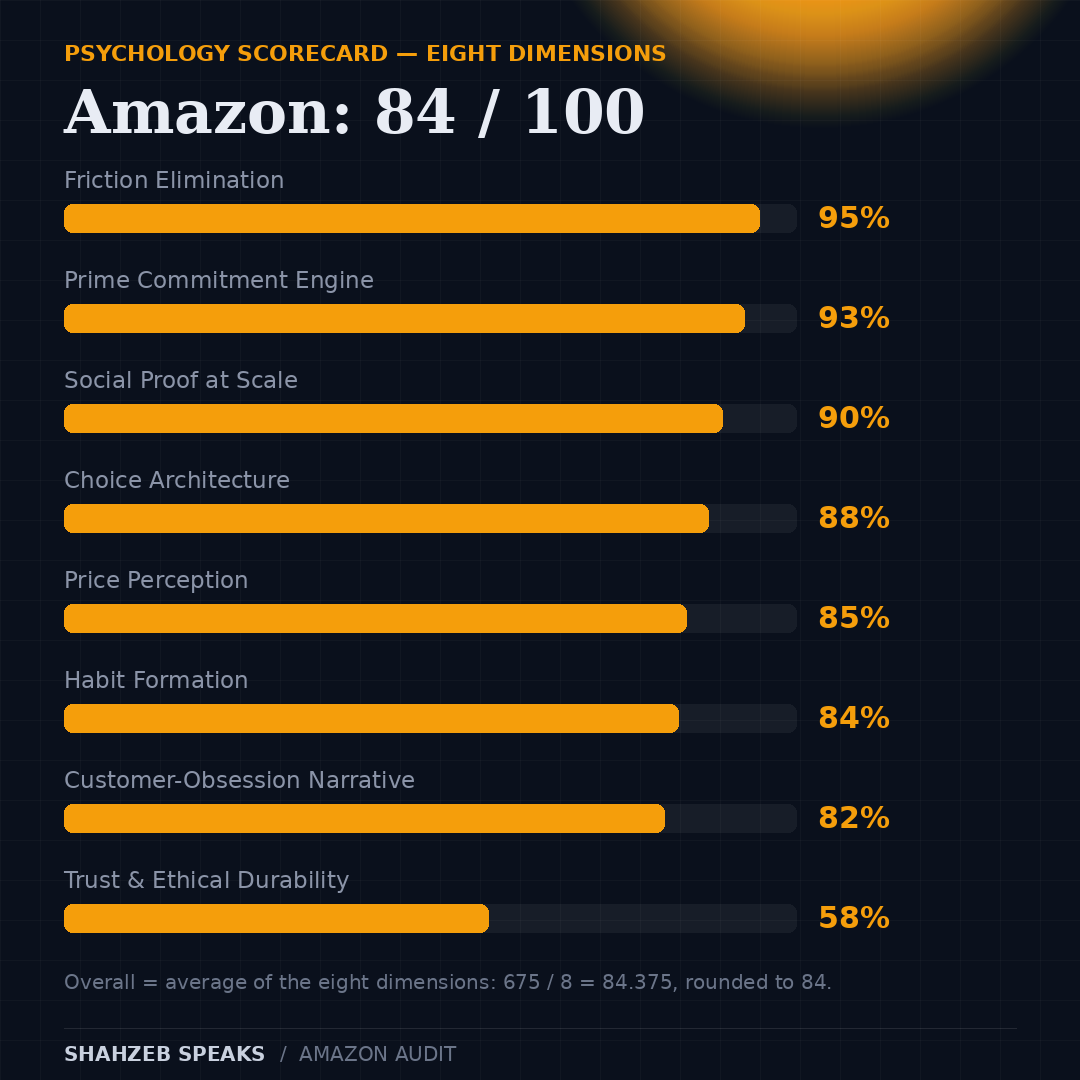
| Psychology Dimension | Score | Verdict |
| Friction Elimination (1-Click, stored details, same-day) | 95/100 | The patent expired in 2017; the behaviour it trained never did. |
| Prime Commitment Engine (subscription, sunk cost) | 93/100 | $139 a year that reframes every purchase as getting your money’s worth. |
| Social Proof at Scale (ratings, reviews, Q&A) | 90/100 | Consensus placed above price; the review corpus is a moat. |
| Choice Architecture (Buy Box, anticipatory fulfilment) | 88/100 | The default sells before persuasion starts; logistics set the expectation. |
| Price Perception (anchoring, lowest-price signalling) | 85/100 | Strikethrough anchors at planetary scale — powerful while trusted. |
| Habit Formation (Subscribe & Save, reorders) | 84/100 | The cue-routine-reward loop, automated: no decision left to make. |
| Customer-Obsession Narrative (principles, working backwards) | 82/100 | A story that organises 1.5 million employees — and hands critics the yardstick. |
| Trust & Ethical Durability | 58/100 | A $2.5B settlement and a docket of not-final fines cap this pillar. |
Score arithmetic: 95 + 93 + 90 + 88 + 85 + 84 + 82 + 58 = 675; 675 ÷ 8 = 84.375 → Overall Psychology Score: 84/100.
✅ Chapter 13: Balance Sheet & A Psychologist’s Prescription
Assets: the most complete friction-elimination system in retail; a subscription engine that converts spending into identity; social proof at a scale no competitor can replicate quickly; logistics that reset what “fast” means; a corporate narrative simple enough to steer 1.5 million people.
Liabilities: the same asymmetry that built the business — effortless buying, effortful cancelling — is now a $2.5 billion settled liability and the subject of a pending antitrust suit; two European fines remain unresolved (one reduced and appealed, one annulled and referred back); and the labour record carries unadjudicated allegations that sit uneasily beside “customer obsession.”
Prescription: Amazon’s psychology is mature enough that its next gains will not come from sharper persuasion but from repaired trust. Make cancellation as easy as enrolment — the settlement already forces the direction of travel. Publish the methodology behind “list prices” before regulators standardise it for you. And recognise that the habit machine’s greatest vulnerability is not a competitor’s lower price but the moment shoppers feel manipulated rather than served: credible scarcity persuades, theatrical scarcity trains distrust, and 200 million members is a lot of people to disappoint at once.
📝 Final Verdict
Amazon is the purest expression of a single psychological idea: that buying is a behaviour, and behaviours follow the path of least resistance. It patented the removal of resistance in 1999, wrapped the resulting habit in a $139 subscription, and scaled the whole system to $638 billion in annual sales. The twelve mechanisms in this audit — from 1-Click to Subscribe & Save — form one coherent machine, and the machine works: the validity of its psychology is written in the revenue line.
But a machine this complete accumulates a shadow. The $2.5 billion Prime settlement, the pending antitrust suit, the two not-final European fines, and the labour allegations describe what happens when friction elimination is applied asymmetrically — easy in, hard out. Amazon’s score reflects both halves: near-perfect persuasion engineering, capped by a trust pillar that the courts are still writing.
Psychology Score: 84/100 — The $638 Billion Habit Machine: one-click buying, Prime lock-in, and social proof at planetary scale — capped by a $2.5B settlement and a legal docket that is still being written.
Want your brand audited the way Amazon was?
I audit the psychology of brands — the mechanisms, the evidence, and the legal record at its exact status. Contact me here.
More brand psychology: see the Zara scarcity-machine audit and the Costco loyalty audit. For the psychology behind the mechanisms, see nudge theory in action, when social proof works — and backfires, and scarcity marketing examples. I write as an industrial psychology in Pakistan practitioner.
📚 References & Sources
- Amazon.com, Inc. (2025). Annual report on Form 10-K for the fiscal year ended 31 December 2024 (filed 6 Feb 2025). https://www.sec.gov/Archives/edgar/data/1018724/000101872425000004/amzn-20241231.htm
- Amazon.com, Inc. (2025). Q4 2024 earnings release (Exhibit 99.1). https://www.sec.gov/Archives/edgar/data/1018724/000101872425000002/amzn-20241231xex991.htm
- Bezos, J. (2021). 2020 letter to shareholders (15 April 2021). (200M+ Prime members; 2M SMB sellers, ~60% of retail sales.)
- US Patent 5,960,411 — “Method and system for placing a purchase order via a communications network” (granted 1999; expired Sept 2017).
- US Patent 8,615,473 — “Method and system for anticipatory package shipping” (granted 24 Dec 2013).
- Amazon Jobs. Leadership Principles (16 principles; “Customer Obsession: Leaders start with the customer and work backwards.”). https://jobs.amazon.in/leadership-principles
- Federal Trade Commission (2023). FTC sues Amazon for illegally maintaining monopoly power (26 Sept 2023). (17 state attorneys general joined; pending.)
- Federal Trade Commission (2025). Amazon to pay $2.5 billion over Prime enrolment and cancellation practices (Sept 2025); expanded payments announced 17 Sept 2026. https://www.ftc.gov/news-events/news/press-releases/2026/09/ftc-announces-additional-payments-consumers-stemming-ftcs-amazon-prime-settlement
- Federal Trade Commission / DOJ (2023). $25M COPPA settlement (Alexa); $5.8M Ring refunds (June 2023). (Settled without admitting or denying.)
- Autorità Garante della Concorrenza e del Mercato (Italy). €1.13B fine (Dec 2021); reduced to €752.4M (Jan 2026); under appeal.
- Commission Nationale pour la Protection des Données (Luxembourg). €746M fine (15 July 2021); annulled in full 12 March 2026; referred back to CNPD.
- European Commission. Digital Markets Act gatekeeper designation (6 Sept 2023). https://digital-markets-act.ec.europa.eu/commission-designates-six-gatekeepers-under-digital-markets-act-2023-09-06_en
- US Senate Committee on Health, Education, Labor, and Pensions (2024). Majority staff report on Amazon warehouse safety (15 Dec 2024). (Allegations; rejected by Amazon.)
- National Labor Relations Board, Region 29. JFK8 ballot count results (1 April 2022): 2,654–2,131 for the Amazon Labor Union; certified January 2023.
- Cialdini, R. B. (2006). Influence: The Psychology of Persuasion (rev. ed.). Harper Business. (Commitment/consistency, social proof, reciprocity, scarcity.)
- Tversky, A., & Kahneman, D. (1974). Judgment under uncertainty: Heuristics and biases. Science, 185(4157), 1124–1131. (Anchoring.)
- Thaler, R. H., & Sunstein, C. R. (2008). Nudge: Improving Decisions About Health, Wealth, and Happiness. Yale University Press. (Choice architecture.)
- Johnson, E. J., & Goldstein, D. (2003). Do defaults save lives? Science, 302(5649), 1338–1339. (Defaults.)
- Arkes, H. R., & Blumer, C. (1985). The psychology of sunk cost. Organizational Behavior and Human Decision Processes, 35(1), 124–140.
- Chevalier, J. A., & Mayzlin, D. (2006). The effect of word of mouth on sales: Online book reviews. Journal of Marketing Research, 43(3), 345–354.
- Lynn, M. (1991). Scarcity effects on value: A quantitative review of the commodity theory literature. Psychology & Marketing, 8(1), 43–57.
- Wharton School, University of Pennsylvania. “Amazon’s 1-Click goes off patent.” Knowledge at Wharton podcast.
- GeekWire (2021). Amazon now 200 million Prime members (15 April 2021).
Key Findings
- FY2024: $638.0B net sales (+11%), AWS $107.6B (+19%), operating income $68.6B vs $36.9B in 2023; ~1,556,000 employees at 31 Dec 2024 (Amazon Q4 2024 release / 10-K)
- 1-Click patent US 5,960,411 (granted 1999, expired Sept 2017); 16 Leadership Principles incl. 'start with the customer and work backwards' (Amazon jobs site)
- Prime: 200M+ members (April 2021, last official figure); $139/year US (Feb 2022); fastest delivery speeds ever in 2024, 65%+ more same-day/overnight items in Q4 2024 (company-reported)
- FTC + 17 state AGs antitrust suit FILED 26 Sept 2023, pending (dismissal largely denied Sept 2024); EU DMA gatekeeper 6 Sept 2023, preliminary price-parity assessment ongoing — no formal decision (as of Oct 2026)
- Settled WITHOUT admitting or denying: $2.5B Prime settlement (Sept 2025; $845M+ paid by Sept 2026); $25M Alexa COPPA penalty + $5.8M Ring refunds (2023)
- EU fines NOT final: Italy €1.13B reduced to €752.4M (Jan 2026), Amazon appealing; Luxembourg €746M ANNULLED 12 March 2026, referred back to CNPD. Labour: Senate HELP report ALLEGED (Dec 2024), rejected by Amazon; JFK8 union vote 2,654–2,131 certified Jan 2023
Overall Psychology Score
Amazon scores 84/100 in our comprehensive psychology audit covering consumer behavior strategies, UX design principles, and psychological marketing effectiveness.
The detailed dimension scores are in the audit's Psychology Scorecard chapter.
RevolutionaryMuhammad Shahzeb
MSc Industrial Psychologist, specializing in consumer behavior, UX psychology, and brand strategy analysis. Helping brands understand the psychology behind their success.
About Muhammad Shahzeb →