Anthropic & Claude Psychology Audit — How “Safety First” Became the Most Profitable Positioning in AI
The deepest psychology audit of Anthropic and Claude ever written. How a company founded on caution became the enterprise AI leader, overtaking OpenAI in enterprise share and revenue, why "safety first" is the sharpest positioning play in tech, how Claude's personality became a genuine brand asset with Gen Z, and the honest case that safety branding can function as marketing. Includes 2026 figures and a psychologist's verdict on where it breaks.

88 / 100
Overall consumer behavior effectiveness

Brand Overview
- Brand nameAnthropic (Claude)
- Founded2021
- HeadquartersSan Francisco, California, USA
- IndustryArtificial Intelligence & Enterprise Software
- Websitewww.anthropic.com ↗
Psychology Techniques Identified
- 01Trust Positioning in a Low-Trust Category
- 02Contrarian Founding Story (The Walkout Narrative)
- 03Anthropomorphism & Parasocial Attachment
- 04Restraint as a Credibility Signal
- 05Costly Signaling (Refusing Capability for Principle)
- 06Category Reframing (Safety as Capability, Not Constraint)
- 07Professional Identity Signalling ("I Use Claude")
- 08Institutional Authority Transfer (Enterprise Trust)
- 09Distinctive Brand Assets (Warm Palette, Calm Voice)
- 10Reduced Anxiety as Product Value
- 11In-Group Formation Among Developers
- 12Moral Licensing Risk in Safety Branding
Full Psychology Audit Report
In this audit
In December 2024, a research company most people had never heard of had roughly $1 billion in annualised revenue. Seventeen months later, in May 2026, that number was around $47 billion, it had passed OpenAI’s approximately $25 billion, and its post-money valuation of about $965 billion had overtaken the company that started the entire consumer AI boom. Its share of enterprise LLM spending climbed to roughly 40% while OpenAI’s collapsed from 50% in 2023 to about 27%.
Here is what makes this a psychology story rather than a technology story. Anthropic did not win by being dramatically more capable; the frontier models trade blows on benchmarks constantly and most buyers cannot meaningfully evaluate the difference. It won by occupying the one position nobody else in the category wanted: the careful one. In an industry racing to demonstrate power, Anthropic built a brand around demonstrating restraint, and restraint turned out to be the most commercially valuable posture available.
I am an Industrial and Organizational Psychologist, and this audit takes apart how that worked: the founding story that gave the position credibility no marketing budget could buy, the personality that made a language model into a brand asset, the enterprise trust transfer that flipped the market, and the serious, unresolved question of whether safety positioning is a conviction or a category strategy that happens to be true so far.
“Every AI company was shouting about what its model could do. Anthropic built a brand around what it would not do, in a category where the customer’s dominant private emotion is fear. That is not modesty. That is the sharpest positioning decision anyone in technology has made this decade.”
— Brand Psychology Analysis, ShahzebSpeaks
📋 Brand Overview: Anthropic at a Glance
| Company Name | Anthropic PBC (product: Claude) |
| Founded | 2021, San Francisco, by former OpenAI researchers including Dario and Daniela Amodei |
| Corporate Structure | Public Benefit Corporation, with a stated mission around safe and beneficial AI |
| Revenue (May 2026) | ~$47 billion annualised, up from ~$1 billion in December 2024 |
| Valuation | ~$965 billion post-money (Series H, May 2026), ahead of OpenAI’s ~$852 billion |
| Enterprise Share | ~40% of enterprise LLM spend (up from 12% in 2023); OpenAI down to ~27% |
| Revenue Mix | ~85% from business customers (OpenAI: ~85% from consumer subscriptions) |
| Revenue Per User | ~$192 per monthly active user annually, versus roughly $23 for OpenAI |
| Signature Concepts | Constitutional AI, published safety research, a defined model character |
| Psychological Code | Caution, competence, calm, considered restraint |
| Psychology Score | 88 / 100 — ⚡ Extreme Impact |
📜 Chapter 1: The Complete History — The Walkout That Became a Brand (2021–2026)
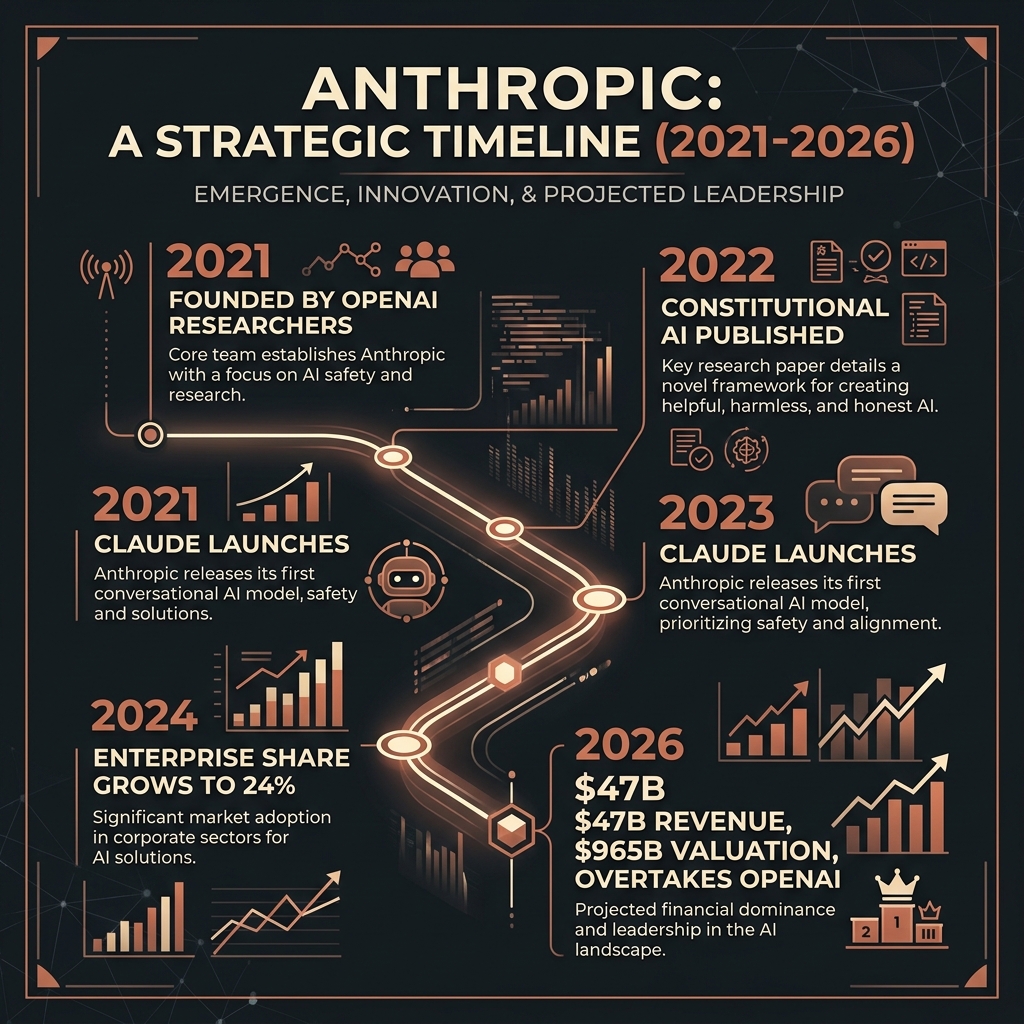
🚪 2021: The Founding Story Nobody Could Manufacture
Anthropic was founded in 2021 by a group of senior researchers who left OpenAI, including siblings Dario and Daniela Amodei, over differences in direction that were widely reported as centring on safety and commercial priorities. Whatever the internal reality, the public story crystallised into something enormously valuable in brand terms: these are the people who walked away from the leading AI company because they thought it was moving too fast.
Psychologically, this is the closest thing to a perfect origin narrative for a trust brand. It is a costly signal in the technical sense: leaving equity, status and access at the most prominent organisation in your field is expensive, and expensive actions are believed in a way that statements are not. Every safety claim Anthropic has made since is read against that founding act. A company that says it cares about caution is making a claim; a company that visibly paid for caution before it had customers is providing evidence.
🏛️ 2021-2022: Building the Credibility Infrastructure
Anthropic incorporated as a Public Benefit Corporation, published safety research openly, and developed Constitutional AI, a training approach in which the model is guided by an explicit written set of principles rather than purely by human preference labelling. Chapter 4 covers why publishing a constitution matters far more psychologically than the technique itself does technically.
🤖 2023: Claude Arrives, Quietly
Claude launched into a market already defined by ChatGPT’s explosive consumer moment. Anthropic did not attempt to out-shout it. The early product was harder to access, less consumer-focused, and noticeably more cautious in its behaviour, which critics called limiting and which enterprise buyers, as it turned out, read as professional.
💼 2023-2025: The Enterprise Flip
This is the period where the positioning converted into money. Anthropic’s share of enterprise LLM spending moved from around 12% in 2023 to 24% in 2024 and onward, while OpenAI’s declined from roughly 50%. Developer adoption of Claude for coding work became a particularly strong beachhead, and Chapter 6 explains why the developer segment was the most strategically valuable group in the market to win.
📈 2025-2026: The Reversal
By May 2026 the numbers had inverted the industry’s assumed hierarchy: roughly $47 billion annualised revenue against OpenAI’s approximately $25 billion, a Series H valuation near $965 billion exceeding OpenAI’s $852 billion, and enterprise share around 40%. Reporting in April 2026 recorded OpenAI losing well over ten percentage points of enterprise share in a single month, its steepest recorded decline.
Read that trajectory carefully, because the causal story matters. This was not a capability leapfrog visible to ordinary users. It was a trust migration, and trust migrations are slower to start and far harder to reverse than feature races.
🛡️ Chapter 2: Safety First — The Sharpest Positioning Play in Tech
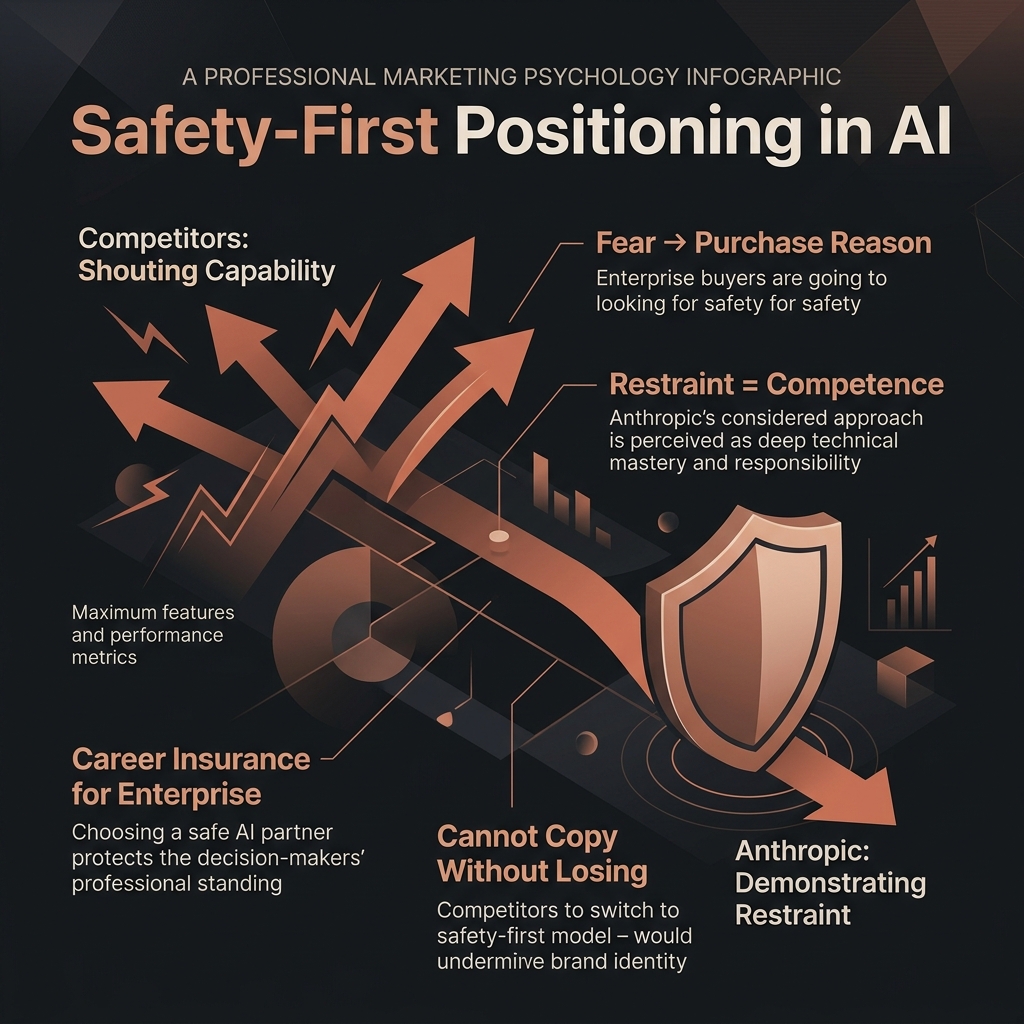
To see why this position is so strong, you have to name the category’s real emotional condition honestly. The dominant private feeling about AI among ordinary people is not excitement. It is unease: about jobs, about accuracy, about what these systems do with information, about a technology advancing faster than anyone’s ability to evaluate it. Survey work through 2024-2026 consistently finds high anxiety alongside high usage, which is a strange and revealing combination.
Every other major AI brand responded to that unease by talking louder about capability, which is the intuitive move and the wrong one. When people are anxious, more power is not reassuring; more power is the thing they are anxious about. Anthropic did the counterintuitive thing and positioned on the anxiety itself, which produced three psychological advantages at once.
First, relief becomes the product. As I argued in my Meezan Bank audit, brands that resolve a customer’s discomfort rather than deliver a superior feature enjoy price insensitivity and gratitude rather than mere satisfaction. Choosing the careful AI is an anxiety-management decision, and anxiety management is worth more than a benchmark point.
Second, restraint reads as competence. There is a robust asymmetry in how humans evaluate caution: a person who acknowledges risk is generally judged as more expert than one who dismisses it, because acknowledging complexity signals that you understand it. A model that declines certain requests, or flags uncertainty, is inconvenient in the moment and quietly credibility-building over time.
Third, and most importantly commercially, it created a position competitors cannot copy without losing. If OpenAI or Google spend heavily on safety messaging now, the market reads it as a response to Anthropic, which reinforces Anthropic as the category’s safety reference point. This is the same structural trap I documented in the Emirates audit, where challengers attacking the prototype end up advertising it.
📜 Chapter 3: Constitutional AI — Why Publishing Principles Beats Promising Them
Constitutional AI is a training method. Its brand value has almost nothing to do with the method and almost everything to do with a single decision: Anthropic wrote the principles down and published them.
Consider what a published constitution does psychologically. It converts an unverifiable claim (“we build responsibly”) into an inspectable artefact. Nobody outside the company can audit training runs, but anyone can read a document and check whether the behaviour they observe matches it. That shift, from trust-me to check-me, is the most powerful move available to a brand asking for trust in a domain where customers lack the expertise to verify anything technical.
It also creates self-imposed accountability, which is a costly signal. A written constitution is a stick you have handed to your critics: every future decision can be measured against it, and the company loses the ability to quietly redefine what it stands for. Organisations only accept that constraint when they intend to be held to it, or when they have badly misjudged the risk, and markets read the first interpretation by default.
There is a useful comparison in my Johnson & Johnson audit. J&J’s Credo, written in 1943, functioned as exactly this kind of artefact and generated decades of credibility, right up until the company’s behaviour and its document visibly diverged, at which point the same document became the yardstick critics used against it. Published principles are a compounding asset and a permanent liability in the same sentence, and Anthropic has taken on both.
🎭 Chapter 4: Claude’s Personality — When a Product Becomes a Character
Here is the part most business analyses of this company miss entirely, and it may be the strongest consumer-side asset in the portfolio.
Claude has a recognisable conversational character: measured, warm without being performatively cheerful, willing to express uncertainty, inclined to disagree politely rather than flatter. Users describe it in personality terms rather than feature terms, which is unusual and commercially significant. Nobody describes a database that way.
Three mechanisms are operating. Anthropomorphism is the human default rather than an error; Nass and Reeves demonstrated decades ago that people apply social rules to computers automatically, treating them as social actors even when they know better. Any conversational system will be anthropomorphised, so the only real question is whether the personality it gets assigned was designed or accidental.
Parasocial attachment follows. Repeated one-sided interaction with a consistent character produces genuine attachment, the same mechanism I analysed in the Rhode audit in a completely different industry. Users who form this attachment do not switch for a marginal capability improvement, because switching feels less like changing software and more like changing colleagues.
Identity signalling completes it. Among developers and knowledge workers, saying “I use Claude” has acquired a mild signalling function, roughly connoting thoughtfulness and craft. That is a distinctive brand asset in the sense I described in my von Restorff article, and it is one competitors cannot replicate by matching a benchmark, because it lives in a social meaning rather than a spec sheet.
An honest note on the risk, since this cuts both ways: a brand whose asset is a personality is exposed every time that personality changes. Model updates that shift tone reliably produce genuine user distress, which sounds absurd until you remember that people are responding to a relationship, not a release note. Anthropic has built something users can lose, and losable things generate louder reactions than replaceable ones.
🏢 Chapter 5: The Enterprise Flip — Why Businesses Bought the Careful One
The most consequential number in this audit is the revenue mix: roughly 85% of Anthropic’s revenue from businesses, against about 85% of OpenAI’s from consumer subscriptions. Those are not two companies competing; they are two companies playing different sports on the same field, and Anthropic picked the sport with better economics.
Enterprise buying psychology is fundamentally different from consumer psychology in one respect that decides everything here. A consumer buying a subscription is optimising for capability and price. An enterprise buyer is optimising against blame. The dominant private question in a corporate procurement decision is not “which is best?” but “which one will not end my career if it goes wrong?” This is why the old line about nobody getting fired for buying IBM survived for forty years: it describes a real psychological mechanism, defensive decision-making under accountability.
In that frame, Anthropic’s positioning is almost unfairly well suited. A CTO who deploys the model from the company known for caution has a defensible answer ready if something goes wrong. A CTO who deploys the model from the company known for moving fast has a harder conversation. Safety branding is, in enterprise terms, career insurance, and career insurance is the single most reliably purchased product in corporate software.
The economics that follow are stark. Anthropic reportedly earns around $192 per monthly active user annually versus roughly $23 for OpenAI, roughly eight times more per user, because business customers buy differently: larger contracts, lower churn, expansion over time, and far less price sensitivity. The company that lost the consumer mindshare war won the segment where mindshare converts into contracts.
💻 Chapter 6: Winning Developers — The Most Valuable Beachhead in Software
Anthropic’s strength in coding and developer workflows deserves separate analysis because of what that audience does to a brand’s trajectory.
Developers are the highest-leverage adopters in software for three reasons. They are ruthlessly evaluative, testing tools against real work rather than marketing, which means their endorsement carries unusual credibility with everyone else. They are vocal, discussing tools publicly and constantly, which turns adoption into distribution. And critically, they are the people who decide what gets embedded into products, which converts individual preference into organisational dependency.
There is a specific psychological reason technical users respond to Claude’s characteristic behaviours. A model that says “I am not certain” and one that produces a confident wrong answer are, to a casual user, similarly satisfying; to a developer who must ship the output, they are completely different products. Calibrated uncertainty is a feature to the people who bear the consequences of errors. Anthropic optimised for the audience that could tell the difference, and that audience then told everyone else.
This also created a genuine in-group. Developer communities form identities around tools, and a tool that feels like it respects the user’s judgment rather than performing for them attracts a particular kind of loyalty. That loyalty is why Anthropic’s growth looks bottom-up in an industry where most enterprise software growth is top-down.
🎨 Chapter 7: The Sensory and Verbal Codes — Warmth in a Category of Chrome
Look at the visual language of AI as a category: cool blues, black interfaces, neon gradients, futuristic sans-serifs, imagery of neural networks and glowing cubes. It is a uniform, and it is remarkably consistent, which as I argued in the von Restorff article makes it an opportunity rather than a standard to follow.
Anthropic broke the uniform in a specific direction: warm terracotta and clay tones, soft cream backgrounds, a humanist serif, generous whitespace, and calm layout. The effect is closer to a research institution or a well-made notebook than to a technology product, and that association is entirely deliberate in its consequences even if it began as taste.
Two psychological mechanisms make this work harder than it looks. Warm colours and rounded, humanist type reduce perceived threat, and this brand’s central job is threat reduction, so the aesthetic and the positioning are saying the same thing in different languages, which is the definition of coherent branding. And the calm restraint produces processing fluency: easy-to-process design is judged as more trustworthy, an effect Reber, Schwarz and Winkielman documented, which means the interface is quietly making the same argument as the marketing.
The verbal code matches. Anthropic’s public writing tends toward long-form, hedged, technically careful prose that reads more like academic communication than product marketing. In most categories that would be a liability. In a category where overclaiming is the norm and everyone is exhausted by hype, measured language is itself a differentiator.
⚠️ Chapter 8: The Dark Side — Safety Washing and the Symmetry Problem
This is the chapter the brand’s admirers usually skip, and it contains the most serious risks in the audit.
🧼 The Safety Washing Critique
The strongest criticism of Anthropic, made seriously by researchers, journalists and parts of the AI ethics community, runs like this: a company genuinely convinced that this technology is dangerous is nonetheless racing to build it, taking enormous investment, and expanding aggressively, which means “safety” functions as a differentiator and a licence rather than a brake. The sharper version notes that if you believe the risk is real, building the thing faster while narrating your caution is not obviously more responsible than building it without the narration.
I do not think this criticism is decisive, because the internal logic Anthropic offers, that safety-focused labs being at the frontier is better than ceding it, is coherent and defensible. But I do think it is unfalsifiable from the outside, and that is the psychological problem. Customers cannot verify it either way, which means the position rests on continuous behavioural evidence rather than argument, and behavioural evidence has to be produced forever.
⚖️ The Symmetry Problem
A brand that positions on ethics is judged by a standard its competitors are not held to. Every commercial decision, every military or government contract, every relaxation of a previous limit, every partnership, is evaluated against the stated identity. This asymmetry is the price of the position and it does not go away with scale. As my Johnson & Johnson audit documented in detail, betrayal by a brand that promised care is punished far more severely than ordinary corporate failure, because trust brands are not judged on outcomes but on consistency with their own claims.
🏃 The Commercial Gravity Risk
Hypergrowth exerts pressure in one direction. Investors at a near-trillion-dollar valuation expect a return path, competitors iterate weekly, and every quarter creates a marginal argument to ship faster, loosen a constraint, or accept a customer that sits awkwardly with the stated position. None of those decisions individually breaks a brand. Their accumulation is precisely how positioning erodes, quietly, while everyone internally still believes the original story.
🙋 The Consumer Gap
A concrete strategic weakness rather than an ethical one: Anthropic won enterprise and largely conceded consumer mindshare. ChatGPT became the generic term for the category in ordinary conversation, which is prototype status, and prototype status compounds over time. Anthropic earns more per user precisely because it has fewer of them, and a company whose brand is unknown to the general public has less protection when public opinion or regulation turns, since nobody defends a company they have never heard of.
⚔️ Chapter 9: Competitive Positioning — Four Companies, Four Psychologies
| Competitor | Psychological Position | Where Anthropic Wins or Loses |
| OpenAI / ChatGPT | The prototype; the household name; consumer-first excitement | Loses public mindshare decisively; wins enterprise trust and revenue per user |
| Google / Gemini | Distribution and integration; already inside everything | Cannot match distribution; wins on being a deliberate choice rather than a default |
| Meta / open-weight models | Openness, control, no vendor dependency | Loses buyers who want sovereignty; wins those who want accountability |
| Chinese and low-cost labs | Price disruption and rapid capability catch-up | The real long-term pressure: if capability commoditises, trust must carry the entire premium |
The structural insight here is that all four rivals are competing on dimensions Anthropic deliberately does not lead on, which is the mark of genuine positioning rather than mere differentiation. The uncomfortable scenario is the last row: if frontier capability becomes cheap and broadly available, the question becomes whether trust alone can sustain a premium. My read is that it can in enterprise, where accountability is the buying criterion, and cannot in consumer, where price and convenience dominate. That split is precisely the shape of Anthropic’s current business, which suggests the company has read its own moat correctly.
📊 Chapter 10: Psychology Scorecard — Detailed Ratings
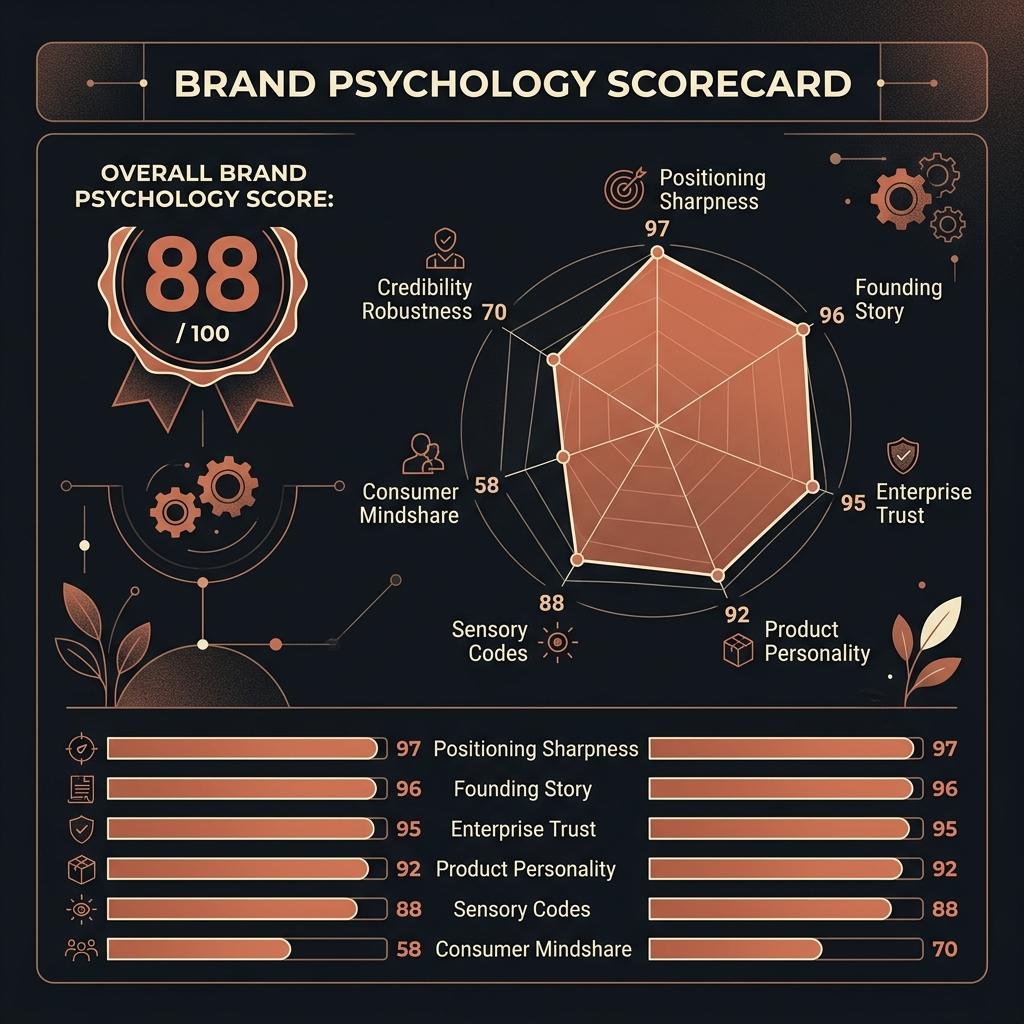
| Psychology Dimension | Score | Verdict |
| Positioning Sharpness | 97/100 | Turned the category’s central fear into its own purchase reason. |
| Founding Story Credibility | 96/100 | A costly signal no marketing budget can manufacture. |
| Enterprise Trust Psychology | 95/100 | Safety branding as career insurance; near-perfect fit to defensive buying. |
| Product Personality as Asset | 92/100 | A character users describe in human terms; rare and hard to copy. |
| Distinctive Sensory Codes | 88/100 | Warm palette and calm voice break a rigid category uniform. |
| Consumer Mindshare | 58/100 | The rival owns the category noun; public recognition remains thin. |
| Credibility Robustness | 70/100 | Held to a standard rivals are not; every decision is evidence. |
| Durability Under Commercial Pressure | 72/100 | Near-trillion-dollar expectations pull steadily against stated restraint. |
| OVERALL PSYCHOLOGY SCORE | 88/100 | ⚡ Extreme Impact — the best positioning in tech, on the hardest terms. |
✅ Chapter 11: Balance Sheet & A Psychologist’s Prescription
💪 Psychological Strengths
- Owned the anxiety: positioned on the category’s dominant private emotion instead of arguing against it
- Unbuyable origin story: a costly, visible act of principle before there was any commercial reason for it
- Published principles: converted an unverifiable promise into an inspectable artefact
- Enterprise fit: safety branding functions as career insurance in defensive corporate buying
- A product with a character: parasocial attachment and identity signalling that benchmarks cannot deliver
- Broke the category uniform: warm, calm design saying the same thing as the positioning
⚠️ Psychological Weaknesses
- Asymmetric judgment: held to a standard competitors are exempt from, permanently
- Unfalsifiable core claim: customers cannot verify safety, so the position needs continuous behavioural proof
- Consumer invisibility: the rival owns the category noun, and unknown companies have no public defenders
- Growth gravity: valuation expectations push steadily against the restraint that built the brand
- Personality fragility: an asset built on character is disrupted every time the character shifts
🔮 The Prescription
- Publish the refusals, not just the principles. The most credible thing this company could do is document specific commercial opportunities it declined and why. Costly signals require visible cost, and a constitution without published examples of it binding a decision is a claim rather than evidence.
- Treat the personality as a governed asset. Since users form attachments to Claude’s character, changes to it should be communicated the way product deprecations are: explained, previewed, and acknowledged as a loss. Silent personality shifts break something users cannot articulate but definitely feel.
- Build public recognition before it is needed. Enterprise revenue does not buy public goodwill, and regulation is written in the public arena. A company invisible to ordinary people has no constituency when the conversation turns against the industry.
- Engage the safety-washing critique directly. Ignoring it lets critics define it. A brand confident in its own logic should publish the argument, including the strongest counter-case, because the willingness to state the objection fairly is itself the most persuasive answer available.
- Pre-commit to the lines that will be tested. Stating in advance what the company will not do, before commercial pressure makes it costly, is worth far more than defending the same decision afterwards. Positions announced under pressure are read as damage control; positions announced in advance are read as character.
📝 Final Verdict
Anthropic executed the most counterintuitive positioning move in modern technology and was rewarded with the most improbable result. In a category racing to demonstrate capability, it built a brand around demonstrating restraint, and in seventeen months went from roughly $1 billion to $47 billion in annualised revenue, overtook the company that created the category, and took roughly 40% of enterprise AI spending from a rival that once held half of it. Almost none of that is explained by benchmarks. It is explained by the fact that the buyers with the most at stake were not asking which model was most powerful. They were asking which company they could defend having chosen.
The honest closing note is that this position is expensive to hold and gets more expensive with scale. A brand built on caution is judged forever against its own claims, cannot prove its central promise, and faces steady commercial gravity pulling against the restraint that created it. Anthropic’s real competition is not OpenAI or Google. It is the version of itself that a near-trillion-dollar valuation and quarterly pressure will keep quietly proposing, and the only defence against that competitor is the boring, unglamorous discipline of visibly refusing things while nobody is forcing you to.
Psychology Score: 88/100 — Anthropic earns near-perfect marks for positioning sharpness (97), founding-story credibility (96), and enterprise trust psychology (95), held back by consumer mindshare (58), credibility robustness under asymmetric judgment (70), and durability under commercial pressure (72). The sharpest brand strategy in technology, operating under the heaviest burden of proof any brand can choose to carry.
🧠 Want a Psychology Audit for Your Brand?
I’m Muhammad Shahzeb, an MSc Industrial Psychologist and Full-Stack Developer. I audit positioning, trust and customer psychology using behavioral science, including the uncomfortable part where I tell you which of your claims your market cannot verify. Let’s look at yours.
📚 References & Sources
- Anthropic. Company information, research publications and Constitutional AI documentation. anthropic.com
- SQ Magazine. “Claude AI Statistics 2026: Revenue and Market Share.” sqmagazine.co.uk
- AI Business Weekly. “Anthropic Statistics 2026: Revenue, Valuation & Growth Data.” aibusinessweekly.net
- TipRanks. “Anthropic targets $26 billion revenue as AI demand accelerates.” 2026.
- Deep Research Global. “Anthropic Company Overview, Analysis and Outlook Report (2026).”
- Reeves, B., & Nass, C. (1996). The Media Equation: How People Treat Computers, Television, and New Media Like Real People and Places. Cambridge University Press.
- Horton, D., & Wohl, R. R. (1956). “Mass communication and para-social interaction.” Psychiatry, 19(3), 215-229.
- Zahavi, A. (1975). “Mate selection: A selection for a handicap.” Journal of Theoretical Biology, 53(1), 205-214. (Costly signalling.)
- Reber, R., Schwarz, N., & Winkielman, P. (2004). “Processing fluency and aesthetic pleasure.” Personality and Social Psychology Review, 8(4), 364-382.
- Rosch, E. (1975). “Cognitive representations of semantic categories.” Journal of Experimental Psychology: General, 104(3), 192-233. (Prototype status.)
- Ries, A., & Trout, J. (1981). Positioning: The Battle for Your Mind. McGraw-Hill.
- Romaniuk, J. (2018). Building Distinctive Brand Assets. Oxford University Press.
- Public commentary and criticism regarding AI safety positioning and “safety washing,” various outlets and researchers, 2023-2026.
Audit conducted by Muhammad Shahzeb, MSc Industrial & Organizational Psychology | Brand Psychology Specialist | Full-Stack Web Developer
Learn more about my approach →
Key Findings
- Anthropic reached roughly $47 billion in annualised revenue by May 2026, overtaking OpenAI's approximately $25 billion, on a post-money valuation of around $965 billion
- Anthropic's enterprise LLM spend share climbed to around 40% while OpenAI's fell from 50% to about 27%, a trust-driven reversal
- Roughly 85% of Anthropic's revenue comes from business customers while about 85% of OpenAI's comes from consumer subscriptions, earning around eight times more per active user
- The "safety first" position converted the category's biggest liability, public fear, into a purchase reason
- Claude's conversational personality functions as a genuine distinctive asset, generating parasocial attachment and identity signalling
- The central risk is credibility symmetry: a brand that positions on ethics is judged by a standard competitors are not held to
Overall Psychology Score
Anthropic (Claude) scores 88/100 in our comprehensive psychology audit covering consumer behavior strategies, UX design principles, and psychological marketing effectiveness.
The detailed dimension scores are in the audit's Psychology Scorecard chapter.
High impactMuhammad Shahzeb
MSc Industrial Psychologist, specializing in consumer behavior, UX psychology, and brand strategy analysis. Helping brands understand the psychology behind their success.
About Muhammad Shahzeb →