
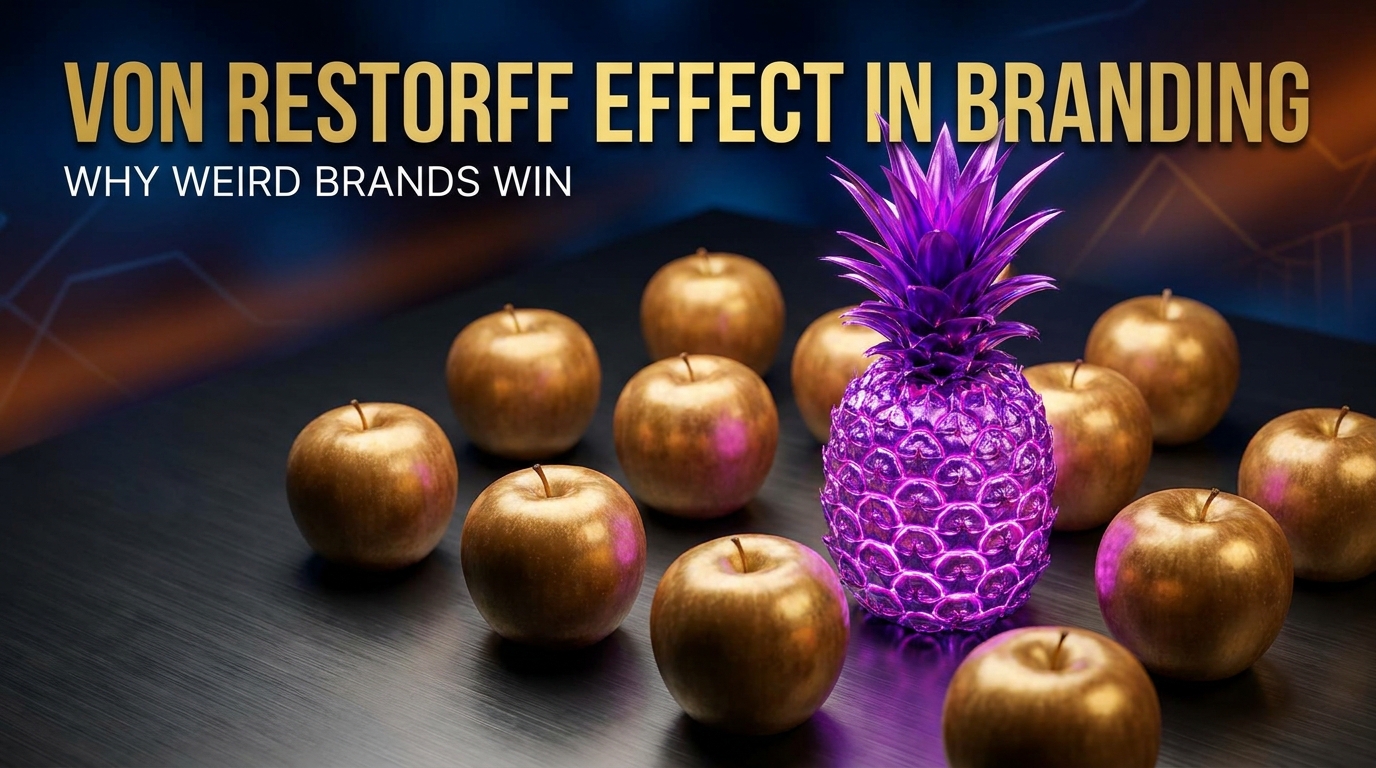
Picture a supermarket shelf of bottled water. Blue labels. Mountains. Droplets. Words like pure, natural, spring, fresh. Fifteen brands, all whispering the same thing in the same voice, and none of them staying in your head for more than four seconds. Now put one matte black tallboy can among them that looks like a heavy metal beer and says “Murder Your Thirst.”
You already know which one you would remember tomorrow. You probably remember it right now, and you have not even seen a picture. That is the von Restorff effect, and it is quietly the most underused principle in branding, because being distinctive requires a nerve that most marketing committees do not have. I am an Industrial and Organizational Psychologist, and this article covers the 1933 experiment behind it, the brands that built empires on being the odd one, the mechanics that make weirdness stick in memory, and the honest limits, because “be weird” is terrible advice on its own and I will explain exactly where it fails.
“Every category has a uniform. Wearing it makes you look like you belong. It also makes you look like everyone else, and memory does not save copies.”
— Consumer Psychology Analysis, ShahzebSpeaks

🧠 The 1933 experiment: what von Restorff actually found
Hedwig von Restorff was a German psychiatrist and researcher working in Berlin under Gestalt psychologist Wolfgang Köhler. In 1933 she ran a deceptively simple study: participants memorized lists of items where most entries were similar, say a run of three-digit numbers, with one item deliberately different, such as a syllable or a colored shape dropped into the middle.
The result was consistent and strong. The odd item was recalled dramatically better than the homogeneous items around it. It was not because the odd item was more interesting in itself; the same item recalled poorly when it sat among other odd items. The isolation was doing the work, not the item. That is why researchers also call it the isolation effect, and it is a distinction that matters enormously for branding, as we will see.
What is happening cognitively? Two things worth knowing. First, memory encodes by difference. When several inputs share features, they interfere with each other and blur into a category rather than individual traces. The isolated item has nothing to blur into, so it keeps a clean address in memory. Second, distinctiveness captures attention involuntarily, which means it gets more processing before it is even filed away. Later work by Robert Hunt on distinctiveness in memory refined this considerably: the effect depends on a background of similarity. No background, no figure.
Now translate that to a shelf, a feed, or a search results page. Your brand is never encountered alone. It is always an item in a list. And the list is where the effect lives.
💀 Example 1: Liquid Death — the clearest case in modern branding
Liquid Death sells water. That is the whole product. The category is the definition of undifferentiated: hydration, sold at low margins, in a market where every competitor uses the same visual vocabulary of blue, mountains and purity.
The brand’s founder, an advertising creative, made one decision that carried everything: put water in a tallboy can with heavy metal artwork, name it something violent, and market it with the slogan “Murder Your Thirst.” Every element is a deliberate violation of category norms. The result is a brand that people photograph, post, argue about, and wear as merchandise, which is genuinely bizarre behavior toward drinking water.
What makes it a textbook von Restorff case rather than just a funny idea: the weirdness is anchored to a real product benefit. The can format is genuinely more recyclable than plastic bottles, and the tallboy also gave the brand a social use case (something to hold at a party without drinking alcohol) that no water bottle could serve. Weird plus useful is a strategy. Weird alone is a costume, and the difference decides which brands survive their own novelty.

🐊 Example 2: Crocs — the ugliness that became identity
Crocs are, by conventional design standards, not beautiful. Foam clogs with ventilation holes. For years they were the punchline of fashion jokes, and there were entire hate pages devoted to them.
Here is the psychology that turned that into a multi-billion-dollar business: an object nobody feels neutral about is an object nobody forgets. The mockery was free, continuous distribution of a highly distinctive silhouette, and a shape that can be recognized in a photograph from thirty meters is a distinctive brand asset that competitors cannot copy without becoming a joke themselves.
Crocs then did the smart second move: they let the wearers convert the joke into identity. Jibbitz charms turned the shoe into a canvas for self-expression, which reframed wearing them from “I have poor taste” to “I am in on the joke and comfortable enough not to care.” That reframing is the difference between the brands that ride out a weird phase and the brands that build a tribe from it. The weirdness got attention; the community gave it meaning.

👹 Example 3: Labubu — nine teeth of engineered distinctiveness
I dissected this in my full Labubu psychology audit, so here is just the von Restorff layer. The collectible toy market is saturated with cuteness: round eyes, soft shapes, gentle smiles. In that environment, another cute character is an item on a homogeneous list, and homogeneous lists do not produce memory traces.
Kasing Lung’s design keeps most of the cute schema, huge eyes and a round head, then adds one violation: a wide grin with nine serrated teeth and a glint of mischief. The result reads as cute-and-slightly-wrong, which is precisely the configuration the brain refuses to file away neatly. In a lineup of pastel plushies, Labubu is the isolated item, and 100 million units sold in a single year is what isolation is worth when the rest of the machine is built correctly.
🟣 Example 4: Cadbury purple and the ownable-asset version
The von Restorff effect does not require being strange. It requires being different from your neighbors, which is why colour is one of the most efficient applications. Cadbury’s purple, Tiffany’s blue, T-Mobile’s magenta, and Christian Louboutin’s red soles all exploit the same mechanic: in a category where competitors cluster around conventional colours, one brand owns an off-convention shade and becomes instantly identifiable at a glance, before a single word is read.
These brands then did the thing most companies skip: they defended the asset legally and, more importantly, used it with obsessive consistency for decades. Distinctiveness only compounds if it is repeated. A brand that changes its distinctive asset every rebrand is starting the memory work over each time, which is expensive and slow, and I have watched clients do it because a new marketing head wanted a fresh look. The fresh look is usually the cost of erasing years of recognition.
🍔 Example 5: The category-uniform trap (and who escapes it)
Look at almost any category and you will find a uniform. Law firms: navy, serif, columns. Banks: blue, shields, handshakes. Fitness: black, red, aggressive italics. Beauty: as I described in the Rhode audit, the current uniform is minimalist beige, which was distinctive five years ago and is now the crowd.
The uniform exists for a reason worth respecting: it signals category membership. A bank that looks like a nightclub creates a comprehension problem, and comprehension failures cost more than obscurity. But most brands wear the uniform far past the point of necessity, adopting not only the category’s grammar but its exact vocabulary, which buys belonging at the price of memory. The escape route that consistently works is 90% conventional, 10% violation: keep the category cues that create trust, break one cue hard. Aviation is a good illustration: as I covered in my Emirates audit, an airline shower is an absurd, category-violating detail that made the brand permanently memorable while everything else about the operation stayed reassuringly conventional.

⚠️ An honest caveat: three ways “be weird” goes wrong
This is the section most articles on this topic skip, and it is the reason the advice fails in practice.
Weirdness without relevance is noise. Von Restorff’s own data hints at this: an item recalled because it was odd is not the same as an item that means anything. A distinctive brand that nobody understands has bought attention it cannot convert. The test I give clients: can a stranger explain what you sell after five seconds with your packaging? If not, your violation is in the wrong place. Break the aesthetic norm, not the comprehension one.
Weirdness in a weird category is invisible. This is the isolation effect’s hidden clause. When everyone is loud, loudness is the uniform, and the isolated item becomes the plain one. Energy drinks discovered this: after a decade of extreme graphics, the distinctive move became clean minimalism. Craft beer discovered it too, where a plain label now stands out in an aisle of chaotic illustration. Distinctiveness is relative, always, which means the right move depends entirely on what your neighbors are doing this year, not on a permanent brand truth.
Weirdness ages, and fast. The moment your violation gets imitated, it stops being isolated. Byron Sharp’s work at the Ehrenberg-Bass Institute makes the practical point better than most academic literature: what marketers should chase is distinctive brand assets, consistent codes that trigger recognition, rather than novelty for its own sake. Novelty is a one-time payment. Distinctiveness, held for twenty years, is an annuity.
🛠️ How to apply it without becoming a gimmick
Practical version, in the order I actually work through it with clients.
Start by auditing the uniform. Print your competitors’ packaging, homepages, or ads at thumbnail size and lay them out together. Whatever features repeat across most of them, colour, layout, tone, imagery, is your category’s uniform. Half the value of this exercise is that it embarrasses people into honesty; brands that believe they are unique usually discover they are indistinguishable at thumbnail scale, which is the scale most decisions happen at.
Then pick one violation and go all the way. A single strong deviation beats five mild ones, because mild differences blur back into the category and cost you the isolation. Choose the dimension where the deviation also carries meaning: format (Liquid Death’s can), silhouette (Crocs), colour (Cadbury), a product detail (Emirates’ shower), or voice.
Finally, commit for years and defend it. Consistency is what converts a novelty into an asset, and the number of brands that abandon a working distinctive code because internal stakeholders got bored of it is, professionally speaking, the most avoidable waste I encounter. Your customers see your branding a fraction as often as your team does. By the time you are sick of it, the market is barely starting to remember it.
❓ Frequently asked questions
What is the von Restorff effect in simple terms?
Things that stand out from their surroundings are remembered much better than things that blend in. Named after Hedwig von Restorff, who demonstrated it in 1933 with lists where one odd item was recalled far more often than the similar items around it.
Why is it also called the isolation effect?
Because the memory advantage comes from the item being isolated against a background of similar items, not from the item itself being inherently memorable. Put the same odd item among other odd items and the advantage disappears.
How do brands use the von Restorff effect?
By deliberately violating one category convention while keeping the rest: Liquid Death selling water in a beer-style tallboy can, Crocs’ unmistakable silhouette, Labubu’s serrated grin among cute toys, or owning an off-convention colour like Cadbury purple or Tiffany blue.
Does being weird always help a brand?
No. Weirdness fails when it breaks comprehension rather than aesthetics, when the whole category is already weird (making conventional the distinctive move), or when it is novelty rather than a consistent asset held long enough to build recognition.
What is the difference between distinctiveness and differentiation?
Differentiation is being meaningfully different in what you offer. Distinctiveness is being instantly recognizable in how you look and sound. The von Restorff effect operates on distinctiveness, and research from the Ehrenberg-Bass Institute argues distinctiveness drives more real-world brand growth than most marketers assume.
🧠 Is your brand wearing the category uniform?
I’m Muhammad Shahzeb, an MSc Industrial and Organizational Psychologist and Full-Stack Developer. I run distinctiveness audits that compare your brand against your category at thumbnail scale and identify the one violation worth committing to. It is usually uncomfortable, and it is usually the highest-return branding decision available.
📚 References and further reading
- von Restorff, H. (1933). “Über die Wirkung von Bereichsbildungen im Spurenfeld” [The effects of field formation in the trace field]. Psychologische Forschung, 18, 299-342.
- Hunt, R. R. (1995). “The subtlety of distinctiveness: What von Restorff really did.” Psychonomic Bulletin & Review, 2(1), 105-112.
- Hunt, R. R., & Worthen, J. B. (Eds.) (2006). Distinctiveness and Memory. Oxford University Press.
- Sharp, B. (2010). How Brands Grow: What Marketers Don’t Know. Oxford University Press. (Distinctive brand assets.)
- Romaniuk, J. (2018). Building Distinctive Brand Assets. Oxford University Press.
- Köhler, W. (1929). Gestalt Psychology. Liveright. (Context for von Restorff’s Berlin research.)
- Berlyne, D. E. (1970). “Novelty, complexity, and hedonic value.” Perception & Psychophysics, 8(5), 279-286.
- McGraw, A. P., & Warren, C. (2010). “Benign violations: Making immoral behavior funny.” Psychological Science, 21(8), 1141-1149. (Cute-creepy tension.)
Written by Muhammad Shahzeb, MSc Industrial & Organizational Psychology | Consumer Psychology Specialist | Full-Stack Web Developer
Learn more about my approach →