Starbucks Psychology Audit — How “Back to Starbucks” Tried to Buy Back the Third Place With a Sharpie
A deep psychology audit of Starbucks and the "Back to Starbucks" turnaround. How a Seattle bean shop sold Americans the idea of a third place, how mobile ordering quietly turned the coffeehouse into a factory, why the name on the cup matters more than the coffee, what the Sharpie and the four-minute promise are really doing, why the new Rewards tiers triggered a backlash, and the uncomfortable question the turnaround has not answered: can warmth be scripted by the people you are still negotiating with?

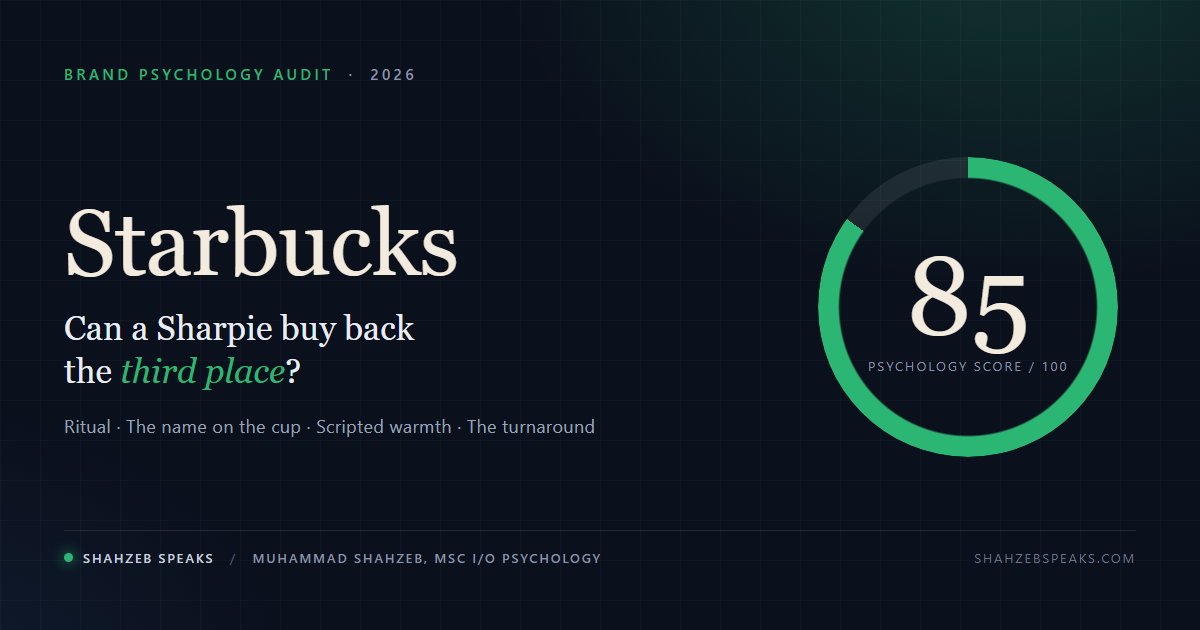
85 / 100
Overall consumer behavior effectiveness
Brand Overview
- Brand nameStarbucks
- Founded1971
- HeadquartersSeattle, Washington, USA
- IndustryFood & Beverage
- Websitewww.starbucks.com ↗
Psychology Techniques Identified
- 01The Third Place (Oldenburg)
- 02Ritual & Habit Architecture
- 03Personalisation & the Name Effect
- 04Customisation as Identity (IKEA Effect)
- 05Distinctive Brand Assets (Siren, Green Apron, Cup)
- 06Seasonal Scarcity (Pumpkin Spice, Red Cups)
- 07Loyalty Tiers & Status Signalling
- 08Loss Aversion in Rewards Changes
- 09Service Speed & Waiting Psychology
- 10Scripted Warmth & Emotional Labour
- 11Turnaround Narrative (Return to Roots)
- 12Restorative Justice Framing After Crises
Full Psychology Audit Report
In this audit
At 7:52 on a weekday morning, somewhere in America, a person walks into a Starbucks and does not order anything. Their drink is already waiting in a paper bag on a crowded shelf by the door, one of thirty, ordered from the app in a car park. They grab it, check the sticker, and leave without making eye contact with a single human being. The whole visit takes nine seconds. It is extremely efficient. And it is the reason Starbucks nearly lost its way.
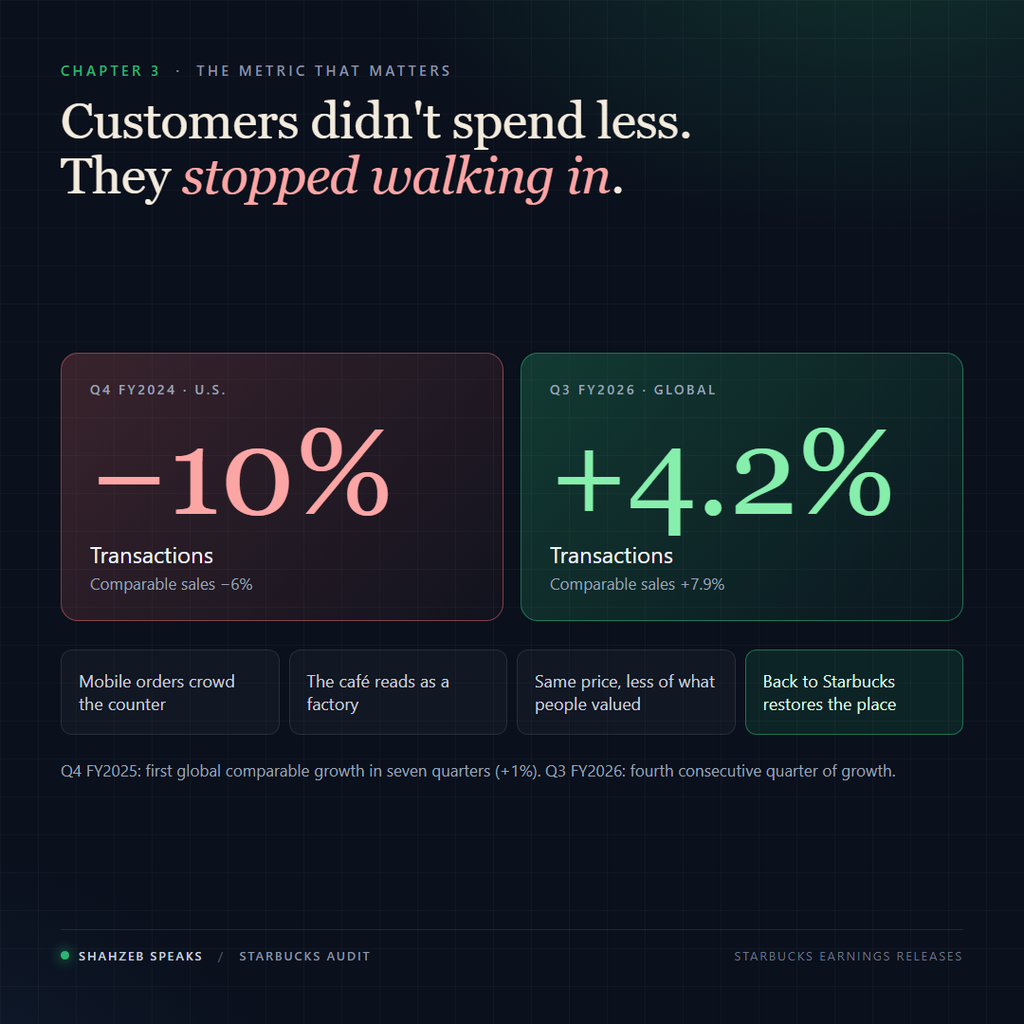
Starbucks did not become one of the most valuable restaurant brands on earth by selling coffee. It sold a place: somewhere between home and work where you could sit, be known by name, and feel like a slightly better version of yourself for the price of a drink. By 2024 that place had turned, for many customers, into a pickup counter with a queue. U.S. comparable store sales fell 6% in the fourth quarter of fiscal 2024, and transactions fell 10%. People had not just started spending less. They had stopped coming.
Then the board brought in Brian Niccol, the executive credited with rescuing Chipotle, and he launched a plan with a name that was itself a piece of psychology: “Back to Starbucks.” Sharpies on cups. Ceramic mugs. Condiment bars. A four-minute service target. Two years on, global comparable sales rose 7.9% in the third quarter of fiscal 2026. I am an Industrial and Organizational Psychologist, and this audit examines how Starbucks built its psychological empire, how it quietly dismantled it, what the turnaround is really doing to customers’ minds, and the one problem that no amount of handwriting can solve.
“Starbucks never sold coffee. It sold the feeling of being recognised in a public place. Mobile ordering made the coffee faster and the recognition disappear, and ‘Back to Starbucks’ is a two-year attempt to put a human face back on a machine the company built to remove it.”
— Brand Psychology Analysis, ShahzebSpeaks
📋 Brand Overview: Starbucks at a Glance
| Company Name | Starbucks Corporation |
| Founded | 1971, Pike Place Market, Seattle, by Jerry Baldwin, Zev Siegl and Gordon Bowker |
| Headquarters | Seattle, Washington, USA |
| CEO | Brian Niccol (since September 2024; previously CEO of Chipotle) |
| Stores | 41,304 worldwide at the end of Q3 FY2026, including 16,933 in the U.S. |
| Latest Quarter | Q3 FY2026: revenue $9.3B; global comparable sales +7.9% (transactions +4.2%, ticket +3.5%); U.S. comparable sales +7.9% |
| Loyalty | 35.8 million 90-day active Starbucks Rewards members in the U.S. (Q3 FY2026); tiered Green / Gold / Reserve program since March 2026 |
| China | Joint venture with Boyu Capital closed April 2026: Boyu 60%, Starbucks 40% and brand owner, around 8,000 stores |
| Signature Assets | The Siren, the green apron, the white cup with a name on it, “tall / grande / venti,” the red holiday cup, the Pumpkin Spice Latte |
| Psychological Code | You are known here |
| Psychology Score | 85 / 100 — ⚡ High Impact |
📜 Chapter 1: The History — From Bean Shop to Third Place to Pickup Counter (1971–2026)
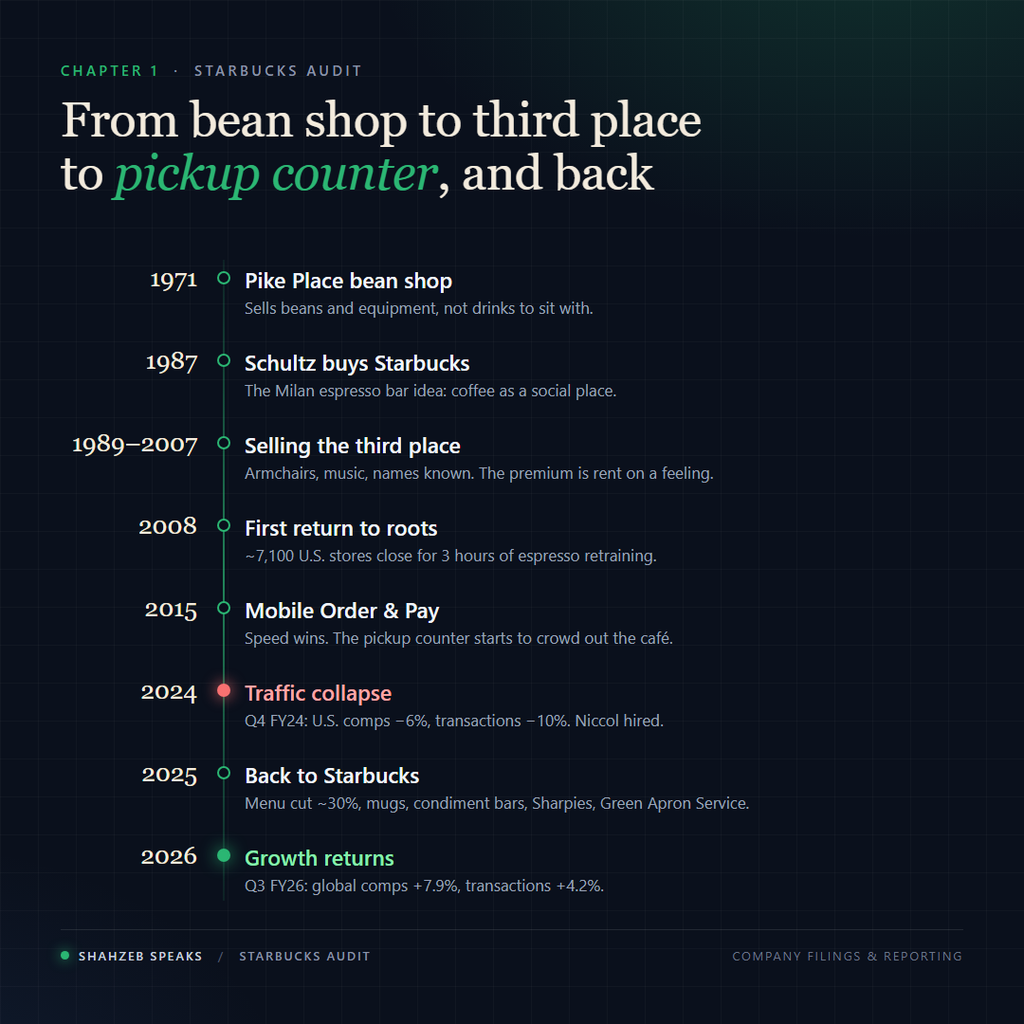
☕ 1971–1987: A Shop That Sold Beans, Not Experiences
The original Starbucks at Pike Place Market sold whole coffee beans and equipment. It did not sell drinks to sit with. Howard Schultz joined in 1982, travelled to Milan in 1983, and came back convinced that the Italian espresso bar was not a place to buy coffee but a social institution. The founders were not persuaded. Schultz started his own chain, Il Giornale, and in 1987 bought Starbucks and merged the two. Everything the brand became starts with that disagreement about what a coffee shop is for.
🛋️ 1987–2007: Selling the Third Place
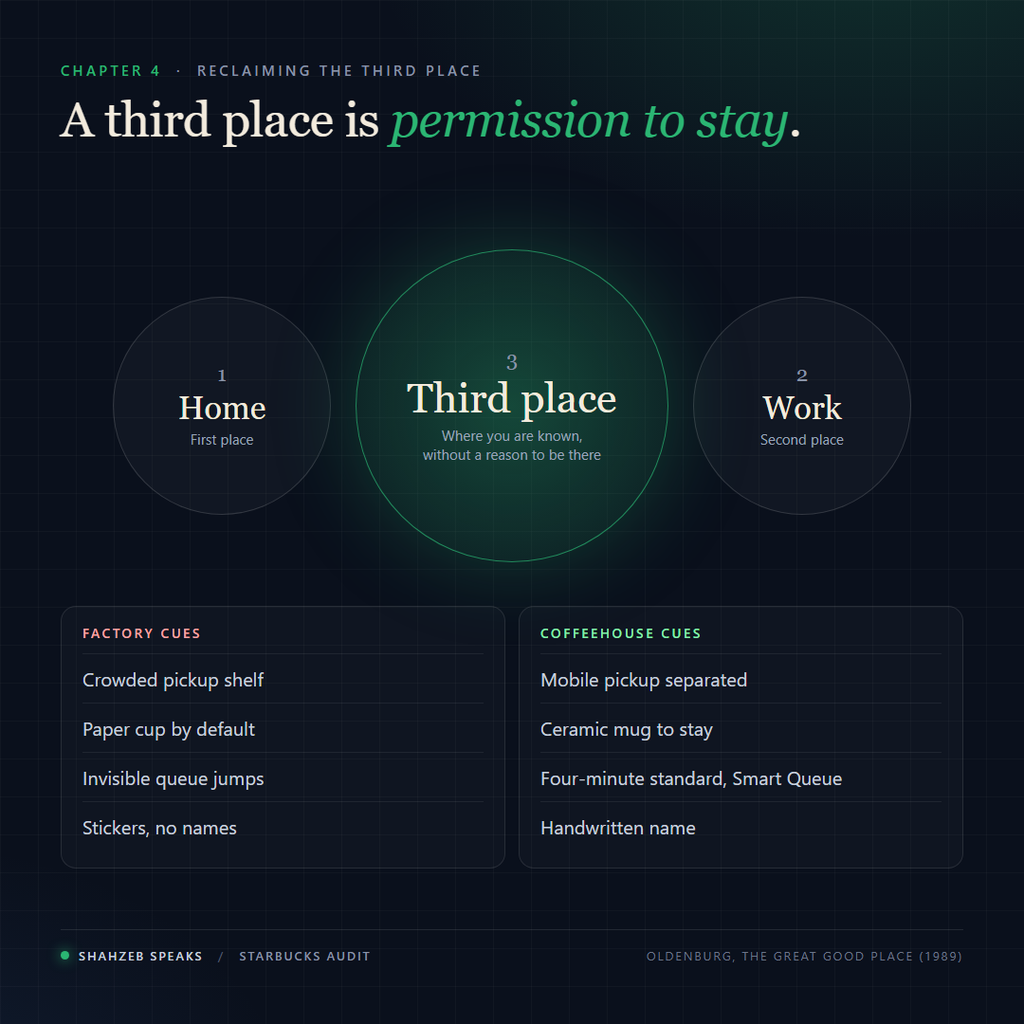
Schultz found his language in the sociologist Ray Oldenburg, whose 1989 book The Great Good Place described “third places”: informal public spaces, distinct from home (the first place) and work (the second), where community forms. Starbucks adopted the idea as its identity. The stores were designed for lingering, with armchairs, music, warm lighting and staff who learned regulars’ orders. Prices far above a diner coffee made sense only because you were paying rent on a feeling.
🔁 2008: The First Return to Roots
By 2008 rapid expansion had diluted the experience, and Schultz returned as CEO. On 26 February 2008 Starbucks closed around 7,100 U.S. stores for three hours to retrain baristas on espresso. It was operationally modest and symbolically enormous: a company publicly admitting it had drifted from what made it special. Remember that move. Seventeen years later, a different CEO would run the same play.
📱 2015–2023: The App Wins, the Place Loses
Mobile Order & Pay rolled out nationally in 2015 and grew into a major share of U.S. transactions. Starbucks Rewards became one of the most successful loyalty programmes in retail. The company optimised relentlessly for throughput: drive-throughs, pickup stores, complex customised cold drinks. Each decision was rational. Together, they quietly converted a third place into a fulfilment operation, and the chapters below explain the psychological cost.
📉 2024: The Traffic Collapse
By fiscal 2024 comparable sales were falling, with U.S. transactions down 10% in the fourth quarter. In August 2024 the board replaced CEO Laxman Narasimhan with Brian Niccol, and the share price jumped by roughly a quarter in a day, one of the largest single-day gains in the company’s history. The market was not reacting to a coffee strategy. It was reacting to the belief that someone could restore what the brand had lost.
🖊️ 2024–2026: Back to Starbucks
Niccol’s plan combined symbolism with operations: cutting around 30% of the menu, bringing back condiment bars and ceramic mugs, handwriting on cups, a Coffeehouse Code of Conduct, the Green Apron Service model with a four-minute target, store renovations, a $1 billion restructuring that closed stores and cut 900 non-retail roles, a China joint venture, and a redesigned Rewards programme. Global comparable sales returned to growth in the fourth quarter of fiscal 2025, the first increase in seven quarters, and reached +7.9% by the third quarter of fiscal 2026.
🧠 Chapter 2: The Core Product Was Never Coffee
If you want to understand every decision in this audit, start here. Starbucks has always charged a premium that the coffee itself cannot justify, and customers have always known it. What they were buying was a bundle of psychological benefits, and it helps to name them precisely.
Ritual. A daily ritual reduces decision load and gives the day structure. The same drink, the same route, the same greeting. Habit research by Wendy Wood and colleagues shows that a large share of daily behaviour runs on context cues rather than conscious choice. Starbucks positioned itself as the cue in millions of morning routines, and a cue that is part of your identity is extraordinarily hard to replace.
Affordable self-reward. A £4 or $6 drink is a small luxury that nearly anyone can justify. It functions as what economists call an affordable indulgence: a way to feel you are treating yourself without the guilt of a big purchase. I covered how these small, justified rewards stack up in my Diderot effect article.
Identity through customisation. “Venti iced oat milk shaken espresso, extra shot, light ice” is not an order. It is a statement of who you are. Customisation creates authorship, and authorship creates attachment, which is the IKEA effect I described in my IKEA effect article: we value what we helped create. A drink you designed yourself is worth more to you than a standard one, even if it costs the same to make.
Recognition. Being known by name, or even just having your name called out, is a small social reward. Humans are wired to notice their own name; the classic “cocktail party effect” research shows our own name can capture attention even when we are focused elsewhere. Starbucks made that cue part of the transaction itself.
A place to be. The third place. Somewhere you are allowed to exist in public without a reason, which in a culture of long commutes and isolated work has real value.
Now notice something. Mobile ordering keeps the first three benefits and destroys the last two. You still get your ritual, your treat and your custom drink. You lose recognition and you lose the place. That is exactly the pattern the numbers showed: customers who still loved the product but no longer loved going.
📉 Chapter 3: How Efficiency Destroyed the Experience
The decline of Starbucks was not caused by one bad decision. It was caused by a series of good ones that nobody evaluated from the customer’s emotional point of view.
The waiting problem
David Maister’s classic work on the psychology of waiting lines established that how long a wait feels matters more than how long it is. Unexplained waits feel longer than explained ones. Uncertain waits feel longer than known ones. Unfair waits, where someone who arrived after you is served first, feel longest of all. Mobile ordering produced all three at once. A customer standing at the counter watched barista after barista make drinks for invisible app users, with no idea where their own order sat in the queue. The wait felt unfair even when it was short.
The crowded counter
A handoff area piled with bags and cups signals a factory, not a café. Environmental psychology shows that crowding and clutter raise stress and reduce the desire to stay. The café that was designed for lingering now visually told customers to grab and go, and many took the hint and stopped coming in at all.
Complexity as a hidden tax on staff
Endless modifiers and elaborate cold drinks slowed production and put baristas under constant time pressure. Stressed staff cannot perform warmth. The relationship between employee experience and customer experience is one of the most consistent findings in service research, often described as the service-profit chain: when frontline employees are overloaded, customers feel it.
Price without the place
Prices kept rising through this period. That is survivable when you are paying for an experience. It becomes much harder to justify when the experience has been removed and what remains is a paper bag on a shelf. The same price had quietly started buying less of what customers valued. This is what the 10% transaction decline represents: a rational re-evaluation by millions of people.
Niccol described the problem publicly in similar terms, saying in 2026 interviews that stores had come to operate more like a manufacturing facility than a coffeehouse. That is an unusually candid admission for a CEO, and it is psychologically the correct diagnosis.
🛋️ Chapter 4: “Back to Starbucks” — Reclaiming the Third Place
The name of the plan is worth pausing on. “Back to Starbucks” is a nostalgia frame. It does not promise something new. It promises the return of something customers already believe was good. Nostalgia is a powerful persuasive tool because it borrows credibility from memory: people do not need to be convinced that the old Starbucks was pleasant, they only need to believe it can return. It also quietly assigns blame for the decline to a recent past, not to the brand itself.
The individual changes are small, and that is deliberate. Each one targets a specific psychological cue.
Ceramic mugs for customers who stay. A mug is an invitation. A paper cup says “take this with you”; a mug says “sit down.” It is one of the cheapest environmental cues in the business and it changes how long people feel they are allowed to remain.
Condiment bars return. Letting customers add their own milk and sugar restores a small sense of control and autonomy, and moves part of the customisation back into the customer’s own hands, which both speeds service and increases perceived ownership of the drink.
A simpler menu. Cutting around 30% of items reduces choice overload for customers and complexity for staff. Iyengar and Lepper’s famous 2000 jam study, where fewer options led to more purchases, has had mixed replication results since, and I would not cite it as a law. But the operational logic is sound: fewer items mean faster, more consistent drinks and less stressed baristas.
Renovations for warmth. Starbucks reported more than 1,000 stores renovated in the nine months before its two-year anniversary, targeting 1,500 or more by the end of fiscal 2026, with changes focused on seating and lighting. Lighting and seating are the two variables environmental psychologists most consistently link to how long people stay and how relaxed they feel.
Separating the app from the café. Starbucks has worked to move mobile pickup away from the in-store experience. Psychologically this removes the most visible sign of the factory, and the fairness violation of watching invisible customers get served ahead of you.
The Coffeehouse Code of Conduct. Introduced in January 2025, it made clear that spaces are for customers and partners, reversing the 2018 policy that allowed anyone to use cafés and restrooms without buying. This is the most psychologically complicated change, and I return to it in Chapter 9.
🖊️ Chapter 5: The Name on the Cup
Of every change in the turnaround, the Sharpie gets the most attention, and it deserves it. It is the clearest example of a tiny intervention designed to carry a very large psychological load.
Starbucks paused writing on cups early in the pandemic and reintroduced handwritten names and short messages under Niccol, reportedly buying around 200,000 Sharpies to do it. Why does something so small matter?
Your name is the most personally relevant word you know. Research on self-relevance shows that people attend to and remember information connected to themselves more readily than other information. A name written by hand is a direct signal that a specific human noticed you specifically.
Handwriting signals effort. Printed stickers are free. Handwriting costs a person’s time and attention, and costly signals are more believable. Research on handwritten notes in other settings, such as restaurant servers writing “thank you” on bills, has found small positive effects on tips, though results vary. The mechanism is reciprocity: a gesture that seems personal invites a warmer response.
It makes the cup shareable. Misspelled names on Starbucks cups became an internet genre years ago, and a handwritten message is something people photograph and post. Every photographed cup is free advertising carrying the logo.
It re-introduces a human at the moment of pickup. For mobile customers who never speak to a barista, the handwriting on the cup is the only evidence that a person was involved at all. It is an attempt to put the relationship back into a transaction that the app removed.
In theory, it is an elegant intervention. In practice, it runs into the most difficult problem in this audit.
🎭 Chapter 6: The Scripted Warmth Problem
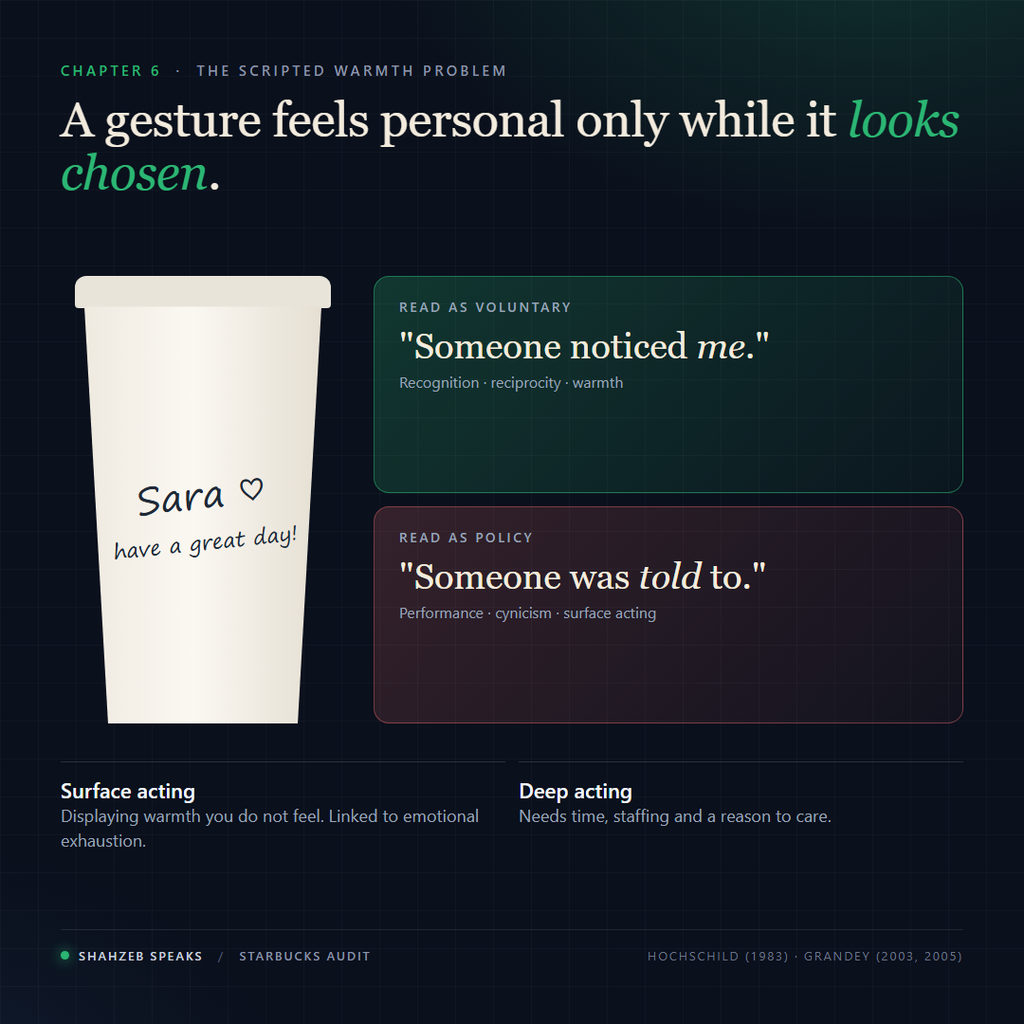
Here is the paradox, stated plainly. A personal gesture feels personal only if it appears voluntary. The moment a customer learns that the smiley face on their cup is required by policy, the gesture stops meaning “someone noticed me” and starts meaning “someone was told to do this.”
That is not a hypothetical. Customer reactions reported in 2025 and 2026 were mixed: some people loved the messages, others described them as sad, forced or irrelevant, and some said the notes stopped feeling special once they realised it was simply a new company policy. Baristas pushed back too, with reports of staff describing the requirement as one more task in an already understaffed shift, and reports that consistently failing to mark cups could be treated as a performance issue.
Industrial psychology has a precise name for what is being asked of these employees. Arlie Hochschild’s 1983 book The Managed Heart described emotional labour: the work of displaying required emotions as part of a job. Later research distinguished between surface acting, displaying emotions you do not feel, and deep acting, trying to genuinely feel them. The research, including Grandey’s work, consistently links surface acting to emotional exhaustion and burnout. A barista writing “have a great day!” for the three hundredth time, on a short-staffed shift, with a timer running, is surface acting almost by definition.
And customers can often tell. Studies of authentic versus inauthentic smiles in service settings, such as Grandey and colleagues’ 2005 research, found that customers responded better to service displays they perceived as authentic. The warmth the company is trying to buy becomes less valuable in exact proportion to how obviously it is required.
This does not make the Sharpie a mistake. It makes it a tool that only works under one condition: that the people holding it are staffed, supported and treated well enough that the gesture is at least partly genuine. Which is why Chapter 10 matters more than any other in this audit.
⏱️ Chapter 7: The Four-Minute Promise and Green Apron Service
Alongside the human cues, Starbucks launched a new operating model called Green Apron Service, which it describes as its largest-ever investment in hospitality, with more than $500 million committed to additional labour hours in company-operated stores, larger rosters and a sequencing system called Smart Queue. The target is that orders should take four minutes or less.
Psychologically, this is the correct pairing, and it is the part of the plan I find most convincing.
Speed and warmth are not opposites; stress is the enemy of both. Asking staff to be warmer without giving them more time is asking for surface acting. Giving them more labour hours and a better queuing system is the only way warmth becomes physically possible.
A known standard reduces uncertainty. Following Maister’s waiting principles, a customer who expects their drink within a few minutes, and gets it, experiences the wait as fair. Smart Queue’s role in sequencing café and mobile orders also directly addresses the fairness violation from Chapter 3.
The number is a message to staff as much as to customers. A clear, measurable standard gives a team something concrete to succeed at, which research on goal setting by Locke and Latham suggests improves performance when goals are specific and achievable. Starbucks has said that most of its cafés are now meeting the four-minute standard. The risk is the familiar one from any timed service metric: a stopwatch that becomes a surveillance tool produces speed at the expense of the very warmth it was supposed to protect. I wrote about that exact trap in my article on micromanagement psychology.
⭐ Chapter 8: Rewards — Status for Some, Loss for Everyone Else
Starbucks Rewards is one of the most successful loyalty programmes in retail, with 35.8 million 90-day active members in the U.S. by the third quarter of fiscal 2026. On 10 March 2026 Starbucks relaunched it with three tiers based on annual spending: Green (the free entry level), Gold (500 Stars a year, earning 1.2 Stars per dollar) and Reserve (2,500 Stars a year, earning 1.7 Stars per dollar, with elite perks).
The design logic is textbook loyalty psychology.
Status signalling. Tiers create visible rank, and rank motivates. Research on hierarchical loyalty programmes, including Drèze and Nunes’s work on status tiers, found that customers value status more when fewer people have it, and that the presence of a tier below you makes your own tier feel more valuable. A Reserve tier is designed for the heaviest customers to feel recognised, which echoes the “you are known here” code at the heart of the brand.
The goal gradient. A visible threshold, 500 or 2,500 Stars, gives customers a target, and people accelerate effort as they approach a goal. I covered this in the Duolingo audit; Starbucks is applying the same mechanism to coffee spending.
The backlash was immediate, and it was also predictable. Many regular customers argued on social media that rewards now felt harder to earn. Whether or not a specific customer is worse off in pure value terms, any restructuring of a loyalty programme is experienced through loss aversion. Prospect theory shows that losses weigh roughly twice as heavily as equivalent gains. The benefits of the new system accrue to a small number of heavy users as gains. The perceived costs are spread across millions of ordinary users as losses. The arithmetic of feeling guarantees that the complaints will be louder than the praise.
There is a subtler risk too. A loyalty scheme that visibly sorts customers into classes sits awkwardly beside a brand whose origin story is a democratic third place where everyone is welcome. Status tiers tell most customers they are ordinary. That is a trade Starbucks has chosen to make for the economics, and it deserves to be named.
⚠️ Chapter 9: The Dark Side — Whose Third Place Is It?
🚪 The Code of Conduct and the limits of “welcome”
In 2018, after two Black men were arrested at a Philadelphia Starbucks while waiting for a colleague without having bought anything, the company apologised, closed more than 8,000 U.S. stores for an afternoon of racial-bias training, and adopted a policy that anyone could use its cafés and restrooms without purchasing. That response is widely taught as a strong example of restorative crisis management.
The January 2025 Coffeehouse Code of Conduct reversed that open-door policy, stating that spaces are for customers and partners, and banning harassment, drug use and disruptive behaviour. Operationally, the company was responding to real safety concerns raised by staff and customers. Psychologically, it redefined who the third place belongs to. Oldenburg’s third place was open to anyone; Starbucks’s version is now explicitly for people who pay. For most customers that is invisible. For a brand that used “a place for everyone” as moral capital, it is a meaningful change.
💸 Price fatigue
The turnaround restored traffic partly through experience improvements while average ticket continued to rise, up 3.5% globally in the third quarter of fiscal 2026. Warmth can justify a premium. It cannot justify an ever-increasing one indefinitely, especially for younger customers comparing Starbucks with cheaper, faster, more playful rivals.
🎭 Symbols as substitutes
The highest-risk version of this turnaround is one where visible symbols such as Sharpies, mugs and condiment bars are used as substitutes for structural fixes such as staffing and pay. Customers are good at detecting when a brand is signalling care rather than practising it. The 2026 results suggest Starbucks has invested in both, but the balance has to hold as margin pressure returns.
🧑🍳 Chapter 10: The Partners Problem — Warmth Delivered by People Without a Contract
Starbucks calls its employees “partners,” and the brand promise is delivered almost entirely by them. This is where the audit’s central tension becomes impossible to ignore.
Workers at hundreds of U.S. stores have voted to unionise since 2021, and there is still no first contract. Starbucks Workers United launched an unfair labour practice strike, the “Red Cup Rebellion,” on 13 November 2025. After 131 days, bargaining resumed in April 2026, and union baristas accused the company of reopening issues that had already been agreed. On 25 August 2026 the union announced a consumer boycott to pressure Starbucks to sign a contract covering around 12,000 unionised baristas. The union’s proposals have focused on pay, minimum staffing and protection from store closures; Starbucks’ position is that it offers competitive pay and benefits and wants to reach an agreement.
I am not taking a side in a labour negotiation, and there are legitimate positions on both. But from a brand psychology standpoint, the risk is not ambiguous.
Every element of “Back to Starbucks” depends on employee discretionary effort. Handwriting a name with genuine care, making eye contact, remembering a regular, staying calm during a rush: none of these can be fully enforced by policy. They come from what organisational psychologists call organisational citizenship behaviour, the voluntary effort beyond the job description, and the research is consistent that it depends on perceived fairness and trust in the employer. I explained that mechanism in my quiet quitting article: the first thing to disappear when people feel treated unfairly is not the job, it is the extra effort.
A company can mandate the Sharpie. It cannot mandate the meaning. If baristas feel unheard, underpaid or overworked, the handwritten message becomes surface acting, and customers sense it. The company has invested heavily in labour hours, which is exactly the right lever. The unresolved contract is the part of the system that could quietly cancel the investment out.
There is also a reputational exposure. For a brand whose marketing promise is human connection, a highly visible dispute with the humans providing that connection creates dissonance that competitors and critics can exploit. The boycott is an attempt to make customers carry that dissonance to the counter.
⚔️ Chapter 11: Competitive Positioning
| Competitor | Psychological Position | Where Starbucks Wins or Loses |
| 7 Brew and Dutch Bros | Drive-through energy, playful customisation, staff chat as the product | Loses on youthful energy and speed of connection; wins on scale, loyalty and the café itself. See my 7 Brew audit |
| McDonald’s (McCafé) | Value, speed, familiarity | Loses badly on price; wins on identity, quality perception and place. See my McDonald’s audit |
| Independent cafés | Authenticity, craft, local belonging | Loses on genuine warmth and taste credibility; wins on consistency, convenience and app |
| Luckin Coffee (China) | Cheap, app-first, fast, heavy discounting | Starbucks lost the price war and restructured into a joint venture; it keeps the premium, aspirational position |
| Home coffee | Cheapest option, total control | The real competitor in a price-sensitive year; only the place and the ritual beat it |
The pattern across the table is revealing. On price and speed Starbucks is beaten by several rivals. On coffee craft it is beaten by independents. The one position nobody else at Starbucks’ scale can credibly hold is the place. That is why the turnaround had to return to the café: it is not nostalgia, it is the only defensible ground left.
📊 Chapter 12: Psychology Scorecard — Detailed Ratings
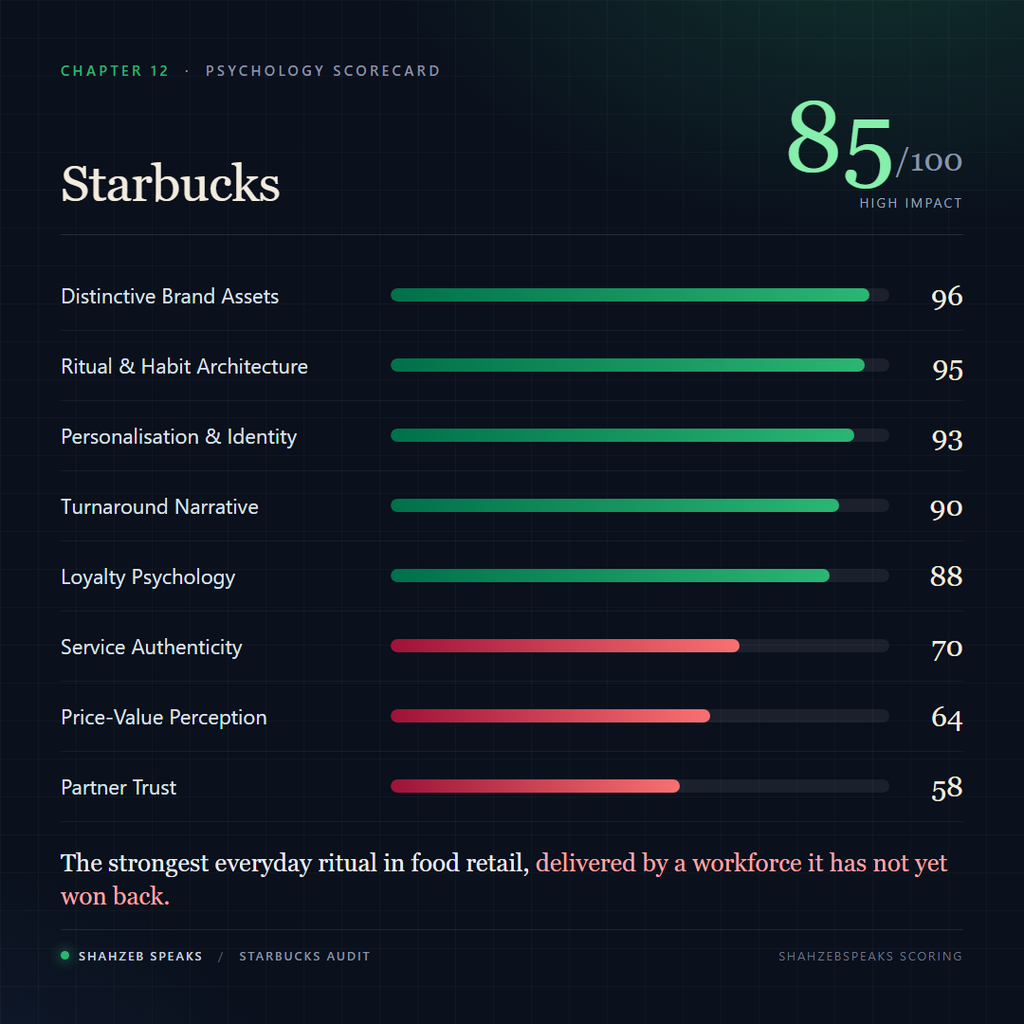
| Psychology Dimension | Score | Verdict |
| Distinctive Brand Assets | 96/100 | The Siren, the apron, the cup and its own size language. Recognised almost everywhere. |
| Ritual & Habit Architecture | 95/100 | A daily cue in millions of routines, reinforced by an app that sits on the phone. |
| Personalisation & Identity | 93/100 | A drink you designed and a name on the cup: authorship and recognition in one object. |
| Loyalty Psychology | 88/100 | 35.8M active members; the tier relaunch added status and triggered loss aversion. |
| Turnaround Narrative | 90/100 | A nostalgia frame with visible symbols and real results: four quarters of growth. |
| Service Authenticity | 70/100 | Mandated warmth risks reading as performance; the labour investment is the saving grace. |
| Price-Value Perception | 64/100 | The place justifies a premium; rising tickets test how far. |
| Partner Trust | 58/100 | No first contract, a long strike and a boycott, in a brand promising human connection. |
| OVERALL PSYCHOLOGY SCORE | 85/100 | ⚡ High Impact — the most powerful everyday ritual in food retail, recovering fast, with its biggest risk inside its own stores. |
✅ Chapter 13: Balance Sheet & A Psychologist’s Prescription
💪 Psychological Strengths
- A ritual, not a product: Starbucks owns a slot in the daily routine of millions, which is far harder to displace than a preference
- Elite distinctive assets: the Siren, the cup, the apron and the size vocabulary work without a single word of copy
- Customisation as identity: the drink is the customer’s own creation, which builds attachment through authorship
- A correct diagnosis: the company identified that it had lost the place, not the product, and aimed its fix there
- Symbols backed by labour: Green Apron Service puts real hours behind the warmth cues
- Proof of recovery: transactions, not just prices, are driving growth again
⚠️ Psychological Weaknesses
- Scripted warmth: a required gesture loses meaning once customers learn it is required
- Emotional labour load: surface acting on busy shifts is a documented route to burnout
- Partner dissonance: an unresolved union dispute sits inside a brand whose promise is connection
- Tiered loyalty: status for heavy users reads as a loss for the majority
- A narrower third place: the Code of Conduct changed who the space is for
- Price elasticity: the premium depends on the experience staying visibly better
🔮 The Prescription
- Make the Sharpie optional and trusted. Give baristas the tools and the time, then stop monitoring whether every cup is marked. A handwritten message that is sometimes absent is believable. One that is always present is policy. Measuring the gesture destroys the thing it measures.
- Treat the first contract as a brand investment, not only a labour cost. Every customer-facing element of the turnaround runs on partner goodwill. Resolving the dispute protects the return on the half-billion dollars already put into labour hours.
- Protect the Green tier from feeling like a demotion. Give the majority a visible, simple benefit that is unrelated to spending, such as a recognition moment on a membership anniversary. Status for the top works best when the base still feels valued.
- Keep the pickup factory out of sight. The single most damaging visual cue of the slump was the crowded handoff counter. Separating mobile pickup physically is worth more to the third place than any renovation budget.
- Measure connection the way you measure speed. The four-minute metric gives teams a clear target. Add a simple, customer-reported measure of whether they felt welcomed, and weight it equally, so speed does not quietly become the only thing that matters again.
📝 Final Verdict
Starbucks built one of the most psychologically powerful brands in consumer history by understanding that people were not paying for coffee. They were paying for a ritual, a small reward, a drink that expressed who they were, the sound of their own name, and a place where they were allowed to be. For twenty years that bundle justified prices no one would pay for the coffee alone.
Then, through a series of reasonable efficiency decisions, the company kept the coffee and removed the place. The traffic collapse of 2024 was customers correctly noticing that they were now paying a premium for a paper bag on a shelf. “Back to Starbucks” is the right diagnosis, executed with a clever mix of cheap symbols and expensive substance, and the fiscal 2026 numbers show it working.
The unresolved question is the one this audit keeps returning to. Warmth cannot be manufactured at scale; it can only be made possible. Starbucks has put Sharpies in baristas’ hands and hours on their rosters. Whether customers feel genuinely welcomed will depend on whether the people writing their names feel genuinely valued, and that is a question no press release, renovation or loyalty tier can answer on the company’s behalf.
Psychology Score: 85/100 — Starbucks earns elite marks for distinctive assets (96), ritual and habit architecture (95), personalisation and identity (93) and its turnaround narrative (90), held back by service authenticity (70), price-value perception (64) and partner trust (58). The best everyday ritual in food retail, back on its feet, and still negotiating with the people who carry it.
🧠 Want a Psychology Audit for Your Brand?
I’m Muhammad Shahzeb, an MSc Industrial Psychologist and Full-Stack Developer. I audit customer experience, loyalty mechanics and the employee side of service brands, including the part where the problem your customers feel starts with how your frontline staff are treated. Let’s look at yours.
📚 References & Sources
- Starbucks Corporation. “Starbucks Reports Q3 Fiscal Year 2026 Results.” Form 8-K earnings release, July 29, 2026. investor.starbucks.com
- Starbucks Corporation. “Starbucks Reports Q4 and Full Fiscal Year 2025 Results.” October 29, 2025.
- Starbucks Corporation. “Starbucks and Boyu Capital Finalize Joint Venture to Accelerate Long Term Growth in China.” April 2, 2026.
- Starbucks Corporation. “Starbucks reimagines its Rewards program with new levels and exclusive perks.” 2026.
- Starbucks Corporation. “Message from Brian: Green Apron Service, one month in.” 2025; “Two years of Back to Starbucks.” 2026.
- CNBC. “Starbucks replaces CEO Laxman Narasimhan with Chipotle CEO Brian Niccol.” August 13, 2024.
- CNBC. “Starbucks to close stores, lay off workers in $1 billion restructuring plan.” September 25, 2025.
- NPR. “See you latte: Starbucks plans to cut 30% of its menu.” January 28, 2025.
- Axios. “Starbucks changes free refill policy, brings back condiment bars.” January 27, 2025.
- CNN Business. “Starbucks baristas are already complaining about doodling on your cups.” February 6, 2025.
- The Boston Globe. “Starbucks baristas forced to pen cheery notes.” May 6, 2026.
- Newsweek. “Starbucks revamps Rewards program—why it’s getting immediate backlash.” March 2026.
- Labor Notes. “Baristas Ask Organizations to Boycott until Starbucks Signs a Contract.” August 2026.
- Fortune. Interview with Starbucks CEO Brian Niccol on how stores had come to run like a manufacturing facility. March 23, 2026.
- Oldenburg, R. (1989). The Great Good Place. Paragon House.
- Schultz, H., & Yang, D. J. (1997). Pour Your Heart Into It. Hyperion.
- Maister, D. H. (1985). “The psychology of waiting lines.” In J. A. Czepiel, M. R. Solomon, & C. F. Surprenant (Eds.), The Service Encounter. Lexington Books.
- Hochschild, A. R. (1983). The Managed Heart: Commercialization of Human Feeling. University of California Press.
- Grandey, A. A. (2003). “When ‘the show must go on’: Surface acting and deep acting as determinants of emotional exhaustion and peer-rated service delivery.” Academy of Management Journal, 46(1), 86-96.
- Grandey, A. A., Fisk, G. M., Mattila, A. S., Jansen, K. J., & Sideman, L. A. (2005). “Is ‘service with a smile’ enough? Authenticity of positive displays during service encounters.” Organizational Behavior and Human Decision Processes, 96(1), 38-55.
- Heskett, J. L., Jones, T. O., Loveman, G. W., Sasser, W. E., & Schlesinger, L. A. (1994). “Putting the service-profit chain to work.” Harvard Business Review, 72(2), 164-174.
- Drèze, X., & Nunes, J. C. (2009). “Feeling superior: The impact of loyalty program structure on consumers’ perceptions of status.” Journal of Consumer Research, 35(6), 890-905.
- Kahneman, D., & Tversky, A. (1979). “Prospect theory: An analysis of decision under risk.” Econometrica, 47(2), 263-291.
- Norton, M. I., Mochon, D., & Ariely, D. (2012). “The IKEA effect: When labor leads to love.” Journal of Consumer Psychology, 22(3), 453-460.
- Wood, W., & Neal, D. T. (2007). “A new look at habits and the habit-goal interface.” Psychological Review, 114(4), 843-863.
- Iyengar, S. S., & Lepper, M. R. (2000). “When choice is demotivating: Can one desire too much of a good thing?” Journal of Personality and Social Psychology, 79(6), 995-1006.
- Locke, E. A., & Latham, G. P. (2002). “Building a practically useful theory of goal setting and task motivation.” American Psychologist, 57(9), 705-717.
Audit conducted by Muhammad Shahzeb, MSc Industrial & Organizational Psychology | Brand Psychology Specialist | Full-Stack Web Developer
Learn more about my approach →
Key Findings
- By Q4 fiscal 2024, U.S. comparable store sales had fallen 6% and transactions 10%, a traffic collapse that says customers stopped visiting, not merely stopped spending
- Mobile ordering solved speed and destroyed atmosphere: a crowded pickup counter turned the "third place" into a production line, which is the psychological problem "Back to Starbucks" was built to reverse
- The turnaround worked on the numbers: global comparable sales rose 7.9% in Q3 fiscal 2026 with transactions up 4.2%, the fourth consecutive quarter of growth after seven quarters of decline
- Handwritten names and messages on cups are a cheap, powerful personalisation cue, but warmth that is mandated and monitored risks being read as performance by both customers and baristas
- The March 2026 Rewards redesign into Green, Gold and Reserve tiers added status signalling for heavy users while making rewards feel harder to earn for everyone else, a textbook loss-aversion backlash
- The deepest risk is internal: a brand whose promise is human connection is still without a first contract for roughly 12,000 unionised baristas, and customers eventually notice when the people delivering the warmth do not feel it
Overall Psychology Score
Starbucks scores 85/100 in our comprehensive psychology audit covering consumer behavior strategies, UX design principles, and psychological marketing effectiveness.
The detailed dimension scores are in the audit's Psychology Scorecard chapter.
High impactMuhammad Shahzeb
MSc Industrial Psychologist, specializing in consumer behavior, UX psychology, and brand strategy analysis. Helping brands understand the psychology behind their success.
About Muhammad Shahzeb →