7 Brew Psychology Audit — How a Drive-Thru Coffee Stand From Arkansas Grew 744% and Started Beating Starbucks at Its Own Game
The first deep psychology audit of 7 Brew ever written. How a drive-thru coffee stand from Arkansas grew from 38 locations to over 777 in three years, posted 244% growth in consumer interest, and built the fastest-growing brand in America by inverting almost every rule Starbucks wrote. Includes the customization loop, the 30-second relationship, the dirty soda wave, and the two risks that could break it.

87 / 100
Overall consumer behavior effectiveness
Brand Overview
- Brand name7 Brew Coffee
- Founded2017
- HeadquartersRogers, Arkansas, USA
- IndustryDrive-Thru Coffee
- Website7brew.com ↗
Psychology Techniques Identified
- 01Choice Architecture via Customization (The IKEA Effect)
- 02Parasocial Micro-Interaction (The 30-Second Relationship)
- 03Category Inversion (Anti-Third-Place Positioning)
- 04Habit Loop Compression (Drive-Thru Speed Design)
- 05Ritual Ownership ("My Order" Identity)
- 06Social Currency & Order Sharing
- 07Sensory Novelty (Flavour Combinatorics)
- 08In-Group Belonging (Regional Cult Dynamics)
- 09Reciprocity via Free Sampling (The Energy Card)
- 10Anticipatory Reward Loops (Dirty Soda Culture)
- 11Employee Enthusiasm as Brand Asset
- 12Scarcity by Geography (The "We Don't Have One Yet" Effect)
Full Psychology Audit Report
In this audit
In January 2023, a coffee company from Rogers, Arkansas had 38 locations. By mid-2026 it had over 777 across 38 states, systemwide sales had climbed from $52 million to roughly $502 million, and Yelp had named it the fastest-growing brand in America on the back of 244% growth in consumer interest. It has no seating. No wifi lounge. No laptop workers. No pastry case. It is, in the most literal sense, a shed with two lanes.
The company is 7 Brew, and it is quietly the most interesting brand story in America right now, because everything about it contradicts what the coffee industry spent thirty years learning from Starbucks. Starbucks won by building a place to stay. 7 Brew is winning by making sure you never get out of the car. I am an Industrial and Organizational Psychologist, and as far as I can tell this is the first deep psychological audit of the brand anyone has written, which is itself a signal of how fast this thing moved.
Across the next twelve chapters I will take apart exactly what is happening here: the customization loop that turns a drink into a creation, the thirty-second relationship at the window that competitors cannot copy with an app, the dirty soda wave it is riding, why the absence of a third place became a positioning rather than a limitation, and the two structural risks that decide whether this becomes a national institution or a very expensive lesson in trend dependency.
“Starbucks sold you a place to belong. 7 Brew sells you thirty seconds of being known, a drink nobody else invented, and your driveway back in four minutes. One of those is harder to scale. The other is harder to quit.”
— Brand Psychology Analysis, ShahzebSpeaks
📋 Brand Overview: 7 Brew at a Glance
| Brand Name | 7 Brew Coffee |
| Founded | 2017, Rogers, Arkansas (the home town of the first Walmart) |
| Ownership Journey | Brew Culture (2020) → Drink House Holdings, backed by Jimmy John Liautaud and Jamie Coulter (2021) → Blackstone growth investment (2024) |
| Growth | 38 locations (Jan 2023) → 777+ across 38+ states (mid-2026); 744%+ unit growth in three years |
| Systemwide Sales | $52 million → ~$502 million (roughly 865% growth) |
| 2026 Recognition | Yelp’s fastest-growing brand in America (244% growth in consumer interest); Franchise Times “Fast & Serious” No. 1 |
| Format | Small double-lane drive-thru stands; no dine-in seating |
| Signature Products | Customizable brews, energy drinks, smoothies, shakes, teas and the dirty-soda-adjacent flavour builds |
| Psychological Code | Speed, warmth, personal authorship |
| Psychology Score | 87 / 100 — ⚡ Extreme Impact |
📜 Chapter 1: The Complete History — Arkansas Shed to National Phenomenon (2017–2026)
☕ 2017: A Stand in Rogers, Arkansas
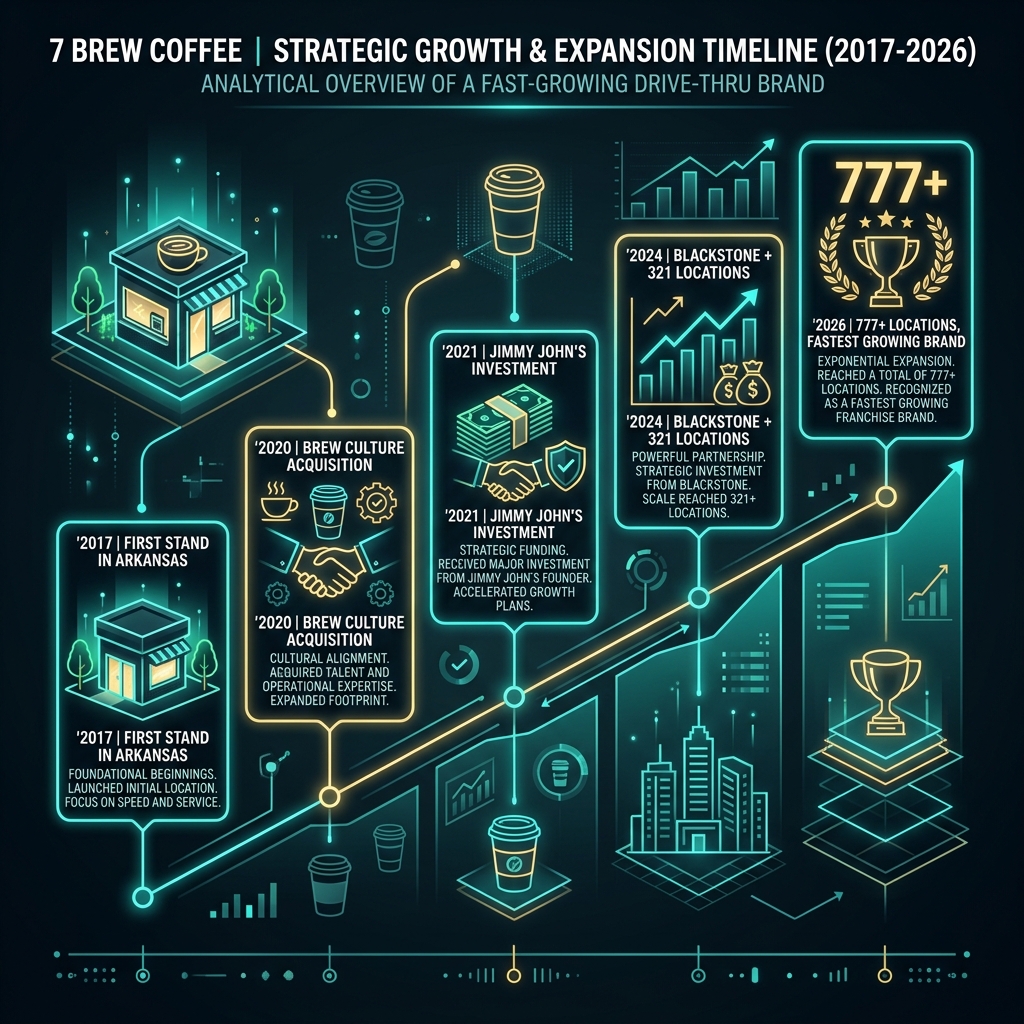
7 Brew opened in 2017 in Rogers, Arkansas, the town where Sam Walton opened his first Walmart, which is a coincidence worth noticing because both businesses solved the same underlying problem: how to serve ordinary people faster and more cheaply than anyone thought possible. The original concept was small and unglamorous, a drive-thru-only beverage stand with a short menu and an emphasis on speed. By 2020 there were seven stands, which is the kind of number that gets a business described as “regional” and then forgotten.
💼 2020-2021: The Ownership That Changed the Trajectory
A group of entrepreneurs formed the parent company Brew Culture and acquired 7 Brew in January 2020. Then in March 2021, with the chain still at nine units, it attracted a majority owner that tells you exactly what was seen in it: Drink House Holdings, an investment partnership created by Jimmy John Liautaud, founder of Jimmy John’s, and Jamie Coulter of Lone Star Steakhouse. Jimmy John’s built an empire on one obsession, speed. That is not a coincidental investor for a drive-thru brand; it is a thesis.
🚀 2022-2024: The Explosion
What followed is the part that makes this an audit rather than a profile. 7 Brew went from 38 units in early 2023 to 321 by the close of 2024, and past 700 by 2026, adding hundreds of net new stores in a period when much of the restaurant industry was closing them. Systemwide sales moved from $52 million to around $502 million. In 2024 private equity giant Blackstone came in with a growth investment as Drink House exited, and Chris Dawson, formerly of Walk-On’s, took over as president.
🏆 2025-2026: The Validation
In 2025 the Flynn Group, the largest franchise operator on earth with Applebee’s, Pizza Hut and Wendy’s in its portfolio, signed a 160-unit development agreement. Then came the two recognitions that put 7 Brew on national radar: Franchise Times named it No. 1 in its 2026 Fast & Serious rankings, and Yelp named it the fastest-growing brand in America for 2026, citing 244% growth in consumer interest during 2025.
That last metric is the one that matters psychologically. Unit growth can be bought with capital and franchise agreements. Consumer interest growth cannot. A 244% jump in people actively searching for a brand means something in the product experience is generating demand faster than the real estate can absorb it, and the rest of this audit is about what that something is.
🎨 Chapter 2: The Customization Engine — Why “Your Drink” Beats “Our Drink”
The single most important psychological mechanism at 7 Brew is not the coffee. It is the fact that the customer builds the drink.
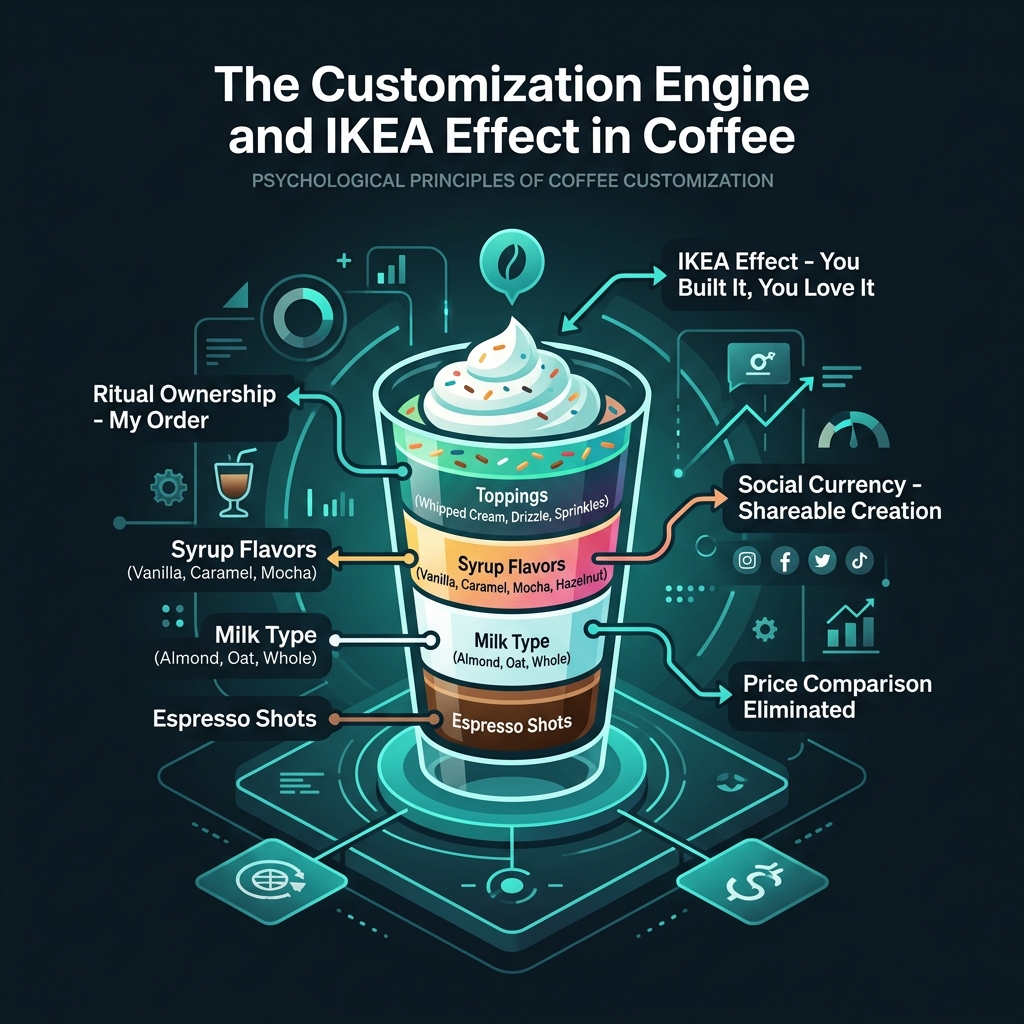
Flavour shots, milk choices, energy bases, sweetness levels and add-ins combine into a menu that is effectively combinatorial rather than fixed. Yelp’s own analysis of the fastest-growing brands identified this explicitly: the winners invite consumers to take part in creating their experience. That participation is doing far more work than it appears to.
I covered the underlying research fully in my IKEA effect article, and the summary is this: Norton, Mochon and Ariely demonstrated that people value things they helped create substantially more than identical things made for them. The labour does not have to be large. It has to be real, and it has to succeed. Choosing four variables for a drink is a tiny act of creation, and it is enough to shift the customer’s relationship to the cup from consumer to author.
Three consequences follow, and they are all commercially significant. First, an authored drink is not comparable to a competitor’s product, because nobody else sells your combination, which quietly removes price comparison from the decision. Second, the customer develops what I would call ritual ownership: “my order” becomes a small piece of identity, repeated daily, and identity purchases are extraordinarily resistant to switching. Third, the combination is tellable. People share their build with friends, which is free advertising with a personal endorsement baked in, and it is the reason this brand grew through word of mouth faster than through media spend.
Contrast this with the traditional coffee model, where the barista is the artisan and you are the recipient. 7 Brew moved the creative act across the window, and gave it to the person holding the money.
😊 Chapter 3: The Thirty-Second Relationship — Parasocial Warmth at Scale
Anyone who has been to a 7 Brew notices the same thing, and it is deliberate: the person at the window is relentlessly, almost implausibly, upbeat. Employees lean out, make eye contact, ask about your day, remember regulars. The industry describes this as culture. Psychologically it is something more specific, and more valuable.
What 7 Brew has engineered is a micro-interaction of social recognition, delivered daily, in under a minute. Belonging is a fundamental human need, and one of the quiet features of modern life, especially in car-dependent American suburbs, is that a person can complete an entire day without being warmly acknowledged by a stranger. A window where someone is visibly pleased to see you is not a service feature. It is a small, reliable dose of mattering, and the brain files reliable positive social contact under things worth repeating.
Notice how neatly this defeats the competitive threat that was supposed to kill drive-thrus. App ordering, kiosk automation and delivery all optimise for removing human contact, and they are excellent at it. But they can only compete on the dimension they optimise, which is friction. 7 Brew is competing on a dimension apps structurally cannot enter: a person who is glad you came. As I noted in my McDonald’s audit, kiosks reliably increase order size partly because the machine never judges you. 7 Brew took the exact opposite bet, that people want to be seen rather than unseen, and the growth numbers suggest a very large segment of the market agrees.
There is also a peak-end mechanism here. Kahneman’s peak-end rule says we remember experiences by their emotional peak and their ending. A 7 Brew visit is short enough that the interaction is both the peak and the end, which means the entire memory of the purchase is a positive human exchange. That is an unusually efficient memory to buy for the price of a drink.
🚫 Chapter 4: Killing the Third Place — Category Inversion as Strategy
Starbucks built the modern coffee category on Ray Oldenburg’s concept of the third place, a space that is neither home nor work where people can linger, work and belong. It was one of the most successful positioning ideas in retail history, and I unpacked how it re-anchored an entire category’s pricing in my anchoring article.
7 Brew’s entire model is the deliberate removal of that idea. No seating, no lounge, no laptops, no bathrooms, no ambience. In brand terms this looks like a downgrade. In psychological terms it is a category inversion, and it works for three reasons that are worth stating plainly.
First, the third place has been partially eaten by remote work. A significant share of the people who once needed a café to work in now have a home office, and what they need from coffee is not a venue but a break, delivered without leaving the car with a child asleep in the back seat.
Second, lingering is a cost the customer pays. Parking, walking, queueing, waiting, walking back. For a habitual daily purchase, that friction is the enemy of the habit loop, and habit research is unambiguous that behaviours become automatic when they are fast, repeatable and immediately rewarded. Removing the building removes the friction.
Third, and most interesting strategically: by refusing to compete on ambience, 7 Brew made itself uncomparable to Starbucks rather than inferior to it. A brand that plays the same game with fewer resources loses. A brand that changes the game cannot be scored on the old card. This is the same move I documented when Qatar Airways reframed business class in the Qatar Airways audit: do not win the category, redefine what the category is measured on.
🔁 Chapter 5: Habit Architecture — Engineering the Daily Return
A coffee brand does not want a customer. It wants a routine, and routines are built by specific mechanics rather than good intentions.
The cue-routine-reward loop here is almost textbook. The cue is the commute, the school run, the mid-afternoon slump, anchored to a physical location the customer passes at the same time daily. The routine is short enough to fit inside an existing journey rather than requiring its own time slot. The reward is triple-layered: caffeine or sugar, an authored drink, and the social micro-hit at the window. Wendy Wood’s research on habit formation emphasises that stable context plus immediate reward is what converts behaviour into automaticity, and 7 Brew has all three variables aligned.
The double-lane format deserves a note of its own. Long queues kill habits, because the anticipated wait becomes a reason not to go, and that anticipation happens before the customer even sets off. By running two lanes and optimising throughput, 7 Brew protects the one thing the entire loop depends on: the belief that this will be quick. The moment a customer starts thinking “there’ll be a line,” the habit begins to decay, which makes throughput a psychological investment rather than an operational one.
🥤 Chapter 6: Riding the Dirty Soda Wave — Trend Surfing With Real Skill
Yelp’s 2026 data included a striking secondary finding: searches related to dirty soda rose 675% during 2025, and customizable sodas and energy drinks moved into the mainstream, with brands including 7 Brew, Sonic and Taco Bell all leaning into flavour-built beverages.
The psychology of this trend is worth unpacking because it explains why 7 Brew is positioned so well for it. Dirty soda culture, flavour shots, cream, mix-ins, is fundamentally about three things. It is combinatorial novelty, an endless supply of new sensory experiences from a fixed set of ingredients, which keeps the exploratory reward system engaged in a way a fixed menu cannot. It is affordable indulgence, a small treat in an expensive era, the same lipstick-effect logic I described in the Labubu audit. And it is social content, because a photogenic layered drink with a personal name is inherently postable.
7 Brew did not invent this wave, and I want to be accurate about that. What it did was build a format almost perfectly shaped to carry it: a customization-first menu, a young enthusiastic staff culture, and a drive-thru model that suits the impulse, afternoon-treat occasion far better than a sit-down café does. Riding a wave you did not create is a legitimate skill. Chapter 10 deals honestly with what happens if the wave recedes.
🏘️ Chapter 7: The Cult Mechanics — Scarcity by Geography
One of the most underrated assets in 7 Brew’s growth is something no marketing team can manufacture on purpose: it is not in your town yet.
A brand expanding from a regional base across 38 states creates a natural scarcity gradient. In markets where it exists, it is a local phenomenon; in markets where it does not, people see it on social media, hear about it from relatives, and want it. When a location finally opens, the result is the queue-around-the-block opening that has become a recognisable feature of the brand’s expansion.
Two mechanisms combine here, both of which I detailed in my scarcity marketing article. Geographic unavailability produces genuine anticipation rather than manufactured urgency, which is the honest version of scarcity and therefore does not carry the trust cost of fake countdown timers. And arrival becomes an event, which generates local press, social posts and a founding cohort of customers who feel like early adopters rather than latecomers.
There is also an in-group dynamic worth naming. Regional chains reliably generate stronger identity attachment than national ones, because belonging requires a boundary. “We have 7 Brew here” is a statement about a town as much as a coffee stand. The strategic problem, which Chapter 10 returns to, is that this asset is spent by success: every new market conquered reduces the scarcity that made conquering it exciting.
🎁 Chapter 8: Reciprocity, Sampling and the Free-Drink Economy
Drive-thru beverage brands in this category are known for generous sampling behaviour, free drinks for first-timers, birthday drinks, spontaneous “this one’s on us” moments at the window, and loyalty rewards that arrive faster than customers expect.
The mechanism is reciprocity, one of Cialdini’s core principles of influence and among the most robust findings in social psychology. An unexpected gift creates a genuine felt obligation, and, crucially, the obligation is disproportionate to the gift’s cost. A free four-dollar drink can buy a return visit, a recommendation to a friend, and a small emotional debt that the customer experiences as goodwill rather than manipulation.
What makes it work here rather than feeling cheap is the framing. The gift is delivered by a smiling human at a window, not by a coupon in an app, which means it reads as generosity from a person rather than a discount from a system. Same monetary value, entirely different psychological currency. Most loyalty programmes fail to grasp this distinction and end up buying transactions when they could have bought relationships.
⚔️ Chapter 9: Competitive Positioning — Who Actually Loses Here
| Competitor | Their Position | Exposure to 7 Brew |
| Starbucks | The third place, premium ritual, global prototype | Loses the daily speed occasion, keeps the meeting and lingering occasion |
| Dutch Bros | The original drive-thru enthusiasm brand, west-coast rooted | The genuine head-to-head rival; nearly identical psychological playbook |
| Dunkin’ | Speed and value, breakfast anchor | Competes on speed but not on authorship or warmth |
| Sonic / Taco Bell drinks | Customizable sodas and energy drinks bolted onto food menus | Chasing the same flavour trend without the beverage-first identity |
The honest competitive read is that 7 Brew’s real rival is Dutch Bros, not Starbucks, because Dutch Bros runs the same core mechanics of drive-thru speed, aggressive customization and engineered staff enthusiasm, and got there first. What 7 Brew has is timing, capital and geography: a Blackstone-backed expansion into a map with more open territory than the west-coast-heavy competition, arriving exactly as the flavour-drink wave crested.
Starbucks, meanwhile, is not being beaten so much as partially unbundled. It still owns the meeting, the study session and the aspirational ritual. What it is losing is the highest-frequency occasion, the daily four-minute purchase, and losing high-frequency occasions is how prototype brands quietly erode without any single dramatic defeat.
⚠️ Chapter 10: The Risks — What Could Break This
🙂 Risk 1: The Enthusiasm Does Not Scale Automatically
Everything in Chapter 3 depends on the person at the window genuinely seeming glad to see you. At 38 locations that is culture. At 777 locations across 38 states with multiple large franchise operators, it becomes a training and selection problem in an industry with high turnover and often modest wages. Organizational psychology is clear that emotional labour, being required to perform an emotion you may not feel, is a documented driver of burnout when it is mandated rather than supported. If the warmth becomes a script enforced from above rather than a culture sustained from within, customers will feel the difference immediately, because humans are extremely good at detecting performed friendliness.
My assessment is that this, not competition, is the single biggest threat to the brand. The asset is human, and human assets degrade quietly at scale.
📉 Risk 2: Trend Dependency
The dirty soda and flavour-drink wave that lifted 7 Brew grew Yelp searches 675% in a year. Trends that rise that fast have a demonstrated tendency to plateau and decline, and a brand whose menu identity is built on a specific flavour culture inherits that cycle. The mitigation is the format itself, drive-thru speed and human warmth are not trends, so the question is whether 7 Brew is a beverage-trend brand wearing a format, or a format brand currently serving a trend. Its own answer to that question will decide the next five years.
💰 Risk 3: Private Equity Growth Pressure
Blackstone’s investment and the Flynn Group’s 160-unit agreement bring capital and operational muscle, and they also bring a growth clock. Rapid franchise expansion under financial targets is exactly the condition under which unit-level experience typically slips: rushed openings, thinner training, market cannibalisation. I noted a version of this dynamic in the Rhode audit, where the risk was scaling a scarcity-and-intimacy brand under a mass-market owner. The pattern is the same here with different products.
🥤 Risk 4: The Health Conversation
A menu built on sweetened, flavoured, caffeinated and energy-based drinks sits in a category facing rising scrutiny, particularly around young consumers and high-caffeine energy products. This is not a present crisis for the brand, and I am not predicting one. It is a structural exposure worth naming in an honest audit, because categories built on indulgence tend to meet regulation and cultural backlash eventually, as the McDonald’s audit documents in detail.
📊 Chapter 11: Psychology Scorecard — Detailed Ratings
| Psychology Dimension | Score | Verdict |
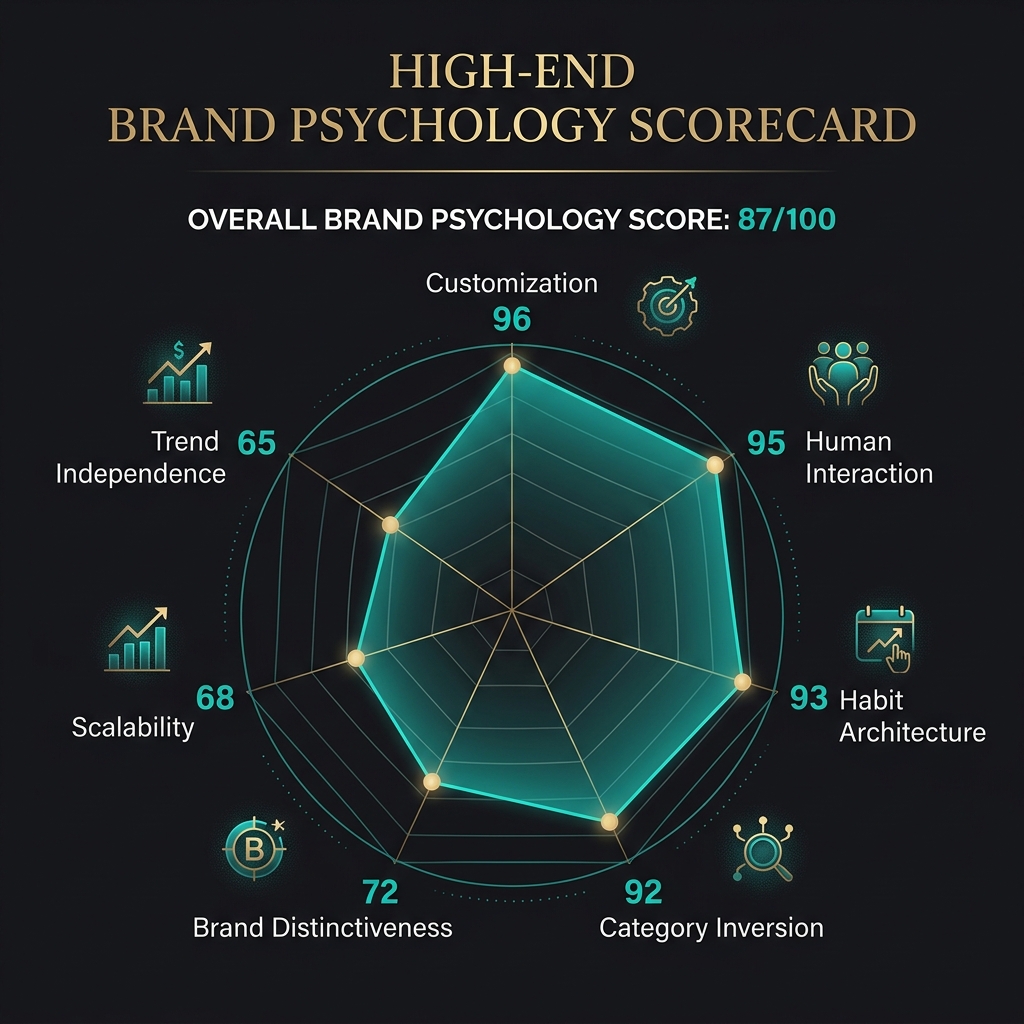
| Customization & Authorship (IKEA Effect) | 96/100 | Turns a commodity drink into a personal creation and removes price comparison. |
| Human Micro-Interaction Design | 95/100 | A daily dose of being recognised, on a dimension apps cannot enter. |
| Habit Architecture | 93/100 | Cue, speed and triple reward aligned; throughput protects the loop. |
| Category Inversion & Positioning | 92/100 | Refused the third place and became uncomparable rather than inferior. |
| Word-of-Mouth & Social Currency | 91/100 | 244% interest growth is demand-led, not media-bought. |
| Brand Distinctiveness (Visual & Verbal) | 72/100 | The format is distinctive; the branding is not yet unmistakable versus Dutch Bros. |
| Scalability of the Core Asset | 68/100 | Engineered warmth is the hardest thing in retail to hold at 777 units. |
| Trend Independence & Durability | 65/100 | Riding a 675% flavour wave it did not create and cannot control. |
| OVERALL PSYCHOLOGY SCORE | 87/100 | ⚡ Extreme Impact — the best new mechanics in American retail. |
✅ Chapter 12: Balance Sheet & A Psychologist’s Prescription
💪 Psychological Strengths
- Authorship over consumption: customers build their drink, which creates attachment, kills comparison shopping and generates shareable content
- A human asset competitors cannot code: thirty seconds of genuine recognition, delivered daily, in a category racing toward automation
- Habit-perfect format: fast, repeatable, physically cued and immediately rewarded, which is the exact recipe for automatic behaviour
- Category inversion: by refusing the third place it made itself uncomparable to the prototype brand rather than a weaker copy of it
- Demand-led growth: 244% growth in consumer interest is the metric capital cannot buy, and it is the one 7 Brew has
⚠️ Psychological Weaknesses
- The warmth is a human asset at franchise scale: the moment enthusiasm becomes a mandated script, customers detect it and the core differentiator evaporates
- Trend dependency: the flavour-drink wave is doing real lifting, and waves recede
- Thin distinctive assets: versus Dutch Bros in particular, the visual and verbal identity is not yet unmistakable at a glance
- Growth-clock pressure: private equity and mega-franchisee expansion typically strain unit-level experience before anyone admits it
- Category health exposure: sweetened and high-caffeine beverages sit in a category with a rising regulatory and cultural conversation
🔮 The Prescription
- Treat crew experience as the brand’s primary marketing budget. The window interaction is the product. Wages, scheduling, autonomy and selection for genuine warmth are not HR line items here; they are brand spend with a higher return than any advertising campaign this company could run.
- Build distinctive assets before the format gets copied. Formats are copyable and will be copied. Ownable colour, a sonic cue, a naming language for builds, and a consistent visual code are what survive imitation, as I argued in the von Restorff article. Right now the experience is more distinctive than the branding, which is a fixable asymmetry.
- Convert trend riders into ritual holders. Name the builds. Let customers save and share them. A drink with a personal name that a customer invented is no longer a trend item; it is theirs, and people do not abandon things that carry their name.
- Protect throughput obsessively as unit count grows. The habit loop dies at the moment customers start expecting a queue. Wait time is not an operations metric here; it is the load-bearing wall of the entire psychology.
- Diversify the occasion before the wave turns. Morning caffeine, afternoon treat and evening social run on different psychological drivers. A brand anchored to only the treat occasion inherits the treat category’s cycle.
- Get ahead of the health conversation voluntarily. Clear caffeine labelling, genuine low-sugar builds and sensible positioning for younger customers cost little now and are far cheaper than responding to a regulatory moment later.
📝 Final Verdict
7 Brew is the most instructive new brand in American retail right now, and the reason has nothing to do with coffee. It won by taking the two things the industry had spent a decade automating away, human warmth and customer participation, and rebuilding the entire format around them. While competitors optimised toward frictionless, contactless, app-mediated efficiency, a company from Arkansas bet that people would rather be greeted by someone who seemed pleased to see them, holding a drink they had personally invented, and would happily do it every single day. Growing from 38 units to 777 and from $52 million to $502 million in three years suggests the bet was correct by a wide margin.
The audit’s honest closing note is about what kind of asset that is. Customization is a system and can be scaled. Speed is engineering and can be scaled. But the thirty seconds at the window is a person having a good day, and no company in history has found a reliable way to mass-produce that under financial pressure. 7 Brew’s next chapter will not be decided by Starbucks, by Dutch Bros, or by the dirty soda trend. It will be decided by whether a brand that grew on genuine human warmth can still afford genuine human warmth at two thousand locations.
Psychology Score: 87/100 — 7 Brew earns elite marks for customization and authorship (96), human micro-interaction design (95), and habit architecture (93), held back by thin distinctive brand assets (72), the scalability of its human core (68), and trend dependence (65). The best new set of mechanics in American retail, resting on the one asset that gets harder to protect with every location it opens.
🧠 Want a Psychology Audit for Your Brand?
I’m Muhammad Shahzeb, an MSc Industrial Psychologist and Full-Stack Developer. I audit customer experience, habit design and brand distinctiveness using behavioral science, including the part where I tell you which of your growth drivers will not survive scale. Let’s look at yours.
📚 References & Sources
- Yelp. “Fastest Growing Brands of 2026.” trends.yelp.com
- Franchise Times. “2026 Fast & Serious Winners: No. 1 7 Brew.” January 2026. franchisetimes.com
- QSR Magazine. “7 Brew is One of the Most Compelling Growth Stories in America.” qsrmagazine.com
- 7 Brew Coffee. Company history and About page. 7brew.com/about
- Fast Company. “This Starbucks competitor is the fastest-growing brand in America.” 2026.
- Numerator. “Fastest Growing Brands to Watch in 2026.” numerator.com
- Norton, M. I., Mochon, D., & Ariely, D. (2012). “The IKEA effect: When labor leads to love.” Journal of Consumer Psychology, 22(3), 453-460.
- Wood, W. (2019). Good Habits, Bad Habits: The Science of Making Positive Changes That Stick. Farrar, Straus and Giroux.
- Duhigg, C. (2012). The Power of Habit. Random House. (Cue-routine-reward loops.)
- Kahneman, D., Fredrickson, B. L., Schreiber, C. A., & Redelmeier, D. A. (1993). “When more pain is preferred to less: Adding a better end.” Psychological Science, 4(6), 401-405.
- Cialdini, R. B. (2006). Influence: The Psychology of Persuasion. Harper Business. (Reciprocity.)
- Oldenburg, R. (1989). The Great Good Place. Paragon House. (The third place concept.)
- Baumeister, R. F., & Leary, M. R. (1995). “The need to belong.” Psychological Bulletin, 117(3), 497-529.
- Hochschild, A. R. (1983). The Managed Heart: Commercialization of Human Feeling. University of California Press. (Emotional labour.)
Audit conducted by Muhammad Shahzeb, MSc Industrial & Organizational Psychology | Brand Psychology Specialist | Full-Stack Web Developer
Learn more about my approach →
Key Findings
- 7 Brew grew from 38 locations in early 2023 to over 777 across 38+ US states by mid-2026, a unit growth rate above 744% in three years
- Yelp named 7 Brew the fastest-growing brand in America for 2026 on the back of 244% growth in consumer interest
- The brand's core psychological weapon is customization: a combinatorial menu that triggers the IKEA effect and converts a beverage into a personal creation
- 7 Brew inverted Starbucks' entire model by removing the third place, betting that modern customers want speed and warmth rather than seating
- The 30-second relationship at the window is a deliberate parasocial mechanic that no app-based competitor can replicate
- The two structural risks are dilution of human warmth at franchise scale, and trend dependency on dirty soda culture which grew 675% in 2025
Overall Psychology Score
7 Brew Coffee scores 87/100 in our comprehensive psychology audit covering consumer behavior strategies, UX design principles, and psychological marketing effectiveness.
The detailed dimension scores are in the audit's Psychology Scorecard chapter.
High impactMuhammad Shahzeb
MSc Industrial Psychologist, specializing in consumer behavior, UX psychology, and brand strategy analysis. Helping brands understand the psychology behind their success.
About Muhammad Shahzeb →