McDonald’s Psychology Audit — How a Toy in a Box Built the Most Powerful Behavioral Machine on Earth
The deepest psychology audit of McDonald's ever written. How the Golden Arches became one of the most recognized symbols on the planet, why the Happy Meal is the most effective childhood conditioning program ever built, how drive-thru design engineers speed into habit, the truth behind the McRib's disappearances, and why McDonald's is not a food company but the world's largest applied behavioral science operation.

92 / 100
Overall consumer behavior effectiveness
Brand Overview
- Brand nameMcDonald's
- Founded1940
- HeadquartersChicago, Illinois, USA
- IndustryFood & Beverage
- Websitewww.mcdonalds.com ↗
Psychology Techniques Identified
- 01Childhood Conditioning (The Happy Meal Loop)
- 02Nostalgia Anchoring Across Generations
- 03Distinctive Brand Assets (Golden Arches & Red-Yellow Coding)
- 04Processing Fluency & Cognitive Ease
- 05Habit Architecture (Drive-Thru Speed Design)
- 06Prototype Branding (Category Mental Default)
- 07Rotating Scarcity (The McRib Strategy)
- 08Decoy & Combo Pricing Psychology
- 09Menu Engineering & Choice Architecture
- 10Consistency as a Trust Heuristic
- 11Sensory Branding (Smell, Sound, Colour)
- 12Glocalization & Cultural Belonging
Full Psychology Audit Report
In this audit
There is a symbol on this planet that a three-year-old can identify from a moving car, in any country, in any language, without reading a single word. Not a flag. Not a religious symbol. A pair of yellow arches, and the child in the back seat will start asking for something they have never been told the name of.
That is not marketing. That is a behavioral installation, performed on billions of nervous systems over seventy years, and it is why I would argue McDonald’s is not a food company at all. It is the largest applied psychology operation in commercial history, and food is simply the medium it operates through. The company runs more than 40,000 restaurants in over 100 countries and feeds tens of millions of people every single day, which means its choice architecture, its colour coding, its menu design and its reward loops are the most widely deployed behavioral system any private organization has ever built.
I am an Industrial and Organizational Psychologist, and this audit takes that machine apart chapter by chapter: the toy that captures children before they can spell, the arches that beat every word in the dictionary, the drive-thru that compressed craving into ninety seconds, the sandwich that gets famous by leaving, and the uncomfortable ethical arithmetic underneath all of it. Some of what follows is genuine admiration. Some of it is not.
“McDonald’s does not sell burgers. It sells a certainty: that in a strange city, in a bad mood, with a tired child in the back seat, one thing on earth will taste exactly the way you expect. They monetised predictability, and predictability is the most underrated craving in human psychology.”
— Brand Psychology Analysis, ShahzebSpeaks
📋 Brand Overview: McDonald’s at a Glance
| Brand Name | McDonald’s |
| Founded | 1940 by Richard and Maurice McDonald; franchised globally from 1955 by Ray Kroc |
| Headquarters | Chicago, Illinois, USA |
| Global Scale | 40,000+ restaurants across 100+ countries; tens of millions of customers served daily |
| Signature Assets | Golden Arches, red-and-yellow colour code, Big Mac, Happy Meal, drive-thru |
| Brand Slogan | “I’m Lovin’ It” (since 2003, one of the longest-running global slogans) |
| Real Business Model | Franchising and real estate as much as food service |
| Psychological Code | Predictability, speed, childhood attachment, effortless recognition |
| Psychology Score | 92 / 100 — ⚡ Extreme Impact |
📜 Chapter 1: The Complete History — A Burger Stand That Became an Operating System (1940–2026)
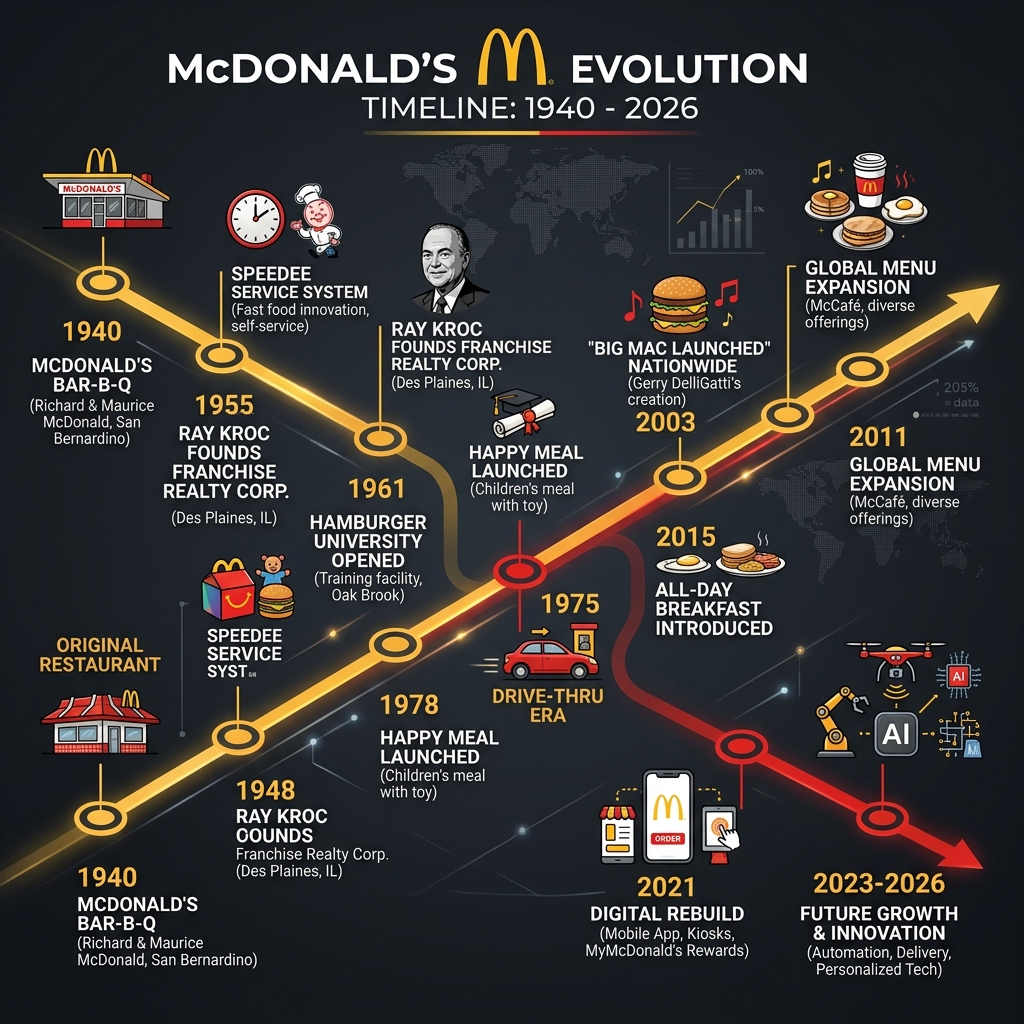
🍔 1940-1948: The Speedee System
Richard and Maurice McDonald opened a barbecue restaurant in San Bernardino, California, then did something that quietly rewrote the psychology of eating out. They noticed most of their profit came from a handful of items, so in 1948 they closed, stripped the menu to a few products, removed waiters, removed plates, removed cutlery, and rebuilt the kitchen as an assembly line. They called it the Speedee Service System.
The behavioral significance is easy to miss. By eliminating choice, waiting and ritual, the brothers converted a social occasion into a transaction. Every psychological mechanism in this audit depends on that original decision, because habits form around short, repeatable, low-friction actions, and the brothers accidentally engineered the shortest possible restaurant action.
🥤 1955: Ray Kroc and the Standardisation Doctrine
Ray Kroc, a milkshake machine salesman, saw the operation and understood something the brothers did not: the product was not the burger, it was the system’s repeatability. Kroc’s obsession with identical procedures across franchises, later formalised at Hamburger University, gave the brand its deepest psychological asset. If the experience is identical everywhere, the brand becomes a guarantee, and guarantees reduce anxiety, and anxiety reduction is worth more than flavour to a huge share of the market.
🤡 1963-1979: Capturing the Child
Ronald McDonald arrived in 1963. Play areas followed. And in 1979 came the Happy Meal, which Chapter 3 treats in full because it deserves it. This period is when McDonald’s stopped competing for adult customers and started acquiring them decades early, at the age when preferences are formed rather than chosen.
🚗 1975: The Drive-Thru Moment
The Sierra Vista, Arizona location opened a drive-thru window largely to serve soldiers from a nearby base who were not permitted to leave their vehicles in uniform. A workaround became the industry’s most important behavioral invention, and Chapter 5 explains why.
🌍 1980s-2000s: Global Sameness, Local Flavour
Expansion into more than 100 countries brought the tension that defines the modern brand: be identical enough to be trusted, local enough to be accepted. The answer was glocalization, which is Chapter 8. This era also produced the backlash years, with Fast Food Nation, Super Size Me and the McLibel case turning the Golden Arches into a symbol for critics as effectively as for customers.
📱 2015-2026: The Digital Rebuild
Self-order kiosks, the app, loyalty rewards, delivery partnerships and the ongoing store redesigns are not cosmetic. They are a systematic rebuild of the choice environment for a customer who now decides on a screen. Kiosks in particular quietly changed the psychology of ordering, as Chapter 6 covers, and the app extended the habit loop beyond the restaurant’s walls into the customer’s pocket.
🔶 Chapter 2: The Golden Arches — The Most Efficient Symbol Ever Designed
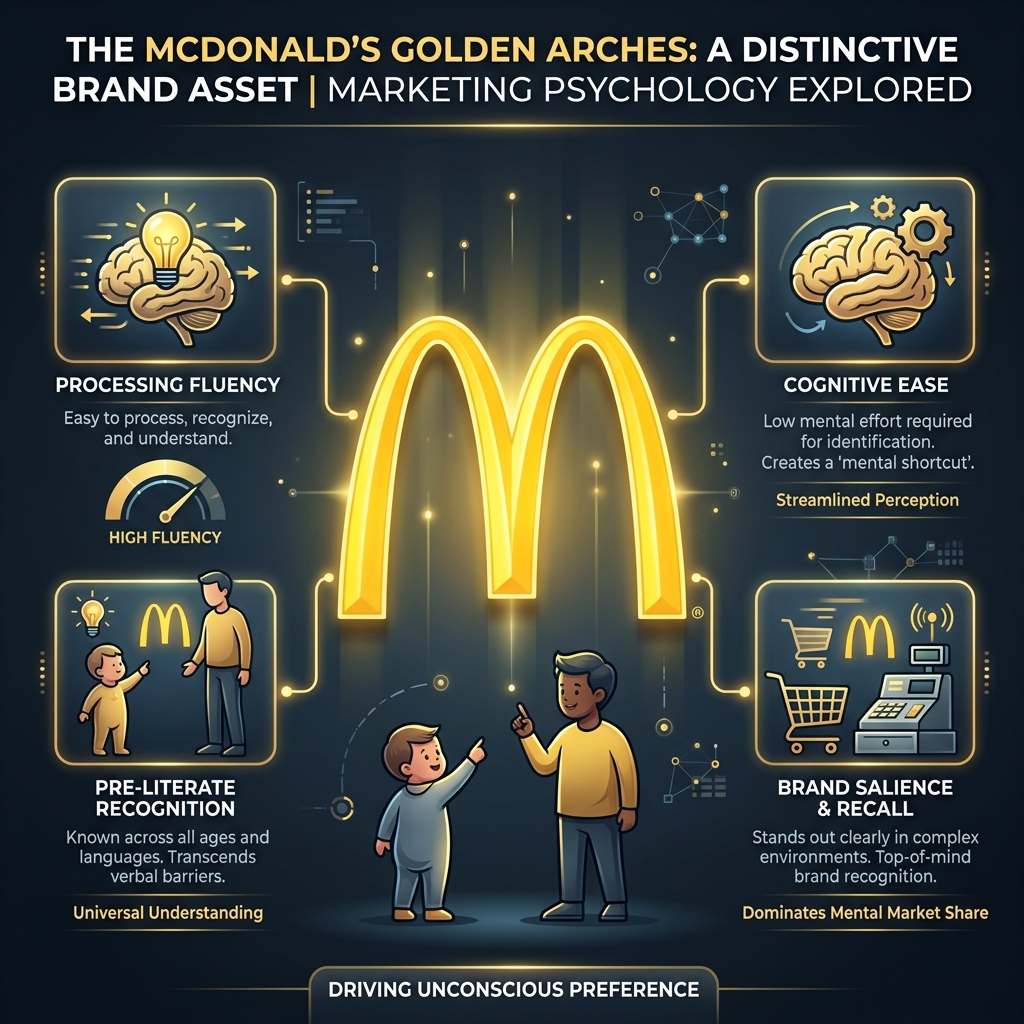
Marketing science distinguishes between differentiation (being meaningfully different) and distinctiveness (being instantly recognisable). Byron Sharp and Jenni Romaniuk’s work at the Ehrenberg-Bass Institute argues persuasively that distinctiveness drives far more real-world growth than marketers assume, and the Golden Arches are the strongest distinctive brand asset in existence.
Consider what the arches achieve. They are recognisable at highway speed, at night, from the air, at thumbnail size, and by people who cannot read. They carry no linguistic barrier, which matters enormously in a company operating in over 100 countries. Recognition studies have repeatedly placed the arches among the most identifiable symbols on the planet, a claim usually made about religious symbols rather than restaurant logos, and I mention that comparison because it is unsettling and also accurate.
🎨 The Red and Yellow Question
Colour psychology in marketing is a field where confident claims outrun the evidence, so let me be careful here. The popular story, that red triggers appetite and yellow triggers happiness, is repeated everywhere and is thinly supported by rigorous research. What is well established is more useful: red-yellow combinations have high visual salience, they attract attention faster than muted palettes, and consistent colour pairing over decades builds automatic associative recognition. The colours work not because they secretly manipulate hunger hormones but because they are impossible to miss and have been repeated for seventy years. Repetition is the mechanism. The rest is folklore, and honest branding advice should say so.
⚡ Processing Fluency: Easy Equals Trustworthy
Psychologists Reber, Schwarz and Winkielman demonstrated that stimuli which are easy to process feel more familiar, more likeable and more true. McDonald’s optimises fluency at every level: a simple symbol, a limited core menu, an identical layout, predictable prices, and a name most of the world can pronounce. Every reduction in cognitive effort translates into a small increase in comfort, and comfort at scale becomes preference. That is why the brand can be simultaneously the most criticised and the most visited restaurant on earth. Criticism operates on the slow, deliberate system; fluency operates on the fast, automatic one, and the fast one is driving the car.
🧸 Chapter 3: The Happy Meal — The Most Effective Conditioning Program Ever Built
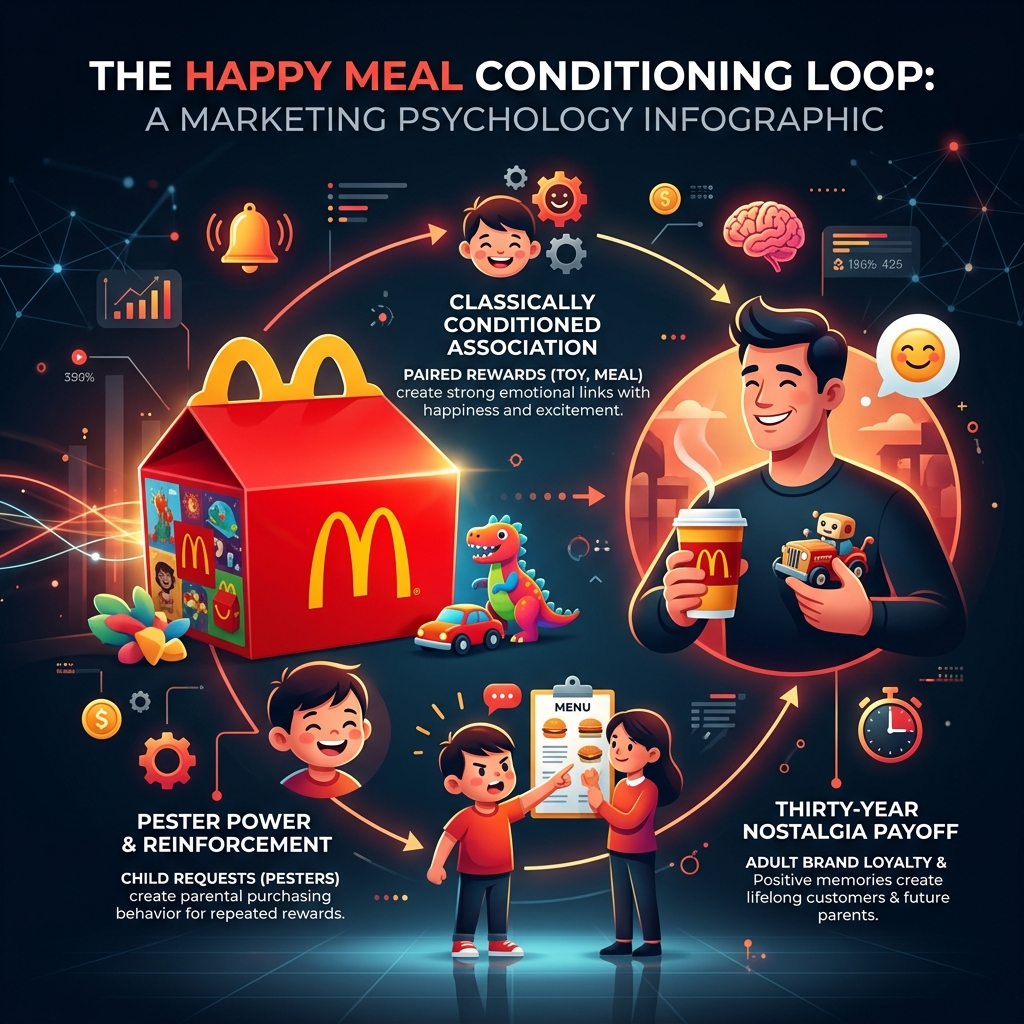
If you asked me to name the single most powerful piece of consumer psychology ever deployed by a corporation, I would not choose an advertising campaign. I would choose a cardboard box with a handle, launched in 1979, containing a small plastic toy.
🔔 The Conditioning Mechanism
The Happy Meal executes textbook classical conditioning. A neutral stimulus (a restaurant brand) is repeatedly paired with an intensely positive one (a surprise gift, plus parental approval, plus sugar and fat) during the developmental window when emotional associations form most durably. The child does not evaluate McDonald’s. The child feels McDonald’s, and feelings installed before the age of reason are almost impossible to argue away later.
Layer on variable reward: the toy changes, is part of a collectible set, and is time-limited. That converts a meal into a small lottery with a guaranteed prize, which is the same reinforcement structure I documented in my Labubu audit, applied here to five-year-olds rather than adult collectors.
👨👩👧 The Pester Power Loop
Notice who actually buys the Happy Meal. Not the child. The child is the demand generator; the parent is the purchaser, and the parent’s decision is driven by a mix of guilt, convenience and conflict avoidance after a long day. Marketing researchers call this pester power, and the Happy Meal is its most refined implementation: the toy gives the child a reason to ask repeatedly, the play area gives the parent a reason to say yes, and the price point removes the objection. Three people’s psychology, one transaction.
⏳ The Thirty-Year Payoff: Nostalgia
Here is the part most analyses miss, and it is where the strategy becomes genuinely long-term. The children conditioned in the 1980s and 1990s are now parents with disposable income, and research by Sedikides and colleagues shows nostalgia reliably increases willingness to spend and strengthens social connectedness. McDonald’s harvests this directly. The 2022 Cactus Plant Flea Market “adult Happy Meal” collaboration sold out to grown adults who wanted the box and the toy, not the food, and it worked because those adults were emotionally reactivating a childhood the brand had helped build. Very few companies get to run a marketing campaign whose target audience they personally conditioned three decades earlier.
⚖️ The Ethical Line
I cannot write this chapter neutrally, so I will be direct. Marketing to children who cannot recognise persuasive intent is a genuine ethical problem, and the research consensus supports that concern rather than dismissing it. Regulators have acted: several jurisdictions restrict toy-linked promotions for meals failing nutrition standards, San Francisco passed a well-known ordinance to that effect, and McDonald’s has responded over the years by adding fruit options, cutting default fries portions and reformulating drinks. Those changes are real and they are also, in behavioral terms, modest adjustments to a mechanism whose power comes from the pairing itself rather than the calorie count.
🚗 Chapter 4: The Drive-Thru — Where Craving Meets Habit
The drive-thru is usually discussed as convenience. Convenience is the cover story. What the drive-thru actually does is compress the interval between impulse and reward, and that interval is the single most important variable in habit formation.
Habit research, particularly Wendy Wood’s work, shows that behaviors become automatic when they are repeated in stable contexts with immediate rewards. Delay weakens the loop; friction weakens it further. A sit-down restaurant separates craving from satisfaction by parking, waiting, ordering, waiting again, eating and paying. McDonald’s drive-thru collapses that into a few minutes without leaving the vehicle, and the company has spent decades optimising those minutes with timers, dual lanes, order confirmation screens and predictive kitchen systems.
The context part matters as much as the speed. The same commute, the same exit, the same sign at the same moment of hunger builds a cue-routine-reward sequence anchored to a physical location, which is why customers describe drive-thru visits as something that “just happens” rather than something they decided. That phrase is the tell. When a purchase stops feeling like a decision, the habit architecture has succeeded.
Store location strategy compounds it. McDonald’s famous focus on real estate is not only a financial model; high-traffic corner sites with easy entry and exit are, in behavioral terms, cue placement. The company bought the trigger, not just the land.
🍟 Chapter 5: Menu Engineering — Choice Architecture at Global Scale
Every menu is a piece of behavioral design, and McDonald’s operates the most tested one on earth.
🍔 Combo Psychology
The value meal is a masterstroke of framing. Priced slightly above the sandwich alone, the combo makes the standalone burger function as a decoy against its own upgrade, a mechanic I unpack fully in my decoy effect article. The customer experiences choosing the combo as thrift, while the transaction value rises. Nobody feels upsold. Everybody buys more.
📏 Size Ladders and the Missing Small
Drink and fries sizing follows the classic ladder: the medium sits close enough to the large that upgrading feels trivial per unit, while the small sits far enough below to look inadequate. The removal of “Super Size” in 2004 after public pressure is instructive, because portion architecture shifted rather than disappeared, and the psychology of relative comparison kept working with the remaining sizes.
🗣️ The Scripted Upsell
“Would you like fries with that?” may be the most profitable sentence in retail history. It works through suggestion at the moment of low resistance: the purchase decision is already made, commitment is established, and the marginal item feels small against the total. Modern kiosks automate the same move with recommendation screens, and here is the finding that should interest every retailer: research on self-service ordering consistently shows customers order more at kiosks than from humans, partly because the machine never judges. Removing the social witness removes the last brake on indulgence, which is exactly the mechanism I described in the Shein audit in a different industry.
🥩 Chapter 6: The McRib — Rotating Scarcity on an Ordinary Sandwich
By most accounts the McRib is a fine but unremarkable pork sandwich. It has also generated tracker websites, news coverage, resale listings and genuine cultural mythology, and the reason has nothing to do with the meat.
The McRib leaves. That is the entire strategy. Periodic withdrawal converts a permanent item into a recurring event, and events generate coverage that shelf-stable products cannot. Each return is news, each farewell tour is news, and the fans do the marketing for free. I covered the underlying mechanism in detail in my scarcity marketing article: the 1975 Worchel cookie jar study showed that identical items are valued more highly when supply appears to be shrinking, and the effect is strongest when abundance visibly turns into scarcity, which is precisely what a menu removal simulates.
What makes the McRib strategically elegant rather than merely clever is that it also solves an operational problem. Pork trim prices fluctuate, so bringing the sandwich back when input costs fall is a supply-side decision dressed as a cultural moment. Scarcity that serves both the P&L and the psychology is rare, and most brands attempting this trick manufacture the scarcity artificially and eventually get caught, a risk I flagged in that same article.
🌏 Chapter 7: Glocalization — The Same Everywhere, Different Everywhere
McDonald’s faces a contradiction most global brands never solve. Its core psychological promise is sameness, the guarantee that a Big Mac in Karachi tastes like a Big Mac in Chicago. But sameness reads as cultural imposition, and a brand perceived as foreign occupation of the high street loses permission to belong.
The resolution is a deliberate split. The system stays identical (layout, service flow, quality control, arches, colour), while the menu localises: the McAloo Tikki and the entirely beef-free menus in parts of India, the McArabia across the Middle East, Teriyaki burgers in Japan, and the spicy variants that dominate South Asian menus including Pakistan. Halal certification in Muslim-majority markets is not a menu tweak but a permission structure, because a brand that respects a religious boundary is granted membership rather than merely tolerance.
The psychology underneath is social identity theory. People accept brands that respect their in-group markers and resist brands that ignore them. McDonald’s learned this the hard way through years of anti-globalisation protests and boycotts, where the arches were targeted precisely because they were the most legible symbol of foreignness available. The localised menu is, in part, a defensive structure built from that experience.
A local observation worth adding for readers here: in Pakistan, McDonald’s occupies a different psychological position than it does in the United States. It is not cheap convenience food but a moderately aspirational family outing, and birthday parties in the play area function as genuine status events for middle-class children. Same arches, entirely different meaning, which is the clearest possible proof that a brand’s psychology is co-authored by the market rather than dictated by headquarters.
👃 Chapter 8: Sensory and Environmental Design
Walk into a McDonald’s and count the sensory decisions. The smell of fries reaches the pavement, and food aroma is among the most direct routes to appetite because olfactory signals travel to the limbic system with unusually little cortical processing. The lighting is bright. The seating in traditional layouts was famously firm, which discourages lingering and increases table turnover, a design choice often discussed as hostile and more accurately described as throughput engineering.
The sonic layer is underrated. The five-note “ba da ba ba ba” mnemonic, introduced with the 2003 “I’m Lovin’ It” campaign, is one of the most successful sonic brand assets ever created; it survives translation, works on radio and video, and can be hummed by people who have not eaten there in years. Audio branding research treats a well-built mnemonic as functionally equivalent to a logo for the ear, and McDonald’s has held this one for over two decades without meddling with it, which is exactly the consistency discipline most brands lack.
The modern redesign is a deliberate psychological repositioning: muted colours, wood textures, softer seating, table service and digital ordering. The intent is to shed the “cheap and rushed” association and buy permission to charge more, borrowing the café aesthetic that consumers already code as premium. Whether the market accepts a calmer McDonald’s is an open question, because the brand’s speed association is an asset it may not want to fully trade away.
⚠️ Chapter 9: The Dark Side — Health, Criticism and the Ethics of Effectiveness
🏥 The Health Reckoning
McDonald’s spent the 2000s as the face of a public health debate it could not win on the merits. Super Size Me, Fast Food Nation and a wave of litigation and legislation forced real changes: nutrition labelling, the end of Super Size portions, apple slices in Happy Meals, reformulated drinks. As an audit finding, I would call these genuine but bounded. They alter the product’s composition; they do not alter the behavioral machine that drives frequency, and frequency is where the health impact lives.
🎪 Marketing to Children, Again
The Ronald McDonald character was quietly retired from most marketing after sustained criticism, including a campaign by health advocacy groups comparing child-targeted mascots to tobacco marketing. That comparison is aggressive and it is not baseless. Developmental research shows young children do not reliably identify persuasive intent, which means the usual consumer-choice defence does not fully apply to them. This is the strongest ethical objection to the brand’s most brilliant mechanism, and it is why my ethics score in Chapter 11 sits where it does.
👷 Labour and the McJob
The term “McJob” entering the dictionary as a synonym for low-wage, low-prospect work is one of the most damaging brand associations any company has ever acquired, because it came from the culture rather than a competitor. Organizational psychology has a straightforward view here: high-turnover, low-autonomy roles produce disengagement, and disengagement degrades exactly the service consistency the brand’s whole promise depends on. The Fight for $15 movement made McDonald’s its symbol for the same reason protesters chose the arches: maximum recognisability cuts both ways.
🌍 The Symbol Problem
Being the most recognisable brand on earth means being the most available target on earth. Anti-globalisation protests, boycott movements, and geopolitical backlash have repeatedly hit McDonald’s franchises that are locally owned and locally staffed. The distinctiveness that makes the arches so valuable also makes them the default stand-in for whatever people are angry at, and there is no marketing solution to that. It is the tax on being a prototype.
⚔️ Chapter 10: Competitive Positioning — Why Nobody Dethrones the Default
| Competitor | Their Psychological Play | Why McDonald’s Holds |
| Burger King | Challenger positioning, edgy humour, direct attacks | Attacking the default reinforces the default; every comparison mentions the arches |
| KFC | Category ownership of fried chicken; strong in South Asia | Wins its category, not the default slot; McDonald’s owns “quick meal” itself |
| Subway | Health halo, customisation, “fresh” framing | Customisation adds decision load, which is the opposite of McDonald’s fluency advantage |
| Local chains (e.g. Cheezious, Jollibee) | Cultural intimacy, local taste calibration, price | Genuine threats in their home markets; they beat the giant on belonging, not on system |
The organising concept is prototype branding, drawn from Eleanor Rosch’s work on how categories are stored in memory with a central example. Ask anyone anywhere to picture fast food and one image arrives first. Prototype status cannot be defeated by product improvement, which is why decades of taste tests favouring competitors have moved so little. It is defeated only by cultural displacement, and the brands doing best against McDonald’s, the local champions, are winning exactly there: not with better burgers, but with more belonging.
📊 Chapter 11: Psychology Scorecard — Detailed Ratings
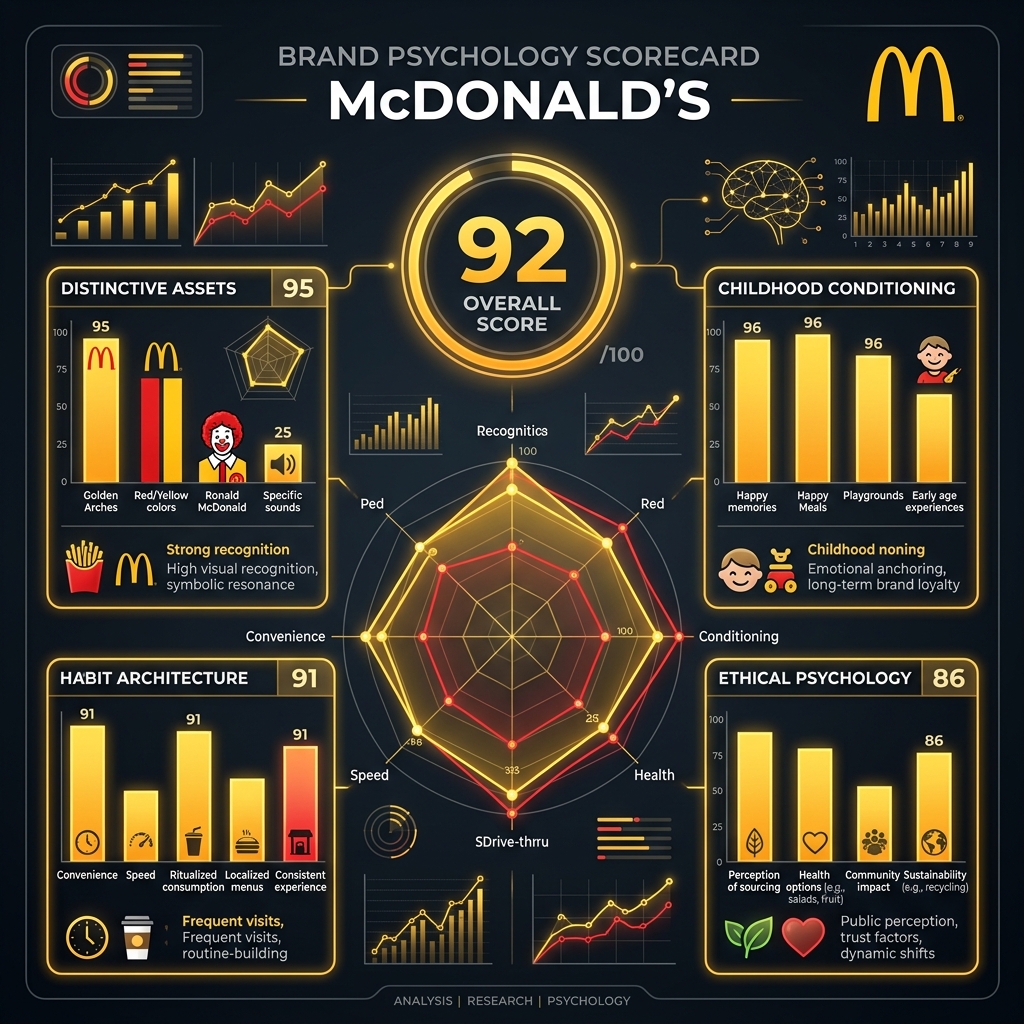
| Psychology Dimension | Score | Verdict |
| Distinctive Brand Assets (Arches, Colour, Sound) | 99/100 | The strongest set of recognisable assets any company has ever assembled. |
| Childhood Conditioning & Nostalgia Chain | 98/100 | Acquires customers before literacy, monetises them again thirty years later. |
| Habit Architecture (Drive-Thru & Location) | 96/100 | Shortest craving-to-reward loop in the industry, anchored to physical cues. |
| Processing Fluency & Consistency | 95/100 | Predictability converted into a global anxiety-reduction service. |
| Menu & Pricing Choice Architecture | 93/100 | Combos, size ladders and kiosk upsells: decades of tested nudges. |
| Cultural Adaptation (Glocalization) | 90/100 | System sameness plus menu localisation; hard-won after real backlash. |
| Brand Affection vs Respect | 74/100 | Enormously used, moderately loved; nostalgia carries more weight than pride. |
| Ethical Psychology | 45/100 | Child-directed conditioning and health externalities remain structurally unresolved. |
| OVERALL PSYCHOLOGY SCORE | 92/100 | ⚡ Extreme Impact — the most complete behavioral machine ever built. |
✅ Chapter 12: Balance Sheet & A Psychologist’s Prescription
💪 Psychological Strengths
- Assets no budget can buy now: seventy years of consistent arches, colour and sound cannot be replicated by a competitor at any spend
- Generational customer chain: conditioned children become nostalgic parents who conditioned children of their own
- Predictability as product: identical experience across 100+ countries makes the brand a safety heuristic for travellers, migrants and tired families
- Habit infrastructure: drive-thru speed plus prime location equals purchases that never feel like decisions
- Prototype status: the default answer to “quick meal” in most of the world, effectively immune to product-level attack
⚠️ Psychological Weaknesses
- Health association is permanent: product tweaks cannot fix a category perception, and the brand carries the whole category’s guilt
- Ethical exposure at the core: the strongest mechanism, child conditioning, is also the least defensible one
- Used more than loved: frequency without affection is fragile when a locally beloved alternative appears
- Target of everything: maximum recognisability makes the arches the default symbol for any grievance about globalisation
- Repositioning risk: the café-style redesign trades speed cues for premium cues, and speed is the asset that built the habit
🔮 The Prescription
- Retire the child-conditioning dependency deliberately, and say so. Shift the Happy Meal’s emotional weight from toy-reward pairing toward family ritual and shared experience. The nostalgia engine will keep running; the ethical liability shrinks; and being first to move earns credit that regulation will otherwise take by force.
- Defend the sensory assets like the crown jewels. The arches, the red-yellow pairing and the five-note mnemonic are worth more than any campaign in the pipeline. Every redesign that dilutes them spends an asset the company cannot rebuy.
- Do not trade speed for calm. The premium redesign is sensible for dine-in, but the drive-thru habit loop is the actual engine. Segment the experience rather than replacing one with the other.
- Convert local ownership into local belonging. Most franchises are owned and staffed by locals, and almost nobody knows it. Making that visible is the strongest available defence against boycott dynamics, because it moves the brand from foreign symbol to neighbour.
- Fix the McJob association from the inside. Organizational psychology is unambiguous that autonomy, progression and respect drive service quality. The brand’s consistency promise is delivered by its lowest-paid people, which makes employee experience a brand asset rather than a cost line.
📝 Final Verdict
McDonald’s is the most complete behavioral machine ever assembled by a private company, and I do not write that as a compliment or an accusation but as a measurement. Every layer reinforces the others: a symbol that beats language, a colour pair that beats attention, a sound that beats memory, a toy that beats reason, a drive-thru that beats deliberation, and a system so consistent it converts eating into reassurance. The company understood before behavioral science had the vocabulary that the winning move was never to make the best food. It was to become the easiest food, in every sense of easy: easiest to see, easiest to reach, easiest to choose, easiest to have already chosen a thousand times before.
The honest closing note is the one the scorecard makes unavoidable. The mechanism scores 92 because it works, and the ethics score sits at 45 because the most effective component of that mechanism operates on people too young to know it is operating. Fixing that would cost McDonald’s something real, which is precisely why it is worth saying plainly. A machine this powerful does not need child conditioning to survive; it has arches, habits, nostalgia and forty thousand cue points across the planet. Retiring the one mechanism it cannot ethically defend would leave it, by my read, almost exactly as strong and considerably harder to attack.
Psychology Score: 92/100 — McDonald’s earns the highest brand-machine score awarded on ShahzebSpeaks, with near-perfect ratings for distinctive assets (99), childhood conditioning and nostalgia (98), and habit architecture (96). It is held back by an affection score of 74 and an ethics score of 45, the second-lowest ever recorded here after Shein. The most effective psychology in commercial history, carrying the heaviest moral bill.
🧠 Want a Psychology Audit for Your Brand?
I’m Muhammad Shahzeb, an MSc Industrial Psychologist and Full-Stack Developer. I apply behavioral science to branding, choice architecture and conversion, including the uncomfortable part where I tell you which of your mechanisms would not survive public scrutiny. Let’s audit yours.
📚 References & Sources
- McDonald’s Corporation. Annual Reports and Form 10-K filings. corporate.mcdonalds.com, sec.gov
- Love, J. F. (1995). McDonald’s: Behind the Arches. Bantam. (Speedee system, Kroc standardisation doctrine.)
- Schlosser, E. (2001). Fast Food Nation. Houghton Mifflin.
- Ritzer, G. (1993). The McDonaldization of Society. Pine Forge Press.
- Sharp, B. (2010). How Brands Grow. Oxford University Press. (Distinctive brand assets, prototype availability.)
- Romaniuk, J. (2018). Building Distinctive Brand Assets. Oxford University Press.
- Rosch, E. (1975). “Cognitive representations of semantic categories.” Journal of Experimental Psychology: General, 104(3), 192-233.
- Reber, R., Schwarz, N., & Winkielman, P. (2004). “Processing fluency and aesthetic pleasure.” Personality and Social Psychology Review, 8(4), 364-382.
- Wood, W. (2019). Good Habits, Bad Habits. Farrar, Straus and Giroux.
- Duhigg, C. (2012). The Power of Habit. Random House. (Cue-routine-reward loops.)
- Sedikides, C., Wildschut, T., Arndt, J., & Routledge, C. (2008). “Nostalgia: Past, present, and future.” Current Directions in Psychological Science, 17(5), 304-307.
- Worchel, S., Lee, J., & Adewole, A. (1975). “Effects of supply and demand on ratings of object value.” Journal of Personality and Social Psychology, 32(5), 906-914. (McRib scarcity mechanism.)
- Tajfel, H., & Turner, J. C. (1979). “An integrative theory of intergroup conflict.” (Social identity theory, applied to glocalization.)
- Institute of Medicine (2006). Food Marketing to Children and Youth: Threat or Opportunity? National Academies Press.
- Wansink, B. (2006). Mindless Eating. Bantam. (Portion and environmental cues.)
Audit conducted by Muhammad Shahzeb, MSc Industrial & Organizational Psychology | Brand Psychology Specialist | Full-Stack Web Developer
Learn more about my approach →
Key Findings
- McDonald's operates over 40,000 locations serving tens of millions daily, making its choice architecture the most widely deployed behavioral system in commercial history.
- The Happy Meal is the most effective childhood conditioning program ever built — it pairs a toy reward with a brand at the exact developmental window when associations form for life.
- The Golden Arches function as a distinctive brand asset so strong that it requires zero text to communicate across borders.
- The drive-thru is not a convenience feature but a habit machine: compressing the decision-to-reward gap to a few minutes builds the shortest craving-to-satisfaction loop in the industry.
- The McRib's periodic disappearance is rotating scarcity applied to an ordinary sandwich, generating recurring free media coverage.
- McDonald's deepest moat is psychological consistency: identical taste and layout across continents converts the brand into a safety heuristic for anxious eaters everywhere.
Overall Psychology Score
McDonald's scores 92/100 in our comprehensive psychology audit covering consumer behavior strategies, UX design principles, and psychological marketing effectiveness.
The detailed dimension scores are in the audit's Psychology Scorecard chapter.
High impactMuhammad Shahzeb
MSc Industrial Psychologist, specializing in consumer behavior, UX psychology, and brand strategy analysis. Helping brands understand the psychology behind their success.
About Muhammad Shahzeb →