Khaadi Psychology Audit — How a Handloom Shop Built Pakistan’s Most Powerful Sale Frenzy
The deepest psychology audit of Khaadi ever written. How a single handloom store in Karachi built a national ritual, why unstitched lawn is one of the most psychologically loaded products on earth, how drop culture and the sale calendar rewired an entire country's buying behaviour, and the honest case that Khaadi's greatest strength has quietly become its most expensive habit.

84 / 100
Overall consumer behavior effectiveness

Brand Overview
- Brand nameKhaadi
- Founded1998
- HeadquartersKarachi, Pakistan
- IndustryFashion & Apparel
- Websitepk.khaadi.com ↗
Psychology Techniques Identified
- 01Artificial Scarcity Through Timed Drops
- 02Loss Aversion via Deadline Framing
- 03Social Proof Through Visible Queues
- 04Anticipation Marketing & The Launch Calendar
- 05Craft Authenticity Narrative (Handloom Origin)
- 06Distinctive Brand Assets (Colour, Print, Texture)
- 07Ritual Consumption Tied to Seasonal Calendar
- 08Identity Signalling Through Recognisable Prints
- 09Choice Overload as Engagement Device
- 10Sensory Branding in Retail Space
- 11Deal-Proneness Conditioning
- 12Diaspora Nostalgia Marketing
Full Psychology Audit Report
In this audit
Somewhere in Pakistan right now, a woman has a date saved in her phone that is not a birthday, not an appointment, and not a deadline. It is a launch date. She knows roughly what time the website will slow down, which prints she wants, and which cousin she is coordinating with so they do not end up in the same fabric at the same wedding. She is not being frivolous. She is participating in something that functions closer to a seasonal ritual than a shopping trip, and Khaadi is one of the brands that built it.
Here is what makes this a genuinely interesting psychology case rather than just a successful retail story. Khaadi sells, in large part, unstitched fabric. Not a dress. Not a finished object. Three pieces of cloth that the buyer must then take to a tailor, wait for, and hope turns out the way she pictured it. That is one of the strangest products in global retail, because the customer is buying an imagined outcome, and everything about how it is marketed follows from that single fact.
I am an Industrial and Organizational Psychologist, and this audit takes apart the whole machine: the 1998 handloom origin that gives the brand an authenticity asset its competitors cannot manufacture, the drop calendar that creates scarcity in something that is not scarce, the queue that is doing marketing work while it stands there, the sale that has become both the brand’s biggest engine and its most expensive habit, and the honest question of what happens to a brand when its customers learn to wait.
“Khaadi did not just sell fabric to Pakistan. It helped turn a season into an event, an event into a calendar, and a calendar into a habit. The genius is not the print. The genius is that everyone knows when.”
— Brand Psychology Analysis, ShahzebSpeaks
📋 Brand Overview: Khaadi at a Glance
| Brand Name | Khaadi (from khaddar, handwoven cloth) |
| Founded | 1998 by Shamoon Sultan; first store at Zamzama, Karachi, 1999 |
| Headquarters | Karachi, Pakistan |
| Footprint | 60+ stores in Pakistan, plus international presence and e-commerce |
| US Expansion | First US store at Tysons Corner Center, Virginia (February 2026); second at Houston Galleria (June 2026); DC-area distribution centre |
| Core Categories | Unstitched lawn and fabrics, pret, menswear, kids, home, fragrance, accessories |
| Signature Assets | Bold colour blocking, distinctive prints, textured handloom feel, seasonal drop calendar |
| Peak Moments | Lawn launch season (spring), Eid collections, and the end-of-season sale |
| Psychological Code | Craft, colour, occasion, and the fear of missing the drop |
| Psychology Score | 84 / 100 — ⚡ Extreme Impact |
📜 Chapter 1: The History — From a Handloom to a National Calendar (1998–2026)
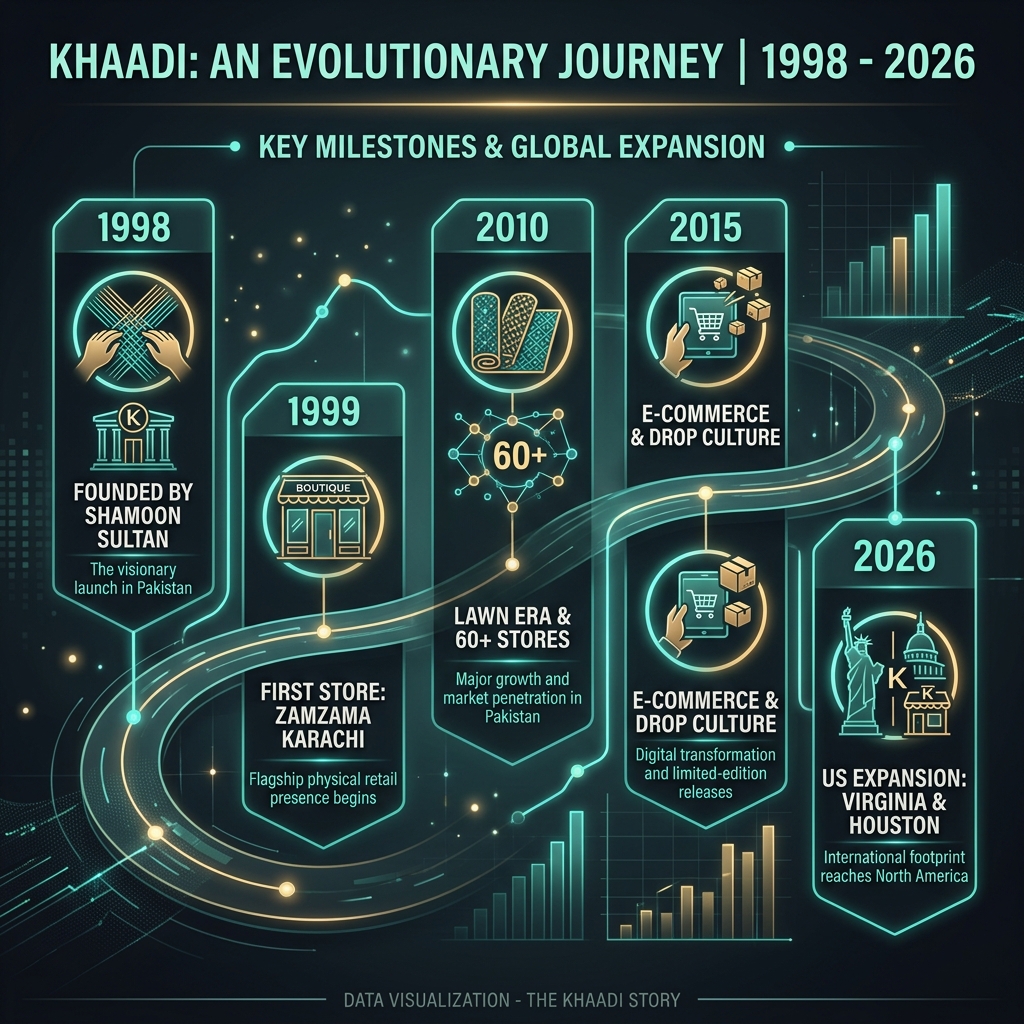
🧵 1998–2005: The Handloom Bet
Khaadi was founded in 1998 by Shamoon Sultan, with the first store opening at Zamzama in Karachi in 1999. The name itself comes from khaddar, handwoven cloth, and the original proposition was narrow and unfashionable at the time: take a traditional handloom fabric associated with rural craft and simplicity, and treat it as something contemporary and worth paying for.
That decision matters more than it looks. Most Pakistani apparel brands that scaled did so from a mill outward, which means their story is capacity, printing capability and volume. Khaadi’s story starts at a loom, which means its story is craft. Chapter 7 covers why that is worth more in brand terms than any factory, and why I think Khaadi has spent the last decade quietly underusing it.
🎨 2005–2015: Colour, Category Expansion and the Lawn Era
Through this period Khaadi did two things at once. It expanded far past handloom into unstitched lawn, pret, menswear, kids, home and accessories, becoming a lifestyle brand rather than a fabric brand. And it developed the visual identity that people can now recognise across a room: saturated colour blocking, bold and slightly unconventional prints, and a textured, tactile look that reads as handmade even when it is not literally handwoven.
This is also the period when Pakistan’s lawn category became a genuine cultural phenomenon rather than simply a summer fabric. Khaadi did not create that alone; Gul Ahmed, Alkaram, Sana Safinaz, Nishat and others built it together. But Khaadi’s contribution was tonal. It positioned lawn as something with taste and personality rather than just something with a designer name attached.
📱 2015–2022: Digital, Scale and the Drop Rhythm
E-commerce turned the launch into an event with a timestamp. Once a collection goes live at a specific hour and stock is finite by design, you have converted a shopping decision into a competitive one, and everything about the psychology changes. Chapter 4 covers this in detail because I think it is the single most important structural shift in the brand’s history.
🌍 2023–2026: Diaspora and the International Push
By 2026, Khaadi had moved decisively on the United States, opening its first US store at Tysons Corner Center in Virginia in February, following with a Washington DC area distribution centre to support online, and opening a second store at the Houston Galleria in June. Chapter 11 argues that the psychology of this expansion is not an extension of the domestic model at all, and that treating it as one would be a mistake.
🧠 Chapter 2: The Strangest Product in Retail — Why Unstitched Fabric Changes Everything
Before any discussion of sales or drops, you have to understand what is actually being sold, because unstitched fabric breaks most of the rules of normal apparel retail.
When you buy a dress, you try it on. Fit, comfort and how you look are all resolved before you pay. When you buy three pieces of unstitched lawn, none of that has happened yet. You are buying a print, a colour combination, and a mental image of yourself in something that does not exist. The tailor stands between you and the outcome, and everyone reading this in Pakistan knows exactly how reliable that step is.
Three consequences follow, and they explain almost everything else in this audit.
Imagination replaces evaluation. Because you cannot judge the finished garment, you judge the possibility. This is why print, colour and the styled campaign image carry so much more weight in this category than construction quality does. The customer is not assessing a product; she is running a simulation, and the brand’s job is to make that simulation vivid.
Regret is deferred and therefore discounted. Any disappointment arrives weeks later, at the tailor’s, far from the moment of purchase. Behavioural economics is clear that consequences separated in time from a decision carry far less weight in that decision. The buying moment is almost pure anticipation, and anticipation is one of the most pleasurable states people experience.
The product is inherently collectable. A finished dress is one outfit. Three metres of fabric is a possibility you can store, which is why the almari full of unstitched suits waiting for the right occasion exists in so many homes. That is not overbuying in the customer’s mental accounting. It is inventory, and I wrote about the psychology of held-back sacred inventory in a separate piece because the same mechanism runs through Pakistani households in a dozen other forms.
📅 Chapter 3: Turning a Season Into a Ritual
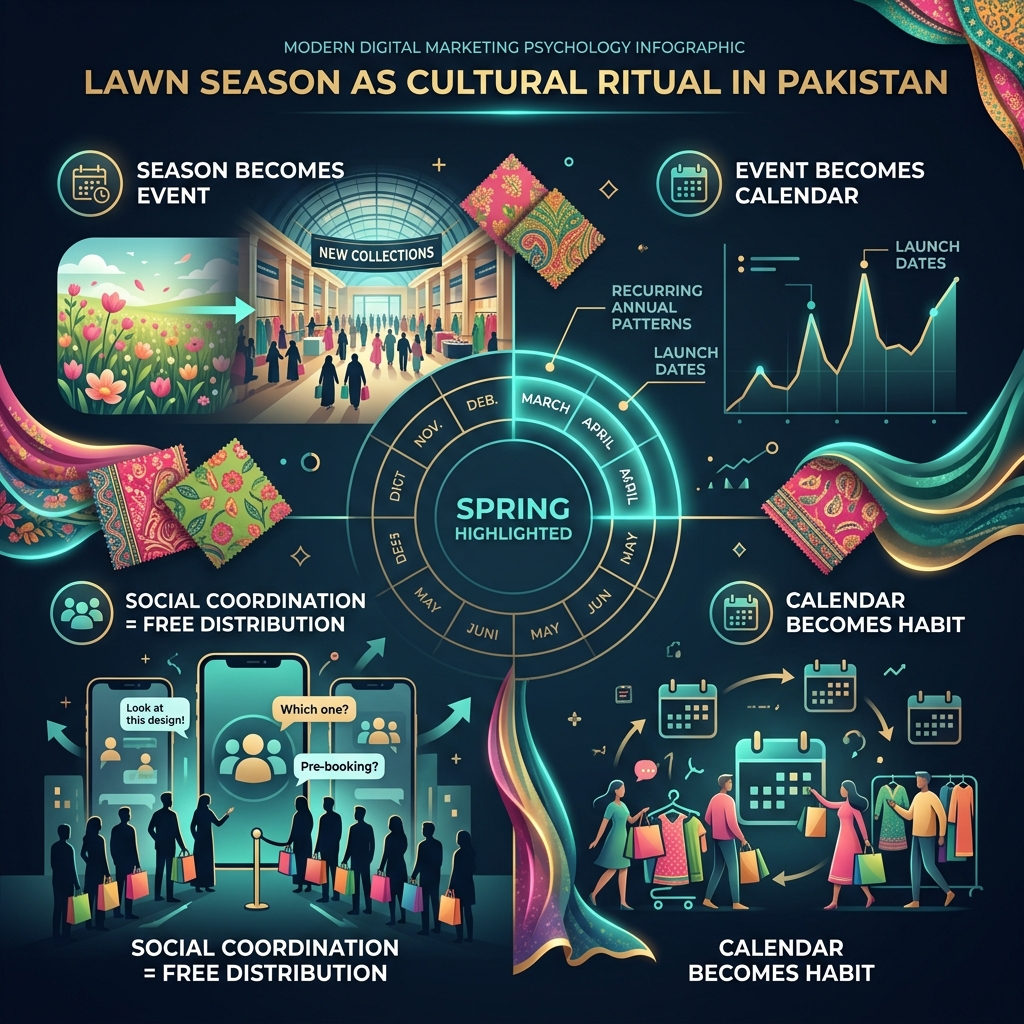
The deepest competitive advantage Khaadi holds is not a print or a price. It is that a large part of the country now has an internal calendar synchronised to the category, and Khaadi occupies a firm place inside it.
Rituals are enormously powerful commercially, and for reasons that have nothing to do with the product. Research on consumption rituals, notably by Kathleen Vohs and colleagues, finds that ritualised behaviour before consuming something measurably increases enjoyment and perceived value of the thing consumed. The preparation is part of the pleasure. Anyone who has watched the anticipation build in the weeks before a lawn launch has seen this working at national scale.
Rituals also do something no advertising can buy: they create a recurring obligation that does not feel like one. Christmas retail works this way in the West. Eid shopping works this way here. When a purchase becomes attached to a moment in the year, the customer no longer decides whether to buy, only what and where. That is a completely different and far easier competitive question to win.
The social layer amplifies it further. Lawn purchasing in Pakistan is rarely solitary. It involves group chats, opinions, coordination between sisters and cousins, and a genuine concern about turning up in the same print at the same event. Every one of those conversations is unpaid brand distribution, and the brand that gets talked about during the coordination is the brand that ends up in the trolley.
⏳ Chapter 4: Drop Culture — Manufacturing Scarcity in Something That Is Not Scarce
Here is the mechanism that deserves the most attention, and it is the same one that made sneaker culture what it is.
Fabric is not scarce. Khaadi can print more. Yet the launch model creates a hard psychological boundary: a specific date, a specific hour, a finite run, and a real chance of missing out. The scarcity is structural rather than physical, which is exactly what makes it work, because physical scarcity would be a supply failure while structural scarcity is a design decision.
The classic demonstration is Worchel, Lee and Adewole’s 1975 cookie jar study, in which identical cookies were rated as more desirable when there were fewer of them, and most desirable of all when they had been plentiful and then became scarce. Change in availability drives desire more than availability itself. Every timed drop reproduces that condition on purpose. I covered the full spectrum of this in my article on scarcity marketing, and the lawn drop belongs firmly in the “real but engineered” middle of it.
Underneath, three separate systems are firing at once.
Loss aversion. Kahneman and Tversky’s prospect theory established that losses loom substantially larger than equivalent gains. A drop reframes the decision from “would I like this?” to “will I lose this?” and the second question produces far more urgency and far less deliberation.
Reactance. Brehm’s theory holds that when a freedom is threatened, people want the restricted thing more, not less. A countdown timer is a threatened freedom expressed as a number.
Anticipation. This one is underrated and it may be the most valuable of the three. Research on anticipatory pleasure, including work by Elizabeth Dunn and colleagues on experiential purchasing, consistently finds that waiting for something enjoyable produces genuine pleasure in its own right. The weeks before a launch are not dead time for the brand. They are free engagement, and Khaadi’s marketing calendar is built to occupy them.
🛍️ Chapter 5: The Sale Frenzy — What the Queue Is Actually Doing
The Khaadi sale is a cultural reference point in Pakistan, and the crowd is the most misunderstood part of it.
Most people read a long queue as evidence of demand. It is that, but it is also doing active psychological work while it stands there, and the work is worth more than most advertising spend.
The queue is social proof in its most physical form. Cialdini’s work on social validation shows that in ambiguous situations people look to others to decide what is correct. “Is this sale worth my Saturday?” is exactly such a situation, and two hundred people answering yes with their bodies is a more persuasive answer than any campaign.
The queue creates commitment. Once you have queued for forty minutes, walking out empty-handed feels like a loss. This is effort justification, the same mechanism behind Aronson and Mills’ 1959 finding that people who endured a harder initiation liked the group more, and it is closely related to the IKEA effect I wrote about separately. The effort spent gets folded into the perceived value of the purchase, which is why in-store sale baskets tend to be larger than intended.
The crowd narrows attention. Under time pressure and social density, people deliberate less and rely more on quick heuristics. Anyone who has bought three suits they did not plan to buy has experienced this, and it is not a character flaw. It is a predictable consequence of the environment.
One honest note before anyone quotes this chapter incorrectly. Sale rushes at Pakistani apparel retailers are widely discussed and easily observed, but rigorously documented crowd figures for specific Khaadi events are not readily available in published sources, and I am not going to invent numbers to make a point land harder. The mechanisms above are well established. The dramatic anecdotes that circulate online are usually unverifiable, and a brand audit that repeats them uncritically is not doing its job.
🎨 Chapter 6: Distinctive Brand Assets — The Khaadi Look
Ask someone in Pakistan to describe Khaadi without naming a product and you will usually get something about colour. That is a significant achievement and it is worth understanding why.
Jenni Romaniuk’s work on distinctive brand assets makes a distinction most marketers blur: a differentiator is a reason to choose you, while a distinctive asset is simply something that lets people identify you fast. Both matter, but distinctive assets matter more for repeat categories, because the buyer is not re-evaluating every season. She is looking for something she recognises.
Khaadi’s assets are unusually strong for a fashion brand in a crowded market:
- Saturated, confident colour. In a category where a lot of competitors play safe with pastels and formal palettes, Khaadi has been consistently louder, and loudness is memorable.
- Print personality. The prints tend to read as slightly artistic and slightly unconventional rather than purely traditional, which gives the wearer something to signal.
- Texture. The tactile, woven quality connects visibly to the handloom origin story, which is a rare case of an aesthetic choice reinforcing a brand narrative rather than decorating it.
The strategic value is what happens at a wedding or an office. If a print is recognisably Khaadi, the wearer is signalling something about her taste, and identity signalling is the strongest form of brand loyalty that exists, because dropping the brand now costs the customer something socially rather than just practically. This is the same mechanism I analysed in my article on why weird brands win, applied to fabric.
🧵 Chapter 7: The Craft Story — The Asset Khaadi Under-Uses
This chapter contains my strongest single criticism of the brand, and it is a criticism about a strength.
Khaadi’s name means handwoven cloth. It began in 1998 around a loom, in a market where scale came from mills. That is an authenticity asset, and authenticity assets have a specific property: competitors cannot buy them, because they are historical facts rather than capabilities. Sapphire cannot acquire a 1998 handloom origin. Neither can anyone else.
Authenticity works psychologically because it functions as a costly signal. Handloom is slower, less consistent and less profitable per metre than industrial printing. A brand that visibly ties itself to a harder method is making a claim that is expensive to fake, and expensive claims are believed. Zahavi’s handicap principle in biology and its consumer applications describe exactly this.
My honest read is that as Khaadi scaled into lawn, pret, home, kids, menswear and fragrance, the craft story receded into the background of the brand rather than the foreground. That is understandable commercially, since handloom cannot carry the volume the business needs. But it left a gap, because the brand now competes largely on print, colour and price in a category where a dozen well-funded rivals also compete on print, colour and price.
The asset is still there. It is in the name, on every label, every time anyone says the word. I would argue it is the single most under-deployed thing Khaadi owns, and Chapter 12 says what I would do with it.
🏬 Chapter 8: The Store as a Sensory Argument
Khaadi’s retail environments do something specific: they present fabric as abundance. Colour massed together, bolts and racks in volume, a visual density that is closer to a bazaar than to a minimalist boutique.
Two mechanisms make this effective. The first is that visual abundance signals choice, and in a category where the customer is hunting for the one print that is right for her, the perception that everything is here reduces the fear of leaving and missing something better elsewhere. The second is touch. Peck and Childers’ research on the need for touch shows that physically handling a product increases perceived ownership and willingness to pay, and fabric is one of the few categories where touch is not optional. You cannot judge lawn from an image, which is precisely why physical retail remains strong in this category even as e-commerce grows.
There is a real tension here that the brand has to manage. Massed choice creates engagement, but Iyengar and Lepper’s jam study, and the wider literature since, shows that too many options can reduce satisfaction and increase decision paralysis. In this category I think the tradeoff usually favours abundance, because the search is part of the enjoyment. But it argues strongly for better curation online, where none of the sensory compensations exist and a wall of two hundred thumbnails is just a wall.
⚠️ Chapter 9: The Dark Side — Discount Conditioning and the Cost of the Sale
This is the most important chapter in the audit, and the one that would make a marketing team uncomfortable.
💸 The brand is training its own customers to wait
When sales are frequent, predictable and deep, customers do not simply enjoy them. They learn from them. Behavioural research on deal proneness and reference price formation is consistent on this point: repeated discounting shifts what customers believe the product is actually worth, and the discounted price becomes the mental anchor rather than the list price. I covered anchoring at length in my article on anchoring bias, and this is its most expensive commercial form.
The result is a slow trap. Full-price purchase declines because waiting is rational. Margins compress. The brand responds with more or deeper promotions to hit the same revenue, which teaches the lesson harder. JCPenney’s attempt to exit this cycle in 2012 by simply removing discounts is the standard cautionary tale, and it cost the company enormously, because customers had been conditioned for years and experienced the change as loss rather than fairness.
I want to be careful here: I do not have Khaadi’s internal margin data, and no outsider does. But the structural risk applies to any brand whose sale has become a cultural event, and a sale that people plan their year around is by definition predictable.
🧩 Category sprawl and dilution
Khaadi now spans unstitched, pret, menswear, kids, home, fragrance and accessories. Breadth builds revenue and it also blurs meaning. A brand that means handwoven craft is sharp. A brand that means many products for many people is a department store, and department stores compete on price and convenience, which are the two dimensions where a brand has least protection.
🔍 Ethics and supply chain transparency
Global fashion is under increasing scrutiny on labour conditions and environmental impact, and Pakistani apparel brands are not exempt from that direction of travel, particularly as they expand into US and European markets where disclosure expectations are higher and rising. I am not making an accusation, because I have no verified findings to make one with. What I am pointing out is a positioning vulnerability: a brand whose name means handwoven craft carries an implied promise about how things are made, and implied promises are the ones that hurt most when tested. My Shein audit documented what happens to a brand that never made the promise in the first place. Khaadi has made it, quietly, in its name.
💻 The digital experience gap
High-traffic drops are technically punishing, and the categories most vulnerable to launch-day site problems are exactly the ones built on timed scarcity. When a customer has arranged her day around a launch and the site fails, the emotional response is disproportionate, because the brand created the expectation that produced the disappointment. Anticipation is an asset with a matching liability, and it is collected in full on launch day.
⚔️ Chapter 10: Competitive Positioning
| Competitor | Psychological Position | Where Khaadi Wins or Loses |
| Sapphire | Modern, minimal, styled aspiration; strong campaign aesthetic | Loses on contemporary polish; wins on colour personality and craft heritage |
| Gul Ahmed | Heritage textile scale and mass reach; trusted household name | Loses on breadth and distribution; wins on distinctiveness and design voice |
| Sana Safinaz | Designer prestige; status signalling at the premium end | Loses top-end status ground; wins on accessibility and everyday wearability |
| Alkaram / Nishat | Value, reliability and volume; strong price-performance perception | Loses on price competition; wins by not needing to compete there if craft is used properly |
| Limelight / mass fast fashion | Speed, trend turnover, low commitment | Loses on price and newness cadence; wins on perceived quality and longevity |
The pattern worth noticing is that Khaadi sits in the middle of every axis: not the most premium, not the cheapest, not the most minimal, not the most traditional. Middle positions can be commercially excellent, because the middle is where the volume lives, and they are also the most vulnerable, because being second-best on four dimensions is a weaker defence than being first on one. Khaadi’s protection is its distinctiveness rather than its position, and distinctiveness has to be actively maintained.
🌍 Chapter 11: The International Play — Selling Memory, Not Fabric
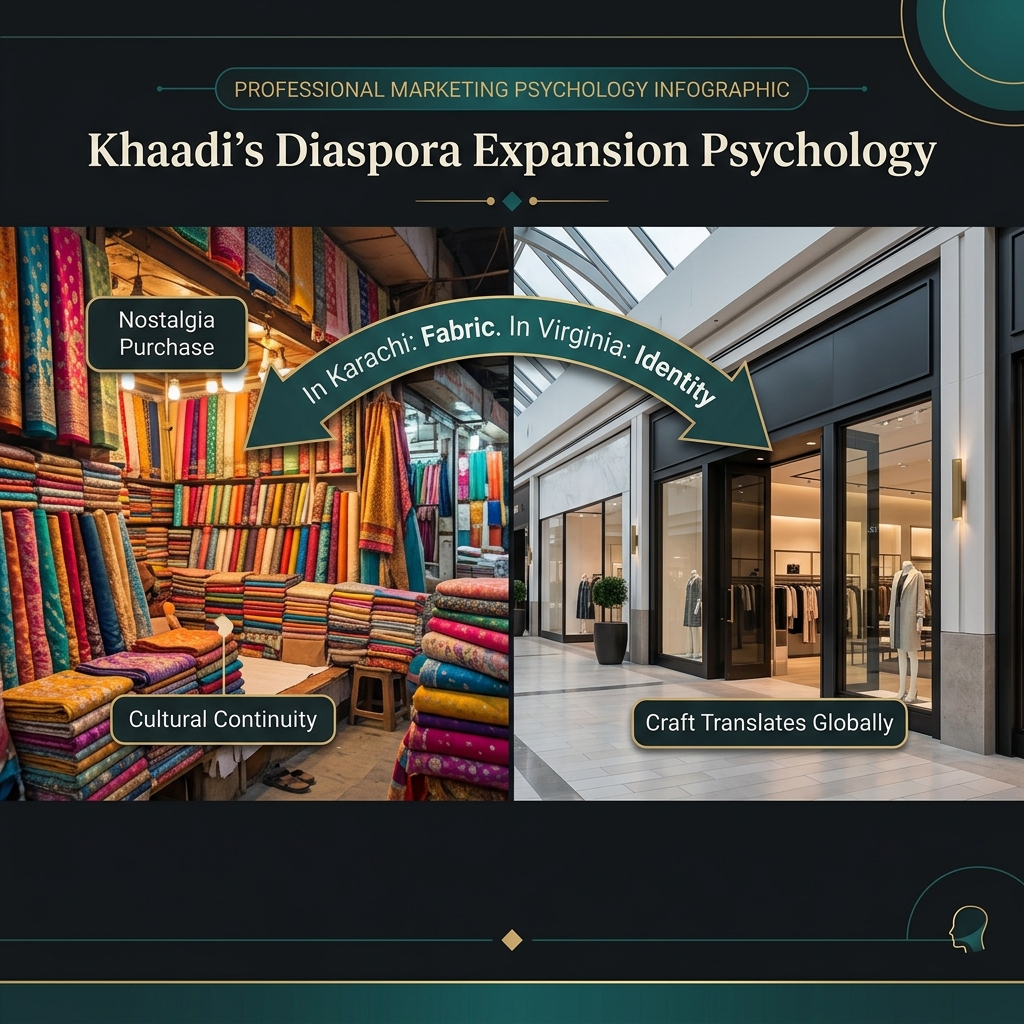
Khaadi’s US moves in 2026, the Tysons Corner store in February, the DC-area distribution centre, and the Houston Galleria store in June, are usually reported as expansion. Psychologically they are something quite different, and getting this wrong would be expensive.
In Pakistan, Khaadi competes on print, price and drop timing against a dozen strong rivals. In the United States, for the South Asian diaspora, it is selling continuity of identity. A Pakistani-American woman buying lawn in Virginia is not primarily solving a clothing problem. She is maintaining a connection, marking Eid properly, dressing her daughter in something that carries a place, and doing it without a trip home.
That changes the psychology in three ways. Price sensitivity drops sharply, because identity purchases are evaluated against meaning rather than against a competitor’s discount. The tailoring problem becomes a real barrier, because the stitching infrastructure that makes unstitched fabric convenient in Lahore does not exist in most US cities, which argues strongly for pret and ready-to-wear leading the international assortment. And the craft story becomes far more valuable, because a non-Pakistani American customer has no reason to care about a print but does have reason to care about handwoven cloth from a 1998 workshop in Karachi. Craft translates internationally. Colour trends do not.
The honest risk is that a nostalgia purchase is emotionally powerful and commercially infrequent. Diaspora demand clusters hard around Eid and weddings, which means the international business may look seasonal in a way the domestic business does not, and store economics have to survive the quiet months.
📊 Chapter 12: Psychology Scorecard — Detailed Ratings
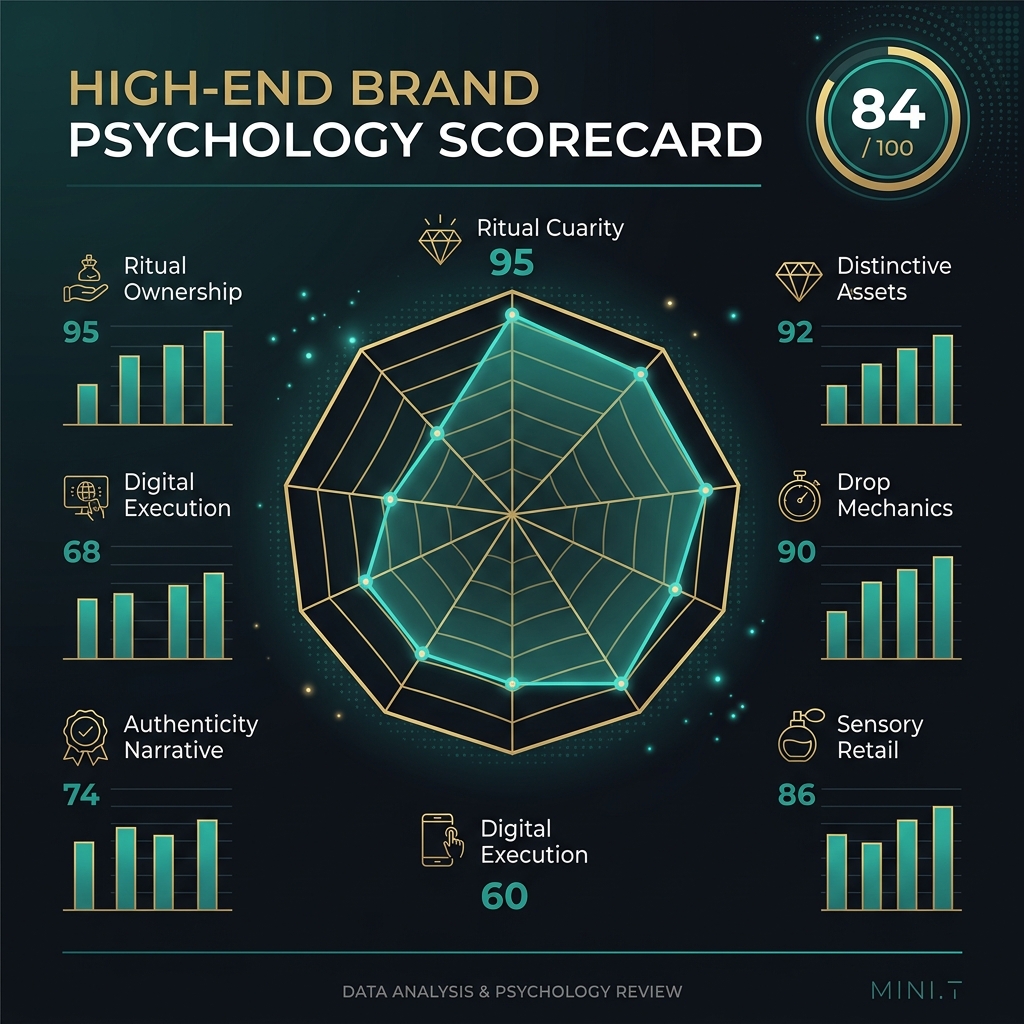
| Psychology Dimension | Score | Verdict |
| Ritual Ownership | 95/100 | A place in the national calendar; the deepest moat a retailer can hold. |
| Distinctive Brand Assets | 92/100 | Colour and print recognisable across a room; rare in a crowded category. |
| Scarcity & Drop Mechanics | 90/100 | Loss aversion, reactance and anticipation working together, deliberately. |
| Retail Sensory Experience | 86/100 | Abundance and touch; strong in store, weaker translated to screen. |
| Authenticity Narrative | 74/100 | Owns an unbuyable craft story and keeps it in the background. |
| Pricing Power | 62/100 | Predictable deep sales teach customers to wait; the reference price slides. |
| Brand Focus & Coherence | 70/100 | Category breadth builds revenue and blurs what the brand means. |
| Digital & Launch Execution | 68/100 | Anticipation is an asset with a liability attached, collected on launch day. |
| OVERALL PSYCHOLOGY SCORE | 84/100 | ⚡ Extreme Impact — cultural ownership at an elite level, spending itself on discounts. |
✅ Chapter 13: Balance Sheet & A Psychologist’s Prescription
💪 Psychological Strengths
- A place in the calendar: the customer decides what and where, not whether
- Recognisable at a distance: colour and print function as genuine distinctive assets
- Anticipation engine: weeks of free engagement before every launch
- Touch advantage: a category where physical retail still beats a screen
- An unbuyable origin: a 1998 handloom story no competitor can acquire
- Social distribution: group coordination turns every purchase into a conversation
⚠️ Psychological Weaknesses
- Discount conditioning: a predictable sale teaches customers that list price is optional
- Middle positioning: second-best on several axes rather than first on one
- Craft story sidelined: the strongest asset is the least used
- Launch-day fragility: the brand creates the expectation that its own systems must survive
- Implied ethical promise: a name meaning handwoven craft invites scrutiny the brand has not loudly answered
🔮 The Prescription
- Break the discount rhythm carefully, not suddenly. The JCPenney lesson is not that discounting must continue; it is that removing it abruptly reads as loss. Shift gradually toward fewer, shorter, less predictable events, and give the saved margin back as visible value in the product rather than as a lower headline price.
- Put the loom back in the foreground. Create a genuine handloom line, small, expensive, slow and honestly labelled, and let it sit at the top of the range. It does not need to be a large business. It needs to make the name true again in a way customers can point at, which quietly raises the perceived value of everything below it.
- Solve the tailoring problem, especially abroad. The gap between buying fabric and wearing a garment is the single biggest source of disappointment in this category, and it sits outside the brand’s control. Any brand that reliably closes it, through partnerships, in-store services or a stronger pret assortment, converts a recurring frustration into a reason to stay.
- Treat launch-day infrastructure as brand spending, not IT spending. When anticipation is your engine, a failed launch damages more than a lost sale, because it punishes exactly the most loyal customers, the ones who showed up on time.
- Get ahead of the ethics question voluntarily. Publish something specific about sourcing and labour before anyone asks. Brands that disclose early are read as confident; brands that disclose under pressure are read as caught, and the difference is entirely in the timing.
- Lead internationally with craft, not colour. Print trends do not cross cultures. A handwoven story from a 1998 Karachi workshop does, and it is the only part of the proposition that a non-Pakistani buyer has any reason to care about.
📝 Final Verdict
Khaadi belongs in the small group of brands that did something rarer than building market share: it helped install a habit inside a country’s year. When a season, a launch date and a sale all sit in people’s heads without being advertised into them, the brand has stopped competing for attention and started collecting it. That is worth more than any single product advantage, and it is why the score here is high despite real problems.
The problems are real, though, and they share a root. Almost every weakness in this audit traces back to the same decision: the brand chose volume where it could have chosen meaning. Deep predictable sales bring volume and cost pricing power. Category sprawl brings volume and costs clarity. Backgrounding the handloom story served volume and cost the one asset competitors can never replicate.
My honest view is that Khaadi’s next decade is not decided by print design or store count. It is decided by whether the brand is willing to be slightly smaller in order to be much clearer. The name on the label already says what the brand is. Somewhere along the way it stopped being the loudest thing about it, and I think getting that back is worth more than another sale.
Psychology Score: 84/100 — Khaadi scores at an elite level for ritual ownership (95), distinctive assets (92) and drop mechanics (90), pulled down by pricing power (62), digital launch execution (68), brand coherence (70) and an under-deployed authenticity narrative (74). Cultural ownership most brands would trade anything for, quietly funded by discounts it may not be able to stop.
🧠 Want a Psychology Audit for Your Brand?
I’m Muhammad Shahzeb, an MSc Industrial Psychologist and Full-Stack Developer. I audit positioning, pricing psychology and customer behaviour using behavioral science, including the uncomfortable part where I tell you what your discounts are teaching your customers. Let’s look at yours.
📚 References & Sources
- Khaadi. Official brand and product information. pk.khaadi.com and us.khaadi.com
- Wikipedia. “Khaadi” and “Shamoon Sultan.” (Founding date, first store, leadership.)
- Modern Retail. “Pakistani fashion brand Khaadi makes first moves in U.S.” (Tysons Corner and Houston Galleria openings, 2026.)
- Milestone Magazine. “Shamoon Sultan, Founder & CEO, Khaadi.”
- Dawn. “Style: Secrets of the luxury lawn.” (Pakistani lawn category context.)
- Worchel, S., Lee, J., & Adewole, A. (1975). “Effects of supply and demand on ratings of object value.” Journal of Personality and Social Psychology, 32(5), 906-914.
- Kahneman, D., & Tversky, A. (1979). “Prospect theory: An analysis of decision under risk.” Econometrica, 47(2), 263-291.
- Brehm, J. W. (1966). A Theory of Psychological Reactance. Academic Press.
- Cialdini, R. B. (2007). Influence: The Psychology of Persuasion. Harper Business. (Social proof, scarcity.)
- Vohs, K. D., Wang, Y., Gino, F., & Norton, M. I. (2013). “Rituals enhance consumption.” Psychological Science, 24(9), 1714-1721.
- Aronson, E., & Mills, J. (1959). “The effect of severity of initiation on liking for a group.” Journal of Abnormal and Social Psychology, 59(2), 177-181.
- Peck, J., & Childers, T. L. (2003). “Individual differences in haptic information processing: The ‘need for touch’ scale.” Journal of Consumer Research, 30(3), 430-442.
- Iyengar, S. S., & Lepper, M. R. (2000). “When choice is demotivating.” Journal of Personality and Social Psychology, 79(6), 995-1006.
- Romaniuk, J. (2018). Building Distinctive Brand Assets. Oxford University Press.
- Zahavi, A. (1975). “Mate selection: A selection for a handicap.” Journal of Theoretical Biology, 53(1), 205-214. (Costly signalling.)
- Dunn, E. W., Gilbert, D. T., & Wilson, T. D. (2011). “If money doesn’t make you happy, then you probably aren’t spending it right.” Journal of Consumer Psychology, 21(2), 115-125. (Anticipation.)
- Contemporary business reporting on JCPenney’s 2012 pricing strategy change and its consequences.
Audit conducted by Muhammad Shahzeb, MSc Industrial & Organizational Psychology | Brand Psychology Specialist | Full-Stack Web Developer
Learn more about my approach →
Key Findings
- Khaadi helped convert Pakistan's lawn category into a national seasonal ritual with a fixed emotional calendar, which is a far deeper competitive position than product quality
- Unstitched fabric is psychologically unusual because the customer buys potential rather than a finished object, making imagination the deciding factor at point of sale
- The drop model manufactures scarcity in a product that is not actually scarce, and the queue outside the store is a functioning part of the marketing
- Khaadi's 1998 handloom founding gives it an authenticity asset competitors cannot buy, but the brand under-uses it
- The most serious risk is discount conditioning: when customers learn to wait for the sale, full-price sales fall and margins compress
- International expansion into the US in 2026 is a diaspora-nostalgia play whose psychology is completely different from the domestic one
Overall Psychology Score
Khaadi scores 84/100 in our comprehensive psychology audit covering consumer behavior strategies, UX design principles, and psychological marketing effectiveness.
The detailed dimension scores are in the audit's Psychology Scorecard chapter.
High impactMuhammad Shahzeb
MSc Industrial Psychologist, specializing in consumer behavior, UX psychology, and brand strategy analysis. Helping brands understand the psychology behind their success.
About Muhammad Shahzeb →