Crocs Psychology Audit — The Ugly Shoe You Personalise
Crocs audit: how Jibbitz, comfort and being proudly ugly turned a boat-show clog into a $4 billion brand — and where HEYDUDE dented it. Score: 80/100. See scorecard.

80 / 100
Overall consumer behavior effectiveness
Brand Overview
- Brand nameCrocs
- Founded2002
- HeadquartersBroomfield, Colorado, USA
- IndustryFashion & Apparel
- Websitewww.crocs.com ↗
Psychology Techniques Identified
- 01Extended Self & Identity Expression (Jibbitz Charms as Personal Identity)
- 02Personalisation as Co-Creation (Customer Finishes the Blank Shoe)
- 03IKEA Effect (Labour Leads to Love: Decorating Raises Value)
- 04Autonomy & Self-Determination (Choosing Each Charm, Reversibly)
- 05Comfort & Effort Reduction (Soft, Light, Easy as Permission)
- 06Social Identity Through Opposition (Proud Ugliness as In-Group Badge)
- 07Scarcity & Limited Collaborations (Drops and Sold-Out Charms)
- 08Loss Aversion (Gaps in a Collection Feel Like Losses to Close)
- 09Social Proof Across Groups (Nurses, Chefs, Students, Celebrities)
- 10Habit & Collection Lock-In (Charms Transfer to the Next Pair)
- 11Relational Significance (BARK Matching: Owner and Dog as One Identity)
- 12Expectation Management (Low Promise: Comfort, Not Fashion)
Full Psychology Audit Report
In this audit
In October 2026, as the seasonal “Croc-Tober” coverage rolled around again, a shoe that the fashion world once treated as a joke was still, stubbornly, on feet everywhere — on nurses, on chefs, on teenagers, on celebrities, each pair slightly different from the next because its owner had finished it. Crocs did not win by becoming beautiful. It won by making ugliness a choice, and then handing the choice to the customer, one charm at a time.
Crocs, Inc. is an American footwear company headquartered in Broomfield, Colorado, founded in 2002 in Boulder by Scott Seamans, Lyndon “Duke” Hanson and George Boedecker Jr., and led since 2017 by chief executive Andrew Rees. Its first model, The Beach, was unveiled at the Fort Lauderdale Boat Show in 2002, and the company listed on Nasdaq in February 2006. In 2024 it reported revenue of $4.10 billion and net income of $950.1 million; in 2025 revenue was $4.04 billion and the company reported a net loss of $81.2 million, after a reported impairment of about $738 million on its HEYDUDE brand. This audit asks how a foam clog survived being a punchline, a near-death experience and a $2.5 billion acquisition — and where the same psychology that saved it now limits it.
I am an Industrial and Organizational Psychologist based in Karachi. I audit brands by matching each persuasion technique to a documented feature or campaign, and by keeping legal claims at their exact status. Crocs is a useful test case because its core technique is unusually visible: the product is deliberately unfinished, and the customer finishes it. Everything else — the collaborations, the drops, the personalisation stores — is built on that one decision.
“Most brands sell you a finished identity. Crocs sells you a blank one, with holes in it — and charges you, happily, for the pieces you use to fill it.”
— Brand Psychology Analysis, ShahzebSpeaks
📋 Brand Overview: Crocs at a Glance
| Brand | Crocs, Inc. (Nasdaq: CROX); brands: Crocs and HEYDUDE |
| Founded | 2002, Boulder, Colorado; first model The Beach, Fort Lauderdale Boat Show 2002; Nasdaq IPO February 2006 |
| Headquarters | Broomfield, Colorado, USA; CEO Andrew Rees (since 2017) |
| What it sells | Foam clogs and other footwear in proprietary Croslite material, plus Jibbitz charms, sandal charms and shoe tattoos for personalisation |
| 2024–2025 results | Revenue $4.10 billion (2024), $4.04 billion (2025); net income $950.1 million (2024), net loss $81.2 million (2025) |
| October 2026 news | BARK partnership expanded 6 October 2026 after Pet Crocs sold out; personalisation push reported, including Crocs by You in Wuhan and sold-out sandal charms |
| Signature moves | Jibbitz personalisation; “Ugly Can Be Beautiful”; limited collaborations and drops; comfort-first design |
| Psychology score | 80/100 — High impact |
📜 Chapter 1: The History — From a Boat Show to a Near Death to $4 Billion
Crocs began with a foam boating clog made by the Canadian company Foam Creations. Three friends from Boulder saw it on a sailing trip, acquired the design, and unveiled their first model, The Beach, at the Fort Lauderdale Boat Show in 2002. The shoe was light, waterproof, non-slip and easy to clean — practical for boats, and, as it turned out, for anyone who spent long hours on their feet. Early adopters included restaurant workers and nurses, people for whom comfort was not a fashion statement but a working condition. The name, from the crocodile, made the point: at home on land and in water.
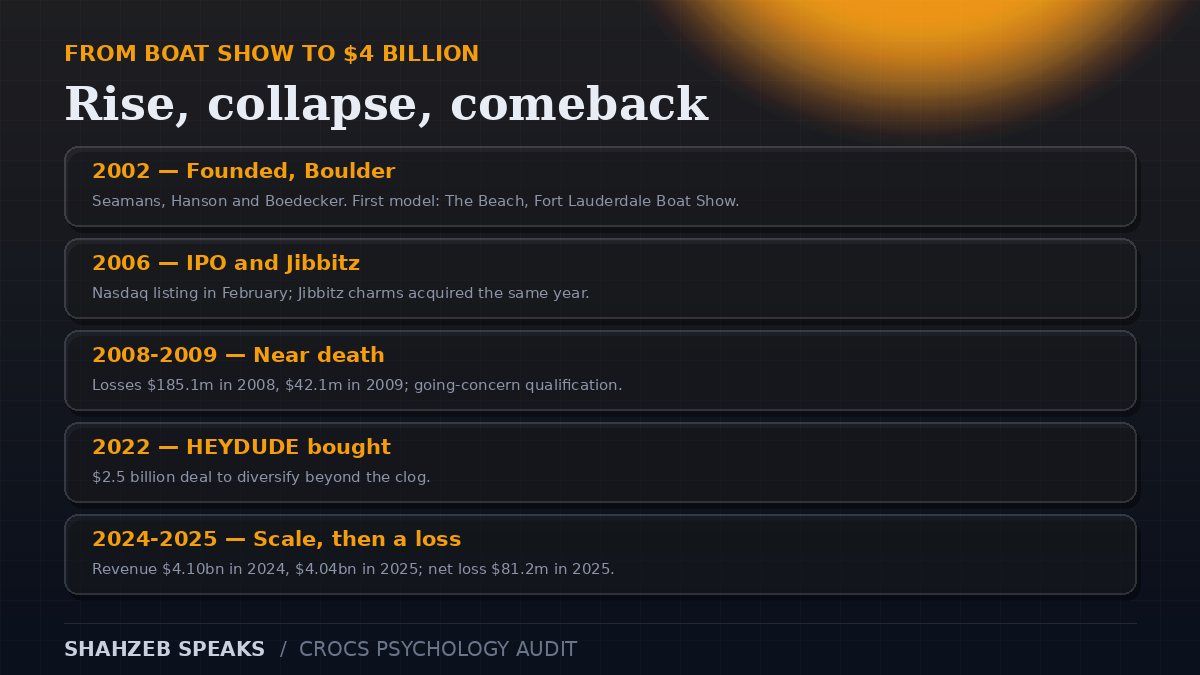
Growth was explosive. By 2005 the company had passed $100 million in sales, and in February 2006 it listed on Nasdaq in what was then the largest-ever US footwear IPO. That year it also acquired Jibbitz, the charm company founded by Sheri Schmelzer after she decorated her children’s Crocs — a purchase that, in hindsight, mattered more than the IPO, because it turned the shoe’s ventilation holes into a platform. Then came the collapse. Crocs expanded its product line, built inventory and capacity for demand that did not hold, and the global financial crisis cut consumer spending. The company reported losses of $185.1 million in 2008 and $42.1 million in 2009, its auditors issued a going-concern qualification, and its chief financial officer later called it “pretty much a near-death experience”. The turnaround, under successive chief executives, was unglamorous: downsizing, paying down debt, cutting inventory, and refocusing on the core clog and its personalisation.
The second act began in earnest under Andrew Rees, chief executive since 2017, with collaborations, direct-to-consumer growth and a disciplined core range. In February 2022, Crocs bought HEYDUDE, the Italian-founded casual footwear brand, for $2.5 billion, to become a two-brand company and reduce dependence on the clog. That bet has not yet worked as planned: HEYDUDE’s revenue fell, and in 2025 Crocs reported an impairment of about $738 million on the brand. The group still reported revenue above $4 billion in 2025, and in October 2026 Modern Retail reported that the Crocs brand alone had surpassed $1 billion in quarterly revenue for the first time. The audit’s question is therefore precise: is Crocs a one-product psychology that happens to own a second brand, or a multi-brand company whose second brand is a drag? The evidence so far points to the first.
🧩 Chapter 2: The Blank Shoe — Personalisation as Identity
The core principle is the extended self (Belk, 1988): possessions become part of how people express who they are. Crocs takes that principle literally. The Classic Clog is, by design, almost featureless: a single colour, a set of holes, a shape that offends no one because it expresses nothing. Jibbitz charms — small figures that snap into the holes — are where identity enters. A pair decorated with a football club, a cartoon character, a flag or a joke is no longer a commodity. It is a statement that can be changed, rearranged and added to, at low cost, without buying a new pair.
That is why personalisation is not a side business for Crocs. It is the business model in miniature. Each charm is a small, reversible commitment (in Cialdini’s terms, a foot in the door that leads to more charms), and the collection as a whole becomes a record of taste that the owner can display at a glance. In October 2026, Modern Retail reported that the play was extending beyond the holes: sandal charms that clip onto straps, with several designs already sold out, and press-on “shoe tattoos” in testing that can go anywhere on the shoe, not only in the Jibbitz holes. The company’s chief product officer, Lori Foglia, told Modern Retail that Crocs by You, an experiential store in Wuhan where shoppers work with a stylist to make one-of-one products, rests on the idea that a shopper cannot buy a shoe without personalising it. Read literally, that is a claim about the brand’s future. Read psychologically, it is an admission: the unpersonalised Croc is no longer the product. The personalised one is.
🛋️ Chapter 3: Comfort as Permission — Why Ugly Works
The second principle is effort reduction, sharpened by the brand’s early slogan, “Ugly Can Be Beautiful”. Most fashion brands ask the customer to work for the look: to endure discomfort, to learn the code, to risk getting it wrong. Crocs asks for none of that. The shoe is soft, light, easy to put on and easy to clean. For a nurse, a chef or a parent, that is not a compromise. It is the point. And for a fashion customer, the same comfort becomes permission: you can wear the “wrong” shoe precisely because it is comfortable, and the comfort is the alibi.
Social identity theory (Tajfel & Turner, 1979) explains the rest. A brand that is openly mocked creates a strong in-group for the people who wear it anyway. Wearing Crocs in public, when the fashion consensus says not to, signals confidence and a refusal of the consensus — a costly signal, in the sense that it costs social approval and therefore proves something. That is why the “ugly” label never killed Crocs, and why it could not be copied by a brand that wanted to be loved by everyone. The insult is the badge. When celebrities and designers later adopted the clog, they did not remove the badge. They borrowed it, and in borrowing it they confirmed that the in-group had been right all along. For a related case of a brand that turned a liability into identity, see my audit of Liquid Death, and for scarcity done differently, my audit of Zara.
🔥 Chapter 4: Scarcity, Collaborations and the Hunt
Crocs’ collaborations work because the base product is so plain. A collaboration does not need to redesign the shoe. It needs to add a colour, a charm set, or a name — and because the base is unchanged, the collaboration reads as a limited edition of something familiar, not as a new product to learn. That is why Crocs can move fast on trends: a film, a musician or a meme becomes a charm set in weeks, while a traditional shoe collaboration takes seasons. Scarcity here is mostly genuine in the short term — limited runs do sell out, as the October 2026 sandal-charm sell-outs show — and it is amplified by collectability: a charm you missed is a gap in a collection, and gaps are felt more keenly than ordinary stock-outs, through loss aversion (Kahneman & Tversky, 1979).
The BARK expansion of October 2026 shows the same machinery moving sideways. After Pet Crocs sold out, BARK and Crocs expanded into matching collars, leashes, a clog-shaped dog bed with charm-style slots, and coordinating shoes, so that dog and owner could match “from the front door to the dog park”. The psychology is not really about dogs. It is about extending the personalisation canvas to a second wearer who cannot object, and to a relationship — owner and dog — that people already treat as identity. A brand that can personalise the dog’s bed has understood that its product was never the shoe. It was the act of decorating something you live with.
🤝 Chapter 5: Co-Creation and the IKEA Effect
There is a deeper reason personalisation binds customers, beyond identity: labour leads to love. Norton, Mochon and Ariely (2012) showed that people value things they helped to build more highly — the IKEA effect. A Croc that you decorated is, in a small way, a thing you built. You chose the charms, you placed them, you rearranged them, and the result is yours in a way a factory-finished shoe is not. That is why Crocs by You, with its stylist and its Hall of Fame of past collaborations, matters more than its single store in Wuhan suggests. It is a prototype for turning a purchase into a making experience, and a making experience into loyalty.
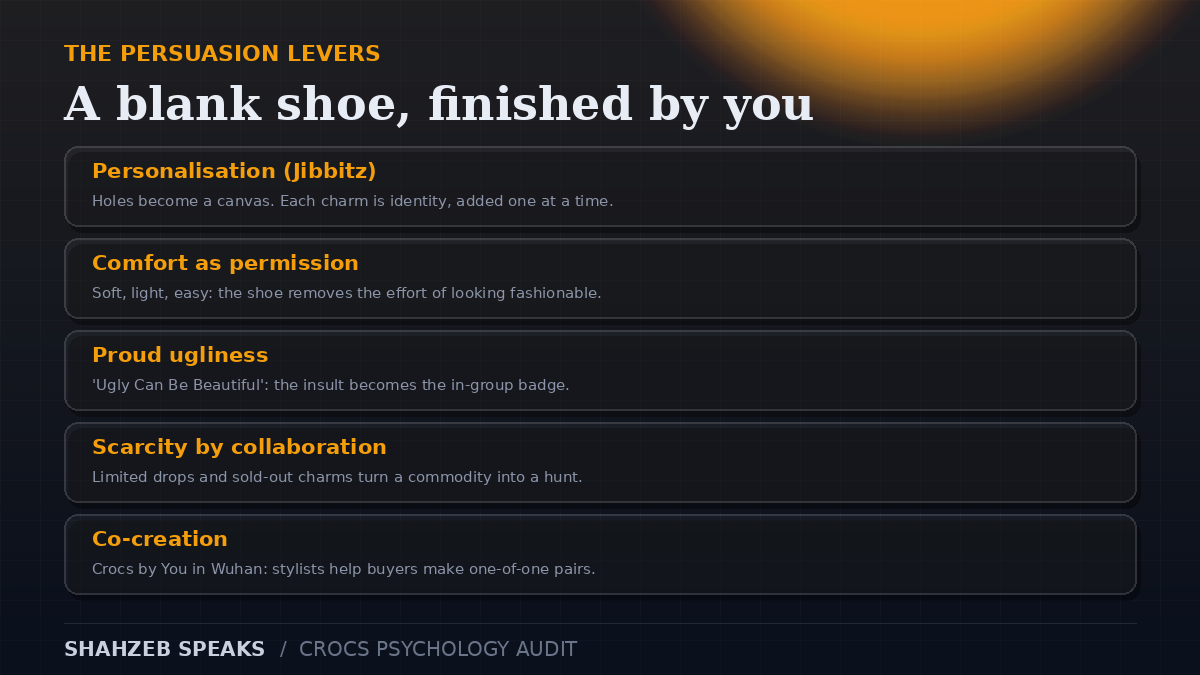
Self-determination theory (Deci & Ryan) adds the mechanism: autonomy is itself motivating. A customer who chooses each charm experiences autonomy that a customer who chooses between three finished colours does not. That autonomy is also why Crocs’ personalisation is hard for rivals to copy by simply adding charms to their own shoes. The rival’s shoe already expresses something. Adding charms to it dilutes the expression. Crocs’ shoe expresses nothing, so adding charms creates the expression. The blankness is the moat, and it is a strange moat: it only works because the shoe was once considered too ugly to matter.
📱 Chapter 6: Habit, Community and the Second Pair
Once a customer has a decorated pair, the next purchase is easier than the first. The charms transfer, or new charms are bought for a new colour, and the collection grows. The habit is not daily use in the app sense. It is seasonal and social: a new collaboration, a new charm set, a new colour for summer, a gift for a friend who already wears Crocs. Social proof does the rest. Seeing Crocs on nurses, chefs, students and celebrities in the same week normalises a shoe that no single group could normalise alone. The brand does not need to persuade any one group that Crocs are fashionable. It needs each group to see its own people wearing them, for its own reasons — comfort at work, irony at university, ease at home — and the sum of those reasons looks, from the outside, like a trend.
The risk of that breadth is that it is not loyalty in the usual sense. A customer who wears Crocs because they are comfortable at work will stop when the job changes. A customer who wears them ironically will stop when the irony fades. Crocs’ answer has been to keep adding reasons — new silhouettes, new collaborations, new personalisation formats — so that when one reason fades, another is ready. That is a treadmill, and it is expensive to run. But it is also why the brand has survived two decades of being declared dead: it never depended on a single reason, because it never offered a single identity.
⚠️ Chapter 7: The Dark Side — Designs, Trademarks and the HEYDUDE Bill
This chapter keeps every legal and regulatory matter at its exact status as of 24 October 2026. Nothing here is a finding against Crocs unless stated as one, and no current fine or damages figure is claimed.
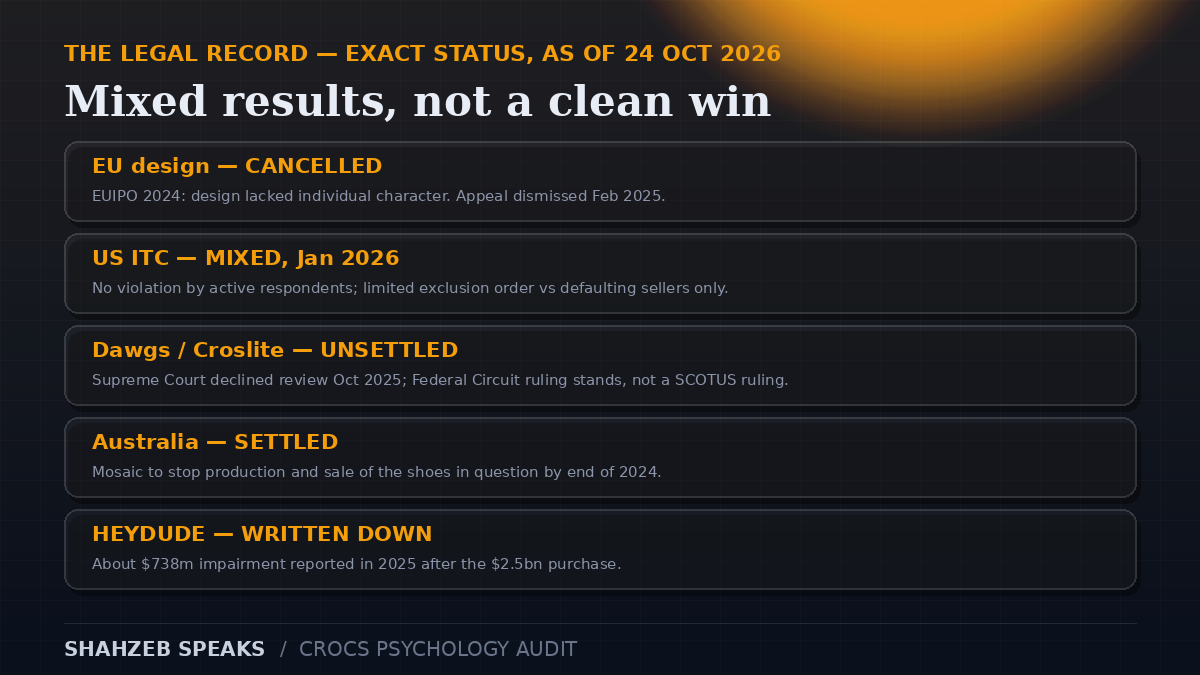
EU design — cancelled, appeal dismissed. On 22 January 2024, the EU Intellectual Property Office’s Cancellation Division upheld an application to declare Crocs’ EU design for the clog invalid, finding that it lacked individual character because an earlier “Holey Soles” clog had been disclosed to the public on 13–14 April 2003, before Crocs’ priority date of 28 May 2004. Crocs appealed. On 5 February 2025, the EUIPO Third Board of Appeal dismissed the appeal, upholding the cancellation. That is a loss of a design right in Europe, not a finding that Crocs copied Holey Soles in any broader sense, and it does not by itself remove trademark protection for the brand or for specific features.
US International Trade Commission — mixed result, January 2026. Crocs filed a complaint with the US International Trade Commission in June 2021, alleging that imports infringed or diluted its registered three-dimensional trademarks covering features of the Classic Clog, and sought a general exclusion order or, failing that, a limited one. The Commission’s final determination in September 2023 found no violation by the respondents who actively defended the case, but issued a limited exclusion order against respondents who had defaulted. On 8 January 2026, the US Court of Appeals for the Federal Circuit dismissed Crocs’ appeal of the no-violation finding as untimely, and affirmed the limited exclusion order for the defaulting sellers. The result is therefore mixed in a precise sense: Crocs can block imports tied to sellers who did not participate, but not imports by the companies that defended and were found not to have violated its rights.
Dawgs and Croslite — the Supreme Court did not rule. In a separate, long-running dispute, Dawgs alleged that Crocs falsely advertised its Croslite material as patented, proprietary and exclusive. The Federal Circuit held in October 2024 that false claims of patent ownership in advertising could support a false-advertising claim under the Lanham Act. On 6 October 2025, the US Supreme Court declined to review the case. Declining review is not a ruling for either side. It leaves the Federal Circuit’s ruling intact and the circuit split on the underlying legal question unresolved. Any summary that says the Supreme Court “ruled against Crocs” on this point is wrong, and this audit does not say it.
Australia — settled. Crocs sued Mosaic in Australia over a Classic Clog-style shoe, alleging trademark infringement, passing off and breach of Australian Consumer Law. The case settled, with Mosaic to stop production and sale of the footwear in question and similar styles by the end of 2024. A settlement is not a court finding, and it should not be reported as one.
Beyond the courtroom, the financial dark side is HEYDUDE. Crocs paid $2.5 billion in 2022 to diversify beyond the clog. By 2025 it reported an impairment of about $738 million on the brand, and group operating income fell from $1,021.9 million in 2024 to $149.5 million in 2025, with a net loss of $81.2 million for the year. Those are company-reported figures, and they raise a question the psychology cannot answer alone: if the core brand’s magic is its blankness, can a second brand that is not blank — HEYDUDE’s slip-ons have their own shape and identity — ever benefit from the same machinery? The evidence so far suggests the answer is no, or at least not yet.
🇵🇰 Chapter 8: What Pakistani brands should — and shouldn’t — copy
Copy the blank canvas, not the clog. What transfers is the decision to leave part of the product deliberately unfinished so the customer can finish it — a plain kurta with a choice of embroidery, a plain sneaker with local charms, a food box the customer assembles. The personalisation must be real, low-cost and reversible, and it must be visible to others, or it will not function as identity. A brand that offers three finished colours and calls it personalisation has missed the point: Crocs’ charms work because they are chosen one at a time, over time, and because the collection grows.
Do not copy the acquisition strategy without Crocs’ cash flow. A $2.5 billion purchase to diversify away from a single product only works if the core product keeps generating the cash to carry the new brand through its bad years. A smaller brand that buys a second brand to escape dependence on its first will often find it has doubled its dependence — on two brands, neither of which it can afford to fix. Do copy the comfort discipline: make the base product genuinely easy to use, easy to clean and easy to buy again, and let the customer, not the marketing department, decide what it means. In markets where imported fashion is expensive and local craft is undervalued, a well-made blank product that customers can decorate with local designs is not a compromise. It is a strategy.
👣 Chapter 9: The Crocs Customer, Step by Step
Walk through the experience and the psychology stacks in order. First, comfort: the shoe is easy, and easy is the permission to try it. Second, identity: the plain shoe offends no tribe, so any tribe can adopt it. Third, personalisation: the first charm turns a commodity into a statement, and the statement is reversible, so the risk is low. Fourth, collection: each new charm fills a gap, and gaps are felt as small losses to be closed. Fifth, scarcity: a limited collaboration or a sold-out charm turns a routine purchase into a hunt. Sixth, co-creation: a store or a stylist helps the customer make a one-of-one pair, and the labour itself raises the value. Seventh, habit: the charms transfer to the next pair, so switching brands means abandoning a collection. Each step is documented above. None of them requires the customer to believe the shoe is fashionable in the ordinary sense — which is why the shoe survived being called unfashionable for twenty years.
📊 Chapter 10: Psychology Scorecard
| Dimension | Score | Verdict |
|---|---|---|
| Identity & self-expression (Jibbitz) | 94 | The holes are the product. Identity is added one charm at a time. |
| Comfort & effort reduction | 90 | Easy to wear, easy to clean, easy to justify — the permission slip. |
| Personalisation & co-creation | 93 | Crocs by You turns a purchase into a making experience. |
| Scarcity & collaborations | 84 | Limited drops sell out because the base is familiar, not new. |
| Social proof & celebrity | 86 | Worn by nurses, chefs, students and stars — each group for its own reason. |
| Habit & collectability | 80 | Charms transfer to the next pair, so switching means abandoning a collection. |
| Transparency & trust | 62 | Croslite claims and design losses leave a trust cost, even where no finding was made. |
| Diversification & resilience | 52 | HEYDUDE’s $2.5 billion bet, written down by about $738 million, is still on trial. |
Overall: 94 + 90 + 93 + 84 + 86 + 80 + 62 + 52 = 641 ÷ 8 = 80.125 → 80/100.
✅ Chapter 11: Balance sheet & prescription
On the credit side: a blank product that customers finish themselves, comfort that functions as permission, an insult turned into an in-group badge, collaborations that move at charm speed, and a co-creation experience that makes the customer value the shoe more because they helped to make it. On the debit side: a design right lost in Europe, a mixed trademark result in the US, an unsettled advertising dispute over Croslite claims, and a $2.5 billion diversification whose impairment wiped out a year’s operating profit.
The prescription for Crocs is narrow: protect the blankness. Do not fill the clog with so many official designs, sub-brands and collaborations that there is nothing left for the customer to add. Keep the base plain, keep the charms cheap and reversible, and let HEYDUDE either find its own blank canvas or be judged on its own terms, not as a second Crocs. For other brands, the prescription is in Chapter 8: leave something unfinished, on purpose, and let the customer finish it in public. That is the cheapest loyalty programme ever invented, and the hardest to copy, because it requires a brand to be comfortable with not controlling the final look of its own product.
📝 Final Verdict
Crocs is the most honest persuasion machine in footwear, because it does not pretend to sell beauty. It sells comfort, blankness and a set of holes, and it lets the customer supply the meaning. That machine survived a near-death experience, a fashion consensus against it, and a $2.5 billion acquisition that has not yet worked — not because the shoe is fashionable, but because the shoe is finishable. The moment Crocs forgets that, and starts selling finished identities like everyone else, it will have to compete on fashion alone. And fashion, unlike a blank shoe with holes in it, is a game Crocs was never built to win.
Psychology Score: 80/100 — The ugly shoe that refused to become beautiful, and got rich by letting you finish it instead.
If your brand wants Crocs’ loyalty without its legal and diversification costs, the lesson is not “make an ugly product”. It is: leave part of the product unfinished, make finishing it cheap and visible, and let the customer own the result.
For more brand psychology, see my audits of Liquid Death and Zara, and for the field behind this work, my writing on industrial psychology in Pakistan.
📚 References & Sources
- Belk, R. W. (1988). Possessions and the extended self. Journal of Consumer Research, 15(2), 139–168.
- Crocs, Inc. financial statements: revenue $4,102,108 thousand (2024) and $4,040,647 thousand (2025); net income $950,071 thousand (2024), net loss $81,198 thousand (2025); operating income $1,021,911 thousand (2024), $149,515 thousand (2025).
- Crocs, Inc. Form 10-K, 17 March 2009: 2008 revenue decline on a 24.7% fall in units sold; losses $185.1 million (2008) and $42.1 million (2009).
- CFO.com. How Crocs regained its footing (2006 IPO $208 million; 2007 sales $847 million; going-concern qualification; “pretty much a near-death experience”).
- Deci, E. L., & Ryan, R. M. Self-determination theory (autonomy, competence, relatedness).
- Kahneman, D., & Tversky, A. (1979). Prospect theory: An analysis of decision under risk. Econometrica, 47(2), 263–291.
- Modern Retail (October 2026). Shoe tattoos and ballet ribbons: Crocs embraces “elevated” accessories (Crocs brand $1 billion quarterly revenue; sandal charms sold out; Crocs by You, Wuhan; Foglia quotation).
- Business Wire, 6 October 2026. BARK x Crocs collection expands after Pet Crocs sold out (Snore Mode dog bed; crocs.com availability late October).
- Norton, M. I., Mochon, D., & Ariely, D. (2012). The IKEA effect: When labor leads to love. Journal of Consumer Psychology, 22(3), 453–460.
- Tajfel, H., & Turner, J. C. (1979). An integrative theory of intergroup conflict. In W. G. Austin & S. Worchel (Eds.), The Social Psychology of Intergroup Relations.
- Tversky, A., & Kahneman, D. (1974). Judgment under uncertainty: Heuristics and biases. Science, 185(4157), 1124–1131.
- EUIPO Cancellation Division decision, 22 January 2024, and Third Board of Appeal decision, 5 February 2025 (Crocs EU design, Holey Soles prior disclosure 13–14 April 2003).
- Crocs, Inc. v. International Trade Commission, No. 24-1300 (Fed. Cir. 8 January 2026): appeal dismissed in part as untimely, limited exclusion order affirmed.
- Miller Canfield (2025). Supreme Court declines to review Dawgs/Croslite Lanham Act case, 6 October 2025.
- EmergeCounsel. Crocs Australian case settles (Mosaic to stop production/sale by end of 2024).
Key Findings
- Founded 2002 in Boulder, Colorado, by Scott Seamans, Lyndon "Duke" Hanson and George Boedecker Jr.; first model The Beach unveiled at the Fort Lauderdale Boat Show in 2002; headquarters Broomfield, Colorado, USA; CEO Andrew Rees since 2017
- In February 2006 Crocs listed on Nasdaq, and in 2006 it acquired Jibbitz, turning the clog's ventilation holes into a personalisation platform
- Crocs reported losses of $185.1 million in 2008 and $42.1 million in 2009, with a going-concern qualification from its auditors, before a restructuring turnaround
- In February 2022 Crocs acquired HEYDUDE for $2.5 billion; in 2025 it REPORTED an impairment of about $738 million on HEYDUDE, and group revenue was $4.04 billion with a net loss of $81.2 million (2024: revenue $4.10 billion, net income $950.1 million)
- In January 2024 the EUIPO Cancellation Division CANCELLED Crocs' EU clog design for lack of individual character, and on 5 February 2025 the EUIPO Third Board of Appeal DISMISSED Crocs' appeal, upholding the cancellation
- In January 2026 the US Court of Appeals for the Federal Circuit produced a MIXED result in the ITC case: it DISMISSED Crocs' appeal on active respondents as untimely and AFFIRMED a limited exclusion order against defaulting sellers only; separately, on 6 October 2025 the US Supreme Court DECLINED to review the Dawgs/Croslite case, which is not a ruling on the merits
Overall Psychology Score
Crocs scores 80/100 in our comprehensive psychology audit covering consumer behavior strategies, UX design principles, and psychological marketing effectiveness.
The detailed dimension scores are in the audit's Psychology Scorecard chapter.
High impactMuhammad Shahzeb
MSc Industrial Psychologist, specializing in consumer behavior, UX psychology, and brand strategy analysis. Helping brands understand the psychology behind their success.
About Muhammad Shahzeb →