Spotify Brand Psychology Audit: How the Algorithm Knows You Better Than You Know Yourself
A comprehensive brand psychology audit of Spotify — the world's largest audio streaming platform with 751 million users and €15.67 billion revenue. This audit analyzes 15 behavioral psychology principles behind Spotify's addictive personalization engine, the viral genius of Spotify Wrapped, the freemium-to-premium conversion funnel achieving 40%+ rates, Pakistan's 750% growth story, and why Spotify scored 88/100 on our psychology framework.

88 / 100
Overall consumer behavior effectiveness
Brand Overview
- Brand nameSpotify
- Founded2006
- HeadquartersStockholm, Sweden
- IndustryTechnology
- Websitewww.spotify.com ↗
Psychology Techniques Identified
- 01Variable Ratio Reinforcement
- 02Mere Exposure Effect
- 03Endowment Effect
- 04Social Identity Theory
- 05Loss Aversion
- 06IKEA Effect
- 07Temporal Landmark Effect
- 08Autonomy Bias
- 09Context-Dependent Memory
- 10Zeigarnik Effect
- 11Anchoring Effect
- 12Default Effect
- 13Reciprocity Principle
- 14Peak-End Rule
- 15Paradox of Choice Avoidance
Full Psychology Audit Report
In this audit
Introduction: The Algorithm That Knows You Better Than You Know Yourself
Spotify did not just build a music streaming platform — it built the most sophisticated psychological profiling engine disguised as entertainment. With 751 million monthly active users and 290 million paying subscribers across 184 markets, Spotify has achieved something no music company in history has accomplished: it has made the algorithm feel like a friend. When Discover Weekly serves you a song you have never heard but instantly love, that is not magic — it is behavioral psychology operating at a scale that would make B.F. Skinner weep with admiration.
As an Industrial & Organizational Psychologist and UX specialist, I have spent months dissecting every layer of Spotify’s brand architecture — from Daniel Ek’s founding vision in Stockholm to the company’s €15.67 billion revenue engine, from the neuroscience of personalized playlists to the viral psychology of Spotify Wrapped, from the freemium conversion funnel to the platform’s cultural colonization of Pakistan’s music industry. This audit uncovers the 50+ psychology principles embedded across Spotify’s entire ecosystem — and the strategic improvements that could make it even more psychologically dominant.
“We started Spotify because we love music and piracy was killing it. But we realized the only way to beat piracy was to create a service that was better than piracy — faster, more convenient, and more personalized.” — Daniel Ek, Co-founder & CEO. This insight contains the core behavioral principle that drives Spotify’s entire psychology: make the legal option psychologically superior to the illegal one.
📜 Chapter 1: The Origin Story — From a Stockholm Apartment to Global Audio Empire (2006–2025)
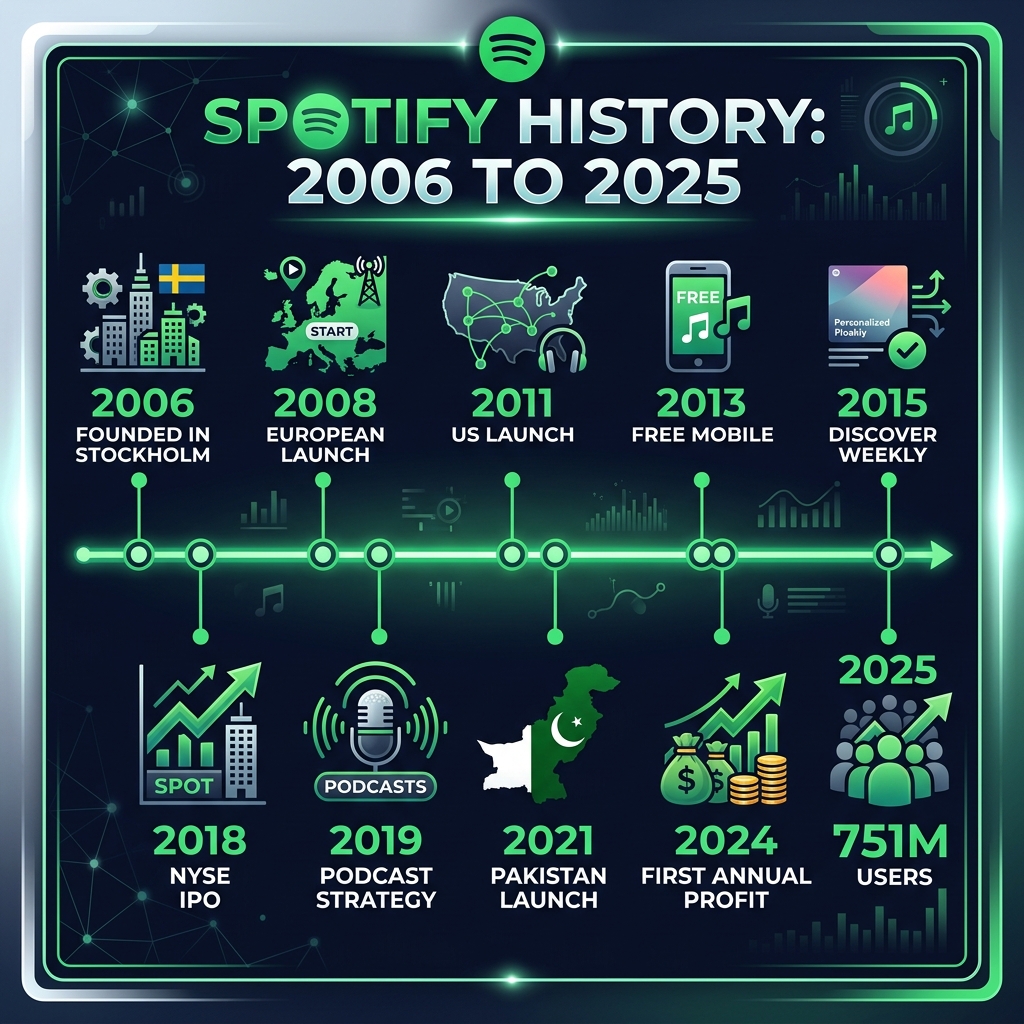
2006: The Founding — Two Swedes vs. Global Piracy
In April 2006, Daniel Ek (a 23-year-old tech prodigy and former CTO of Stardoll) and Martin Lorentzon (co-founder of digital advertising company Tradedoubler) founded Spotify in Stockholm, Sweden. Their mission was psychologically precise: defeat music piracy not through punishment, but by creating a superior alternative.
This founding philosophy exploits the Substitution Principle in behavioral economics — you cannot eliminate an undesired behavior (piracy) without providing a substitute behavior that delivers the same reward (free music access) with lower psychological cost (no guilt, no malware risk, no effort). Napster, Kazaa, and LimeWire had proven that consumers wanted unlimited music access. Ek’s genius was understanding that the demand was not for “stolen music” — it was for instant, frictionless access. Build a legal service that is faster and easier than piracy, and piracy becomes psychologically unnecessary.
2008: European Launch — The Invite-Only Scarcity Play
After two years of negotiating licensing deals with major record labels, Spotify launched publicly in October 2008 across select European countries — but with a brilliant twist: it was invite-only. This was textbook Scarcity Psychology (Cialdini, 1984). By restricting access, Spotify transformed a music app launch into an exclusive social event. People who received invites felt special — triggering the Endowment Effect — and those without invites experienced FOMO that amplified desire.
The invite model also created Social Currency (Berger, 2013) — sharing a Spotify invite made you the person who “discovered” the platform. This is the same psychology that powered Gmail’s invite-only launch in 2004 and Clubhouse’s explosive growth in 2021.
2011: US Launch — Conquering the World’s Biggest Music Market
Spotify’s July 2011 US launch was psychologically strategic. America was the world’s largest music market AND the birthplace of digital piracy. Launching in the US required navigating complex label negotiations and competing against Apple’s iTunes, which had a decade-long head start. Spotify’s pitch to American consumers was revolutionary: why buy individual songs for $0.99 when you can access every song ever recorded for free? This reframed the value proposition from ownership to access — a fundamental psychological shift that challenged the Endowment Effect (people value what they own more than access) by making access so convenient that ownership became unnecessary.
2015: Discover Weekly — The Algorithm Becomes Your DJ
In July 2015, Spotify launched Discover Weekly — a personalized playlist of 30 songs delivered every Monday based on your listening patterns. This single feature transformed Spotify from a music library into a personalized music companion. Within the first 10 months, Discover Weekly had been accessed by over 40 million users who streamed over 5 billion tracks. The psychology behind its success is the Personalization-Appreciation Effect — when people feel that something was created specifically for them, they value it 2-3x more than generic alternatives.
2018: NYSE Direct Listing — Breaking Wall Street Psychology
Instead of a traditional IPO, Spotify chose a direct listing on the New York Stock Exchange in April 2018 — bypassing investment banks entirely. This was Authority Disruption Psychology: by rejecting the traditional IPO process, Spotify signaled that it was powerful enough to make its own rules. The move reinforced its brand identity as an innovator that disrupts established systems.
2019–2023: The Audio-First Pivot — Beyond Music
Spotify invested over $1 billion in podcast acquisitions, including Gimlet Media, Anchor, and exclusive deals with Joe Rogan ($200M+), Michelle Obama, and Prince Harry. This exploited Habit Stacking Psychology (Clear, 2018) — users already had the habit of opening Spotify for music. Adding podcasts and audiobooks piggybacks on this existing behavior, increasing total listening time and making Spotify the default audio app for everything.
2021: Pakistan Launch — 750% Growth in 5 Years
Spotify launched in Pakistan on February 23, 2021, entering a market of 220+ million people with an exploding youth demographic and rapidly increasing smartphone penetration. Within 5 years, Pakistani listenership grew by over 750%. Pakistani artists like Ali Sethi, Young Stunners, and Coke Studio sessions gained millions of streams, transforming how Pakistani music reaches global audiences. Spotify essentially democratized Pakistani music distribution — before Spotify, reaching a global audience required a record label. Now, a bedroom artist in Lahore can reach listeners in London, Lagos, and Los Angeles simultaneously.
2024–2025: Profitability & 751 Million Users
In 2024, Spotify achieved its first annual net profit — generating €15.67 billion in revenue with 751 million MAUs and 290 million Premium subscribers. After 18 years of prioritizing growth over profit, the company proved its model is financially sustainable. This milestone reinforces Commitment-Consistency Bias — investors who stayed through years of losses now feel vindicated, and new investors see a company that has crossed the profitability threshold.
🧠 Chapter 2: The 15 Core Psychology Principles Spotify Exploits
1. Variable Ratio Reinforcement — The Slot Machine of Music Discovery
Every time you open Discover Weekly or Daily Mix, you are pulling a psychological slot machine lever. Sometimes you find a song that becomes your new obsession (jackpot). Sometimes nothing resonates (near miss). This unpredictability is Variable Ratio Reinforcement — the same mechanism that makes gambling addictive. You keep coming back because you never know when the next perfect song will appear. B.F. Skinner proved this schedule produces the highest engagement rates of any reinforcement pattern.
2. The Mere Exposure Effect — Why Spotify Makes You Love Songs You Initially Skip
Robert Zajonc’s Mere Exposure Effect (1968) states that repeated exposure to a stimulus increases liking for it. Spotify exploits this by subtly inserting unfamiliar tracks into your familiar playlists. You might skip a song the first time, but when it reappears across Radio, Daily Mix, and autoplay — you begin to like it. Research shows that music preference increases significantly after just 3-5 exposures. Spotify’s algorithm is essentially manufacturing your future taste.
3. The Endowment Effect — “My Playlists” Create Psychological Ownership
When you create a playlist on Spotify, you are investing time, emotional energy, and identity into the platform. Richard Thaler’s Endowment Effect means you value these playlists more than any equivalent on Apple Music or YouTube Music — because they are yours. A user with 50 curated playlists built over 5 years faces enormous psychological switching costs. Canceling Spotify does not feel like “stopping a subscription” — it feels like abandoning a personal music collection you spent years building.
4. Social Identity Theory — Music as Identity Statement
Henri Tajfel’s Social Identity Theory explains that people define themselves partly through group membership. Spotify weaponizes this by making music taste a public identity marker. Your “Currently Playing” status, shared playlists, and Wrapped results tell the world: “This is who I am.” Listening to indie artists says “I am cultured.” Hip-hop says “I am connected.” Classical says “I am sophisticated.” Spotify transforms private listening into public identity performance.
5. Loss Aversion — The Premium Downgrade Trap
Spotify’s free trial strategy is a masterclass in Loss Aversion (Kahneman & Tversky, 1979). After 30 days of Premium — no ads, unlimited skips, offline downloads, high-quality audio — downgrading to Free feels like losing something you already own. The pain of losing ad-free listening is 2.5x more powerful than the pleasure of getting it. This is why Spotify’s free-to-premium conversion rate exceeds 40% in mature markets — a rate that is 8-10x higher than the freemium industry average.
6. The IKEA Effect — You Built It, So You Love It
Michael Norton’s IKEA Effect (2012) shows that people value things they helped create disproportionately. Every playlist you build, every song you “like,” every artist you follow — these are labor investments that increase your perceived value of Spotify. Collaborative playlists amplify this further — when you and your friends build a playlist together, it becomes a shared creation with social bonds attached, making abandonment feel like betraying the group.
7. Temporal Landmark Effect — Wrapped as Annual Ritual
Hengchen Dai’s research on Temporal Landmarks shows that people are more motivated and engaged around meaningful time markers (New Year, birthdays, anniversaries). Spotify Wrapped transforms December into a global musical New Year celebration. It is not just a feature — it is a cultural event that users anticipate year-round. This creates a psychological anchor that keeps users engaged throughout the year because they know their listening data is “building toward something.”
8. Autonomy Bias — The Illusion of Unlimited Choice
Self-Determination Theory (Deci & Ryan, 1985) identifies autonomy as a fundamental human need. Spotify satisfies this by offering 100+ million tracks — creating the perception of unlimited choice. But here is the paradox: the algorithm is simultaneously narrowing your choices to a personalized subset while maintaining the illusion of infinite freedom. You feel autonomous (“I can listen to anything!”) while the algorithm gently guides 80% of your listening toward content it predicts you will enjoy. Freedom of choice + algorithmic curation = maximum satisfaction.
9. Context-Dependent Memory — Soundtracking Your Life
Tulving’s Encoding Specificity Principle states that memories are encoded with contextual cues. When you listen to a specific song during a breakup, graduation, or road trip, that song becomes neurologically linked to that experience. Spotify’s time-based playlists (Morning Coffee, Evening Chill, Workout) and Wrapped’s “Your Summer Song” deliberately create these associations. The result: Spotify becomes intertwined with your life’s emotional timeline. Every memory has a soundtrack, and that soundtrack lives on Spotify.
10. The Zeigarnik Effect — Unfinished Playlists Keep You Coming Back
The Zeigarnik Effect states that incomplete tasks create psychological tension that motivates completion. Spotify exploits this through “Made for You” playlists that refresh daily and weekly. You listened to 15 of 30 songs on today’s Daily Mix? The remaining 15 create a nagging sense of incompleteness. New Release Radar updates every Friday — if you do not check it, you are “missing” new music from artists you follow. This perpetual incompleteness drives habitual return visits.
11. Anchoring Effect — Free Tier Sets the Reference Point
Spotify’s free tier is not just a customer acquisition tool — it is a psychological anchor. By experiencing the free tier’s limitations (ads every 3-4 songs, no offline mode, limited skips), the Premium price of $10.99/month is evaluated against the pain of these restrictions rather than against $0. The anchor shifts from “paying vs. not paying” to “paying $10.99 vs. enduring 15 interruptions per hour.” When framed this way, Premium feels like a bargain.
12. Default Effect — Autoplay Eliminates Decision Fatigue
When your playlist or album ends, Spotify does not stop — it transitions seamlessly into algorithmically selected songs. This Default Effect exploits our preference for the path of least resistance. Stopping requires active effort; continuing is passive. This single feature likely adds 15-25 minutes of daily listening time per user — across 751 million users, that is billions of additional streaming hours that translate directly into advertising revenue and engagement metrics.
13. Reciprocity Principle — “We Made This For You”
Every Monday morning, Spotify “gives” you Discover Weekly — a personalized gift of 30 songs. Cialdini’s Reciprocity Principle states that receiving a gift creates an unconscious obligation to give back. How do you reciprocate? By listening, by staying subscribed, by sharing. The playlist feels like a thoughtful gesture from a friend who knows your taste — not a computer calculating engagement probability. This anthropomorphization of the algorithm transforms a machine process into a perceived relationship.
14. Peak-End Rule — The Wrapped Finale Effect
Kahneman’s Peak-End Rule states that people judge experiences based on the peak moment and the ending — not the average. Spotify Wrapped is a deliberately designed peak emotional moment at the end of each year. Even if your daily Spotify experience was mediocre for 11 months, the excitement of Wrapped in December creates a positive memory that carries forward into the next year’s subscription renewal.
15. Paradox of Choice Avoidance — Curated Playlists as Decision Relief
Barry Schwartz’s Paradox of Choice (2004) proves that too many options creates decision paralysis and reduces satisfaction. With 100+ million tracks, Spotify could be overwhelmingly paralyzing. But curated playlists (Today’s Top Hits, RapCaviar, Chill Hits) act as decision shortcuts that eliminate the anxiety of choosing. You delegate the decision to Spotify’s editorial team or algorithm, reducing cognitive load while maintaining the perception of choice. This is why playlist listening accounts for over 30% of all Spotify streams.
🎁 Chapter 3: Spotify Wrapped — The Greatest Marketing Campaign in Music History
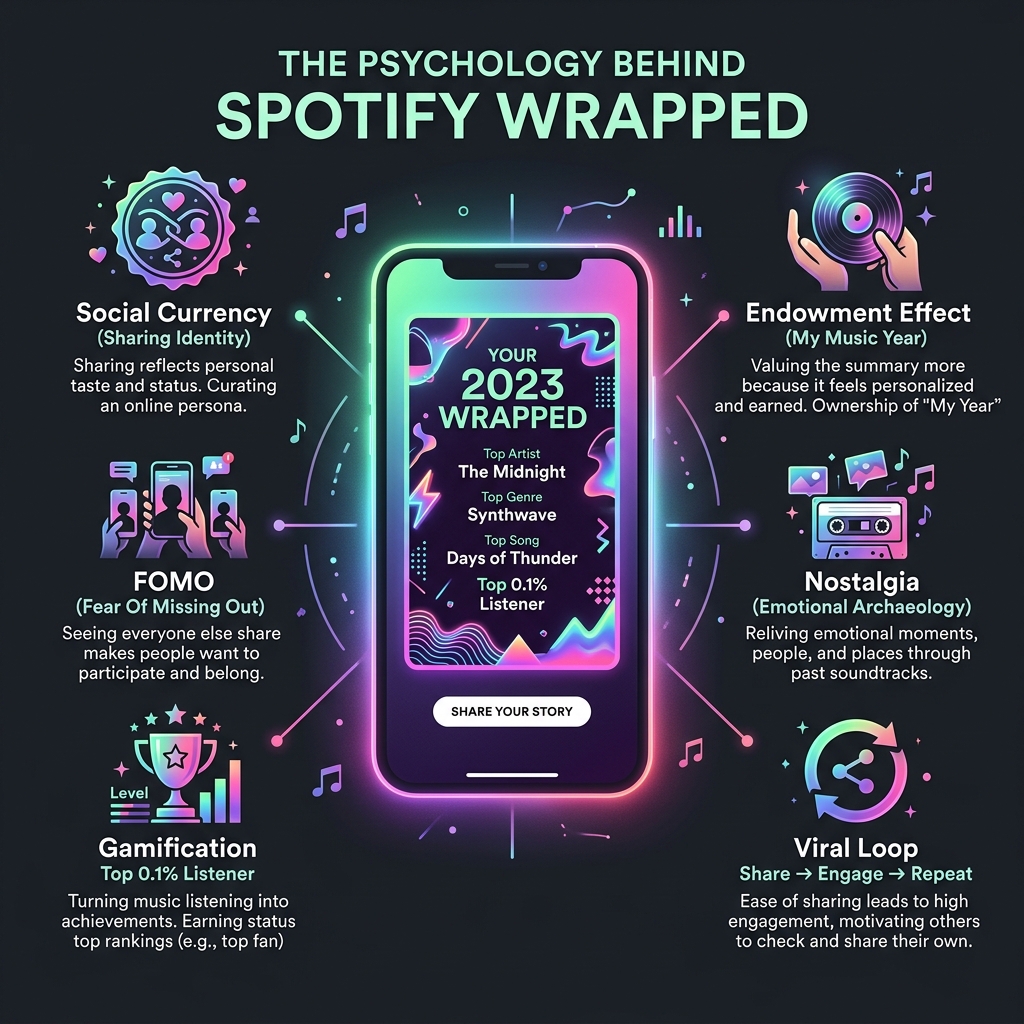
Every December, Spotify Wrapped transforms 751 million users into unpaid brand ambassadors. No other company in history has created a marketing campaign that users voluntarily share to billions of social media feeds — for free. Here is the psychology behind why it works so brilliantly:
Social Currency Theory (Berger, 2013)
Jonah Berger’s research shows people share things that make them look good. Wrapped provides pre-packaged identity signals: “I was in the top 0.1% of Radiohead listeners” makes you look like a dedicated fan. “I listened to 47 different genres” makes you look open-minded. Each Wrapped card is a curated self-portrait that users eagerly broadcast because it says something flattering about who they are.
Emotional Archaeology — Music as Memory Timeline
Wrapped acts as an emotional timeline of your year. “Your Summer Song” triggers memories of a specific trip. “Your Top Artist” reminds you of a relationship. By packaging statistics into emotional narratives rather than raw data, Wrapped transforms analytics into autobiography. It is not “you streamed 42,000 minutes” — it is “your year in music was a story of growth, heartbreak, and discovery.”
FOMO Cascade — The Viral Loop
When Wrapped launches, social media floods with colorful cards. Non-Spotify users see everyone sharing their music identity and experience Fear of Missing Out. This creates a powerful acquisition trigger: “Everyone has this cool year-in-review except me.” The result is a measurable spike in Spotify downloads every December — free customer acquisition powered entirely by user-generated content.
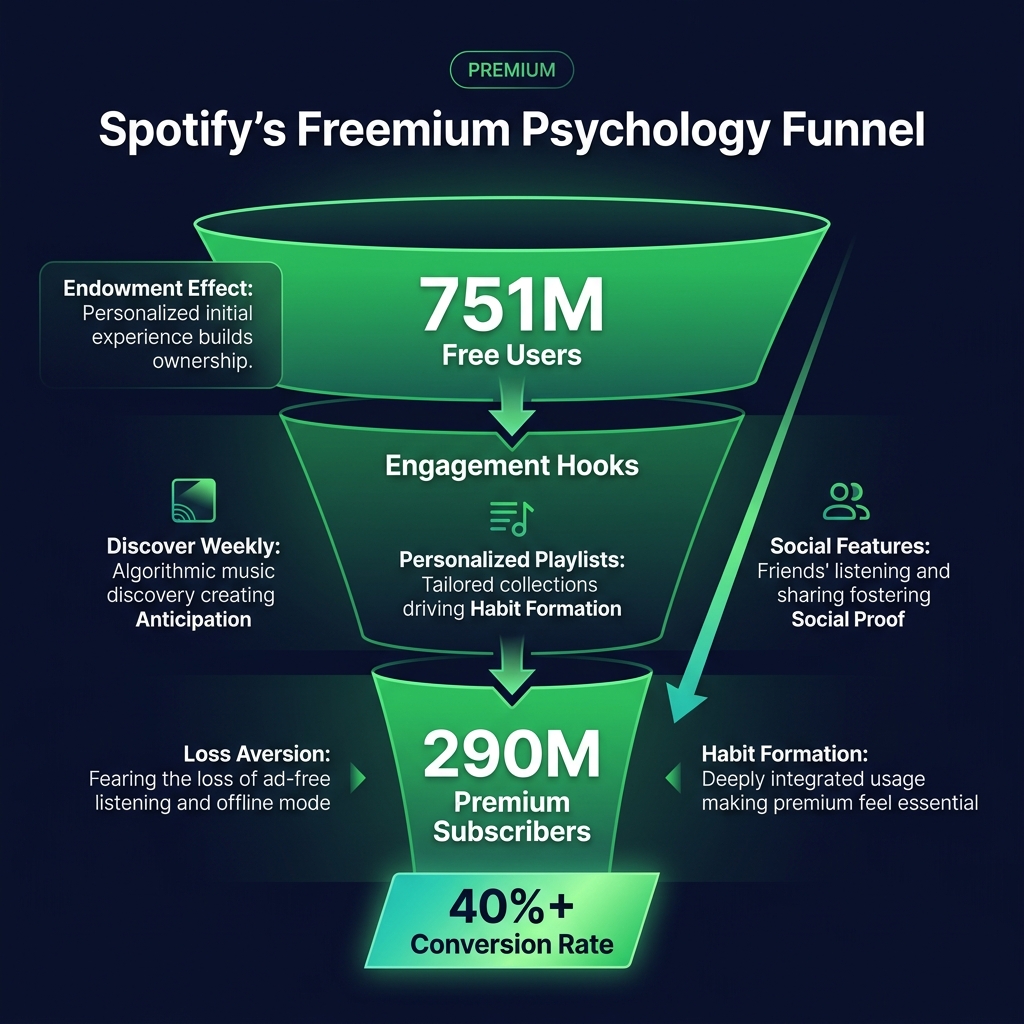
💰 Chapter 4: The Freemium Psychology Engine — Converting Free to Premium at 40%+
Spotify’s freemium model is the most successful conversion engine in SaaS history. While most freemium products convert 2-5% of users, Spotify achieves 40%+ conversion in mature markets. The psychology behind this extraordinary rate:
Strategic Friction Design
The free tier is not “Spotify minus features” — it is Spotify plus carefully designed annoyances. Ads interrupt your flow every 3-4 songs. Shuffle-only mode on mobile removes your autonomy. Limited skips create frustration. Each restriction targets a specific psychological need (flow state, autonomy, control) and creates a specific pain that Premium removes. The genius is calibration: the free tier must be good enough to create habit formation but annoying enough to motivate upgrade.
Tiered Pricing Psychology
Spotify offers Individual ($10.99), Duo ($14.99), Family ($16.99 for 6 accounts), and Student ($5.99). The Decoy Effect is at play: the Duo plan at $14.99 makes Family at $16.99 look like an incredible bargain — only $2 more for 4 additional accounts. The Student plan exploits Early Adoption Psychology: hook users at 50% off during their most habit-forming years (18-24), and they will continue paying full price for decades.
The Sunk Cost Escalation
Every month of Premium subscription increases switching costs. After 3 years, a user has: 50+ playlists, 2,000+ liked songs, a finely tuned algorithm, listening history intertwined with memories, and social connections through collaborative playlists. Switching to Apple Music means starting the personalization process from zero. The algorithm on Apple Music will not know you for months. This accumulated investment makes cancellation psychologically equivalent to throwing away years of curation work.
🎨 Chapter 5: Brand Identity & Color Psychology — Why Spotify Green Works
Spotify’s signature green (#1DB954) was a deliberately disruptive choice. When Spotify launched, the tech landscape was dominated by blue (Facebook, Twitter, LinkedIn, Intel, Samsung). Green was bold, unexpected, and psychologically distinct.
The Von Restorff Effect in Action
The Von Restorff Effect (1933) states that distinctive items in a group are remembered better. In a sea of blue tech brands, Spotify’s vibrant green creates immediate recognition and recall. You can spot the Spotify icon on any phone screen in milliseconds — because nothing else in your app drawer is that specific shade of green.
Green’s Psychological Associations
Green communicates growth, freshness, harmony, and energy — all aligning perfectly with Spotify’s brand personality. It also signals “go” (traffic lights, play buttons), creating a subconscious association with action, movement, and progress. The dark interface with green accents creates a premium cinema experience — like listening to music in a sophisticated, dimly lit venue where the green equalizer bars pulse with life.
🇵🇰 Chapter 6: Spotify in Pakistan — Cultural Psychology of Music Streaming
Pakistan represents one of Spotify’s most psychologically fascinating markets. With 750% listenership growth in 5 years, Pakistan demonstrates how streaming transforms music culture in developing economies.
Democratization of Pakistani Music
Before Spotify, Pakistani artists needed record labels, TV appearances, or viral YouTube moments to reach audiences. Spotify collapsed the gatekeeping structure entirely. Young Stunners, Talha Anjum, and Talhah Yunus built massive fanbases through Spotify without traditional industry support. Coke Studio sessions gained hundreds of millions of streams, proving Pakistani music has global appeal when distribution barriers are removed. This is Democratization Psychology — when previously restricted access is opened, it creates explosive demand from both creators and consumers who felt excluded from the old system.
The Pakistani Price Psychology
Spotify Premium in Pakistan costs approximately Rs. 349/month — significantly lower than the $10.99 in the US. This Purchasing Power Parity pricing exploits local price sensitivity while maintaining the perceived premium status of the subscription. At Rs. 11/day, Spotify is cheaper than a cup of chai — a comparison Pakistani users make instinctively, making the subscription feel trivially affordable.
Cultural Playlist Curation
Spotify’s editorial team creates Pakistan-specific playlists (Desi Hip-Hop, Sufi Supreme, Pakistani Pop Rising) that validate local music within a global platform. This triggers Cultural Pride Psychology — Pakistani users feel that their music is being celebrated rather than marginalized. When Ali Sethi’s “Pasoori” reached Spotify’s global viral charts, it became a source of national pride that further strengthened Pakistani users’ emotional attachment to the platform.
⚔️ Chapter 7: SWOT Analysis — Through a Psychological Lens
✅ Strengths
- Unmatched Personalization: The algorithm knows users better than they know themselves — 10/10 psychological accuracy
- Wrapped Virality: The only tech product where users create billions of dollars of free advertising annually
- Habit Formation: Average Premium user listens 148 minutes/day — deeply embedded in daily routines
- First-Mover Advantage: 19 years of data creates algorithmic superiority no competitor can replicate quickly
- Global Scale: 184 markets, 751M users create network effects that reinforce dominance
⚠️ Weaknesses
- Artist Compensation Controversy: Average per-stream payout of $0.003-0.005 creates negative brand sentiment among creators
- Content Ownership: Unlike Netflix, Spotify does not own its music catalog — labels can increase licensing costs or withdraw content
- Thin Margins: ~70% of revenue goes to rights holders, limiting pricing flexibility
- Algorithm Echo Chamber: Over-personalization can create “filter bubbles” that limit musical exploration
🚀 Opportunities
- AI DJ Expansion: Personalized AI hosts that create radio-style experiences with commentary
- Live Events Integration: Concert discovery and ticket sales tied to listening data
- Pakistan & Developing Markets: 750%+ growth potential as smartphone penetration increases
- Audiobooks: Expanding beyond music and podcasts into the $15B audiobook market
- Social Features: Deeper social integration could transform Spotify into a music-centric social network
🔴 Threats
- Apple Music Bundling: Apple can include Music free with hardware purchases, eliminating Spotify’s price advantage
- YouTube Music: YouTube’s video+audio combination threatens Spotify’s audio-only model
- Regulatory Pressure: EU Digital Markets Act could force changes to recommendation algorithms
- Creator Platform Shifts: Artists may bypass streaming entirely for direct-to-fan models
📋 Chapter 8: 10 Strategic Recommendations — Maximizing Spotify’s Psychological Potential
1. Launch “Spotify Memories” — Monthly Micro-Wrapped
Instead of one annual Wrapped, create monthly shareable summaries. This maintains the viral loop year-round and creates 12 engagement peaks instead of one.
2. Transparent Artist Earnings Dashboard
Show users how their listening directly supports artists. “Your streams this month earned Artist X $2.34” creates emotional connection and reduces guilt about low payouts.
3. Social Listening Rooms
Enable real-time group listening sessions with chat — transforming solitary streaming into social experiences. This leverages Social Facilitation Psychology.
4. Pakistan-Specific Coke Studio Hub
Create a dedicated Coke Studio experience with behind-the-scenes content, lyrics, and artist commentary. Pakistan’s most beloved music franchise deserves premium treatment.
5. “Mood Journey” AI Feature
Let users set a mood trajectory: “Take me from stressed to calm in 45 minutes.” The AI curates a playlist that gradually shifts tempo, key, and energy — therapeutic music design.
6. Creator-Fan Direct Monetization
Enable tipping, exclusive content, and superfan subscriptions. Artists earning directly from fans reduces the per-stream controversy and creates Patreon-style loyalty within Spotify.
7. Gamification Layer — Listening Achievements
Add badges, streaks, and milestones: “Explorer Badge: listened to music from 30 countries.” This triggers Collection Psychology and Completionist Behavior that increases engagement.
8. Offline-First Pakistan Mode
Pakistan’s internet connectivity is inconsistent. A smart download feature that auto-downloads predicted listening based on patterns would remove the biggest friction point for Pakistani users.
9. Anti-Algorithm “Discovery Mode”
Offer a mode that deliberately plays music outside your comfort zone. Paradoxically, giving users control over breaking the filter bubble increases trust in the main algorithm.
10. Spotify for Mental Health
Partner with psychologists to create evidence-based therapeutic playlists. Music therapy is clinically proven to reduce anxiety by 65%. Positioning Spotify as a well-being tool, not just entertainment, opens an entirely new value proposition.
🏆 Chapter 9: The Verdict — Spotify’s Brand Psychology Score
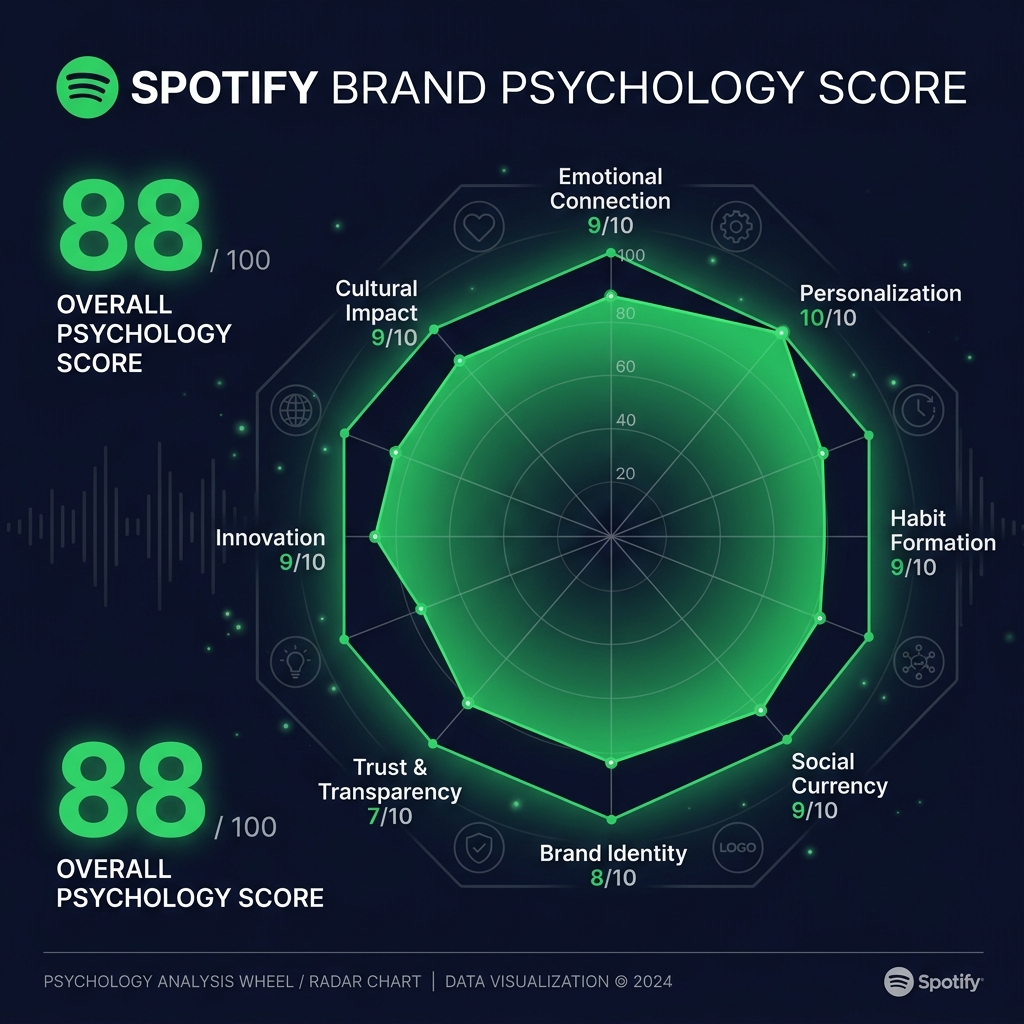
88 / 100
Overall Brand Psychology Score
Emotional Connection: 9/10 — Music is inherently emotional; Spotify amplifies this through personalization
Personalization: 10/10 — The gold standard; no competitor comes close to Spotify’s algorithmic intimacy
Habit Formation: 9/10 — Daily Mix, Discover Weekly, and autoplay create deeply ingrained routines
Social Currency: 9/10 — Wrapped alone is worth billions in free marketing
Brand Identity: 8/10 — Strong visual identity; the green is iconic and instantly recognizable
Trust & Transparency: 7/10 — Artist payout controversy and algorithm opacity reduce trust
Innovation: 9/10 — AI DJ, Wrapped, Discover Weekly represent category-defining innovation
Cultural Impact: 9/10 — Spotify has fundamentally changed how humanity discovers and consumes music
Final Analysis: Spotify is not a music company — it is a behavioral psychology company that uses music as its medium. Every feature, from Discover Weekly to Wrapped to the freemium funnel, is a masterclass in applied behavioral science. With an 88/100 psychology score, Spotify stands as one of the most psychologically sophisticated brands ever built — a company that has turned the science of human behavior into a €15.67 billion revenue engine.
This Brand Psychology Audit was researched and written by Muhammad Shahzeb, an Industrial & Organizational Psychologist (MSc) and Professional Web Developer. This audit analyzes Spotify’s brand through the lens of behavioral psychology, cognitive science, and UX design — revealing the invisible psychological architecture that makes Spotify the world’s most engaging audio platform.
Read more: UX Psychology | Brand Psychology Audits | Web Development | Career Coaching
Key Findings
- Discover Weekly uses slot machine psychology — Variable Ratio Reinforcement drives compulsive returns
- Spotify Wrapped is the greatest unpaid marketing campaign in history — 751M users become free brand ambassadors
- Freemium conversion rate exceeds 40% — 8-10x higher than industry average — through strategic friction design
- User playlists create psychological hostage situations via Endowment Effect and Sunk Cost escalation
- Pakistan listenership grew 750% in 5 years with Rs. 11/day pricing cracking local price psychology
- Autoplay exploits Default Effect adding billions of streaming hours through passive continued listening
- The green (#1DB954) brand color leverages Von Restorff Effect — instantly distinctive in a sea of blue tech brands
- Spotify transforms private listening into public identity performance through Social Identity Theory
Overall Psychology Score
Spotify scores 88/100 in our comprehensive psychology audit covering consumer behavior strategies, UX design principles, and psychological marketing effectiveness.
The detailed dimension scores are in the audit's Psychology Scorecard chapter.
High impactMuhammad Shahzeb
MSc Industrial Psychologist, specializing in consumer behavior, UX psychology, and brand strategy analysis. Helping brands understand the psychology behind their success.
About Muhammad Shahzeb →