J.C. Penney Psychology Audit — Black Friday Pricing: The Discount Is the Product
JCPenney's Black Friday 2026 sale runs 20–29 November, with discounts of up to 80% off fine jewellery — and a pricing machine so effective that, before 2012, about 73% of the company's revenue came from goods sold at 50% or more off. Our psychology audit of the anchor, the urgency and the $50 million lesson in "was" prices scores JCPenney 81/100.

81 / 100
Overall consumer behavior effectiveness
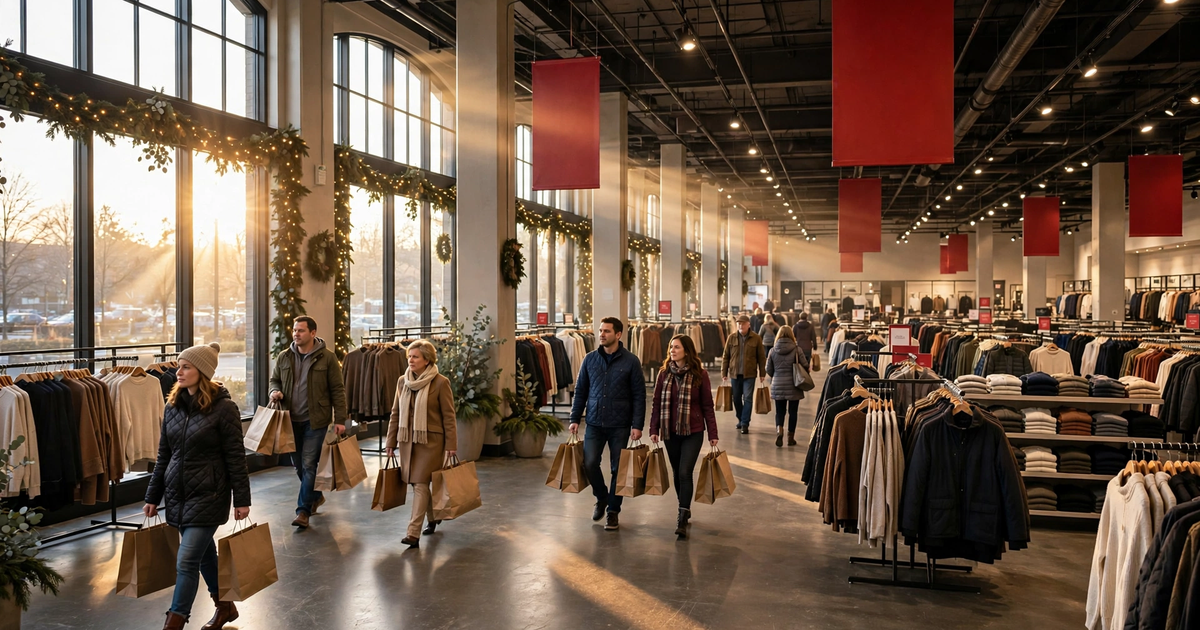
Brand Overview
- Brand nameJ.C. Penney
- Founded1902
- HeadquartersPlano, Texas, USA
- IndustryRetail
- Websitewww.jcpenney.com ↗
Psychology Techniques Identified
- 01Anchoring & reference pricing (Tversky & Kahneman 1974; the crossed-out "was" price sets the reference point for everything after it)
- 02Transaction utility (Thaler 1985; the saving is judged separately from the item, and the saving is the part the shopper remembers)
- 03Smart-shopper pride (Schindler 1989; the bargain as a small achievement that belongs to the shopper, not the store)
- 04Scarcity & urgency (Cialdini 2001; four timed giveaways, "while supplies last", a 5 a.m. opening)
- 05Loss aversion (Kahneman & Tversky 1979; the discount framed as something the shopper already owns, and leaving as giving it back)
- 06Price framing — dollar vs percentage (Chen, Monroe & Lou 1998; percentages for the small things, where a big number feels generous)
- 07Reference-price advertising (Grewal, Monroe & Krishnan 1998; the advertised reference price shifts the buyer's own internal reference price)
- 08Decoy & asymmetric dominance (Huber, Payne & Puto 1982; the tiered discounts make each tier look better by comparison — with the Frederick et al. 2014 fragility caveat)
- 09Deal proneness (Lichtenstein, Burton & Netemeyer 1997; customers trained to hunt for the deal, and to change when and where they shop for it)
- 10The honest-price reversal (Fair and Square, 2012; removing the game removed the reason to shop — the lesson, not the failure)
- 11Timed giveaways as variable reward (the "5, 9, 1, 5" schedule: four separate moments in one day, each with its own prize and deadline)
- 12Price matching as trust repair (matching a competitor's price even on Black Friday — the store inviting the shopper to check it)
Full Psychology Audit Report
In this audit
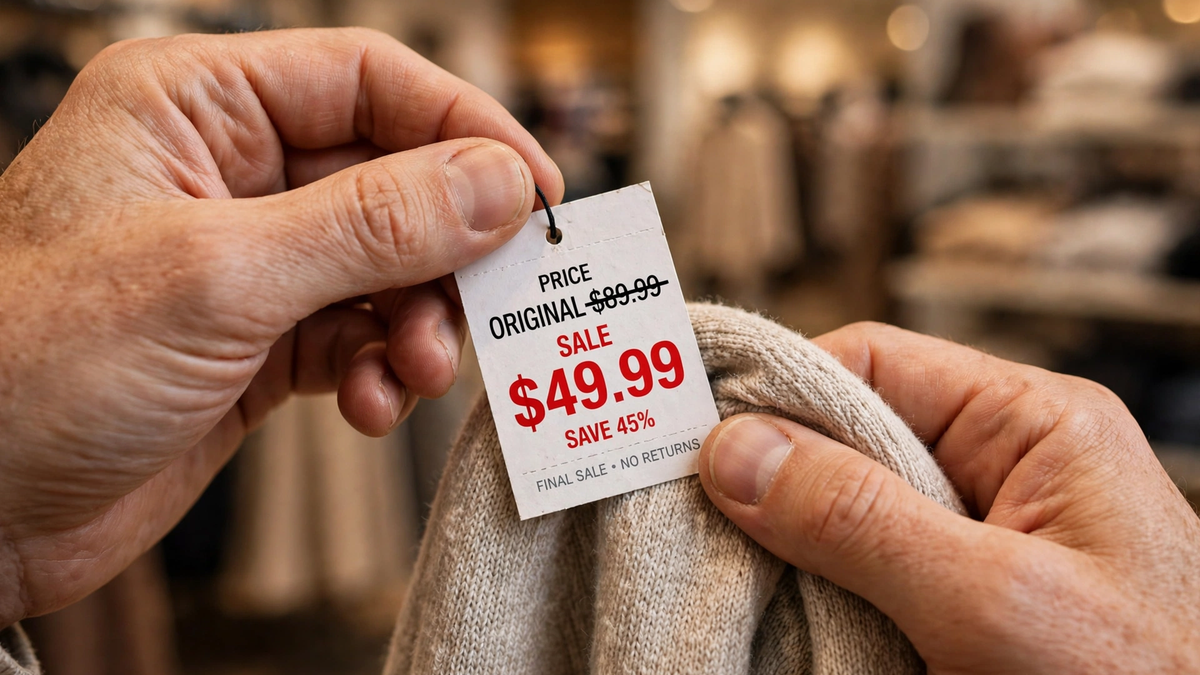
At five in the morning on Friday 27 November 2026, the doors open and the first shoppers walk into a store that has been selling them the same trick for more than a century: a price crossed out, a lower price underneath, and the feeling that they have just outsmarted the shop. The tag says “was $46, now $31.99” — the exact example in a Los Angeles complaint that alleged the item had never been sold above $31.99. This JCPenney Black Friday pricing audit explains why the discount became the product at America’s oldest department store chain — and why a company that once tried honest prices discovered its customers would not buy them.
I am an Industrial and Organizational Psychologist in Karachi, and I audit brands on the psychology of what they actually do — not on how much I like their products. This audit is of J.C. Penney, the American department store chain founded in 1902, and of its Black Friday 2026 pricing event, which runs from 20 to 29 November 2026. One honest note before the rest: JCPenney’s own Black Friday page could not be read on 23 November 2026 — it returned an access error — so the sale details in this audit come from TheStreet’s 21 November 2026 report of JCPenney’s holiday announcement and from blackfriday.com, and no individual 2026 doorbuster price is printed, because none was verified. What it scores is the pricing psychology and the company behind it: the anchor, the urgency, the pride of the bargain — and the $50 million settlement that sits behind the crossed-out price.
JCPenney scores 81/100 in our psychology audit. Black Friday 2026 runs 20–29 November, with discounts of up to 80% off fine jewellery, 60% off apparel and 70% off home essentials — and a pricing machine so effective that, before 2012, about 73% of the company’s revenue came from goods sold at 50% or more off, while only 0.2% came from goods sold at full price. It is one of the strongest pricing performances I have audited, and one of the least trustworthy price tags.
“The discount was never the incentive. It was the product.”
— Brand Psychology Analysis, ShahzebSpeaks
📋 Brand Overview
| Field | Detail |
|---|---|
| Brand | J.C. Penney Company, Inc. (JCPenney) — department stores: apparel, home, jewellery, beauty and footwear |
| Founded | 14 April 1902, Kemmerer, Wyoming, by James Cash Penney, as a Golden Rule store — one fair price |
| Headquarters | Plano, Texas, USA (moved there in 1987) |
| Scale | About 650 stores in 2026; merged into Catalyst Brands in January 2025 — $9 billion revenue, 1,800 stores, 60,000 employees across six banners |
| Ownership | Private, via Catalyst Brands: Simon Property Group, Brookfield Corporation, Authentic Brands Group and Shein |
| Current campaign | Black Friday 2026, 20–29 November; stores closed Thanksgiving, open from 5 a.m. on Friday 27 November |
| Website | https://www.jcpenney.com |
| Psychology score | 81/100 |
📜 Chapter 1: History — the Golden Rule, the coupon, and the bankruptcy
The direct answer is that JCPenney began in 1902 on one fair price, spent a century training its customers to buy only discounts, tried honest pricing in 2012 and lost a quarter of its sales, went bankrupt in 2020, and came back inside a $9 billion group — and its Black Friday sale is the same story, told in prices.
James Cash Penney opened his first store on 14 April 1902 in Kemmerer, Wyoming, with William Henry McManus, and called it a Golden Rule store. The rule was simple: one fair price, the same for everyone, no haggling, no games. It was a moral idea as much as a commercial one — the customer should be able to trust the number on the tag. The idea worked. By 1929, when the company listed on the New York Stock Exchange, it had 1,392 stores. By 1973 it had more than 2,000. A store that began by refusing to bargain had become one of the largest retailers in America, and the price on the tag was still supposed to be the price.
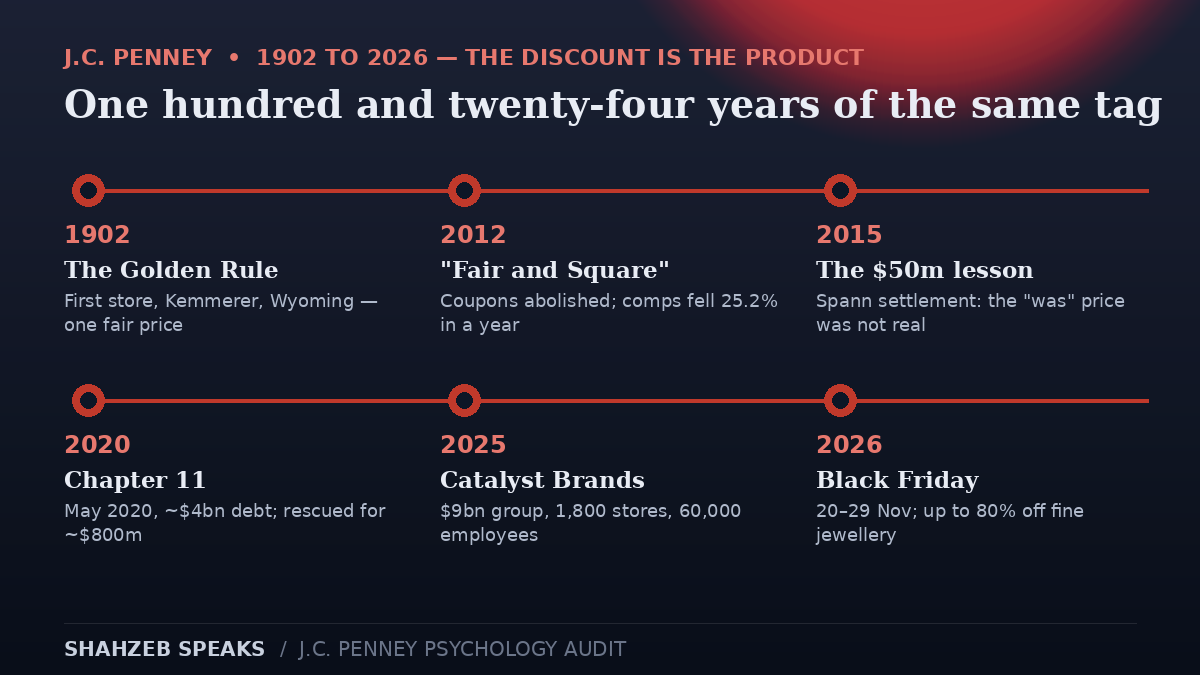
Somewhere along the way, the fair price became a fiction. By 2011, the year before the experiment this audit turns on, about 73% of JCPenney’s revenue came from goods sold at 50% or more off their stated price, and only 0.2% of revenue came from goods sold at full price. Think about what that means. A store in which almost nothing sells at the price on the tag is not a store with a sale. It is a store in which the tag is a prop and the discount is the product. The customer was not buying a blouse. She was buying the feeling of having paid $17.99 for a $30 blouse — and the $30 was, in the case that eventually reached a federal court, a price the blouse had hardly ever been sold at.
The company tried to stop. In 2011, Ron Johnson, the former Apple retail chief, became chief executive, and on 25 January 2012 he announced “Fair and Square” pricing: no more coupons, no more constant sales, everyday prices cut by about 40%, twelve month-long events a year instead of about 590 promotions, and “Best Price Fridays” on the first and third Fridays of each month. It was, in effect, a return to the Golden Rule — one fair price, the same for everyone. The customers refused it. Comparable-store sales fell 18.9% in the first quarter of 2012, 21.7% in the second, 26.1% in the third and 31.7% in the fourth. For the full year, comparable sales fell 25.2%, sales dropped by $4.3 billion, the company lost $985 million, and gross margin fell from 36.0% to 31.3%. Sales events were brought back in January 2013. Johnson was ousted on 8 April 2013. By the 2016 financial year, sales were still 27.3% below their 2011 level.
The rest of the history is a rescue, not a recovery. JCPenney filed for Chapter 11 bankruptcy in May 2020 with about $4 billion of debt and 846 stores, and closed more than 200 of them. In September 2020, Simon Property Group and Brookfield Asset Management — the company’s own landlords — agreed to buy the operating assets for about $800 million, and the sale closed on 7 December 2020. In January 2025, JCPenney merged with SPARC Group to form Catalyst Brands, a group with $9 billion in revenue, 1,800 stores and 60,000 employees across six banners: JCPenney, Aéropostale, Brooks Brothers, Eddie Bauer, Lucky Brand and Nautica. Marc Rosen, who had run JCPenney since 2021, became chief executive of Catalyst Brands, and Michelle Wlazlo became chief executive of JCPenney. The company has promised more than $1 billion of reinvestment in the business by the end of the 2025 financial year. Eight stores closed by mid-2025. That is the company whose Black Friday sale this audit scores: a 124-year-old chain, rescued by its landlords, selling discounts to customers it trained itself.
🎄 Chapter 2: Black Friday 2026 — ten days, four giveaways, and a 5 a.m. queue
The direct answer is that JCPenney’s Black Friday 2026 is a ten-day event, 20–29 November, built around four timed giveaways in a single day — and its psychology is not the size of the discounts, which are large, but the way the sale is staged as a series of deadlines.
The event runs for ten days, from 20 to 29 November 2026, with Black Friday itself falling on 27 November. The stores are closed on Thanksgiving, 26 November, and open at 5 a.m. local time on Black Friday. The headline discounts, as listed by blackfriday.com, are up to 80% off fine jewellery and watches, up to 60% off men’s and women’s apparel, and up to 70% off home essentials. Small appliances are listed below $20, gift sets under $25, and thousands of items at $20 or less between 12 November and 25 December. A “Price Lock” holds prices on selected items from 1 to 25 December. The same deals apply online and in store, except for in-store doorbusters and giveaways — and JCPenney honours price matching even on Black Friday, if the shopper brings proof of the competitor’s price.
The staging is the interesting part. On Black Friday itself, JCPenney runs what it calls the “5, 9, 1, 5” surprise giveaways, at 5 a.m., 9 a.m., 1 p.m. and 5 p.m., in store only, for shoppers aged 18 and over, while supplies last. At 5 a.m. there are mystery coupons and a free Harry Potter mini snow globe, a Hogwarts Express collectible — last year’s collectible was a Snoopy snow globe. At 9 a.m. the giveaway is a Ninja dual-basket air fryer, worth about $270. At 1 p.m. it is a pair of lab-grown diamond stud earrings, 1.5 carats total weight, worth about $599.98. At 5 p.m. it is a Samsonite 21-inch hardside suitcase, worth about $220. Those values are the values as reported by TheStreet from JCPenney’s announcement, not prices verified on the company’s own site, and this audit prints them as values, never as sale prices. What matters for the psychology is the structure: four separate moments in one day, each with its own prize, each with its own deadline, each requiring the shopper to be in the store at a specific hour. A single sale gives the shopper one reason to come. Four giveaways give four.
There is also a longer rhythm worth noticing. The “Biggest Sale of the Season” ran from 5 to 11 November 2026, with 97% of in-store merchandise on sale — two weeks before Black Friday itself. The sale that is supposed to be the event of the year is preceded by another sale, and followed by a “Price Lock” that runs into Christmas. As Neil Saunders of GlobalData noted, Black Friday crowds have shrunk as deals spread across the season, and JCPenney’s calendar shows why: the urgency is no longer concentrated in a single morning. It is spread across a month, in smaller and smaller doses, and each dose needs its own reason to hurry. The giveaways are that reason. The audit scores the staging in Chapter 5; the point here is simpler — the sale is ten days long, but the psychology is built for four hours.
⚓ Chapter 3: Anchoring — the number you see first decides what the second number means
The direct answer is that a crossed-out price is an anchor: the first number the shopper sees sets the reference point, and everything after it is judged against that number, whether or not the first number was ever real.
The principle is anchoring, and the experiment behind it is one of the cleanest in psychology. In 1974, Amos Tversky and Daniel Kahneman published “Judgment under Uncertainty: Heuristics and Biases” in Science. In one experiment, they spun a wheel of fortune rigged to land on either 10 or 65, and then asked people what percentage of African nations belonged to the United Nations. The wheel had nothing to do with the question. People who saw 10 gave a median estimate of 25%. People who saw 65 gave a median estimate of 45%. A random number, openly random, moved the answer by twenty points. The first number does not need to be true. It only needs to be seen first.
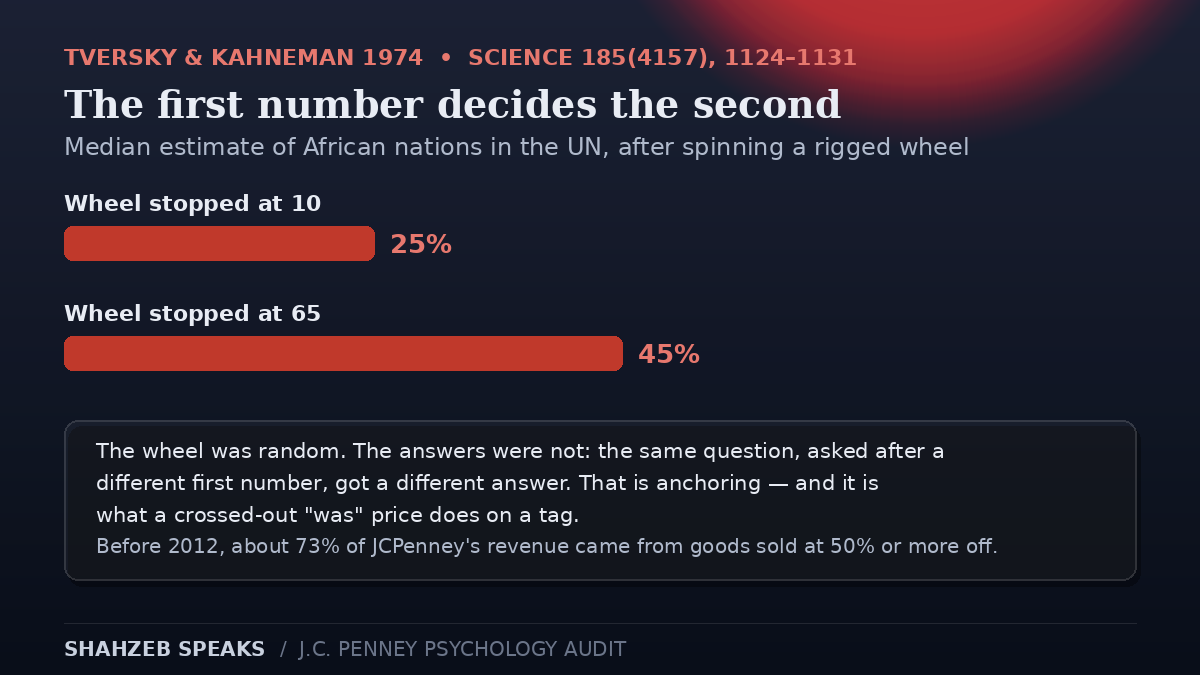
A “was” price is the same experiment, run on a price tag. Grewal, Monroe and Krishnan showed in 1998, in the Journal of Marketing, that an advertised reference price shifts the buyer’s own internal reference price — the price they carry in their head as “what this sort of thing costs” — and that the perceived transaction value, the feeling of having got a good deal, is what carries the effect into the intention to buy. The tag does two jobs at once. The crossed-out number tells the shopper what the item is worth. The lower number tells them what a clever person pays for it. The gap between the two is the product.
That is why the 73% figure matters so much. Before 2012, about 73% of JCPenney’s revenue came from goods sold at 50% or more off their stated price, and only 0.2% came from goods sold at full price. A store in which the anchor is almost never the price paid has trained its customers to do the arithmetic every time: the stated price is not a price, it is a starting point, and the real question is always how far below it you can get. The anchor still works — the shopper still feels the saving — but the anchor has become a fiction, and a fiction that works is a fiction that eventually attracts a court. Chapter 11 is about what happened when it did. The audit scores anchoring and reference pricing 90, the highest in this audit, because the mechanism is textbook-grade and the execution is total: the anchor is on almost everything, and it is the reason the customer walks in.
💰 Chapter 4: Transaction utility and deal pride — the saving is the reward
The direct answer is that shoppers do not only buy the item. They buy the feeling of having got a bargain — and at JCPenney, that feeling was the product for so long that removing it removed the reason to shop.
The principle is transaction utility. Richard Thaler argued in 1985, in Marketing Science, that a purchase is judged by two utilities at once. Acquisition utility is the value of what you get: the blouse, the air fryer, the suitcase. Transaction utility is the value of the deal itself: how good it feels to have paid less than the reference price. A shopper can be perfectly happy with the blouse and unhappy with the price, or indifferent to the blouse and delighted by the price. The “was $46, now $31.99” tag sells both at once. The blouse is the acquisition. The $14.01 is the transaction, and the transaction is the part the shopper remembers and tells other people about.
Robert Schindler gave that feeling a name in 1989, in Advances in Consumer Research: smart-shopper feelings. Getting a discount produces pride in being responsible for the saving — the shopper feels clever, not just richer. In later work, Schindler (1998) developed the idea into smart-shopper pride: the bargain is a small achievement, and the achievement belongs to the shopper, not to the store. That is a precise description of what JCPenney’s customers were doing for decades. They were not being fooled by the crossed-out price. They were using it. The coupon, the sale, the doorbuster — these were the tools of a skill, and the skill was the point. A shopper who has spent years learning to hunt for the deal does not want a store that takes the hunt away.
That is the honest reading of the “Fair and Square” failure, and it is kinder to the customers than the usual one. The usual story is that shoppers are irrational, that they prefer a fake discount to a real low price. The better story is that they were rational about something the store had taught them to value: the transaction itself. When Ron Johnson cut everyday prices by about 40% and took the coupons away, he did not only change the numbers. He removed the game, and with it the pride of winning it. Customers who had been trained on coupons experienced the honest everyday price as a loss — not because the price was high, but because the saving was gone. Thaler’s framework predicts exactly that: take away the transaction utility, and the acquisition utility alone is not enough. The audit scores deal pride and smart-shopper reward 86, because the mechanism is real and the store’s history proves it — the customers’ loyalty was to the deal, and the deal was the brand.
⏰ Chapter 5: Scarcity and urgency — four deadlines in one day
The direct answer is that the “5, 9, 1, 5” giveaways work because they turn one sale into four separate deadlines — and a deadline is the oldest scarcity trick there is.
The principle is scarcity. Robert Cialdini, in Influence (1984, revised 2001), described it as one of the most reliable persuasion tools there is: people value what is limited, and they value it more when the limit is a deadline, and more still when the limit is a quantity. JCPenney’s Black Friday uses all three. The giveaways are limited in quantity — “while supplies last”. They are limited in time — four specific hours. And they are limited in place — in store only, which means the shopper must be there, at that hour, in person. A shopper who misses the 9 a.m. air fryer cannot get it at 10 a.m. The deadline has passed, and the passing is the point.
There is a second scarcity in the sale, and it is quieter. The headline discounts are framed as “up to” — up to 80% off fine jewellery, up to 60% off apparel, up to 70% off home essentials. “Up to” is doing a lot of work in that sentence. It promises the maximum and delivers a range, and the shopper who walks in hoping for 80% will find some items at 80% and most at less. That is not, by itself, a deception — “up to” is a standard retail phrase — but it is a scarcity frame in disguise. The best discount is presented as available, and the shopper’s job is to find it before someone else does. The hunt is the urgency.
The honest limit on this chapter is that the scarcity here is manufactured, and the shopper knows it. The air fryers and the diamond studs are not scarce because the world has run out of them. They are scarce because JCPenney has decided to give away a small number of them at specific hours, to bring people into the store. That does not make the mechanism weaker — manufactured scarcity works just as well as real scarcity, and often better, because it can be scheduled — but it does make the trust question sharper. A store that manufactures urgency must also be believed when it says the price is real. Chapter 11 is about what happens when that belief fails. The audit scores scarcity and urgency 88, because the four-deadline structure is the best-staged part of the whole event, and it is the part most likely to bring a shopper through the door at 5 a.m.
😨 Chapter 6: Loss aversion — the fear of missing the deal
The direct answer is that Black Friday works because missing a deal feels worse than getting one feels good — and JCPenney’s whole event is built to make the shopper feel the miss.
The principle is loss aversion. Kahneman and Tversky showed in 1979, in “Prospect Theory”, published in Econometrica, that losses weigh more heavily than equal gains: losing $20 hurts more than gaining $20 pleases. The finding has been replicated so often that it is now the single most cited idea in behavioural economics, and it is the engine of every sale that has a deadline. A shopper who sees a price of $31.99 against a “was” price of $46 is not only seeing a saving of $14.01. They are seeing a loss of $14.01 that will happen if they walk away. The discount is framed as something they already own, and leaving the store is giving it back.
JCPenney’s event is structured to maximise that feeling. The giveaways are one-time: the 9 a.m. air fryer, the 1 p.m. diamond studs, the 5 p.m. suitcase. Each one is a separate loss, waiting to happen. The “while supplies last” on the doorbusters is the same mechanism in a different form: the item will be gone, and the going is the threat. Even the “Price Lock”, which holds prices from 1 to 25 December, works on the same principle in reverse — it removes the fear of buying too early, so that the shopper buys now instead of waiting. Every part of the event is either a loss to avoid or a loss already prevented, and the shopper is kept moving between the two.
There is a cost to building a sale on loss aversion, and the cost is the one this audit keeps returning to. A customer who buys because they are afraid of missing out is a customer who may regret the purchase when the fear passes. The regret is not the store’s problem on the day — the sale is made — but it is the store’s problem over time, because a customer who regrets a purchase learns to distrust the next one. JCPenney’s own history is the evidence: the customers who were trained to chase the deal eventually learned to wait for it, and the store that taught them could not sell to them at any other price. The audit scores loss aversion and fear of missing out 85, because the mechanism is powerful and the event uses it at every turn, but it notes the debt: fear sells today and costs trust tomorrow.
🏷️ Chapter 7: Price framing — dollars for the big things, percentages for the small ones
The direct answer is that JCPenney frames its discounts the way the research says works: percentages for the small things, where a big number feels generous, and the event’s structure does the rest.
The principle is price framing. Chen, Monroe and Lou showed in 1998, in the Journal of Retailing, that the same saving feels different depending on how it is stated. For higher-priced products, a dollar-off frame — “save $120” — is more persuasive, because the absolute amount feels substantial. For lower-priced products, a percentage-off frame — “save 60%” — wins, because the percentage feels large even when the money is small. A $20 item at 60% off saves $12, and $12 sounds like nothing; 60% sounds like a triumph. A $600 item at 20% off saves $120, and 20% sounds like a shrug. The frame is not the discount. It is the story about the discount.
JCPenney’s headline framing follows the second half of that rule. The event is advertised in percentages: up to 80% off fine jewellery and watches, up to 60% off apparel, up to 70% off home essentials. Those are big numbers, and they are attached to categories where the individual items are mostly modest in price — a shirt, a towel, a pair of earrings. A 60% saving on a $30 shirt is $18, and $18 is not a story. Sixty per cent is. The fine jewellery category is the exception that proves the rule: there, the percentages are attached to items where the money is real — the diamond studs valued at about $599.98 — and the percentage and the dollars agree with each other. The framing is doing exactly what Chen, Monroe and Lou would predict.
The limit is the one that applies to every “up to” claim. The headline percentage is the maximum, not the typical, and the shopper who walks in expecting 60% off everything will find a range. That is not a legal problem by itself — “up to” is a standard phrase, and the research file records no finding against it — but it is a trust problem, and it is the same trust problem that runs through this whole audit. A frame that over-promises and under-delivers teaches the shopper to discount the frame itself. The audit scores price framing 84, because the percentages are well chosen for the categories they are attached to, and the event’s structure — small appliances below $20, gift sets under $25, thousands of items at $20 or less — gives the shopper concrete numbers to hold on to alongside the percentages.
🎯 Chapter 8: The decoy and the tiers — why three prices beat one
The direct answer is that a third option, worse than the one you want the shopper to pick, makes the one you want look better — and JCPenney’s tiered discounts do the same work in a quieter way.
The principle is the decoy effect, also called asymmetric dominance. Huber, Payne and Puto showed in 1982, in the Journal of Consumer Research, that adding an option which is clearly worse than a target option, on every attribute, raises the target’s share of choices — by about nine percentage points on average, in a study of 153 college students. The dominated option is not there to be chosen. It is there to make the target look like the sensible choice. A shopper choosing between a $20 item and a $60 item may hesitate; add a $55 item that is worse than the $60 one in every way, and the $60 item suddenly looks like good value. The comparison does the selling.
This audit must be careful here, because the research file does not document a specific JCPenney decoy offer in the 2026 sale, and this audit will not invent one. What it can say, honestly, is that the event’s tiered structure does the same work by a different route. The discounts are tiered by category — 80% for jewellery, 60% for apparel, 70% for home — and the tiers create a ladder of value. The shopper who came for a 60%-off shirt walks past the 80%-off jewellery counter, and the 60% suddenly feels modest. The shopper who came for the $20 small appliance sees the $270 air fryer being given away at 9 a.m., and the $20 item feels like a small win by comparison. The tiers are not decoys in the strict Huber sense, but they use the same mechanism: the value of an option is judged against the options around it, not on its own.
And the caveat must be printed in full, because the decoy effect is one of the most overstated findings in popular psychology. Frederick, Lee and Baskin showed in 2014 that the effect is fragile, appearing mostly in stylised designs with numeric attributes, and Huber and colleagues replied the same year defending it. The honest statement is that the decoy is a real but narrow effect, not a law of nature — and that a retailer does not need it to be a law, because the tiered sale does the same work with real prices. The audit scores decoy and tiered offers 76, the lowest of the campaign’s psychology scores, because the mechanism is real but the specific JCPenney evidence for it is thinner than for the other dimensions, and this audit will not score what it cannot document.
🎟️ Chapter 9: Deal proneness — the customers the coupons made
The direct answer is that JCPenney did not only sell discounts. It bred a customer who shops for the discount itself — and that customer is the reason honest pricing failed.
The principle is deal proneness. Lichtenstein, Burton and Netemeyer argued in 1997, in Advances in Consumer Research, that some shoppers are dispositionally deal-prone: they seek out promotions for their own sake, they enjoy the hunt, and they will change what they buy, when they buy and where they buy in order to get a deal. Deal proneness is not the same as being poor, or being careful with money. It is a preference, and like any preference it can be trained. A store that runs about 590 promotions a year — as JCPenney did in 2011 — is not responding to deal-prone customers. It is making them.
That is the mechanism behind the “Fair and Square” disaster, and it deserves to be stated without the usual condescension. The customers who stopped coming in 2012 were not irrational. They were consistent. They had been taught, over decades, that the right way to shop at JCPenney was to wait for the coupon, to check the sale, to feel the pride of the bargain — and then the store told them the lesson was over, the coupons were gone, and the price on the tag was the price. The customers did what any student does when the exam changes without warning: they left. Comparable sales fell 25.2% in a year, and the company lost $985 million, not because the new prices were too high — they had been cut by about 40% — but because the new prices offered nothing to be proud of. The saving was gone, and with it the reason to come.
The lesson is the one this audit would put on the wall of every retailer that runs a sale. A discount is not a price cut. It is a relationship, and a relationship has a history. JCPenney’s history is that it spent a century teaching its customers to value the deal, and then discovered, in a single year, that the deal was the only thing they valued. The Black Friday event of 2026 is the company accepting that lesson: the coupons are back, the sales are back, the crossed-out prices are back, and the customers are back with them. The audit does not score deal proneness as a separate dimension — it is folded into deal pride — but it is the chapter that explains the rest. A store that trains its customers to hunt will always have to feed them.
💰 Chapter 10: The money — from $4 billion of debt to a $9 billion group
The direct answer is that JCPenney is no longer the company that went bankrupt. It is a rescued chain inside a $9 billion retail group, and its Black Friday sale is the first big test of whether the rescue can sell.
The bankruptcy is a matter of record. In May 2020, JCPenney filed for Chapter 11 with about $4 billion of debt and 846 stores, and closed more than 200 of them. In September 2020, Simon Property Group and Brookfield Asset Management — the company’s own landlords, who owned the malls its stores sat in — agreed to buy the operating assets for about $800 million, about $300 million in cash and about $500 million in new term debt. The court approved the purchase in November 2020, and the sale closed on 7 December 2020, with about $1.5 billion of new financing, including a Wells Fargo-led credit facility. The combined deal is sometimes described as a $1.75 billion valuation, but that figure includes the separate property companies — 160 stores and distribution centres bought by the lender group — and this audit prints it only with that explanation, never as the price paid for the operating assets.
The rescue became a merger in January 2025, when JCPenney combined with SPARC Group to form Catalyst Brands, in an all-equity deal. The new group’s shareholders are Simon Property Group, Brookfield Corporation, Authentic Brands Group and Shein, and the group reports $9 billion in revenue, 1,800 stores and 60,000 employees across six banners: JCPenney, Aéropostale, Brooks Brothers, Eddie Bauer, Lucky Brand and Nautica. Marc Rosen, who had run JCPenney since 2021, became chief executive of Catalyst Brands, and Michelle Wlazlo became chief executive of JCPenney. The company has promised more than $1 billion of reinvestment in the business by the end of the 2025 financial year. Eight stores closed by mid-2025, and in July 2025 Copper Property Trust announced it would sell 119 JCPenney store properties to an affiliate of Onyx Partners for $947 million, with JCPenney saying the stores would stay open — whether that sale closed has not been verified, and this audit does not claim it did.
What the money chapter cannot say is as important as what it can. No sales or revenue figure for the 2026 Black Friday event itself exists, because the event is live and has not been reported — and this audit will not invent one, or project one from the discounts. No individual 2026 doorbuster price was verified, so none is printed. The audit scores the money on what is known: a company that was worth saving to its landlords, that is now part of a group with $1 billion of liquidity, and that is spending its first big holiday as a merged company on the oldest trick in its book. The pricing is the strategy. Whether it is a good strategy is a question for the scorecard, not for this chapter.
⚠️ Chapter 11: The dark side — the $50 million settlement, and the case that came back
The direct answer is that JCPenney’s crossed-out prices have been to court twice, and the second case came after the company said it had stopped — which is why the trust score in this audit is the lowest by a wide margin.
The first case is a matter of court record. On 8 February 2012, a class action was filed in the United States District Court for the Central District of California — Spann v. J.C. Penney Corp., No. 8:12-cv-00215 — alleging false price-comparison advertising on private and exclusive-brand apparel and accessories: “original” and “regular” prices that the merchandise was hardly ever sold at. The class was certified on 18 May 2015, and the court denied JCPenney’s motions to dismiss and for summary judgment. In September 2015 the case settled for $50 million, with no admission of wrongdoing, and the final approval order was signed on 30 September 2016 by Judge Fernando M. Olguin. The class was about 8 to 11 million California purchasers who had bought items at 30% or more off the stated original or regular price, between 5 November 2010 and 31 January 2012 and between 1 January 2013 and 31 December 2014. Attorneys’ fees were $13.5 million, and the settlement required pricing-practice changes, plus training and auditing to comply with California’s price-comparison laws. In November 2015, JCPenney represented that it would stop the practice and had implemented a new price-comparison policy.
The example that carried the case is worth stating, because it is the whole audit in one transaction. The plaintiff, Cynthia Spann, bought three blouses marked $30 each and paid $17.99 — 40% off — and then learned that JCPenney had never sold them above $17.99 in the prior three months. The $30 was the anchor. The $17.99 was the price. The 40% was the feeling. Everything in Chapters 3 and 4 happened in that one purchase, and a federal court certified a class of millions on the strength of it.
The second case is the one that makes the trust score what it is. On 7–8 December 2016, the Los Angeles City Attorney, Michael N. Feuer, filed a complaint in Los Angeles Superior Court — People of the State of California v. J.C. Penney Corp. — alongside parallel actions against Kohl’s, Macy’s and Sears, alleging false reference pricing under California Business and Professions Code sections 17200 (unfair competition), 17500 (false advertising) and 17501 (the former-price rule). The examples alleged included a maternity swim top with an “original” price of $46, on sale at $31.99, that had never been sold above $31.99, and “Buy 1 Get 1 Free” and “Buy 1 Get 1 For A Penny” offers described as false free offers. The complaint sought $2,500 per violation, plus $2,500 for violations against seniors and disabled people, across thousands of products. The trial court sustained a demurrer on the section 17501 claim, holding it void for vagueness — and on 16 April 2019 the Court of Appeal, in People v. Superior Court, 34 Cal.App.5th 376, granted the writ and revived the claim, holding that section 17501 is not unconstitutionally vague. A settlement followed, according to one law-firm source — but no amount or date was found, and this audit prints no settlement figure for this action. That is the exact status, as of 23 November 2026.
The rules that govern the “was” price are worth stating plainly, because they are the standard this audit applies. The Federal Trade Commission’s Guides Against Deceptive Pricing, 16 CFR Part 233, require that a former price be a genuine price at which the product was openly offered for a reasonable time in the recent past. California’s section 17501 requires that a former price have been the prevailing market price within the preceding three months, or that the date be stated. Other retailers have been caught by the same rules: in People v. Overstock.com in 2017, a court imposed $6.8 million in civil penalties for deceptive reference pricing, and in Hinojos v. Kohl’s in 2013 the Ninth Circuit held that a customer who bought on the basis of a false “original” price has standing to sue. Those are other companies’ cases, and this audit says so — but they show the rule is enforced, and enforced against the same practice.
One absence, stated with the same care as the findings: no action by the Federal Trade Commission against JCPenney was found in the searches run on 23 November 2026. That is a statement about the searches run, not proof that no action exists, and this audit does not write “JCPenney has never been sued” or “clean legal record”. What it does write is the pattern: a company that settled a $50 million class action over its reference prices, represented that it had stopped, and was sued again four years later by a city attorney over the same practice. Trust and transparency is scored 58, the lowest in this audit by a wide margin — and it is the score that keeps the overall at 81 instead of higher.
🌍 Chapter 12: What retailers everywhere should — and shouldn’t — copy
Retailers everywhere should copy the staging, not the tag. The best idea in JCPenney’s Black Friday is not a discount. It is the four deadlines in one day — the “5, 9, 1, 5” giveaways, each with its own hour, its own prize and its own reason to be in the store. A retailer running a sale at Christmas, at back-to-school, or at a Singles’ Day-style shopping festival should build its event the same way: not one long sale that nobody hurries for, but a series of small, timed moments, each with a reason to show up now. Urgency that is scheduled is urgency that can be planned for, and a shopper who knows when to come is a shopper who comes.
Retailers everywhere should copy the price matching. JCPenney honours price matching even on Black Friday, if the shopper brings proof of the competitor’s price. That is a small policy with a large psychological effect: it tells the shopper that the store is confident enough to be checked, and a store that invites checking is a store that is believed. A retailer that matches a competitor’s price — and says so, plainly, in the store — buys more trust with that one sentence than with a month of advertising.
Retailers should copy the lesson of “Fair and Square”, and they should copy it in the right direction. The lesson is not that honest pricing fails. It is that you cannot change what a price means to your customers overnight, after decades of teaching them the opposite. A retailer that has trained its customers to wait for the sale cannot abolish the sale in a single season and expect them to stay. If the price is going to change, the meaning has to change first — slowly, and with the customer, not against them.
And retailers should not copy the crossed-out price. A “was” price that was never the price is not a discount. It is a fiction, and a fiction that works is a fiction that eventually attracts a court — as JCPenney learned twice, for $50 million and then again in Los Angeles. A retailer that wants to run a sale should do the one thing JCPenney’s tag did not: make sure the original price was real, that the item was actually sold at it, and that the date is on the tag. The cheapest time to earn trust is before you lose it, and the most expensive discount is the one a judge has to price.
📊 Psychology Scorecard — the JCPenney Black Friday pricing audit verdict
The scorecard below scores the pricing psychology and the company behind it, not the outcome of the sale. No sales figure for the 2026 event exists, and none is claimed. The overall score is the rounded average of eight dimensions scored out of 100.
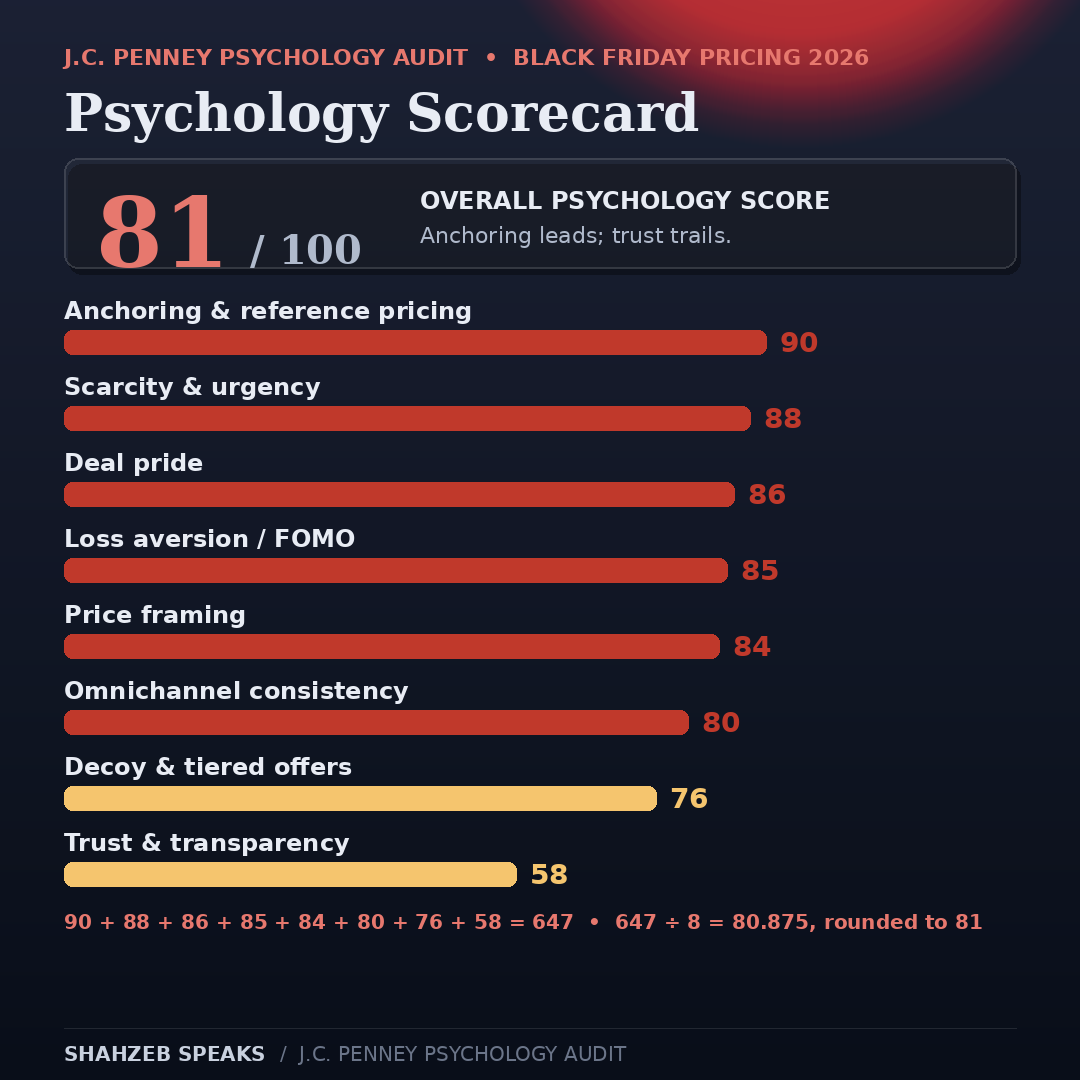
| Dimension | Score | Verdict |
|---|---|---|
| Anchoring & reference pricing | 90 | The crossed-out price is on almost everything, and it is the reason the customer walks in — textbook Tversky & Kahneman |
| Scarcity & urgency | 88 | Four giveaways, four deadlines, one day — the best-staged part of the whole event |
| Deal pride & smart-shopper reward | 86 | The saving is the achievement, and the customers’ loyalty was to the deal — Schindler’s smart-shopper pride, proved by the 2012 revolt |
| Loss aversion & fear of missing out | 85 | Every giveaway is a separate loss waiting to happen, and “while supplies last” is the threat that keeps the queue moving |
| Price framing | 84 | Percentages for the small things, where a big number feels generous — Chen, Monroe & Lou, applied cleanly |
| Omnichannel consistency | 80 | Same deals online and in store, except doorbusters and giveaways — and price matching honoured even on Black Friday |
| Decoy & tiered offers | 76 | The tiered discounts do the decoy’s work, but no specific JCPenney decoy offer was documented — scored on what could be shown |
| Trust & transparency | 58 | A $50 million settlement over “was” prices, a promise to stop, and a second action four years later over the same practice |
| Overall | 81/100 | 90 + 88 + 86 + 85 + 84 + 80 + 76 + 58 = 647; 647 ÷ 8 = 80.875, rounded to 81 |
🧠 Psychology Techniques Identified
- Anchoring & reference pricing (Tversky & Kahneman 1974; the crossed-out “was” price sets the reference point for everything after it)
- Transaction utility (Thaler 1985; the saving is judged separately from the item, and the saving is the part the shopper remembers)
- Smart-shopper pride (Schindler 1989; the bargain as a small achievement that belongs to the shopper, not the store)
- Scarcity & urgency (Cialdini 2001; four timed giveaways, “while supplies last”, a 5 a.m. opening)
- Loss aversion (Kahneman & Tversky 1979; the discount framed as something the shopper already owns, and leaving as giving it back)
- Price framing — dollar vs percentage (Chen, Monroe & Lou 1998; percentages for the small things, where a big number feels generous)
- Reference-price advertising (Grewal, Monroe & Krishnan 1998; the advertised reference price shifts the buyer’s own internal reference price)
- Decoy & asymmetric dominance (Huber, Payne & Puto 1982; the tiered discounts make each tier look better by comparison — with the Frederick et al. 2014 fragility caveat)
- Deal proneness (Lichtenstein, Burton & Netemeyer 1997; customers trained to hunt for the deal, and to change when and where they shop for it)
- The honest-price reversal (Fair and Square, 2012; removing the game removed the reason to shop — the lesson, not the failure)
- Timed giveaways as variable reward (the “5, 9, 1, 5” schedule: four separate moments in one day, each with its own prize and deadline)
- Price matching as trust repair (matching a competitor’s price even on Black Friday — the store inviting the shopper to check it)
✅ Balance sheet & prescription
What works: the anchor, which is on almost everything and is the reason the customer walks in; the four-deadline giveaway structure, which is the best-staged part of the event; the deal pride, which the store’s own history proves is real — the customers’ loyalty was to the discount, and the discount brought them back; the price framing, which follows the research on when percentages beat dollars; and the rescue, which put the company inside a $9 billion group with $1 billion of liquidity and a reason to keep selling.
What does not: the trust in the price tag, where a $50 million settlement and a second action four years later sit behind every crossed-out price; the “up to” framing, which promises the maximum and delivers a range; the manufactured scarcity, which the shopper knows is scheduled rather than real; the dependence on fear, which sells today and costs trust tomorrow; and the absence of any verified 2026 doorbuster price or sales figure, which means this score is a judgement of psychology and craft, not of outcome.
The prescription: keep the four deadlines — they are the best idea in the event — and keep the price matching, which is the most honest sentence in the sale. But print the “was” price only when it was real, and put the date on the tag: the item was sold at that price, in the last three months, and here is when. A store that has been to court twice over the same practice cannot afford a third lesson, and the cheapest way to avoid it is to let the shopper check. And do not try “Fair and Square” again in a single season — if the price is going to change, change what it means first, slowly, and with the customer, not against them.
📝 Final Verdict
JCPenney’s Black Friday is one of the strongest pricing performances I have audited, and one of the least trustworthy price tags. The psychology is textbook-grade at every turn: the anchor is on almost everything, the deadlines are staged four times in a single day, the pride of the bargain is real enough that customers revolted when it was taken away, and the framing follows the research on when a percentage beats a dollar. It is a machine that works, and it has worked for more than a century. Its weakness is that the machine runs on a number — the “was” price — that has twice been to court, once for $50 million and once again four years after the company said it had stopped. A discount that cannot be believed is a discount that cannot last, and the most expensive thing JCPenney sells this Black Friday is not in any aisle. It is the doubt on the tag.
Psychology Score: 81/100 — a crossed-out price, four deadlines in one day, and a $50 million lesson in what “was” really means. The pricing machine is superb; the trust in the tag is not.
— Brand Psychology Analysis, ShahzebSpeaks
🔑 Key Findings
- Anchoring and reference pricing is the event’s strongest psychology, scoring 90/100: the crossed-out “was” price sets the reference point for everything after it, and Tversky and Kahneman (1974) showed that a random anchor — 10 versus 65 — moved people’s estimates from a median of 25% to 45%. Before 2012, about 73% of JCPenney’s revenue came from goods sold at 50% or more off, and only 0.2% at full price.
- Scarcity and urgency is the best-staged part of the sale, scoring 88/100: the “5, 9, 1, 5” giveaways on Black Friday — a Ninja air fryer worth about $270 at 9 a.m., diamond stud earrings worth about $599.98 at 1 p.m., a Samsonite suitcase worth about $220 at 5 p.m. — create four separate deadlines in one day, each in store only, while supplies last.
- Deal pride is the reason honest pricing failed, scoring 86/100: Schindler (1989) showed that getting a discount produces pride in being responsible for the saving, and when “Fair and Square” took the coupons away in 2012, comparable sales fell 25.2% in a year and the company lost $985 million — Thaler’s (1985) transaction utility, removed, took the reason to shop with it.
- The money is a rescue, not a recovery: JCPenney filed for Chapter 11 in May 2020 with about $4 billion of debt and 846 stores, was bought by its own landlords Simon Property Group and Brookfield for about $800 million in December 2020, and merged into Catalyst Brands in January 2025 — $9 billion revenue, 1,800 stores, 60,000 employees — with more than $1 billion of reinvestment promised by the end of the 2025 financial year.
- Legal record: Spann v. J.C. Penney Corp., filed in February 2012, alleged false “original” and “regular” prices and settled in September 2015 for $50 million, with no admission of wrongdoing and final approval on 30 September 2016 — the example being three blouses marked $30, paid for at $17.99, never sold above $17.99. The Los Angeles City Attorney sued again in December 2016 over the same practice; the Court of Appeal revived the claim in April 2019; the settlement terms were not verified. No FTC action against JCPenney was found in the searches run on 23 November 2026. Trust and transparency scores 58/100.
- No effectiveness data exists for the 2026 event, and no individual 2026 doorbuster price was verified: JCPenney’s own Black Friday page returned an access error on 23 November 2026, so the sale details come from TheStreet and blackfriday.com, and no 2026 sales figure has been reported — so 81/100 is a judgement of psychology and craft, not of outcome.
❓ Questions I am asked most often
What is JCPenney’s Black Friday 2026 sale?
It runs 20–29 November 2026, ten days, with Black Friday itself on 27 November. Stores are closed on Thanksgiving and open at 5 a.m. on Black Friday. Discounts are listed at up to 80% off fine jewellery and watches, 60% off apparel and 70% off home essentials, with “5, 9, 1, 5” giveaways at four hours on Black Friday itself.
How good is the pricing, psychologically?
Our audit scores it 81/100. It is strongest on anchoring and reference pricing (90) and scarcity and urgency (88), and weakest on trust and transparency (58), because of the $50 million settlement over “was” prices and the second action that followed it.
What happened with “Fair and Square” pricing in 2012?
Chief executive Ron Johnson abolished coupons and most sales in February 2012 and cut everyday prices by about 40%. Customers left: comparable sales fell 25.2% in the year, sales dropped $4.3 billion, the company lost $985 million, and Johnson was ousted in April 2013. The discount had been the product.
What is JCPenney’s legal record on pricing?
Spann v. J.C. Penney, filed in 2012, alleged false “original” prices and settled in September 2015 for $50 million, with no admission of wrongdoing; final approval came in September 2016. The Los Angeles City Attorney sued in December 2016 over the same practice; the Court of Appeal revived the claim in 2019, and the settlement terms were not verified. No FTC action was found in searches run in November 2026.
Is JCPenney’s Black Friday actually a good deal?
This audit cannot say item by item, because no individual 2026 doorbuster price was verified — JCPenney’s own sale page returned an access error on 23 November 2026. Check the “was” price against the FTC rule: it must be a price the item was openly offered at for a reasonable time recently. Price matching is honoured even on Black Friday, so bring proof of a competitor’s price.
Why did customers reject honest everyday prices?
Because the discount was the reward, not the price cut. Thaler (1985) showed that shoppers judge a purchase by transaction utility — how good the deal feels — as well as by what they get, and Schindler (1989) showed that a bargain produces pride in being responsible for the saving. Removing the coupons removed the pride, and the customers left with it.
If your brand is selling well and still has a story it has not told — a record quarter, a product people do not yet understand, a gap between what people feel and what they buy — the problem is not awareness. It is the reason to choose. I help organisations build evidence-based brand strategy — get in touch here.
If this audit helped, you may also like Scarcity Marketing Examples: 13 Brands That Sell You “Almost Gone”, The Psychology of Pricing: Why Rs. 999 Works Better Than Rs. 1,000, and Decoy Effect Examples: 15 Real Brands That Use It on You Every Day. For the wider field, the homepage of this site covers industrial psychology in Pakistan and beyond.
📚 References & Sources
- TheStreet (Kelly Tyko), “JCPenney Black Friday 2026: store hours, deals and giveaways” (21 November 2026): sale 20–29 Nov 2026, stores closed Thanksgiving, open 5 a.m. 27 Nov, “5, 9, 1, 5” giveaways and values, Neil Saunders quote.
- blackfriday.com, “JCPenney Black Friday 2026” (12 November 2026): headline discounts up to 80% jewellery, 60% apparel, 70% home; small appliances below $20; gift sets under $25; “Price Lock” 1–25 Dec; “Biggest Sale of the Season” 5–11 Nov; price matching.
- JCPenney newsroom, “JCPenney emerges from Chapter 11” (7 December 2020): court approval November 2020, sale closed 7 December 2020, about $1.5 billion new financing.
- Business Wire, “Catalyst Brands launches” (8 January 2025): JCPenney + SPARC Group merger, $9 billion revenue, 1,800 stores, 60,000 employees, $1 billion liquidity, six banners, Marc Rosen and Michelle Wlazlo roles.
- RetailDive, “The rise and fall of JCPenney’s Fair and Square pricing” (2016): Ron Johnson, 25 January 2012 announcement, 1 February 2012 launch, 590 promotions cut to 12, everyday prices cut about 40%.
- Harvard Business Review (2013): “Fair and Square” analysis, 73% of revenue at 50% or more off, 0.2% at full price, the lesson that customers experienced the honest price as a loss.
- Final approval order, Spann v. J.C. Penney Corp., No. 8:12-cv-00215 (C.D. Cal., 30 September 2016, Judge Fernando M. Olguin): $50 million settlement, no admission of wrongdoing, class of about 8–11 million California purchasers, $13.5 million fees, pricing-practice changes.
- Complaint, People of the State of California v. J.C. Penney Corp. (Los Angeles Superior Court, filed 7–8 December 2016, City Attorney Michael N. Feuer): false reference pricing under §§17200, 17500, 17501.
- People v. Superior Court, 34 Cal.App.5th 376 (16 April 2019, No. B292416): Court of Appeal revived the §17501 claim.
- Federal Trade Commission, Guides Against Deceptive Pricing, 16 CFR Part 233.
- Tversky, A. & Kahneman, D. (1974). Judgment under uncertainty: Heuristics and biases. Science, 185(4157), 1124–1131.
- Kahneman, D. & Tversky, A. (1979). Prospect theory: An analysis of decision under risk. Econometrica, 47(2), 263–291.
- Thaler, R. (1985). Mental accounting and consumer choice. Marketing Science, 4(3), 199–214.
- Huber, J., Payne, J. W. & Puto, C. (1982). Adding asymmetrically dominated alternatives: Violations of regularity and the similarity hypothesis. Journal of Consumer Research, 9(1), 90–98. DOI: 10.1086/208899.
- Frederick, S., Lee, L. & Baskin, E. (2014). Study on the limits of the attraction (decoy) effect — cited in the research notes for the finding that the effect is fragile and mostly appears in stylised numeric-attribute designs.
- Schindler, R. M. (1989). The excitement of getting a bargain: Some hypotheses concerning the origins and effects of smart-shopper feelings. Advances in Consumer Research, 16, 447–453.
- Schindler, R. M. (1998). Smart-shopper pride.
- Grewal, D., Monroe, K. B. & Krishnan, R. (1998). The effects of price-comparison advertising on buyers’ perceptions of acquisition value, transaction value, and behavioral intentions. Journal of Marketing, 62(2), 46–59. DOI: 10.2307/1252160.
- Chen, S.-F. S., Monroe, K. B. & Lou, Y.-C. (1998). The framing of price promotions. Journal of Retailing, 74(3).
- Lichtenstein, D. R., Burton, S. & Netemeyer, R. G. (1997). Psychological correlates of a proneness to deals. Advances in Consumer Research.
- Cialdini, R. B. (2001). Influence: Science and Practice (4th ed.). Allyn & Bacon.
Key Findings
- Anchoring and reference pricing is the event's strongest psychology, scoring 90/100: the crossed-out "was" price sets the reference point for everything after it, and Tversky and Kahneman (1974) showed that a random anchor — 10 versus 65 — moved people's estimates from a median of 25% to 45%. Before 2012, about 73% of JCPenney's revenue came from goods sold at 50% or more off, and only 0.2% at full price.
- Scarcity and urgency is the best-staged part of the sale, scoring 88/100: the "5, 9, 1, 5" giveaways on Black Friday — a Ninja air fryer worth about $270 at 9 a.m., diamond stud earrings worth about $599.98 at 1 p.m., a Samsonite suitcase worth about $220 at 5 p.m. — create four separate deadlines in one day, each in store only, while supplies last.
- Deal pride is the reason honest pricing failed, scoring 86/100: Schindler (1989) showed that getting a discount produces pride in being responsible for the saving, and when "Fair and Square" took the coupons away in 2012, comparable sales fell 25.2% in a year and the company lost $985 million — Thaler's (1985) transaction utility, removed, took the reason to shop with it.
- The money is a rescue, not a recovery: JCPenney filed for Chapter 11 in May 2020 with about $4 billion of debt and 846 stores, was bought by its own landlords Simon Property Group and Brookfield for about $800 million in December 2020, and merged into Catalyst Brands in January 2025 — $9 billion revenue, 1,800 stores, 60,000 employees — with more than $1 billion of reinvestment promised by the end of the 2025 financial year.
- Legal record: Spann v. J.C. Penney Corp., filed in February 2012, alleged false "original" and "regular" prices and settled in September 2015 for $50 million, with no admission of wrongdoing and final approval on 30 September 2016 — the example being three blouses marked $30, paid for at $17.99, never sold above $17.99. The Los Angeles City Attorney sued again in December 2016 over the same practice; the Court of Appeal revived the claim in April 2019; the settlement terms were not verified. No FTC action against JCPenney was found in the searches run on 23 November 2026. Trust and transparency scores 58/100.
- No effectiveness data exists for the 2026 event, and no individual 2026 doorbuster price was verified: JCPenney's own Black Friday page returned an access error on 23 November 2026, so the sale details come from TheStreet and blackfriday.com, and no 2026 sales figure has been reported — so 81/100 is a judgement of psychology and craft, not of outcome.
Overall Psychology Score
J.C. Penney scores 81/100 in our comprehensive psychology audit covering consumer behavior strategies, UX design principles, and psychological marketing effectiveness.
The detailed dimension scores are in the audit's Psychology Scorecard chapter.
High impactMuhammad Shahzeb
MSc Industrial Psychologist, specializing in consumer behavior, UX psychology, and brand strategy analysis. Helping brands understand the psychology behind their success.
About Muhammad Shahzeb →