Target Psychology Audit — Black Friday 2026: The Red Bullseye, the Queue and the $1,000 Gift Card
Target's Black Friday 2026 sale runs 22–29 November, up to 50% off thousands of gifts — and the first 100 guests at every store on 27 November get a GiftCard worth $25, $50 or $100, with one $1,000 card per store. Our psychology audit of the queue, the ticket and the loyalty machine behind it scores Target 83/100.

83 / 100
Overall consumer behavior effectiveness
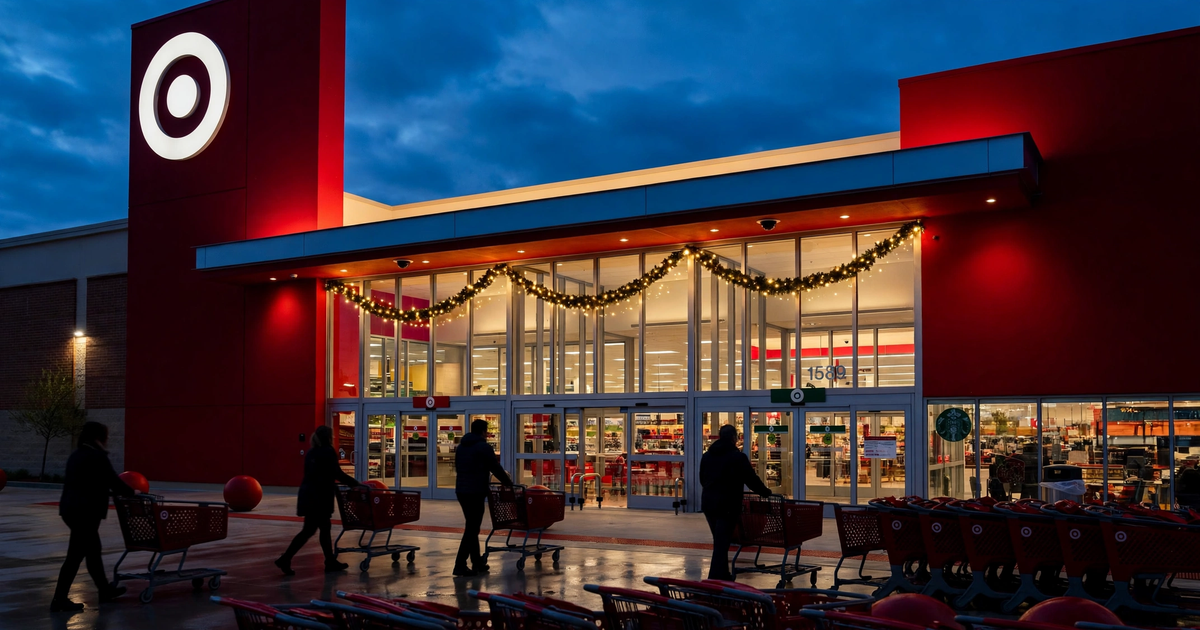
Brand Overview
- Brand nameTarget
- Founded1902
- HeadquartersMinneapolis, Minnesota, USA
- IndustryRetail
- Websitewww.target.com ↗
Psychology Techniques Identified
- 01Anchoring and reference pricing (Tversky & Kahneman 1974; Grewal et al. 1998 — "up to 50% off thousands of gifts" sets the reference point for every price after it)
- 02Scarcity and urgency (Cialdini 1984 — first-100 GiftCards, tickets forfeited after one hour, timed drops, "while supplies last")
- 03Loss aversion (Kahneman & Tversky 1979 — the Holiday Price Match Guarantee sells the fear of paying too much later; the queue sells the fear of missing the $1,000 card)
- 04Smart-shopper pride / deal pride (Schindler 1989 — the GiftCard is a prize for queuing, not a discount; the shopper feels clever for being early)
- 05Goal-gradient loyalty (Kivetz, Urminsky & Zheng 2006 — Target Circle progress, Circle Rewards and Circle 360 early access on 25 November pull members to spend more as the reward nears)
- 06Mental accounting / transaction utility (Thaler 1985 — the 5% Circle Card discount, Circle Rewards on future purchases and GiftCards separate "the deal I got" from "the thing I bought")
- 07Treasure-hunt novelty (Bullseye's Playground, refreshed every eight weeks with seasonal finds at the front of the store, manufactures a new reason to browse on every visit)
- 08Colour and identity (the red Bullseye, red carts and red-and-white store as a single unmistakable identity cue — with the Elliot & Maier 2014 caveat that colour effects are context-dependent, not hard-wired)
- 09Choice architecture / curated assortment (owned brands and curated drops — Pokémon, POP MART, the BTS book — narrow an overwhelming store into a small set of "only at Target" choices; Iyengar & Lepper 2000, with the later-literature caveat)
- 10Mere exposure and familiarity (Zajonc 1968 — 75% of Americans within 10 miles of a store, weekly trips, the same red Bullseye everywhere: familiarity itself builds liking)
- 11Peak-end rule (Kahneman et al. 1993 — the 6 a.m. opening, the GiftCard reveal at the event cart and the "first 100" moment are designed as the peak and the ending shoppers remember)
- 12Cross-merchandising / suggestive selling (lifestyle staging and complementary products placed side by side turn one errand into a full basket; the "Target Effect" as the folk name for it)
Full Psychology Audit Report
In this audit
At five in the morning on Friday 27 November 2026, the first people in line outside a Target store are not there for a television or a toy. They are there for a ticket — a small piece of paper handed out from about an hour before the 6 a.m. opening, good for a GiftCard worth $25, $50 or $100, and for one person in every store, $1,000. This Target Black Friday 2026 audit explains why the queue is the product: a retailer that spent a year losing shoppers has built its biggest sale around the oldest trick in retail — being first — and it works because the prize is certain, the deadline is short, and the line itself is the advertisement.
I am an Industrial and Organizational Psychologist in Karachi, and I audit brands on the psychology of what they actually do — not on how much I like their products. This audit is of Target Corporation, the American retailer founded in 1902, and of its Black Friday 2026 event, which runs from 22 to 29 November 2026. Every sale detail here comes from Target’s own press release of 17 November 2026, read directly, and every financial figure comes from the company’s own filings and earnings releases. Where a number is Target’s own claim rather than an independent finding — the loyalty spend multiples, for example — I say so plainly.
Target’s Black Friday 2026 is a queue, not a sale. The first 100 guests at every store on 27 November get a GiftCard — one per store worth $1,000 — and that scarcity does more work than the discounts of up to 50%. We score it 83/100: brilliant staging, a loyalty machine behind it, and a trust record needing repair.
“The queue is the product. The discount is only the excuse to join it.”
— Brand Psychology Analysis, ShahzebSpeaks
📋 Brand Overview
| Field | Detail |
|---|---|
| Brand | Target Corporation (NYSE: TGT) — general merchandise retailer: apparel, home, beauty, food, electronics and toys |
| Founded | 1902, Minneapolis, Minnesota, as Goodfellow Dry Goods; first Target store opened 1 May 1962 in Roseville, Minnesota; parent renamed Target Corporation in 2000 |
| Headquarters | Target Plaza, 1000 Nicollet Mall, Minneapolis, Minnesota, USA |
| Scale | More than 2,000 U.S. stores; 415,000 team members in FY2025; FY2025 net sales $104.78 billion; 75% of Americans live within 10 miles of a Target store |
| Leadership | Michael Fiddelke became chief executive on 1 February 2026, succeeding Brian Cornell, who had led the company for 11 years |
| Current campaign | Black Friday 2026, 22–29 November; stores closed Thanksgiving, open from 6 a.m. on Friday 27 November; first 100 guests per store receive a GiftCard |
| Website | https://www.target.com |
| Psychology score | 83/100 |
📜 Chapter 1: History — from a dry-goods store to a bullseye
The direct answer is that Target began in 1902 as a small Minneapolis dry-goods store, became America’s most design-conscious discounter, spent 2025 losing shoppers and trust, and put a first-time chief executive in place in February 2026 to win both back — and its Black Friday sale is the first big test of whether that turnaround is real.
George Dayton opened Goodfellow Dry Goods in Minneapolis in June 1902. The first Target store opened on 1 May 1962 in Roseville, Minnesota, co-founded by John Geisse and Douglas Dayton: the quality and presentation of a department store at the prices of a discounter. The parent company took the Target name in 2000. Since 1946, Target has given 5 percent of its profit to communities — a commitment older than the Target name, and one that matters here, because the company’s troubles in 2025 were, in large part, a fight with the very communities it had courted.
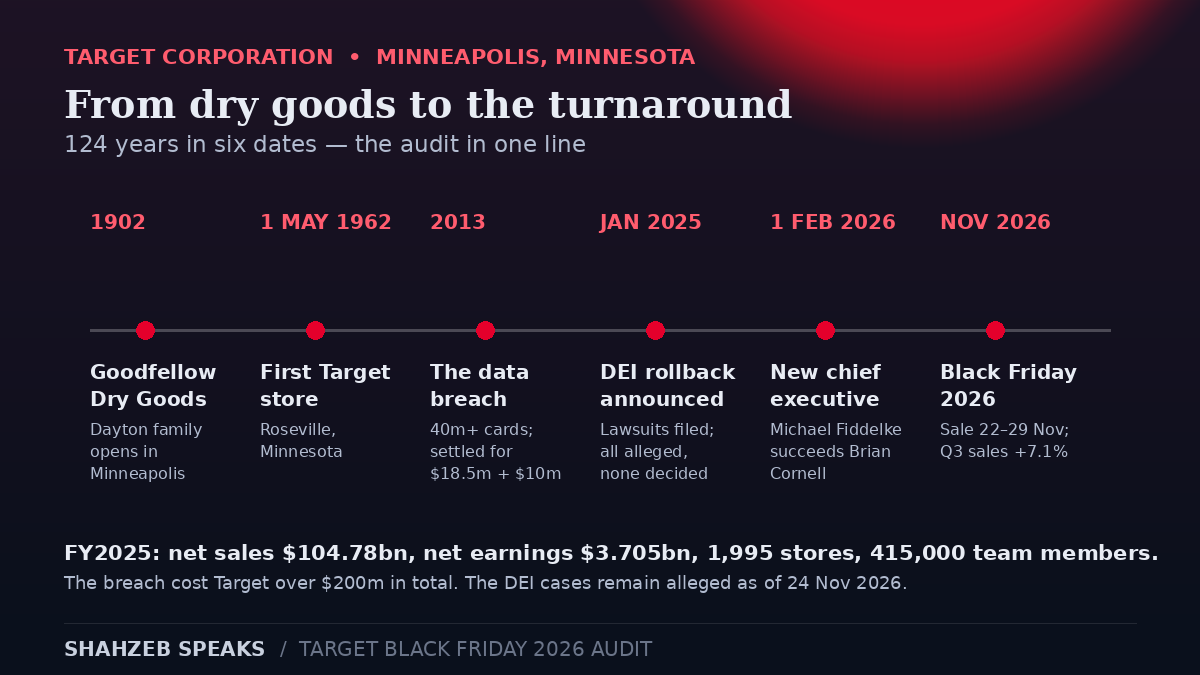
The recent history is a fall and a climb. In the 2025 financial year, ended 31 January 2026, net sales were $104.78 billion, down 1.7%, with comparable sales down 2.6% — the fourth straight quarter of falling comparable sales — and net earnings of $3.705 billion. The company had 1,995 stores and 415,000 team members. Then the direction changed: in the 2026 financial year, net sales rose 6.7% in the first quarter, 5.3% in the second quarter to $26.5 billion, and 7.1% in the third quarter to $27.07 billion, with comparable sales up 5.6% and traffic up 5.0%. Third-quarter earnings per share were $2.65, against $1.51 a year earlier — although $0.50 of that came from tariff refunds, a one-off benefit the company itself disclosed. Three good quarters do not make a recovery, and this audit does not call it one.
The leadership change explains the timing. Brian Cornell had been chief executive for 11 years when, on 20 August 2025, Target announced that its chief operating officer, Michael Fiddelke, would succeed him from 1 February 2026. Fiddelke joined Target as an intern in 2003. At his first town hall on 4 February 2026, he acknowledged that customer and employee trust had been lost and vowed to regain it. Behind the sale is a physical plan: a $5 billion capital investment in 2026, more than 30 new stores — including the 2,000th store, opened in Fuquay-Varina, North Carolina — more than 300 new stores by 2035, and a long-term goal of at least $15 billion of additional sales growth by 2030. The reason is in the company’s own filings: stores fulfilled more than 96 percent of merchandise sales in each of the last three years. The store is not a legacy cost. It is the machine.
🎄 Chapter 2: Target Black Friday 2026 — eight days, one queue, and a $1,000 ticket
The direct answer is that Target’s Black Friday 2026 is an eight-day event, 22–29 November, whose centrepiece is not a discount at all: it is a queue. The first 100 guests at every store on Black Friday get a GiftCard, and one of them gets $1,000 — and the rules of that giveaway are the most carefully engineered part of the whole event.
The event runs from Saturday 22 November to Saturday 29 November 2026, with discounts of up to 50% off thousands of gifts: up to 50% off select headphones and speakers from Beats and Bose, savings of up to $100 on select Apple devices, up to 50% off select laptops and printers from HP and Acer, up to 30% off select televisions and soundbars from Samsung, up to 50% off select toys, and games at $5 and $10. The weekend deals, 26–29 November, add up to 50% off all apparel and accessories, $5 pajama tees and pants from Wondershop, sweatshirts and sweatpants from $10, sweaters at $15, 40% off beauty and health gift sets, 50% off decorative pillows and throws, and 40% off all holiday trees. The stores are closed on Thanksgiving, Thursday 26 November, and reopen at 6 a.m. on Black Friday, 27 November.
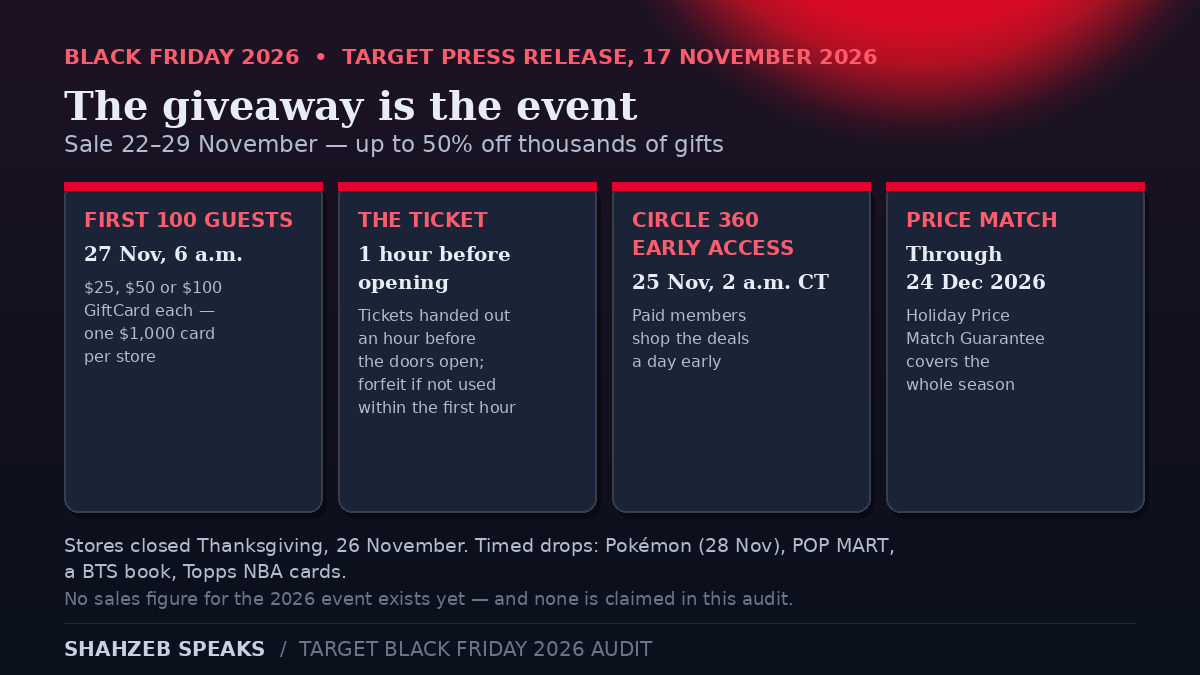
The giveaway is where the psychology lives. On Black Friday, the first 100 eligible guests at each store receive a Target GiftCard valued at $25, $50 or $100, and one guest at each store wins a $1,000 Target GiftCard. Tickets are given to the first 100 people in line from about one hour before the store opens until one hour after opening, or while supplies last, and must be redeemed within the first hour after opening, or the GiftCard is forfeited. No purchase is necessary, and guests must be 13 years or older. Three design choices do the work. First, the prize is a GiftCard, not a discount — it can only be spent at Target, so the giveaway buys a second visit. Second, the one-hour window punishes anyone who takes a ticket and wanders off. Third, the queue is visible: a hundred people outside a store at dawn is an advertisement no poster can match.
Around the queue, Target has built a week of timed moments. On 25 November, Target Circle 360 members get 24 hours of early access to select deals, from 2 a.m. Central Time. On 28 November, a Pokémon trading card game drop arrives, alongside drops from POP MART, a special BTS book, Topps NBA trading cards, a guest-favourite artist, and first-time food and beverage drops from GOODLES, Katjes and Backflip. The holiday offer behind all of this is large: more than 8,000 new gifts, over half exclusive to Target, thousands priced at $5 and under, and a $30 Thanksgiving meal for six. And one policy does quieter work than any discount: the Holiday Price Match Guarantee — if the price drops at Target later in the season, Target matches its own lower price through 24 December 2026. That is a promise aimed at the fear of buying too early, and Chapter 5 returns to it.
⚓ Chapter 3: Anchoring — “up to 50% off” sets the number you judge everything by
The direct answer is that “up to 50% off thousands of gifts” is an anchor: the first number the shopper sees sets the reference point, and every price after it is judged against that number — whether or not the shopper ever finds an item at 50% off.
The principle is anchoring. In 1974, Amos Tversky and Daniel Kahneman published “Judgment under Uncertainty: Heuristics and Biases” in Science. In one experiment, they spun a wheel of fortune rigged to land on either 10 or 65, then asked people what percentage of African nations belonged to the United Nations. People who saw 10 gave a median estimate of 25%. People who saw 65 gave a median estimate of 45%. A random number, openly random, moved the answer by twenty points. The first number does not need to be true. It only needs to be seen first. Grewal, Monroe and Krishnan showed in 1998, in the Journal of Marketing, that an advertised reference price shifts the buyer’s own internal reference price, and that the perceived transaction value — the feeling of having got a good deal — is what carries the effect into the intention to buy. “Up to 50% off” does two jobs at once: it tells the shopper what the saving could be, and it makes every smaller discount feel like a smaller win. Target’s anchors are honest in a way that matters for the trust score: the company advertises discount bands rather than crossed-out “was” prices on individual items, and this audit found no individual product was/now price to check, because none was verified. An “up to” claim still over-promises — the headline number is the maximum, not the typical — but a band is easier to check than a fiction. The audit scores anchoring and reference pricing 88.
⏰ Chapter 4: Scarcity and urgency — the first 100, the one hour, and the 28 November drop
The direct answer is that Target’s Black Friday works because almost everything in it is limited — by number, by time, or by both — and the first-100 GiftCard giveaway is the tightest limit of all: a hundred tickets, a one-hour window, and a $1,000 prize that only one person per store can win.
The principle is scarcity. Robert Cialdini, in Influence (1984, revised 2001), described it as one of the most reliable persuasion tools there is: people value what is limited, and they value it more when the limit is a deadline, and more still when the limit is a quantity. Target’s Black Friday uses all three at once. The giveaway is limited in quantity — the first 100 guests, one $1,000 card per store. It is limited in time — tickets from about an hour before opening, forfeited if not redeemed within the first hour after. And it is limited in place — in store only, which means the shopper must be there, at dawn, in person. The timed drops add a second layer of scarcity, aimed at collectors: the Pokémon trading card drop on 28 November, the POP MART drop, the BTS book, the Topps NBA cards. A trading card drop that arrives on one day and may not return is scarce in the way a half-price television is not: the item itself is limited, not only the discount. That is why the drops are dated, one by one, across the week — each date a separate reason to come back. The honest limit is that the scarcity here is manufactured, and the shopper knows it. The GiftCards are not scarce because the world has run out of them. They are scarce because Target has decided to give away a hundred of them per store at a specific hour. That does not make the mechanism weaker — manufactured scarcity works just as well as real scarcity, because it can be scheduled — but it does make the trust question sharper. The audit scores scarcity and urgency 92, the highest in this audit.
😨 Chapter 5: Loss aversion — the price match, and the fear of buying too early
The direct answer is that Black Friday works because missing a deal feels worse than getting one feels good — and Target’s Holiday Price Match Guarantee is the cleverest answer to that fear in the whole event: it removes the loss of buying too early, so the shopper buys now.
The principle is loss aversion. Kahneman and Tversky showed in 1979, in “Prospect Theory”, published in Econometrica, that losses weigh more heavily than equal gains: losing $20 hurts more than gaining $20 pleases. A shopper who sees a saving of $100 on an Apple device is not only seeing a gain. They are seeing a loss of $100 that will happen if they walk away. Target’s event is structured to maximise that feeling in two directions at once. The giveaway is a loss waiting to happen: the $1,000 card exists, one person per store will win it, and everyone else in the queue will watch it go to someone else. The timed drops are the same mechanism in a different form: the Pokémon cards arrive on 28 November, and the collector who misses them may not get another chance. And then, in the opposite direction, the Holiday Price Match Guarantee takes a loss away. If the price drops at Target later in the holiday season, Target will match its own lower price through 24 December 2026. That removes the shopper’s biggest reason to wait — the fear that the price will fall after they have bought — and it does so without giving anything away, because Target is only promising to match itself. It is a small policy with a large psychological effect: it tells the shopper that the store is confident enough to be checked. There is a cost, though. A customer who buys because they are afraid of missing out may regret the purchase when the fear passes, and a customer who regrets a purchase learns to distrust the next one.
💰 Chapter 6: Deal pride and mental accounting — the GiftCard is a prize, not a discount
The direct answer is that shoppers do not only buy the item. They buy the feeling of having got a bargain — and Target’s GiftCard giveaway is designed to produce exactly that feeling, because a prize you queued for feels earned in a way a discount never does.
The principle is transaction utility. Richard Thaler argued in 1985, in Marketing Science, that a purchase is judged by two utilities at once: acquisition utility, the value of what you get, and transaction utility, the value of the deal itself — how good it feels to have paid less than the reference price. The GiftCard adds a third ledger. It is not a discount on something bought. It is money for queuing, and the shopper files it in a separate mental account from the purchase. The $100 GiftCard feels like a win. The $100 spent in the store feels like the price of the win. That separation is the whole trick, and it is why a GiftCard giveaway is more powerful than a $100 price cut: a price cut is forgotten by the time the shopper reaches the car, and a GiftCard is carried out of the store in the hand. Robert Schindler gave that feeling a name in 1989, in Advances in Consumer Research: smart-shopper feelings — getting a discount produces pride in being responsible for the saving. The shopper who stood outside at five in the morning did not get a discount. They earned a ticket. The pride is not in the $25 or the $50. It is in being first. The Circle Card adds the same mechanism in a quieter form: an extra 5% off nearly every purchase, with no annual fee, and Circle Rewards redeemable on future purchases. The audit scores deal pride and smart-shopper reward 86.
🔴 Chapter 7: Goal-gradient loyalty — Circle turns a sale into a membership
The direct answer is that Target Circle is the real product behind Black Friday: more than 100 million members, a paid tier that buys early access, and a reward structure that pulls shoppers to spend more as the reward gets closer — and the 25 November early access is the moment that pull is strongest.
The principle is the goal-gradient effect. Kivetz, Urminsky and Zheng showed in 2006, in the Journal of Marketing Research, that people accelerate towards a reward as they get closer to it. In their café study, customers given a 12-stamp card with two stamps already filled in as a “bonus” finished it faster, in a median of 10 days against 15 days for a plain 10-stamp card, even though both required ten purchases. The progress itself is the motivation. Target Circle is built on exactly that pull. The programme launched in 2019 and was relaunched on 7 April 2024, with three options: the free Target Circle, the Target Circle Card — formerly the RedCard — and the paid Target Circle 360. The free tier applies deals automatically at checkout, offers personalised deals and bonuses, and gives a 5% birthday discount for 30 days. The Circle Card adds an extra 5% off nearly every purchase and an extra 30 days to return items, with no annual fee. Circle 360, at $99 a year or $10.99 a month — $49 a year for Circle Card holders — adds unlimited free same-day delivery on orders over $35, monthly freebies, and same-day delivery with no price markups from more than 100 non-Target retailers through Shipt Marketplace.
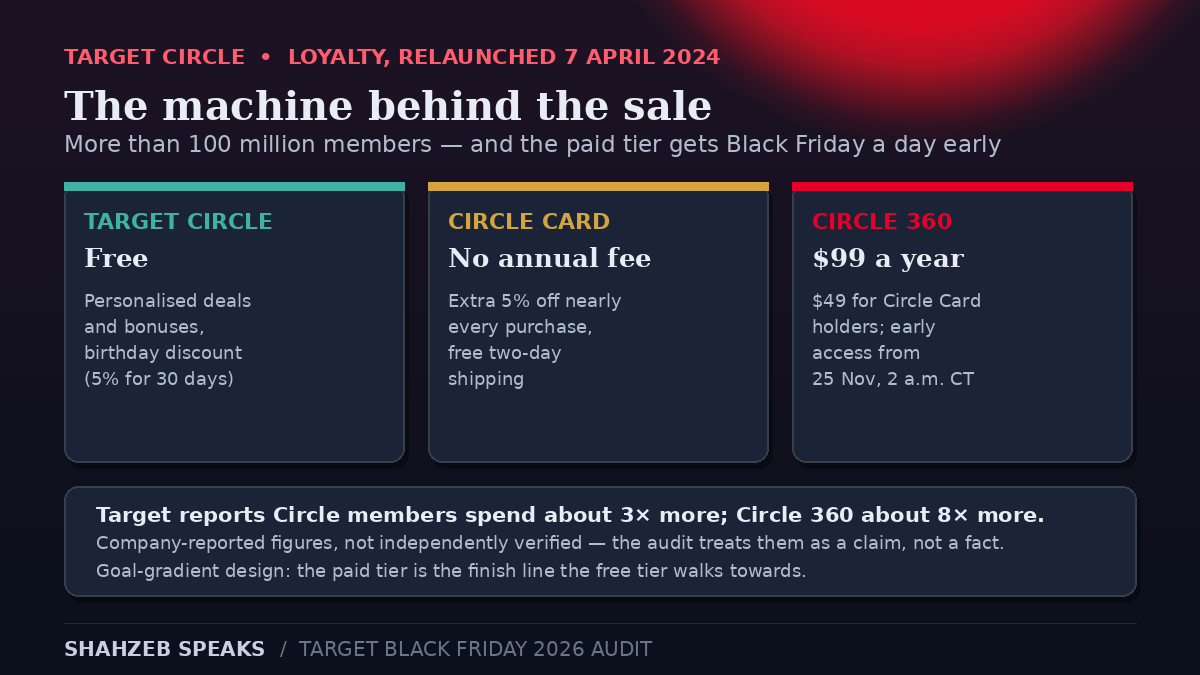
On 25 November, Circle 360 members get 24 hours of early access to select deals, from 2 a.m. Central Time. That is not a discount. It is a status, and status is what a paid tier sells. Target says Circle members spend about three times more than non-members, and Circle 360 members about eight times more, shopping about six times more often — but those are Target’s own figures, reported through loyalty-industry press, not independently verified findings, and this audit prints them as company-reported claims, never as facts. The programme aims to triple Circle 360 membership over the next three years, which tells you what Black Friday is for: the sale is the funnel, and the membership is the product. The audit scores loyalty and goal-gradient design 87.
🎯 Chapter 8: Treasure-hunt novelty — Bullseye’s Playground and the eight-week refresh
The direct answer is that the front of a Target store is a treasure hunt: a small section of cheap, seasonal finds, refreshed every eight weeks, that gives the shopper a new reason to browse on every visit — and it works because the finds are new, not because they are cheap.
The section is called Bullseye’s Playground, once called “The One Spot”. Target renamed it in November 2015, and the assortment is refreshed every eight weeks around seasonal moments — a new set of small finds for each holiday, each season, each excuse to look. Bullseye is Target’s bull terrier mascot. What matters is the refresh: a shopper who visits every week sees a different Playground every eight weeks, and a shopper who sees a different Playground has a reason to stop, to look, and to buy something they did not come for. The section is small, cheap, and at the front of the store — so the shopper meets it before anything they planned to buy, and the unplanned purchase happens before the planned one sets the budget. The mechanism is novelty plus scarcity, and Cialdini’s scarcity principle is the right frame: the finds are limited, seasonal, and gone when they are gone. The Black Friday drops do the same work on a weekly scale — a Pokémon drop, a POP MART drop, a BTS book — each a small treasure hunt of its own. The honest limit: the numbers sometimes quoted about the Playground — that 90% of shoppers visit it regularly, that the average spend is $30 a trip — come from a marketing blog and were not verified from a primary source. This audit does not print them. The audit scores treasure-hunt novelty 84.
🛒 Chapter 9: Choice architecture — one-third of the store can only be bought here
The direct answer is that Target solves the problem of too much choice by selling things only it can sell: about one-third of its merchandise sales come from its own brands, and 11 of those brands each take more than $1 billion a year — so the shopper never has to compare them with anyone else’s price.
The principle is choice overload. In 2000, Sheena Iyengar and Mark Lepper published “When Choice Is Demotivating” in the Journal of Personality and Social Psychology, reporting the famous jam study: when shoppers were offered 6 jams, about 30% of those who tasted bought one; when they were offered 24 jams, only about 3% bought. More choice, fewer purchases. The caveat must be printed in full: later research, averaging across 50 experiments, found the average effect close to zero — the jam result is real, but it is not universal. The honest statement is that too much undifferentiated choice can paralyse, and curation is the cure. Target’s own brands are that cure, applied at the scale of a whole store. About one-third of merchandise sales come from Target’s owned and exclusive brands, and 11 of those brands exceed $1 billion in annual sales each: Good & Gather, Cat & Jack, up & up, Threshold, All in Motion, A New Day, Goodfellow & Co, Universal Thread, Wild Fable, Hearth & Hand with Magnolia, dealworthy, Wondershop, Favorite Day. The Black Friday deals sit heavily on those names — and that is not an accident. An own-brand item has no rival price to be compared with. The discount is judged on its own terms, and the anchor is whatever Target says it is. That is a powerful position, and a responsibility: a price that cannot be compared must be believed. The audit scores choice architecture and curation 85.
🔴 Chapter 10: Colour, identity and mere exposure — the red bullseye you cannot miss
The direct answer is that Target’s red is an identity cue, not a sales trick: the bullseye, the red carts and the red-and-white store make the brand recognisable in a glance, and the familiarity of seeing it everywhere is itself a reason shoppers like it — but the research does not support the claim that red makes people buy.
The colour claim needs care, because it is one of the most overstated ideas in popular psychology. Elliot and Maier reviewed the evidence in 2014, in the Annual Review of Psychology, and their conclusion was careful: colour “can carry important meaning” for affect, cognition and behaviour, but the literature is “at a nascent stage” and “considerable work on boundary conditions, moderators, and real-world generalizability is needed before strong conceptual statements” can be made. That is a warning, not a licence. This audit does not claim that red makes people buy. What red does for Target is simpler and better supported: it makes the brand unmistakable. That familiarity is itself a psychological mechanism — the mere exposure effect. Robert Zajonc showed in 1968, in the Journal of Personality and Social Psychology, that repeated exposure alone, with no reward attached, makes attitudes more positive. People like what they have seen before. And Target is built to be seen before: 75% of Americans live within 10 miles of a Target store, the company has more than 2,000 stores, and the same red bullseye is on every one of them. Inside, home products are staged in lifestyle settings — mock bedrooms and living rooms — so shoppers can picture the products in their own homes. Joe Perdew, Target’s vice president of store design, has said home products are “cross-merchandised and displayed in lifestyle settings, so guests can imagine what they’ll look like in their own homes”. That is not decoration. It is a decision about what the shopper is buying: not a lamp, but a living room.
🎬 Chapter 11: Peak-end and cross-merchandising — the moment you remember, and the basket you did not plan
The direct answer is that shoppers remember a visit by its best moment and its ending, not by its average — and Target stages both: the GiftCard reveal at the event cart is the peak, the checkout is the ending, and everything placed between them is designed to add one more item to the basket.
The principle is the peak-end rule. Kahneman, Fredrickson, Schreiber and Redelmeier showed in 1993, in Psychological Science, that people judge an experience by its most intense moment and by how it ends, not by the average of everything in between. Target’s Black Friday is built to peak twice. The first peak is the ticket: the moment a shopper learns they are one of the first 100, and the moment at the event cart when the GiftCard is revealed — $25, $50, $100, or for one person per store, $1,000. The second peak is the drop: the Pokémon cards on 28 November, found on the day they were promised. And the ending is the checkout, where the GiftCard is in the hand and the Circle rewards are applied — a small win at the end of a long morning. Between the peak and the ending, the store does its quietest work. Cross-merchandising places complementary products from different categories next to each other, so one errand becomes a full basket. Tom Meyvis, a marketing professor at New York University’s Stern School of Business, has described it plainly: stores have an idea about the path shoppers take, and they can cross-sell by making sure the right products are next to each other. The folk name for the result is the “Target Effect” — walking in for a few items and leaving with far more — and it is worth saying plainly that this is a popular term, not a scientific one. There is no study called the Target Effect.
⚠️ Chapter 12: The dark side — a $200 million breach, and three cases that are still only allegations
The direct answer is that Target’s trust record has two halves, and they must not be confused: the 2013 data breach is settled history — $18.5 million to the states, a $10 million consumer settlement finally approved in 2018, more than $200 million in total costs — while the three securities cases about Pride and DEI are allegations only, with no finding, no fine and no settlement as of 24 November 2026.
The breach is a matter of court record. On 19 December 2013, Target disclosed that intruders had stolen payment-card and other guest information from its network in November and December 2013, covering transactions from 27 November to 18 December 2013. Payment-card data of about 40 million customers was exposed, and contact information of tens of millions more. The attackers had obtained network credentials from a third-party vendor, an HVAC contractor. The settlements that followed are all final. On 23 May 2017, Target agreed a multi-state settlement of $18.5 million with the Attorneys General of 47 states and the District of Columbia — Alabama, Wisconsin and Wyoming were not parties — and the settlement required Target to implement a comprehensive information-security programme within 180 days. California received the largest share, over $1.4 million. The consumer class action settled for a $10 million fund, agreed in March 2015, plus up to $6.75 million in attorneys’ fees; the district court’s approval was vacated and sent back by the Eighth Circuit on 1 February 2017, and on remand the settlement was finally affirmed on 13 June 2018. Settlements with banks and card issuers in 2015 totalled about $108 million. A separate figure of $39.4 million paid to banks and credit unions was also reported, and whether it is part of the $108 million was not resolved — so this audit does not add the two together. Target reported that the total cost of the breach exceeded $200 million. That is settled history, and this audit prints it as settled.
The DEI rollback is a different kind of record. On 24 January 2025, Target announced changes to its “Belonging at the Bullseye” strategy: concluding its three-year diversity, equity and inclusion goals, ending its Racial Equity Action and Change programme — set up after George Floyd’s murder in Minneapolis in 2020 — discontinuing participation in external diversity surveys including the Human Rights Campaign Corporate Equality Index, and renaming its Supplier Diversity team “Supplier Engagement”. The backlash was immediate: civil-rights groups and Black clergy called for boycotts, and Rev. Jamal Bryant launched a 40-day “TargetFast” boycott from 5 March 2025, with organisers saying more than 150,000 people had pledged to take part, although other reports put the figure higher. Foot-traffic data from Placer.ai showed store visits down 9% year on year in February 2025 and 6.5% in March 2025, and first-quarter comparable sales fell 3.8%, with net sales of $23.8 billion against $24.5 billion a year earlier. But the causation warning must be printed in full: Placer.ai declined to say how much of the decline the DEI decision contributed, and Target’s annual report cited cautious, value-focused consumers and tariff volatility. This audit does not write that the boycott caused a specific loss, because no source in the research file supports that claim.
The three securities cases are allegations, and this audit reports them as allegations. Craig v. Target Corp. was filed on 8 August 2023 in the Middle District of Florida by America First Legal on behalf of shareholder Brian Craig, alleging that Target misled investors by failing to disclose the risk of backlash to its May 2023 Pride campaign and its DEI and ESG programmes. The complaint alleged a $10 billion fall in market value between 18 and 23 May 2023 — a figure from the complaint, not verified market data. On 4 December 2024, Judge John L. Badalamenti denied Target’s motion to dismiss, and on 6 January 2025 the court entered a stay pending mediation. No later outcome was verified. The City of Riviera Beach Police Pension Fund case, filed on 31 January 2025, is a proposed securities class action alleging that Target defrauded investors by concealing DEI and ESG backlash risks, citing the 22% share-price fall on 20 November 2024. The State Board of Administration of Florida case, filed on 20 February 2025, alleges similar claims on behalf of Florida’s pension fund. The Riviera Beach and SBA cases were consolidated in July 2025, transferred to federal court in Minnesota in November 2025, and in October 2026 Target asked the Minnesota court to dismiss; no ruling, trial date or settlement had been announced as of 14 November 2026, according to a legal-explainer site rather than a court record. No finding of wrongdoing, fine or settlement exists in any of these cases as of 24 November 2026. One absence, stated with the same care: no FTC action, SEC enforcement action or consumer-protection fine against Target was found in the searches run on 24 November 2026. That is a statement about the searches run, not proof that none exists. Trust and transparency is scored 58, the lowest in this audit by a wide margin.
🌍 Chapter 13: What retailers everywhere should — and shouldn’t — copy
Retailers everywhere should copy the queue, not the discount. The best idea in Target’s Black Friday is not a price cut. It is the first-100 GiftCard giveaway: a certain prize, a short deadline, and a line of people outside the store at dawn that advertises the event better than any poster. A retailer running a sale at Christmas, at back-to-school, or at a shopping festival anywhere in the world should build its event the same way: not one long sale that nobody hurries for, but a timed moment with a real prize, a clear rule, and a reason to be there in person. Retailers should copy the price match, too: the Holiday Price Match Guarantee tells the shopper that the store is confident enough to be checked, and a store that invites checking is a store that is believed. And they should copy the loyalty design — a free tier anyone can join, a paid tier that buys early access, and rewards structured as progress towards a visible goal. The sale is the funnel. The membership is the product.
And retailers should not copy the silence. Target’s breach is settled, and its DEI cases are allegations — but the gap between the two is where trust is lost. A company that settles a breach and then says nothing about what changed, or that faces allegations about hiding a risk and says nothing while the cases are pending, leaves the story to be told by its critics. The cheapest time to earn trust is before you lose it, and the most expensive discount is the one a judge has to price. A retailer that wants to run a sale like Target’s should do the one thing Target’s record makes hardest: make sure the promise on the ticket — first 100, one hour, $1,000 — is kept exactly as printed, and that the price on the tag is one the shopper can check. The queue will form either way. The question is whether the people in it come back.
📊 Psychology Scorecard — the Target Black Friday 2026 audit verdict
The scorecard below scores the event psychology and the company behind it, not the outcome of the sale. No sales figure for the 2026 event exists, and none is claimed. The overall score is the rounded average of eight dimensions scored out of 100.
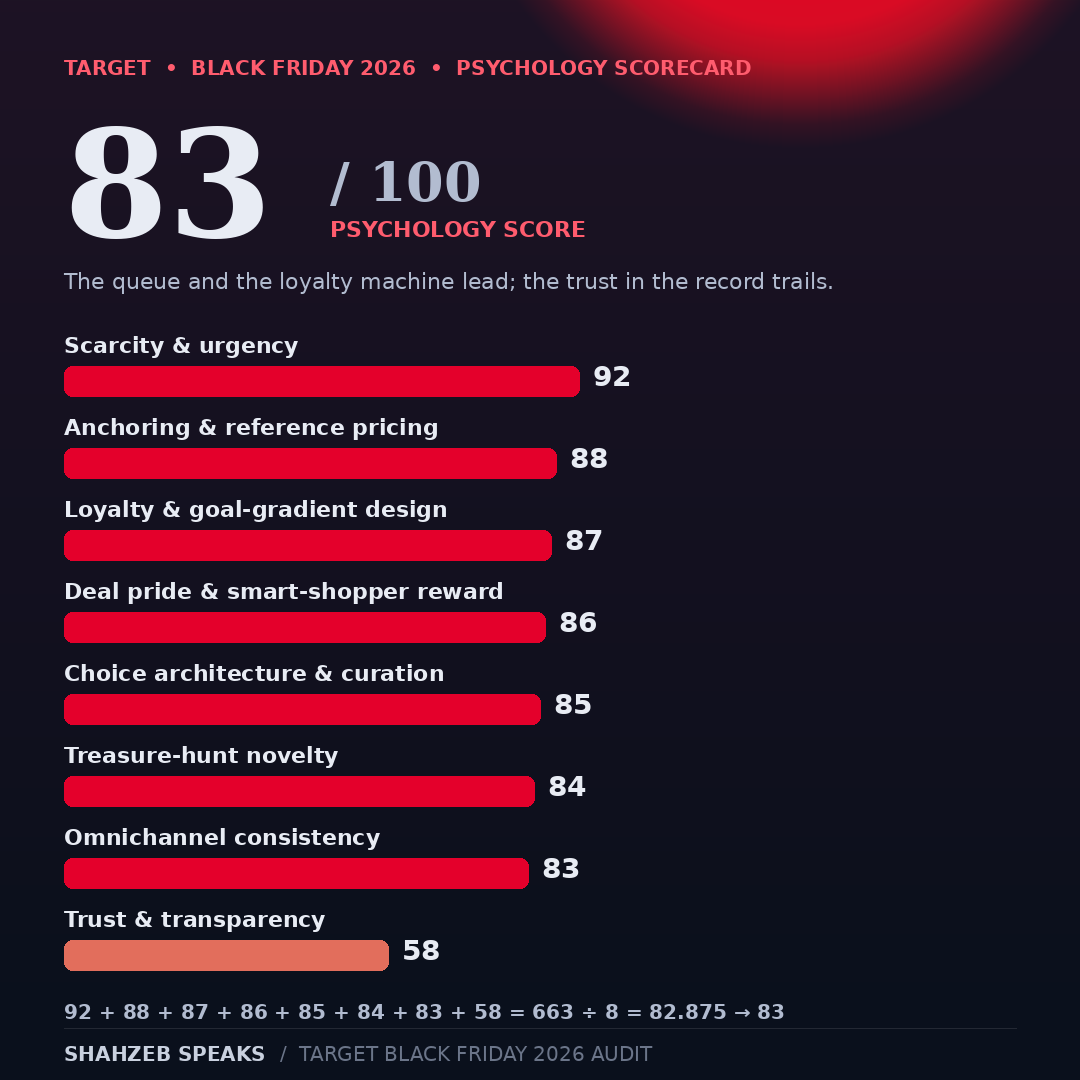
| Dimension | Score | Verdict |
|---|---|---|
| Scarcity & urgency | 92 | First 100 guests, a one-hour window, one $1,000 card per store — the best-staged scarcity in a Black Friday event |
| Anchoring & reference pricing | 88 | “Up to 50% off thousands of gifts” sets the number every price is judged by — Tversky & Kahneman, applied at scale |
| Loyalty & goal-gradient design | 87 | Circle’s 100 million+ members and the paid tier’s day-early access — Kivetz, with the sale as the membership funnel |
| Deal pride & smart-shopper reward | 86 | The GiftCard is a prize you queue for, not a discount — Schindler’s smart-shopper pride, earned at 5 a.m. |
| Choice architecture & curation | 85 | About a third of sales from own brands no rival can price-compare, and drops that narrow the choice to one |
| Treasure-hunt novelty | 84 | Bullseye’s Playground, refreshed every eight weeks, and a week of dated drops — a new reason to look, every time |
| Omnichannel consistency | 83 | Stores fulfil over 96% of merchandise sales, and the same deals run online — the store is the machine, and it works |
| Trust & transparency | 58 | A $200 million-plus breach, settled, and three DEI securities cases that remain allegations with no finding as of 24 Nov 2026 |
| Overall | 83/100 | 92 + 88 + 87 + 86 + 85 + 84 + 83 + 58 = 663; 663 ÷ 8 = 82.875, rounded to 83 |
🧠 Psychology Techniques Identified
- Anchoring and reference pricing (Tversky & Kahneman 1974; Grewal et al. 1998 — “up to 50% off thousands of gifts” sets the reference point for every price after it)
- Scarcity and urgency (Cialdini 1984 — first-100 GiftCards, tickets forfeited after one hour, timed drops, “while supplies last”)
- Loss aversion (Kahneman & Tversky 1979 — the Holiday Price Match Guarantee sells the fear of paying too much later; the queue sells the fear of missing the $1,000 card)
- Smart-shopper pride / deal pride (Schindler 1989 — the GiftCard is a prize for queuing, not a discount; the shopper feels clever for being early)
- Goal-gradient loyalty (Kivetz, Urminsky & Zheng 2006 — Target Circle progress, Circle Rewards and Circle 360 early access on 25 November pull members to spend more as the reward nears)
- Mental accounting / transaction utility (Thaler 1985 — the 5% Circle Card discount, Circle Rewards on future purchases and GiftCards separate “the deal I got” from “the thing I bought”)
- Treasure-hunt novelty (Bullseye’s Playground, refreshed every eight weeks with seasonal finds at the front of the store, manufactures a new reason to browse on every visit)
- Colour and identity (the red Bullseye, red carts and red-and-white store as a single unmistakable identity cue — with the Elliot & Maier 2014 caveat that colour effects are context-dependent, not hard-wired)
- Choice architecture / curated assortment (owned brands and curated drops — Pokémon, POP MART, the BTS book — narrow an overwhelming store into a small set of “only at Target” choices; Iyengar & Lepper 2000, with the later-literature caveat)
- Mere exposure and familiarity (Zajonc 1968 — 75% of Americans within 10 miles of a store, weekly trips, the same red Bullseye everywhere: familiarity itself builds liking)
- Peak-end rule (Kahneman et al. 1993 — the 6 a.m. opening, the GiftCard reveal at the event cart and the “first 100” moment are designed as the peak and the ending shoppers remember)
- Cross-merchandising / suggestive selling (lifestyle staging and complementary products placed side by side turn one errand into a full basket; the “Target Effect” as the folk name for it)
✅ Balance sheet & prescription
What works: the queue, the best-staged scarcity in a Black Friday event; the anchor, on almost everything; the loyalty machine, with more than 100 million Circle members and a paid tier that buys a day of early access; the deal pride, which turns a GiftCard into a trophy; the price match, the most honest sentence in the sale; and the turnaround, with three straight quarters of growth and a chief executive who has said out loud that trust must be won back.
What does not: the trust in the record, where a breach that cost more than $200 million and three securities cases that remain allegations sit behind every red sign; the “up to” framing, which promises the maximum and delivers a range; the manufactured scarcity, which the shopper knows is scheduled rather than real; the dependence on fear, which sells today and costs trust tomorrow; and the absence of any verified 2026 sales figure or individual product price, which means this score is a judgement of psychology and craft, not of outcome.
The prescription: keep the first-100 giveaway and the price match. But publish the numbers that would let shoppers check the treasure hunt, and close the gap between the two halves of the trust record: the breach is settled, so say what changed since 2013 in plain language, and the DEI cases are allegations, so say so plainly and let the courts decide. A company whose chief executive has promised to win trust back should start by making its promises checkable.
📝 Final Verdict
Target’s Black Friday 2026 is one of the best-staged sales events I have audited, and one of the most honest about what it is selling. The anchor is on almost everything, the queue is a certain prize with a short deadline, the loyalty machine turns a sale into a membership, and the price match softens the fear it sharpens everywhere else. The turnaround behind it is real — three quarters of growth after a year of decline, a new chief executive, a $5 billion plan to build more stores. Its weakness is that the machine runs on trust, and the trust record is unfinished: a breach that cost more than $200 million, settled and paid for, and three cases about Pride and DEI that allege the company hid a risk from its investors — cases that, as of today, remain allegations and nothing more. A queue that cannot be believed is a queue that cannot last.
Psychology Score: 83/100 — a red bullseye, a queue before dawn, and a $1,000 GiftCard for being first. The staging is superb; the trust record still needs repair.
— Brand Psychology Analysis, ShahzebSpeaks
🔑 Key Findings
- Black Friday 2026 is built as a queue, not a sale: the first 100 guests at every store on 27 November get a GiftCard of $25, $50 or $100, one per store wins $1,000, and tickets not redeemed within the first hour after the 6 a.m. opening are forfeited.
- Target’s turnaround is genuine but unproven over a full year — three good quarters in FY2026 (net sales up 6.7%, 5.3% and 7.1%, with third-quarter comparable sales up 5.6% and traffic up 5.0%) after a full year of decline in FY2025 (comparable sales down 2.6%, net sales $104.78 billion).
- Circle is the real product: more than 100 million members, and the paid 360 tier buys 24 hours of early access from 2 a.m. Central Time on 25 November — with Target’s reported spend multiples (about 3x for Circle, about 8x for Circle 360) labelled as company-reported, not independently verified.
- Owned brands (about one-third of merchandise sales, 11 brands over $1 billion a year each) let Target discount without ever being price-compared — the Black Friday apparel deals sit heavily on Cat & Jack, A New Day, Goodfellow & Co, Universal Thread and Wild Fable.
- Trust is Target’s open wound: the $18.5 million multi-state breach settlement of May 2017 and the $10 million consumer class settlement finally affirmed in June 2018 are settled history, with total breach costs over $200 million — but three DEI and Pride securities cases remain ALLEGED and undecided as of 24 November 2026, with no finding, fine or settlement in any of them.
- The store, not the website, does the work: over 96% of merchandise sales are fulfilled by stores, 75% of Americans live within 10 miles of a Target, and the 2026 expansion (more than 30 new stores, the 2,000th store opened in March 2026) doubles down on physical retail while rivals retreat.
❓ Questions I am asked most often
What is Target’s Black Friday 2026 sale?
It runs 22–29 November 2026, eight days, with Black Friday itself on 27 November. Stores are closed on Thanksgiving and open at 6 a.m. on Black Friday. Discounts are up to 50% off thousands of gifts, and the first 100 guests at every store receive a GiftCard of $25, $50 or $100, with one $1,000 GiftCard per store.
How good is the event, psychologically?
Our audit scores it 83/100. It is strongest on scarcity and urgency (92) and anchoring and reference pricing (88), and weakest on trust and transparency (58), because of the 2013 breach record and the three DEI securities cases that remain allegations as of 24 November 2026.
How does the $1,000 GiftCard giveaway work?
On Black Friday, 27 November, the first 100 eligible guests at each store receive a Target GiftCard. Tickets are given out from about an hour before the 6 a.m. opening until an hour after opening, or while supplies last, and must be redeemed within the first hour after opening or the GiftCard is forfeited. No purchase is necessary, and guests must be 13 or older.
What is Target Circle 360, and what does it get you on Black Friday?
Circle 360 is Target’s paid loyalty tier, at $99 a year or $10.99 a month, with a $49-a-year rate for Circle Card holders. On 25 November, Circle 360 members get 24 hours of early access to select Black Friday deals, starting at 2 a.m. Central Time. The tier also includes free same-day delivery on orders over $35 and free two-day shipping.
What is Target’s legal record on the 2013 data breach?
The breach was disclosed in December 2013. Target settled with 47 states and the District of Columbia for $18.5 million in May 2017, and a $10 million consumer class action settlement was finally affirmed by the Eighth Circuit in June 2018. Settlements with banks totalled about $108 million in 2015, and Target reported total breach costs of more than $200 million.
Are the DEI lawsuits against Target decided?
No. Three securities cases allege Target misled investors about Pride and DEI backlash risks — Craig, filed in August 2023, and the Riviera Beach and Florida pension fund cases, filed in early 2025. They were consolidated in July 2025 and transferred to Minnesota in November 2025, and Target asked the court to dismiss them in October 2026. No ruling or settlement had been announced as of 14 November 2026.
If your brand is selling well and still has a story it has not told — a record quarter, a product people do not yet understand, a gap between what people feel and what they buy — the problem is not awareness. It is the reason to choose. I help organisations build evidence-based brand strategy — get in touch here.
If this audit helped, you may also like Black Friday Psychology 2026: Why the Sale Works on Your Brain — and How to Shop It Without Regret, J.C. Penney Psychology Audit — Black Friday Pricing: The Discount Is the Product, and Costco Psychology Audit: How a $1.50 Hot Dog and a $65 Card Built the Most Loyal Customers in Retail. For the wider field, the homepage of this site covers industrial psychology in Pakistan and beyond.
📚 References & Sources
- Target Corporation, “Target Announces Black Friday Deals and Giveaways” (17 November 2026): event 22–29 Nov 2026, first-100 GiftCard giveaway and ticket rules, 6 a.m. opening, Circle 360 early access 25 Nov from 2 a.m. CT, timed drops, Holiday Price Match Guarantee through 24 Dec 2026.
- Target Corporation, “Target Corporation Reports Third Quarter Earnings” (18 November 2026): Q3 FY2026 net sales $27.07bn, +7.1%; comps +5.6%; traffic +5.0%; EPS $2.65 including $0.50 tariff-refund benefits; nine-month net sales $79.05bn, +6.4%; more than 8,000 new gifts; $30 Thanksgiving meal for six.
- Target Corporation, FY2025 Form 10-K and corporate overview: FY2025 net sales $104.78bn, net earnings $3.705bn, EPS $8.13; comps -2.6%; 1,995 stores; 415,000 team members; stores fulfilled over 96% of merchandise sales; owned brands about one-third of sales; 11 brands over $1bn a year.
- Target Corporation, “Target Ramps Up Store Investments” (March 2026): $5bn capital investment in 2026; 30+ new stores including the 2,000th store in Fuquay-Varina, N.C.; 300+ by 2035; 130+ remodels.
- Target Corporation, Circle relaunch announcement (5 March 2024): Circle relaunched 7 April 2024 — free Circle, Circle Card, Circle 360.
- Target Corporation, 2025 Sustainability and Governance Report: Target Circle more than 100 million members; 75% of the U.S. population within 10 miles of a Target store.
- RetailDive (17 November 2026): corroboration of the Black Friday giveaway and Circle 360 early access. RetailDive (6 October 2026): Q2 FY2026 net sales +5.3% to $26.5bn, comps +3.8%.
- National Jeweler (20 August 2025): Michael Fiddelke to succeed Brian Cornell as CEO effective 1 February 2026. AfroTech (via Bloomberg, February 2026): Fiddelke’s first town hall, 4 February 2026.
- Target corporate blog, “Bullseye’s Playground” (2 November 2015): “The One Spot” renamed November 2015; assortment refreshed every eight weeks.
- Retail Boss (2026): Target Beauty Studio launched 10 September 2026 in more than 600 stores, 1,600+ products from 90 brands. AnalystLens, Ulta 8-K summary (14 August 2025): Ulta partnership ended August 2026.
- Legal500 (2017): $18.5m multi-state settlement, 23 May 2017; 47 states + D.C.; California over $1.4m; information-security programme within 180 days; total breach cost over $200m.
- Debevoise (May 2017): breach disclosed 19 December 2013; transactions 27 November – 18 December 2013; credentials from a third-party vendor. Eighth Circuit (13 June 2018, 855 F.3d 913): $10m consumer settlement finally affirmed, after vacatur and remand on 1 February 2017 (847 F.3d 608). Cleary Gottlieb (11 July 2017): $10m consumer fund, up to $6.75m fees; about $108m in financial-institution settlements in 2015.
- Barchart (AP, 24 January 2025): DEI rollback — concluding three-year DEI goals, ending REACH, discontinuing external diversity surveys, renaming Supplier Diversity. HR Grapevine (2 April 2025): TargetFast boycott from 5 March 2025; organisers reported 150,000+ participants. RetailWire (2025): Placer.ai visits down 9% YoY February 2025, 6.5% March 2025; Q1 2025 comps -3.8%.
- Legal Dive (2023): Craig v. Target Corp., filed 8 August 2023, M.D. Fla. No. 2:23-cv-00599; alleged $10bn market-cap fall 18–23 May 2023. Gibson Dunn (5 February 2025): motion to dismiss denied 4 December 2024; stay pending mediation entered 6 January 2025.
- Inc. (Reuters, 2025): City of Riviera Beach Police Pension Fund v. Target, filed 31 January 2025; class period 26 August 2022 – 19 November 2024; 22% share-price fall on 20 November 2024 cited in the complaint. America First Legal (February 2025): State Board of Administration of Florida v. Target, filed 20 February 2025. The Lawsuit Watch (status as of 14 November 2026): cases consolidated July 2025; transferred to Minnesota November 2025; dismissal motion October 2026; no ruling announced.
- Tversky, A. & Kahneman, D. (1974). Judgment under uncertainty: Heuristics and biases. Science, 185(4157), 1124–1131.
- Kahneman, D. & Tversky, A. (1979). Prospect theory: An analysis of decision under risk. Econometrica, 47(2), 263–291.
- Thaler, R. (1985). Mental accounting and consumer choice. Marketing Science, 4(3), 199–214.
- Grewal, D., Monroe, K. B. & Krishnan, R. (1998). The effects of price-comparison advertising on buyers’ perceptions of acquisition value, transaction value, and behavioral intentions. Journal of Marketing, 62(2), 46–59. DOI: 10.2307/1252160.
- Schindler, R. M. (1989). The excitement of getting a bargain: Some hypotheses concerning the origins and effects of smart-shopper feelings. Advances in Consumer Research, 16, 447–453.
- Cialdini, R. B. (2001). Influence: Science and Practice (4th ed.). Allyn & Bacon.
- Iyengar, S. S. & Lepper, M. R. (2000). When choice is demotivating: Can one desire too much of a good thing? Journal of Personality and Social Psychology, 79(6), 995–1006. DOI: 10.1037/0022-3514.79.6.995.
- Kivetz, R., Urminsky, O. & Zheng, Y. (2006). The goal-gradient hypothesis resurrected: Purchase acceleration, illusionary goal progress, and customer retention. Journal of Marketing Research, 43(1), 39–58. DOI: 10.1509/jmkr.43.1.39.
- Zajonc, R. B. (1968). Attitudinal effects of mere exposure. Journal of Personality and Social Psychology, 9(2, Pt. 2), 1–27.
- Elliot, A. J. & Maier, M. A. (2014). Color psychology: Effects of perceiving color on psychological functioning in humans. Annual Review of Psychology, 65, 95–120. DOI: 10.1146/annurev-psych-010213-115035.
- Kahneman, D., Fredrickson, B. L., Schreiber, C. A. & Redelmeier, D. A. (1993). When more pain is preferred to less: Adding a better end. Psychological Science, 4(6), 359–363.
Key Findings
- Black Friday 2026 is built as a queue, not a sale: the first 100 guests at every store on 27 November get a GiftCard of $25, $50 or $100, one per store wins $1,000, and tickets not redeemed within the first hour after the 6 a.m. opening are forfeited.
- Target's turnaround is genuine but unproven over a full year — three good quarters in FY2026 (net sales up 6.7%, 5.3% and 7.1%, with third-quarter comparable sales up 5.6% and traffic up 5.0%) after a full year of decline in FY2025 (comparable sales down 2.6%, net sales $104.78 billion).
- Circle is the real product: more than 100 million members, and the paid 360 tier buys 24 hours of early access from 2 a.m. Central Time on 25 November — with Target's reported spend multiples (about 3x for Circle, about 8x for Circle 360) labelled as company-reported, not independently verified.
- Owned brands (about one-third of merchandise sales, 11 brands over $1 billion a year each) let Target discount without ever being price-compared — the Black Friday apparel deals sit heavily on Cat & Jack, A New Day, Goodfellow & Co, Universal Thread and Wild Fable.
- Trust is Target's open wound: the $18.5 million multi-state breach settlement of May 2017 and the $10 million consumer class settlement finally affirmed in June 2018 are settled history, with total breach costs over $200 million — but three DEI and Pride securities cases remain ALLEGED and undecided as of 24 November 2026, with no finding, fine or settlement in any of them.
- The store, not the website, does the work: over 96% of merchandise sales are fulfilled by stores, 75% of Americans live within 10 miles of a Target, and the 2026 expansion (more than 30 new stores, the 2,000th store opened in March 2026) doubles down on physical retail while rivals retreat.
Overall Psychology Score
Target scores 83/100 in our comprehensive psychology audit covering consumer behavior strategies, UX design principles, and psychological marketing effectiveness.
The detailed dimension scores are in the audit's Psychology Scorecard chapter.
High impactMuhammad Shahzeb
MSc Industrial Psychologist, specializing in consumer behavior, UX psychology, and brand strategy analysis. Helping brands understand the psychology behind their success.
About Muhammad Shahzeb →