
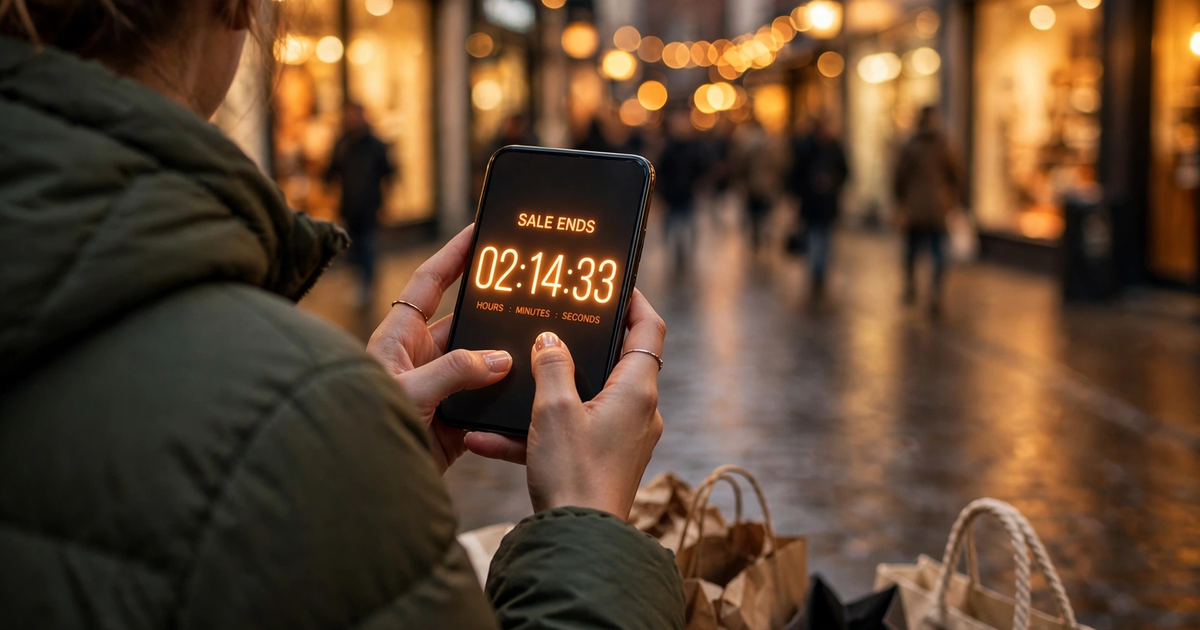
It is 11:47 on a Thursday night and a woman in Manchester has a television in her basket that she did not want this morning. She came online to check one price. A red banner says the deal ends in thirteen minutes. A line under the price says only three left in stock — Black Friday psychology, working exactly as designed. Below that, a small grey note says 214 people have viewed this item today. She knows her current television works and the price was probably lower last month. She buys it anyway — and then, at 11:52, she buys the soundbar, because it is “frequently bought together” and the discount only applies tonight. That is Black Friday psychology at work: the sale is built around six well-studied mental shortcuts, and in 2026 it is bigger, faster and more personalised than ever — yet the evidence says most of the “deals” are not deals at all.
I am an Industrial and Organizational Psychologist in Karachi, and I write about work and behaviour for a global reader. This article is built on primary sources read directly: Adobe’s 2026 holiday forecast, the National Retail Federation’s survey released on 19 November 2026, DHL’s 2026 eCommerce Trends Report covering 29,000 shoppers in 29 countries, a Which? price investigation, and a November 2026 report on Amazon’s advertised deals — plus the classic psychology research that explains why these tactics work. It is written for the person who will shop the sale this year and wants to keep the good deals while skipping the traps. The honest version of this story is not that Black Friday is a con. Some prices really do fall. It is that the sale is designed to make you buy first and check later — and the data shows that checking later usually comes too late.
“Sales like Black Friday often lead to impulsive shopping, motivated by FOMO (fear of missing out) and the satisfaction of picking up a bargain. Even if we want to hold back for environmental reasons or to save money, it’s hard to resist the sales hysteria; we may need the product later or regret not buying it now. A reduced price can also make us feel like the product has a higher value than usual.”
— Charlotte Bäccman, senior lecturer in psychology, Karlstad University
This guide covers the short answer, Black Friday 2026 in numbers, the six psychological levers the sale pulls, the deal illusion — what the price evidence actually shows — how AI changed the sale this year, what the morning after costs, and a shopper’s playbook that actually works.
🎯 Chapter 1: The short answer — Black Friday psychology, explained
Black Friday psychology is the set of mental shortcuts a big sale exploits: scarcity, loss aversion, anchoring, social proof, the thrill of a bargain, and time pressure. Adobe forecasts $275.1 billion in US online holiday spending in 2026, yet Which? found 83% of the deals it tracked were the same price or cheaper elsewhere.
That gap — between how the sale feels and what it actually delivers — is the whole subject of this article. The feeling is real. A countdown timer genuinely raises urgency, a “only 2 left” badge genuinely creates fear of missing out, and a crossed-out price genuinely makes the new price feel like a win. None of that is imaginary, and none of it means you are foolish for feeling it. These are normal features of how human minds judge value under pressure, documented in peer-reviewed research over fifty years. What is new in 2026 is the scale and the machinery around them: the sale now follows you onto your phone, learns what you looked at, and — for the first time — an AI assistant may be doing the comparing for you. The shopper who understands the six levers can still enjoy the sale. The shopper who does not will pay for it twice: once at the checkout, and once in the regret that follows.
📈 Chapter 2: Black Friday 2026 in numbers — the surge is real, and it is already here
Black Friday 2026 falls on Friday 27 November, with Cyber Monday on 30 November. A week before the day, the search data shows demand already climbing steeply. In the United States, Google Trends interest in “black friday 2026” sat at about 1 on the index in late August and reached 91.5 in the current partial week — roughly doubling in the past two weeks, with the worldwide index at 99.0. Searches for “Black Friday deals” more than doubled week on week, and the rising query “when do black friday deals start” is up 2,400%. Similarweb’s US search data tells the same story from a different angle: searches for “black friday deals” hit 80,600 in September 2026, up 418% from August, with the July-to-September total up 64.5% on the year before. The surge is not American only: the fastest-rising related queries worldwide ask when Black Friday is, in Swedish, Greek, Dutch, Spanish, French, Italian and Polish.
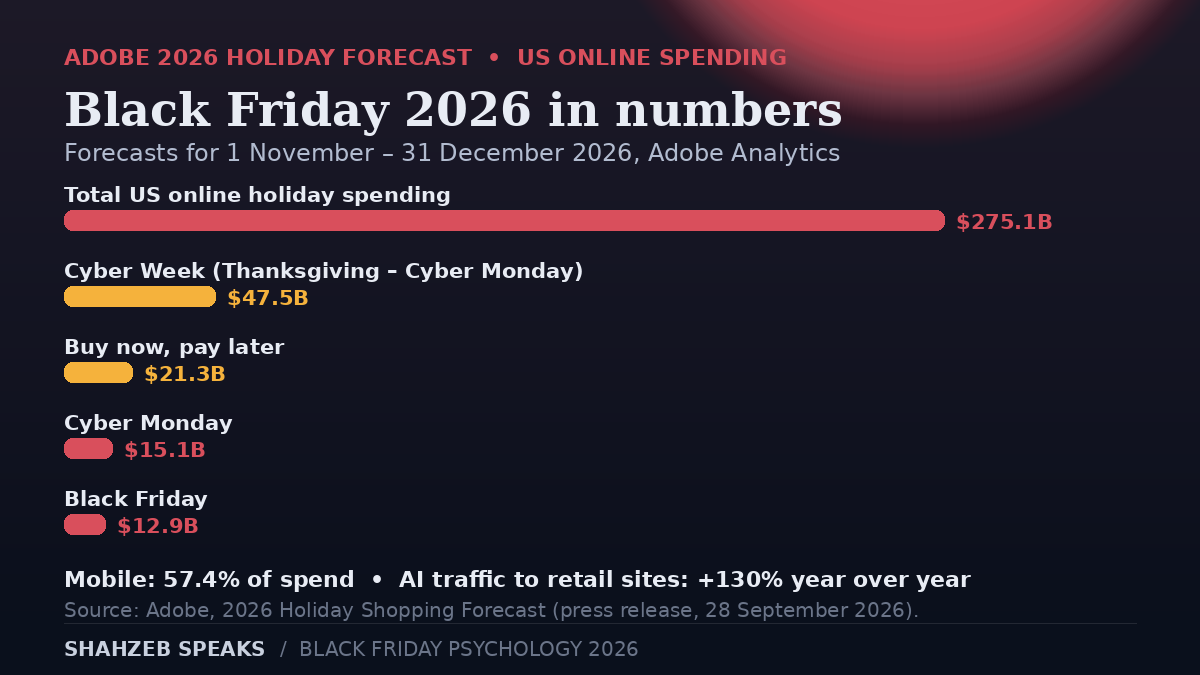
The spending forecasts match the search surge. Adobe’s 2026 holiday forecast, published on 28 September 2026 and based on more than a trillion visits to US retail sites, expects US online sales of $275.1 billion between 1 November and 31 December, up 6.7% on last year. Within that, Cyber Week — the five days from Thanksgiving to Cyber Monday — is forecast at $47.5 billion, up 7.4%, with Black Friday itself at $12.9 billion and Cyber Monday at $15.1 billion. More than half of all of it, 57.4%, is expected to happen on a mobile phone. And buy now, pay later is forecast to drive $21.3 billion of holiday spending, up 6.6%, with about 82% of it on mobile — a payment method that makes an impulse purchase feel painless, because the bill does not arrive for weeks.
The National Retail Federation’s survey, released on 19 November 2026, puts the human scale on those dollars. An estimated 182.7 million American consumers plan to shop over the Thanksgiving weekend, down slightly from 186.9 million in 2025, and about 126 million of them — 69% — expect to shop on Black Friday itself. The survey asked 7,956 adults between 30 October and 9 November, with a margin of error of ±1.1 percentage points. The NRF also forecasts November–December retail sales growing 4.2% to $1.013 trillion. The weekend is slightly smaller in headcount than last year, but the money is bigger — each shopper is expected to spend more.
| Black Friday 2026 — the scale | Figure | Source |
|---|---|---|
| US online holiday spending (1 Nov–31 Dec) | $275.1 billion (+6.7%) | Adobe, Sep 2026 |
| Black Friday online spend | $12.9 billion | Adobe, Sep 2026 |
| Cyber Monday online spend | $15.1 billion | Adobe, Sep 2026 |
| Buy now, pay later (Nov–Dec) | $21.3 billion (+6.6%) | Adobe, Sep 2026 |
| Mobile share of online spend | 57.4% | Adobe, Sep 2026 |
| US consumers planning to shop Thanksgiving weekend | 182.7 million | NRF, 19 Nov 2026 |
| Of them, expecting to shop on Black Friday | 126 million (69%) | NRF, 19 Nov 2026 |
One more number belongs in this chapter, because it explains why the sale feels so unavoidable. DHL’s 2026 eCommerce Trends Report, based on surveys of 29,000 shoppers in 29 countries and 5,800 businesses, found that only 41% of online shoppers actually buy during Black Friday — while 84% of e-commerce businesses run promotions. The sale is, in other words, louder than its audience. Nearly every shop is shouting, and fewer than half of shoppers are buying. That imbalance is exactly why the tactics have to be so aggressive: when almost everyone is discounting at once, the retailer that shouts loudest — the brightest banner, the shortest timer, the scarcest stock — wins the sale.
🧠 Chapter 3: The six levers — what the sale is actually pulling
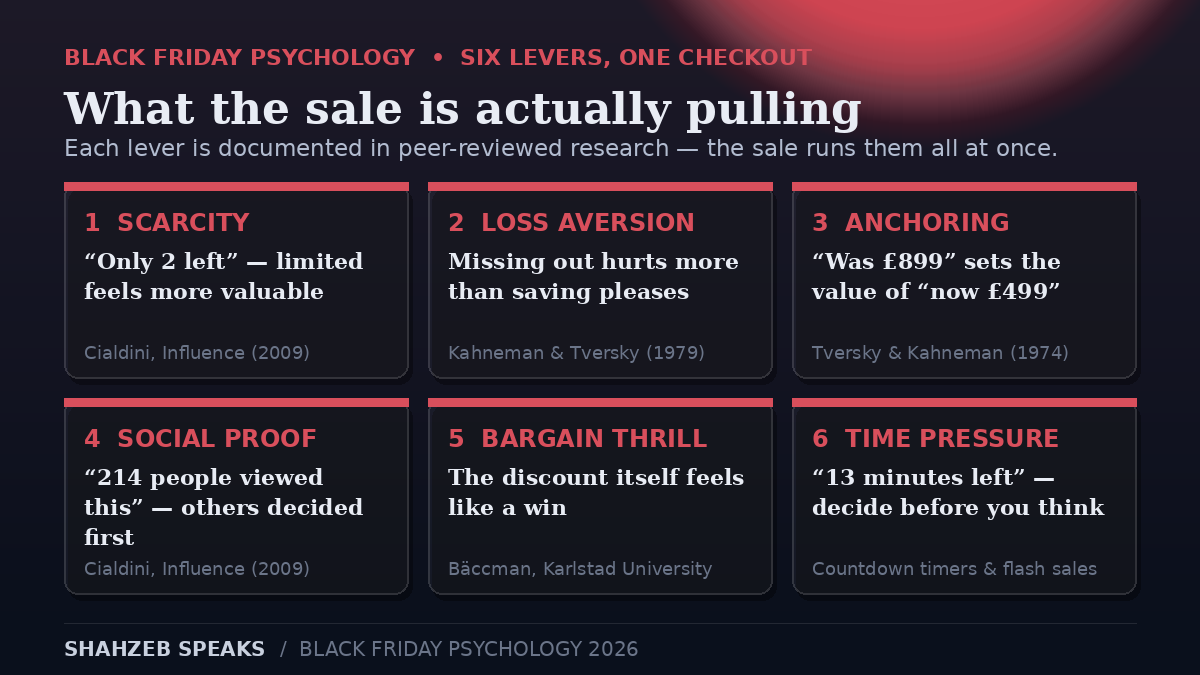
Black Friday does not rely on one trick. It stacks six, and each one is backed by research that long predates the sale itself. Knowing them by name is the cheapest protection there is, because a lever you can name is a lever you can notice while it is working on you.
1. Scarcity — “only 2 left”
Things feel more valuable when they are hard to get. Robert Cialdini documented scarcity as a persuasion principle in Influence (2009): limited availability increases desire, partly because scarcity signals quality and partly because it threatens our freedom to choose. A “only 2 left in stock” badge does both at once. It also creates competition — not with the shop, but with the invisible other shoppers who might take the last one. The honest question to ask is whether the scarcity is real. A doorbuster with forty units at one price is genuinely limited. A website badge that says “low stock” on a product the warehouse holds by the thousand is not.
2. Loss aversion — the pain of missing out
Losses hurt more than equal gains please. That is the core of prospect theory, established by Kahneman and Tversky in 1979 in Econometrica, and it is the engine of FOMO. A sale framed as “save £100” is pleasant. The same sale framed as “you will lose £100 if you wait” is urgent, because the mind weighs the loss more heavily than the gain. Countdown timers and “deal ends tonight” banners work on this lever: they convert a possible gain into a possible loss, and the loss is what moves you. Bäccman’s observation fits here exactly — shoppers buy because they “may need the product later or regret not buying it now”. The regret is imagined in advance, and the purchase is made to prevent it.
3. Anchoring — the crossed-out price
The first number you see shapes every number after it. Tversky and Kahneman showed in 1974, in Science, that people anchor on an initial value and adjust insufficiently from it — even when the anchor is arbitrary. A television shown as “was £899, now £499” feels like a £400 victory, whatever the television is actually worth. The anchor does the persuading; the sale price just collects it. This is why the crossed-out price is the most important number on the page, and why Chapter 4 spends so long on whether it is honest. For the wider story of how anchors steer choices, see my article on anchoring bias in marketing.
4. Social proof — “214 people viewed this today”
When we are unsure, we look at what others are doing. Cialdini’s second principle at work in the sale is social proof: “bestseller” badges, star ratings, view counts and “frequently bought together” suggestions all tell you that other people have already decided this is a good buy. It is a reasonable shortcut most of the year — other people’s choices do carry information. On Black Friday it is also the easiest lever to fake, because a view count or a “trending” badge costs the retailer nothing to display. The question is not whether other people bought it, but whether the number on the screen is a real count of real buyers. For the full picture, see my article on social proof: when it works and when it backfires.
5. The thrill of the bargain — the reward itself
Finding a bargain feels good in itself, separate from the product. Bäccman puts it plainly: a bargain “activates our reward system and offers temporary satisfaction. We feel that we’ve gotten ‘good value for money’.” That feeling is the product, in a sense — the purchase is the way to keep it. It also explains why a reduced price can make a product feel more valuable, not less: the discount is read as evidence of quality at a low price, rather than as a warning that the price was inflated. The trap is that the satisfaction is temporary, while the spending is permanent. The bargain high fades in days; the bank balance takes longer to recover.
6. Time pressure — decide now, think later
The final lever is the one that makes the other five work: time pressure. A countdown timer, a “deal ends in 13 minutes” banner, a flash sale — all of them compress the decision into a window too short for the careful thinking that would normally check the other five levers. Under time pressure, people rely more on mental shortcuts, which is exactly what the other levers are. This is why the most useful single habit in this article is also the simplest: give yourself time. A genuine deal on a product you actually want will usually still be there tomorrow, and the timer is the one part of the sale that is almost never telling the truth about urgency. For the wider pattern of how scarcity and urgency are engineered, see my article on scarcity marketing examples, and for why the fear of losing drives spending harder than the promise of gaining, my article on loss aversion in marketing.
🔍 Chapter 4: The deal illusion — most “deals” are not deals
Here is the chapter that should change how you shop the sale, because the price evidence is blunt. In 2025, the British consumer organisation Which? tracked the prices of 175 Black Friday deals on home, tech and health products over a full year. It found that 83% were the same price or cheaper at least once outside the sales period — and not one of them was at its cheapest on Black Friday itself. The sale, in other words, is often the autumn price in a new coat: the same number, louder packaging. The finding was covered by the Guardian on 25 November 2025 and by the BBC, and it is the single most useful fact in this article. Write down today’s price before the sale starts, and you will know on the day whether the deal is real.
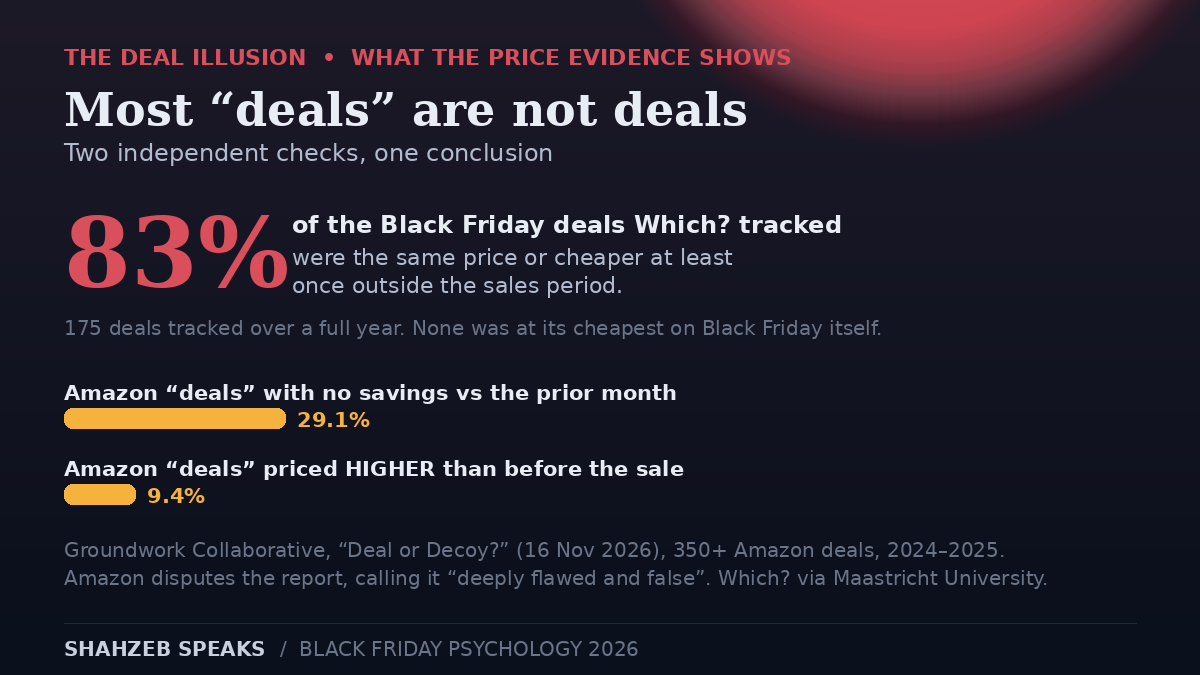
A second, newer check points the same way. On 16 November 2026, Groundwork Collaborative, a US research and advocacy organisation, published “Deal or Decoy?”, a review of more than 350 products Amazon itself promoted as deals during the Black Friday and Cyber Monday sales of 2024 and 2025. It found that 29.1% were priced the same or higher during the sale than in the month before it, and 9.4% were priced higher — actually more expensive on the sale day than in the weeks before. Looking back 90 days, the share offering no savings rose to nearly 60%. The examples are stark: an Apple Watch Series 10 advertised at $679.99 on Black Friday 2025 had cost $602 a month earlier; a pair of Hunter rain boots “on sale” at $126.99 had been $79.97 nine days before; men’s UGG Butte boots at $179.98 had been $98.40 four weeks earlier.
Amazon disputes the report, and fairness requires saying so. In a statement on 16 November, Amazon called the claims “deeply flawed and false”, said the 350 items were a tiny fraction of more than ten million deals, and said 98% of the products were at the same price or lower than the price over the prior 30 days. It also said some of the earlier lows were early-event deals and some items were never badged as deals in the store. Groundwork maintains that all the products came from Amazon’s own sale event pages. Both claims cannot be fully true at once, and a shopper cannot settle the dispute from the outside. But the dispute itself is instructive: even on Amazon’s own account, the defence is that the deals were no worse than the prior month’s price — not that they were better. And Which?’s year-long tracking, which Amazon’s statement does not address, found the same pattern across many retailers: the sale price is usually a price the product has already been sold at.
There is also a legal asymmetry worth knowing. In the European Union, a seller advertising a discount must calculate it from the lowest price it charged in the 30 days before the promotion. The United States has no comparable federal rule. A crossed-out price in the US can be a manufacturer’s suggested price, or a price charged months ago — which is why “was £899” tells you nothing on its own. The practical rule follows from all of this, and it is short: a deal is real when the price you pay is lower than what the same item cost in the weeks before, and the only way to know is a price you saw yourself, with a date. Price-history tools such as Keepa and CamelCamelCamel show the record for Amazon products, and the habit costs thirty seconds. For the psychology of why the crossed-out price works even when it is meaningless, see my article on the hidden psychology behind every purchase decision.
🤖 Chapter 5: AI changed the sale in 2026 — and shoppers are changing with it
The genuinely new thing about Black Friday 2026 is not the discounts. It is who is doing the shopping. DHL’s 2026 eCommerce Trends Report found that AI-assisted shoppers — people using AI to compare prices, find products and decide faster — are now the biggest buyers of the event: 50% of them bought during Black Friday, against 42% of traditional deal seekers, who were the least likely of twelve shopper profiles to buy at all. Almost nine in ten Black Friday shoppers, 88%, have used AI to compare prices or plan to, and 47% have already used AI to browse or buy. On the other side, 38% of e-commerce businesses now let shoppers browse or buy through AI. Adobe’s forecast agrees: AI traffic to US retail sites is forecast to rise 130% year over year this season, and AI-referred visits generated 83% more revenue per visit than other traffic in September, according to Adobe figures reported by Digital Commerce 360.
That shift cuts both ways. On the one hand, an AI assistant that compares prices across shops is the best defence against the deal illusion in Chapter 4 — it does in seconds the checking that takes a human half an hour, and it does not feel urgency. DHL’s own advice to retailers is telling: “Make sure your prices, product data and offers are visible wherever AI tools look for them.” The bargain hunt is becoming a machine-readable contest, and the shops that win are the ones whose real prices are easiest to check. On the other hand, the same tools can be steered. An assistant that ranks offers can be gamed, and a shopper who outsources the decision to an AI also outsources the judgement about whether the product is wanted at all. DHL found that 29% of shoppers globally would be willing to let AI make purchases for them within five years — 33% of Gen Z and 36% of millennials — which is a large share of the population handing over the one decision that matters most: whether to buy.
The generational split is the other new pattern. DHL found that 47% of Gen Z and 47% of millennials have made a Black Friday purchase, against 39% of Gen X and 30% of Baby Boomers, and 91% of Gen Z trust the offers and prices from retailers during seasonal shopping. Gen Z are also the most likely to be treating themselves, at 36%, while Baby Boomers are the most likely to shop early to spread the costs, also at 36%. And 41% of Gen Z plan to increase their Black Friday spending over the next five years, against 13% of Boomers. The sale is, increasingly, a young person’s event — which is also why it matters that younger shoppers report the highest regret rates, a finding Chapter 6 returns to.
One counterweight deserves a paragraph, because it complicates the story in a useful way. The impulsive shopper is not the whole story in 2026. YouGov research of more than 2,000 UK online shoppers found that 47% mainly buy products they had already planned to buy during major sale events, and only 9% say social media encourages them to add extra items, while 5% say AI recommendations encourage them to consider different products. KPMG’s UK survey of 3,000 people, reported on 9 November 2026, found the same careful streak: 77% are planning to shop or may be tempted, but 49% of them have delayed purchases specifically in the hope of seeing their target items reduced, and 94% of Irish shoppers in PwC’s 2026 survey said they check whether discounts offer genuine savings. A large part of the crowd is not being swept along. They are waiting, watching, and checking — and the sale rewards them more than it rewards the impulse buyer.
💸 Chapter 6: The morning after — what the sale costs when the thrill fades
The bill for Black Friday does not arrive on Black Friday. It arrives in the weeks after, and the evidence on what it looks like is consistent across countries. A SweepsPulse survey of 2,000 US adults, published on 5 November 2026, found that 43% of Black Friday shoppers regret at least one purchase within a week of buying it, and the average regretful shopper wastes $214 on items they never return, resell or use. The firm extrapolates that to roughly $19 billion in post-holiday waste — its own estimate, built by scaling the survey to the number of Thanksgiving-weekend shoppers, and worth treating as an illustration rather than a precise total. What is harder to argue with is the behaviour behind it: only 38% of shoppers who regretted a purchase actually returned it. The rest kept it, re-gifted it, sold it, or left it sitting unused with the tags on — 12% admitted the last one. Electronics and gadgets were the most regretted category at 34%, followed by clothing and shoes at 29% and kitchen appliances at 21%. When asked what pushed them into the purchase, shoppers pointed to countdown timers and aggressive messaging (36%) and the size of the advertised discount (31%). Only one in four compares prices before buying during a flash sale. And the youngest shoppers regret most: over half of 18- to 34-year-olds admitted to at least one purchase they regretted within the first month.
The pattern repeats wherever it is measured. In Australia, an AMP Bank GO survey of 1,003 adults found that 52% are more likely to make impulse purchases during sales, 40% spend more than they should during the Black Friday, Christmas and Boxing Day sales, and 29% set no budget at all. In Ireland, PwC’s 2026 survey found that 55% of shoppers made an unplanned purchase during last year’s Black Friday weekend, up from 37% the year before — impulse buying rising, not falling, even as shoppers say they check prices more carefully. And the debt side is visible in Adobe’s own forecast: buy now, pay later is expected to drive $21.3 billion of US holiday spending, most of it on mobile, where a purchase takes seconds and the instalments feel small until they stack up. Deloitte expects the average US household to spend $1,654 on the holidays this year, up 4%, while 79% of shoppers expect higher prices — spending more, in other words, while feeling poorer for it.
The psychology of the morning after is as well documented as the psychology of the sale. Leon Festinger’s theory of cognitive dissonance (1957) describes the discomfort we feel when our actions do not line up with our values — and the way we resolve it, usually by changing our attitudes rather than our behaviour. Bäccman describes exactly this in shoppers: “We make excuses for a purchase by arguing that it was a ‘bargain’, or using compensatory thoughts — we ride our bike to work, or that the product has already been produced and therefore it won’t affect the environment as much.” The bargain story is the excuse that lets the purchase stand. Knowing that in advance is useful, because the test of a purchase is not how it feels on the night. It is how it feels a week later, when the timer has gone and the box is still unopened.
🛡️ Chapter 7: The shopper’s playbook — seven moves that actually work
None of this means skipping Black Friday. Some prices really do fall, and a planned purchase at a genuine discount is a real win. The aim is to buy the wins and skip the rest, and the moves below are the ones the evidence supports — including the advice of the psychologist who studies exactly this.
1. Make the list before the sale starts
Bäccman’s first tip is the most important: “Make a list of things that you really need, not just things that you want to buy but don’t actually need. Focus on quality and function.” Write it on paper, not in an app that can show you “recommended” extras. On the day, you buy from the list. Everything else is a decision for later — and later, the sale will have ended, which is the point.
2. Write down today’s price, with a date
For every item on the list, note the price you can buy it for right now, before the sale. On Black Friday, compare the sale price with your note, not with the crossed-out price on the screen. If the sale price is not lower than your note, it is not a deal. Price-history tools such as Keepa and CamelCamelCamel do the same job for Amazon products, and they take seconds.
3. Wait 24 hours on anything not on the list
Time is the one thing the whole architecture cannot function without. A countdown timer works by removing the pause in which you would check the price, the need and the budget. Put the item in the basket and walk away. If you still want it tomorrow, and the price is genuinely lower than your note, buy it then. Most of it will still be for sale — and the Which? evidence says it will probably be the same price again before Christmas anyway.
4. Set the budget in money, not in discounts
“I will save £200” is not a budget; it is a permission slip, because every purchase “saves” money on paper. Set a spending limit in pounds — the most you will spend in total — and stop when you reach it. Remember that 29% of Australian shoppers in the AMP survey set no budget at all, and they are the group most likely to overspend. A budget written down before the sale is worth more than willpower during it.
5. Treat buy now, pay later as debt, because it is
Instalments make a £400 purchase feel like four £100 decisions, and the fourth one is months away. Add up the total of everything you buy on instalments, and ask whether you would have bought it all if the full amount left your account today. If the answer is no, the payment method is doing the persuading, not the price.
6. Check the seller, not just the price
DHL’s research adds a lever shoppers forget: delivery. One in three Black Friday shoppers is most likely to abandon a purchase at the shipping-options stage, 81% would abandon without their preferred delivery options, and 77% would not shop with a brand if they did not trust its delivery or returns provider. A cheap price from a seller with slow delivery and no returns is not a bargain; it is a risk. Check the returns policy before you check the discount.
7. Ask Bäccman’s question: do I love it?
Her bonus tip is the simplest test in this article: if the item meets an actual need, offers good value, is good quality and fits with the rest of your home or wardrobe, ask yourself one question — “Do I love it?” If the answer is a pause rather than a yes, close the tab. The sale will be back next year. The money will not.
❓ Questions I am asked most often
Why do people overspend on Black Friday?
Because the sale stacks six psychological levers at once: scarcity, loss aversion, anchoring on the crossed-out price, social proof, the thrill of a bargain and time pressure. Each one is a normal mental shortcut, and together they push people to decide before they have checked the price, the need or the budget.
Are Black Friday deals real?
Some are, but many are not. Which? tracked 175 Black Friday deals over a full year and found 83% were the same price or cheaper at another time, and none was cheapest on Black Friday. Groundwork found 29.1% of Amazon’s advertised deals offered no savings against the prior month. Check the price history, not the badge.
How do I stop impulse buying on Black Friday?
Make a list of things you actually need before the sale, write down today’s price for each item, and set a total spending limit in money. On the day, buy only from the list, and wait 24 hours on anything else. The timer is designed to remove the pause in which you would think — so put the pause back.
Is Black Friday cheaper than other sales?
Not reliably. The Which? evidence shows most Black Friday prices recur at other times of year, and Bäccman advises considering whether it is worth waiting until the December sales after Christmas, when prices tend to be even lower. A price you noted yourself, with a date, is the only reliable comparison.
What is the psychology behind Black Friday?
Black Friday psychology is the use of scarcity, loss aversion, anchoring, social proof, reward and time pressure to speed up buying decisions. The mechanisms come from classic research — Kahneman and Tversky on loss aversion (1979), Tversky and Kahneman on anchoring (1974), Cialdini on scarcity and social proof — applied at industrial scale, on one weekend, to millions of shoppers at once.
When is Black Friday 2026?
Black Friday 2026 falls on Friday 27 November 2026, with Cyber Monday on 30 November. Search interest in the US roughly doubled in the two weeks before 20 November, and Adobe forecasts $275.1 billion in US online holiday spending between 1 November and 31 December 2026.
If the way you buy, decide and regret is the part of your work or life you want to understand better, that is what I do. I am an Industrial and Organizational Psychologist, and I work with people and teams on decision-making, work design and the measurement of behaviour. Get in touch here.
If you want the wider context, start with my guide to industrial psychology in Pakistan and my article on the psychology behind why people buy. For the specific tactics in more depth, see scarcity marketing examples, loss aversion in marketing and decoy effect examples.
Sources
- Adobe (2026). Adobe: U.S. Holiday Shopping Season to Hit Record $275.1 Billion Online, Rising 6.7% YoY (press release, 28 September 2026). https://news.adobe.com/news/2026/09/adobe-us-holiday-shopping-season-to-hit-record
- National Retail Federation (2026). 183 Million Consumers Expected to Shop During Thanksgiving Weekend (press release, 19 November 2026). https://nrf.com/media-center/press-releases/183-million-consumers-expected-to-shop-during-thanksgiving-weekend
- DHL eCommerce (2026). The New Formula for Black Friday — 2026 Black Friday Trends Report. https://www.dhl.com/global-en/microsites/ec/ecommerce-insights/insights/reports/2026-black-friday-trends.html
- Which? (2025). Black Friday deals price investigation, as reported by Maastricht University and The Guardian (25 November 2025). https://www.maastrichtuniversity.nl/news/black-friday-real-bargain-or-autumn-sale-new-coat-0
- Groundwork Collaborative (2026). Deal or Decoy? Amazon’s Deceptive Discounts (report, 16 November 2026). https://groundworkcollaborative.org/work/amazon/
- Digital Trends (2026). Amazon’s crossed-out prices might be the biggest lie in your Black Friday cart (18 November 2026). https://www.digitaltrends.com/business/amazons-crossed-out-prices-might-be-the-biggest-lie-in-your-cart-this-black-friday/
- Karlstad University (2024). Black Friday: Researcher shares top tips to avoid sales hysteria and promote sustainable consumption (published 22 November 2024, updated 14 April 2026). https://www.kau.se/en/news/black-friday-researcher-shares-top-tips-avoid-sales-hysteria-and-promote-sustainable
- SweepsPulse (2026). Americans Waste $19 Billion on Black Friday Purchases They Later Regret (GlobeNewswire, 5 November 2026). https://rss.globenewswire.com/news-release/2026/11/05/3396789/0/en/americans-waste-19-billion-on-black-friday-purchases-they-later-regret.html
- Similarweb (2026). Black Friday 2026 Early Signals in US Electronics. https://www.similarweb.com/blog/daas/data-analysis/black-friday-2026-us-electronics/
- Kurums (2026). Black Friday 2026: A Final-Week Briefing for Online Sellers (20 November 2026). https://kurums.com/black-friday-2026-online-sellers-final-week-briefing/
- PwC Ireland (2026). Black Friday survey, as reported by ThinkBusiness (16 November 2026). https://www.thinkbusiness.ie/articles/black-friday-ireland-pwc-shopping-survey-2026/
- KPMG UK (2026). Black Friday 2026 survey, as reported by Retail Bulletin (9 November 2026). https://www.theretailbulletin.com/general-merchandise/black-friday-2026-half-of-shoppers-delay-purchases-in-hope-of-discounts-09-11-2026/
- AMP Bank GO (2025). Black Friday blowouts: impulse sales spending leads to buyers’ remorse for 40% of Aussies (Dynata survey, October 2025). https://www.amp.com.au/about-amp/news/2025/november/Black-Friday-blowouts–impulse-sales-spending-leads-to-buyers–remorse-for-40–of-Aussies
- YouGov / Paxon (2026). Black Friday shoppers: almost half plan purchases in advance, as reported by Home of Direct Commerce. https://homeofdirectcommerce.com/news/black-friday-shoppers-plan-purchases/
- Kahneman, D., & Tversky, A. (1979). Prospect theory: An analysis of decision under risk. Econometrica, 47(2), 263–291.
- Tversky, A., & Kahneman, D. (1974). Judgment under uncertainty: Heuristics and biases. Science, 185(4157), 1124–1131.
- Cialdini, R. B. (2009). Influence: Science and Practice (5th ed.). Pearson.
- Festinger, L. (1957). A Theory of Cognitive Dissonance. Stanford University Press.