
It is 2:14 in the morning and a final-year student in Leeds is refreshing a graduate jobs portal for the fourth time tonight. Nothing has changed since 2:07. She knows nothing will change before morning. She also knows that, and she refreshes again anyway — because the not-knowing is worse than any answer the portal could give her. That feeling has a name in psychology: intolerance of uncertainty. And a study published this week in JAMA Psychiatry shows it has been rising in young adults for thirty years — and rising about three times faster since 2012.

I am an Industrial and Organizational Psychologist in Karachi, and I write about work and behaviour for a global reader. This article is built on primary sources read directly: the JAMA Psychiatry study itself, published on 18 November 2026, the Columbia University release that announced it, the American Psychological Association’s Stress in America 2026 survey, and the meta-analyses that connect intolerance of uncertainty to anxiety and to treatment. It is written for the student waiting on results, the graduate waiting on a job, and the employee waiting on a contract decision — and for anyone who has noticed that waiting has become harder than it used to be.
“IU is not itself a health outcome or a root cause of disease, but an intermediary cognitive process that contributes to the development of anxiety.”
— Katherine M. Keyes, professor of epidemiology, Columbia University Mailman School of Public Health
This guide covers the short answer, the study behind the headline, what intolerance of uncertainty actually is, why it matters for anxiety, why it rose after 2012, what the treatment evidence really shows, and a playbook for students and employees who want to get better at living with not knowing.
🎯 Chapter 1: The short answer — intolerance of uncertainty, explained
Intolerance of uncertainty is the distress you feel when an outcome is unknown, and it has risen in young adults. A JAMA Psychiatry meta-analysis of 138 studies and 35,296 US and Canadian students found scores climbing about 0.65 points a year since 1992, and three times faster after 2012. It is a driver of anxiety, but it can be changed.
That is the whole article in sixty words, but the details matter, because this is not a story about young people being fragile. Intolerance of uncertainty — IU for short — is a measurable trait, not a complaint. It predicts anxiety, it predicts worry, and it predicts the small behaviours that quietly run a life: the constant checking, the postponed decisions, the plans that never get made because the outcome cannot be guaranteed in advance. The new study does not say young adults invented a new problem. It says an old one has been getting measurably worse, on a timetable that lines up with the arrival of the smartphone, and that the rise is real enough to show up even in a measure most people have never heard of.
📈 Chapter 2: The study in numbers — thirty-one years, 35,296 students
The study, published on 18 November 2026 in JAMA Psychiatry, is a temporal meta-analysis — a study of studies, arranged by year, so the authors could watch a psychological trait move through time. The team, led by Jeroen van Baar at Boston University’s School of Public Health and Katherine Keyes at Columbia University’s Mailman School of Public Health, searched the Web of Science database for peer-reviewed studies of college students in the United States and Canada published between 2007 and 2025. After screening nearly 300 full-text articles, they kept 138 studies covering 35,296 participants, all of whom had completed either the 27-item or the 12-item Intolerance of Uncertainty Scale. The work was funded by the US National Institute of Mental Health, and the authors declared no financial conflicts of interest.
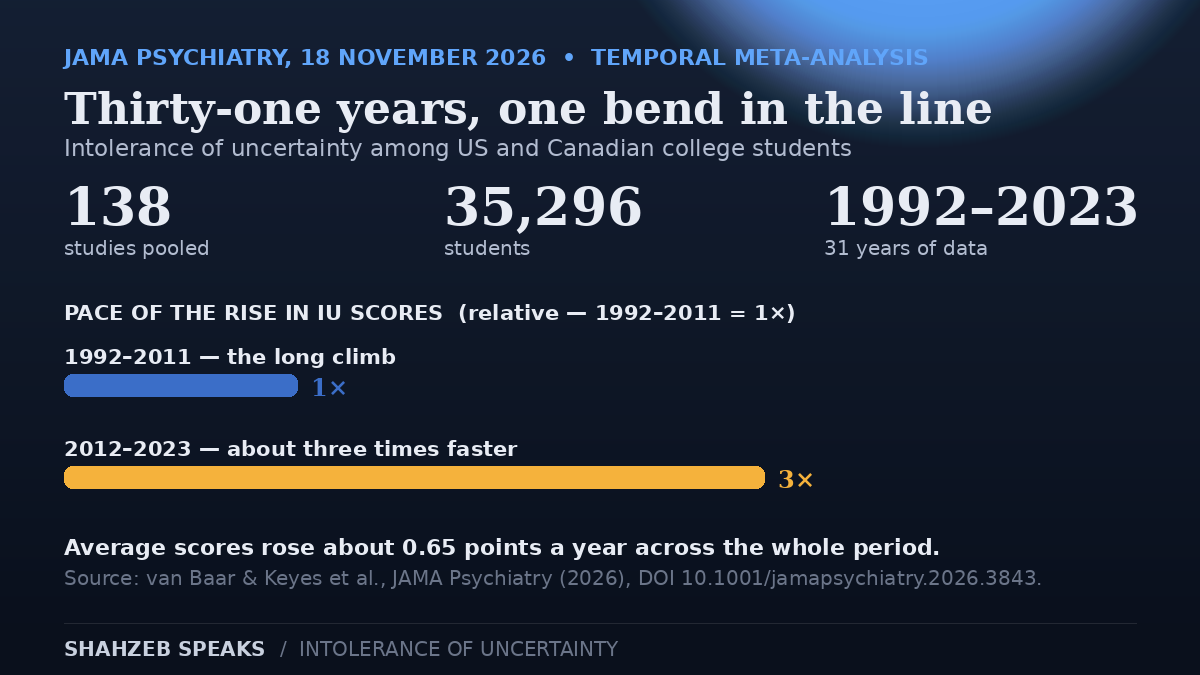
The headline finding is simple. Average IU scores rose by about 0.65 points a year from 1992 through 2023. But the rise was not steady: it ran about three times faster between 2012 and 2023 than it had between 1992 and 2011. Something bent the curve around 2012, and the bend is the most interesting part of the paper — Chapter 5 comes back to what might explain it, and what the study cannot prove about it.
Two features of the design deserve a paragraph, because they are what make this study harder to dismiss than the usual single survey. First, the sample is large and long: 138 studies over three decades is not one campus in one year. Second, intolerance of uncertainty is an unfamiliar idea outside psychology. That matters because of a fair objection to most research on rising anxiety: perhaps young people only report more anxiety because they now have the words for it. Van Baar answers that objection directly. Young people are now more familiar with terms like “anxiety”, he notes, so they may report symptoms more readily even if their feelings have not changed. But intolerance of uncertainty “remains a relatively unfamiliar concept outside psychology, making this study less vulnerable to that criticism”. Keyes makes the same point from the other side: the fact that IU rose steadily, mirroring the trends in anxiety and mood symptoms, “suggests these patterns are unlikely to be explained solely by greater mental health awareness and may instead reflect genuine changes in underlying mental health”.
The limits are real too, and the honest version of this story includes them. The study covers college students in the United States and Canada only. It cannot say the same rise happened among non-students, older adults, or young people in other countries. It is built on published studies, so it inherits whatever those studies got wrong. And it documents a rise without proving what caused it. None of that makes the finding small. A trait that tracks anxiety this closely, rising this steadily, in 35,296 people, is worth taking seriously.
🧠 Chapter 3: What intolerance of uncertainty actually is
Intolerance of uncertainty is the tendency to react badly — emotionally, cognitively and behaviourally — to situations where important information is missing or the outcome is unknown. It is not the same as disliking risk. A person can enjoy a gamble and still be unable to sit with an unanswered email. The discomfort is about the gap itself: the mind wants the answer now, and treats the absence of one as a threat.
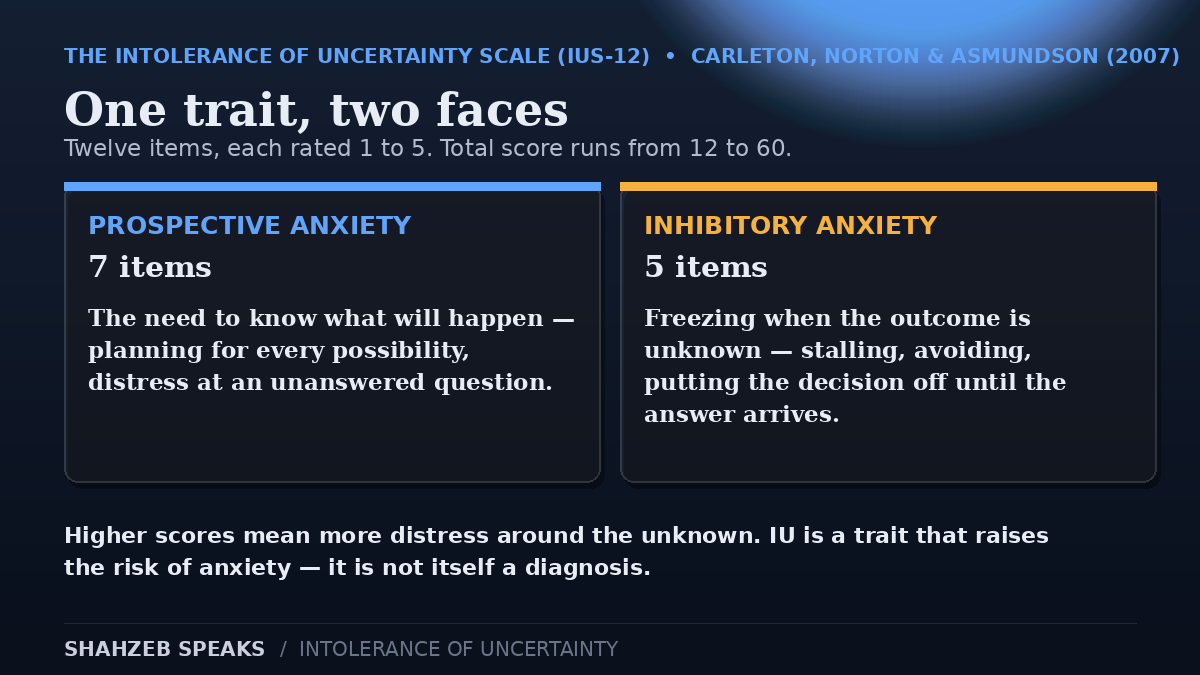
Researchers measure it with the Intolerance of Uncertainty Scale. The original, developed in French by Freeston and colleagues in 1994 and validated in English by Buhr and Dugas in 2002, has 27 items. The short form most studies use today, the IUS-12, was validated by Carleton, Norton and Asmundson in 2007 and has 12 items, each rated from 1 (“not at all characteristic of me”) to 5 (“entirely characteristic of me”), giving a total score from 12 to 60. The short form has two faces, and they describe two different ways the trait shows up. Prospective anxiety, seven items, is the forward-looking side: the need to know what will happen, the urge to plan for every possibility, the distress of an unanswered question. Inhibitory anxiety, five items, is the freezing side: the sense that uncertainty makes it impossible to act at all, so the person stalls, avoids, or puts the decision off until the answer arrives on its own.
Both faces will be familiar to anyone who has watched a student or an employee deal with an uncertain outcome. Prospective anxiety is the student who checks the portal four times a night and reads the same job description ten times looking for a clue. Inhibitory anxiety is the graduate who does not apply at all, because applying means waiting, and waiting means weeks of not knowing. The first looks like over-activity; the second looks like laziness. Both are the same trait, doing its work in different directions. And both are expensive: the first costs sleep and attention, the second costs opportunities that never get pursued.
It is worth saying plainly what IU is not. It is not a diagnosis. Nobody is diagnosed with intolerance of uncertainty, and a high score does not mean a person has an anxiety disorder. It is a vulnerability — a way of reacting that makes anxiety more likely when life is uncertain, in the same way that a thin roof makes a house more likely to leak when it rains. The rain still matters. The roof is what you can work on.
🔗 Chapter 4: Why it matters — the anxiety connection
The reason a rise in IU should concern anyone is how tightly it is tied to anxiety. The best summary of that link is a 2011 meta-analysis by Gentes and Ruscio in Clinical Psychology Review, which pooled the evidence across studies and found that IU shared a mean correlation of .57 with symptoms of generalised anxiety disorder, .53 with major depression and .50 with obsessive-compulsive disorder. A correlation of .57 is large by the standards of psychology: it means the two things move together closely enough that knowing one tells you a great deal about the other. A later meta-analysis by McEvoy and colleagues in 2019, pooling 181 studies and 52,402 participants, found the same pattern of moderate associations between IU and symptoms across disorders, with an overall correlation of .51. The pattern also appears early: a meta-analysis of 31 studies of children and adolescents found that IU accounted for 36% of the variance in anxiety and nearly 40% in worry.
Those numbers describe the trait. The American Psychological Association’s Stress in America 2026 survey describes what it feels like to live inside the world that produces it. The survey, conducted by the Harris Poll among 3,132 US adults between 29 July and 24 August 2026, is titled “The stress of uncertainty” — and its findings read like a portrait of a population that has stopped expecting certainty and started organising its life around its absence.
| Stress in America 2026 — living with uncertainty | Figure | Source |
|---|---|---|
| “Have become accustomed to living with uncertainty” | 68% | APA, Oct 2026 |
| “Stress is just something I have to live with” | 72% | APA, Oct 2026 |
| Put their futures on hold in the past year | 26% | APA, Oct 2026 |
| Ages 18–29 who delayed future planning | 34% | APA, Oct 2026 |
| Little or no control over their future (up from 23% in 2025) | 28% | APA, Oct 2026 |
| Ages 18–29 naming anxiety or fear as a barrier to their goals | 41% | APA, Oct 2026 |
| Ages 18–29 who lowered expectations for what they could achieve | 66% | APA, Oct 2026 |
The two findings belong together. The JAMA Psychiatry study shows the trait rising; the APA survey shows the behaviour that follows from it. One in four American adults put their futures on hold in the past year — 17% stopped planning for the future entirely, and 16% delayed major life decisions such as changing careers, buying a home or having a child, because of stress, uncertainty or feeling overwhelmed. Among adults aged 18 to 29, the figure for delayed planning was 34%, and 41% named anxiety or fear as a barrier standing between them and their goals, against 27% of adults overall. Two-thirds of the youngest adults had lowered their expectations for what they could achieve in life. That is inhibitory anxiety, measured at the scale of a country.
For students and employees, the connection is direct. A student who cannot tolerate uncertainty does not simply feel worse before an exam; she revises differently, avoids the questions she cannot predict, and puts off applications until the deadline forces her hand. An employee who cannot tolerate uncertainty does not simply worry about a restructuring; he stops raising his hand for the project whose outcome he cannot guarantee, and he reads every vague email from his manager as a signal. The trait does its damage quietly, through the decisions that do not get made. For the wider picture of how inner resources protect people at work, see my article on psychological capital at work, and for the specific fear that your skills will not survive the next change, my article on capability anxiety.
📱 Chapter 5: Why it rose after 2012
The bend in the curve around 2012 is the part of the study that invites the most speculation, so it is the part that needs the most care. The authors list several societal changes that “may all contribute” to the rise: increased smartphone and social media use, greater academic pressure, loneliness, economic instability, childhood adversity, and the COVID-19 pandemic. Read that sentence again, because the wording is doing careful work. “May contribute” is not “caused”. The study was not designed to test any of these explanations, and none of them is proven by it. What the study does show is the timing: the acceleration began around the year smartphones became something most young adults carried everywhere, and the years since have added academic pressure, a pandemic, and an economy in which a degree no longer guarantees what it once did.
Van Baar’s own framing is more useful than any single cause. “It is likely that these factors are intertwined and mutually reinforcing,” he says, “jointly contributing to population-level increases in intolerance of uncertainty and anxiety among young adults. Any explanation will be strongest if it accounts for both the long-term upward trend since the 1990s and the inflection point observed around 2012.” That is a high bar, and it rules out the simple stories. A phone alone does not explain a rise that began before the phone. A pandemic alone does not explain a rise that was already accelerating years before it. The honest account is a pile-up: more to be uncertain about, more channels delivering the uncertainty in real time, and fewer of the quiet stretches in which a person used to sit with not knowing and discover that nothing terrible happened.
There is one mechanism in that pile-up that deserves a closer look, because it connects directly to something readers can change. A phone that answers every question instantly trains the expectation that every question has an instant answer. When the answer does not exist yet — a result, a reply, a decision — the gap feels wrong in a way it did not feel twenty years ago, when waiting was simply what life involved. That is a plausible mechanism, not a proven one, and I am marking it as such. But it fits the shape of the data: a trait defined by distress at missing information, rising fastest in the years when missing information became something you could almost always fix with a search. For the evidence on what two weeks away from a phone actually does, see my article on digital detox; for the anxiety that new technology itself stirs up, my article on the psychology of AI anxiety.
One more caution belongs here. The study cannot rule out that part of the rise reflects how students are selected into the studies themselves, or how the scale performs across generations. And the 2012 bend could partly reflect the studies published after that year being different in some way from the ones before it. The authors’ design — a temporal meta-analysis of published work — is the best available way to watch a trait move across decades, but it is still an indirect window. The finding is strong. It is not the last word.
🛠️ Chapter 6: What actually helps — the treatment evidence, honestly stated
The encouraging part of this story, in Keyes’s words, is that “effective interventions to reduce IU already exist for people with anxiety and mood disorders”. The evidence for that claim is real, but it is mixed in a way that matters, and this chapter reports both sides.
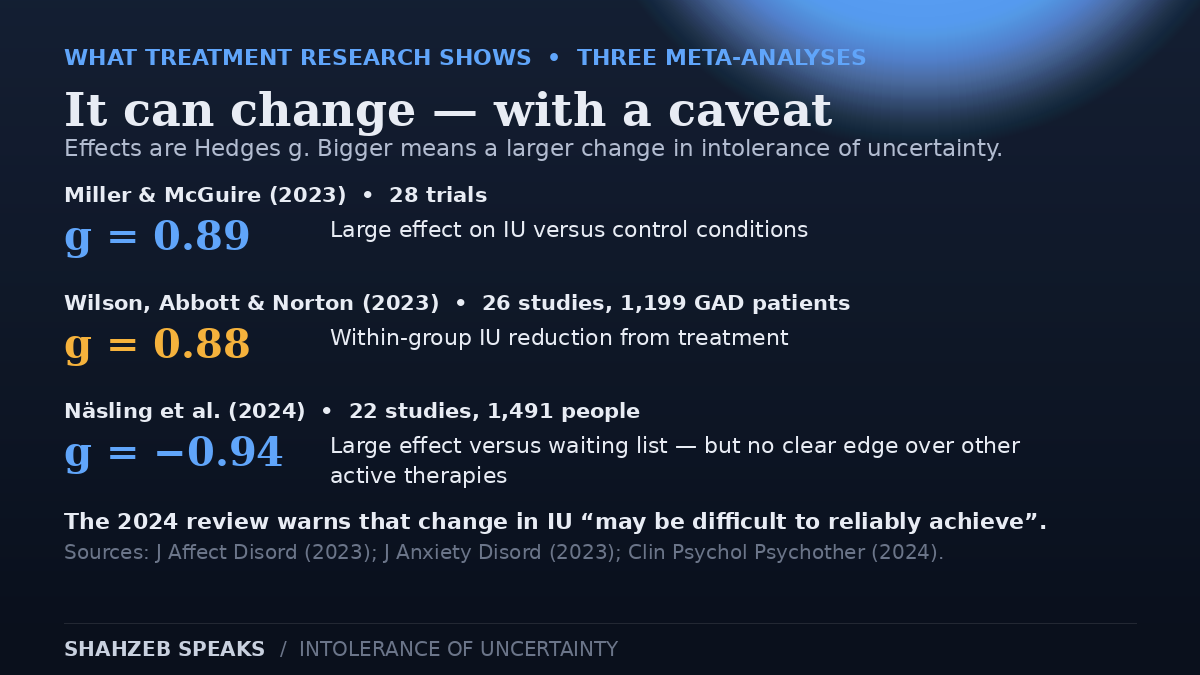
The strongest result comes from Miller and McGuire’s 2023 meta-analysis in the Journal of Affective Disorders, which pooled 28 randomised controlled trials of evidence-based treatments for anxiety-related disorders. Across those trials, the treatments showed a large effect on intolerance of uncertainty compared with control conditions (Hedges g = 0.89), and improvements in IU lined up with improvements in symptoms — accounting for 36% of the variance in how much symptoms improved. That is the finding that supports Keyes’s optimism: when IU moves, anxiety moves with it.
A 2023 review focused on generalised anxiety disorder tells a similar story with a useful detail. Wilson, Abbott and Norton pooled 26 studies covering 1,199 adults with GAD and found a large within-group effect on IU from before to after treatment (g = 0.88), alongside large reductions in worry, anxiety and depression. Their subgroup analysis found that cognitive behavioural therapy which directly targeted intolerance of uncertainty — CBT-IU — worked better than general CBT at reducing IU and worry immediately after treatment, though the advantage did not hold at follow-up. The ingredients of that targeted treatment are worth naming, because they are also the ingredients of the playbook in the next chapter: making predictions about what will happen and how bad it will feel, then testing those predictions with small behavioural experiments, and comparing what actually happened with what was feared. Dugas and colleagues tested a version of this in 2022: twelve weekly sessions built around predictions and experiments, for 60 adults with GAD, and the treatment group improved more than a waiting-list group.
Now the caveat, because it changes what a reader should expect. A 2024 systematic review and meta-analysis by Näsling and colleagues, covering 22 studies and 1,491 participants, found a large pooled effect on IU against passive controls such as waiting lists (g = −0.94) — but no significant effect when psychotherapy was compared with other active treatments, and significant variation between studies. The authors concluded that changes in IU “may be difficult to reliably achieve in psychotherapy” and that more research is needed on what actually drives the change. Put plainly: therapy helps, and targeting uncertainty directly helps more, but the advantage over other good therapies is not yet proven, and the field does not fully understand which ingredient does the work. That is not a reason to skip treatment. It is a reason to be wary of anyone selling a quick fix for uncertainty, and a reason to value the slower, testable approach: small experiments, honest predictions, and a record of what actually happened.
One thing the treatment literature does agree on is what does not help. Reassurance-seeking — asking the same question of five people, checking the same portal four times a night — brings relief that lasts minutes and keeps the trait in place, because each check teaches the mind that uncertainty is something to escape rather than something to survive. Avoidance works the same way. The student who does not apply never learns that waiting is survivable; the employee who does not ask never learns that a vague answer is not a bad one. The way out is not to feel certain. It is to collect evidence that uncertainty is bearable — and that evidence only comes from staying in it.
✅ Chapter 7: A playbook for students and employees
None of the moves below is a treatment, and none of them replaces professional help if uncertainty is stopping you from living your life. They are the practical form of what the research supports: small, deliberate contact with not knowing, recorded honestly, so the mind can update its estimate of how dangerous the gap really is.
1. Give every decision a deadline, in writing
Uncertainty expands to fill the time you give it. Before you start researching a choice — a course, a job, a move — write down the date you will decide, and the two or three facts that would change the decision. When the date arrives, decide on the facts you have. A deadline does not remove the uncertainty. It removes the extra weeks of it that were never going to add information.
2. Run one small experiment a week
Pick something uncertain and small: send the email without re-reading it three times, submit the application before you feel ready, ask the question in the meeting without knowing the answer in advance. Before you do it, write down what you expect to happen and how bad you expect it to feel, on a scale of 0 to 10. Afterward, write down what actually happened and how bad it actually felt. Keep the record. After a month, the gap between the two columns is your evidence — and it is usually large. This is the behavioural experiment from the treatment literature, shrunk to a size you can run yourself. For why decisions feel so draining in the first place, see my article on decision fatigue.
3. Separate what you control from what you do not
Draw two columns. In the first, everything about the situation you can actually influence: the quality of the application, the hours of preparation, the email you send. In the second, everything you cannot: the date of the reply, the number of other applicants, the mood of the person deciding. Work only from the first column. The second column is not a problem to solve; it is weather. Reading it as a problem is the trait talking.
4. Put a limit on checking
Checking feels like doing something. It is usually the opposite: it is a way of not doing the thing that matters. Decide in advance how often you will check — once a day, at a set time — and keep the phone face-down outside that window. The first week is uncomfortable, and that discomfort is the point: it is the feeling of tolerance being built. If the urge is strong, write down what you are afraid will happen if you do not check, and check the prediction a day later. It almost never happens.
5. Ask the question you would ask if you already knew
When a decision is stuck, try this: imagine the answer came back exactly as you hope, and ask what you would do next. Then imagine it came back badly, and ask the same question. Most of the time, the next step is the same in both versions — prepare the same way, apply to the same places, have the same conversation. If the next step does not change, the waiting is not protecting anything, and the decision can be made now.
6. Name the worst case, in numbers
Vague dread is always worse than a specified fear. “What if it all goes wrong” has no size and no end. Write the specific version: what actually happens, what it would cost, how long it would take to recover, what you would do on the first day after. Most worst cases, written down, turn out to be survivable and specific — a lost month, a bruised application round, a conversation you would rather not have. A fear with a number on it can be planned for. A fear without one can only be obeyed.
7. Know when to get help
If uncertainty is stopping you from applying, sleeping, eating, or leaving the house — or if worry has become the main activity of your days — that is beyond a playbook. A psychologist can work with you directly on intolerance of uncertainty, and the evidence in Chapter 6 says that work can help. There is no prize for managing this alone, and asking for help is itself a small experiment in tolerating the unknown: you do not know how it will go, and you go anyway.
❓ Questions I am asked most often
What is intolerance of uncertainty?
It is the distress you feel when an outcome is unknown or important information is missing. Researchers measure it with a 12-item questionnaire, the IUS-12, scored from 12 to 60. High scorers feel threatened by ambiguity itself, not just by bad outcomes. It is a trait that raises the risk of anxiety, not a diagnosis.
Is intolerance of uncertainty the same as anxiety?
No, but they are closely linked. Intolerance of uncertainty is a way of reacting to the unknown; anxiety is the emotional state that often follows. A 2011 meta-analysis found IU correlated .57 with generalised anxiety symptoms, .53 with depression and .50 with obsessive-compulsive symptoms. Think of IU as the soil and anxiety as what grows in it.
Why is intolerance of uncertainty rising in young adults?
A JAMA Psychiatry meta-analysis of 138 studies and 35,296 students found IU rising since 1992, about three times faster after 2012. The authors list smartphones, social media, academic pressure, loneliness, economic instability and the pandemic as possible contributors — not proven causes. The rise is real; the explanation is still open.
Can intolerance of uncertainty be changed?
Yes, and the evidence is encouraging but honest. A 2023 meta-analysis of 28 trials found a large treatment effect on IU (g = 0.89). But a 2024 review found no clear advantage over other active therapies, and the authors warn change can be hard to achieve reliably. Therapy helps; no quick fix is proven.
How do I know if I have high intolerance of uncertainty?
Look at the behaviour, not a score. Do you check the same thing repeatedly, put off decisions until the answer arrives on its own, or need to know exactly what will happen before a class or a social event? Those are the signs the researchers describe. A psychologist can measure it formally with the IUS-12 if it is interfering with your life.
What should I do if uncertainty is stopping me from deciding?
Set a written decision deadline and the two or three facts that would change the choice, then decide on what you have. Run small experiments: act before you feel ready, predict how bad it will feel, and record what actually happens. If worry is stopping you from sleeping, working or applying, speak to a licensed mental health professional.
If the way you decide, wait and worry is the part of your work or life you want to understand better, that is what I do. I am an Industrial and Organizational Psychologist, and I work with people and teams on decision-making, work design and the measurement of behaviour. Get in touch here.
If you want the wider context, start with my guide to industrial psychology in Pakistan and my article on psychological capital at work. For the specific pressures in more depth, see capability anxiety at work, the psychology of AI anxiety and decision fatigue.
Sources
- van Baar, J. M., Keyes, K. M., et al. (2026). Intolerance of Uncertainty Among US and Canadian Young Adults Attending College 1992–2023. JAMA Psychiatry (published 18 November 2026). DOI: 10.1001/jamapsychiatry.2026.3843. https://jamanetwork.com/journals/jamapsychiatry
- Columbia University Mailman School of Public Health (2026). Sharp Rise in Key Psychological Risk Factor May Help Explain Growing Anxiety Among Young Adults (19 November 2026). https://www.publichealth.columbia.edu/news/sharp-rise-key-psychological-risk-factor-may-help-explain-growing-anxiety-among-young-adults
- American Psychological Association (2026). Stress in America 2026: The Stress of Uncertainty (October 2026). https://www.apa.org/pubs/reports/stress-in-america/2026/full-report.pdf
- Carleton, R. N., Norton, M. A. P. J., & Asmundson, G. J. G. (2007). Fearing the unknown: A short version of the Intolerance of Uncertainty Scale. Journal of Anxiety Disorders, 21, 105–117.
- Freeston, M. H., Rhéaume, J., Letarte, H., Dugas, M. J., & Ladouceur, R. (1994). Why do people worry? Personality and Individual Differences, 17(6), 791–802.
- Buhr, K., & Dugas, M. J. (2002). The Intolerance of Uncertainty Scale: Psychometric properties of the English version. Behaviour Research and Therapy, 40(8), 931–945.
- Gentes, E. L., & Ruscio, A. M. (2011). A meta-analysis of the relation of intolerance of uncertainty to symptoms of generalized anxiety disorder, major depressive disorder, and obsessive-compulsive disorder. Clinical Psychology Review, 31(6), 923–933.
- McEvoy, P. M., Hyett, M. P., Shihata, S., Price, J. E., & Strachan, L. (2019). The impact of methodological and measurement factors on transdiagnostic associations with intolerance of uncertainty: A meta-analysis. Clinical Psychology Review, 73, 101778.
- Osmanagaoglu, N., Creswell, C., & Dodd, H. F. (2018). Intolerance of uncertainty, anxiety, and worry in children and adolescents: A meta-analysis. Journal of Affective Disorders, 225, 80–90.
- Miller, M. L., & McGuire, J. F. (2023). Targeting intolerance of uncertainty in treatment: A meta-analysis of therapeutic effects, treatment moderators, and underlying mechanisms. Journal of Affective Disorders, 341, 283–295.
- Wilson, E. J., Abbott, M. J., & Norton, A. R. (2023). The impact of psychological treatment on intolerance of uncertainty in generalized anxiety disorder: A systematic review and meta-analysis. Journal of Anxiety Disorders, 97, 102729.
- Näsling, J., Åström, E., Jacobsson, L., & Ljungberg, J. K. (2024). Effect of psychotherapy on intolerance of uncertainty: A systematic review and meta-analysis. Clinical Psychology & Psychotherapy, 31(4), e3026.
- Dugas, M. J., et al. (2022). Behavioral Experiments for Intolerance of Uncertainty: A Randomized Clinical Trial for Adults With Generalized Anxiety Disorder. Behavior Therapy, 53(6), 1147–1160.