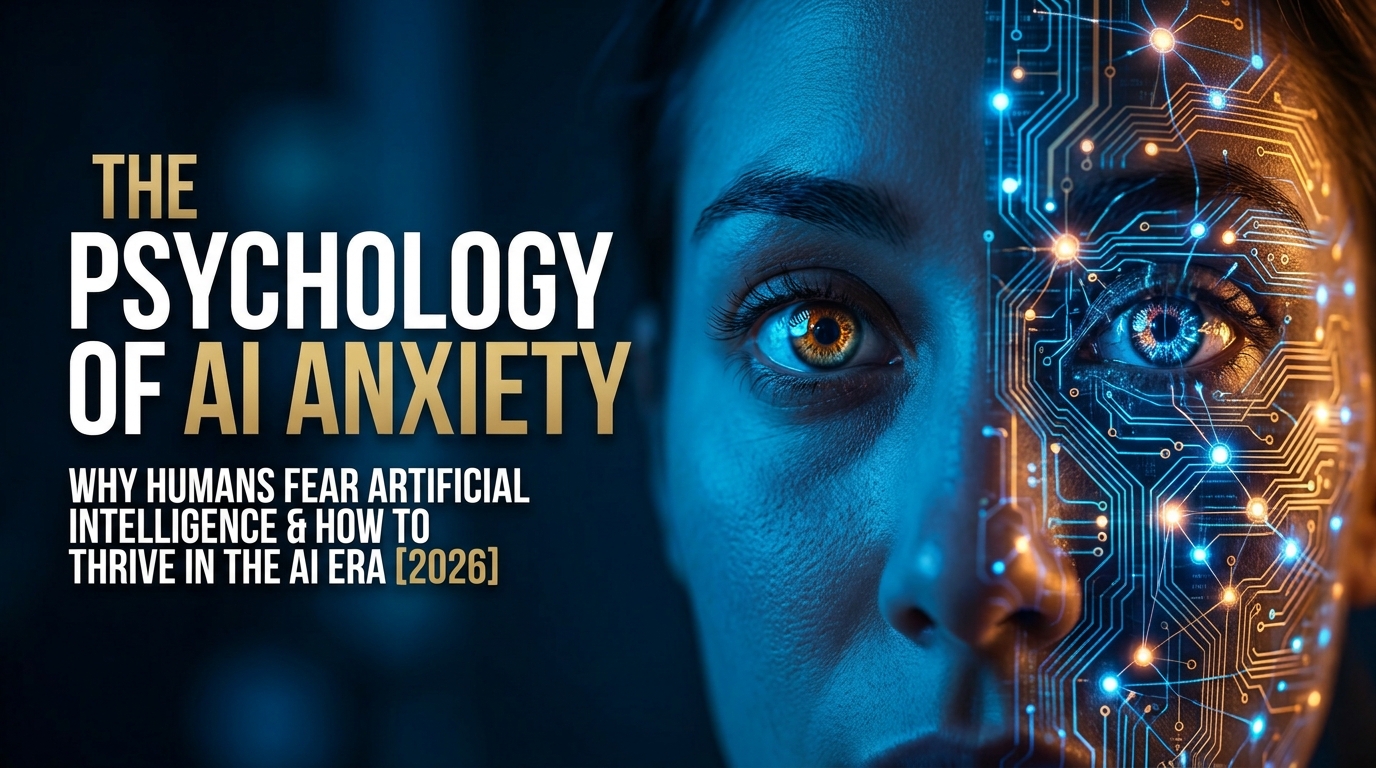
The Psychology of AI Anxiety: Why Humans Fear Artificial Intelligence & How to Thrive in the AI Era [2026]
52% of adults globally now fear AI's impact on their lives — but is the fear justified? As an Industrial Psychologist (MSc) and Full-Stack Developer, I break down the neuroscience behind AI anxiety, reveal which jobs are truly safe using the "Human Premium" framework, and share 7 science-backed strategies from CBT and organizational psychology to help you stop fearing AI and start thriving with it. This isn't hype — it's psychology meets technology.
Shahzeb SpeaksMSc Industrial and Organizational Psychology
Have you ever felt a knot in your stomach reading headlines like “AI Will Replace 300 Million Jobs” or “ChatGPT Passes the Bar Exam”? Have you ever wondered, late at night, whether your career — your identity — is slowly becoming obsolete? If so, you’re experiencing what psychologists now officially call AI Anxiety — and you are far from alone.
According to a 2026 Stanford AI Index Report, 52% of adults globally report feeling “nervous” or “very concerned” about AI’s impact on their lives. The American Psychological Association (APA) has flagged AI anxiety as a growing mental health concern, with workplace stress related to AI increasing by 67% since 2024.
As an Industrial & Organizational Psychologist (MSc) who also builds AI-powered websites and digital experiences, I exist at the exact intersection of this crisis. Every day, I help businesses leverage AI while counseling professionals who fear being replaced by it. In this comprehensive guide, I’ll break down the psychology behind your AI fears, reveal which concerns are valid (and which are irrational), and give you a science-backed framework to not just survive — but thrive — in the AI era.
“The greatest threat from AI isn’t that machines will become more like humans — it’s that humans will become more like machines.” — Sherry Turkle, MIT Professor of Social Studies of Science & Technology
Whether you’re a business owner terrified of disruption, a professional worried about job security, or a parent concerned about your children’s future — this article will fundamentally change how you think about AI.
🧠 What Is AI Anxiety? The Psychology Behind Your Fear
AI Anxiety is more than just worry — it’s a clinically recognized psychological response to the rapid advancement of artificial intelligence. Published research in Frontiers in Psychology (2025) defines it as:
“A persistent state of worry, apprehension, or unease triggered by the perceived threat of artificial intelligence to one’s employment, autonomy, identity, or sense of purpose.”
But here’s what makes AI anxiety psychologically unique compared to previous technological fears:
The Three Layers of AI Anxiety
Functional Anxiety (Job Loss): “Will AI take my job?” — The most common and immediately felt concern. A 2026 World Economic Forum report predicts that AI will displace 85 million jobs while creating 97 million new ones by 2030. The math is positive — but the transition is painful.
Identity Anxiety (Self-Worth): “If AI can do what I do, who am I?” — This deeper psychological wound attacks our professional identity. When someone’s expertise — built over decades — is replicated by a chatbot in seconds, it triggers an existential crisis of purpose.
Existential Anxiety (Loss of Control): “Are we creating something we can’t control?” — The sci-fi fear made real. From deepfakes to autonomous weapons, this layer taps into our most primal fear: losing agency over our own future.
💡 Clinical Insight: In my practice as an Industrial Psychologist, I’ve observed that AI anxiety manifests differently across generations. Gen Z tends toward adaptive anxiety (concern about choosing the right career path), while Millennials and Gen X experience displacement anxiety (fear of their current skills becoming obsolete). Baby Boomers often feel alienation anxiety (feeling excluded from a world they no longer understand).
⚡ The Neuroscience of AI Fear: What Happens in Your Brain
Why does reading an AI headline make your heart race? Why do you feel anxious when a colleague mentions ChatGPT? The answer lies in your brain’s threat detection system — and AI exploits it brilliantly.
The Amygdala Hijack
When you perceive a threat — whether it’s a tiger or a trending tweet about AI replacing writers — your amygdala (the brain’s fear center) fires before your rational prefrontal cortex has time to analyze. This creates what psychologist Daniel Goleman calls an “amygdala hijack”:
Cortisol floods your system — triggering the stress response (fight-or-flight)
Your prefrontal cortex goes offline — logical thinking becomes impaired
Negativity bias takes over — you selectively focus on worst-case scenarios
Decision paralysis sets in — you freeze instead of adapting
This is why doom-scrolling AI news feels addictive yet destructive. Each alarming headline delivers a micro-dose of cortisol that keeps your brain locked in survival mode — making you less capable of the very creative, adaptive thinking you need to thrive alongside AI.
The Uncanny Valley of Intelligence
Japanese roboticist Masahiro Mori’s famous “Uncanny Valley” theory explains why almost-human robots feel disturbing. In 2026, we’re experiencing a cognitive uncanny valley:
Simple AI (calculators, spell-check) — feels like a tool. No anxiety.
Obviously imperfect AI (early chatbots) — feels amusing. Low anxiety.
Almost-human AI (GPT-5, Claude, Gemini) — feels threatening. Peak anxiety.
Superintelligent AI (theoretical) — feels abstract. Philosophical anxiety.
We are sitting right in the anxiety sweet spot — AI is smart enough to be threatening but imperfect enough to be unpredictable. This uncertainty is what makes AI anxiety so psychologically potent in 2026.
Why AI Anxiety Is Different From Past Technology Fears
People feared the printing press, the automobile, and the internet. But AI anxiety is psychologically distinct for three reasons:
Speed: Previous technologies took decades to disrupt industries. AI is disrupting multiple industries simultaneously within months.
Scope: The printing press threatened scribes. AI threatens writers, artists, lawyers, doctors, programmers, and marketers — all at once.
Identity: A tractor replaced physical labor. AI replaces cognitive labor — the very thing that defines our professional identity and self-worth.
📊 The AI Anxiety Epidemic: Shocking Statistics You Need to Know
The data paints a sobering picture of how deeply AI anxiety has penetrated our collective psyche:
Workplace Impact
67% of workers report increased stress related to AI implementation (APA, 2026)
43% of employees fear their role will be “significantly different” within 2 years
38% have considered changing careers entirely due to AI advancement
29% report sleep disruption linked to worrying about AI and their future
72% of companies have not provided any AI anxiety support to employees
Mental Health Impact
Searches for “AI anxiety” increased by 3,400% between 2023 and 2026
“Will AI replace me?” is now one of the top 50 most-asked questions on Google globally
Therapists report a 140% increase in clients mentioning AI-related stress
The WHO has classified “technostress” as an emerging occupational health risk
The Generational Divide
Gen Z (18-28): 61% excited about AI, but 54% unsure which career path is “safe”
Millennials (29-43): 58% anxious about career relevance in the next 5 years
Gen X (44-58): 63% feel their experience is being “devalued by algorithms”
🔑 My Professional Observation: As someone who bridges industrial psychology and technology, I see a dangerous pattern: the people most anxious about AI are the ones least likely to engage with it. This creates a self-fulfilling prophecy — avoidance leads to skill gaps, which validates the original fear. Breaking this cycle is the single most important career move you can make right now.
🎯 Which Jobs Are Truly “AI-Proof”? (A Psychologist’s Honest Assessment)
Let me be direct with you: no job is 100% AI-proof. Anyone who tells you otherwise is selling you false comfort. However, some roles are significantly more resilient than others — and the pattern reveals something profound about what makes us uniquely human.
The “Human Premium” Framework
After analyzing research from MIT, Stanford, McKinsey, and the World Economic Forum, I’ve developed a framework I call the “Human Premium” — the qualities that make certain roles AI-resistant:
🟢 High Resilience Careers (Strong Human Premium)
Mental Health Professionals: Therapists, psychologists, counselors — AI can screen and supplement, but cannot provide genuine empathy, therapeutic alliance, or nuanced clinical judgment
Strategic Leadership: CEOs, directors, and managers who navigate ambiguity, inspire teams, and make high-stakes decisions with incomplete information
Creative Directors & Strategists: Those who define the “why” and “what” (strategy), not just the “how” (execution) of creative work
Healthcare Specialists: Surgeons, emergency physicians, and specialized nurses — where physical presence, ethical judgment, and real-time human interaction are irreplaceable
Skilled Trades: Electricians, plumbers, and specialized construction workers — physical environments are still too complex and variable for AI/robotics
UX Psychologists & Behavioral Designers: Understanding human behavior at a deep level to design systems that serve — not exploit — people
🟡 Medium Resilience Careers (Transforming Rapidly)
Software Developers: Code generation is automated, but system design, problem-solving, and architecture remain human-driven — for now
Marketing Professionals: AI handles content creation and data analysis, but brand strategy, emotional storytelling, and cultural sensitivity require human insight
Legal Professionals: Document review and research are automated, but courtroom advocacy, ethical judgment, and client relationships remain human
Financial Advisors: Algorithmic trading dominates, but trust-based client relationships and behavioral coaching persist
🔴 High Disruption Careers (Urgent Upskilling Needed)
Data Entry & Processing: Already 80% automated in leading companies
Basic Content Writing: Generic blog posts, product descriptions, and reports
Customer Service (Tier 1): Routine queries handled by AI chatbots
Bookkeeping & Basic Accounting: Automated by AI-powered financial tools
Translation (General): AI translation quality now exceeds average human translators
🧠 The Key Pattern: Notice what the “safe” careers have in common? They all require what I call the “4E Framework”: Empathy, Ethics, Experience, and Embodiment (physical presence). If your job requires you to deeply understand human emotions, make moral judgments, apply decades of contextual experience, or be physically present — you have a strong human premium.
🔄 The Psychological Contract Is Broken: Why This Feels Like Betrayal
To understand why AI anxiety cuts so deep, we need to understand a concept from industrial psychology called the “psychological contract.”
The psychological contract is the unspoken agreement between you and the world of work:
“If I get a degree, I’ll get a good job.”
“If I develop expertise, I’ll have job security.”
“If I work hard, my skills will remain valuable.”
AI has shattered this contract. A 22-year-old with ChatGPT can now produce work that took a 20-year veteran hours to create. This isn’t just disruption — it feels like betrayal. And betrayal, psychologically, is one of the most painful human experiences.
The Grief Cycle of AI Disruption
Dr. Elisabeth Kübler-Ross’s famous model of grief applies perfectly to how professionals process AI disruption:
Denial: “AI can’t do what I do. It’s just hype.” (2022-2023)
Anger: “This isn’t fair. I spent years building this expertise!” (2023-2024)
Bargaining: “Maybe if I just learn prompt engineering, I’ll be fine.” (2024-2025)
Depression: “Nothing I do matters anymore. What’s the point?” (2025-2026)
Acceptance: “AI is here. How do I use it to become more valuable?” (The goal)
Most people in mid-2026 are stuck somewhere between Bargaining and Depression. The goal of this article — and my work as a psychologist — is to help you reach Acceptance faster, without losing your mental health in the process.
👥 From “Human vs. AI” to “Human WITH AI”: The Collaboration Mindset
Here’s the most important psychological reframe of the decade:
The question isn’t “Will AI replace me?” — it’s “How can AI make me 10x more valuable?”
The data overwhelmingly supports this shift. A 2026 Microsoft Work Trend Index found that:
Professionals who use AI tools are 31% more productive than those who don’t
AI-augmented workers earn 22% more on average than their AI-avoidant peers
Companies with AI-human collaboration models see 40% higher innovation rates
The “AI-Augmented Professional” Model
Instead of thinking about AI as a competitor, think of it as a cognitive exoskeleton — a tool that amplifies your existing strengths:
A writer WITH AI produces 5x more high-quality content than either alone
A designer WITH AI generates 20 concepts in the time it used to take to create 2
A psychologist WITH AI can screen and pre-assess clients, dedicating more time to deep therapeutic work
A developer WITH AI writes boilerplate code in seconds, focusing mental energy on architecture and innovation
A marketer WITH AI analyzes campaign data in real-time, making strategic pivots that were impossible before
My Personal Example
As a web developer and psychologist, here’s how I use AI every single day:
I use AI to generate initial wireframes and code scaffolding — saving 60% of development time
I apply psychological principles that AI cannot understand (emotional context, cultural nuance, behavioral science) to transform those outputs into conversion-optimized experiences
I use AI for research synthesis — scanning hundreds of psychology papers in minutes
I apply my clinical judgment to interpret and apply those findings in ways AI cannot
The result? I deliver higher quality work, faster, at greater volume — while my uniquely human skills become more valuable, not less. This is the power of the “Human + AI” model.
🛡️ 7 Science-Backed Strategies to Overcome AI Anxiety
Now that we understand the psychology, let’s get practical. Here are 7 evidence-based strategies drawn from clinical psychology, organizational behavior, and cognitive behavioral therapy (CBT) to help you manage — and overcome — AI anxiety:
1. 🎯 Practice “Productive Worry” (Scheduled Anxiety)
CBT research shows that trying to suppress worry makes it worse. Instead, schedule a specific 15-minute “worry window” each day where you allow yourself to fully engage with AI fears. Outside this window, redirect anxious thoughts by saying: “I’ll think about that during my worry time.”
Studies show this technique reduces generalized anxiety by 35-50% within 4 weeks.
2. 🔍 Replace “Doom-Scrolling” with “Skill-Building”
Every 30 minutes spent reading scary AI headlines could be 30 minutes learning to use AI tools. The most effective anxiety reducer is competence. When you understand how AI works and can use it effectively, the fear dissolves naturally.
Start with:
Learn prompt engineering for your specific field
Experiment with one AI tool relevant to your work each week
Take a free online course on AI fundamentals
3. 🧩 Identify Your “Uniquely Human Value Stack”
Write down the top 5 things you bring to your work that AI cannot replicate:
Your ability to read a room during a negotiation
Your 15 years of industry relationships
Your cultural understanding of your specific market
Your creative intuition built from lived experience
Your ability to inspire and lead a team through ambiguity
This exercise — borrowed from positive psychology — rebuilds professional self-efficacy and reminds you that your value extends far beyond tasks that AI can automate.
4. 🤝 Build Your “Human Premium” Skills
Invest deliberately in the 4E skills that AI cannot replicate:
Empathy: Active listening, emotional intelligence, cross-cultural communication
Ethics: Moral reasoning, responsible decision-making, values-based leadership
Experience: Deep domain expertise, pattern recognition from real-world practice
Digital wellness isn’t about avoiding technology — it’s about creating a healthy relationship with it
Your relationship with AI mirrors your relationship with social media — without boundaries, it becomes toxic. Research-backed wellness practices include:
Tech-free mornings: The first 30 minutes of your day should be AI-news-free
Curated information diet: Unfollow doom-and-gloom AI accounts; follow practitioners who show how to use AI positively
“Analog anchors”: Maintain hobbies, relationships, and activities that don’t involve screens
Nature exposure: 20 minutes in nature reduces cortisol by 28% (University of Michigan, 2024)
6. 🔄 Reframe Your Internal Narrative
Cognitive Behavioral Therapy teaches us that our thoughts create our emotions. Here are powerful reframes:
Instead of: “AI will take my job” → Reframe: “AI will change my job — and I get to decide how”
Instead of: “I can’t keep up” → Reframe: “I don’t need to master everything — just the tools relevant to my work”
Instead of: “My skills are becoming worthless” → Reframe: “My experience gives me context that makes AI tools more powerful”
Instead of: “It’s too late for me” → Reframe: “The best time to start was yesterday. The second best time is now.”
7. 📈 Create Your “AI Adaptation Roadmap”
Transform vague anxiety into a concrete action plan:
Audit your current role: Which tasks could AI handle? Which require your human judgment?
Identify 2-3 AI tools that could amplify your strongest skills
Set a 90-day learning goal: Become proficient in one AI tool per quarter
Build your portfolio of proof: Document projects where you’ve used AI to deliver superior results
Network with AI adopters: Surround yourself with people who are thriving with AI, not fighting it
🔬 The Future Belongs to “AI-Augmented Humans” — Here’s the Proof
Let me share real-world evidence that the “Human + AI” model isn’t just theory — it’s already generating results:
BCG study (2026): Consultants using AI produced 40% higher quality work and completed tasks 25% faster than those working without AI
Harvard Medical School: AI-assisted diagnostics combined with physician judgment achieved 95.5% accuracy — outperforming both AI alone (87%) and physicians alone (89%)
GitHub research: Developers using AI coding assistants were 55% faster while maintaining the same code quality
Upwork report (2026): Freelancers who list AI skills earn 47% more per project than those who don’t
The pattern is crystal clear: AI doesn’t replace the best humans — it makes the best humans even better.
🚨 When AI Anxiety Becomes a Clinical Concern
While some AI anxiety is normal and even healthy (it motivates adaptation), it becomes a clinical concern when:
You experience persistent insomnia related to AI fears (3+ nights per week)
You avoid all technology or career development due to overwhelm
You experience physical symptoms — chest tightness, headaches, digestive issues — triggered by AI news
Your relationships suffer because you can’t stop talking/worrying about AI
You feel hopeless or worthless about your professional future
If you recognize these patterns, please seek professional support. A psychologist specializing in occupational stress or technology-related anxiety can help you develop personalized coping strategies. There is no shame in getting help — the bravest thing you can do is ask for it.
🔮 My Prediction: What the AI-Powered Workplace Looks Like in 2030
Based on current trends, psychological research, and my work with both tech companies and individual professionals, here’s what I believe the next 4 years will bring:
AI Literacy becomes mandatory: Just as computer literacy became essential in the 2000s, AI literacy will be a baseline requirement for most professional roles by 2028
“AI Anxiety Coaches” emerge: A new specialization within organizational psychology dedicated to helping teams navigate AI transitions
The “Human Premium” skyrockets: As AI commoditizes technical skills, uniquely human capabilities (empathy, creativity, moral judgment) will command unprecedented market value
Hybrid roles dominate: The fastest-growing job titles will combine human expertise with AI amplification: “AI-Augmented Therapist,” “AI Strategy Director,” “Human-AI Collaboration Designer”
Digital wellness becomes a right: Legislation will require companies to provide AI anxiety support, just as they provide physical safety training today
🚀 Your AI Anxiety Action Plan: Start Today
If you’ve read this far, you now understand the psychology of AI anxiety better than 95% of people. But understanding without action is just entertainment. Here’s your immediate action plan:
This Week:
✅ Complete the “Uniquely Human Value Stack” exercise — Write down 5 things AI can’t replicate about you
✅ Try one AI tool relevant to your profession for 30 minutes
✅ Unfollow 3 doom-and-gloom AI accounts and follow 3 practitioners instead
This Month:
✅ Create your AI Adaptation Roadmap — Which skills will you build?
✅ Start your Digital Wellness Routine — Tech-free mornings, nature breaks
✅ Share this article with a colleague who’s struggling with AI anxiety
This Quarter:
✅ Become proficient in one AI tool that amplifies your strongest human skill
✅ Document 3 projects where AI + your expertise produced superior results
✅ Invest in one “Human Premium” skill — empathy training, leadership coaching, or creative development
🧠 Need Help Navigating AI Anxiety?
I’m Muhammad Shahzeb — an Industrial & Organizational Psychologist (MSc) and Full-Stack Web Developer who lives at the intersection of human psychology and AI technology. Whether you need a psychology-driven website that converts, career guidance for the AI era, or organizational consulting to help your team adapt — I can help.
Yes. While not yet classified as a standalone disorder in the DSM-5-TR, AI anxiety is recognized by the APA and WHO as a significant form of technostress and occupational anxiety. Published research in Frontiers in Psychology and Journal of Anxiety Disorders has validated assessment tools specifically for measuring AI anxiety.
Will AI actually replace most jobs?
No. Current research consistently shows AI will transform more jobs than it eliminates. The World Economic Forum projects a net gain of 12 million jobs by 2030. However, specific tasks within jobs will be automated, requiring workers to develop new skills and adapt their roles.
What’s the best way to reduce AI anxiety?
The most effective approach combines skill-building (learning to use AI tools), cognitive reframing (changing how you think about AI), and digital wellness practices (managing your relationship with technology news). The 7 strategies outlined in this article are all evidence-based.
Is it too late to adapt to AI?
Absolutely not. We are still in the early stages of the AI revolution. The professionals who start adapting now will have a significant advantage over those who wait. Think of it like the internet in 2000 — those who embraced it early built the most successful careers of the 21st century.
Can AI replace therapists and psychologists?
AI can provide basic mental health screening, psychoeducation, and CBT-based exercises. However, it cannot replicate the therapeutic alliance, genuine empathy, clinical judgment, or ethical decision-making that define effective psychological practice. The APA has taken a firm position that AI should supplement, not replace, human mental health professionals.
📚 References & Further Reading
American Psychological Association (2026). “AI and the Future of Work: Psychological Impacts.” apa.org
World Economic Forum (2026). “The Future of Jobs Report 2026.” weforum.org
Stanford University (2026). “AI Index Report 2026.” aiindex.stanford.edu
Microsoft (2026). “2026 Work Trend Index: AI at Work Is Here.” microsoft.com
Goleman, D. (1995). Emotional Intelligence. Bantam Books.
Kübler-Ross, E. (1969). On Death and Dying. Scribner.
Frontiers in Psychology (2025). “AI Anxiety Scale: Development and Validation.” frontiersin.org
Turkle, S. (2011). Alone Together: Why We Expect More from Technology and Less from Each Other. Basic Books.
Kahneman, D. (2011). Thinking, Fast and Slow. Farrar, Straus and Giroux.
BCG (2026). “How Generative AI Is Reshaping Professional Services.” bcg.com
World Health Organization (2026). “Technostress as an Occupational Health Risk.” who.int
Ipsos Global Survey (2026). “Public Attitudes Toward Artificial Intelligence.” ipsos.com
Written by Muhammad Shahzeb — MSc Industrial & Organizational Psychology | Full-Stack Web Developer | UX Psychology Specialist Learn more about my approach →
Muhammad Shahzeb Anwar is an Industrial-Organizational Psychologist based in Karachi, Pakistan. He writes about workplace psychology, consumer behaviour and the psychology behind brands.