

It is 9 p.m. You pick up your phone to check one message. Forty minutes later you are still scrolling, you cannot remember what the message said, and you feel oddly tired — not from work, but from nothing in particular. You put the phone face-down on the table and pick up a book instead. The room goes quiet. Ten minutes later, your attention is back. That small, ordinary moment is the whole question behind the digital detox: what actually happens when you switch off — and what does not?
I am an Industrial and Organizational Psychologist in Karachi, and I write about work and behaviour for a global reader. This piece is built on the newest evidence available: a preregistered randomised trial published in 2025 in which 467 people blocked mobile internet for two weeks, a Harvard study of a one-week social media break published in November 2025, two meta-analyses, and survey data from Pew Research Center and Google covering 2026. I will keep the scope honest throughout. A digital detox produces real benefits, but they are modest, selective and short-lived — and the part of the story most people skip is how hard it is to actually do one.
“A digital detox is not a cure. It is a pause — and a pause only helps if you know what the pause is for.”
— Workplace Psychology Analysis, ShahzebSpeaks
This guide covers what a digital detox is and is not, why the appetite for one has surged in 2026, what the two best experiments actually found, why attention and sleep improve first, what the evidence says does not work, how Australia has just taken the idea into schools, and a practical plan built only from doses that were actually tested. It is written for anyone who has tried to cut back on their phone and discovered that wanting to is not the same as doing it.
📱 Chapter 1: The short answer — what a digital detox does
A digital detox is the deliberate, temporary reduction of digital use — usually mobile internet or social media, for one or two weeks. The strongest evidence we have is a preregistered randomised trial from 2025: 467 people who blocked all mobile internet on their phones for two weeks saw their well-being, mental health and objectively measured sustained attention improve, with the attention gain roughly equal to ten years of age-related decline, reversed. A one-week break from social media cut anxiety by 16.1%, depression symptoms by 24.8% and insomnia by 14.5% in young adults. Meta-analyses agree the reliable benefit is a small reduction in depressive symptoms.
But three limits matter as much as the headline. First, only a quarter of the people in the two-week trial managed to keep the block on for at least ten of the fourteen days. Second, screen time rebounded sharply once the block ended — from 161 minutes a day back to 265, against a baseline of 314. Third, the reviews find no significant effect on life satisfaction, stress or overall well-being. A detox is not a reset button. It is a two-week experiment that works while it lasts, and whose benefits fade if nothing else changes.
📈 Chapter 2: Why everyone suddenly wants to switch off
The appetite to switch off is no longer a fringe idea. It is the mainstream mood of 2026, and the numbers now say so plainly. Pew Research Center, surveying 9,750 American adults between 26 May and 1 June 2026, found that 53% say they spend too much time on their smartphone — rising to 70% of adults aged 18 to 29. More than a quarter, 26%, say they use their phone “almost constantly”, and that figure reaches 42% among 18- to 29-year-olds. The phone is also now a sleep problem: 41% of adults say it hurts how much sleep they get, against only 5% who say it helps, and 62% of under-30s say it hurts their sleep.
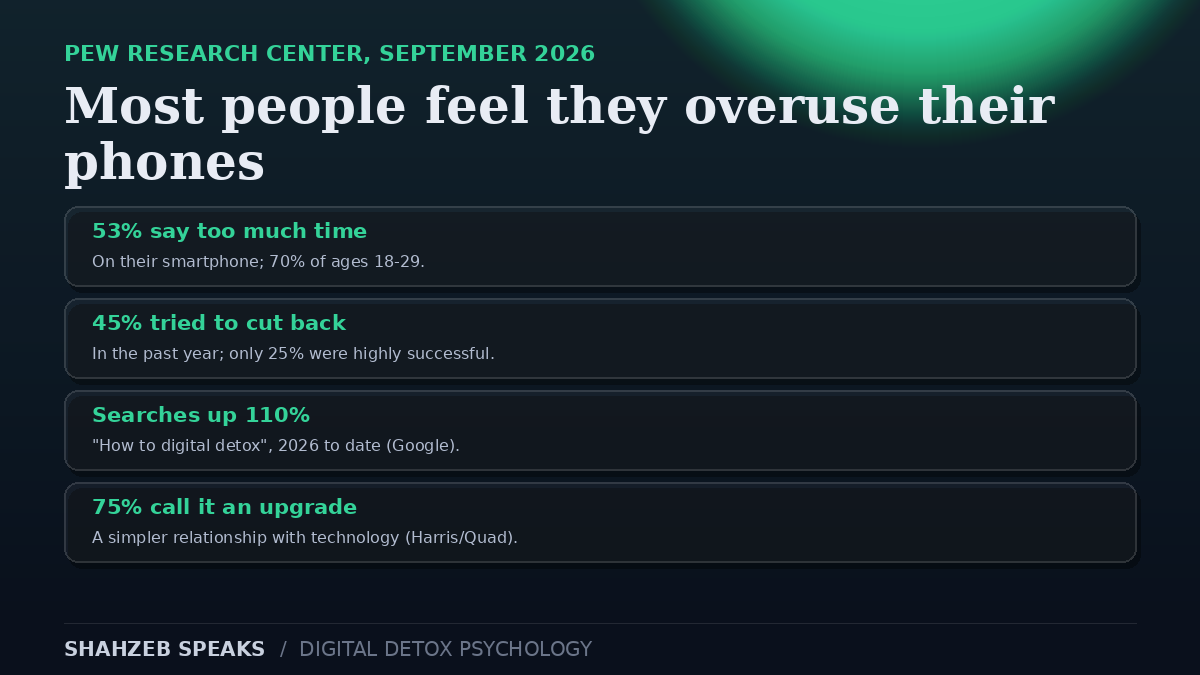
Google’s own search data tells the same story from a different angle. In July 2026 Google reported that searches for “how to digital detox” had risen 110% since the start of the year, and that “how to touch grass” — internet slang for going outside — had become a breakout search. A Harris Poll survey for Quad, published in October 2026 and covering 2,004 American adults, found that 75% say a simpler relationship with technology feels like a lifestyle upgrade rather than a sacrifice, and 53% intentionally leave their phones at home or turn them off to be more present with others. Among Gen Z, 82% reported improved mental health from taking breaks from social media. That last survey was commissioned by a marketing company, so I treat it as attitudinal data rather than clinical evidence — but the direction matches everything else.
| Measure | Result |
|---|---|
| US adults who say they spend too much time on their smartphone | 53% (70% of ages 18–29) |
| US adults who use their phone “almost constantly” | 26% (42% of ages 18–29) |
| US adults who tried to cut back in the past year | 45% (58% of ages 18–49) |
| Of those who tried, extremely or very successful | Only 25% |
| Searches for “how to digital detox”, 2026 to date | Up 110% |
| Americans who call simpler tech a lifestyle upgrade | 75% |
Sources: Pew Research Center, 1 September 2026 (9,750 US adults); Google, 28 July 2026; Harris Poll / Quad, 14 October 2026 (2,004 US adults).
The most revealing figure is the one about failure. Pew found that 45% of American adults tried to cut back on smartphone use in the past year — and of those who tried, only 25% say they were extremely or very successful. Half were only somewhat successful, and nearly a quarter were not successful at all. That gap between appetite and action is the real story of 2026. People are not waiting to be convinced that they overuse their phones. They are convinced, and they are failing to change. New research published on 5 November 2026, from the University of Bath and Goethe University Frankfurt, helps explain why: the researchers developed the first validated scale for measuring attitudes toward a digital detox — a seven-item measure called the Attitude toward Digital Detox scale — and found that more than eight in ten participants were positive about the idea of switching off. Attitudes were linked to mindfulness and self-control, and could help predict how much time people later spent watching online videos. But the study did not test whether those positive people actually switched off. A positive attitude and a changed habit are two different things, and the Pew figures show how wide the gap between them is.
🔍 Chapter 3: What “digital detox” actually means
Before judging whether a detox works, it helps to know what the word covers — because the research does not agree. There is no single, accepted definition of a digital detox in the literature, and studies vary between complete abstinence from devices and cutting back on specific apps or platforms. The newest definition, from the scale-development work above, calls it the “intentional temporary reduction of digital usage behaviour” — a deliberate, time-limited cut-back, not necessarily total abstinence. An earlier systematic review defined it more loosely, as timeouts from electronic devices, either completely or for specific subsets of smartphone use such as social networks and instant messaging.
The distinction matters, because the evidence favours reduction over abstinence. A 2024 review in Pediatrics, written by authors from the Harvard T.H. Chan School of Public Health, found that reducing social media and smartphone time showed more beneficial effects on well-being than promoting total abstinence, and that the effects varied by outcome, gender, age and context. A 2025 meta-analysis of ten randomised trials reached a similar conclusion: reduction interventions had about twice the effect of full-abstinence interventions on depressive symptoms, though the difference was not statistically significant. The practical reading is simple. A detox that bans everything is harder to keep, and the evidence does not reward the extra difficulty. A detox that cuts one thing — mobile internet, or social media, or the phone after 10 p.m. — is easier to hold, and the tested benefits come from exactly those partial cuts.
🧪 Chapter 4: The two-week experiment — what blocking mobile internet did
The best experiment we have is refreshingly strict. In February 2025, Castelo and colleagues published a preregistered, month-long randomised controlled trial in PNAS Nexus. They recruited 467 iPhone users in the United States and Canada, average age 32, through the research platform Prolific, and asked half of them to block all mobile internet — Wi-Fi and data — on their phones for two weeks, using an app called Freedom. Calls and texts still worked, and internet on other devices still worked. The other half carried on as usual. The trial measured well-being, mental health and sustained attention with an objective computer task, before, during and after the block.
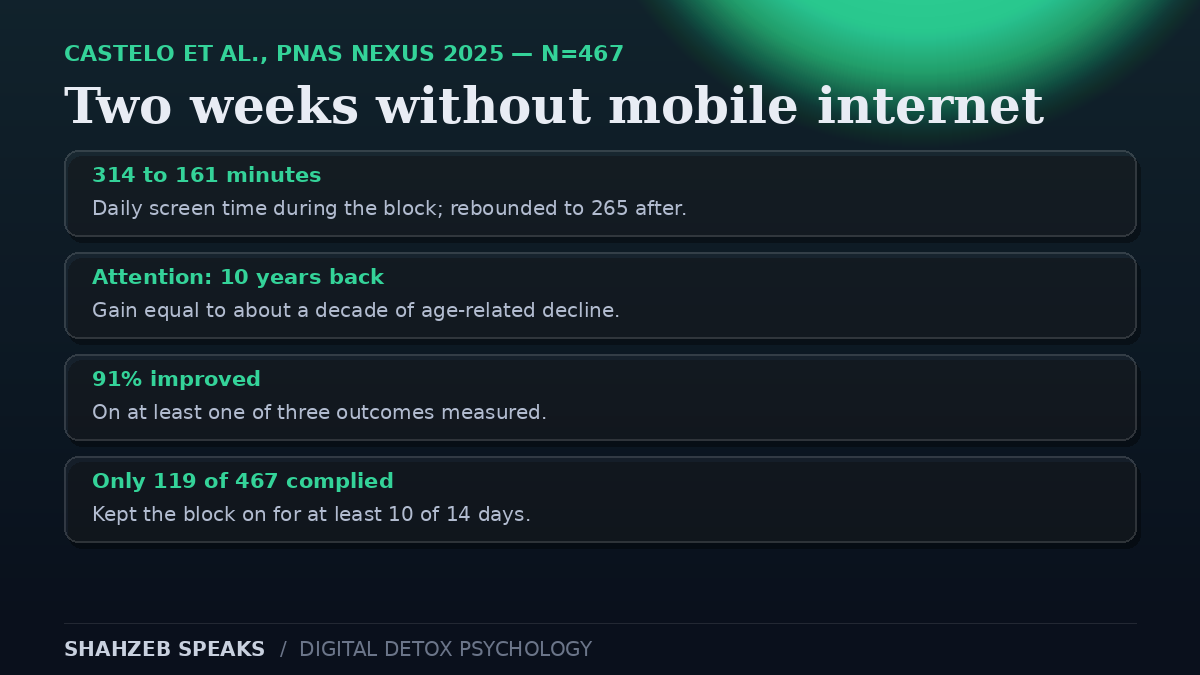
The results were genuinely striking. Average daily screen time fell from 314 minutes to 161 minutes during the block. Subjective well-being improved, mental health improved, and objectively measured sustained attention improved. The authors compared the attention gain to about ten years of age-related decline, reversed, and the depression-symptom effect to one larger than the meta-analytic effect of antidepressants and similar to cognitive behavioural therapy. Ninety-one per cent of participants improved on at least one of the three outcomes. People with higher baseline fear of missing out improved more, and the benefits were partly explained by what the freed-up time was spent on: more time socialising in person, exercising, being in nature, doing hobbies and reading, less media consumption, greater social connectedness, better self-control and more sleep.
Now the honest half of the story, which the authors themselves report. Only 119 of the 467 participants — 25.5% — met the preregistered definition of compliant, keeping the block active for at least ten of the fourteen days. Only 266 even set up the app. The effects were larger among those who complied, but significant effects remained in the full sample, including people who barely kept the block on. Two weeks after the block ended, screen time had rebounded to 265 minutes a day — still below the 314 baseline, but most of the way back. And two caveats apply to the headline comparisons: the authors warn that their sample and intervention differ from clinical contexts, so the antidepressant comparison is a statement about effect size, not evidence that a detox replaces treatment; and participants knew the study was about phones and well-being, so expectancy effects cannot be ruled out. The trial is the best evidence a detox works. It is also the best evidence that a detox is hard to do and hard to keep.
📵 Chapter 5: One week off social media
A second study, published in JAMA Network Open in November 2025, tested a shorter and narrower break. Calvert and colleagues at Beth Israel Deaconess and Harvard enrolled 417 young adults aged 18 to 24, of whom 373 completed the baseline measures, then offered an optional one-week detox from Facebook, Instagram, Snapchat, TikTok and X. Almost four in five, 295 people, opted in. After the week, anxiety had fallen 16.1%, depression symptoms 24.8% and insomnia 14.5%. There was no significant change in loneliness — a useful reminder that removing social media also removes some social contact, and the net effect on feeling alone was zero.
This study is weaker than Castelo’s in one important way: it was an observational cohort with an optional intervention, not a randomised trial. The people who chose the detox may already have been the ones most likely to benefit from it. The authors also flag that the durability of the effects is unknown, particularly in more diverse populations. Still, the direction agrees with the randomised evidence, and the effect sizes are large enough to take seriously.
An older experiment adds a useful detail. In 2018, Hunt and colleagues at the University of Pennsylvania randomised 143 undergraduates to limit Facebook, Instagram and Snapchat to ten minutes per platform per day — about thirty minutes in total — for three weeks, against a group that used them as usual. The limited-use group showed significant reductions in loneliness and depression compared with the control group. Anxiety and fear of missing out fell in both groups, which suggests that simply being in a study about phone use can change how people feel — another reason to read the headline figures with care. The tested dose here is modest and practical: thirty minutes a day, not zero.
🧠 Chapter 6: Why it works — attention, notifications, FOMO and sleep
The benefits of a detox make more sense once you see what the phone is actually doing to attention. Attention restoration theory, developed by Kaplan and Kaplan, treats directed attention — the effortful focus you use at work — as a finite resource that fatigues, and that recovers in settings offering “being away”, extent, compatibility and “soft fascination”, where involuntary attention takes over. A phone is the opposite of that setting: it demands directed attention in short, repeated bursts, all day.
Notifications are the clearest example. Stothart and colleagues showed in 2015 that mobile phone notifications alone significantly disrupted performance on an attention-demanding task even when participants did not interact with the phone at all — the distraction was comparable in magnitude to actively using the phone for calls or texts, plausibly because the notification set off task-irrelevant thoughts. You do not have to pick up the phone for it to cost you attention. It only has to buzz.
The loop that keeps people picking it up has a name. Fear of missing out, defined by Przybylski and colleagues in 2013 as “a pervasive apprehension that others might be having rewarding experiences from which one is absent”, is the desire to stay continually connected, measured on a ten-item scale and framed within self-determination theory as the result of unmet needs for autonomy, competence and relatedness. In the Castelo trial, people with higher baseline FOMO improved more from the block — which suggests the detox worked partly by breaking the loop, not just by removing the screen.
Sleep is the fourth mechanism, and the newest evidence is precise. Zhao and colleagues, in a study published online in JAMA Pediatrics in October 2026, followed 425 American adolescents with a mean age of 14.8 across 7,591 person-nights, combining passively sensed phone use with Fitbit sleep data. On nights when teenagers used their phone more than their own average after 10 p.m., they slept a mean of 20.05 minutes less and fell asleep about 64.73 minutes later. Each additional minute of phone use after 10 p.m. above their own average was associated with sleep onset 0.87 minutes later and total sleep 0.43 minutes shorter. This was observational, so it is association rather than proof of causation — but the dose-response pattern, minute by minute, is hard to ignore. A phone in the bedroom after 10 p.m. is not a neutral object. It is a delay machine.
⚠️ Chapter 7: What does NOT work — the honest limits
A responsible account of the detox has to spend as much time on what does not work as on what does. The meta-analyses are the place to start. Ramadhan and colleagues, in a 2024 systematic review and meta-analysis of ten studies, found that digital and social media detox significantly reduced depressive symptoms — a small effect, standardised mean difference of −0.29 — but had no statistically significant effect on life satisfaction, stress or overall mental well-being. May and colleagues, in a 2025 meta-analysis of ten randomised trials with 1,491 participants, found the same pattern: depressive symptoms fell, with an effect size of 0.25, and there was substantial variation between studies. Radtke and colleagues, reviewing 21 studies with 3,625 participants in 2022, found that every study reduced phone use, but that associations with well-being were inconclusive or contradictory — positive, negative and null effects side by side — and concluded the review could not give clear guidance on whether to promote or discard digital detox.
Put plainly: a detox reliably moves one thing, depressive symptoms, by a small amount. It does not reliably make life feel better overall, and it does not reliably reduce stress. The benefits in the Castelo trial were real, but they came with a rebound: screen time was most of the way back to baseline two weeks after the block ended, and only a quarter of participants kept the block on. No study read for this piece followed participants beyond about four weeks, so nobody can honestly claim the benefits last. A detox is also not a treatment. The authors of the Castelo trial say so themselves, and the Calvert study’s authors flag that durability is unknown. If someone is struggling with depression or anxiety, a phone break is not a substitute for professional help.
There is one more limit worth naming, because it explains the Pew failure figures. A detox removes a habit without replacing it. The people in the Castelo trial who benefited most were the ones who filled the freed time with something else — people, exercise, nature, reading. A detox that leaves an empty evening is a detox that ends at the first boring moment. The evidence does not support “dopamine detox” claims either: no peer-reviewed test of a dopamine reset was found in this research, and the tested behaviour is simply reduced digital use, not a change in brain chemistry.
🏫 Chapter 8: From self-help to public policy
The clearest sign that the digital detox has moved beyond self-help came on 5 November 2026, when Australia’s state and federal education ministers agreed to a “digital detox in Australian schools”. The agreement covers setting or considering screen-time limits in schools across the country, restricting generative AI in primary schools and secondary school assessments, and returning Year 5 NAPLAN writing tests to pen and paper. A new Australian Schools Digital Detox Taskforce will collect evidence, survey students, teachers and parents, and advise ministers on further action next year.
Two corrections matter here. First, this is not a ban: the announcement is explicit that a complete technology ban across all schooling is not what is being suggested, and that technology should be used for a purpose and restricted if it causes harm. Second, there is no comprehensive national data on how much time Australian children spend on devices at school — the policy is being built on concern and partial evidence, not on a full national picture. That is worth saying plainly, because it is the same pattern as the personal detox: strong appetite, incomplete data, and a decision to act anyway. The difference is that a school policy affects millions of children, so the evidence bar should be higher — and the taskforce’s job is to raise it.
✅ Chapter 9: A plan built only from tested doses
If you want to try a digital detox, copy the doses that were actually tested rather than inventing your own. Each step below is tied to the study that tested it.
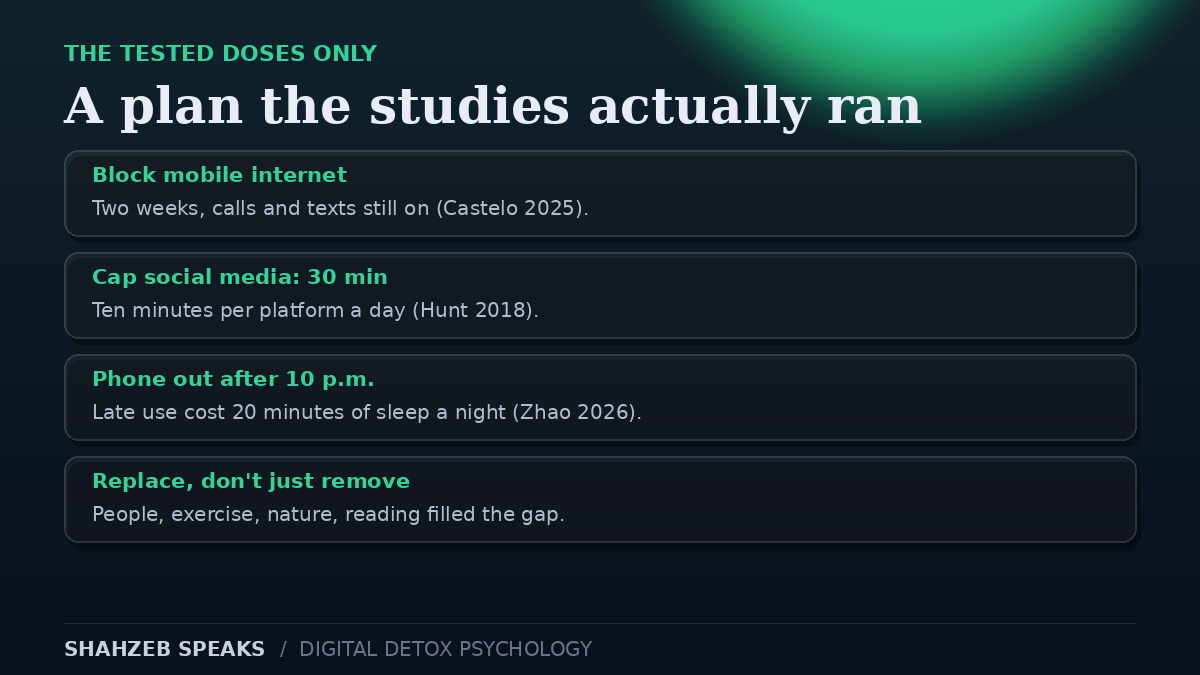
First, block mobile internet rather than the whole phone. The Castelo trial blocked Wi-Fi and data on the phone for two weeks while calls, texts and other devices kept working — and that partial block produced the strongest results in the literature. Use a blocking app, and set a defined end date: two weeks, not forever. Second, cap social media at about thirty minutes a day. Hunt’s experiment limited three platforms to ten minutes each for three weeks and reduced loneliness and depression. A cap is easier to keep than a ban, and the evidence favours it. Third, protect the hour after 10 p.m. The Zhao study links phone use after 10 p.m. to measurably later sleep, minute by minute. Charge the phone outside the bedroom. Fourth, replace the time rather than just removing it. The Castelo trial’s benefits were partly explained by more time spent socialising in person, exercising, being in nature, doing hobbies and reading. Pick the replacement before you start the block, and put it in the diary the way you would put in a meeting.
Fifth, expect to fail the first time, and plan for it. Only a quarter of the people in the best trial kept the block on, and only a quarter of Americans who tried to cut back say they were highly successful. That is not a reason to skip the attempt. It is a reason to treat the first try as a rehearsal: note what broke the block, fix that one thing, and try again. And finally, keep the claim honest. A detox may lift your mood, sharpen your attention and help you sleep. It will not fix your life, it will not cure depression, and its benefits fade unless something else changes. What it can do is show you, in two weeks, how much of your attention the phone was quietly taking — and that information, once you have it, is hard to unsee.
❓ Questions I am asked most often
What is a digital detox?
It is the deliberate, temporary reduction of digital use — usually mobile internet or social media, for one or two weeks. The newest research defines it as the “intentional temporary reduction of digital usage behaviour”, and the evidence favours cutting back on one thing rather than banning everything at once.
Does a digital detox actually work?
Yes, modestly and selectively. The best trial found two weeks without mobile internet improved well-being, mental health and attention, and meta-analyses agree the reliable benefit is a small reduction in depressive symptoms. But there is no significant effect on life satisfaction, stress or overall well-being, and benefits fade once use rebounds.
How long should a digital detox last?
The tested doses are one to two weeks: one week off social media, or two weeks without mobile internet. No study read for this piece followed people beyond about four weeks, so nobody can honestly promise lasting change from a single detox. Treat it as an experiment, not a reset.
Is a digital detox better than just cutting back?
Cutting back is usually better. A 2024 review found reducing social media and smartphone time showed more benefit than total abstinence, and a 2025 meta-analysis found reduction had about twice the effect of full abstinence on depressive symptoms. A cap you can keep beats a ban you abandon.
Can a digital detox help with anxiety or depression?
A one-week social media break cut anxiety by 16.1% and depression symptoms by 24.8% in young adults, and meta-analyses confirm a small reduction in depressive symptoms. But a detox is not a treatment: the trial authors say so themselves, and the effects are short-term. If you are struggling, professional help matters more than a phone break.
Why do most digital detoxes fail?
Because a detox removes a habit without replacing it, and because the loop is strong: fear of missing out, notifications that distract even when unanswered, and a phone that is always in reach. Only 25% of Americans who tried to cut back say they were highly successful, and only a quarter of trial participants kept a two-week block on. Plan the replacement activity first.
If your team cannot stop checking their phones in meetings, the problem is usually the work design, not the willpower. I help organisations measure attention load and redesign it — get in touch here.
Read more: industrial psychology in Pakistan is my home base, and my related pieces on the psychology of social media addiction, decision fatigue, the psychology of workplace burnout and employee engagement at a 15-year low cover the neighbouring questions this research raises.
Sources
- Castelo et al. (2025). Blocking mobile internet on smartphones improves sustained attention, mental health, and subjective well-being. PNAS Nexus.
- Calvert et al. (2025). Social media detox and youth mental health. JAMA Network Open.
- Hunt et al. (2018). No more FOMO: Limiting social media decreases loneliness and depression. Journal of Social and Clinical Psychology.
- Ramadhan et al. (2024). Impacts of digital social media detox for mental health: A systematic review and meta-analysis. Narra J.
- May et al. (2025). Reducing social media use and depressive symptoms: A meta-analysis of randomised controlled trials. European Journal of Investigation in Health, Psychology and Education.
- Radtke et al. (2022). Digital detox: An effective solution in the smartphone era? A systematic literature review. Mobile Media & Communication.
- Winkler, S., et al. (2026). In favor of digital detox: Developing the Attitude Toward Digital Detox Scale. Psychology & Marketing.
- Pew Research Center (2026). About half of Americans say they spend too much time on their smartphone, 1 September 2026.
- Google (2026). These Google Trends show people really want to touch grass, 28 July 2026.
- Harris Poll / Quad (2026). Return of Touch: The Human Advantage, 14 October 2026.
- Kaplan (1995). The restorative benefits of nature: Toward an integrative framework. Journal of Environmental Psychology.
- Przybylski et al. (2013). Motivational, emotional, and behavioral correlates of fear of missing out. Computers in Human Behavior.
- Stothart et al. (2015). The attentional cost of receiving a cell phone notification. Journal of Experimental Psychology: Human Perception and Performance.
- Zhao et al. (2026). Nighttime smartphone use and sleep in adolescents. JAMA Pediatrics, published online 19 October 2026.
- Ministers’ Media Centre, Australian Government (2026). Digital detox, schools, curriculum reform and establishment of Teaching and Learning Commission, 5 November 2026.
- Pediatrics (2024). The state of the art on social media and adolescent mental health.