

It is 10.40 p.m. You are in bed, and your phone lights up: a message from your manager, marked urgent, about a report that is not due until Thursday. You answer it, because not answering feels riskier than answering. Then you answer the next one. By midnight you have done an hour of unpaid work, and nobody will ever count it as work — but everyone will notice if you stop. That habit now has a name, performative availability, and a new survey of 1,006 American workers suggests it is one of the worst deals in modern working life: 71% feel the pressure to be always on, yet only 8% say it won them a promotion.
I am an Industrial and Organizational Psychologist in Karachi, and I write about work and behaviour for a global reader. This piece is built on research published in the first week of November 2026 — a survey of 1,006 American employees, a term coined in Fast Company on 2 November, a Fortune report on 8 November, and a 2025 experiment covering 16 studies and 7,800 people — set against wider evidence from Gallup, Hubstaff, Mental Health UK and the Health and Safety Executive. I will keep the scope honest throughout: the core figures are American survey data, the studies are cross-sectional self-reports, and the payoff from staying visible is small and uneven rather than zero. The fear behind the habit, though, is not imaginary — and any honest answer has to start there.
“Being seen to work is not the same as working. The tragedy of performative availability is that the people who pay most for it are the ones least likely to be rewarded for it.”
— Workplace Psychology Analysis, ShahzebSpeaks
This guide covers what performative availability is, what the newest survey numbers show, why the habit persists when the return is poor, the experiment that proves the fear behind it has some basis, what the hidden costs look like, and the structural fixes that actually change the pattern — followed by a one-week plan you can start on Monday.
🎯 Chapter 1: The short answer — performative availability rarely pays off
Performative availability is the habit of staying visibly reachable after hours — replying fast, staying online late, answering on holiday — to show commitment rather than to do work that is actually needed. A survey of 1,006 American employees, conducted in June 2026 by Software Finder, found that 71% feel pressure to be always on after hours, yet only 8% say being highly responsive outside work hours directly contributed to a promotion, and only 12% credit it with a raise or bonus. Almost seven in ten, 69%, say after-hours availability has not meaningfully improved their careers at all.
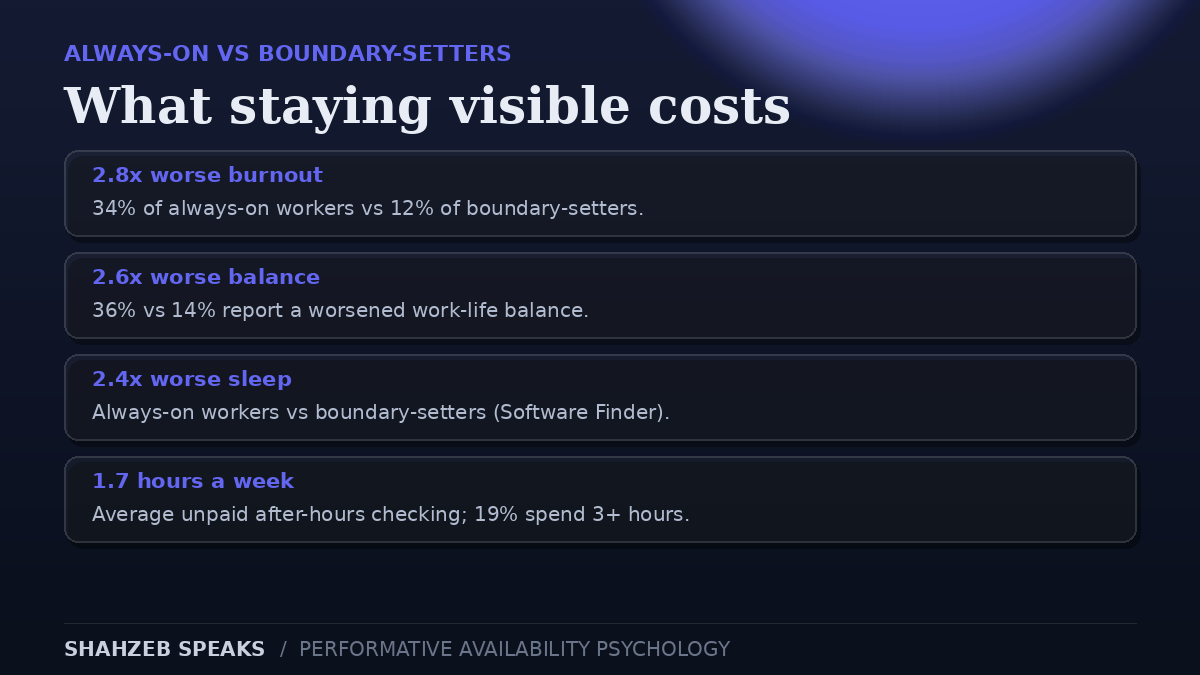
The costs fall on a much larger share than the rewards. Workers who describe themselves as always-on were 2.8 times as likely to report worsened burnout as workers who set boundaries — 34% against 12% — and 2.6 times as likely to report a worsened work-life balance. And yet the fear that drives the habit is not baseless: in a 2025 programme of 16 studies with 7,800 participants, managers rated employees who switched off as more productive but less committed and less promotable, even when their past evaluations were identical. So the honest short answer: staying visibly available after hours is a poor investment for most people, but a rational response to a system that rewards visibility. The fix has to be structural — clear reply-time norms, email-free weekends, outcome-based evaluation — not a pep talk about switching off.
🆕 Chapter 2: The new phrase — where “performative availability” came from
The phrase is barely a week old, which is part of why it has spread so fast. Jeff LeBlanc, a lecturer at Bentley University, coined “performative availability” in Fast Company on 2 November 2026, defining it as “the compulsion to demonstrate professional commitment based on visibility instead of the value or importance of your contributions”. The distinction in that sentence is the whole argument: visibility is being measured, value is not, and the worker pays the difference in evenings, weekends and sleep.
Six days later, on 8 November 2026, Fortune picked the story up, reporting that only 8% of workers say being always on won them a promotion — the headline figure from the Software Finder survey. The piece also quoted Emma Codd, Deloitte’s global chief people and purpose officer, who warned: “When showing up becomes more important than being well, inequities deepen, and the cost shows up in burnout, attrition, and lost potential.” Fortune also reported Workday data showing promotion rates fell in ten of the eleven industries tracked in the first half of 2025 — the ladder has narrowed while the performance of climbing it has intensified.
The phrase arrived during International Stress Awareness Week, 2 to 6 November 2026, under the theme “Shaping the Future of Stress and Wellbeing: Rehumanising the Workplace”. A new phrase does not create a new problem — but once a pressure has a name, it can be raised in a meeting rather than endured quietly at midnight.
📊 Chapter 3: The numbers — pressure is high, payoff is not
The Software Finder survey, conducted in June 2026 among 1,006 American employees, is the fullest picture we have of the always-on habit. Seventy-one per cent of workers feel pressure to be always on, checking work communications after hours. Managers feel it most, at 81%. Gen Z reports the least pressure of any generation — 65%, against 72% for both millennials and Gen X — yet pays a similar price, with worsened burnout reported by 34% of Gen Z and 34% of millennials, against 26% of Gen X. The pressure is not evenly spread, but the cost is.
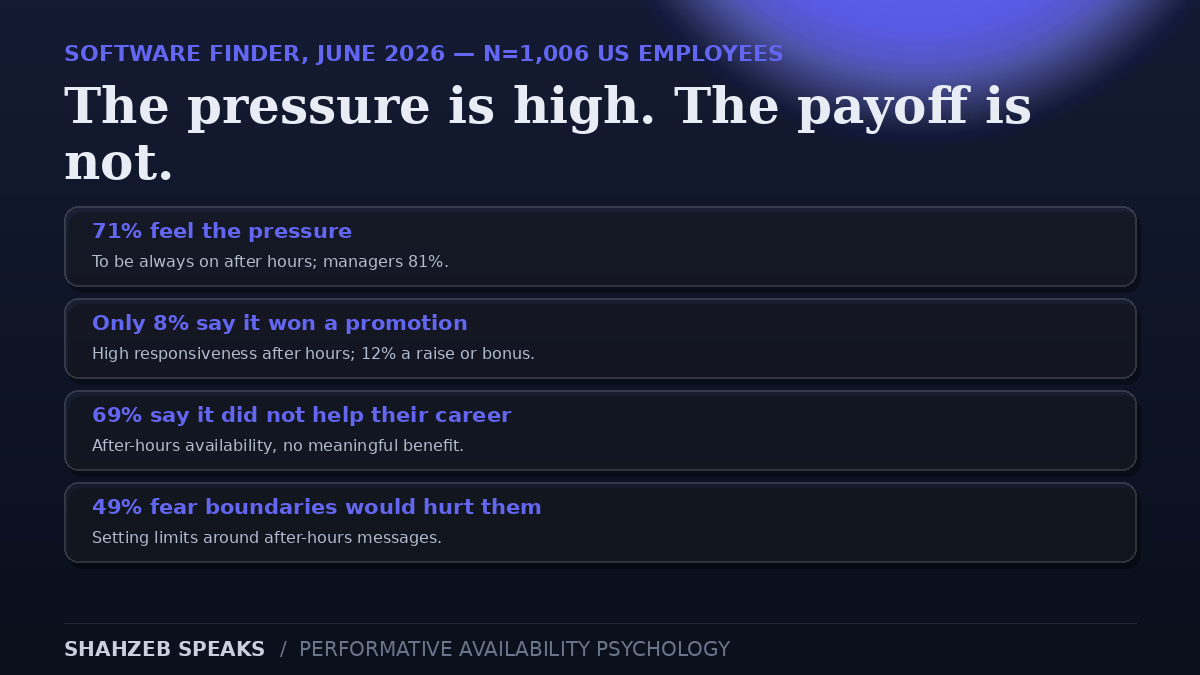
The time cost is the figure most people underestimate. The average worker spends 1.7 hours a week checking work communications after hours — more than two full working weeks a year of unpaid availability, assuming a 40-hour week — and 19% spend three or more hours a week. The channels matter: email drives after-hours work more than any other tool, at 68%, followed by text messages at 54%, with Teams at 22% and Slack at 11%. The benefit workers most often name is manager trust, at 30%, followed by visibility with leadership at 22%. Trust and visibility, in other words, are what people think they are buying — and the promotion figures suggest they are mostly not getting it.
| Measure | Result |
|---|---|
| Feel pressure to be “always on” after hours | 71% of workers (managers 81%; Gen Z 65%) |
| Say it directly contributed to a promotion | Only 8% |
| Credit it with a raise or bonus | Only 12% |
| Say it has not meaningfully improved their career | 69% |
| Worry setting boundaries could hurt their career | 49% (11% worry frequently) |
| Average unpaid after-hours checking per week | 1.7 hours (19% spend 3+ hours) |
| Check work communications on vacation | 73% (51% answered an email; 18% joined a call) |
Source: Software Finder survey, June 2026, 1,006 US employees. Software Finder is a software-comparison platform; the survey is vendor-funded and should be read as company research, not independent academic work. All figures are self-reported.
A ZeroBounce survey of 1,157 professionals in February 2026 found the same pattern: 74% feel pressure to reply quickly even off the clock, only 11% never feel it, and only 29% fully disconnect on vacation. The reasons people give are revealing: 48% check from fear of missing something important, 33% worry about falling behind, 20% worry how they will be perceived — and 31% say checking has simply become a reflex. The habit, once learned, no longer needs a reason.
🧠 Chapter 4: Why we do it — telepressure, impression management and blurred boundaries
Three ideas from psychology explain why a habit with such a poor return is so hard to break. The first is telepressure, a term coined by Barber and Santuzzi in 2015: the combination of a strong urge to respond to work messages and a preoccupation with quick response times, measured with a six-item scale covering both the urge and the preoccupation. Telepressure is not a personality flaw. It is a learned response to an environment where a fast reply is read as a signal of commitment — and where the phone makes a fast reply possible at any hour, in any place, including, in the ZeroBounce survey, the bathroom (53% have checked work email there) and, respectfully noted, a funeral (18%).
The second idea is older: impression management. In The Presentation of Self in Everyday Life (1959), Erving Goffman described social life as a performance, with a “front stage” where people present a chosen version of themselves to an audience and a “back stage” where the performance stops. The always-on worker is performing on a front stage that never closes. A 10.40 p.m. reply is not a message; it is a costume — evidence, visible to the audience that matters, that the performer is still on stage. LeBlanc’s definition of performative availability is Goffman with a phone in it: commitment demonstrated through visibility rather than value.
The third idea is boundary theory. Ashforth, Kreiner and Fugate (2000) described work and home roles as sitting on a continuum from segmentation to integration: integration lowers the cost of crossing between roles, but it also increases blurring, so people have to do active “boundary work” to keep the roles apart. The smartphone destroyed the physical boundary — the office door, the commute, the desk — and nothing replaced it.
⚖️ Chapter 5: The detachment paradox — the fear has a real basis
Here is the part of the story that makes simple advice dishonest. In a programme of 16 studies with 7,800 participants, published in Organizational Behavior and Human Decision Processes in 2025 and summarised in Harvard Business Review on 12 May 2025, managers rated employees who switched off from work as more productive but less committed and less promotable than colleagues with identical past evaluations. The penalty held even when the detaching employee was objectively better at the job, was the manager’s own direct report, did no work during time off, or detached to care for a sick family member. It held just as strongly among managers who say they value work-life balance, and among managers who had explicitly encouraged detachment. As the Harvard Business Review summary put it: “We are trained, often unconsciously, to value visibility and responsiveness as a proxy for dedication.”
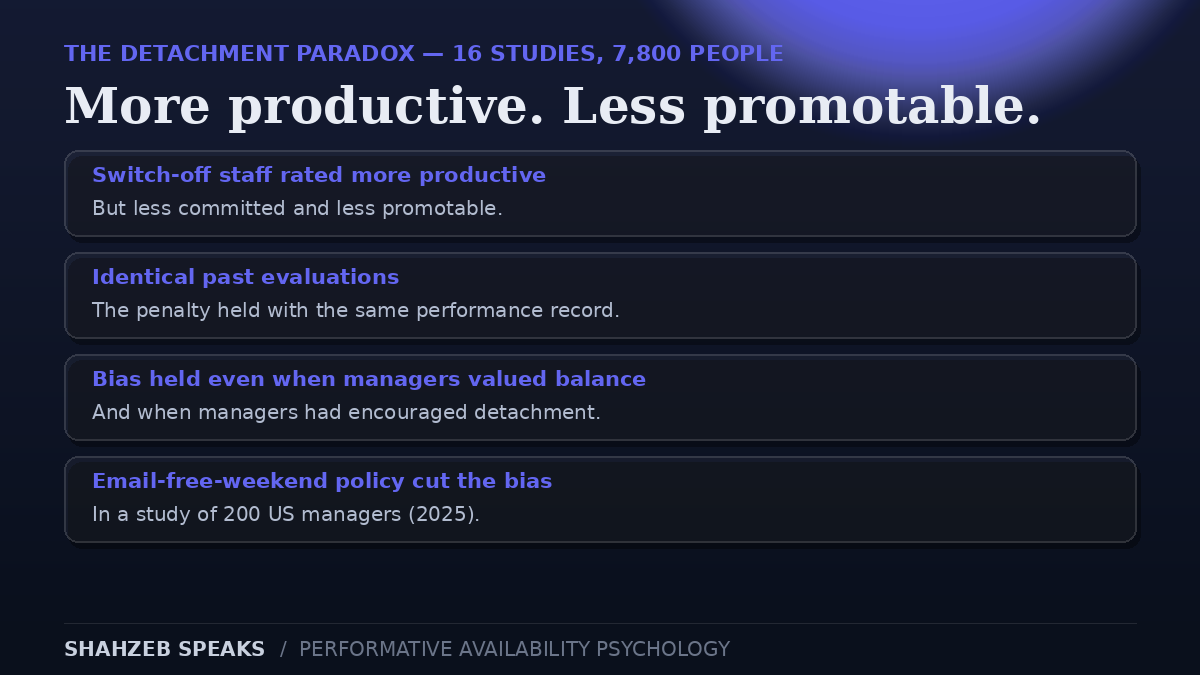
That finding reframes the whole problem. The 49% of workers in the Software Finder survey who worry that setting boundaries could hurt their careers are not being paranoid; they are reading their environment correctly. A manager can sincerely believe in work-life balance and still, in the moment of a promotion decision, reach for the visible worker — because visibility is the easiest proxy for dedication available, and the brain reaches for easy proxies under pressure. This is why “just switch off” is false comfort, and why the advice in Chapter 8 is structural rather than individual. One hopeful detail from the same research programme points the way: in a study of 200 American managers, showing a company policy that encouraged email-free weekends significantly reduced the bias. A policy changes what the manager sees as normal — and normal is what gets rewarded.
💸 Chapter 6: The hidden cost — “I’m fine”
The cost of always-on working is not only measured in hours. It is measured in what people stop saying. Hubstaff’s State of the Workweek 2026, a survey of 1,068 full-time American computer-based workers, found 69% experienced burnout in the past 12 months, and 22% of all employees say it lasted an extended period or is still going on. Fifty-five per cent have told a manager everything was fine when they were actually overwhelmed. Among burned-out employees, 47% say their manager or employer did not know — and among those whose manager did know, 64% say nothing changed, while only 19% say their manager knew and took action. The chain breaks at every link: people hide it, managers miss it, and when they do see it, nothing happens.
The wider context makes the same point at a larger scale. Gallup’s State of the Global Workplace 2026, reporting 2025 data, found that 40% of employees worldwide experienced a lot of stress the previous day — 45% of managers, 43% of women, 42% of under-35s — and that global employee engagement fell to 20% in 2025, with manager engagement down to 22% from 31% in 2022. In Britain, Mental Health UK’s Burnout Report 2026, based on a YouGov survey of 4,502 adults including 2,591 workers, found that 91% of adults experienced high or extreme pressure or stress in the last year — but that figure must be read carefully, because it counts anyone who felt that pressure even rarely; only 34% said they felt it often or always. It is a broad measure of pressure, not a burnout rate, and I will not present it as one. The sharper figure from the same report is that 20% of workers took time off for poor mental health caused by stress, rising to 39% of 18- to 24-year-olds. In Great Britain, the Health and Safety Executive estimates 964,000 workers suffered work-related stress, depression or anxiety in 2024/25, costing 22.1 million working days. The World Health Organization puts the global cost of depression and anxiety at around 12 billion working days and US$1 trillion in lost productivity a year.
There is one more cost that rarely gets counted: the invisibility of the work itself. Hubstaff found that 54% of workers say their employer sees half or less of their workweek, and 71% check work messages outside working hours at least a few times a week — 39% every day — while only 44% can fully log off at the end of the workday. When the work that matters is invisible and the work that is visible is after-hours, the rational worker invests in the visible part. That is the trap: the system rewards the performance, then the performance hides the real work, then the real work goes unrecognised, and the worker works longer to compensate. Deloitte’s 2026 survey of 22,595 Gen Z and millennial workers across 44 countries found 48% of Gen Zs and 45% of millennials say they feel burned out, and only 6% name reaching a leadership position as their primary career goal.
🔍 Chapter 7: The honest nuance — the payoff is uneven, not zero
A responsible account of performative availability has to say the thing the headline leaves out: the payoff is small and uneven, not zero. Among workers who describe themselves as always-on, 57% say availability helped their career — against only 8% of boundary-setters — and 17% credit it with a promotion, against 2% of boundary-setters. For raises and bonuses the gap is 24% against 1%. LeBlanc makes the point himself in Fast Company: “the rewards might not be nonexistent, just uneven.” For a minority of workers, in some roles, under some managers, being visible after hours genuinely helps. The honest reading is that the reward exists, but it is concentrated — while the costs, burnout, broken sleep and a worsened balance, fall on a much larger share.
That unevenness is also the reason the habit is so hard to kill. When a reward is uncertain but occasionally large — a promotion, a manager’s trust, a visible win — people keep pulling the lever, exactly as they do with any intermittent reward. The 8% who did get a promotion become the story everyone tells; the 69% who got nothing become the silence nobody mentions. And the survey cannot tell us whether the boundary-setters who still advanced did so because of something else — better work, a better manager — or in spite of the boundary. All of these surveys are cross-sectional self-reports: associations, not causes. Nobody in this research tracked what actually happened to people who set boundaries over time, so I will not claim boundaries are cost-free. They are not. They are cheaper than the alternative for most people, most of the time — and that is a different, smaller claim, and the honest one.
🛠️ Chapter 8: What actually works — fix the system, not the worker
Individual advice — “just switch off”, “set boundaries”, “protect your evenings” — fails for the reason Chapter 5 gives: the worker who switches off alone gets penalised, while the visible worker gets rewarded, even when the switch-off worker is more productive. The fixes that work are the ones that change what the whole team sees as normal.
First, set explicit reply-time norms. A team that agrees, in writing, that messages sent after 7 p.m. are answered the next working day removes the guesswork that telepressure feeds on. The norm has to be written and repeated by the manager, not implied — because an implied norm is read as “reply fast”, and a written norm is read as permission. Second, run email-free weekends. The 200-manager experiment in the detachment-paradox research found that a company policy encouraging email-free weekends significantly reduced the bias against switch-off employees. A policy is not a suggestion; it is a signal to managers about what the organisation values, and it changes the proxy they reach for. Third, evaluate outcomes, not hours. When promotion decisions are built on documented results rather than on who was online latest, the visibility proxy loses its power — and the detachment paradox has nothing left to feed on. Fourth, protect recovery as a performance input, not a perk. The detachment meta-analysis by Wendsche and Lohmann-Haislah and colleagues, covering 86 publications and 38,124 employees, found that psychological detachment — mentally switching off from job-related thoughts during non-work time — was linked on average to less exhaustion, higher life satisfaction, better well-being and better sleep, with small-to-medium links to task performance. Recovery is not the opposite of performance. It is one of its inputs.
One limit: a larger meta-analysis by Headrick, Newman, Park and Liang (2023), covering 316 samples and 99,329 people, found detachment reliably helps the person — less exhaustion, less conflict — but does not seem to benefit job outcomes such as engagement or performance. Switching off helps you. It may not help your promotion case. And one more figure explains why the problem is getting worse: Hubstaff found that 46% of workers who use AI say the amount of work expected of them has increased since they adopted it, while only 5% say it decreased. The hours AI saves are being filled with more work, not with rest — the same pattern as the phone, one level up.
📅 Chapter 9: A plan for the week — start on Monday
Here is a one-week plan, with each step tied to the evidence above rather than to willpower.
Monday: count your after-hours hours for one week, honestly, including the “quick checks”. The Software Finder average is 1.7 hours a week; if yours is higher, you now have a number to show your manager instead of a feeling. Tuesday: propose one written norm to your team — for example, that messages sent after 7 p.m. are answered the next working day. Frame it as a team agreement, not a personal boundary, so nobody has to be brave alone. Wednesday: turn off notifications after a fixed hour, and tell your team the hour. The evidence on notifications is that they distract even when unanswered, so the point is not discipline; it is removing the trigger. Thursday: protect one evening completely — no email, no messages — and spend it on something the research links to recovery: people, exercise, nature, reading. Friday: write down what you actually finished this week, in results, not hours. That list is your evidence for an outcome-based conversation with your manager. Weekend: try one email-free weekend, and notice what happens. The 200-manager experiment suggests the policy, not the willpower, is what changes the judgement — so if your workplace has no such policy, this weekend is your evidence for proposing one. Next Monday: bring the numbers — your hours, your results, your one protected evening — to your manager, and ask for the norm in writing. You are not asking for a favour. You are asking for the system to stop taxing the people it claims to reward.
Performative availability survives because it looks like dedication and feels like safety. The evidence says it is mostly neither: a small, uneven payoff, bought with burnout, broken sleep and evenings that never quite end. The workers who break the pattern are rarely the ones with the strongest willpower. They are the ones whose teams agreed, in writing, that 10.40 p.m. is not working time — and whose managers kept that agreement when it mattered.
❓ Questions I am asked most often
What is performative availability?
It is the habit of staying visibly reachable after hours to show commitment rather than to do needed work. Jeff LeBlanc coined the term in Fast Company on 2 November 2026, defining it as “the compulsion to demonstrate professional commitment based on visibility instead of the value or importance of your contributions”.
Does being always on after hours help your career?
Rarely. In a 2026 survey of 1,006 US employees, only 8% said high responsiveness after hours directly contributed to a promotion, and 69% said it had not meaningfully improved their careers. Among always-on workers themselves, 57% said it helped their career — so the payoff exists, but it is small and uneven.
Why do people stay always on if it rarely pays off?
Because the fear is partly rational. In 16 studies with 7,800 participants, managers rated switch-off employees as more productive but less committed and less promotable, even with identical past evaluations. Telepressure, impression management and blurred boundaries all push the same way: visibility feels safer than rest.
Is always-on working linked to burnout?
Yes, in self-reported survey data — but the link is an association, not proof of causation. Always-on workers were 2.8 times as likely to report worsened burnout as boundary-setters (34% vs 12%). Hubstaff’s 2026 survey found 69% of US computer-based workers experienced burnout in the past 12 months, and 55% had told a manager they were fine when overwhelmed.
What is telepressure?
Telepressure is the urge to respond quickly to work messages combined with a preoccupation with response times, defined by Barber and Santuzzi in 2015. It is measured with a six-item scale covering the urge and the preoccupation. It is a learned response to workplaces where fast replies are read as commitment, not a personal weakness.
How can I stop being always on without hurting my career?
Do not do it alone. Agree written reply-time norms with your team, try an email-free weekend, and push for outcome-based evaluation — the 200-manager experiment found that a written email-free-weekend policy significantly reduced the bias against switch-off employees. Bring your results, not your hours, to promotion conversations.
If your team cannot stop replying at midnight, the problem is usually the work design, not the willpower. I help organisations measure after-hours load and redesign it — get in touch here.
Read more: industrial psychology in Pakistan is my home base, and my related pieces on the psychology of workplace burnout, decision fatigue, employee engagement at a 15-year low, the AI productivity paradox and the psychology of social media addiction cover the neighbouring questions this research raises.
Sources
- Software Finder (2026). Always on after hours: The hidden cost of after-hours work. Survey of 1,006 US employees, June 2026; report published 12 July 2026, updated 27 July 2026.
- LeBlanc, J. (2026). Gen Z is challenging performative availability. Fast Company, 2 November 2026.
- Jones, C. (2026). Gen Z pushes back on “performative availability” as only 8% of workers say it won them a promotion. Fortune, 8 November 2026 (read via syndicated republication).
- Crumley, B. (2026). Always-on work rarely pays off. Inc., 4 November 2026.
- Harvard Business Review (2025). Research: Are you penalizing your best employees for unplugging? 12 May 2025. Research published in Organizational Behavior and Human Decision Processes (2025), 16 studies, 7,800 participants.
- Hubstaff (2026). State of the Workweek 2026. Survey of 1,068 full-time US computer-based workers, via Pollfish, October 2026.
- Gallup (2026). State of the Global Workplace 2026 (2025 data).
- Mental Health UK (2026). Burnout Report 2026. YouGov survey of 4,502 UK adults, including 2,591 workers; fieldwork 3–5 November 2025.
- ZeroBounce (2026). The Out-of-Office Illusion. Survey of 1,157 professionals, US and Europe, February 2026.
- Health and Safety Executive (2026). Work-related stress, depression or anxiety statistics, 2024/25.
- World Health Organization (2022). Mental health at work.
- Deloitte (2026). Deloitte Global 2026 Gen Z and Millennial Survey. 22,595 respondents, 44 countries; fieldwork 24 November 2025–15 January 2026.
- International Stress Management Association (2026). International Stress Awareness Week, 2–6 November 2026.
- Barber, L. K. & Santuzzi, A. M. (2015). Please respond ASAP: Workplace telepressure and employee recovery. Journal of Occupational Health Psychology, 20(2), 172–189.
- Sonnentag, S. & Fritz, C. (2007). The Recovery Experience Questionnaire: Development and validation of a measure for assessing recuperation and unwinding from work. Journal of Occupational Health Psychology, 12(3), 204–221.
- Wendsche, J. & Lohmann-Haislah, A. (2016). A meta-analysis on antecedents and outcomes of detachment from work. Frontiers in Psychology, 7, 2072.
- Headrick, L., Newman, D. A., Park, Y. A. & Liang, Y. (2023). Recovery from work: A meta-analysis of the effects of psychological detachment. Journal of Business and Psychology, 38(4), 821–864.
- Ashforth, B. E., Kreiner, G. E. & Fugate, M. (2000). All in a day’s work: Boundaries and micro role transitions. Academy of Management Review, 25(3), 472–491.
- Goffman, E. (1959). The Presentation of Self in Everyday Life. Doubleday.