

Picture the scene. An analyst finishes a report in twenty minutes with an AI tool, a job that used to take half a day. By lunch, her manager has added two more reports to the pile. By Friday, the time she saved has vanished, and her week is exactly as full as it was before — except now the bar is higher, because everyone knows the work can be done faster. That is the AI productivity paradox: the tool saves hours, and the workload grows to swallow them.
I am an Industrial and Organizational Psychologist in Karachi, and I write about work for a global reader. This piece is built on one new survey, Hubstaff’s State of the Workweek 2026, published on 27 October 2026, which asked 1,068 full-time American workers in computer-based roles what their weeks actually look like. I will keep the scope honest throughout: this is a US survey of perceptions, commissioned by a workforce-software company, and it does not prove that AI causes burnout. What it does prove is that something is off in how the time AI saves is being spent — and that managers are making staffing decisions with half the picture missing.
“AI is giving time back to individual employees, but most organizations aren’t capturing it as capacity.”
— Jared Brown, CEO of Hubstaff, quoted in Fair Play Talks, 2 November 2026
This guide covers what the survey found, why two old ideas from 1865 and 1955 explain it better than any new theory, where the saved hours actually go, and what a manager can change first. It is written for managers, team leads and anyone who has wondered why a faster tool left them with less time, not more.
🤖 Chapter 1: The short answer — the AI productivity paradox
The AI productivity paradox is simple to state: AI tools save most workers real time, yet the work expected of them rises at least as fast as the time saved. Hubstaff’s survey found that 79% of employees in computer-based roles use AI tools for work, and among those who could estimate their savings, 76% save at least an hour in a typical week, with 32% saving four hours or more. But 46% of AI users say the amount of work expected from them has increased since they started using AI, and only 5% say it has decreased. The saving is real. The relief is not.
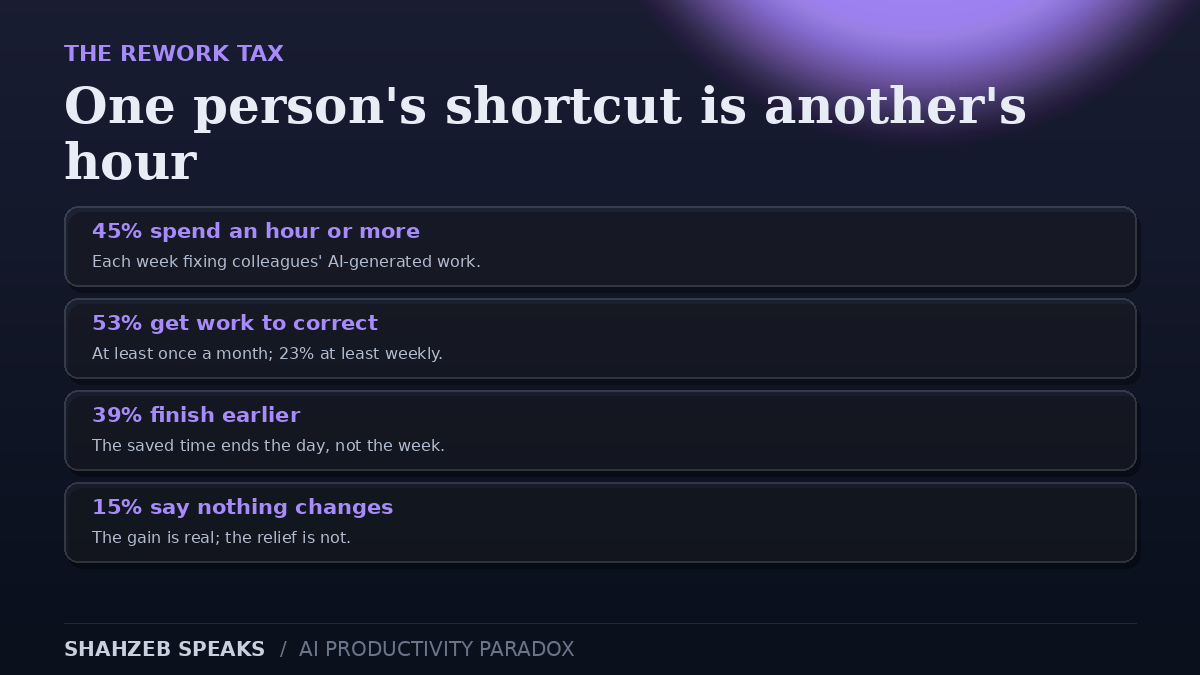
Only 26% of AI users say they take on more work with the time they save, which means the extra work is not mostly a free choice. For 39%, the saved time simply means finishing earlier; for 15%, nothing really changes. The paradox is not that AI fails. It is that a gain measured for one person gets spent by the organisation around them — through higher expectations, through extra work created for colleagues, and through hours that nobody counts. If you manage a team, the first question is not how much time AI saves your people. It is where that time goes, and who decides.
🔢 Chapter 2: The numbers behind the headline
Hubstaff’s State of the Workweek 2026 is based on a survey of 1,068 full-time workers in the United States, aged 18 to 64, whose jobs mainly involve working at a computer. The survey was run through Pollfish in October 2026, and Hubstaff commissioned it — it sells time-tracking and workforce software, so it has a commercial interest in the question, and its findings should be read with that in mind. Results are unweighted, percentages are rounded, and the margin of error is plus or minus three percentage points at a 95% confidence level for the full sample. These are self-reported perceptions, not a time diary, so they measure what workers believe about their weeks, not what a stopwatch would show. That is a limit, but it is also the point: decisions about workloads are made on the basis of what managers believe, and what workers believe is the only check on that.
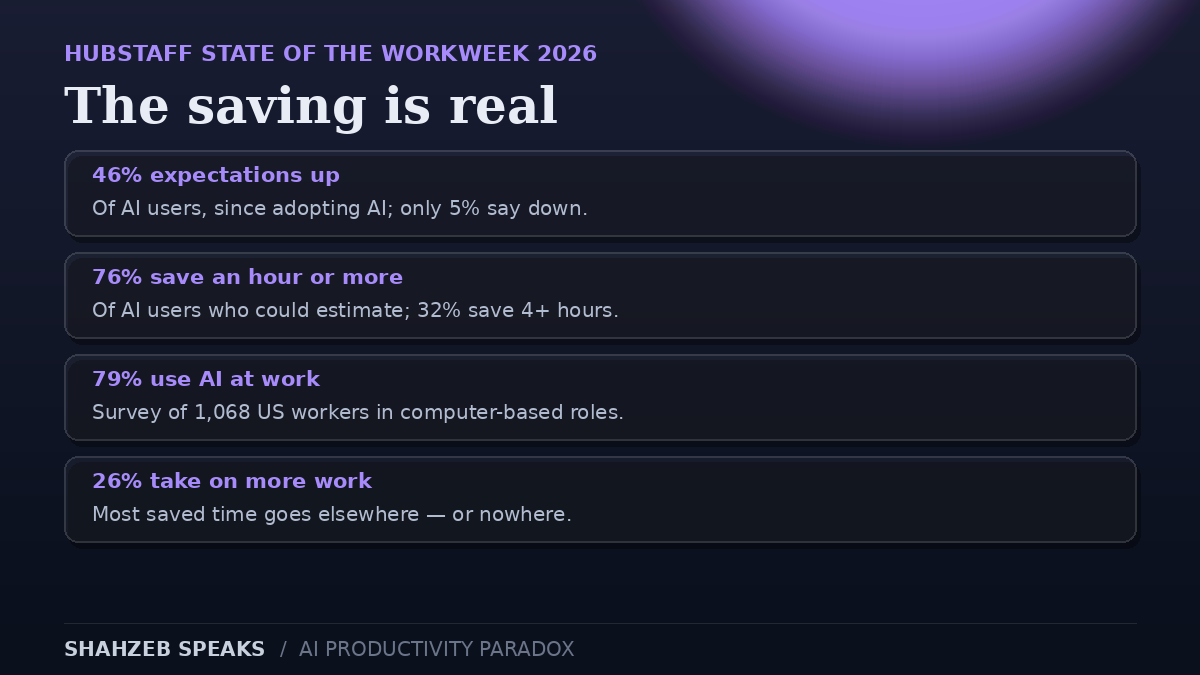
The headline numbers sit together in a way that should stop any manager mid-sentence. AI adoption is widespread: 79% use it. The savings are large: three in four savers gain at least an hour a week, and nearly a third gain four hours or more. Yet the expectations moved in only one direction for nearly half of users. Five per cent say expectations fell. That asymmetry is the story. If AI were simply making weeks lighter, the two numbers would move together. Instead, the saving accrues to the worker and the demand accrues to the job, and the gap between them is filled with work that was never planned.
| Measure | Result |
|---|---|
| Use AI tools for work | 79% |
| Save at least 1 hour a week (of those who could estimate) | 76% |
| Save 4 hours or more a week | 32% |
| Say work expectations increased since adopting AI | 46% |
| Say work expectations decreased since adopting AI | 5% |
| Take on more work with the time saved | 26% |
| Finish work earlier with the time saved | 39% |
Source: Hubstaff, State of the Workweek 2026; n=1,068 full-time US workers in computer-based roles, October 2026.
There is a second survey worth setting beside this one. Culture Amp’s research, reported by Fair Play Talks, found that 71% of employees believe AI improves their productivity, rising to 93% among the heaviest users. Yet 72% of AI power users considered their workload reasonable, against 69% of employees who did not regularly use AI — a difference of three percentage points. The tools feel productive, and the workload feels almost exactly the same. Both surveys point the same way: the productivity gain is real at the level of the individual task, and it evaporates at the level of the week.
🧹 Chapter 3: The hidden rework tax
The first place the saved time goes is into work nobody planned: fixing what AI produced. More than half of AI users, 53%, receive AI-generated work from colleagues that needs significant editing or correction at least once a month, and 23% receive it at least once a week. Nearly half, 45%, spend an hour or more in a typical week reviewing, editing or correcting other people’s AI-generated work. That is a new line item in the working week, and it is almost entirely uncounted.
Think about what that means in a team of ten. If five people each save two hours a week with AI, the team has apparently gained ten hours. But if four of them each spend an hour a week correcting a colleague’s AI draft, four of those hours are gone before the team has done anything new — and the correction work is the kind that never appears on a status update. The person who generated the draft saved time. The colleague who received it spent time checking facts, fixing errors and rewriting. The saving is visible; the cost is not. That is why counting individual time saved overstates the gain for the team, and why a manager who plans capacity on individual savings will keep wondering why the team feels overloaded.
The fix here is a rule, not a tool. Whoever uses AI to produce a document should check its facts and edit it before passing it on, so the cleanup stays with the person who saved the time. Teams can agree a review standard — facts checked, numbers verified, claims sourced — before AI output reaches a colleague. Without that, the fastest drafter in the team quietly becomes the most expensive, because everyone downstream pays for the speed.
📜 Chapter 4: Two old ideas that explain it — Jevons and Parkinson
Two observations from long before AI explain the paradox better than any new framework. The first is the Jevons paradox, named after the English economist William Stanley Jevons, who set it out in The Coal Question in 1865. Jevons noticed that more efficient steam engines did not reduce Britain’s coal use. Cheaper coal-powered work spread into more uses — railways, ships, ironworks, textile mills — and total consumption rose. His line was blunt: it is a confusion of ideas to suppose that the economical use of fuel is equivalent to diminished consumption. The same shape appears with AI. A report that costs less time to produce does not mean fewer reports. It means reports become cheap enough to ask for more of, and the demand expands to absorb the saving.
The second is Parkinson’s law, from a satirical essay by the British naval historian Cyril Northcote Parkinson in The Economist on 19 November 1955: work expands so as to fill the time available for its completion. Parkinson was writing about bureaucracy, and his essay was a joke about government offices, but the observation outlived the joke because everyone recognises it in their own week. Give a task a week, and it takes a week. Give a worker an hour back, and the week refills. Neither idea is a law of nature — both are observations about how people and organisations behave when a constraint loosens. Taken together, they predict exactly what Hubstaff measured: efficiency gains that lower the cost of work will raise the demand for work, until the week is full again.
Why this matters for AI policy
Both ideas point to the same management error. Treating every hour AI saves as spare capacity assumes demand stays fixed while supply grows. It does not. Demand grows because the work got cheaper, and because the people setting the demand can see the speed but not the rework. A team that adopts AI without deciding in advance what the saved time is for — shorter weeks, better quality, learning, or genuinely more output — will have the decision made for it, by default, in favour of more output. That is a choice, and it should be made openly rather than discovered in a burnout survey.
👁️ Chapter 5: The half of the week nobody sees
The deeper problem is not the rework. It is that managers are deciding workloads with half the picture missing. More than half of employees, 54%, say their employer sees half or less of their real workweek. A quarter, 26%, say their employer sees little or almost none of it. Only 15% believe their employer sees all of it. The real workweek, as Hubstaff defines it, includes late replies, rework, and the effort of keeping up — the parts that rarely come up in a meeting or a status update.
The after-hours numbers fill in the shape. Seventy-one per cent check work messages outside their working hours at least a few times a week, and 39% do so every day. Forty-three per cent work evenings or weekends most weeks or every week, and only 44% say they can fully log off at the end of the workday. More than a quarter, 28%, worked during their most recent holiday. Nobody asked them to, in most cases. A message arrives at eight in the evening, or a deadline cannot be met inside a regular day, and the extra hours happen without being recorded, planned or paid for in any staffing model.
Capacity planning usually assumes a forty-hour week. A workload that only fits when employees add evenings and weekends looks manageable against those forty hours, even when the real number is closer to forty-five or fifty. That is the planning trap the survey exposes. Return-to-office policies do not fix it either: 58% of fully on-site employees say their employer sees half or less of their week, against 51% of remote and hybrid employees. Sitting near a manager does not reveal evening work, AI rework or how much capacity someone has left. If one goal of bringing people back to the office is a clearer view of how work gets done, physical presence alone will not deliver it.
😶🌫️ Chapter 6: Burnout that stays hidden
The human cost sits in the same survey. Sixty-nine per cent of employees say they experienced burnout in the past twelve months, and for 22% of all employees it lasted an extended period or is still going on. The World Health Organization defines burnout as an occupational phenomenon resulting from chronic workplace stress that has not been successfully managed, and that definition matters here: it places the cause in the work, not in the worker.
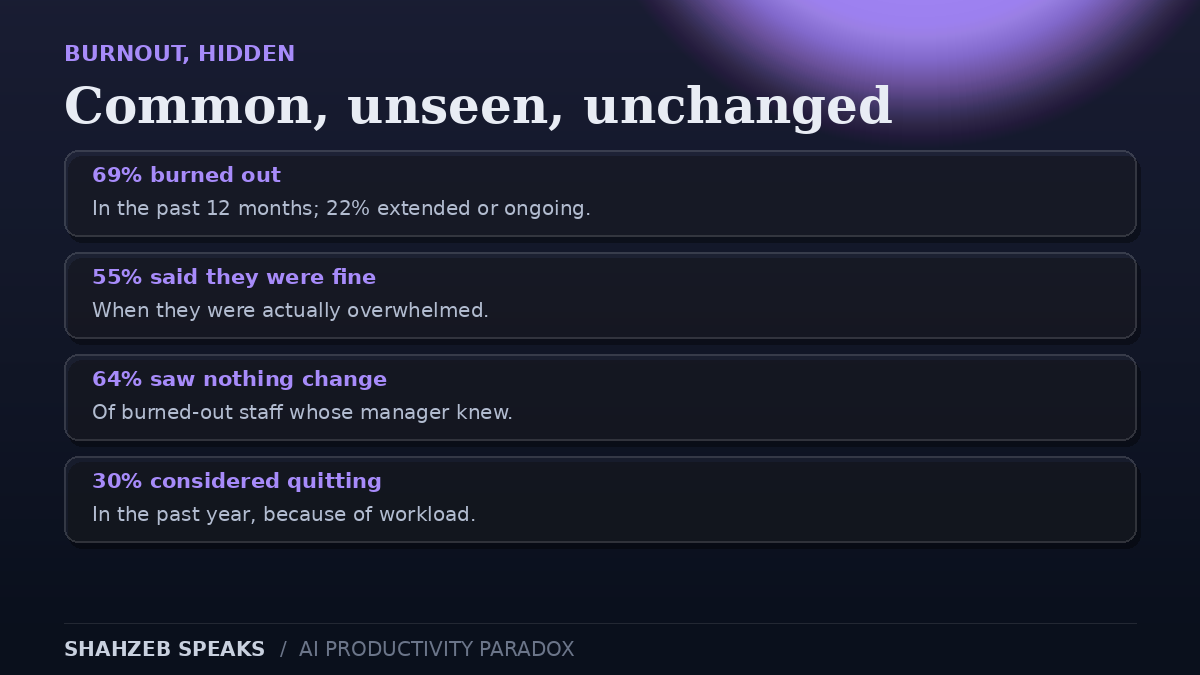
Much of it stays hidden. Fifty-five per cent have told their manager everything was fine when they were actually overwhelmed, and 47% of employees who experienced burnout say their manager or employer did not know. A general check-in question — “how are you doing?” — is easy to deflect with “fine”, and the manager plans the next month of work around that answer. Specific questions are harder to deflect: which project is taking the most out of you, what would you drop if you could, what is taking longer than planned this week.
What happens after disclosure is the most troubling figure in the whole survey. Among burned-out employees whose manager or employer knew, 64% say nothing changed. Only 19% of employees who experienced burnout say their manager knew and took action. A manager knowing about burnout is a starting point, and in about two out of three cases it is also where things stop. When speaking up changes nothing, employees have less reason to speak up the next time, which helps explain why so many say they are fine. Managers are not always in a position to act — a team lead may lack the authority to move a deadline or bring in help — but that is an organisational design problem, not a reason to stop asking.
The stakes are concrete. Thirty per cent of employees seriously considered quitting in the past year because of their workload. Workload is something an employer can change, but only after learning about it and responding to it. The wider context fits: Gallup’s State of the Global Workplace 2026 found that 40% of employees worldwide experienced significant stress during the previous day, and Mental Health UK’s Burnout Report 2026 found that 91% of adults reported high or extreme levels of pressure, with one in five UK workers taking time off because of poor mental health caused by stress in the previous year. A separate US study from Modern Health, reported during International Stress Awareness Week in early November 2026, found that 69% of employees believed AI would lead to layoffs at their company within three years, 49% feared personally losing their jobs, and 67% believed AI had increased productivity expectations. Fear and workload are travelling together.
🚫 Chapter 7: What this survey does not prove
Honesty about limits is part of the job, so here they are. First, this survey does not establish that AI adoption is directly responsible for burnout. The two appear together in the same workforce, but the survey cannot separate AI-driven pressure from every other source of overload, and Fair Play Talks says so explicitly in its report. A manager who blames the tool will miss the workload decision that actually caused the harm.
Second, the survey is American and computer-based. Its 1,068 respondents are full-time US workers whose jobs mainly involve working at a computer, and the results are unweighted. Readers elsewhere should treat it as a case study with a familiar shape, not a global statistic. Third, the figures are perceptions. People report what they believe about their weeks, and beliefs can be wrong in both directions — some will overstate their hours, some will understate them. What matters is that staffing decisions are also made on beliefs, so the gap between what managers see and what workers live is itself a real finding, even if the exact percentages carry a margin of error of three points.
Fourth, the Culture Amp and Modern Health figures in this piece come second-hand, through Fair Play Talks reporting. I have not read those original reports, and I say so rather than presenting their numbers as if I had. Finally, the Jevons paradox and Parkinson’s law are analogies, not proofs. They describe patterns in economics and administration, and they fit this data well, but neither one demonstrates that AI must raise workloads. They explain why it tends to, unless someone decides otherwise.
🛠️ Chapter 8: Fix in this order
If you manage a team, fix in the order the survey points. First, measure the whole week, not the visible part. In one-to-ones, ask what took longer than planned this week and what got done after hours. Fifty-four per cent of employees say you are seeing half of their week or less, and you cannot plan capacity on half a picture. Second, decide what the saved time is for, before AI takes it. If the answer is more output, say so openly and price it honestly. If the answer is better quality, shorter weeks or learning, protect it — a saved hour that is immediately refilled is not a gain, it is a faster treadmill.
Third, account for AI rework. Ask your team how much time they spend correcting AI-generated work, and agree a review standard before AI output gets passed to a colleague: the person who used the tool checks facts and edits first. Fourth, make “I am overwhelmed” safe to say, and follow awareness with action. When someone tells you they are burned out, agree on one specific change — moving a deadline, reassigning a project, approving time off — and check back within two weeks. Fifty-five per cent have said they were fine when they were not, and 64% of those whose manager knew saw nothing change. The test of a manager is not whether they ask. It is whether something visible happens after they ask.
Fifth, set expectations for after hours. Tell your team whether evening and weekend messages need a reply before the next workday. Seventy-one per cent are checking them at least a few times a week, and most of that checking is driven by guesswork about what is expected. A short, written rule removes the guesswork. None of these five steps requires new software. They require a manager to count what the dashboard does not show, and to treat a saved hour as a decision, not as free capacity.
❓ Questions I am asked most often
Is AI making workloads heavier?
For many workers, yes. In Hubstaff’s 2026 survey, 46% of AI users said the work expected of them had increased since they adopted AI, against 5% who said it had decreased. That is a survey of perceptions in one US sample, not proof of causation, but the direction is clear.
Does AI actually save time?
Yes, for most users. Among AI users who could estimate, 76% saved at least an hour in a typical week and 32% saved four hours or more. The problem is not the saving. It is that the saved time is absorbed by higher expectations and by correcting colleagues’ AI output.
What is the AI productivity paradox?
It is the pattern where AI tools make individual tasks faster, yet total workload does not fall — because cheaper work invites more work, expectations rise, and new tasks such as checking AI output appear. It echoes the Jevons paradox of 1865 and Parkinson’s law of 1955.
How much time do workers spend fixing AI-generated work?
Forty-five per cent of AI users spend an hour or more a week reviewing, editing or correcting other people’s AI-generated work, and 53% receive work needing significant correction at least once a month. That rework is rarely counted in productivity figures.
Why do managers not see the overload?
Because 54% of employees say their employer sees half or less of their real workweek, and 55% have told a manager they were fine when they were overwhelmed. Status updates show finished work, not evening hours, rework or the exhaustion behind them.
Is burnout caused by AI?
The survey does not prove that. Sixty-nine per cent of respondents experienced burnout in the past year, but the study cannot separate AI-driven pressure from other causes. What it shows is that burnout, rising expectations and invisible work are arriving together, and that managers often do not know or do not act.
If AI has made your team faster and more tired at the same time, the workload is the place to look first. I help organisations measure the whole workweek and redesign expectations around what it actually shows — get in touch here.
Read more: industrial psychology in Pakistan is my home base, and my related pieces on the psychology of workplace burnout, workplace burnout statistics 2026, decision fatigue and capability anxiety at work cover the neighbouring questions this survey raises.
Sources
- Hubstaff (2026). State of the Workweek 2026. Survey of 1,068 full-time US workers in computer-based roles, conducted through Pollfish in October 2026; published 27 October 2026.
- Fair Play Talks (2026). “AI’s Hidden Cost: Nearly Half Face Rising Workloads Amid Widespread Burnout, Study Finds”, 2 November 2026.
- Fair Play Talks (2026). “Stress Awareness Day 2026: Rehumanising the Workplace as Burnout and Pressure Mount”, 4 November 2026.
- Inc. (2026). “Two-Thirds of Workers Just Reported Burnout. Most Leaders Still Can’t See the Clearest Warning Sign”, 29 October 2026.
- World Health Organization. Burnout as an occupational phenomenon, ICD-11.
- Jevons, W. S. (1865). The Coal Question. Macmillan.
- Parkinson, C. N. (1955). “Parkinson’s Law”, The Economist, 19 November 1955.
- Gallup (2026). State of the Global Workplace 2026, as reported by Fair Play Talks.
- Mental Health UK (2026). Burnout Report 2026, as reported by Fair Play Talks.