

A manager I know keeps asking the same question in team meetings: why does the same job, with the same pay, now buy less effort than it did ten years ago? On 3 November 2026, the Resolution Foundation published an answer that should worry every employer in Britain. Job satisfaction among UK workers has fallen to its lowest level since the British Social Attitudes survey first asked the question in 1989. The job has not just got harder; the bargain behind it has changed, and workers can feel the gap every payday and every rota.
I am an Industrial and Organizational Psychologist in Karachi, and I write about work for a global reader. This piece is about Britain, and I will keep it there: the numbers below come from one British survey, analysed by one British think tank, and they describe British workers. They are still useful far beyond Britain, because the pattern they show — rising expectations meeting jobs that have not kept up — is easy to recognise anywhere.
“Workers increasingly want jobs that provide flexibility, independence and financial security. But many feel those expectations are not being met.”
— Workplace Psychology Analysis, ShahzebSpeaks
This guide covers what the survey actually found, what it does not prove, why the old explanations fail, and what a manager can change first. It is written for managers, team leads and anyone deciding whether to stay in a job that no longer feels worth the effort.
📉 Chapter 1: The short answer — UK job satisfaction
UK job satisfaction fell from 81% in 2015 to 74% in 2025, according to the Resolution Foundation’s analysis of the 2025 British Social Attitudes survey. That 74% is the lowest figure recorded in any wave of the survey since the question was first asked in 1989. Over the same decade, the share of workers willing to work harder than required to help their employer succeed fell from 69% to 55%. In plain terms: fewer people like their jobs, and fewer are willing to give extra effort for them.
The short answer to the manager’s question is therefore not laziness. Only 4% of working-age adults say they would ideally prefer not to work at all. People still want work. What they no longer want, in the same numbers, is the particular deal on offer: a job that pays less than they need, controls their hours more than they accept, and offers less interesting work and less chance to advance than it did ten years ago.
🔢 Chapter 2: The numbers behind the headline
The Resolution Foundation’s report, titled Work in Progress: A Decade of Change in the World of Work, is an analysis of the latest British Social Attitudes (BSA) survey, conducted by the National Centre for Social Research (NatCen). The 2025 survey fieldwork ran from 26 August to 6 October 2025 and gathered 4,656 fully completed interviews from adults aged 16 and over across the UK. The BSA is the UK’s longest-running survey of social and political attitudes, run annually by NatCen since 1983, and the job-satisfaction question itself dates back to 1989. That long run is what makes the new low meaningful: this is not one bad year against a short baseline.
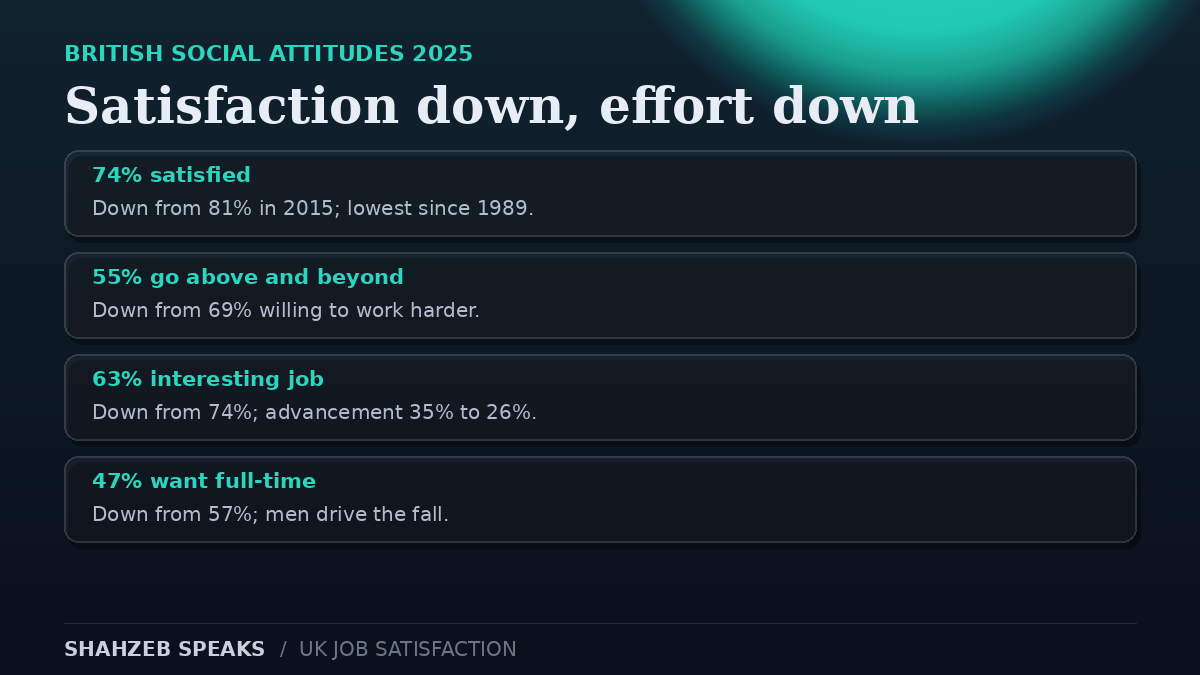
Four falls carry the story. Satisfaction with the main job dropped seven points, from 81% to 74%. Willingness to work harder than required dropped fourteen points, from 69% to 55%, which the Foundation describes as the lowest ever level over the past decade. The share calling their job interesting fell from 74% to 63%. And the share reporting opportunities for advancement fell from 35% to 26%. Notice the order of size: the effort measure fell twice as far as satisfaction itself. People are withdrawing effort faster than they are withdrawing approval, which is exactly what a broken bargain looks like — you still show up, you just stop giving the extra mile for free.
| Measure | 2015 | 2025 | Change |
|---|---|---|---|
| Satisfied with main job | 81% | 74% | −7 points |
| Willing to work harder than required | 69% | 55% | −14 points |
| Job is interesting | 74% | 63% | −11 points |
| Opportunities for advancement | 35% | 26% | −9 points |
Source: Resolution Foundation analysis of the British Social Attitudes survey, published 3 November 2026.
⚖️ Chapter 3: The want-provide gap
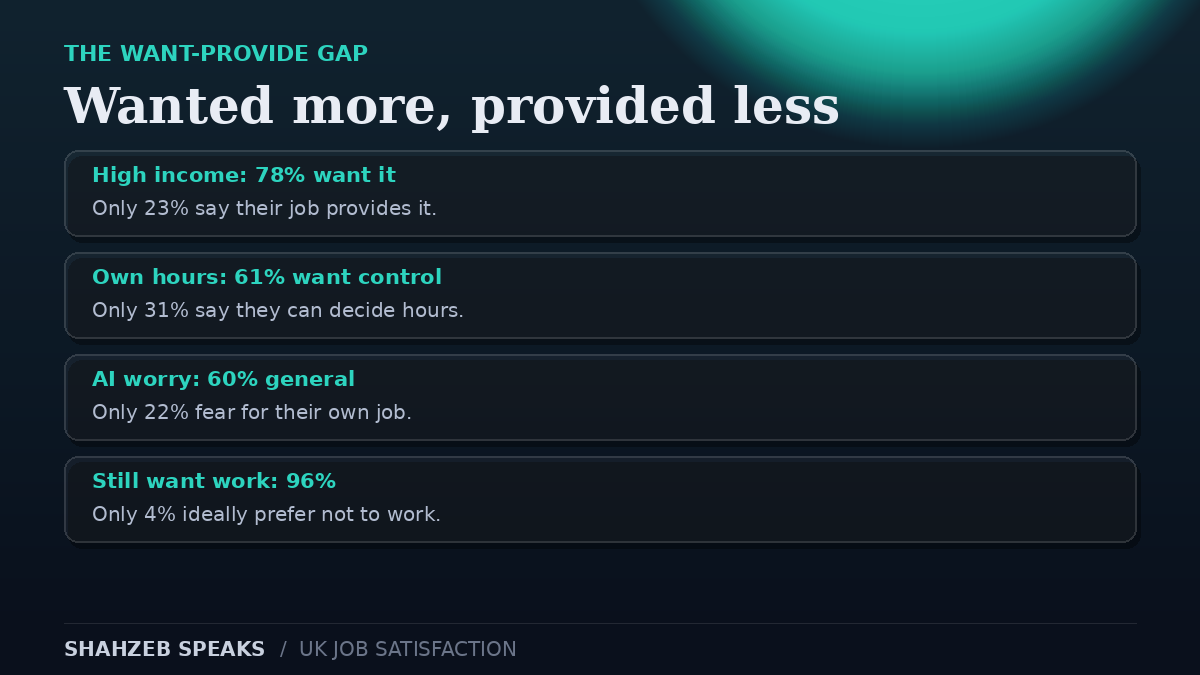
The most useful part of the report is not the satisfaction figure alone. It is the gap between what workers say matters and what their jobs provide. A high income became more important, not less: the share saying it matters when choosing a job rose from 67% to 78%. Yet only 23% feel their job provides a high income. Control over working hours shows the same shape. The share saying it matters to decide their own hours rose from 46% to 61%, which the Foundation links, cautiously, to the experience of the pandemic. Only 31% say they can actually do that in their job.
I call this the effort bargain because it captures what a survey question about satisfaction cannot: work is an exchange. The worker offers time, attention and effort. The employer offers pay, security, control over hours, interesting work and a future. When one side of the exchange improves and the other stands still, satisfaction falls even if nobody is mistreated. Nothing in the report says employers suddenly became crueller. It says workers’ expectations moved — towards flexibility, independence and financial security — while jobs, for many, did not move with them. Hannah Slaughter, the Resolution Foundation’s principal economist and co-author of the analysis, put it directly: the result is rising frustration, which she calls a “dissatisfaction drain”, and she warns it bodes poorly for productivity and labour supply. That warning is an interpretation, not a measured effect, and I keep it labelled as one below.
🕐 Chapter 4: The full-time puzzle
The strangest finding concerns full-time work. The share of working-age adults who would ideally like to work full-time fell from 57% in 2015 to 47% in 2025 — below half for the first time in this comparison. The decline is entirely accounted for by men, among whom the figure fell from 77% to 62%, while the share of women wanting full-time work, at 38%, is little changed. At the same time, the share who actually work full-time rose by three points over the decade.
Read those two facts together and the puzzle sharpens. More people are working full-time than want to, and the mismatch is concentrated among men. That is not a story about people refusing work. It is a story about hours that do not fit the lives around them, and about a labour market where the full-time default is easier to keep than to redesign. It also answers the laziest reading of the report before it can take hold. Sir John Curtice, co-editor of the British Social Attitudes report, said young people have not become more “work-shy”, nor have workers in general become more reluctant to change jobs. The evidence backs him: only 2% of under-30s who are not full-time students say they do not want to work, and the share saying they are likely to look for a new job in the next 12 months, at 34%, has changed little since 2015. People are not opting out. They are opting out of extra effort for a deal they no longer rate.
🧠 Chapter 5: Why the old theories fit this data so well
Three classic ideas explain the pattern better than any slogan about attitude. The first is Herzberg’s two-factor theory (Herzberg, Mausner and Snyderman, 1959). Herzberg argued that satisfaction and dissatisfaction come from different sources: motivators such as achievement, recognition, responsibility and the work itself create satisfaction, while hygiene factors such as pay, policy, supervision and working conditions prevent dissatisfaction when they are adequate. The BSA data shows both sides weakening at once. Interesting work and advancement — classic motivators — fell. Pay adequacy and hour control — hygiene factors — lag behind what workers now value. A theory from 1959 predicts exactly this double squeeze: fix only pay, and you remove a complaint without creating enthusiasm; fix only interesting work, and people still leave over money and hours.
The second is the Job Characteristics Model of Hackman and Oldham (1976). It names five features that make work motivating: skill variety, task identity, task significance, autonomy and feedback. Together they produce experienced meaningfulness, responsibility for outcomes and knowledge of results. The BSA falls map onto that model with uncomfortable neatness. Interesting work down, advancement down, hour control wanted but not provided — that is variety, significance and autonomy all under pressure. A job can be busy all day and still score low on every one of those five features, which is why headcount and effort are such poor proxies for satisfaction.
The psychological contract
The third idea is the psychological contract: the unwritten set of expectations between worker and employer about what each owes the other. When the contract holds, extra effort feels like reciprocity. When it breaks — pay stagnates while demands rise, flexibility is promised but rotas do not bend — extra effort starts to feel like exploitation, and people withdraw it quietly. That withdrawal is what the 69% to 55% fall measures. It is not a strike and not a resignation. It is the quiet repricing of effort by people who have decided the old price no longer holds.
🚫 Chapter 6: What this survey does not prove
Honesty about limits is part of the job, so here are the limits stated plainly. First, these are stated attitudes, not measured output. The survey asks people what they feel and what they would ideally prefer. It does not measure how much they produce, and it cannot show that lower satisfaction caused lower productivity, even though the Foundation warns the pattern bodes poorly for productivity. Association is not causation, and a manager who treats a survey as a productivity meter will misread it.
Second, the survey is British. Its sample is adults across the UK, and its story is about British expectations after a decade that included the pandemic, a cost-of-living squeeze and rapid change in how work is organised. Readers elsewhere should treat it as a case study with a familiar shape, not as a global statistic. Third, the report gives a decade comparison, 2015 against 2025, not a year-by-year path. It cannot say whether the fall was steady, sudden, or concentrated in a few years, and it cannot isolate which single change — pay, hours, or the work itself — mattered most. Any article claiming one cause from this data alone is guessing.
Fourth, the artificial intelligence finding needs care. Sixty per cent of working-age adults worry that digital technologies will take over many jobs currently done by humans, but only 22% of workers fear for their own job. That gap is familiar in risk research: people rate a threat to others higher than the same threat to themselves. It does not mean workers are complacent, and it does not mean the worry is irrational. It means the anxiety is general and the personal risk feels distant, which is a poor basis for either panic or reassurance.
🛠️ Chapter 7: Fix in this order
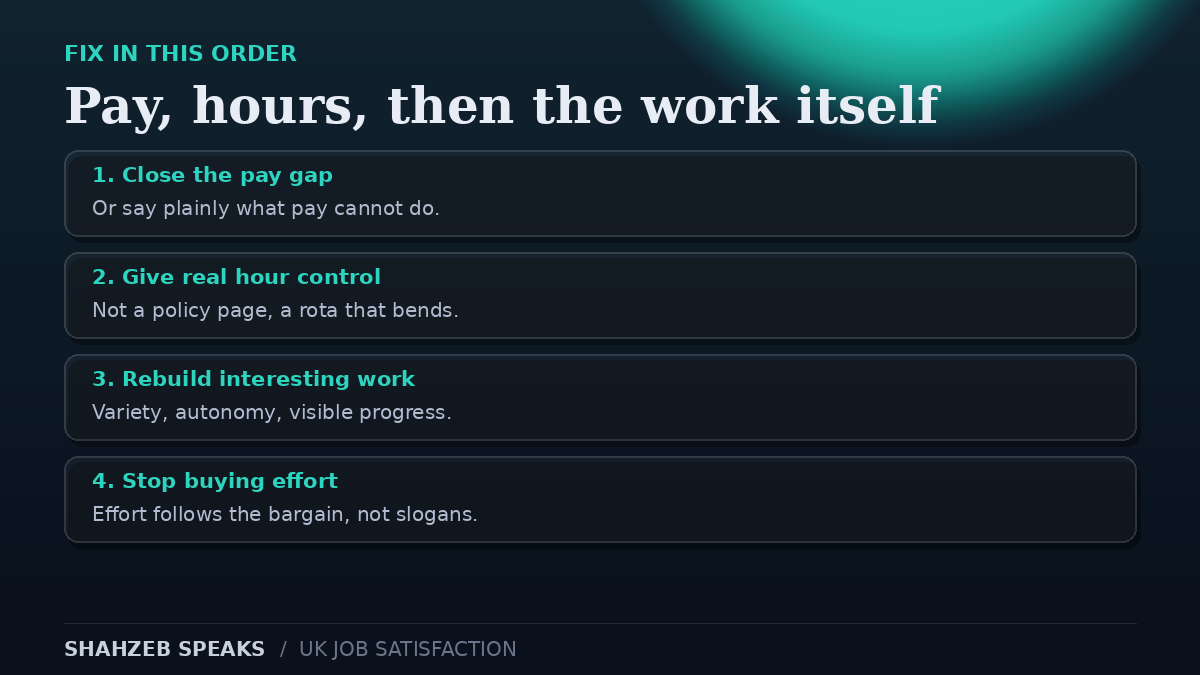
If you manage a team, fix in the order workers feel the gap. First, close the pay gap or say plainly what pay cannot do. The worst version of this conversation is silence: workers already know 78% of them value a high income and only 23% feel they get one. A manager who names the constraint, shows the range honestly, and explains what would have to change for pay to move is more credible than one who changes the subject to purpose. Purpose matters — my previous work on mission and harassment showed people can believe deeply in a mission and still be harmed at work — but purpose is not a substitute for pay.
Second, give real control over hours. That means rotas, start times and meeting loads that actually bend, not a flexibility policy that requires three approvals. The BSA gap here is thirty points wide (61% want control, 31% have it), which is the largest single want-provide gap in the report. Third, rebuild interesting work: variety in tasks, a visible finished product, and feedback that arrives while it can still change something. Those are Hackman and Oldham’s levers, and they cost less than a pay rise while reaching the motivators pay cannot reach. Fourth, stop trying to buy effort back with slogans. Extra effort is a response to a fair bargain, not a response to a poster. If the bargain is fair, most teams will give the extra mile without being asked. If it is not, no campaign will persuade them otherwise, and the attempt itself will deepen the cynicism.
✅ Chapter 8: A checklist for your next one-to-one
Take three questions into your next one-to-one, and listen for the bargain underneath the answer. Ask what part of the job still feels worth extra effort, and what part stopped feeling worth it. Ask which hour of the week feels least in the employee’s control, and what one change would fix it. Ask what progress the person is proud of that nobody has noticed. The first question surfaces the motivators. The second surfaces the hygiene gap. The third surfaces recognition, which Herzberg listed as a motivator and which costs nothing except attention. Write down what you hear, act on one item within a fortnight, and say what you changed. Trust in these surveys is not built by measurement. It is built by a visible response to measurement, which is why so many engagement surveys fail: they ask, then nothing happens, then they ask again.
For workers reading this rather than managers: the data gives you a useful test for your own situation. If your dissatisfaction is mostly about pay and hours, that is a bargain problem, and it is negotiable in those terms — a different role, a different pattern, or a different employer with a better bargain. If it is mostly about the work itself feeling dull and dead-ended, that is a design problem, and it may follow you unless the next role is genuinely different in variety, autonomy and feedback. Naming which problem you have is the first step to solving the right one, rather than quitting a pay problem for a worse design problem, or enduring a design problem while negotiating pay.
❓ Questions I am asked most often
Is UK job satisfaction really at a record low?
Yes, on this survey’s measure. The Resolution Foundation’s analysis of the 2025 British Social Attitudes survey puts satisfaction at 74%, down from 81% in 2015, the lowest since the question was first asked in 1989. That is a survey record, not a claim about every possible measure of work.
Are workers just less willing to work hard?
No. Willingness to work harder than required fell from 69% to 55%, but only 4% of working-age adults say they would ideally prefer not to work at all. The fall is in extra effort for the current bargain, not in willingness to work.
Do young people not want to work any more?
No. Only 2% of under-30s who are not full-time students say they do not want to work, and Sir John Curtice explicitly rejects the “work-shy” reading. Young workers want work; they are less willing to accept the old hours and pay deal.
Is this caused by working from home?
The report does not show that. It links the rising importance of deciding one’s own hours, cautiously, to the pandemic experience, but it does not isolate remote work as a cause. Hours control and pay adequacy are the gaps it documents.
Will raising pay alone fix satisfaction?
Probably not alone. Herzberg’s theory predicts pay adequacy removes dissatisfaction without creating satisfaction, which also needs interesting work, recognition and advancement. The BSA data shows both sides weakening at once — pay adequacy lagging and interesting work falling — so a manager who fixes only pay should expect complaints to quieten without enthusiasm returning.
Should managers worry about AI from this survey?
They should listen, not panic. Sixty per cent worry technology will take over many jobs, but only 22% fear for their own job. The useful response is honest discussion of which tasks will change and what training follows, not reassurance without a plan.
If your team’s effort has quietly dropped, the bargain is usually the place to look first. I help organisations read survey data honestly and redesign work around what it actually shows — get in touch here.
Read more: industrial psychology in Pakistan is my home base, and my related pieces on employee engagement at a 15-year low, capability anxiety at work and organisational justice cover the neighbouring questions this survey raises.
Sources
- Resolution Foundation (2026). “Dissatisfaction drain” press release and analysis of the British Social Attitudes survey, published 3 November 2026.
- National Centre for Social Research (2026). British Social Attitudes survey, 2025 wave; fieldwork 26 August–6 October 2025; 4,656 interviews.
- Herzberg, F., Mausner, B. and Snyderman, B. (1959). The Motivation to Work. John Wiley & Sons.
- Hackman, J. R. and Oldham, G. R. (1976). Motivation through the design of work: Test of a theory. Organizational Behavior and Human Performance, 16(2), 250–279.
- Rousseau, D. M. (1989). Psychological and implied contracts in organizations. Employee Responsibilities and Rights Journal, 2(2), 121–139.