

She is still at her desk when you leave at six. She is already there when you arrive at eight. She answers emails at midnight, volunteers for the extra project, and treats a quiet Friday afternoon like a personal insult. You have not been told to work harder. Nobody has said a word to you. And yet, by the end of the week, you are staying later, checking your inbox more often, and — if you are honest — saying unkind things about her in the kitchen. A 2026 study of a workaholic colleague and the people around them explains why: a hard-driving peer raises your performance pressure, pushes you to work harder, and makes you more likely to badmouth them — and whether you think they are doing it for themselves or for the team changes everything.
I am an Industrial and Organizational Psychologist in Karachi, and I write about work and behaviour for a global reader. This piece is built on a study published in the Journal of Organizational Behavior in 2026 and reported by PsyPost on 8 November 2026 — four studies, from a four-week field study in a Chinese bank to an experiment with American workers — set against the wider evidence on workaholism, social comparison and burnout. One limit up front, and I will repeat it in the sourcing: the journal paper itself could not be read directly, because the publisher’s page was blocked when I tried to open it, so the study details here come from PsyPost’s report of the study, and I print no effect sizes or p-values for it. This article is also different from my 9 November piece on performative availability: that one was about your own always-on signalling after hours. This one is about a colleague’s workaholism, and what it does to the people sitting next to them.
“A workaholic colleague does not have to say a word to change your behaviour. Their hours become your benchmark — and their motive decides whether you admire them or resent them.”
— Workplace Psychology Analysis, ShahzebSpeaks
This guide covers what workaholism actually is, what the four studies in the 2026 research found, why the colleague’s perceived motive matters more than their hours, the social comparison mechanism behind the effect, what the wider research says about colleagues catching the habit, what it costs the workaholic themselves, and what you, your team and your manager can do about it — followed by a one-week plan.
🎯 Chapter 1: The short answer — a workaholic colleague raises your pressure, your effort and your badmouthing
A workaholic colleague is a coworker who works excessively and compulsively — long hours driven by an inner pressure they cannot switch off, rather than by the demands of the job. New research by Gu, She and colleagues (2026), published in the Journal of Organizational Behavior and reported by PsyPost on 8 November 2026, found that working beside such a colleague raises your performance pressure: you feel you must keep up, so you work harder — and you also talk about them behind their back more often. The twist is the motive you assign to them. When you believe the colleague is driven by personal ambition — a promotion, a bonus, getting ahead — the pressure is strong. When you believe they are working hard to help the team, the link between their workaholism and your pressure was not statistically significant. In other words, the same long hours land very differently depending on why you think they are being worked.
The finding held across four studies: a four-week field study with 316 bank representatives and 56 supervisors in China, an experiment with 228 working adults in the United States, and two recall experiments with 372 and 142 business students. The effect is about immediate reactions, not long-term outcomes — the authors themselves note that over a longer horizon, as the problems of workaholism such as burnout become visible, the workaholic may stop looking like a benchmark worth chasing. So the honest short answer is this: a workaholic colleague pushes you harder and makes you more likely to badmouth them, but only when you read their effort as self-serving. Read it as team-serving, and the pressure largely disappears.
📖 Chapter 2: What workaholism actually is — and what it is not
The word “workaholism” was coined by Wayne E. Oates in 1971, defined as “an addiction to work, the compulsion or uncontrollable need to work incessantly”. That definition has two parts, and both matter: working excessively, and working compulsively. Long hours alone do not make someone a workaholic. As the American Psychological Association put it in October 2026: “It’s not just about how much you work — it’s about whether you have a choice.” A person working long hours to pay rent is not the same as a person who cannot stop working when the rent is paid.
Spence and Robbins (1992) gave the field its clearest map, the “Workaholism Triad”: work involvement, work drive (the inner pressures that compel the person to work), and work enjoyment (the pleasure taken from the work itself). A workaholic is high in involvement, high in drive and low in enjoyment. A “work enthusiast”, by contrast, is high in involvement and enjoyment and low in drive — they work hard because they love it, not because they are driven by guilt. Spence and Robbins put the difference sharply: “the workaholic feels driven or compelled to work, not because of external demands or pleasure in work, but because of inner pressures that make the person distressed or guilty about not working”. That guilt is the tell. The enthusiast can take a holiday. The workaholic takes the laptop.
Workaholism is also not the same as work engagement, and confusing the two is the most common mistake managers make. Work engagement, defined by Schaufeli and colleagues (2002), is a positive state of vigour, dedication and absorption. Both involve heavy work investment, but the engaged worker is not prevented from enjoying life outside work, while the workaholic’s work crowds everything else out. Shimazu and Schaufeli (2009), studying 776 Japanese employees, showed the two are empirically distinct: workaholism was linked to ill-health and lower life satisfaction and job performance, while engagement showed the opposite pattern. Van Beek, Taris and Schaufeli (2011), with 1,246 Dutch employees, found the same split in motivation: workaholics were driven by controlled motivation, engaged employees by autonomous motivation — and “engaged workaholics”, driven by both, spent the most time working but did not report the highest burnout, suggesting engagement may soften the damage of workaholism. A two-year longitudinal study of 1,196 employees found workaholism predicted more ill-health and less life satisfaction over time, while engagement predicted the reverse. And one fact worth stating plainly: workaholism is not an official diagnosis in the DSM-5. Some researchers treat it as a behavioural addiction; others see it more like a form of obsessive-compulsive disorder or anxiety. Either way, it is a pattern, not a label to throw at a colleague you dislike.
🔬 Chapter 3: The 2026 study — four studies, one pattern
The research at the centre of this article is Gu, She, Li, Ocampo, Mitchell and Lam (2026), “Workaholics Anonymous? Proself Attributions of Workaholism Increase Coworker Work Effort and Badmouthing”, published in the Journal of Organizational Behavior (DOI: 10.1002/job.70099). The lead authors are Jun Gu of Macquarie University and Zhuolin She of Renmin University of China. I must be honest about how I read it: the journal page returned an access error when I tried to open it on 10 November 2026, so I have not read the paper itself. Everything that follows about its design and findings comes from PsyPost’s full report of the study, published 8 November 2026, and I print no effect sizes, coefficients or p-values for it, because none were verified.
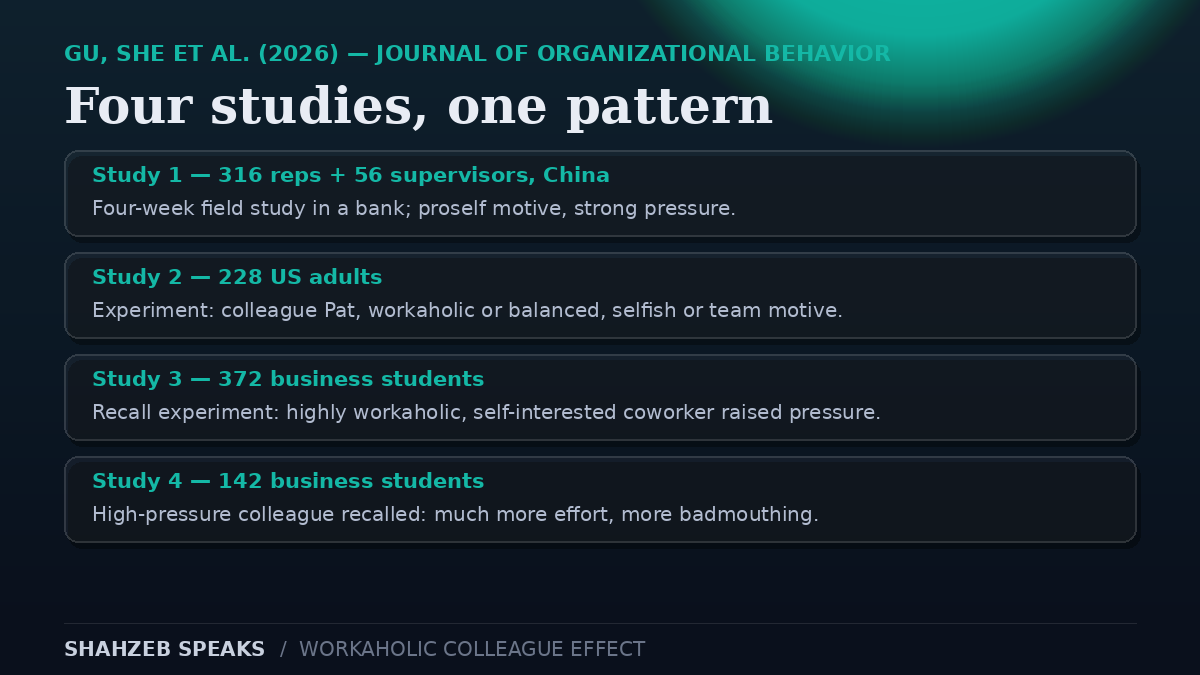
Study 1 was a four-week field study in a bank in China, with 316 financial services representatives and 56 supervisors. In week one, the representatives reported their baseline workplace stress and their tendency to badmouth colleagues. In week two, each rated one randomly selected coworker’s workaholism and judged whether that coworker’s motives were proself or prosocial. In week three, they reported the performance pressure they felt when interacting with that coworker. In week four, supervisors rated the representatives’ work effort, while the representatives reported how often they had badmouthed the focal coworker. The result: representatives paired with a workaholic colleague felt heightened performance pressure, and that pressure was linked to higher supervisor-rated work effort and more badmouthing. Crucially, the effect depended on perceived motive: when the workaholic was seen as driven by personal gain, the resulting performance pressure was strong; when the extra work was viewed as helping the team, the relationship between the coworker’s workaholism and the observer’s performance pressure was not statistically significant.
Study 2 tested the same idea experimentally, with 228 working adults in the United States who read a hypothetical workplace scenario about a colleague named Pat — described as either extremely workaholic or having a healthy work-life balance, and motivated either by a personal bonus (proself) or by the company’s collective success (prosocial). High workaholism generated intense performance pressure, increased work effort and more badmouthing — but only when Pat’s motives were framed as selfish. Study 3, a recall experiment with 372 employed business students, asked participants to recall an actual coworker from the past month, randomly assigned across four profiles (high or low workaholism, crossed with personal ambition or team success). Recalling a highly workaholic coworker motivated by self-interest produced elevated performance pressure. Study 4, with 142 business students, worked backwards: participants recalled a real coworker who made them feel either very high or very low pressure to perform, and those who recalled a high-pressure colleague reported exerting much more effort and higher rates of badmouthing that colleague. Four different designs, four different samples, and the same shape of result. That consistency is what makes the finding worth taking seriously, even with the limits I will spell out in Chapter 8.
🧠 Chapter 4: Why motive changes everything — attribution theory
The study’s real contribution is not that workaholic colleagues are stressful. Anyone who has worked beside one could have told you that. It is that the same behaviour produces a different reaction depending on the story you tell yourself about why it is happening. That is attribution theory: how people explain the causes of other people’s behaviour. The researchers draw a line between two attributions. A proself attribution says the colleague works those hours for personal gain — the promotion, the bonus, the status. A prosocial attribution says they work those hours for the team — to help colleagues, to serve a shared goal. The hours are identical. The judgement is not.
Why should the motive matter so much? Because motive changes what the colleague’s hours mean for you. If they are working for themselves, their effort is a threat: they are raising the bar to get ahead of you, and every hour they work is an hour you must match or fall behind. If they are working for the team, their effort is a contribution: they are carrying some of the load, and their hours are not a judgement on yours. The first reading turns a colleague into a competitor. The second turns the same colleague into an ally. That is why the pressure appears in one case and not the other — and why the most practical lesson of this research is not about hours at all, but about how a team talks about why people work hard.
There is a second, quieter point here. Attributions are guesses, and guesses can be wrong. The Harvard Business Review, in 2023 advice on working with a workaholic colleague, warned against assuming the colleague is trying to outshine you — the classic fundamental attribution error, where we explain someone else’s behaviour by their character and our own by our circumstances. A colleague staying late may be chasing a promotion. They may also be covering for a sick teammate, clearing a backlog nobody else will touch, or simply unable to stop. The Gu et al. finding does not tell you which reading is true. It tells you that the reading you choose decides how much pressure you feel. That is worth knowing before you decide what to think of the person at the next desk.
⚖️ Chapter 5: Social comparison — the benchmark you never agreed to
Underneath the motive effect sits an older idea: social comparison theory. Leon Festinger argued in 1954 that people have an innate drive to evaluate their opinions and abilities, and that when objective standards are unavailable, they compare themselves with other people. For abilities, he said, there is a “unidirectional drive upward” — people want to improve, so they look up. A workaholic colleague is the perfect upward comparison target: visible, measurable, and always slightly ahead. You do not need a performance review to know where you stand. You only need to look across the room at six o’clock and see who is still there.

Festinger also saw the darker side of comparison. His Hypothesis VI holds that when a person’s opinions or abilities diverge too far from the group, they become an unsuitable comparison target — and the group’s response can be derogation of the divergent person. That is, in plain terms, what badmouthing is: the group cutting the outlier down to a size it can live with. The researchers hypothesised that coworkers might badmouth a workaholic colleague to offset the pressure they feel. I need to be careful here, because this is a point where the reporting is often misread: the finding is that pressure was associated with more badmouthing, not that badmouthing reduced the pressure. Nobody in this research showed that talking behind someone’s back makes you feel better. It may simply be what pressure looks like when it has nowhere useful to go.
The comparison effect also explains why the workaholic’s influence spreads beyond the people sitting nearest them. Atroszko and colleagues (2025), in the Journal of Behavioral Addictions, surveyed 33,222 employees from 85 cultures across six continents and found that, in most cultures, perceived supervisor and colleague work addiction was linked to one’s own work addiction, positively to job stress and negatively to job satisfaction — and that perceived colleagues’ work addiction was more strongly related to one’s own work addiction and job stress than the supervisor’s. A 2026 study in Current Psychology, using a four-wave design with 310 full-time employees in China, found that having a workaholic coworker was linked to workaholism among other employees through workplace anxiety and a tendency to copy the behaviour — and the link was significantly stronger when employees’ trait competitiveness was high. The benchmark, in other words, is contagious. One person’s hours become the team’s hours, one desk at a time.
🌍 Chapter 6: The wider fallout — what colleagues actually experience
The Gu et al. study is the sharpest evidence, but it is not the only evidence. The Harvard Business Review’s 2023 advice on working with a workaholic colleague describes the everyday mechanics: a hard-driving peer’s overtime can make colleagues feel compelled to do the same; their urgency and ultra-responsiveness create more tasks and more replies for everyone else; and the behaviour can increase burnout risk and reduce creativity, productivity and job satisfaction. That is practical guidance from HBR, not a verified study finding, and I present it as such — but it matches the pattern the research describes, and it matches what most readers will recognise from their own offices.
There is also a cost that rarely gets discussed: the moral one. A UK–Italy study by Knoll and colleagues (2025), published in the Journal of Organizational Behavior and reported by the American Psychological Association in October 2026, found that workaholism detaches people from their moral values, making them less likely to speak up when they notice something ethically wrong. A team that normalises overwork may therefore also be a team that normalises silence — not because anyone decided to, but because the people most likely to notice a problem are the ones least likely to raise it. And the badmouthing itself has a cost. A team that talks about its hardest worker behind their back is a team that has stopped talking to them. The pressure does not disappear when it is whispered. It just stops being something the team can fix together.
💸 Chapter 7: What it costs the workaholic — the other side of the desk
It would be easy to write this article as a complaint about one difficult colleague. That would be dishonest. The research is clear that the workaholic pays the highest price of anyone in the room — and that price is worth stating, because it changes how you respond to them.
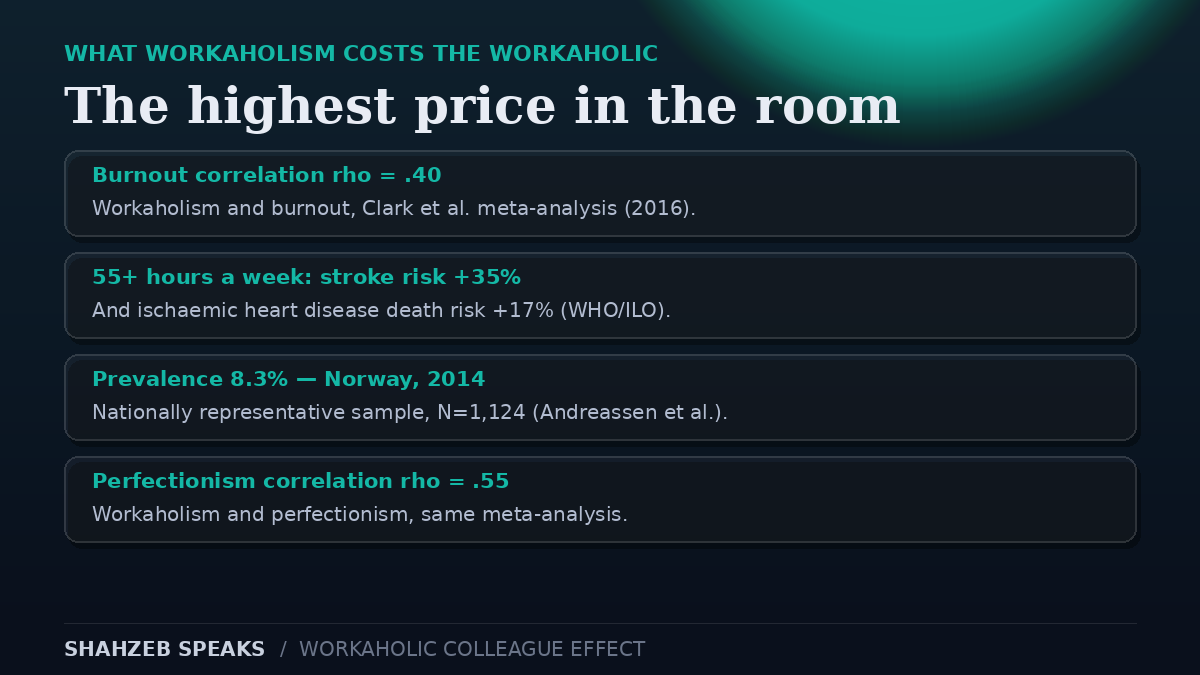
Clark and colleagues (2016), in a meta-analysis in the Journal of Management, found workaholism related to burnout, job stress, work–life conflict and poorer physical and mental health, and concluded it is best understood as an addiction to work with negative individual, interpersonal and organisational outcomes. The same body of evidence puts the correlation between workaholism and burnout at ρ = .40, and between workaholism and perfectionism at ρ = .55. The health evidence is stark: a World Health Organization and International Labour Organization analysis found that working 55 or more hours a week is associated with an estimated 35% higher risk of stroke and a 17% higher risk of dying from ischaemic heart disease, compared with working 35 to 40 hours a week. That figure is about long hours, not the compulsive dimension of workaholism, and I will not pretend otherwise — but the two travel together often enough for the warning to matter.
The day-to-day evidence is just as clear. In a ten-workday diary study of 114 people (Menghini et al., 2024), on days participants reported higher workaholic levels they also had higher blood pressure, more emotional exhaustion and greater sleep disturbance. In a ten-working-day study of 121 employees (Clark et al., 2021), on days people scored higher in work addiction they reported more fatigue and greater relationship tension — and their spouses agreed that home life was strained on the partner’s more workaholic days. As for how common this is: Andreassen and colleagues (2014), in a nationally representative sample of 1,124 Norwegian employees using the Bergen Work Addiction Scale, found a workaholism prevalence of 8.3%. That is Norway in 2014, not a current global rate, and I will not present it as one — estimates vary widely because different researchers use different scales in different cultures. But it is enough to say this: in a team of twelve, one person fitting the workaholic pattern is not unusual. The colleague you are frustrated with may also be the colleague who most needs the pattern to change.
🛠️ Chapter 8: What to do — if you work beside one, if you are one, if you manage one
If you work beside a workaholic colleague, start by checking your attribution. Before you decide they are trying to outshine you, ask what evidence you actually have. Have they taken credit for your work, or have they simply worked longer? Have they asked you to stay late, or have you assumed you must? The Gu et al. finding gives you a practical test: if you can reframe their effort as team-serving — and if that reframing is honest, not forced — the pressure you feel should ease. If it does not ease, the problem may be real, and it is worth raising directly: “When you send work at midnight, I feel I have to reply at midnight. Can we agree that after-hours messages wait until morning?” That is a conversation about a norm, not an accusation about a person, and norms are easier to change than people.
If you are the workaholic colleague — and if you recognised yourself in Chapter 2, you may be — the evidence in Chapter 7 is the argument, not a lecture. The pattern is linked to burnout, ill-health, strained relationships and worse sleep, and it does not make you more productive in the long run. The practical steps are small and concrete: set a hard finish time and tell your team what it is, so your hours stop being their benchmark; stop sending after-hours messages, even if you are still working, by scheduling them for the morning; and take one evening a week completely off, and notice what happens. None of this requires willpower alone. It requires a rule you can keep.
If you manage a team with a workaholic in it, you are the person whose behaviour matters most. Do not praise overwork in public, even casually — a “well done for staying late” is a performance target for everyone who heard it. Evaluate outcomes, not hours, and say so in writing, so the benchmark is the result rather than the desk lamp. And watch the comparison dynamic: if one person’s hours are setting the pace for the team, name it in a team meeting, without naming the person. The team needs to hear that the standard is the work, not the person who works longest.
One limit, honestly stated: the Gu et al. studies focused on immediate reactions. They did not test what happens over months or years, did not account for differing cultural or industry norms, and did not account for individual traits such as high work centrality. The authors themselves note that over a longer horizon, as the problems of workaholism become evident, the workaholic’s status as a comparison benchmark may fade. All of the surveys behind this article are self-reports, and associations are not causation. I will not claim more than the evidence supports — and what it supports is already enough to act on.
📅 Chapter 9: A plan for the week — start on Monday
Here is a one-week plan, with each step tied to the evidence above rather than to willpower.
Monday: write down, honestly, how many extra hours you worked last week because a colleague was still working — not because your work required it. That number is your benchmark tax. Tuesday: ask one question before you judge a hard-driving colleague: what evidence do I have about why they work these hours? Write the answer down. If the evidence is thin, your attribution is a guess, not a fact. Wednesday: agree one norm with your team — for example, that messages sent after 7 p.m. are answered the next working day. Frame it as a team agreement, so nobody has to be brave alone. Thursday: if you are the one staying late, send nothing after your finish time. Schedule it for the morning. Notice whether anyone actually needed it at midnight. Friday: write down what you finished this week in results, not hours. That list is your evidence for an outcome-based conversation with your manager. Weekend: take one evening completely off work, and notice what the rest does for you. The diary studies in Chapter 7 suggest the difference will be visible by Monday. Next Monday: bring the numbers — your benchmark tax, your results, your one protected evening — to your manager, and ask for the norm in writing. You are not asking for a favour. You are asking for the team to be judged on its work, not on who stays latest.
A workaholic colleague is not a villain, and you are not a victim. You are two people caught in the same comparison — one setting a benchmark they cannot sustain, the other chasing a standard nobody agreed to. The research says the way out is not to work harder, and not to talk behind their back. It is to ask why they are working so hard, to agree as a team what good work actually looks like, and to judge each other on that instead.
❓ Questions I am asked most often
What is a workaholic colleague?
A workaholic colleague is a coworker who works excessively and compulsively, driven by inner pressure rather than by the job itself. Psychologists define workaholism as a compulsive, excessive need to work, and the key test is whether the person can stop. Long hours alone do not make someone a workaholic; the compulsion does.
How does a workaholic colleague affect you?
Research by Gu, She and colleagues (2026) found that a workaholic colleague raises your performance pressure, which pushes you to work harder and makes you more likely to badmouth them. The effect was found across four studies, including a four-week field study with 316 bank representatives and 56 supervisors in China.
Why does a colleague’s motive matter so much?
Because motive changes what their hours mean for you. When you believe a workaholic colleague is driven by personal ambition, the pressure is strong. When you believe they are working to help the team, the link between their workaholism and your pressure was not statistically significant in the 2026 study.
Is workaholism the same as being hard-working or engaged?
No. Work engagement is a positive state of vigour, dedication and absorption, and engaged workers can enjoy life outside work. Workaholism is linked to ill-health, lower life satisfaction and burnout. Shimazu and Schaufeli (2009), studying 776 Japanese employees, showed the two are empirically distinct.
Can a workaholic colleague make the whole team workaholic?
The evidence points that way. Atroszko and colleagues (2025) surveyed 33,222 employees in 85 cultures and found perceived colleagues’ work addiction was linked to one’s own work addiction and job stress. A 2026 study of 310 employees in China found the same spread through anxiety and copying, stronger among competitive people.
How do I work with a workaholic colleague without burning out?
Check your attribution first, then agree a team norm in writing — for example, that messages after 7 p.m. wait until morning. Do not praise overwork, judge work by results rather than hours, and talk to the colleague directly about norms instead of talking about them behind their back.
If one person’s hours are setting the pace for your whole team, the problem is usually the work design, not the willpower. I help organisations measure after-hours load and redesign it — get in touch here.
Read more: industrial psychology in Pakistan is my home base, and my related pieces on the psychology of workplace burnout, toxic workplace signs, employee engagement at a 15-year low, decision fatigue and performative availability — your own always-on signalling cover the neighbouring questions this research raises.
Sources
- Gu, J., She, Z., Li, Q., Ocampo, A. C. G., Mitchell, R. & Lam, L. W. (2026). Workaholics Anonymous? Proself Attributions of Workaholism Increase Coworker Work Effort and Badmouthing. Journal of Organizational Behavior. DOI: 10.1002/job.70099. (Reported by PsyPost, 8 November 2026; the journal paper itself was not read directly, as the Wiley page was blocked.)
- PsyPost (2026). The social fallout of working alongside an office workaholic, 8 November 2026.
- Oates, W. E. (1971). Confessions of a Workaholic: The Facts About Work Addiction. World Publishing.
- Spence, J. T. & Robbins, A. S. (1992). Workaholism: Definition, measurement, and preliminary results. Journal of Personality Assessment, 58(1), 160–178.
- Schaufeli, W. B., Salanova, M., González-Romá, V. & Bakker, A. B. (2002). The measurement of engagement and burnout: A two sample confirmatory factor analytic approach. Journal of Happiness Studies, 3(1), 71–92.
- Shimazu, A. & Schaufeli, W. B. (2009). Is workaholism good or bad for employee well-being? The distinctiveness of workaholism and work engagement among Japanese employees. Industrial Health, 47(5), 495–502.
- Van Beek, I., Taris, T. W. & Schaufeli, W. B. (2011). Workaholic and work engaged employees: Deadlines and psychological detachment. Journal of Occupational Health Psychology, 16(4), 468–482.
- Clark, M. A., Michel, J. S., Zhdanova, L., Pui, S. Y. & Baltes, B. B. (2016). All work and no play? A meta-analytic examination of the correlates and outcomes of workaholism. Journal of Management, 42(7), 1836–1873.
- Andreassen, C. S., Griffiths, M. D., Hetland, J., Kravina, L., Jensen, F. & Pallesen, S. (2014). The prevalence of workaholism: A survey study in a nationally representative sample of Norwegian employees. PLOS ONE, 9(8), e102446.
- Menghini, L. et al. (2024). Diary study of workaholism, blood pressure, emotional exhaustion and sleep disturbance. Journal of Occupational Health Psychology.
- Clark, M. A. et al. (2021). Diary study of work addiction, fatigue and relationship tension. Journal of Occupational Health Psychology.
- Atroszko, P. A., Atroszko, B., Demetrovics, Z. & Griffiths, M. D. (2025). Perceived coworkers’ work addiction and its correlates across 85 cultures. Journal of Behavioral Addictions, 14(1), 246–262.
- Current Psychology (2026). Four-wave study of workaholic coworkers, workplace anxiety, emulation and competitiveness, 310 full-time employees in China.
- Knoll, M. et al. (2025). Workaholism and moral detachment. Journal of Organizational Behavior.
- Festinger, L. (1954). A theory of social comparison processes. Human Relations, 7(2), 117–140.
- American Psychological Association (2026). Workaholics and balance, APA Monitor, October 2026.
- Harvard Business Review (2023). How to work with a workaholic colleague, February 2023.
- World Health Organization & International Labour Organization (2021). Long working hours and health: 55 or more hours a week and stroke and ischaemic heart disease risk.
- Longitudinal study of workaholism and work engagement over two years, 1,196 employees (CIR NII record).