

Picture the scene. It is the third Monday of the year, and the team has just been told about its third reorganisation in twelve months. The reporting lines change again. A new AI tool arrives on Wednesday, with a training video nobody has time to watch. The return-to-office rule changes on Friday. Nobody in the room objects. Nobody asks a question either. They nod, open their laptops, and carry on — a little slower, a little quieter, and a little less willing to believe the next announcement. That is change fatigue: not resistance to one change, but exhaustion from change that never stops.
I am an Industrial and Organizational Psychologist in Karachi, and I write about work for a global reader. This piece is built on the newest evidence available: Deloitte’s 2026 Global Human Capital Trends report, published in March 2026, a Deloitte study of 1,000 change leaders published in October 2026, and research on change fatigue by Joseph Drasin and Tacy Holliday, published in EDUCAUSE Review in November 2025 and discussed in Human Resources Director on 7 November 2026. I will keep the scope honest throughout: these studies show that heavy change and low engagement travel together. None of them proves that change alone causes the damage. What they do prove is that the pace of change has outrun most organisations’ ability to absorb it — and that the cost is showing up in engagement, workload and resignations.
“We describe it as a debilitating state paralleling physical fatigue. It’s really caused by frequent, intense changes.”
— Joseph Drasin, University of Maryland, quoted in Human Resources Director, 7 November 2026
This guide covers what change fatigue is and how it differs from burnout, what the numbers actually say, why it builds up like a drained battery, what it costs when leaders ignore it, why it gets misread as laziness, and what a manager can change first. It is written for managers, team leads and anyone who has watched a good team go quiet after one change too many.
🔋 Chapter 1: The short answer — what change fatigue is
Change fatigue is the state of emotional and physical exhaustion that builds up when people face frequent, intense organisational change with too little time to recover between one change and the next. It is not the same as disliking change, and it is not the same as burnout, though the two overlap. Burnout is usually an individual experience. Change fatigue, as Drasin puts it, “is usually experienced at a departmental, divisional or even a whole organizational level.” A whole team can be fatigued at once, and the fatigue lasts longer than burnout — Drasin describes it as a multi-year challenge, with recovery still not visible several years after the pandemic first strained teams.
The scale of the problem is now measurable. Deloitte’s 2026 Global Human Capital Trends report found that one-third of surveyed workers experienced 15 major changes in the past year alone — restructurings, new technology rollouts, leadership shifts and process overhauls, often happening at the same time. Among those workers, 68% reported lower well-being, 50% reported lower engagement and 60% reported a higher workload. Only 27% of leaders said their organisations manage change effectively. If your team seems tired of change, the data says they probably are — and the organisation around them is not managing the pace well enough to help.
🔢 Chapter 2: The numbers behind the headline
Deloitte’s report, “From tensions to tipping points: Choosing the human advantage”, was published in March 2026 and drew on more than 9,000 business and HR leaders in 93 countries, with surveys running from July to December 2025. The headline figure is the one that should stop any leader mid-sentence: one in three workers went through 15 or more major changes in a single year. These were not small adjustments. Deloitte describes them as restructurings, new technology rollouts, leadership shifts and process overhauls — the kind of changes that each demand new routines, new relationships and new skills.
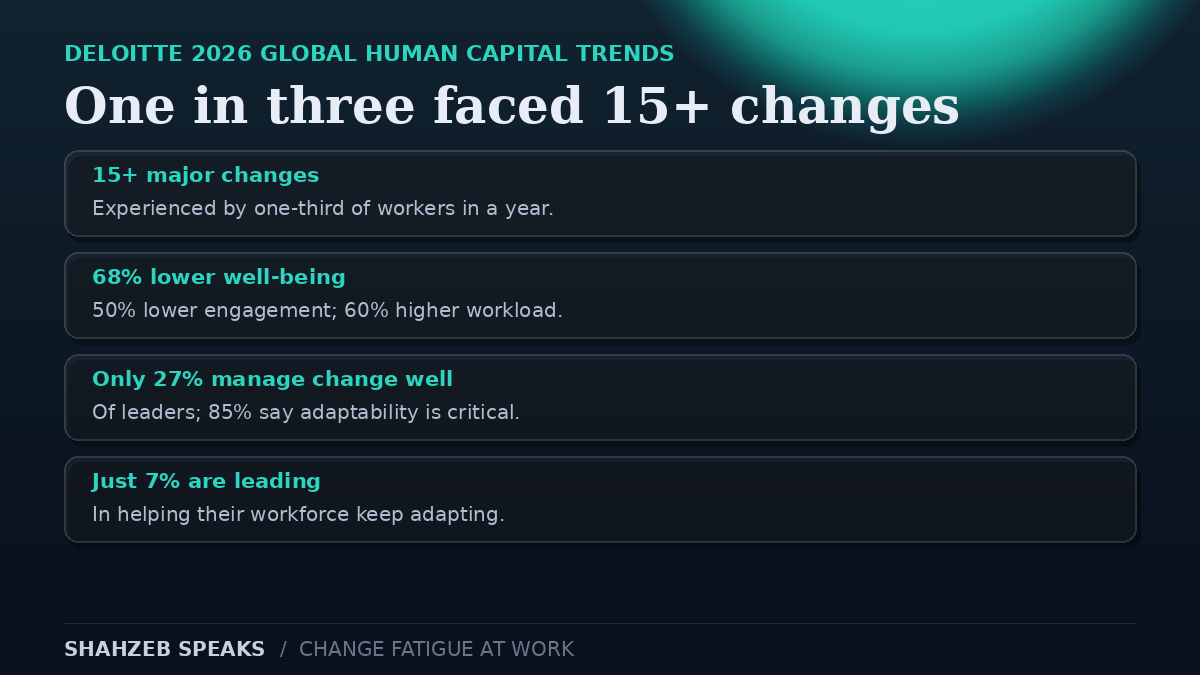
The effects Deloitte measured sit together in a way that should worry any manager. Well-being fell for 68% of workers, engagement for 50%, and workload rose for 60%. In the United Kingdom the well-being figure was even higher, at 76%. At the same time, 85% of leaders said building the ability to adapt is critical, yet only 7% said they are leading in helping their workforce continuously grow and adapt. The gap between what leaders know matters and what they are actually doing is the story. Change is being launched faster than people can absorb it, and the organisations launching it know they are not managing it well.
| Measure | Result |
|---|---|
| Workers who experienced 15+ major changes in a year | One-third |
| Reported lower well-being from too many changes | 68% |
| Reported lower engagement | 50% |
| Reported higher workload | 60% |
| Leaders who say their organisation manages change effectively | 27% |
| Leaders who say adaptability is critical | 85% |
| Leaders who say they are leading in workforce adaptation | 7% |
Source: Deloitte, 2026 Global Human Capital Trends, “From tensions to tipping points: Choosing the human advantage”, March 2026.
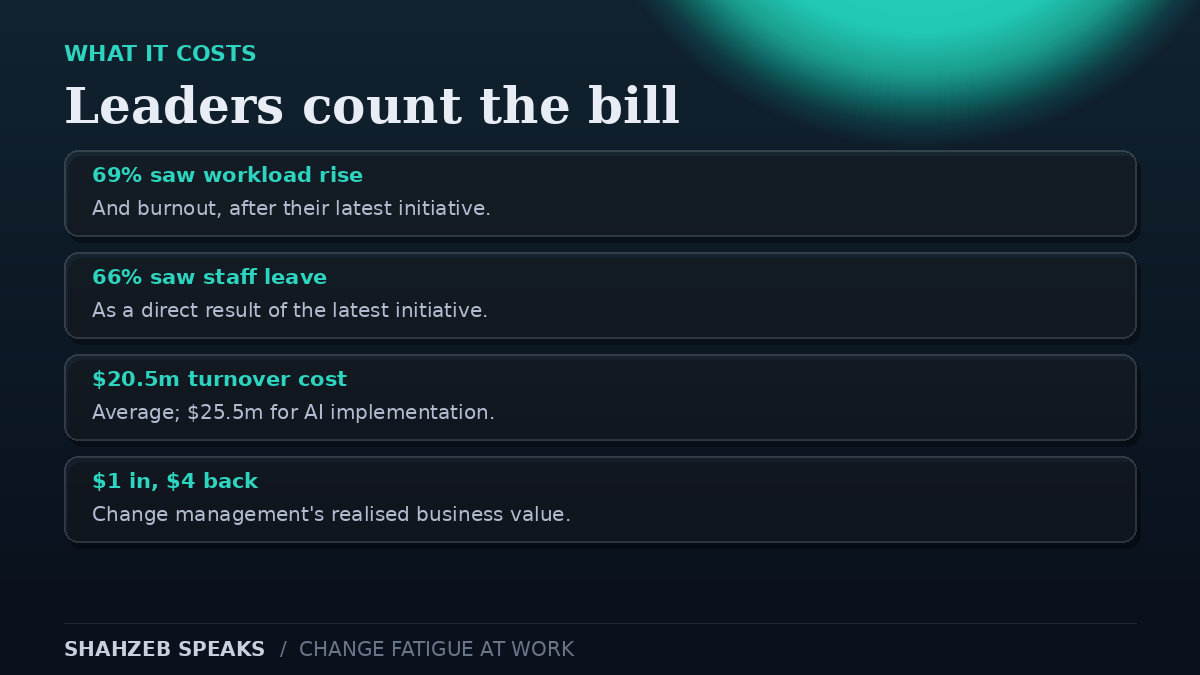
There is a second Deloitte study worth setting beside this one. The Deloitte + Workplace Intelligence 2026 Change Management Study, reported in October 2026, surveyed 1,000 change management leaders across the United States, the United Kingdom, Australia and Canada. Nearly seven in ten, 69%, said their most recent change initiative increased employee workload and burnout, and 68% reported at least one form of employee resistance. Two-thirds, 66%, said employees left their company as a direct result of their latest initiative. The average turnover-related cost was $20.5 million, rising to $25.5 million for AI implementation efforts. These are leaders reporting on their own initiatives, not employees complaining about them — which makes the figures harder to dismiss.
🧭 Chapter 3: How fatigue differs from burnout
It is tempting to call change fatigue a new name for burnout, but the researchers who study it say the difference matters. Burnout, as the World Health Organization defines it, is an occupational phenomenon resulting from chronic workplace stress that has not been successfully managed. It is usually diagnosed and treated one person at a time. Change fatigue, by contrast, is a property of a team or a whole organisation. Drasin’s point is that the unit of analysis is different: “When you think about things like burnout, those are usually considered more individual experiences, while fatigue is usually experienced at a departmental, divisional or even a whole organizational level.” A manager who treats a fatigued team as a collection of burned-out individuals will offer individual fixes — a day off, a wellness session — to a problem that is structural.
The second difference is time. Drasin notes that even burnout can be recovered from in a matter of years, while fatigue is a multi-year challenge, and the data on it is still being developed. Early on, he says, the assumption was that the pandemic caused the fatigue. It has persisted: “It’s been several years and we’re not seeing people recover.” That persistence is the diagnostic clue. If a team was tired in 2021 and is still tired in 2026, the cause is not one crisis. It is the pace that never slowed after the crisis ended.
The third difference is what people still want. Holliday and Drasin’s research found that fatigued teams are not unwilling or confused. In their words, change fatigue is “neither unwillingness nor a lack of understanding of what to do. It reflects a reduced ability to sustain effort, attention, and emotional engagement over time.” Their survey of higher-education leaders found that 89.7% reported their teams were experiencing moderate or high levels of change fatigue — and the people in those teams wanted the change to succeed. They were simply exhausted. That distinction changes the management response completely. A team that does not understand needs explanation. A team that is exhausted needs rest, and a slower pace — not another slide deck.
🔋 Chapter 4: The battery — why fatigue builds and does not clear
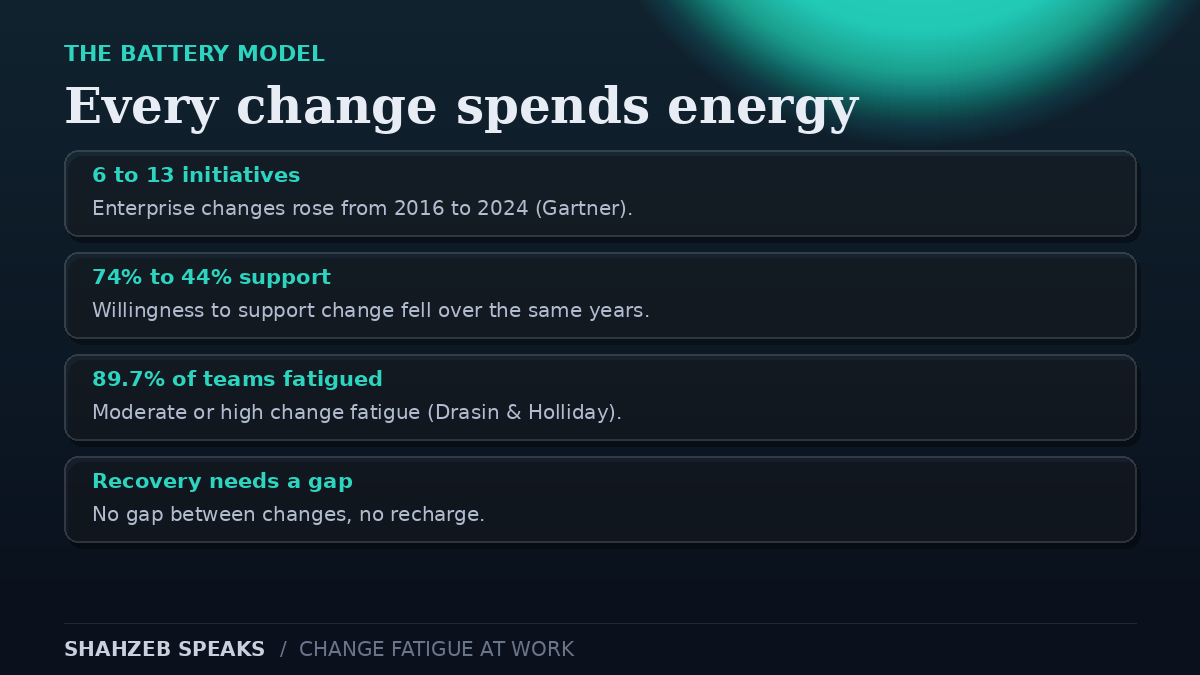
Drasin offers an analogy that any manager can use. “I’ve always described it a little bit like our ability to adapt is like a battery,” he said. “When our adaptive systems get overwhelmed with stimuli, our battery drains really low. And if we’re not given enough time to recover from it, it’s like overworking your muscles and you tear a muscle.” The analogy maps neatly onto conservation of resources theory, the idea from Hobfoll (1989) that people strive to protect and build the resources they need to cope, and that repeated losses without recovery produce stress. Each change spends some of the battery. Without a gap between changes, it never recharges.
What is different now, Drasin argues, is that the drain no longer comes only from inside the organisation. “What’s different now is the stimulation outside the organization is equal to or greater than the stimulation inside the organization.” News, social media and technology shifts keep people emotionally unsettled before they even arrive at work, and anxiety from outside the workplace adds to the load inside it. Holliday and Drasin’s Energy-Commitment Model makes the same point in formal terms: fatigue is driven by changes at three levels at once — the project, the organisation, and the world outside it. A manager who counts only internal changes is counting only part of the drain.
The history of the last decade explains why the battery is so low. Gartner’s tracking shows the number of enterprise change initiatives rose from 6 in 2016 to 13 in 2024, while employees’ willingness to support organisational change fell from 74% to 44% over the same period. A 2024 Gartner survey of HR leaders found that 73% said their employees were fatigued by change, and 74% believed their managers were not equipped to lead change effectively. The volume of change doubled, support for it nearly halved, and the managers in the middle were not prepared. That is the structural shape of the problem: more change, less capacity, and no one in the middle with the tools to bridge the gap.
💸 Chapter 5: What it costs when leaders ignore it
The cost of change fatigue is not only human. It is financial, and it is now being measured by the people who launch the changes. In the Deloitte + Workplace Intelligence study, two-thirds of change leaders said employees left as a direct result of their latest initiative, at an average turnover-related cost of $20.5 million — $25.5 million where the initiative was an AI implementation. Sixty-one per cent of leaders overseeing AI implementation believed the transformation was moving faster than employees could handle, and 59% said AI overload was negatively affecting employees. The same study found that every $1 invested in change management was associated with $4 in realised business value — yet 60% of companies treat change management as a project cost rather than a business capability, and 70% of change leaders said their latest attempts at change failed to deliver value.
The pattern repeats across other surveys. Emergn’s global survey of more than 750 business leaders, reported in January 2026, found that 83% said transformation projects are crucial for staying competitive — yet half reported transformation fatigue in their organisation, 45% said burnout due to ongoing change was a problem, and 44% said they would consider leaving their job because of organisational changes. Nearly a third of organisations, 31%, had seen digital transformation projects delayed by more than six months. Gartner’s October 2025 research found that only 45% of employees reported they had realised the change goals set by their organisation, and 36% of leaders said their teams were more likely to hesitate and delay action to see if changes would stick before adopting them. When people stop believing a change will last, they stop investing in it — and the change fails for the reason they predicted.
None of this proves that change fatigue causes turnover in a strict causal sense. These are surveys of perceptions, and the people who leave may have other reasons. But the direction is consistent across independent studies, and the leaders reporting the damage are the ones who launched the changes. A manager who treats fatigue as an attitude problem is ignoring a cost their own peers are already counting in millions.
😶🌫️ Chapter 6: Why it gets misread as disengagement
The most damaging thing about change fatigue is how easily it is misread. When workers get overwhelmed, Drasin says, “we kind of see that fight or flight response appear at work. It gets misinterpreted a lot, but a lot of times it’s seen as disengagement.” A quiet team in a meeting looks like a team that does not care. A slow adoption of a new tool looks like resistance. A person who stops volunteering looks lazy. In each case the visible behaviour is real, and the interpretation is wrong. The person is not disengaged from the work. They are depleted by the pace of it.
The engagement numbers make the misreading easy. United States employee engagement fell to 29% in the third quarter of 2026, its lowest level since 2011, according to Gallup, and global engagement fell to 20% in 2025, its lowest since 2020. It is natural to look at those figures and conclude that workers have stopped caring. The fatigue research offers a different reading: they have not stopped caring, they have run out of capacity to show it. Drasin’s advice to managers is blunt: “When an employee doesn’t seem engaged, don’t assume it’s that they’re lazy or whatever. Just recognize that they’re probably dealing with a lot.” He adds that managers and senior leaders are feeling the same strain as their teams, and that people at every level should extend colleagues some grace.
The warning signs Drasin lists are concrete enough to watch for: increased absenteeism, slower work production, poor work quality, less innovation and less collaboration. Notice that none of these is an attitude. They are all performance measures, and they all fall when a team’s battery is empty. A manager who tracks these five signals has an early-warning system. A manager who waits for someone to say “I am fatigued” will wait a long time — exhausted people rarely announce it, and in a fatigued team nobody wants to be the one who says the pace is too much.
🛠️ Chapter 7: What actually helps — changefulness, safety and measurement
Deloitte’s answer to the problem is a shift it calls “changefulness”: moving from change management, which treats change as a series of events to be managed, to embedding continuous learning, feedback and in-the-moment support directly into the flow of work, so people can adapt fluidly as priorities, skills and technology evolve. The idea is that if change is continuous, the support for it must be continuous too — not a launch event and a training video, but help available at the moment someone needs it. It is a sensible direction, though it is worth saying plainly that “changefulness” is Deloitte’s term for a direction, not a tested programme with measured outcomes. No study cited here proves it works. What the evidence does support is the three ingredients underneath it.
The first ingredient is psychological safety. Gartner reported in 2023 that when managers create a psychologically safe environment, it can be associated with up to a 46% reduction in change fatigue. Edmondson’s (1999) work on psychological safety gives the mechanism: when people can say “I do not understand this” or “I cannot keep up” without fear, the team learns about problems early instead of discovering them after a change has failed. The second ingredient is a change reflex — Gartner’s term for the practical skills that let a person adopt a change healthily. In an April 2025 survey of more than 2,500 employees, those who applied a relevant change reflex were 3.5 times more likely to achieve healthy change adoption. The third ingredient is measurement. Deloitte’s study found that one in five organisations do not formally measure the human impact of initiatives or how prepared the workforce is before launching them. You cannot manage a battery you never check.
Drasin’s own guidance is simpler, and it is the part a manager can start this week. Watch for the warning signs. Think strategically about delaying changes that are not necessary — he is direct about reorganisations in particular: “Things like reorgs are really, really, really psychologically debilitating to people large scale.” Take the temperature of the organisation, the way HR already tracks attitudes like engagement, and start with simple questions: “How are you feeling when you leave work?” and “How do you feel when you come back from vacation?” The answers to those two questions tell a manager more about fatigue than any adoption metric will.
✅ Chapter 8: Fix in this order
If you manage a team, fix in the order the evidence points. First, count the change load before you add to it. List every live change affecting your team — restructures, new tools, new processes, new targets — and ask whether the team has had a gap between them. One-third of workers faced 15 or more major changes last year; if your team’s list is long, the next change should wait. Second, delay or drop the change that is not necessary. A reorganisation that can wait six months should wait six months. Drasin’s warning about reorgs is the clearest single piece of advice in this whole piece.
Third, make it safe to say “I cannot keep up”. Ask the two questions Drasin suggests — how people feel when they leave work, and how they feel when they come back from a holiday — and act on what you hear. Psychological safety is associated with up to a 46% reduction in change fatigue, and it costs nothing to build except the willingness to hear an uncomfortable answer. Fourth, measure the human cost alongside the business case. Track workload, readiness and fatigue next to the financial measures, the way Deloitte’s study recommends. One in five organisations does not do this at all. Fifth, protect the recovery gap. When a change lands, say openly what the team will stop doing to make room for it, and defend a period with no new announcements. A battery recharges only when nothing is draining it.
None of these five steps requires new software or a new framework. They require a manager to treat the pace of change as a real constraint, like a budget, rather than as a test of the team’s attitude. The teams that look disengaged are usually the ones that have been asked to change the most, with the least time to recover. Slow the pace, protect the gap, and the engagement that looks lost often turns out to have been tired, not gone.
❓ Questions I am asked most often
What is change fatigue at work?
It is the emotional and physical exhaustion that builds when people face frequent, intense organisational change with too little recovery time between changes. Deloitte’s 2026 report found one-third of workers experienced 15 or more major changes in a year, with 68% reporting lower well-being.
How is change fatigue different from burnout?
Burnout is usually an individual experience; change fatigue is felt at team or organisational level, and it lasts longer — researchers describe it as a multi-year challenge. A fatigued team still wants the change to work; its members are exhausted, not unwilling or confused.
What causes change fatigue?
Frequent, intense changes arriving without gaps: restructurings, AI rollouts, return-to-office mandates and new processes, often at the same time. Stimulation from outside work — news, social media, technology shifts — adds to the load, so the adaptation battery drains from both sides.
Is change fatigue the same as resistance to change?
No. Resistance implies people oppose the change. Fatigue means they cannot sustain the effort it requires. Gartner found willingness to support change fell from 74% in 2016 to 44% in 2024, while the number of initiatives rose from 6 to 13 — capacity, not attitude, is what changed.
What are the signs of change fatigue in a team?
Increased absenteeism, slower work production, poorer work quality, less innovation and less collaboration. These are the warning signs researcher Joseph Drasin lists. They are performance measures, not attitudes, and they fall when a team’s capacity is depleted.
How can managers reduce change fatigue?
Count the change load before adding to it, delay changes that are not necessary, make it safe to say “I cannot keep up”, and measure workload and fatigue alongside financial results. Psychological safety is associated with up to a 46% reduction in change fatigue, according to Gartner.
If your team has gone quiet after one change too many, the pace is the place to look first. I help organisations measure the change load and redesign it around what teams can actually absorb — get in touch here.
Read more: industrial psychology in Pakistan is my home base, and my related pieces on the psychology of workplace burnout, employee engagement at a 15-year low, psychological safety at work and return-to-office psychology cover the neighbouring questions this research raises.
Sources
- Deloitte (2026). 2026 Global Human Capital Trends, “From tensions to tipping points: Choosing the human advantage”. Press release, 4 March 2026.
- Deloitte (2026). Key UK Findings from the 2026 Deloitte Human Capital Trends Report, June 2026.
- Deloitte Romania (2026). “Change fatigue, the new challenge faced by employees globally”, 8 April 2026.
- Deloitte + Workplace Intelligence (2026). 2026 Deloitte Change Management Study, as reported by Human Resources Director, 21 October 2026.
- Dunham, J. (2026). “Think your workers are disengaged? It could be change fatigue”, Human Resources Director, 7 November 2026.
- Holliday, T. & Drasin, J. (2025). “Identifying Change Fatigue in Teams: Insights from the Energy-Commitment Model”, EDUCAUSE Review, November 2025.
- Holliday, T. & Drasin, J. (2024). “Navigating Change Fatigue: The Energy-Commitment Model for Organizational Change”, EDUCAUSE Review, November 2024.
- Gartner (2025). “Gartner HR Research Finds Less Than Half of Employees Achieved the Change Goals Set by Their Organization”, press release, 9 October 2025.
- Gartner (2024). Workforce Change Fatigue Survey and Organization Design and Change Management Employee Survey, as reported in “From Resistance to Results”.
- Emergn (2026). Transformation survey of 750+ business leaders, as reported by Human Resources Director, 9 January 2026.
- Gallup (2026). Employee engagement, Q3 2026 (29% in the US, lowest since 2011); State of the Global Workplace 2026 (20% globally in 2025).
- Hobfoll, S. E. (1989). Conservation of resources: A new attempt at conceptualizing stress. American Psychologist, 44(3), 513–524.
- Edmondson, A. (1999). Psychological safety and learning behavior in work teams. Administrative Science Quarterly, 44(2), 350–383.
- World Health Organization. Burnout as an occupational phenomenon, ICD-11.