

It is nine in the evening and the office is empty except for you and your laptop. The chatbot has answered your question in seconds — faster than any colleague could — and yet you feel further from your team than you did before lunch. You have not argued with anyone. Nobody has ignored you. You simply spent the day asking a machine instead of a person, and somewhere in that quiet, the day’s energy leaked away. A 2026 study of 290 teachers found that GenAI technostress — the stress of keeping up with generative AI — is linked to lower work effort, not directly, but through work loneliness: the stress drains social connection first, and the loneliness is what quietly pulls effort down.
I am an Industrial and Organizational Psychologist in Karachi, and I write about work and behaviour for a global reader. This piece is built on a peer-reviewed study published in Frontiers in Psychology on 5 November 2026, which I read in full, set against the wider evidence on technostress, loneliness at work and leadership. One limit up front, and I will repeat it in the sourcing: the study is a single survey, taken at one point in time, of Taiwanese public school teachers using ChatGPT in late 2023 — so everything here is an association, not proof of cause, and I will say so wherever it matters. This article is also different from my 6 November piece on the AI productivity paradox: that one was about workload and rising expectations — AI saving hours while work expands. This one is about a different pathway entirely: loneliness.
“The chatbot answers in seconds, and the room gets quieter. The cost of AI at work is not always measured in hours — sometimes it is measured in the colleagues you stopped talking to.”
— Workplace Psychology Analysis, ShahzebSpeaks
This guide covers what GenAI technostress actually is, what the 2026 study of 290 teachers found and what it did not find, why loneliness sits in the middle of the chain, what work loneliness feels like and how it differs from simply being alone, where transformational leadership helps and where it does not, how common loneliness and AI use at work really are, what the study cannot tell us, and what you, your team and your manager can do about it — followed by a one-week plan.
🎯 Chapter 1: The short answer — AI stress is linked to lower effort only through loneliness
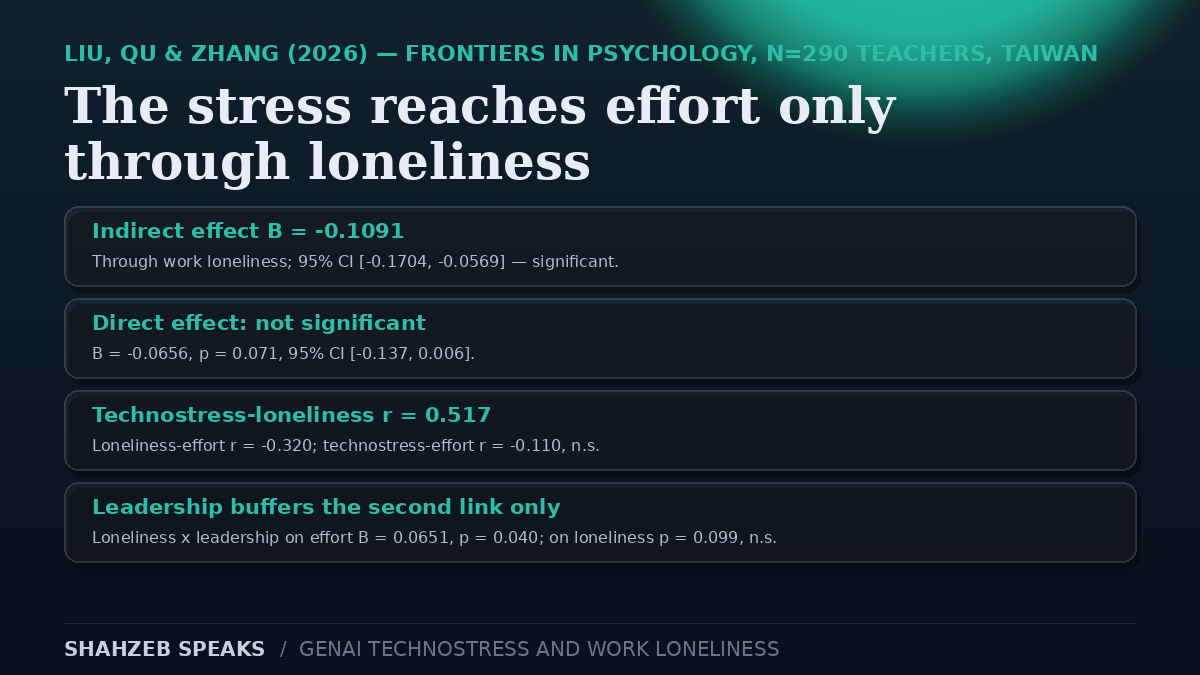
GenAI technostress is the strain of trying to keep up with generative AI tools — not understanding them well enough, worrying about your job security because of them, and watching them change faster than you can learn. A 2026 study by Liu, Qu and Zhang, published in Frontiers in Psychology, surveyed 290 public school teachers in Taiwan who used ChatGPT at work. It found that technostress was associated with lower work effort indirectly, through work loneliness: the indirect effect was B = −0.1091, with a 95% bootstrap confidence interval of [−0.1704, −0.0569], which does not include zero, so it is statistically significant. The direct link, by contrast, was not significant at all: B = −0.0656, p = 0.071. In plain terms, stressed teachers did not simply work less. They felt lonelier first — and the lonelier they felt, the less effort they reported. Remove loneliness from the chain and the connection between AI stress and effort disappears.
That pattern is called indirect-only mediation, and it matters for anyone managing an AI rollout. It means the damage is not in the tool itself but in what the tool does to the social fabric of work. A teacher who struggles with ChatGPT asks colleagues fewer questions, skips the corridor conversations where problems get solved, and slowly withdraws — and it is the withdrawal, not the software, that shows up as lower effort. The study also tested whether transformational leadership could break the chain. It could, but only at one link: good leadership weakened the connection between loneliness and effort (B = 0.0651, p = 0.040), but it did not significantly weaken the connection between technostress and loneliness (B = 0.1351, p = 0.099), and the overall moderated mediation was not significant. A good manager cannot simply lead the stress away — but they can keep a lonely employee’s effort from falling.
📖 Chapter 2: What GenAI technostress actually is — five old pressures, one new tool
The word “technostress” was coined by Craig Brod in 1984, who called it “a modern disease of adaptation caused by the inability to cope with new computer technologies”. Forty years later, the disease has a new host. Liu, Qu and Zhang define GenAI-induced technostress, building on Tiwari (2020), as the maladjustment or adaptation problems people experience when interacting with rapidly evolving generative AI technologies — specifically, when the demands of understanding, using and adapting to these technologies exceed what a person feels able to cope with. The emphasis is on the gap: not the technology, but the distance between what it demands and what you believe you can do.
The classic map of that gap comes from Ragu-Nathan and colleagues (2008), building on Tarafdar and colleagues (2007), who identified five technostress creators. Techno-overload is technology forcing people to work faster and longer. Techno-invasion is technology invading private life through constant connectivity, blurring work and home. Techno-complexity is the effort of learning new applications and keeping up with jargon that feels intimidating. Techno-insecurity is the fear of losing your job to someone who understands the new technology better. Techno-uncertainty is the churn itself: short life cycles and constant upgrades, so what you learned last month is already out of date. Tarafdar and colleagues (2011) found technostress significantly reduces job satisfaction, commitment, innovation and productivity, and Tarafdar and colleagues (2007) found a negative relationship between technostress and employee productivity. The evidence, in other words, already said technology stress hurts work. What the 2026 study adds is how it hurts work when the technology is generative AI.
Generative AI intensifies three of the five creators in particular, the authors argue. Techno-complexity grows because AI systems are harder to understand than a new spreadsheet: you cannot see how the answer was produced, so you cannot tell when it is wrong. Techno-uncertainty grows because AI functions change every few months, and the tool you mastered in January behaves differently by June. And techno-insecurity grows because the threat is no longer “someone who uses the tool better than me” but “the tool itself doing part of my job”. The study’s own survey items make this concrete. Teachers were asked to agree or disagree with statements such as “I don’t know enough about ChatGPT to do a good job” and “I am constantly concerned about my job security as a result of ChatGPT”. Those are not complaints about a bad interface. They are worries about competence and survival — and worries like that are the kind people carry home, and the kind that make them stop asking for help.
| The five technostress creators | What it feels like with GenAI |
|---|---|
| Techno-overload | AI produces more output, faster — so more is expected of you |
| Techno-invasion | The chatbot is always available, so the workday never quite ends |
| Techno-complexity | You cannot see how the AI reached its answer, so you cannot judge it |
| Techno-insecurity | You worry the tool — or a colleague who uses it better — will replace you |
| Techno-uncertainty | The tool changes every few months, so what you learned is already old |
Source: Ragu-Nathan et al. (2008); Tarafdar et al. (2007); Liu, Qu & Zhang (2026).
🔬 Chapter 3: The 2026 study — 290 teachers, one hidden pathway
The research at the centre of this article is Liu, Qu and Zhang (2026), “The dark side of GenAI in the workplace: technostress, loneliness, and the buffering role of transformational leadership”, published in Frontiers in Psychology, volume 17, article 1910745 (DOI: 10.3389/fpsyg.2026.1910745). It was received on 16 June 2026, accepted on 21 October 2026 and published on 5 November 2026. It is open access, the authors declared no funding and no commercial conflicts of interest, and the corresponding author is Yixiao Zhang of City University of Hong Kong. I read the full paper directly — abstract, methods, results tables, discussion and limitations — so every number in this chapter comes from the paper itself, not from a summary.
The sample was 290 public school teachers in Taiwan, teaching at primary, junior high and senior high level. Data were collected in October and November 2023 through Metasurvey, a Taiwanese commercial survey company, which recruited from its registered teacher member database and offered coupons as incentives. Quota sampling kept the school levels almost even — 33.1% primary, 33.4% junior high, 33.4% senior high — and teachers came from 20 administrative regions. The target sample was 300; 290 usable questionnaires remained after quality checks. The sample was 59.7% female, the largest age group was 31 to 40 years (49.7%), 72.1% held a bachelor’s degree and 22.1% a master’s, and 65.8% had under ten years of tenure. A screening question excluded anyone who had not used ChatGPT, responses were limited to one per IP address, and the study had ethics approval from City University of Hong Kong. The context matters: in late 2022, Taiwan’s Ministry of Education revised its Digital Learning Enhancement Plan for Grades 1 to 12, and public schools ran workshops promoting ChatGPT as a primary digital aid. Teachers used it for lesson planning, material development, rubric generation, progress monitoring, customised feedback, parent correspondence and recommendation drafting. This was not casual use. It was work, mandated from above, with a tool most teachers were still learning.
Four things were measured, all on five-point scales. GenAI-induced technostress was measured with a six-item scale adapted from Khan and colleagues (2023), with ChatGPT as the referent technology; its reliability was Cronbach’s alpha 0.793. Work loneliness was measured with the three-item scale of Hughes and colleagues (2004), adapted from the 20-item R-UCLA scale, with “at work” added to each item — “I feel that I lack companionship at work”, “I feel left out at work”, “I feel isolated from others at work” — alpha 0.881. Work effort was measured with the ten-item scale of De Cooman and colleagues (2009), covering direction, intensity and persistence; alpha 0.877. Transformational leadership was measured with the scale of Chen and colleagues (2012), covering the four dimensions I will explain in Chapter 6; alpha 0.857. The average scores tell their own story: technostress averaged 3.061 out of 5, loneliness 2.670, work effort 4.016, and transformational leadership 3.694. Teachers, in other words, were putting in effort — but carrying real stress and real loneliness alongside it.
Then the correlations. Technostress and loneliness moved together strongly: r = 0.517, p < 0.01. Loneliness and effort moved in opposite directions: r = −0.320, p < 0.01. But technostress and effort barely moved together at all: r = −0.110, not statistically significant. That last number is the clue. If AI stress directly lowered effort, you would expect a clear correlation. There was none. The mediation analysis, using Hayes’s PROCESS Model 4 with 5,000 bootstrap samples, confirmed it. The total effect of technostress on effort was B = −0.0656 (95% CI [−0.1370, 0.0057]); the direct effect, once loneliness was accounted for, was B = 0.0434 (95% CI [−0.0371, 0.1239]) — not significant, and in fact slightly positive. The indirect effect through work loneliness was B = −0.1091 (SE 0.0289, 95% CI [−0.1704, −0.0569]) — significant, because the interval does not contain zero. The authors describe this as an indirect-only, or full mediation, pattern, while noting that a small direct effect or other unmeasured mediators remain possible. I should be precise about one thing the paper does not report: it does not print the individual path coefficients from the simple mediation model — the technostress-to-loneliness path and the loneliness-to-effort path on their own — so I will not print them either. The numbers above are what the paper actually gives, and they are enough: the whole association between AI stress and effort runs through loneliness.
🧠 Chapter 4: Why loneliness is the missing middle — resources, drained and withdrawn
The study explains its finding through two theories, and both are worth understanding because they explain why the pathway runs the way it does. The first is Conservation of Resources theory, proposed by Stevan Hobfoll in 1989. Its claim is simple: people strive to acquire, retain and protect the things they value — time, energy, status, relationships — and when those resources are threatened or depleted, they withdraw to conserve what is left. When AI stress drains a teacher’s energy, the loss spreads: first to the relational domain, then to behaviour. The second theory is the Stressor–Strain–Outcome framework of Koeske and Koeske (1993): an external stressor triggers a psychological strain, which then shapes a behavioural outcome. In this study, technostress is the stressor, work loneliness is the strain, and work effort is the outcome. Put together, the two theories tell one story: the stress of keeping up with AI depletes your energy, you protect what is left by cutting back on social interaction — the corridor chat, the shared lunch, the question you would have asked a colleague — and that withdrawal becomes loneliness, which then shows up as lower effort.
That mechanism also explains the study’s most surprising result: why the direct effect was not significant. The authors themselves offer the reason. Generative AI also delivers resource gains — efficiency in personalised instruction, automated grading, learning analytics — and those gains partly offset the losses from technostress. A teacher who is stressed by ChatGPT may still get more done with it, so stress alone does not show up as lower effort. It is only when the social pathway is involved — when the stress has cost you your connections — that effort falls. This is a more hopeful finding than it first looks. It means AI stress is not, on its own, a productivity problem. It becomes one when it is allowed to eat away at the relationships that make work bearable.
There is a second reason the loneliness link matters, and it comes from the definition of work loneliness itself. Ozcelik and Barsade (2018) define it as an employee’s subjective experience that their emotional and psychological needs are insufficiently fulfilled within the work context — a perceived gap between the interpersonal experience you want and the one you actually have (a definition that goes back to Perlman and Peplau, 1981). It is a subjective state, not objective isolation: as Wright and colleagues (2006) and Wright and Silard (2021) show, employees can feel lonely even in collaborative environments. You can sit in a room full of colleagues and still feel lonely at work — and in the AI case, that is exactly the point. The teacher is not alone. The teacher is surrounded by people and still turning to a machine instead of them, because asking a person now feels like admitting you cannot keep up.
😔 Chapter 5: Work loneliness is not being alone — it is feeling unmet
It is easy to confuse work loneliness with working alone, and the confusion matters, because it leads managers to the wrong fix. A teacher working from home is alone; a teacher in a crowded staff room who feels that nobody understands what they are going through is lonely. The difference is the gap between the connection you want and the connection you have. The three items in the study’s loneliness scale capture it precisely: lacking companionship at work, feeling left out at work, feeling isolated from others at work. None of those items asks how many people are in the room. All of them ask how the room feels.

The performance evidence for taking this seriously comes from Ozcelik and Barsade (2018), published in the Academy of Management Journal. Through a time-lagged field study of 672 employees and their 114 supervisors in two organisations, they found that greater workplace loneliness was related to lower job performance — and they found the mechanism, too: lonelier employees were less approachable, and less affectively committed to their organisations. They measured loneliness first and performance six weeks later, and they cautioned, in their own words, that “we cannot confirm causality”. That caution is honest and I repeat it here. But the pattern is consistent with the 2026 study: loneliness does not just feel bad, it behaves badly — it makes people harder to reach and less attached to the place they work. And when the trigger is AI stress, the withdrawal has a particular shape. You stop asking colleagues for help because asking would reveal that you are struggling with the tool everyone else seems to have mastered. You stop offering help for the same reason.
There is also a wider context worth stating, because it shows this is not only a teacher problem. A 2025 MIT and OpenAI preprint (Fang and colleagues, arXiv:2503.17473) ran a four-week randomised controlled trial with 981 participants using ChatGPT in text, neutral-voice or engaging-voice modes, exchanging more than 300,000 messages. The assigned conditions did not produce significant effects on average — but participants who chose to use the chatbot more showed consistently worse outcomes: higher daily usage correlated with higher loneliness, emotional dependence and problematic use, and lower socialisation. A companion OpenAI platform study (Phang and colleagues, 2025) analysed more than three million ChatGPT conversations and surveyed 4,076 users, finding that very high usage correlated with increased self-reported indicators of dependence. Both are preprints, not peer-reviewed papers, and both are about personal and emotional chatbot use, not workplace use — and the key loneliness finding is correlational, so lonely people may simply chat more. I include them only as context, never as proof about work. But they do suggest something worth watching: the more a person turns to the machine for company, the less they may turn to people — and the workplace version of that trade is exactly what Liu, Qu and Zhang measured.
🛡️ Chapter 6: Where leadership helps — and where it does not
The most useful part of the 2026 study, for anyone who manages people, is not the headline finding. It is the leadership finding — because it is partial, and the partiality is the lesson. Transformational leadership was first conceptualised by James MacGregor Burns (1978) and refined by Bernard Bass (1985). Bass and Riggio (2006) describe four dimensions: idealised influence (being a role model people trust), inspirational motivation (painting a vision worth following), intellectual stimulation (inviting people to rethink how they work), and individualised consideration (coaching each person through their own learning curve). In the AI context, the paper argues these work through sensemaking: reframing uncertainty as a growth opportunity, modelling calm acceptance of change, encouraging new ways of working, and giving tailored coaching on the learning curve.
The study tested whether this kind of leadership could break the chain at two points, using Hayes’s PROCESS Model 58. At the first link — technostress to loneliness — it could not. The interaction of technostress and transformational leadership on work loneliness was B = 0.1351, p = 0.0994: not statistically significant, so Hypothesis 3 was not supported. The authors note the interaction was in the expected direction, suggesting only a possible trend. At the second link — loneliness to effort — it could. The interaction of work loneliness and transformational leadership on work effort was B = 0.0651, p = 0.0404: statistically significant, so Hypothesis 4 was supported. Higher transformational leadership weakened the negative relationship between loneliness and effort. And the overall test — whether leadership changed the whole indirect pathway — was not significant: the index of moderated mediation was −0.028, with a 95% confidence interval of [−0.174, 0.095], which includes zero, so Hypothesis 5 was not supported. At low transformational leadership, the indirect effect was B = −0.0883 (CI [−0.1635, −0.0162]); at the mean level, B = −0.0728 (CI [−0.1199, −0.0282]); at high leadership, B = −0.0483 (CI [−0.1113, 0.0003]) — merely non-significant, because the interval just crosses zero.
Read plainly, that is a precise and honest result. A good leader cannot stop AI stress from making people lonely. The stress of learning a new tool, worrying about your job, watching the tool change every few months — no amount of vision-setting removes that. What a good leader can do is stop loneliness from turning into lower effort. When a lonely employee still feels seen by their manager — when the manager paints a clear vision for how AI fits the team’s work, models calm acceptance of the change, invites the team to rethink its routines, and coaches individuals through the learning curve — the loneliness still exists, but it costs less. That is a partial buffer, not a cure, and I will not present it as more than that. The authors’ own practical recommendations match this reading: organisations should recognise the psychosocial costs of GenAI, watch for and identify work loneliness directly — with targeted measures such as peer support platforms and professional psychological counselling — and actively use transformational leadership as a buffering mechanism. Notice the order. The loneliness is named and addressed directly. It is not left to leadership alone.
There is one more number that makes the leadership case concrete. Gallup (June 2025) found that only 22% of employees say their organisation has communicated a clear plan or strategy for AI, even though 44% say their organisation has begun integrating it, and only 30% say it has general guidelines or formal policies. When leaders had communicated a clear plan, employees were three times as likely to feel very prepared to work with AI and 2.6 times as likely to feel comfortable using it. A clear plan is, in effect, the first dimension of transformational leadership made practical: inspirational motivation, written down. It costs nothing, it takes an afternoon, and it is the single most underused buffer in the data.
📊 Chapter 7: How common is this? The wider numbers
The 2026 study is one sample of 290 teachers. Before generalising from it, it is worth asking how widespread the two ingredients — loneliness at work and AI use at work — actually are. Both are common, and both are rising.
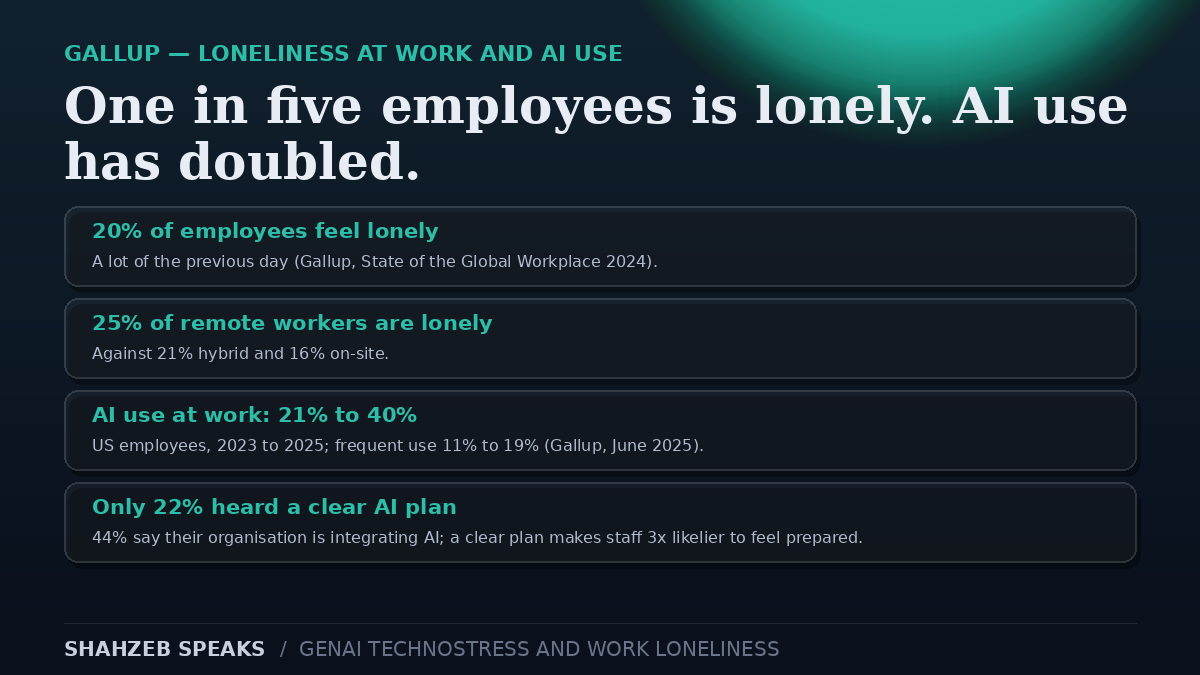
On loneliness, Gallup’s State of the Global Workplace: 2024 Report found that globally, one in five employees (20%) report experiencing loneliness “a lot of the previous day”. The pattern by work location is the sharpest: fully remote employees report significantly higher loneliness (25%) than those working exclusively on-site (16%), with hybrid workers in between (21%). Loneliness is more prevalent among employees under 35 than those 35 and older, and working men and women report the same rate (20%). Working adults are less likely to experience loneliness (20%) than those who are unemployed (32%). And engagement protects: engaged employees were 64% less likely to be lonely than those who are not engaged; employees who say their opinion counts are 39% less likely to be lonely; those who get to do what they do best every day are 37% less likely; and employees who say they have a best friend at work are 21% less likely. A company-funded survey tells a similar story at a higher level: the Cigna Group’s Loneliness in America 2025 report, based on more than 7,500 US adults surveyed between 29 May and 14 June 2024, found that 57% of Americans classify as lonely and 52% of workers report feeling lonely. I flag the funding because it matters: this is Cigna’s survey, not independent research, and I present the two headline numbers only.
On AI use, Gallup (June 2025) found that the share of US employees who say they have used AI in their role a few times a year or more nearly doubled in two years, from 21% in 2023 to 40% in 2025. Frequent AI use (a few times a week or more) also nearly doubled, from 11% to 19%, and daily use doubled in the past twelve months alone, from 4% to 8%. Frequent use is concentrated in white-collar roles — 27% of white-collar employees report frequent use — and in technology (50%), professional services (34%) and finance (32%). Leaders report frequent use at 33%, twice the rate of individual contributors (16%). Yet only 15% of employees say it is very or somewhat likely that automation, robots or AI will eliminate their job within the next five years — a figure unchanged from 2023 and 2024. The fear, in other words, is not mostly about being replaced. It is about keeping up — which is exactly what the technostress scale measures.
⚠️ Chapter 8: What the study cannot tell us
A good study is honest about its limits, and this one is. The authors state six, and I will state them plainly, because they decide how far you should take the findings.
First, the design is cross-sectional: a single survey, taken at one point in time. It cannot establish temporal order, so it cannot prove that technostress causes loneliness, or that loneliness causes lower effort. Reverse causality remains plausible — for example, lonelier or lower-effort employees may report more technostress — and unmeasured factors such as self-efficacy, organisational support and technology readiness may offer alternative explanations. Longitudinal, multi-source or experimental designs are needed. That is why this article says “associated with” throughout, and why you should be suspicious of any summary that says “AI makes workers lonely”. This study does not show that.
Second, the sample is narrow: convenience sampling from a commercial panel, among public school teachers in Taiwan, using ChatGPT in the early stages of GenAI adoption (data collected in October and November 2023). The findings may not generalise to other occupations — especially ones lower in interpersonal interdependence and emotional labour — to other countries, or to later stages of AI integration, when the tools and the training around them look different. Third, the absence of school-level identifiers meant the authors could not account for clustering within schools. Fourth, the work-effort scale’s average variance extracted was 0.420, below the conventional 0.50 threshold, so the authors themselves note scale refinement is warranted — although the measurement model overall was sound (KMO 0.88, CFI 0.94, RMSEA 0.054, and a Harman single-factor test of 20.89%, below the 50% threshold).
None of this makes the study useless. A single well-measured survey of 290 people, with a significant indirect effect and a clear theoretical mechanism, is worth taking seriously — as a signal, not a verdict. The honest reading is this: among Taiwanese teachers using ChatGPT in late 2023, AI stress was linked to lower effort only through loneliness, and good leadership softened the second link but not the first. If your workplace looks nothing like that sample, treat the finding as a hypothesis to test, not a fact about your team. And if your workplace looks a lot like it — mandated AI tools, thin training, people quietly struggling — treat it as a warning worth acting on.
✅ Chapter 9: What to do — a one-week plan
The recommendations in this chapter are practical advice grounded in the evidence above. They are not tested interventions, and I will not present them as such. But each one follows directly from the mechanism the study found.
For managers — fix the loneliness link, not just the tech. The study found leadership does not weaken the technostress-to-loneliness link, but does weaken the loneliness-to-effort link. So stop trying to lead the stress away and start protecting the social parts of work. Name the loneliness directly: ask your team, in a one-to-one, whether the new tools have made them feel more isolated — and mean it as a question, not a survey. Set up a peer support channel where people can ask “stupid” AI questions without judgement; the study’s authors recommend peer support platforms and professional psychological counselling for exactly this reason. And close the planning gap Gallup found: write down, in one page, what AI is for in your team, what it is not for, and what good use looks like. Only 22% of employees have heard a clear plan from their organisation. Yours can be the exception by Friday.
For employees — protect the social parts of work. The mechanism in the study is that drained employees cut back on informal interaction first, and that withdrawal becomes loneliness. So protect the interaction deliberately. Ask a colleague a question sometimes instead of asking the chatbot — not because the chatbot is worse, but because the colleague is a relationship and the chatbot is not. Keep one team check-in a week that is not about the tool. And ask for learning time, not just the tool: techno-complexity was a core stressor in the study’s own items (“I require a lot of time to learn and use ChatGPT”), so asking for training time and a slower rollout is a legitimate response to a real stressor, not resistance to AI.
The one-week plan. Monday: write down which AI tools you use, and rate each one from 1 to 5 for how stressful it is to keep up with. The highest score is your technostress hotspot. Tuesday: answer the study’s three loneliness items honestly — do you lack companionship at work, feel left out, feel isolated? If any of them is true, name it to one person. Wednesday: ask one colleague a question you would normally have asked the chatbot. Notice how the conversation feels. Thursday: if you manage people, write the one-page AI plan: what the tools are for, what they are not for, and what good use looks like. Share it. Friday: protect one social ritual — a shared lunch, a Friday check-in, a ten-minute coffee — and put it in the calendar as firmly as any meeting. Weekend: take one evening completely away from the tools, and notice whether the quiet feels restful or lonely. The answer tells you which of the two you have been confusing. Next Monday: bring the week’s notes to your manager: your hotspot, your loneliness answers, your one-page plan. You are not asking for less AI. You are asking for AI with the human parts of work still attached.
The chatbot will keep getting faster, and the tools will keep changing every few months. That is not going to stop. What can stop is the quiet drift — the day you realise you have not really spoken to a colleague in a week, and your effort has slipped without you noticing why. The 2026 study gives that drift a name and a shape: stress, then loneliness, then less effort. And it gives you the one place where the chain can be broken. Not at the tool. At the loneliness.
❓ Questions I am asked most often
What is GenAI technostress?
GenAI technostress is the strain of keeping up with generative AI tools — the feeling that the demands of understanding, using and adapting to them exceed what you can cope with. It covers five pressures identified by Ragu-Nathan and colleagues (2008): overload, invasion, complexity, insecurity and uncertainty, all intensified by how fast AI changes.
Does AI make employees lonely?
A 2026 study of 290 Taiwanese teachers found GenAI-induced technostress was associated with higher work loneliness (r = 0.517, p < 0.01). But the study was a single survey at one point in time, so it cannot prove causation. Lonelier employees may also report more technostress. The honest answer is that the two are linked, and the direction is not yet proven.
Does AI technostress directly reduce work effort?
No — not in this study. The direct effect of technostress on work effort was not statistically significant (B = −0.0656, p = 0.071). The link only appeared indirectly, through work loneliness: the indirect effect was B = −0.1091, with a 95% confidence interval of [−0.1704, −0.0569]. Remove loneliness from the chain and the connection disappears.
Can a good manager stop AI technostress from causing loneliness?
Not according to this study. Transformational leadership did not significantly weaken the link between technostress and loneliness (B = 0.1351, p = 0.099). It did weaken the link between loneliness and effort (B = 0.0651, p = 0.040). A good manager cannot lead the stress away, but can keep a lonely employee’s effort from falling.
How many employees feel lonely at work?
Gallup’s State of the Global Workplace 2024 report found that one in five employees (20%) globally feel lonely “a lot of the previous day” — 25% of fully remote workers, 21% of hybrid workers and 16% of on-site workers. A company-funded Cigna survey in 2025 put the figure higher, at 52% of workers, but that is Cigna’s survey, not independent research.
What can I do if AI tools are stressing me out?
Ask for learning time, not just the tool — techno-complexity was a core stressor in the 2026 study. Protect the social parts of your work: ask a colleague a question sometimes instead of the chatbot, and keep one team check-in a week. If you feel lonely at work, name it to your manager; the study’s authors recommend peer support and professional counselling for exactly this.
If AI tools are quietly draining your team’s energy, the problem is usually the rollout, not the people. I help organisations measure technostress and redesign it — get in touch here.
Read more: industrial psychology in Pakistan is my home base, and my related pieces on the AI productivity paradox — why your workload grows while AI saves you hours, the psychology of AI anxiety, employee engagement at a 15-year low, the workaholic colleague effect and performative availability cover the neighbouring questions this research raises.
Sources
- Liu, F., Qu, M. & Zhang, Y. (2026). The dark side of GenAI in the workplace: technostress, loneliness, and the buffering role of transformational leadership. Frontiers in Psychology, 17:1910745. DOI: 10.3389/fpsyg.2026.1910745. (Full paper read directly, 11 November 2026.)
- Koeske, G. F. & Koeske, R. D. (1993). A preliminary test of a stress-strain-outcome model for reconceptualizing the burnout phenomenon. Journal of Social Service Research, 17(3–4), 107–135.
- Hobfoll, S. E. (1989). Conservation of resources: A new attempt at conceptualizing stress. American Psychologist, 44(3), 513–524.
- Brod, C. (1984). Technostress: The Human Cost of the Computer Revolution. Addison-Wesley.
- Ragu-Nathan, T. S., Tarafdar, M., Ragu-Nathan, B. S. & Tu, Q. (2008). The consequences of technostress for end users in organizations: Conceptual development and empirical validation. Information Systems Research, 19(4), 417–433.
- Tarafdar, M., Tu, Q., Ragu-Nathan, B. S. & Ragu-Nathan, T. S. (2007). The impact of technostress on role stress and productivity. Journal of Management Information Systems, 24(1), 301–328.
- Tarafdar, M., Tu, Q., Ragu-Nathan, T. S. & Ragu-Nathan, B. S. (2011). Crossing to the dark side: Examining creators, outcomes, and inhibitors of technostress. Communications of the ACM, 54(9), 113–120.
- Ozcelik, H. & Barsade, S. G. (2018). No employee an island: Workplace loneliness and job performance. Academy of Management Journal, 61(6), 2343–2366.
- Hughes, M. E., Waite, L. J., Hawkley, L. C. & Cacioppo, J. T. (2004). A short scale for measuring loneliness in large surveys. Research on Aging, 26(6), 655–672.
- De Cooman, R., De Gieter, S., Pepermans, R., Jegers, M. & Van Hofmans, J. (2009). A cross-sectoral comparison of the work effort construct. (Cited via Liu, Qu & Zhang, 2026.)
- Chen, X.-P., Eberly, M. B., Chiang, T.-J., Farh, J.-L. & Cheng, B.-S. (2012). Affective trust in Chinese leaders: Linking Paternalistic leadership to employee performance. (Leadership scale cited via Liu, Qu & Zhang, 2026.)
- Khan, A. et al. (2023). Technostress scale adapted for GenAI (cited via Liu, Qu & Zhang, 2026).
- Burns, J. M. (1978). Leadership. Harper & Row.
- Bass, B. M. (1985). Leadership and Performance Beyond Expectations. Free Press.
- Bass, B. M. & Riggio, R. E. (2006). Transformational Leadership (2nd ed.). Lawrence Erlbaum Associates.
- Perlman, D. & Peplau, L. A. (1981). Toward a social psychology of loneliness. In S. Duck & R. Gilmour (Eds.), Personal Relationships in Disorder (pp. 31–56). Academic Press.
- Wright, S. L. & Silard, A. (2021). Loneliness and work. (Cited via Liu, Qu & Zhang, 2026.)
- Gallup (2024). State of the Global Workplace: 2024 Report — employees worldwide feel lonely.
- Gallup (2025). Work: AI use nearly doubled in two years, June 2025.
- The Cigna Group (2025). Loneliness in America 2025 (company-funded survey; 7,500+ US adults, 29 May–14 June 2024).
- Fang, C. M., Liu, A. R., Danry, V. et al. (2025). How AI and Human Behaviors Shape Psychosocial Effects of Extended Chatbot Use: A Longitudinal Randomized Controlled Study. arXiv:2503.17473. (Preprint — not peer-reviewed.)
- Phang, J. et al. (2025). OpenAI platform study of ChatGPT use and dependence (preprint; OpenAI-funded).