
It is a Tuesday morning and a junior analyst is staring at her inbox before she has even taken her coat off. Two deadlines moved overnight, her manager wants a rewrite of a report she finished on Friday, and a message from HR hints at a restructure nobody has explained. She is not the only one. The American Psychological Association’s 2026 Work in America survey found that 37% of American workers now say their job harms their mental health, up from 32% a year earlier — and that psychological capital at work separates the workers who weather weeks like this from those who do not. Workers who score high on it report a strikingly different working life from those who score low: less tension, less fear of losing their job, and a far healthier view of the place they work. Psychological capital at work — hope, efficacy, resilience and optimism — is a developable set of inner resources, and in APA’s 2026 survey of 2,009 workers, people who had more of it reported better mental health on every measure.

I am an Industrial and Organizational Psychologist in Karachi, and I write about work and behaviour for a global reader. This article is built on primary sources read directly: the American Psychological Association’s 2026 Work in America survey, the original research that defined psychological capital, a meta-analysis of 51 studies covering 12,567 employees, and a study of 486 undergraduates published in July 2026. It is written for two people at once — the employee who wants to know whether anything about her own working life can actually change, and the manager who wants to know whether investing in people’s inner resources is worth the money. Both questions have answers, and both come with honest limits, stated plainly. The evidence is strong that psychological capital tracks with better outcomes. It is also clear that it is no substitute for a decent job, a fair wage or a respectful manager — and this article will not pretend otherwise.
“Unlike credentials or technical skills, psychological capital often goes unrecognized and unaccounted for by organizational leaders. But research shows that it’s not fixed and can be strengthened through intentional efforts, including steps employers can take.”
— Arthur C. Evans Jr., PhD, CEO, American Psychological Association
This guide covers the short answer, what psychological capital actually is, the 2026 survey numbers in full, what fifty-one studies say about its link to satisfaction and performance, whether it can be trained and how long the gains last, what the newest student research shows, the two guards that keep this idea honest — and what employers and workers should do with all of it.
🎯 Chapter 1: The short answer — psychological capital at work, explained
Psychological capital at work, usually shortened to PsyCap, is a person’s combined stock of four positive psychological resources — hope, self-efficacy, resilience and optimism — that helps them cope with pressure, recover from setbacks and keep working toward their goals. It is state-like and developable, not a fixed trait.
In the APA’s 2026 Work in America survey of 2,009 employed American adults, workers with high PsyCap were far less likely than low-PsyCap workers to feel tense at work (38% against 55%), far less likely to say work harmed their mental health (24% against 47%), and far less likely to plan to look for a new job next year (19% against 51%). One caution before the numbers: the survey is cross-sectional, so it shows an association between PsyCap and these outcomes, not proof that PsyCap causes them — a point Chapter 7 returns to.
That gap is the reason this idea is getting attention in 2026. It is not a personality test, and it is not a label for people who are simply cheerful. PsyCap is best understood as a state-like resource: more stable than a mood, less fixed than a personality trait, and — this is the part that matters for anyone trying to improve a workplace — open to development. The four resources were first brought together as a single concept by Fred Luthans, Carolyn Youssef and Bruce Avolio in their 2007 book Psychological Capital: Developing the Human Competitive Edge, published by Oxford University Press. Their argument was that organisations had spent decades measuring human capital (what people know) and social capital (who people know), while ignoring the psychological resources that decide whether people actually use what they know when things get hard.
The other guard belongs here too, before any of the numbers. Psychological capital is something organisations should invest in, not a demand to place on workers — a point Chapter 7 returns to in full. A person who is struggling in a bad job does not have a PsyCap problem. They have a job problem. For that side of the problem, see my article on the psychology of workplace burnout and the numbers in my article on workplace burnout statistics 2026.
🧱 Chapter 2: What psychological capital is — the HERO framework
PsyCap is four resources that work together, and the acronym is HERO: hope, efficacy, resilience and optimism. The four are not four separate ideas stapled together. They form a single higher-order factor — which is to say, people who score high on one tend to score high on the others, and the combined score predicts outcomes better than any one part on its own. That is exactly what Luthans, Avolio, Avey and Norman found in 2007, in a study published in Personnel Psychology (volume 60, issue 3, pages 541–572): the composite PsyCap factor was related to performance and satisfaction, and it was a better predictor than the four facets individually.
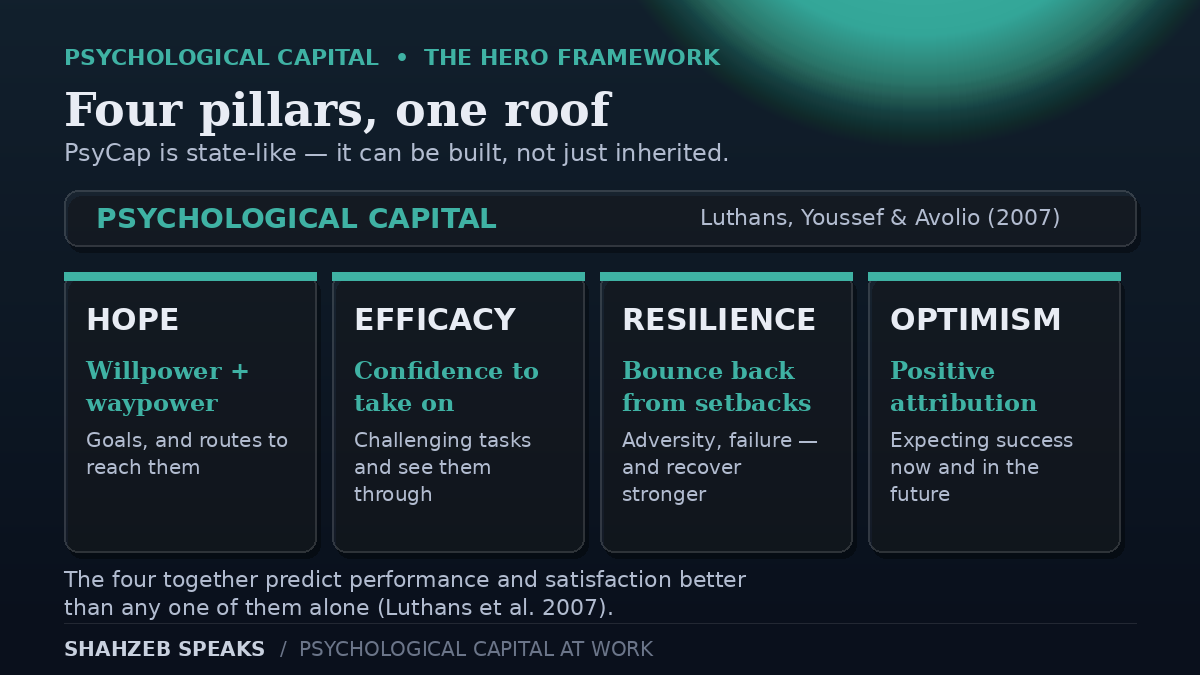
Hope, in this framework, is not wishful thinking. It is two things at once: the willpower to pursue a goal, and the “waypower” to find a route to it. A hopeful worker does not just want a promotion — she can picture three different ways to get there, and when the first route is blocked she switches to the second instead of giving up. Self-efficacy is confidence of a specific kind: the belief that you can mobilise the motivation and resources to succeed at a particular task — the quiet conviction, before a presentation or a difficult conversation, that you have done this kind of thing before and can do it again. Resilience is the capacity to bounce back from adversity, conflict and failure — and, interestingly, from positive events too, because a sudden promotion can be destabilising in its own way. Optimism is an explanatory style: attributing good events to personal, permanent and pervasive causes, and bad events to external, temporary and situation-specific ones. The optimist who misses a deadline thinks “the brief changed at the last minute”; the pessimist thinks “I am hopeless at this.” The event is the same. The explanation is what differs.
| Resource | What it means | What it looks like at work |
|---|---|---|
| Hope | Willpower plus “waypower” — agency and pathways toward a goal | Setting a goal, planning several routes to it, switching routes when one is blocked |
| Efficacy | Confidence to mobilise motivation and resources for a specific task | Taking on a hard assignment because you trust you can work through it |
| Resilience | Capacity to rebound from adversity, conflict or failure — and beyond it | Recovering after a rejected proposal instead of withdrawing for a month |
| Optimism | Explaining good events as personal and lasting, bad events as external and temporary | Treating a setback as a one-off problem with a cause, not as proof you cannot do the job |
The standard workplace measure is the Psychological Capital Questionnaire, the PCQ-24: 24 items, six per dimension, developed and validated by Luthans, Youssef and Avolio in 2007 and by Luthans, Avolio and colleagues in the same year. If your employer ever runs a PsyCap survey, this is almost certainly the instrument behind it. One thing is worth knowing about how such measures work: a questionnaire score is a snapshot, not a verdict. Scores move — a worker measured after a restructure will score differently from the same worker after a good quarter. That movement is not a flaw. It is the whole point of a state-like resource: it changes with conditions, which is exactly why it can be developed.
One more distinction, because it matters for anyone who has heard of grit. PsyCap is deliberately positioned as state-like — more stable than a passing mood, less fixed than a personality trait — and that is what separates it from trait-like strengths such as grit. A trait is something you carry through life. A state-like resource is something you have more of on good days and less of on bad ones, and something a good manager, a fair workload and a bit of training can actually increase. That claim — that PsyCap can be developed — is the hinge of this whole article, and it is tested properly in Chapter 5.
📊 Chapter 3: The 2026 numbers — what high-PsyCap workers actually report
The APA’s 2026 Work in America survey is a serious piece of work, and it is worth saying how it was done before quoting a single figure from it. The survey was conducted by The Harris Poll on behalf of the American Psychological Association between 21 May and 1 June 2026, among 2,009 employed adults in the United States aged 18 and over. The data were weighted by age, gender, race and ethnicity, region, education, marital status, household size, work status, household income and smoking status, and the sample is accurate to within ±3.1 percentage points at 95% confidence. PsyCap was measured with a validated five-item scale covering hope, efficacy, resilience and optimism, and respondents were grouped into low, moderate and high PsyCap. The press release was published on 22 September 2026.
The headline finding is bleak. In 2026, 37% of American workers say their work environment negatively affects their mental health, up from 32% in 2025, and nearly half — 48% — say they typically feel tense or stressed during their workday. The share who describe their workplace as healthy has fallen from 85% to 80%, and only 80% now say they feel valued at work, down from 84% — even though 95% say it is important to work for an organisation that values their emotional and psychological well-being. There is a gap between what workers want from an employer and what they are getting, and it widened in a single year.
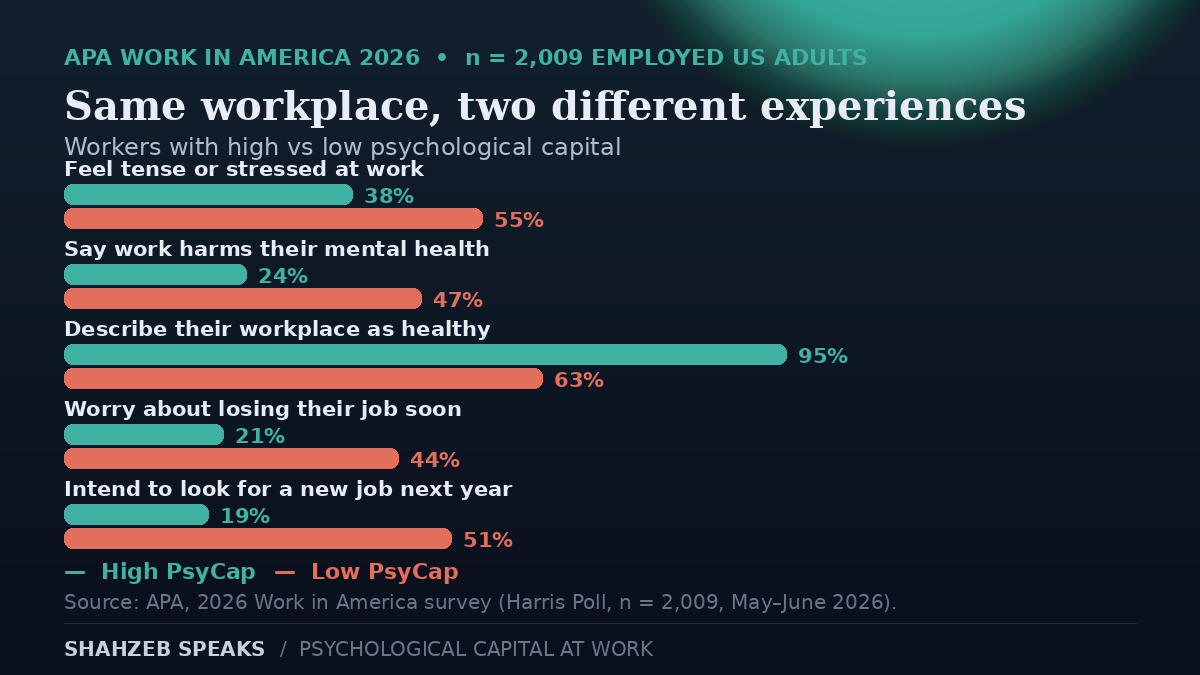
Against that background, the PsyCap gaps are startling. High-PsyCap workers are far less likely to say they typically feel tense or stressed at work — 38%, against 55% of low-PsyCap workers — and about half as likely to say their work environment harms their mental health: 24%, against 47%. And 95% of high-PsyCap workers describe their workplace as healthy, against 63% of low-PsyCap workers. Either high PsyCap changes how people experience the same workplace, or healthy workplaces build PsyCap — or, most likely, both happen at once.
The fear figures tell the same story in a different key. Overall, 32% of workers are concerned they might lose their job within the next few weeks or months, up from 26% in 2025 — but the split by PsyCap is wide: 21% of high-PsyCap workers report that worry, against 44% of low-PsyCap workers. Concern that an economic slump could cost them their job within twelve months held steady at 44% overall, the same as in 2025, but workers with low PsyCap were nearly twice as likely as high-PsyCap workers to report that concern. And on the question that defines working life in 2026, artificial intelligence: 48% of all workers worry that AI could make some or all of their job duties obsolete, the highest rate since Work in America started asking the question in 2023 — 37% among high-PsyCap workers, 53% among low-PsyCap workers.
| APA 2026 Work in America (n = 2,009) | High PsyCap | Low PsyCap |
|---|---|---|
| Typically tense or stressed at work | 38% | 55% |
| Work environment harms mental health | 24% | 47% |
| Describe workplace as healthy | 95% | 63% |
| Worried about losing job in next few weeks/months | 21% | 44% |
| Worry AI could make job duties obsolete | 37% | 53% |
| Intend to look for a new job next year | 19% | 51% |
Two findings in this chapter deserve a paragraph each. The first is about technology. Almost two-thirds of all workers — 64% — believe technological change is benefiting employers more than workers, up from 52% in 2025, and 37% worry they will fall behind if they do not use AI, up from 30% a year earlier. Yet among high-PsyCap workers, 64% say technological change has created new opportunities in their current role or career path. The same change, seen through two different lenses: the worker who believes she can learn new tools and recover from a false start is more likely to see opportunity in AI, while the worker who does not is more likely to see a threat. That does not mean the threat is imaginary — the overall figures show real anxiety — but it does suggest that how people are equipped to meet change shapes what change feels like. For the wider picture, see my articles on the AI productivity paradox and GenAI technostress and work loneliness.
The second finding should worry every employer reading this. Among high-PsyCap workers, only 19% intend to look for a new job in the next year. Among low-PsyCap workers, 51% do — more than half. That is a thirty-two-point gap in the intention to leave, in a labour market where engagement is already at a fifteen-year low: I wrote about that in my article on employee engagement at a 15-year low, where Gallup’s third-quarter 2026 figure fell to 29%. The APA numbers do not prove that raising PsyCap would keep those workers — remember, this is a cross-sectional survey — but they do show that the workers most likely to leave are the ones with the fewest inner resources to draw on.
🔬 Chapter 4: Fifty-one studies, 12,567 workers — what the evidence says
A single survey, however well done, is not enough to build a case on. The case for PsyCap rests on a much wider body of research, and the most useful summary of it is a meta-analysis by Avey, Reichard, Luthans and Mhatre, published in 2011 in Human Resource Development Quarterly (volume 22, issue 2, pages 127–152). A meta-analysis pools the results of many studies into one estimate, so it is the closest thing psychology has to a verdict. This one pooled 51 independent samples representing 12,567 employees, and it asked a simple question: across all those studies, what does PsyCap actually go with?
The answer, on the desirable side, was consistent. PsyCap showed significant positive relationships with job satisfaction, organisational commitment and psychological well-being; with organisational citizenship behaviour — the helpful, voluntary things people do that are not in their job description; and with performance, measured three ways: self-rated, supervisor-rated and objective. The fact that the performance link held across all three kinds of measure matters, because self-ratings alone can flatter. On the undesirable side, PsyCap showed significant negative relationships with cynicism, turnover intentions, job stress, anxiety and deviance — the behaviours, from cutting corners to lashing out, that damage a team. In plain terms: across 51 samples, people with more psychological capital were more satisfied, more committed, better performers and better colleagues, and less stressed, less anxious, less cynical and less likely to want to leave.
One number from that meta-analysis is worth quoting precisely, because it is the only exact correlation I can verify. A later peer-reviewed paper reports Avey and colleagues’ job-satisfaction correlation with PsyCap as r = .50–.57, a range across analyses — large by the standards of workplace psychology, where most relationships between a psychological variable and job satisfaction sit well below that. It is still a correlation, which means it carries the same caution as the APA survey: it does not, on its own, prove that PsyCap causes satisfaction. People who are satisfied with their jobs may develop more PsyCap, or a third factor — a good manager, a fair workload — may raise both at once. I am not printing the exact per-outcome correlations from the meta-analysis, because the full text is paywalled and I could not verify them from a source I actually read. The directions are verified from the abstract, and they are enough.
Two qualifications from the meta-analysis deserve to be stated, because they limit how far the findings travel. First, the relationships were strongest in studies conducted in the United States and in the service sector. That does not mean PsyCap is irrelevant elsewhere — it has been studied in many countries — but generalising to other countries and sectors needs care. A factory in Karachi is not a call centre in Ohio, and the evidence base is thinner outside the American service economy. Second, most of the studies were cross-sectional, like the APA survey. They measure PsyCap and outcomes at the same moment, so they cannot establish which came first. The intervention research in the next chapter begins to answer that question — and answers it honestly, with small effects.
🛠️ Chapter 5: Can psychological capital be built? The honest answer
This is the chapter the whole idea stands or falls on. If PsyCap were a fixed trait, it would be interesting and useless — a way of sorting people, not a way of helping them. The claim that it can be developed was tested early, and tested properly, by Luthans, Avey and Patera in 2008. Their study, published in the Academy of Management Learning & Education (volume 7, issue 2, pages 209–221), used a pretest–posttest experimental design: a highly focused two-hour web-based training intervention, with 187 people randomly assigned to the treatment group and 177 to a control group. Random assignment is what makes this study different from a survey — because people were allocated by chance, a difference after the training can reasonably be credited to the training. The study found support that PsyCap can be developed by such training.

The follow-up came two years later. Luthans, Avey, Avolio and Peterson (2010), in Human Resource Development Quarterly (volume 21, issue 1, pages 41–67), ran a pilot PCI with a randomised control-group design, then a follow-up with practising managers — and found that short PCI training not only developed PsyCap but also improved on-the-job performance. That is the beginning of evidence for a causal effect: not just a link between PsyCap and performance, but a change in PsyCap followed by a change in performance. It is beginning evidence, not conclusive proof, and I am describing it that way on purpose. Two studies do not settle a question. They open it.
What a psychological capital intervention actually looks like
A typical PCI is short — one to three consecutive hours, face to face or online — built on a three-pronged strategy: goal design, pathway generation, and overcoming obstacles, inside a goal-oriented framework. In practice that means a session built around a real goal the participant actually cares about. You design the goal properly, making it specific and achievable. You generate pathways: not one route to the goal, but several, so that a blocked route is a detour rather than a dead end. And you work through the obstacles in advance — naming what could go wrong, and deciding what you will do when it does. It is a structured way of thinking that most capable people do instinctively, made explicit so that people who do not do it instinctively can learn it.
How big are the effects? Smaller than the headlines suggest
Here is where honesty matters most. A pre-registered meta-analysis of controlled interventions by Lupșa, Vîrga, Maricuțoiu and Rusu, published in 2020 in Applied Psychology (volume 69, pages 1506–1556), pooled 41 controlled trials covering 3,911 employees or students. The overall effect of interventions on PsyCap variables was significant but small: d = 0.34. By component, the effects were hope d = 0.22, self-efficacy d = 0.37, optimism d = 0.36, and resilience d = 0.49. A d of 0.34 is a real effect — it is not zero, and it is not noise — but it is small. It means the average person who goes through a PCI ends up modestly higher on PsyCap than the average person who does not. It does not mean a two-hour workshop transforms a struggling team.
A more recent meta-analysis tells a slightly brighter story, with a caveat. Loghman, Ramirez-Perez, Bohle and Martin (2025), in Personnel Review (volume 54, issue 1, pages 106–129), pooled 40 studies covering 4,207 people and found intervention effects larger than those in Lupșa and colleagues’ 2020 analysis, strongest on hope and optimism. The effects were sustained on PsyCap, hope, resilience and optimism, but not on efficacy — which faded — and more frequent sessions worked better. I am not printing exact per-component effect sizes for this study, because I could only verify the abstract-level findings.
And then there is the number that should keep everyone modest. A 2019 review by Salanova and Ortega-Maldonado found that PCI and similar PsyCap micro-interventions produced only a 3.11% average increase in individual PsyCap, and the authors called for more research on long-term effectiveness. Three per cent. That is the honest scale of what a short intervention delivers on its own. One smaller study offers a note of encouragement: Russo and Stoykova (2015) replicated PCI in Bulgaria with a pooled sample of 40 students and professionals, found that overall PsyCap and each of the four dimensions improved significantly, and found the improvements remained stable at a one-month follow-up. Notably, resilience only showed its improvement at follow-up, which suggests that practice gradually strengthens it. But a sample of 40 is small, and one month is short. Long-term durability beyond a month is thinly evidenced, and I will not pretend otherwise.
The practical conclusion is straightforward. A one-to-three-hour PCI is a real, evidence-based starting point, but it is a starting point, not a fix. The gains are small on average, they need reinforcement and repeated sessions to last, and they will not compensate for a bad job. An organisation that runs a PsyCap workshop while keeping impossible workloads, unpredictable rotas and a bullying manager has spent its money on the wrong thing. The training works best as one part of a wider investment — alongside fair pay, manageable work, and a manager people actually want to work for. Used as a substitute for fixing the job, it is a way of blaming workers for a problem the organisation created.
🎓 Chapter 6: Psychological capital for students — the newest evidence
PsyCap is not only a workplace idea. Students face the same pattern — pressure, setbacks, uncertainty about the future — and the newest research on PsyCap and students was published in July 2026, which makes it the freshest evidence in this article. Xiao, Jia and Wan (2026), in Frontiers in Psychology (volume 17, article 1905242, published 31 July 2026), studied how positive psychological capital is associated with academic resilience among undergraduates, and whether academic self-efficacy and coping self-efficacy explain the link.
The study surveyed 486 full-time undergraduates, aged 17 to 25 with a mean age of 20.13, at one public university in Central China, using convenience cluster sampling — 226 men (46.5%) and 260 women (53.5%), with an effective response rate of 89.7%. PsyCap was measured with the 24-item PCQ-24 (alpha = 0.92), and academic resilience with a 30-item Academic Resilience Scale (alpha = 0.86). The correlations, all significant at p < .001, were substantial: PsyCap with academic self-efficacy r = 0.56, with coping self-efficacy r = 0.51, and with academic resilience r = 0.54. Academic self-efficacy correlated with resilience at r = 0.58, and coping self-efficacy with resilience at r = 0.49.
The mediation analysis is the interesting part, and it needs to be reported carefully because the headline number is small. The total effect of PsyCap on academic resilience was beta = 0.52, with a 95% confidence interval of 0.44 to 0.59. The direct effect was beta = 0.31, or 59.6% of the total, and the total mediated effect was beta = 0.21, or 40.4%. The sequential chain — PsyCap leading to academic self-efficacy, which leads to coping self-efficacy, which leads to resilience — was significant, but small: beta = 0.02, just 3.8% of the total effect. The authors note the modest chain effect themselves and say longitudinal studies are needed to confirm the process. The story the data tells is that PsyCap is associated with resilience mostly directly, and only a little through the chain of self-efficacy beliefs.
The limits of this study must be stated plainly. It was conducted at a single university in China, with convenience sampling, a cross-sectional design that cannot establish causal order, and self-report scales throughout. The authors frame their findings as institution-specific, not universally representative, and this article respects that. What travels is the pattern, not the precise numbers — and the pattern is consistent with the workplace evidence: the same four resources, the same association with resilience, the same need for better designs before anyone claims cause. The paper also cites systematic reviews of university populations showing that higher PsyCap is positively associated with academic performance and engagement as well as well-being.
For students reading this, the practical lesson is the same as for workers, and it is refreshingly concrete. Academic resilience is not about never failing. It is about what happens after the failure — whether you treat a bad grade as information about one exam, or as a verdict on your ability. Set a specific goal for the next assignment, plan two routes to it, and decide in advance what you will do if the first route fails. It is the same three-pronged structure as the workplace intervention in Chapter 5, scaled down to a single piece of coursework.
⚠️ Chapter 7: What psychological capital is not — the two guards
An idea this appealing needs guards, because appealing ideas get misused. The first guard is about blame. Psychological capital is an organisational investment, not a reason to blame workers for struggling in bad jobs. The APA frames it exactly that way — as something employers should invest in — and its chief executive, Arthur Evans, put it plainly in the press release: “As stress and economic uncertainty continue to build, it’s not surprising that many workers feel that tension interfering with their work. Employers who want to succeed in this environment need to look beyond productivity metrics and help cultivate the psychological resources workers need to thrive.” The responsibility, in that sentence, sits with the employer. The worker is not the problem. The conditions are.
Watch for the misuse, because it is easy to recognise once you know what to look for. It sounds like this: “We offered a resilience workshop, so if you are still stressed, that is on you.” Both sentences of that kind turn a resource into a requirement, and both let the organisation off the hook for the workload, the pay, the rota and the manager. A resilience workshop does not fix a job that requires sixty hours a week. Hope does not pay the rent. Optimism does not make a bullying supervisor tolerable. When PsyCap is used that way, it stops being psychology and starts being a management excuse — and the research gives it no cover.
The second guard is about cause. The APA survey is cross-sectional, and I have said so twice already because it matters that much. High-PsyCap workers report better outcomes, but the survey cannot prove that PsyCap causes them. Healthier workplaces may build PsyCap in the people who work there. People with more resources may also sort themselves into better jobs, or stay in them longer, while people with fewer resources leave — which would produce exactly the same pattern in the data without PsyCap causing anything at all. The APA states this explicitly: “While this survey can’t establish causality, these findings and prior research suggest workplace conditions and psychological capacities reinforce one another over time.” The honest reading is that the two reinforce each other over time. That is not a weakness in the idea. It is the reason the idea is useful: investing in people’s inner resources and improving the conditions of work are not alternatives. They are the same project, approached from two sides.
✅ Chapter 8: What employers and workers should do
For employers, the APA’s own recommendations are a good place to start. First, broaden the definition of performance to include hope, efficacy, resilience and optimism — not as a replacement for output, but alongside it. An employee who hits every target while burning out is not performing well; she is performing unsustainably, and the cost will arrive later as absence, error or resignation. Second, invest in people’s psychological capacity to adapt alongside investment in technology. The survey found that 64% of all workers believe technological change benefits employers more than workers, and 37% worry they will fall behind if they do not use AI. Training people on the tools without training them in the confidence to use them is half a job. Third, design workplaces and cultures that help workers feel valued and supported — which, given that only 80% of workers now feel valued, down from 84%, is a direction of travel that needs reversing.
To those three, I would add two of my own. First, run a short PCI — one to three hours, built around real goals, pathways and obstacles — but run it as part of a wider change, not instead of one. The evidence says the effects are small (d = 0.34) and need reinforcement, so a single workshop followed by silence is money wasted. Repeat the sessions, build the practices into team routines, and measure whether anything actually changed a month later. Second, fix the job at the same time: publish rotas earlier, keep hours stable, give people input into when they work, and deal with the manager whose team keeps leaving. The APA survey shows that the workers most likely to leave are the ones with the fewest inner resources — and the cheapest way to keep them is not a workshop, but a workplace that does not drain them in the first place. For the question of what makes people feel safe enough to speak up, see my article on psychological safety at work, and for the related problem of doubting your own competence under pressure, my article on capability anxiety at work.
For workers, the advice is more personal, and it starts with a small experiment rather than a programme. Pick one goal that matters to you this month — a real one, not a vague aspiration. Write down three different routes to it. Then write down the one obstacle most likely to block the first route, and decide in advance what you will do when it appears. That is the whole intervention, in miniature: goal design, pathway generation, overcoming obstacles. Do it on paper, not in your head, because the act of writing makes the routes real. Then, when the setback comes, notice how you explain it to yourself. If the explanation is “I am hopeless at this”, try the alternative: “the brief changed”, “the timing was wrong”, “this route was blocked”. The explanation is not a trick. It is the difference between a setback that ends the attempt and a setback that redirects it.
And if work is harming your mental health right now, be honest with yourself about what the evidence says. Building your own psychological capital can help — the research is clear on that — but it cannot fix a job that is structurally harmful. The APA survey found that 37% of workers say work harms their mental health, and the most useful response to that number is not a workshop. It is a proper look at the job: the hours, the workload, the manager, the pay, and whether any of them can change. If they cannot, the bravest use of psychological capital may be the decision to leave. For the wider picture of how job quality shapes that choice, see my article on the Gallup American Job Quality Study 2026, where only 41% of American workers hold a job that clears the bar for quality.
❓ Questions I am asked most often
What is psychological capital at work?
Psychological capital at work, or PsyCap, is a person’s combined stock of four positive resources — hope, self-efficacy, resilience and optimism — that helps them cope with pressure and keep working toward goals. It is state-like, meaning it is more stable than a mood but less fixed than a personality trait, and it can be developed through training.
Does psychological capital really improve mental health at work?
It is associated with much better reported mental health, not proven to cause it. In APA’s 2026 survey of 2,009 US workers, high-PsyCap workers were far less likely than low-PsyCap workers to say work harmed their mental health (24% against 47%). The survey is cross-sectional, so it shows a link — and healthier workplaces may also build PsyCap.
What are the four parts of psychological capital?
Hope, efficacy, resilience and optimism — shortened to HERO. Hope is willpower plus “waypower”, the ability to find routes to a goal. Efficacy is confidence to succeed at a specific task. Resilience is bouncing back from setbacks. Optimism is explaining bad events as temporary and external, and good events as personal and lasting.
Can psychological capital be trained?
Yes, but the effects are modest. A randomised 2008 experiment found a two-hour web-based intervention raised PsyCap in 187 treated workers against 177 controls. A 2020 meta-analysis of 41 controlled trials (3,911 people) found a significant but small overall effect, d = 0.34, with resilience improving most (d = 0.49) and hope least (d = 0.22).
How is psychological capital measured?
The standard workplace measure is the Psychological Capital Questionnaire, the PCQ-24 — 24 items, six per dimension, developed by Luthans, Youssef and Avolio in 2007. The APA’s 2026 Work in America survey used a shorter validated five-item scale covering the same four resources, grouping respondents into low, moderate and high PsyCap.
Is psychological capital just blaming workers for bad jobs?
No — and using it that way is a misuse. The APA frames PsyCap as something organisations should invest in, not a demand placed on workers. A resilience workshop cannot fix impossible workloads, low pay or a bullying manager. PsyCap is one resource among several, and the quality of the job itself matters more.
If your organisation is measuring engagement or retention and the numbers are not moving, the problem may be the psychological resources your people are working with — or the job that is draining them. I am an Industrial and Organizational Psychologist, and I work with teams on work design, manager behaviour and the measurement of culture, engagement and retention. Get in touch here.
If you want the wider context, start with my guide to industrial psychology in Pakistan and my article on the Gallup American Job Quality Study 2026, which examines what actually makes a job a good one. For the question of whether your workplace is safe to speak up in, see psychological safety at work, and for what happens when AI changes how people work together, GenAI technostress and work loneliness.
Sources
- American Psychological Association (2026). Workers with psychological capital better prepared to weather increasing work stress (press release, 22 September 2026). https://www.apa.org/news/press/releases/2026/09/psychological-capital-work-stress
- American Psychological Association (2026). Work in America 2026. https://www.apa.org/pubs/reports/work-in-america/2026
- Luthans, F., Youssef, C. M., & Avolio, B. J. (2007). Psychological Capital: Developing the Human Competitive Edge. Oxford University Press.
- Luthans, F., Avolio, B. J., Avey, J. B., & Norman, S. M. (2007). Positive psychological capital: Measurement and relationship with performance and satisfaction. Personnel Psychology, 60(3), 541–572. https://digitalcommons.unl.edu/leadershipfacpub/11
- Avey, J. B., Reichard, R. J., Luthans, F., & Mhatre, K. H. (2011). Meta-analysis of the impact of positive psychological capital on employee attitudes, behaviors, and performance. Human Resource Development Quarterly, 22(2), 127–152. https://digitalcommons.unl.edu/managementfacpub/140/
- Luthans, F., Avey, J. B., Avolio, B. J., Norman, S. M., & Combs, G. M. (2006). Psychological capital development: Toward a micro-intervention. Journal of Organizational Behavior, 27, 387–393.
- Luthans, F., Avey, J. B., & Patera, J. L. (2008). Experimental analysis of a web-based training intervention to develop positive psychological capital. Academy of Management Learning & Education, 7(2), 209–221. https://digitalcommons.unl.edu/managementfacpub/135/
- Luthans, F., Avey, J. B., Avolio, B. J., & Peterson, S. J. (2010). The development and resulting performance impact of positive psychological capital. Human Resource Development Quarterly, 21(1), 41–67. https://digitalcommons.unl.edu/managementfacpub/157
- Lupșa, D., Vîrga, D., Maricuțoiu, L. P., & Rusu, A. (2020). Increasing psychological capital: A pre-registered meta-analysis of controlled interventions. Applied Psychology, 69, 1506–1556. https://doi.org/10.1111/apps.12219
- Loghman, S., Ramirez-Perez, H., Bohle, P., & Martin, A. (2025). A comprehensive meta-analysis of the impact of intervention programmes on psychological capital development. Personnel Review, 54(1), 106–129.
- Salanova, M., & Ortega-Maldonado, A. (2019). Psychological capital development: A review. (As summarised in Loghman et al., 2025.)
- Russo, S. D., & Stoykova, P. (2015). Psychological capital development: A replication study. (As summarised in a 2026 systematic review of PCI studies.)
- Xiao, M., Jia, X., & Wan, Y. (2026). How positive psychological capital is associated with academic resilience: Investigating the sequential mediating effects of academic and coping self-efficacy among undergraduates. Frontiers in Psychology, 17, 1905242. https://doi.org/10.3389/fpsyg.2026.1905242
- Lorenz, T., Beer, C., Pütz, H., & Heinitz, K. (2016). Measuring psychological capital: Construction and validation of the compound PsyCap scale (CPC-12). PLoS ONE, 11(4), e0152892. https://pmc.ncbi.nlm.nih.gov/articles/PMC4817957/