
It is 6:40 on a Wednesday evening. A good employee, the kind a manager fights to keep, is still at her desk, finishing a report that could wait until morning. Her phone lights up. It is her daughter, asking when she will be home. She already knows the answer: not soon. Three weeks later, a recruiter calls with a job that pays slightly less. She takes it. The hours are shorter and the weekends are hers. That choice is now the most common one in the working world: work-life balance overtakes salary as the top reason workers consider leaving, according to a new global survey of 40,500 workers.

I am an Industrial and Organizational Psychologist in Karachi, and I write about work and behaviour for a global reader. This article is built on the Adecco Group’s Global Workforce of the Future report, seventh edition, released on 19 November 2026 — a survey of 40,500 workers across 36 countries and 21 industries, carried out in June and July 2026. One warning belongs up front: Adecco is a staffing and recruitment company, and this is company-funded research. A company that places people for a living has a commercial interest in findings about why people leave jobs. That does not make the numbers wrong — 40,500 workers across 36 countries is a serious sample — but it means I will keep the survey’s claims separate from what the older, independent psychology shows, and I will say where the two agree and where they do not.
“Pay is still the reason most people take a job. It is no longer the reason they stay.”
— Workplace Psychology Analysis, ShahzebSpeaks
This guide covers the short answer, the numbers behind the new ranking, the psychology of why balance beat pay, what the report found about AI and training, the leadership bottleneck underneath it all, what a second major study adds, and what employers and employees can honestly do with the evidence.
🎯 Chapter 1: The short answer — work-life balance overtakes salary
Work-life balance has overtaken salary as the leading reason workers consider leaving their employer. That is the headline of Adecco’s Global Workforce of the Future 2026 report, released on 19 November 2026 — the first time in seven years that pay has lost the top spot. Schedule flexibility ranks second and remote work third, with salary fallen to fourth place.
The pattern is plain: workers are judging jobs less by what they pay and more by how they fit into the rest of a life.
That does not mean pay no longer matters. It means pay has stopped being the deciding factor for a large share of the workforce. Think of it the way a worker thinks about it: a salary is a number on a contract, and it is easy to compare. Balance is the shape of every day — when you start, when you finish, whether you can be at the school gate, whether a weekend is actually yours. A pay rise does not buy back an evening. A shorter week, a flexible start, two days working from home: those change the day itself. The survey suggests that, for the first time in seven years of asking, more workers would leave over the shape of the day than over the size of the number. For employers, the message is uncomfortable but clear: the retention tool they have always reached for first — money — now ranks fourth, behind three things that cost far less than a pay rise and need far more thought.
Two cautions belong at the start. First, this is a survey, not an experiment: it asked 40,500 workers what would make them consider leaving, and people answered about themselves at one point in time. It shows what workers say matters, not what a controlled study proves causes them to leave. Second, the release gives a ranking, not percentages for each reason. I know the order — balance first, flexibility second, remote work third, salary fourth — but I do not know by how much balance leads, because Adecco did not publish that in the release. I will not guess. What follows uses only the numbers the release actually gives, and the older research that helps explain them.
📊 Chapter 2: The numbers — what 40,500 workers told Adecco
The Adecco Group surveyed 40,500 workers across 36 countries and 21 industries between June and July 2026, through an online survey in local languages. The report is the seventh edition of an annual study, which is what makes the headline credible: the same question, asked the same way, year after year, and this is the first year the answer changed. The independent trade coverage the same morning confirmed the point — finwire.io reported that it is the first time in the seven years of Adecco’s annual report that pay has slipped down the rankings, and quoted the Adecco Group’s chief executive, Denis Machuel, saying companies struggle to recruit if they insist on five-day working weeks.
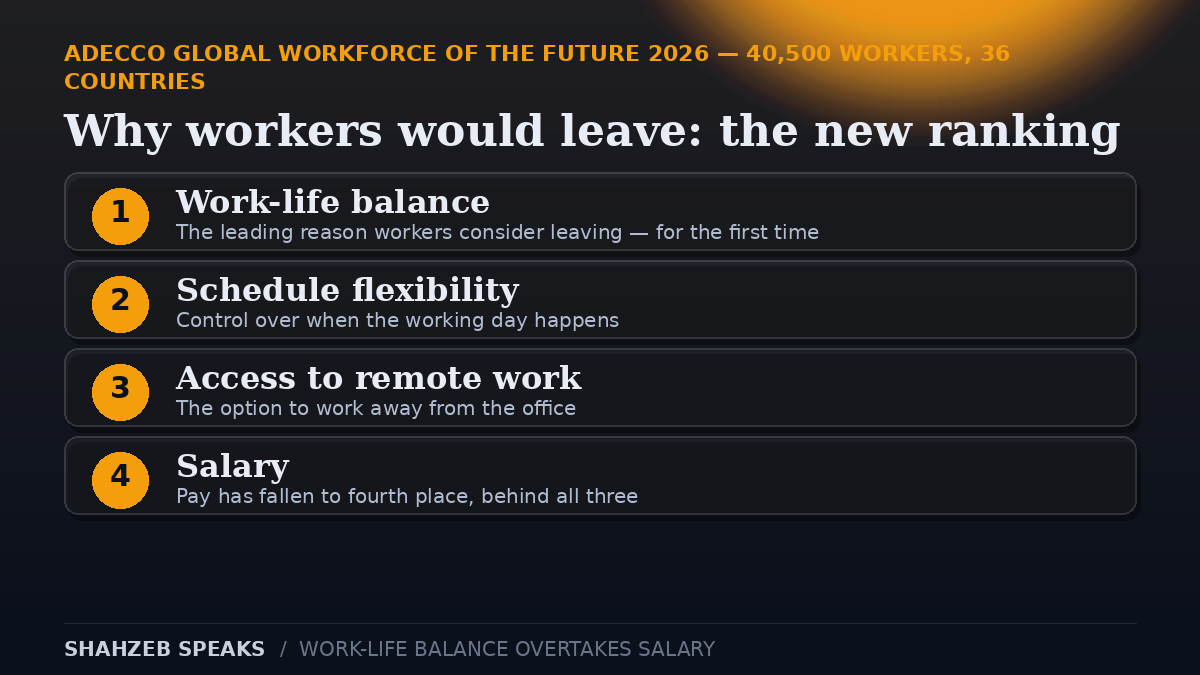
| Rank — reason workers consider leaving | What it means |
|---|---|
| 1 — Work-life balance | The leading reason, for the first time in seven years |
| 2 — Schedule flexibility | Control over when the working day happens |
| 3 — Access to remote work | The option to work away from the office |
| 4 — Salary | Pay has fallen to fourth place, behind all three |
Read the ranking as a group, not as four separate findings, and something important appears: the top three are all the same thing in different clothes. Balance, flexibility and remote work are three ways of saying one thing — control over your own time. A worker who can start at nine instead of eight, who can work from home on a Tuesday, who can leave at five without guilt, has the same thing a worker with “balance” has. The ranking is not really four reasons. It is one reason, stated three ways, with pay in fourth place. That is why the finding matters more than a single headline. It is not that one new benefit has appeared. It is that the whole top of the list is now about time, and pay is the only item on it about money.
The survey was fielded in June and July 2026, more than six years after the pandemic overturned working patterns. This is not a snapshot of a strange year, but of the settled pattern that followed it: hybrid work, flexible hours and remote options are no longer emergency measures. They are the baseline workers expect, and employers who treat them as favours are the ones losing people. As Machuel put it in the release, “AI delivers its greatest impact when it happens with people and not to people.” The same sentence could be written about flexibility: it works when it is designed with workers, not imposed on them.
🧠 Chapter 3: Why balance beat pay — the psychology underneath the ranking
The finding surprises managers more than psychologists, because the research has pointed this way for decades. Work and home are not two rooms with a door between them. They are one life, and strain in one part shows up in the other. Greenhaus and Beutell described this in 1985, in a paper in the Academy of Management Review, as work-family conflict coming from three sources: time (hours given to one role are not available to the other), strain (the tension and fatigue of one role make the other harder), and behaviour (the way you have to act at work does not fit the way you want to be at home). A job that pays well but steals every evening is a time conflict and a strain conflict at once. No pay rise fixes either one, because the problem is not the money. The problem is the hours and the exhaustion.
The link to leaving is not a guess. A meta-analysis published in 2025 by Li, Zhou, Zhang and Martek in Frontiers in Public Health combined 122 empirical studies and found a significant positive correlation between overall work-family conflict and turnover intention (r = 0.446), with work-to-family conflict at r = 0.318 and family-to-work conflict at r = 0.261. In plain words: across more than a hundred studies, the more work and family clashed, the more people thought of leaving. A correlation of 0.446 is strong for this kind of research, and it is the independent evidence behind the Adecco ranking. The survey says workers would leave over balance; a hundred studies say the pattern has held for years.
There is also a simpler way to understand it, and it comes from the idea of diminishing returns. A pay rise from a low salary changes a life: it pays the rent, clears a debt, buys a holiday. A pay rise from a comfortable salary changes a number. But an extra hour of evening, every evening, changes a life at any salary. That is why the ranking looks the way it does. Most workers in this survey are not choosing between poverty and comfort. They are choosing between a comfortable salary with no evenings and a slightly smaller one with their evenings back — and increasingly, they choose the evenings. Gallup’s American Job Quality Study 2026, published a month earlier, tells the same story from the other side: only 41% of American workers hold a quality job, and the weakest of its five dimensions is work structure and autonomy, with only 15% of employees meeting its threshold — a stable, predictable schedule, a manageable workload and real control over when and how work gets done. Read my full breakdown of that study in Only 4 in 10 Workers Have a Good Job. Two different studies, two different methods, one conclusion: the structure of the working day is where jobs are failing people.
🤖 Chapter 4: The AI chapters — involvement, communication and training
The Adecco report is mostly about AI, and its AI findings are worth reading carefully — not because AI is the lead story, but because they explain why balance and AI belong in the same report. Nearly three-quarters of workers (74%) now use AI agents at work, up from 64% in 2025, and technology occupies four of the five leading influences reshaping work. AI is no longer a pilot project. It is in the working day of most workers, and the report’s question is whether it is making that day better or worse. The answer, in every comparison the release gives, depends on how the change is handled — not on the technology itself.
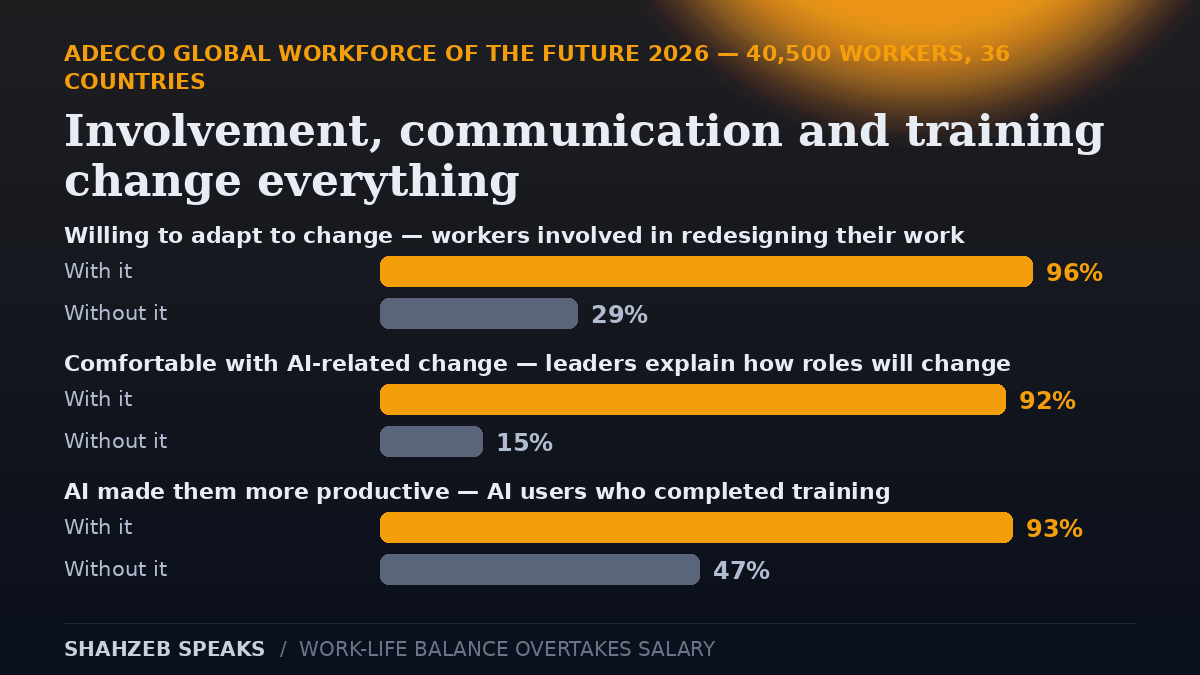
Start with involvement. Among workers involved in redesigning work in response to AI, 96% say they are willing to adapt to changing environments, compared with 29% of those not involved. That is a gap of 67 percentage points — the largest in the whole release — and it is the most useful number in it. People do not resist change. They resist change done to them. Ask a team how a new tool should fit into their day, and almost all of them will go along. Impose it, and seven in ten will not. The same pattern holds for communication: 92% of workers whose leaders explain how AI will change their role are comfortable with AI-related change, versus 15% where that communication is absent. And for training: 93% of AI users who completed training say AI has made them more productive, compared with 47% of those who have not. Three levers, three gaps of roughly 45 to 77 points, all pointing the same way. What changes the outcome is not the tool. It is how the people using it are treated.
| What the employer does | With it | Without it |
|---|---|---|
| Involves workers in redesigning their work | 96% willing to adapt | 29% |
| Leaders explain how AI will change the role | 92% comfortable with change | 15% |
| Workers complete AI training | 93% say AI made them more productive | 47% |
But one number moved the wrong way. Two-thirds of workers (66%) say AI has changed the skills required for their jobs, yet participation in AI training has fallen — from 77% in 2025 to 67% in 2026. The skills are changing faster and the training is reaching fewer people. That is the gap where the balance finding and the AI finding meet. Workers who use well-integrated AI save 20% more time per day than users experiencing lower integration, and they are seven times less likely to feel overwhelmed by the need to use AI tools effectively. But if the training is not there, the time saved goes to the few who already know how, and the rest get the pressure without the benefit. A worker who is expected to use a tool she was never trained on, at a pace set by the tool’s speed rather than her own, does not have a productivity problem. She has a balance problem, and the Adecco ranking tells you what she does about it. I wrote about the darker side of this same pressure in my article on GenAI technostress and work loneliness, and about the better side — what working with AI well actually looks like — in Employee–AI Collaboration.
👥 Chapter 5: The leadership bottleneck — why managers are the problem now
The report names the bottleneck plainly, and it is not the technology. Only 19% of workers say leaders are empathetic to the effects of change. Only 21% feel concerns about new technologies are taken seriously. Only 39% feel supported by their manager to adapt. Read those three numbers together and the picture is stark: four out of five workers do not think their leaders understand what change feels like, four out of five do not think their worries are heard, and three out of five do not feel supported by the person whose job it is to support them. The technology is arriving. The leadership is not.

This is where the report’s one reference to psychological safety matters. Workers who experience high psychological safety — the shared belief that it is safe to speak up, ask a question or admit a mistake — report substantially stronger confidence, problem-solving and willingness to adapt. The concept comes from Amy Edmondson’s 1999 study in the Administrative Science Quarterly, which tested 51 work teams in a manufacturing company and found that team psychological safety was associated with learning behaviour, and that learning behaviour carried the link between safety and team performance. The Adecco numbers fit that old finding exactly. A worker who feels safe to say “I don’t understand this tool” or “this new schedule is not working for me” is a worker who can adapt. A worker who does not feel safe says nothing — and then, eventually, leaves. The 19% empathy figure and the balance ranking are the same story told twice: people leave jobs where they are not heard, and the first thing they stop being heard about is their time.
There is a hard truth in this chapter for managers. Most leadership training teaches managers to set goals and drive results. Almost none of it teaches them to ask a tired employee what her week actually looks like. Yet the Adecco numbers suggest that is the skill that decides whether people stay. A manager who notices that an employee has worked three late evenings in a row, and who says “take Friday morning, we’ll cover it”, has done more for retention than a bonus scheme. A manager who announces a new AI tool on a Monday and offers no training and no conversation has done more damage than a pay freeze. The bottleneck is not money, and it is not technology. It is attention — the manager’s attention to the people in front of them. For more on what happens when that attention is missing, see my article on quiet quitting.
🔍 Chapter 6: What Gallup adds — a second lens on the same problem
One survey, however large, is one survey. So it is worth asking whether an independent study, asking different questions in a different way, lands in the same place. It does. Gallup’s American Job Quality Study 2026, based on 17,874 American workers surveyed between 26 January and 24 March 2026, found that only 41% of all American workers hold a quality job — a figure statistically unchanged from 2025. Of the five dimensions that make a quality job, the weakest by a long way is work structure and autonomy: only 15% of employees meet its threshold. That dimension measures a stable, predictable schedule, a manageable workload and real control over when and how work gets done. It is, in different words, the Adecco finding: the structure of the working day is the part of the job that is failing most people.
Gallup also connects that failure to leaving, with numbers Adecco did not publish. Employees in non-quality jobs in 2025 were nearly twice as likely to be working for a different employer one year later — 15% versus 8% of those in quality jobs. And in 2026, 12% of all American employees say they are very likely to leave their current job within the next year. Put the two studies side by side and the picture sharpens. Adecco says balance is now the top reason people consider leaving. Gallup says the jobs that fail on schedule, workload and control are the jobs people actually leave. One study asks what people say. The other watches what they do. They agree. That agreement is what makes me confident in this article’s headline: this is not one company’s survey finding. It is a pattern showing up in independent research, in the same year, on both sides of the question. For the wider context on how few workers are engaged at all, see my article on employee engagement at a 15-year low.
✅ Chapter 7: What employers should do — my advice, grounded in the findings
Nothing in this chapter is the report’s advice — the release publishes no recommendations, so I will not present any list as theirs. What follows is my own advice as an I/O psychologist, drawn from the findings above.
First, audit time before you audit pay. The ranking says balance, flexibility and remote work outrank salary, so the first question for any retention review should be about the working day, not the pay scale. Ask your people, in a short anonymous survey, three questions: can you predict your schedule two weeks ahead, do you have real control over when you work, and is your workload manageable in the hours you are paid for? If the answers are poor, a pay rise will not fix them — and the Adecco ranking tells you your people know that.
Second, make flexibility the default, not a favour. The top three reasons are all about control over time, so treat flexible hours and remote options as normal, with office days agreed rather than imposed. The finwire coverage quoted Machuel saying companies struggle to recruit if they insist on five-day working weeks, and the Adecco ranking is the evidence behind that warning. A five-day office mandate is now a recruitment handicap, not a sign of discipline.
Third, involve people in redesign before the tool arrives, and train them after it does. The 96% versus 29% gap is the largest in the report, and the 93% versus 47% training gap is nearly as large — yet training participation fell from 77% to 67% while the skills required kept changing. Bring the team into the redesign conversation early, explain clearly how each role will change, and then actually deliver the training.
Fourth, teach managers the one skill the numbers say is missing: noticing. Only 19% of workers say leaders are empathetic to the effects of change, and only 39% feel supported by their manager. That is not a technology problem, and no new tool will fix it. Train managers to spot a changed pattern — the employee who has gone quiet, who is staying late but producing less, who has stopped asking questions — and to ask a simple, private question: “How is the new schedule actually working for you?” Psychological safety is built in those small moments, not in a company-wide announcement.
💼 Chapter 8: What employees can do — when balance is the reason you would leave
If you are the person in the opening scene, the advice is different, and it starts with naming what you actually want. “Better balance” is too vague to negotiate. Work out the specific change that would make the job work: a 9-to-5 that ends at five, two days a week from home, no meetings after four, a deadline moved by two days when a family week is heavy. Then ask for that one thing, tied to one week or one month, and offer the trade that makes it easy to grant. Managers grant specific requests far more readily than general ones, and a specific request also tells you something useful if it is refused: the problem is not your ask. It is the job.
Second, treat the ranking as information about your own market value. The survey says balance now outranks salary for most workers, which means employers who offer real flexibility are competing for you, and employers who do not are losing people like you every week. That is not a reason to threaten to leave. It is a reason to ask with confidence, knowing the market has moved your way. And if the answer is no — if the five-day week is non-negotiable, if the late evenings are treated as loyalty — then you have your answer too. The research on work-family conflict and turnover intention, 122 studies strong, says people in your position do leave — and are usually right to. A job that costs you your evenings is not paying you enough, whatever the number on the contract says. For help thinking through a move itself, see my article on career change psychology, and for why the search for purpose matters alongside the search for balance, see meaningful work.
❓ Questions I am asked most often
What does work-life balance overtaking salary actually mean?
It means that in Adecco’s 2026 survey of 40,500 workers across 36 countries, work-life balance ranked first among the reasons workers consider leaving, ahead of schedule flexibility second, remote work third and salary fourth. It is the first time in the report’s seven-year history that pay has lost the top spot. Pay is not unimportant — balance now decides more departures than pay does.
Is this just about remote work?
No. Remote work ranks third, behind balance first and schedule flexibility second. They are related but not the same: balance is the overall fit between work and life, flexibility is control over when the day happens, and remote work is control over where it happens. Together they are one theme — control over your own time. A job can offer remote work and still destroy balance with endless evening calls.
Why would workers leave a well-paid job over balance?
Because a pay rise cannot buy back an evening. Once a salary covers the basics comfortably, extra money changes a number, while an extra hour of evening, every evening, changes a life. The psychology agrees: Greenhaus and Beutell showed in 1985 that work-family conflict comes from time, strain and behaviour, and a 2025 meta-analysis of 122 studies found work-family conflict strongly linked to thinking about leaving (r = 0.446).
What did the Adecco report find about AI at work?
That 74% of workers now use AI agents at work, up from 64% in 2025, and that how AI is introduced matters more than the tool. Workers involved in redesigning their work were more willing to adapt (96% vs 29%), workers whose leaders explained how their role would change were more comfortable (92% vs 15%), and trained users were more likely to say AI made them productive (93% vs 47%).
How bad is the leadership problem the report found?
Bad. Only 19% of workers say leaders are empathetic to the effects of change, only 21% feel concerns about new technologies are taken seriously, and only 39% feel supported by their manager to adapt. The report links this to psychological safety: workers who feel safe to speak up report stronger confidence, problem-solving and willingness to adapt — a finding from Edmondson’s 1999 study of 51 work teams.
Should I take a lower-paying job for better balance?
It depends on what the pay cut costs you and what the balance buys you. If the lower salary covers your needs, and the new job gives you back evenings, weekends or a commute, you are making the choice most workers now make. Ask for the change in your current job first — a concrete request is easier to grant, and its answer tells you whether the job can change.
If balance has become the reason your best people are leaving, and you want the cause understood with evidence rather than another pay review, I can help. I am an Industrial and Organizational Psychologist, and I work with teams on work design, workload and the schedules that actually keep people. Get in touch here.
If you want to understand the wider context, start with my guide to industrial psychology in Pakistan and my earlier articles on Only 4 in 10 Workers Have a Good Job, Employee–AI Collaboration, GenAI technostress and work loneliness and employee engagement at a 15-year low, which cover the other ways the working day is changing what people will put up with.
Sources
- The Adecco Group (2026, 19 November). The Adecco Group global study: AI delivers more value when people are involved in work redesign. GlobeNewswire. https://www.globenewswire.com/news-release/2026/11/19/3406312/0/en/the-adecco-group-global-study-ai-delivers-more-value-when-people-are-involved-in-work-redesign.html
- finwire.io (2026, 19 November). Flexibility more important to jobseekers than pay, global survey finds. https://finwire.io/news/economy-news/flexibility-more-important-to-jobseekers-than-pay-global-survey-finds
- Gallup, Jobs for the Future and The Families and Workers Fund (2026). The American Job Quality Study | 2026 State of the U.S. Labor Force. https://www.gallup.com/file/analytics/715745/2026-State-of-the-US-Labor-Fource_Report.pdf
- Edmondson, A. (1999). Psychological safety and learning behavior in work teams. Administrative Science Quarterly, 44(2), 350–383. https://doi.org/10.2307/2666999
- Li, G., Zhou, Y., Zhang, X., & Martek, I. (2025). The integrative relationship between work-family conflict and turnover intention: a meta-analysis. Frontiers in Public Health, 13, 1642843. https://doi.org/10.3389/fpubh.2025.1642843
- Greenhaus, J. H., & Beutell, N. J. (1985). Sources of conflict between work and family roles. Academy of Management Review, 10(1), 76–88.