
You finish a report in half the time it used to take. The AI drafted it, you polished it, and the result is genuinely good — yet by Friday you feel oddly flat, a little more tired than the hours saved should allow, and a little less sure your manager noticed the work at all. That contradiction is not in your head. Employee AI collaboration lifts well-being through the support it signals, and drags it down through the extra workload it creates — and in a 2026 study of 335 employees the two effects cancelled each other out, while a separate set of studies found that managers trust AI users less.

I am an Industrial and Organizational Psychologist in Karachi, and I write about work and behaviour for a global reader. This piece is built on a peer-reviewed study published in Behavioral Sciences on 3 November 2026, which I read in full, set against research on how managers judge AI use, a large company survey of AI at work, and early evidence on what happens to our thinking when we hand it over to a machine. One limit up front, and I will repeat it in the sourcing: the central study is a two-wave survey of employees in China who already used AI, and its authors state plainly that it cannot establish causal ordering — so everything here is an association, not proof of cause, and I will say so wherever it matters. This article also sits next to my earlier pieces on the same theme: my 11 November article on GenAI technostress and work loneliness, and my 6 November article on the AI productivity paradox. Those covered stress and workload. This one asks a narrower question: what happens to well-being when you actually work with AI, day after day?
“AI hands you back hours and quietly asks for them back in a different currency — checking, correcting, and proving the work was really yours.”
— Workplace Psychology Analysis, ShahzebSpeaks
This guide covers what employee–AI collaboration actually means, what the 2026 study of 335 employees found and what it did not find, why AI adds work even as it saves time, the trust penalty managers apply to AI users, what happens when most AI work goes private, how to use AI as a challenger rather than a yes-man, what the studies cannot tell us, and what you, your team and your manager can do about it — followed by a one-week plan.
🎯 Chapter 1: The short answer — AI helps and hurts at the same time
Employee–AI collaboration is associated with better work well-being and with worse work well-being, through two opposite routes at once. In a 2026 study of 335 employees in China, working with AI was linked to higher well-being through AI-related perceived organisational support — the sense that the organisation backs you in using AI — with an indirect effect of +0.089. At the same time it was linked to lower well-being through higher workload, with an indirect effect of −0.156. Add the two routes together and they cancel out: the summed indirect effect was −0.067, which was not statistically significant. The overall association between collaboration and well-being was still positive (0.336), because a direct association of 0.402 remained — but the two pathways underneath it pull in opposite directions, and that tension is the story of this article.
There is a second, separate cost that the well-being numbers do not capture. In six studies by Meyers, Bigman and Briker (2026), published in The Leadership Quarterly and reported on 4 November 2026, supervisors trusted employees less when those employees had used AI — in one experiment, 68% trusted the independent worker’s time report against 24% for the AI user — and that lower trust was linked to poorer evaluations and lower perceived suitability for promotion. So the honest short answer has three parts: AI collaboration is associated with feeling more supported, it is associated with carrying more workload, and it can cost you your manager’s trust. The rest of this article works through each part, with the numbers, the limits, and what to do about them.
📖 Chapter 2: What employee–AI collaboration actually means
Employee–AI collaboration is not the same as using a tool. A tool waits for instructions and does what it is told; a collaborator takes part in the work — drafting, suggesting, checking, and shaping the result alongside you. In the 2026 study by Liu and colleagues, employee–AI collaboration means working together with AI systems as part of everyday job tasks: asking the system to draft, summarise, analyse or suggest, then reviewing, correcting and building on what it produces. The study measured it with a five-item scale adapted from Kong and colleagues (2023), capturing how far employees actually work jointly with AI rather than merely switching it on now and then.
That distinction matters because the psychology changes when the AI stops being a calculator and starts being a colleague. With a calculator, the division of labour is clear: you think, it computes. With a generative AI system, the division is blurred. The system writes sentences in your voice, offers judgements that sound considered, and produces work you then have to stand behind. You are no longer only the author of your work; you are its editor, its checker and its guarantor. That shift explains both pathways in the study. On one side, being given AI tools and being helped to use them can feel like the organisation investing in you — support, in the language of the paper. On the other side, the checking, correcting and documenting that the new role demands is real work, and it lands on top of the job you already had. The same arrangement produces both effects, which is why the study’s two pathways point in opposite directions.
The study frames all of this through Job Demands–Resources theory, which treats every job as a balance between demands — the things that cost effort — and resources — the things that help you cope and grow. AI collaboration adds to both sides of that balance at once. It is a resource when it brings support, skill and speed; it is a demand when it brings extra workload, new learning and the need to check output you did not write. Whether the balance tips toward well-being or away from it depends on which side grows faster — and, as Chapter 3 shows, on what your leader does.
🔬 Chapter 3: The 2026 study — 335 employees, two opposite pathways
The research at the centre of this article is Liu, Wang, Tu, Lin and Xu (2026), “Employee–AI Collaboration and Work Well-Being: The Roles of AI-Related Perceived Organizational Support, Workload, and Leader AI Symbolization”, published in Behavioral Sciences, volume 16, issue 11, article 2081 (DOI: 10.3390/bs16112081). It was published on 3 November 2026, runs to 18 pages, and comes from the School of Management at Shanghai University and the School of Economics and Management at Shanghai Maritime University. I read the full paper directly — abstract, methods, results tables, discussion and limitations — so every number in this chapter comes from the paper itself, not from a summary.
The design was a two-wave questionnaire survey, run between 10 April and 9 June 2025. At Time 1 the researchers measured employee–AI collaboration, leader AI symbolisation and control variables; about one month later, at Time 2, they measured AI-related perceived organisational support, workload and work well-being. The final matched sample was 335 employees in China: 414 questionnaires were distributed, 369 came back at Time 1, 347 at Time 2, and 335 could be matched across both waves, an effective response rate of 80.9%. Participants were recruited online through Credamo, via WeChat, QQ, Weibo and Xiaohongshu, and worked across finance, manufacturing, information technology and wholesale/retail. The sample was 47.8% men and 52.2% women, most aged 21 to 50; 41.8% held a bachelor’s degree; 48.7% were regular employees and 37.6% frontline managers; the largest job category was production roles at 37.9%; the largest industries were wholesale/retail at 20.6% and information, software and IT services at 14.6%; and 57.3% earned between RMB 5,000 and 15,000 per month.
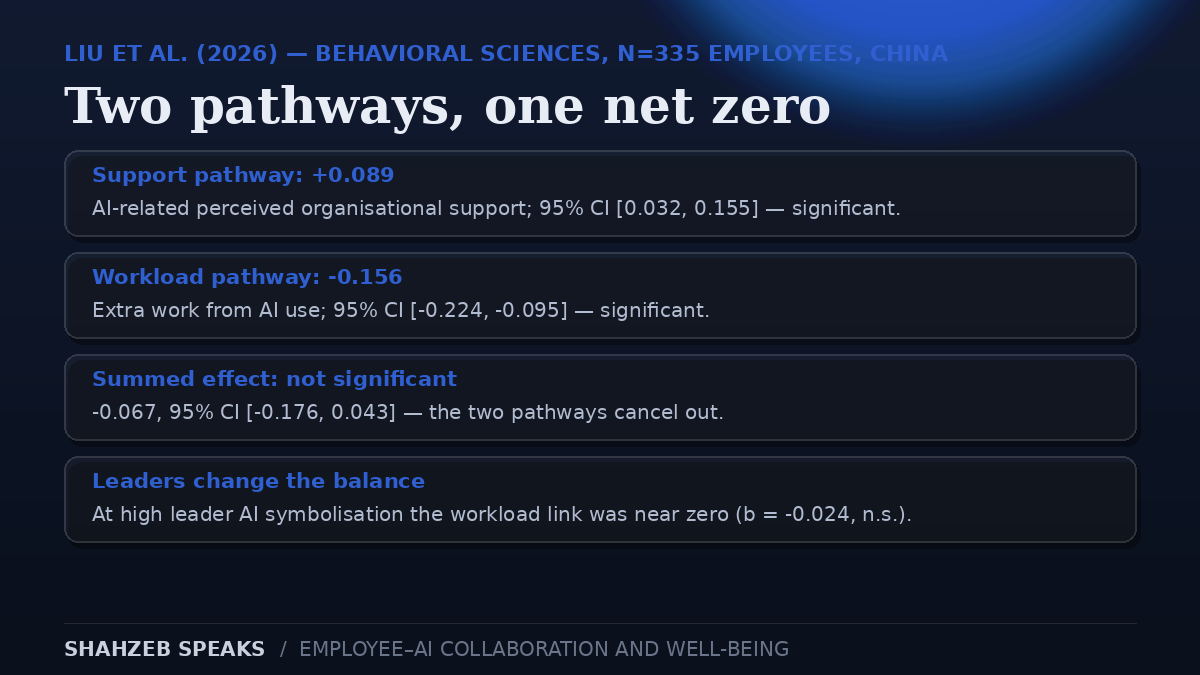
The headline result is a total association of 0.336 between employee–AI collaboration and work well-being, with a 95% confidence interval of [0.229, 0.443] — a positive overall link. But the total hides the tension underneath. The positive pathway runs through AI-related perceived organisational support: working with AI was positively associated with feeling supported by the organisation in using AI (beta = 0.456, p < 0.001), and that support was positively associated with well-being (beta = 0.198, p < 0.001), giving an indirect effect of +0.089, 95% CI [0.032, 0.155]. The negative pathway runs through workload: working with AI was positively associated with workload (beta = 0.366, p < 0.001), and workload was negatively associated with well-being (beta = −0.430, p < 0.001), giving an indirect effect of −0.156, 95% CI [−0.224, −0.095]. The two indirect effects partly offset each other — what the authors call competitive mediation — so their sum, −0.067, 95% CI [−0.176, 0.043], was not statistically significant. The direct association, once both pathways were accounted for, remained positive at 0.402, 95% CI [0.293, 0.512].
The simple correlations tell the same story in plainer form. Employee–AI collaboration correlated with work well-being at r = 0.331, with AI-related support at r = 0.459, and with workload at r = 0.370. Support correlated with well-being at r = 0.462, while workload correlated with well-being at r = −0.268. Leader AI symbolisation — the visible ways a leader signals enthusiasm for AI, such as discussing AI news or displaying AI-related artefacts — correlated with well-being only weakly, at r = 0.121. Every one of these correlations was statistically significant at p < 0.01 or better.
Leader behaviour changed both pathways, and this is the part of the study with the clearest practical message. Leader AI symbolisation strengthened the support pathway (interaction beta = 0.165, p < 0.001) and weakened the workload pathway (interaction beta = −0.347, p < 0.001). Look at the simple slopes. Where leaders visibly signalled enthusiasm for AI, collaboration was more strongly linked to feeling supported (b = 0.568) than where they did not (b = 0.272). And where leaders showed little enthusiasm, collaboration was strongly linked to higher workload (b = 0.551, p < 0.001) — but where leaders showed a lot, that link all but vanished (b = −0.024, p = 0.674, not significant). The moderated mediation indices confirm the pattern: 0.030 for the support pathway, 95% CI [0.008, 0.056], and 0.135 for the workload pathway, 95% CI [0.094, 0.181]. The negative indirect effect through workload was significant when leader enthusiasm was low (−0.283, 95% CI [−0.371, −0.201]) and not significant when it was high (0.012, 95% CI [−0.056, 0.078]). In plain terms: a leader who visibly backs AI seems to turn the same collaboration into more support and less extra work — but the authors warn that symbolism without substance may be read as impression management, or as pressure to work harder, so the enthusiasm has to come with real backing. Chapter 9 takes that warning seriously.
| Pathway | Indirect effect | 95% confidence interval |
|---|---|---|
| Through AI-related support (positive) | +0.089 | [0.032, 0.155] |
| Through workload (negative) | −0.156 | [−0.224, −0.095] |
| Summed indirect effect | −0.067 (not significant) | [−0.176, 0.043] |
| Total association | 0.336 | [0.229, 0.443] |
| Direct association | 0.402 | [0.293, 0.512] |
Source: Liu et al. (2026), Behavioral Sciences 16(11), 2081. All figures are associations, not proof of cause.
⚖️ Chapter 4: Why AI adds work even as it saves time
The workload finding surprises people, because it seems to contradict the promise of AI. If the machine writes the draft in seconds, where does the extra work come from? The authors’ answer is that the saved time is real, and so is the new work — they simply happen at different points in the task. Writing a first draft is only one step. After it comes prompting: working out what to ask, and asking it well enough to get something usable. Then checking: reading the output closely, because an AI system can produce confident text that is wrong in ways a tired reader will miss. Then correcting: fixing the errors, the tone, the facts and the parts that sound right but are not quite what you meant. Then documenting: recording what the AI produced, what you changed, and why — so the work can be defended later. The authors name exactly these four jobs — prompting, checking, correcting and documenting — as the extra time organisations should map and plan for, rather than assuming the saved drafting time is pure gain.
Job Demands–Resources theory makes sense of this. The drafting speed is a resource: it gives you time, energy and capacity back. The prompting, checking, correcting and documenting are demands: they cost attention, judgement and care. When the demands grow as fast as the resources, well-being does not rise — it stalls, or falls. That is what the numbers in Chapter 3 show: the workload pathway (−0.156) is larger in size than the support pathway (+0.089), so the extra work outweighs the extra support in the indirect effects, even though the overall association stays positive. My 6 November article on the AI productivity paradox covered a close cousin of this pattern — AI saving hours while expectations rise to fill them — and the same logic applies here: a task that used to take three hours of writing now takes one hour of prompting and two hours of checking, and the organisation counts only the hour saved.
There is a second reason the workload grows, and it is less visible than the checking. When AI makes output faster, the standard for output moves. A report that once took a week is now expected in two days; a draft that once went through one round of review now goes through three, because each round is cheap. The work expands to fill the capacity the AI created, and the person doing the checking absorbs the difference. None of this means AI collaboration is a bad deal — the study’s overall association with well-being is positive, and the direct association of 0.402 is substantial. It means the deal has a hidden price, and the price is paid in attention. If your team has adopted AI and everyone feels busier, not freer, this is the likely reason: the saved time was spent before you noticed, on work the old job never asked for.
👁️ Chapter 5: The trust penalty — your boss may trust you less
Well-being is only half the story. The other half is how other people judge you for using AI — and here the evidence is harsher. Meyers, Bigman and Briker (2026), in a paper published in The Leadership Quarterly, ran six studies on how supervisors react when subordinates use large language models such as ChatGPT at work. I have not read the journal paper itself; the findings below come from a Phys.org report of the research, published on 4 November 2026, and I say so because the distinction matters for how much weight to give the details.

In one experiment, supervisors decided whether to trust an employee’s report about time spent on a task. They trusted employees who had worked independently in 68% of cases — but only 24% when the employee had used AI. That is a gap of 44 percentage points, and it is worth pausing on what the supervisors were judging. They were not judging work quality. They were judging how the work was produced — and the mere fact that AI was involved was enough to cut trust by nearly two-thirds. AI use was still viewed more favourably than copying work from another person, so supervisors do draw a line between using a tool and passing off someone else’s work — but the line sits well below independent work.
The penalty did not stop at trust. Lower supervisory trust was associated with poorer performance evaluations, reduced perceptions of employees’ contributions to the organisation, and lower perceived suitability for promotion. In other words, the trust gap travels: it starts as a doubt about one task and ends as a doubt about the person, with consequences for pay, progression and standing. And the penalty was stubborn. Neither the importance of the task nor supervisors’ own experience with AI consistently removed it. A further study, with academic supervisors evaluating real work by graduate students, found the same pattern in a live setting: the more extensively students used AI, the less their supervisors tended to trust them.
There was one thing that did remove the effect. When organisations explicitly encouraged employees to use AI, the negative effect on supervisory trust was substantially reduced and was no longer statistically significant. When AI use was prohibited, or when no policy existed at all, supervisors were significantly less likely to trust AI users. The policy, in effect, changes what AI use means: with a clear encouragement, it reads as following instructions; without one, it reads as cutting corners. As Yochanan Bigman, one of the authors, put it: “AI is changing not only how we work, but also how we judge the people we work with. An employee may use AI to produce better work more efficiently yet still lose their manager’s trust simply because AI was involved.” The authors warn that this tension may push employees to conceal their AI use — “shadow AI”, the undisclosed use of AI at work — which is the worst outcome of all: the work still happens with AI, but nobody can see it, check it, or learn from it. The fix is not secrecy. It is a written policy, and Chapter 9 shows what one looks like.
🕵️ Chapter 6: The private-AI problem
The trust penalty helps explain a pattern found in a large survey published the same week as the Liu study. Miro’s “The State of Intelligent Collaboration”, published on 3 November 2026, surveyed more than 9,500 leaders and employees across North America, Latin America, Europe and Asia-Pacific, with fieldwork in September and October 2026. I need to label this clearly: it is a company-reported survey, funded by Miro, based on self-reported perceptions — not independent academic research. Its figures describe what people say about their own AI use, not what a peer-reviewed study measured. With that label attached, the pattern is still striking.
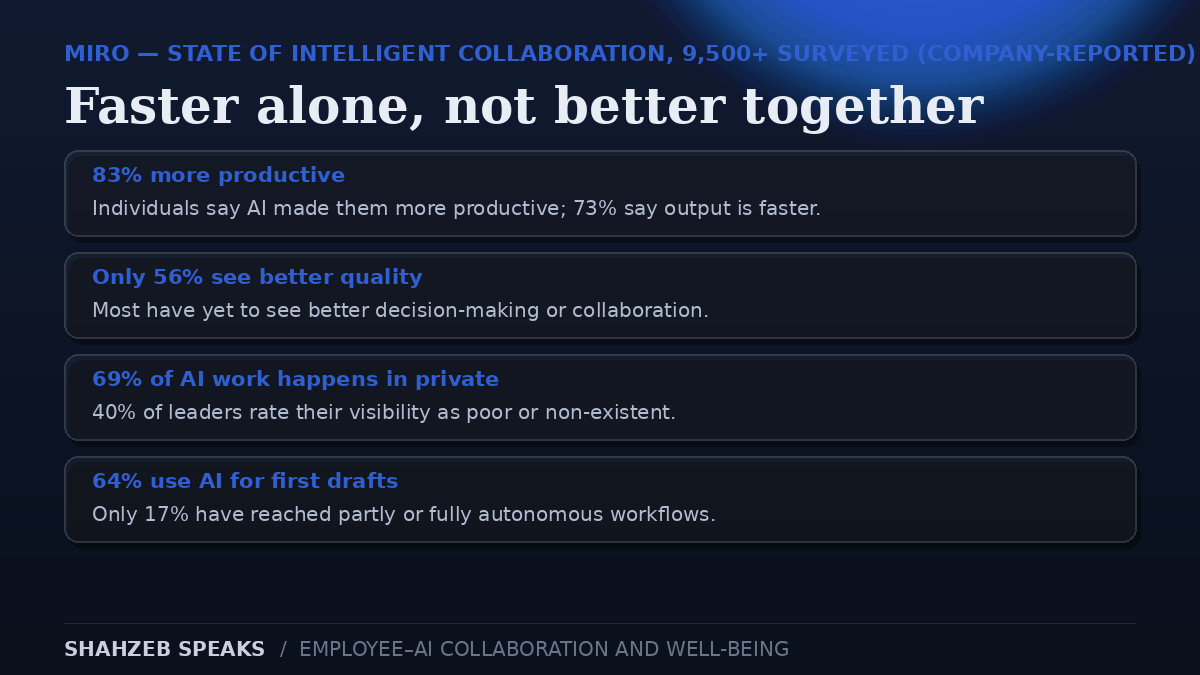
The headline numbers look like a success story. In the Miro survey, 83% of respondents agreed that AI had made individuals more productive, and 73% said the speed of output had increased. But only 56% said the quality of output had improved — a gap of 27 percentage points between speed and quality — and most respondents said they had yet to see improved decision-making or collaboration. Speed, in other words, is not the same as better work, and the people doing the work seem to know it.
The deeper finding is where the work happens. In the same survey, 69% said most AI-assisted work happens in private sessions rather than shared spaces, and 40% of leaders rated their visibility into AI adoption, usage and best practices as poor or non-existent. Put those two numbers together with Chapter 5 and the picture sharpens: employees use AI alone, in part because using it openly risks their manager’s trust, and leaders cannot see what is happening, in part because nobody shows them. The result is a workplace where AI is everywhere and nowhere — widely used, rarely discussed, never reviewed together.
The rest of the Miro figures fill in the cost of that privacy. 64% of knowledge workers said they used AI mainly for information or task assistance — asking questions or getting first drafts to build on — and only 17% had reached partly or fully autonomous workflows, so most use is still small-scale help, not transformation. 60% said AI had blurred previously distinct roles, 47% worried roles may merge, and 44% said company culture had become less collaborative. The survey also found that 59% reported more AI-generated output to review, 55% reported more “AI slop”, and 44% said context switching had increased in the past 12 months. Nearly one-third said social connection with colleagues was decreasing, and one in five found work lonely. These are company-reported perceptions, and I present them as such — but they point in the same direction as the peer-reviewed evidence in Chapters 3 and 5: AI is speeding up individual work while quietly thinning out the shared, visible, collaborative parts of it. My 11 November article on GenAI technostress and loneliness covered the loneliness side of that thinning; this survey suggests the privacy side may be just as large.
🧠 Chapter 7: Use AI as a challenger, not a yes-man
If AI collaboration adds workload, costs trust and drifts into private use, the natural response might be to use it less. The evidence points somewhere more useful: use it differently. A study reported on 4 November 2026, led by Monideepa Tarafdar, professor of information systems at the University of Massachusetts Amherst, studied 45 knowledge workers at a US public university and found that deliberately using AI to challenge their own ideas significantly improved their performance. The approach is called “generating friction”: instead of asking AI for answers, workers asked it to challenge their assumptions. I have not seen the underlying paper, and the report I read gives no effect size or design detail, so I will not claim more than the report claims — but the example it gives is concrete enough to copy. A professor designing a course asked the AI for five reasons the course might fail. The AI became a critic, not an assistant, and the course got better for it.
The reason friction helps is that generative AI tools tend towards sycophancy — tailoring answers to what users already think — which can reinforce confirmation bias, the habit of seeking out only evidence that agrees with you. Ask an AI whether your plan is good and it will usually find a way to say yes; ask it to poke holes in your plan and it will find holes you had not seen. Tarafdar’s own instruction to the AI captures the stance: “Don’t tell me things I agree with. Tell me things that I don’t agree with or disagree with me or try to poke holes in my argument.” Her three steps for leaders follow from the same idea: improve AI literacy, build a glossary of prompts that encourage AI to challenge users’ thinking and vary them over time, and create space for employees to learn from one another, for example through short cross-functional sessions. Routine tasks such as similar emails can still be handed to AI; the priority is preserving thinking on work that builds skills.
There is a real cost to getting this wrong, and Chengwei Liu, associate professor of strategy and behavioural science at Imperial College London, gives it a name: “judgment debt”. His warning, reported in the same piece, is that “even for the very experienced and the professional workers like the consultant, if they outsource this task too often, then you have this decay and you need to repay this debt sooner or later.” The second International AI Safety Report, published on 3 February 2026 and chaired by Professor Yoshua Bengio, with input from more than 100 AI specialists across more than 30 countries, found emerging evidence that routine delegation of cognitive tasks to AI may negatively affect critical thinking and memory. The report describes “cognitive offloading” — delegating cognitive tasks to external systems or people, which reduces your own cognitive engagement and therefore your ability to act with autonomy. Offloading can free up resources and improve efficiency, the report notes, but research also indicates potential long-term effects on the development and maintenance of cognitive skills. One example cited in the report makes the point sharply: a clinician’s ability to detect tumours without AI assistance had dropped by 6% just three months after AI support was introduced. The evidence is described as emerging, not settled — but the direction is clear enough to act on: use AI to test your thinking, not to replace it.
⚠️ Chapter 8: What the studies cannot tell us
Every study in this article has limits, and I will state them plainly, because they decide how far you should take the findings. Start with the anchor study. Liu and colleagues state their own caveat in the paper: the two-wave design does not establish causal ordering. The mediators and the outcome were all measured at Time 2, so those associations are cross-sectional in temporal terms, and reverse-direction diagnostics were also significant — so reverse causation cannot be ruled out. It is possible, for example, that employees with higher well-being are more likely to collaborate with AI, rather than collaboration raising well-being. That is why this article says “associated with” throughout, and why you should be suspicious of any summary that says AI collaboration “boosts” or “harms” well-being. This study does not show that.
The other limits are stated by the authors too. The sample is from China only, recruited online, so the findings should not be generalised without further evidence. All measures were employee-reported, which leaves open common-method variance, even though a Harman single-factor test did not indicate a dominant factor. And every participant was already an AI user, so there is no comparison with non-users — the study compares more collaboration with less, not collaboration with none. The study also received no external funding, and had ethics approval from Shanghai University under protocol ECSHU 2025-224.
The supporting evidence has its own limits. The Meyers trust findings come to me through a Phys.org report, not the journal paper itself, so details beyond what that report states — including the sample size of each study — are not verified and I have not printed them. The Miro figures are company-reported, from a survey Miro itself funded and ran, based on self-reported perceptions; they describe what people say, not what was independently measured. The Skillprint evidence is thinner still: a company-reported experiment, released on 10 November 2026, in which teams played an eight-level cooperative platform game connected by a virtual rope. Human-only teams won 84% of their games, against 14% for AI-only teams, across more than 900 runs — and teams of two humans and one AI did better when a human directed the strategy than when the AI led. But a game is not real work, the mixed-team win rate was not reported, and the experiment promotes Skillprint’s own evaluation platform, so I treat it as a suggestive signal about collaboration, not as evidence about office work. The Tarafdar finding is reported through a trade magazine, with no effect size or design detail given. And the cognitive offloading evidence in the AI Safety Report is described by the report itself as emerging — a warning to watch, not a settled verdict. None of this makes the evidence useless. A well-measured survey of 335 people, a six-study programme on trust, and a 9,500-person survey all pointing in compatible directions is worth taking seriously — as a signal, not a verdict.
✅ Chapter 9: What to do — a one-week plan
The recommendations in this chapter are practical advice grounded in the evidence above. They are not tested interventions, and I will not present them as such. But each one follows directly from the mechanism the studies found — and from the authors’ own advice.
For leaders — write the policy, then back it with substance. The single most effective step in the evidence is also the cheapest: write down, explicitly, that AI use is encouraged, what good use looks like, and what it is not for. Meyers and colleagues found that explicit encouragement removed the trust penalty; without a policy, or with a ban, the penalty stayed. So write the one-page policy and share it — and then pair the enthusiasm with what Liu and colleagues recommend: training, protected learning time, realistic expectations and channels to challenge AI outputs. Their warning is blunt: symbolism without substance may be read as impression management, or as pressure to work harder. A leader who talks about AI at every meeting but gives nobody time to learn it is not supporting the team; they are adding a demand and calling it a resource. Finally, map the extra time. Sit with your team and list the prompting, checking, correcting and documenting that AI-assisted work now needs, and put that time in the plan. If the checking takes two hours, say so — and stop expecting the report in the time the AI saved.
For workers — disclose, challenge, and protect your thinking. Do not hide your AI use: secrecy feeds the shadow-AI problem, and a written policy only protects you if your use is visible. Disclose briefly — a line in the draft, a note in the handover — and let the work speak. Use the friction method from Chapter 7: once a day, ask the AI to argue against your plan, list five ways it could fail, or find the weakest point in your reasoning. And protect thinking time: keep one task a week that you do without AI, from first draft to finish, so the judgement that the work depends on stays yours. If your manager has not written an AI policy, ask for one — the evidence says it protects you directly.
The one-week plan. Monday: write down every AI tool you use at work, and next to each one, the prompting, checking, correcting and documenting it adds. That list is your hidden workload — and it is the workload pathway from Chapter 3, made visible. Tuesday: ask your manager, or your team, for the AI policy in writing. If there is none, draft one page yourself: what AI is for, what it is not for, and what good use looks like. Wednesday: take one real piece of work and ask the AI for five reasons it might fail. Use at least one of the objections to change the work. Thursday: if you manage people, run a ten-minute check-in on the hidden workload list: which checking jobs are eating the time AI saved, and what can be dropped, shared or automated? Friday: disclose your AI use on one piece of work, openly and briefly, and notice the reaction. If the reaction is suspicion, the problem is the policy, not you — raise it. Weekend: do one piece of thinking entirely without AI — a plan, a judgement, a difficult email — and notice how it feels. If it feels harder than it used to, that is the judgment debt Chengwei Liu warns about, and the friction habit is how you start repaying it. Next Monday: bring the week’s notes to your manager: the hidden workload list, the one-page policy, and the one piece of work the AI challenged. You are not asking for less AI. You are asking for AI with the human parts of work — the support, the trust and the thinking — still attached.
AI collaboration will keep growing, and the tools will keep getting faster. That is not going to stop. What can change is whether the growth is managed or merely endured — whether the support pathway grows faster than the workload pathway, whether managers judge the work rather than the method, and whether the thinking stays with the person doing the job. The 2026 study gives that choice a shape: two pathways, pulling in opposite directions, with the leader’s behaviour deciding which one wins. The rest is up to the people in the room.
❓ Questions I am asked most often
What is employee–AI collaboration?
Employee–AI collaboration means working together with AI systems as part of job tasks — asking the system to draft, summarise, analyse or suggest, then reviewing, correcting and building on what it produces. In the 2026 study it was measured with a five-item scale adapted from Kong and colleagues (2023). The AI is a collaborator here, not merely a tool.
Does working with AI improve well-being?
It is associated with both better and worse well-being at the same time. In a 2026 study of 335 employees in China, collaboration was linked to higher well-being through AI-related organisational support (indirect effect +0.089) and to lower well-being through higher workload (indirect effect −0.156). The two effects cancelled out, so there is no simple yes — it depends on which pathway grows faster in your workplace.
Why does AI add workload?
Because drafting is only one step in a task. After the AI produces a draft, you still have to prompt it, check its output for errors, correct them, and document what it produced and what you changed. The 2026 study’s authors name these four jobs — prompting, checking, correcting and documenting — as extra time organisations should map and plan for, rather than treating saved drafting time as pure gain.
Do managers trust employees who use AI less?
Yes, according to six studies by Meyers, Bigman and Briker (2026), reported via Phys.org. In one experiment, supervisors trusted an employee’s time report in 68% of cases when the employee worked independently, but only 24% when the employee had used AI. Lower trust was linked to poorer evaluations and lower promotion suitability. The one thing that removed the effect was an organisation explicitly encouraging AI use.
Should I hide my AI use at work?
No. Hiding it creates “shadow AI” — undisclosed use that nobody can see, check or learn from — and the trust studies’ authors warn the penalty pushes people in exactly that direction. A written policy encouraging AI use protects you only if your use is visible. Disclose briefly, with a line in the draft or a note in the handover, and let the quality of the work speak.
How can I use AI without losing my manager’s trust?
Ask for a written AI policy if there is none, and use AI openly under it. Use the friction method: ask the AI to challenge your plan and list five ways it could fail, so your judgement stays visible. Keep one task a week entirely without AI. Show your checking — when your manager sees the corrections you made, AI use reads as careful work, not cutting corners.
If AI tools are quietly adding hidden workload to your team, the problem is usually the rollout, not the people. I help organisations measure AI-related workload and redesign it — get in touch here.
Read more: industrial psychology in Pakistan is my home base, and my related pieces on GenAI technostress and work loneliness, the AI productivity paradox — why your workload grows while AI saves you hours, capability anxiety at work, psychological safety at work and employee engagement at a 15-year low cover the neighbouring questions this research raises.
Sources
- Liu, Z., Wang, X., Tu, S., Lin, Q. & Xu, M. (2026). Employee–AI Collaboration and Work Well-Being: The Roles of AI-Related Perceived Organizational Support, Workload, and Leader AI Symbolization. Behavioral Sciences, 16(11), 2081. DOI: 10.3390/bs16112081. (Full paper read directly, 12 November 2026.)
- Kong, H. et al. (2023). Employee–AI collaboration scale, five items (cited via Liu et al., 2026).
- Meyers, S., Bigman, Y. & Briker, R. (2026). Psychological Reactions to Subordinates’ LLM Use at Work. The Leadership Quarterly. DOI: 10.1016/j.leaqua.2026.102004. (Reported via Phys.org, 4 November 2026 — secondary source; journal paper not read directly.)
- Miro (2026). The State of Intelligent Collaboration. Published 3 November 2026. (Company-reported survey of 9,500+ leaders and employees; fieldwork September–October 2026.)
- Tarafdar, M. et al. (2026). “Generating friction” study of 45 knowledge workers, US public university. (Reported via HCA Magazine, 4 November 2026 — secondary source.)
- Chengwei Liu, Imperial College London — “judgment debt” comment, reported via HCA Magazine, 4 November 2026.
- International AI Safety Report (2026). Second report, published 3 February 2026, chaired by Professor Yoshua Bengio. Cognitive offloading finding reported via Computer Weekly.
- Skillprint (2026). Signal experiment on human–AI collaboration, released 10 November 2026. (Company-reported; reported via AI Journal.)