LEGO Psychology Audit — The DKK 74.3 Billion Brick That Rebuilt Itself
LEGO psychology audit: DKK 74.3B revenue (+13%), RepTrak #1 four years running. A psychologist audits flow, the IKEA effect, blind bags and AFOL co-creation — plus the exact legal record: IP wins, two pending copyright suits, and the honest finding that no consumer fines exist.

88 / 100
Overall consumer behavior effectiveness
Brand Overview
- Brand nameLEGO
- Founded1932
- HeadquartersBillund, Denmark
- IndustryRetail
- Websitewww.lego.com ↗
Psychology Techniques Identified
- 01Flow State (Immersive Building)
- 02The IKEA Effect (Labour Leads to Love)
- 03Nostalgia & Intergenerational Transfer
- 04Variable Reward Schedules (Blind Bags)
- 05Scarcity & Retired-Set Economics
- 06Endowment Effect (Built, Therefore Mine)
- 07Social Proof at Scale (AFOL Community)
- 08Co-Creation & Autonomy (LEGO Ideas)
- 09Status Signalling (Flagship Display Sets)
- 10Loss Aversion (FOMO on Retiring Sets)
- 11Mere Exposure (Ubiquity & Licensing)
- 12Brand Trust as Availability (RepTrak #1)
Full Psychology Audit Report
In this audit
In 2003, the world’s most beloved toy company was losing more than half a million euro a day. Its shelves were full of products nobody wanted, its costs were spiralling, and a management consultant was about to tell the founding family the unthinkable: stop inventing, go back to the brick. Twenty-one years later, that same company posted record revenue of DKK 74.3 billion, record operating profit of DKK 18.7 billion — and was ranked the most reputable company on earth for the fourth year running. LEGO did not rebuild itself with better plastic. It rebuilt itself with better psychology: flow, the IKEA effect, nostalgia, scarcity, and a community it learned to stop ignoring.
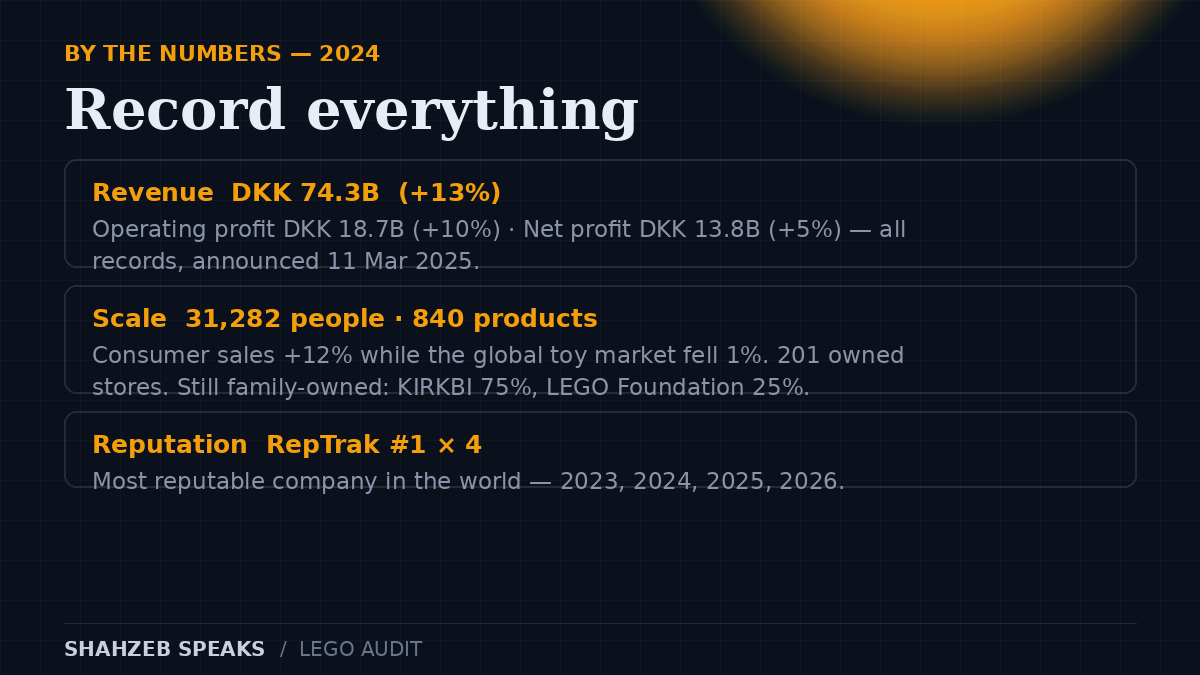
The numbers behind this audit are striking. Consumer sales grew 12% in 2024 while the global toy market shrank 1%. The company employs 31,282 people, runs 201 of its own stores, and sells in a portfolio of 840 products — the largest it has ever offered. It is still privately held: 75% owned by KIRKBI, the Kristiansen family’s holding company, and 25% by the LEGO Foundation. And here is the detail I love most as a psychologist: the landmark academic paper on the IKEA effect — the finding that we love what we build — literally used LEGO sets in its experiments. The brand is not just an example of the psychology. It is the apparatus.
I am an Industrial and Organizational Psychologist in Karachi. I audit brands the way I audit workplaces: principles first, evidence always, flattery never. LEGO scores 88/100 — one of the highest I have given — but the dark side chapter is real, and the prescription at the end is not a love letter.
“LEGO sells the only product on earth whose assembly instructions are also its marketing strategy. Every hour a customer spends building is an hour of flow, an IKEA-effect deposit, and a sunk-cost brick in the wall between them and every competitor.”
— Brand Psychology Analysis, ShahzebSpeaks
📋 Brand Overview: LEGO at a Glance
| Field | Detail |
| Founded | 1932, Billund, Denmark — by carpenter Ole Kirk Christiansen |
| Headquarters | Billund, Denmark |
| Ownership | Privately held — KIRKBI A/S 75%, LEGO Foundation 25% |
| Revenue (2024) | DKK 74.3 billion (+13% vs 2023) — record |
| Operating profit (2024) | DKK 18.7 billion (+10%) — record |
| Employees | 31,282 worldwide (31 Dec 2024) |
| Retail | 201 owned LEGO Brand Retail stores; 840 products in portfolio (largest ever) |
| Reputation | Global RepTrak #1 most reputable company — 2023, 2024, 2025 and 2026 |
📜 Chapter 1: The History — From a Wooden Duck to DKK 74.3 Billion
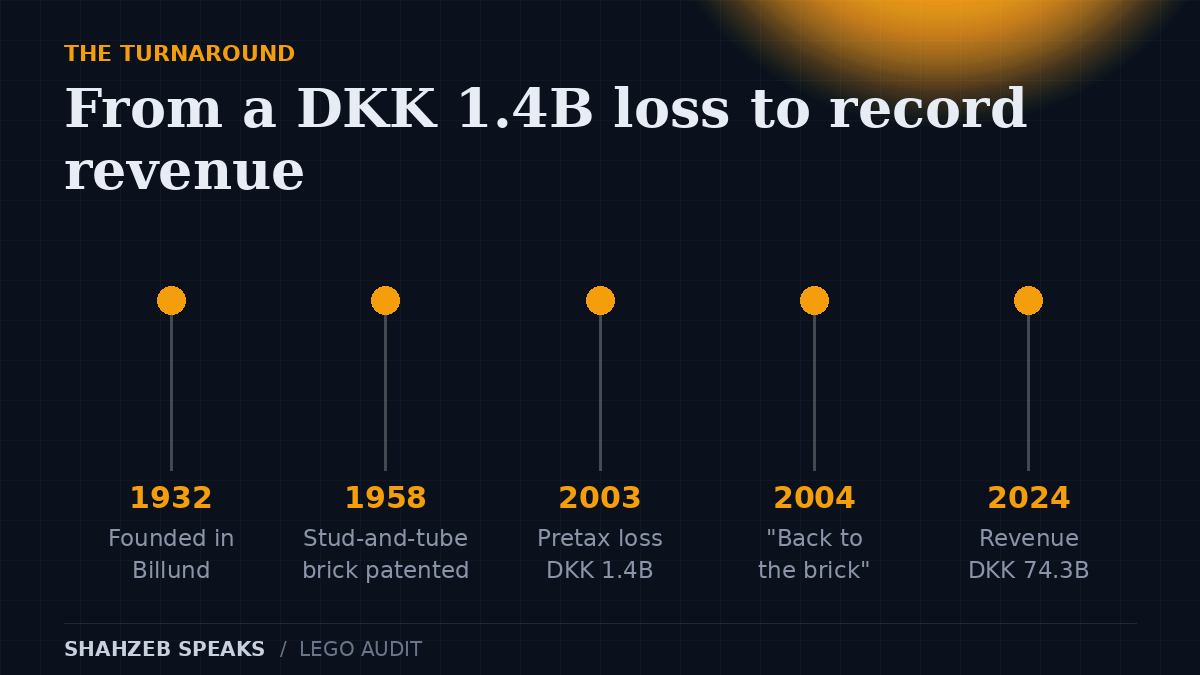
Ole Kirk Christiansen was a carpenter in Billund, Denmark, who started making wooden toys in 1932 when the Depression killed demand for ladders and ironing boards. In 1934 he named the company LEGO, from the Danish “leg godt” — “play well” (he later learned the Latin lego means “I assemble”). The interlocking plastic “Automatic Binding Bricks” arrived in 1949; the modern stud-and-tube brick — the one that still clicks with every brick made since — was patented in 1958 by his son Godtfred, the year Ole Kirk died. The minifigure, designed by Jens Nygård Knudsen, launched in 1978 and gave the system its citizens.
Then the company nearly loved itself to death. Through the 1990s, under former Bang & Olufsen executive Poul Plougmann, LEGO diversified into theme parks, clothing, “juniorised” lines and lifestyle products. Sales stayed flat while costs soared: a pretax loss of DKK 1.4 billion in 2003, losing more than half a million euro a day. In 2004, former McKinsey consultant Jørgen Vig Knudstorp took over as chief executive with a plan his chronicler David Robertson summarised as “back to the brick”: reintroduced LEGO City, cut the colour palette and the exploding parts inventory, sold the Legoland parks to Merlin Entertainments in 2005, and killed the lifestyle experiments. Revenues jumped 23% in 2012 alone. By 2024 the company announced record results on 11 March 2025: DKK 74.3 billion revenue, DKK 18.7 billion operating profit, DKK 13.8 billion net profit — with consumer sales up 12% against a global toy market down 1%. The 2014 LEGO Movie grossed over US$400 million, and the 2024 bestsellers were LEGO City, Star Wars, Technic, Icons and Harry Potter.
🌊 Chapter 2: Flow — The Product Is a Meditation With Instructions
Psychologist Mihaly Csikszentmihalyi (1990) described flow as the state of complete absorption where challenge matches skill — not so easy it bores, not so hard it frustrates. LEGO’s entire product architecture is a flow machine. Sets are age-banded (4+, 9+, 13+, 18+) so the challenge calibrates to the builder; the numbered-bag instruction system breaks a 9,090-piece Titanic into a sequence of small, completable wins; each bag is a feedback loop — click, check, done. Nobody needs to be taught mindfulness when the bricks do it for them.
This is why the adult market exploded. The Botanical Collection — flowers you build — “attracted new builders” around gifting occasions, per the 2024 results: adults buying flow in a box. The 18+ line (Titanic, the Eiffel Tower, the UCS Millennium Falcon) is not really about the finished model. It is about forty hours of structured absorption that a screen cannot interrupt. Competitors sell toys; LEGO sells the only mass-market flow state with a parts list.
🧱 Chapter 3: The IKEA Effect — Labour Leads to Love, Proven on LEGO Itself
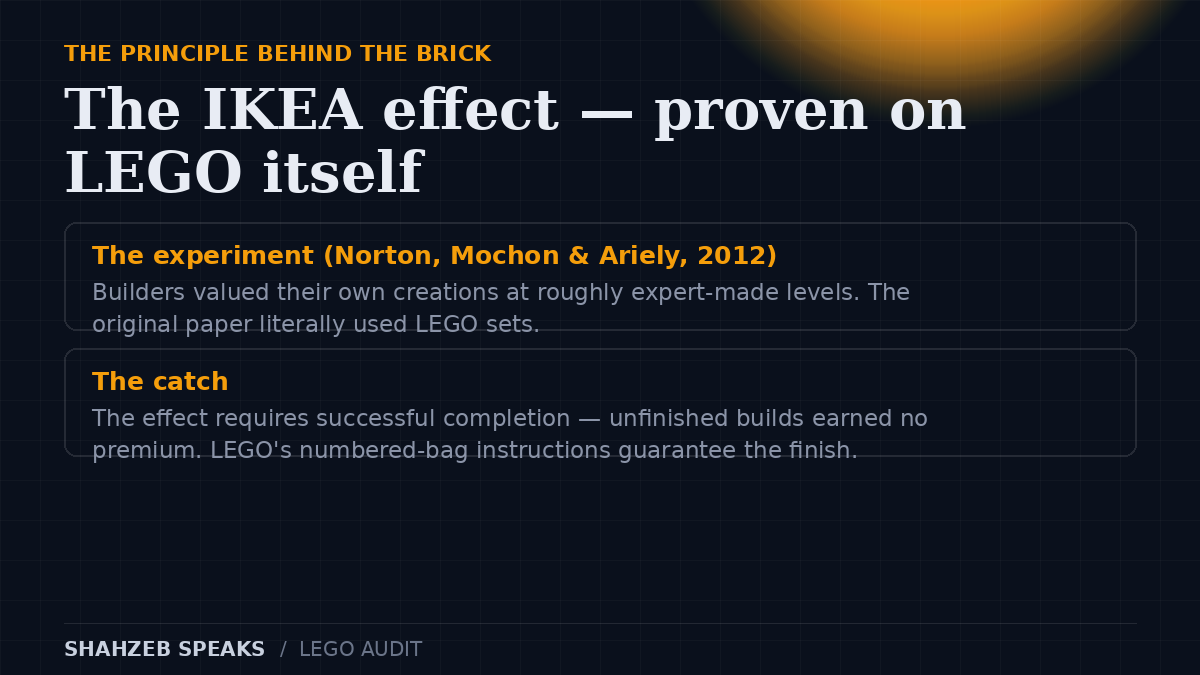
In 2012, Norton, Mochon and Ariely published “The IKEA effect: When labor leads to love” in the Journal of Consumer Psychology. Across four experiments — assembling IKEA boxes, folding origami, and building sets of Legos — they showed that people value their own creations at roughly the level of expert-made goods, and that the effect requires successful completion: unfinished builds earned no premium. The paper’s apparatus was literally LEGO. When I say this brand is built on psychology, I mean the psychology was built on this brand.
The commercial consequences are everywhere. The endowment effect (Kahneman, Knetsch & Thaler, 1990) says we overvalue what we own; the IKEA effect says we overvalue what we made. A LEGO set you spent six hours building is doubly endowed — owned and authored. That is why AFOLs (Adult Fans of LEGO) display rather than dismantle, why “built once, displayed” is the default adult behaviour, and why the secondary market pays premiums for sealed sets: the buyer is purchasing the opportunity to earn the effect themselves.
🕰️ Chapter 4: Nostalgia — Selling Childhood Back to Adults
Nostalgia is not sentimentality; it is a documented psychological resource. Holbrook and Schindler’s research on nostalgia-proneness shows that fondness for the objects of one’s youth strengthens with age and drives preference — and LEGO’s catalogue is engineered to harvest it. The Icons line resurrects the sets adults remember; the 2024 portfolio leaned on Star Wars and Harry Potter, franchises whose original fans are now parents with disposable income. The mechanism is intergenerational transfer: the parent buys “for the child,” builds alongside, and the purchase is really a reunion.
Watch how the company widened the net without breaking the spell. LEGO Fortnite (physical sets from 2024; over 87 million players engaged in the in-game experiences since launch) recruits the gaming generation. The Botanicals line recruits adults who would never buy a “toy.” New multi-year partnerships with Nike and Formula 1, announced for 2025, recruit sneaker and motorsport culture. Each line is a different door into the same brick system — and every door is nostalgia-shaped, because every adult was once a child with bricks.
🎰 Chapter 5: Variable Reward — Blind Bags and the Retirement Economy
In 2010 LEGO launched the Collectible Minifigures line in sealed foil “mystery bags” — you do not know which of the 16 figures is inside until you open it. The first series sold out in its limited markets. This is the variable-ratio reinforcement schedule from behavioural psychology: unpredictable rewards sustain behaviour far longer than predictable ones. It is the same mechanism behind loot boxes and slot machines, domesticated into a US$4.99 bag. (The 10th anniversary series, 71027, arrived in 2020 — the 20th regular series in a decade.)
Then there is the retirement economy. Economist Victoria Dobrynskaya’s 2021 study of 2,322 LEGO sets (1987–2015), published in Research in International Business and Finance, found secondary-market prices of retired sets growing by about 11% annually on average — faster than gold, stocks and bonds in the study window — with growth typically starting 2–3 years after retirement. But the range is the real story: −50% to +600% annually by set. Small and very large sets appreciate fastest; sets tied to famous buildings, films or holidays do best. LEGO never promises returns — and must not — but the possibility of appreciation converts every “retiring soon” label into loss aversion. Buy now or pay the aftermarket later. I have mapped this urgency machinery across industries in my guide to scarcity marketing examples — LEGO runs one of the cleanest versions.
👥 Chapter 6: Community and Co-Creation — The AFOL Army
LEGO’s most underrated asset is not plastic but people. The company maintains a dedicated team engaging roughly 200 Adult Fan of LEGO user groups worldwide; AFOL conventions, fan media and lug communities function as a volunteer marketing department that money cannot buy. This is social proof at industrial scale: when a subculture of adults treats your product as a serious hobby, the product is legitimised for everyone.
The co-creation pipeline is the masterstroke. It began as CUUSOO in Japan in 2008 (global beta 2011): fans submit designs, 10,000 votes earns a formal internal review, and the creator gets a royalty. The first sets to reach shelves — the Shinkai 6500 deep-sea submersible, the Hayabusa spacecraft — proved the model; it relaunched in-house as LEGO Ideas on 30 April 2014. The Research Institute set (2014), designed by geochemist Dr Ellen Kooijman and built around women in STEM, showed what the pipeline could do culturally. And the instinct predates the platform: LEGO consulted “user-hackers” while developing Mindstorms robots in the late 1990s. Self-determination theory (Deci & Ryan) says autonomy and competence are core human needs; LEGO Ideas industrialises both — fans do not just buy the product, they author it.
💎 Chapter 7: Status — The US$849.99 Flex
Every luxury brand needs a flagship the merely curious cannot casually buy, and LEGO’s are priced like jewellery. The 10294 Titanic: US$679.99 for 9,090 pieces (LEGO.com, October 2026). The 75192 UCS Millennium Falcon: US$849.99 (£734.99 in the UK). These are Veblen-adjacent goods — conspicuous consumption in brick form — bought to be displayed, photographed and recognised by the tribe. The price is the signal: it says this owner is serious.
The pricing architecture below the flagships is equally deliberate. The system is modular — every set ever made connects to every other — so each purchase raises the value of the collection (a network effect in plastic). The age-banding creates a visible ladder: Duplo → City → Technic → Icons → UCS. And the “retiring soon” labels convert browsing into loss aversion. Premium pricing here is not extraction; it is positioning. LEGO is the most expensive toy in the aisle the way a good watch is the most expensive thing on the wrist — the price certifies the tribe.
⚠️ Chapter 8: The Dark Side — The Real Legal and Reputational Record
Honesty first: no consumer-protection fines, product-safety penalties or competition-law actions against LEGO were found in this research. For a company of this size and age, that is itself a finding — the dark side here is activist pressure, cultural criticism and IP warfare, not conduct fines. Each item below carries its exact status, as of 13 October 2026.
Greenpeace vs Shell (2014) — activist campaign, NOT a fine. After a three-month Greenpeace campaign — the video “LEGO: Everything is NOT awesome,” an Arctic scene built from LEGO drowning in oil, viewed about 6 million times on YouTube, and a petition signed by more than a million people — LEGO announced on 10 October 2014 that it would not renew the co-promotion contract with Shell when the current deal ended. The deal (begun 2011; LEGO sets distributed at petrol stations in 26 countries; valued at £68m) was honoured to its term for contractual reasons. LEGO framed the dispute as between Greenpeace and Shell. Status precision matters: the company was never fined, charged or ruled against. It yielded to reputation pressure — which, for a brand whose entire asset is trust, may have been the rational move anyway.
LEGO Friends (2012) — cultural criticism, not litigation. The girl-targeted line launched with slimmer “minidoll” figures, pastel colours and beauty-salon themes — and was accused of entrenching gender stereotypes. The Campaign for a Commercial-Free Childhood named the Butterfly Beauty Shop its 2012 “Worst Toy of the Year”; NPR asked “Why do girls need special Legos?” Commercially, the line worked: before Friends, roughly 90% of LEGO’s customer base was boys (per 2011 reporting), and Friends helped triple sales to girls, with H1 2012 sales up 24%. LEGO’s response, in essence: Friends is one more theme option, not a substitute. The company later corrected course visibly — the 2014 Research Institute set (three female scientists) and the 2017 Women of NASA set. The episode remains the brand’s sharpest lesson in how a product can be a commercial success and a reputational wound at once.
Plastic — the structural exposure. LEGO’s bricks are plastic, and plastic is the company’s permanent reputational risk. The response has been money and targets: a DKK 1 billion investment announced in 2015 in sustainable materials R&D (with a 2030 ambition for sustainable core materials), and 2024 progress showing half of purchased materials produced with sustainable sources (47% certified mass balance, 3% segregated). Paper-based inner bags are replacing single-use plastic, aiming to convert remaining lines by 2027. The trajectory is real; the 2030 target is the one to watch.
The legal record — mostly LEGO winning. In April 2024, a Shanghai court imposed a RMB 600 million criminal copyright fine and prison sentences of 8 and 9 years on the operators behind a LEGO-clone business (2016–2022) — a fine against infringers, a win for LEGO, following its first Chinese copyright win in 2017 and the 2020 jailing of the Lepin clone operators. In January 2026, the EU General Court upheld the validity of the LEGO brick’s registered Community design — a final ruling in LEGO’s favour. Against that: in 2010 the European Court of Justice ruled the brick’s shape cannot be protected as a trademark (the studs are functional) — a final ruling against LEGO, which is why compatible clone bricks are legal. Two cases are pending with no final ruling: Zuru’s US challenge to LEGO’s minifigure copyright/trademark claims (Second Circuit remanded in March 2025; a preliminary injunction remains in place), and designer Concannon’s claim that LEGO reproduced his jacket artwork in a Queer Eye set without authorisation (court rejected LEGO’s fair-use and implied-licence defences at summary judgment; headed toward trial as of September 2026 reporting).
🇵🇰 Chapter 9: What Pakistani Brands Should — and Shouldn’t — Copy
Copy the constraint. Knudstorp’s “back to the brick” is the deepest lesson: LEGO recovered by reducing — fewer colours, fewer parts, fewer distractions. Pakistani conglomerates that sprawl into every category should note that the world’s best toy turnaround was an act of subtraction.
Copy the community, not the catalogue. Two hundred AFOL groups and the Ideas platform mean LEGO’s customers do its R&D and much of its marketing. A Pakistani brand with a genuine enthusiast base — textiles, food, motorcycles — could run a 10,000-vote co-creation pipeline tomorrow. The cost is attention; the return is loyalty that advertising cannot buy.
Copy the flow design. Numbered bags, age-banding, completable steps — LEGO onboards a four-year-old and a forty-year-old with the same system. Any Pakistani ed-tech, furniture or DIY brand can steal this: structure the first hour so the customer finishes something. The IKEA effect does the rest.
Don’t copy the plastic. LEGO can afford a DKK 1 billion sustainability programme and a 2030 materials target; a smaller brand aping the plastic-heavy model without the transition plan inherits only the criticism.
Don’t copy the gender segmentation blindly. Friends tripled sales to girls and still became the brand’s most criticised launch. Segment by interest and skill, not by stereotype — the Research Institute correction is the template.
📊 Chapter 10: LEGO Psychology Audit Scorecard — Detailed Ratings
| Psychology Dimension | Score | Verdict |
| Flow & Build Engagement | 94/100 | Age-banded sets and numbered bags are a mass-market flow state with a parts list. |
| IKEA Effect & Endowment | 93/100 | The landmark paper used LEGO sets; builders value creations at expert levels. |
| Nostalgia & Intergenerational Pull | 90/100 | Icons, Star Wars, Botanicals: every adult door is nostalgia-shaped. |
| Scarcity & Variable Reward | 88/100 | Blind bags, retiring-soon labels, ~11% annual retired-set appreciation. |
| Community & Co-Creation | 91/100 | ~200 AFOL groups, LEGO Ideas: customers do the R&D and the marketing. |
| Status & Premium Signalling | 84/100 | Titanic $679.99, Falcon $849.99: the price certifies the tribe. |
| Trust & Reputation Gravity | 95/100 | RepTrak #1 four years running; “Only the best is good enough” as operating system. |
| Regulatory & IP Resilience | 72/100 | IP wins in Shanghai and the CJEU; but Zuru/Concannon pending and plastic is structural exposure. |
Score arithmetic: 94 + 93 + 90 + 88 + 91 + 84 + 95 + 72 = 707; 707 ÷ 8 = 88.375 → Overall Psychology Score: 88/100.
✅ Chapter 11: Balance Sheet & A Psychologist’s Prescription
What LEGO gets right
- It sells flow in a box — the rare product whose use is the marketing, because every build deepens the IKEA effect.
- It turned customers into the company: AFOL groups and LEGO Ideas make the community the R&D department.
- It prices like a luxury brand inside a toy aisle — flagships that certify the tribe while the system stays accessible.
- It survived its own success: the 2004 subtraction (“back to the brick”) is the discipline every diversified brand should study.
- It banked trust as an asset: four straight years as the world’s most reputable company is not luck; it is the compound interest of “only the best is good enough.”
Where it is exposed
- Plastic is the permanent reputational risk: the 2030 sustainable-materials target is the single number the next decade will judge.
- Two copyright lawsuits are pending (Zuru, Concannon) with no final ruling — and the 2010 ECJ trademark loss means clones stay legal forever.
- The Friends episode proved commercial success and cultural criticism can arrive together; the next segmentation misstep will be judged faster.
- Concentration in licensed themes (Star Wars, Harry Potter among 2024 bestsellers) rents cultural relevance from licensors.
The prescription
- Hit the 2030 materials target early and loudly. Trust is the moat; sustainable bricks are how the moat gets a drawbridge for the next generation of parents.
- Productise the community. LEGO Ideas is a decade old — give its creators more than a royalty line: revenue shares, design credit on the box, a real career ladder from fan to designer.
- Defend the design moat in court and in the lab. The CJEU win protects the brick; continuous innovation in the building system protects the future clones cannot copy.
- Segment by skill, never by stereotype. The Friends wound healed through the Research Institute template — make it policy, not repair.
📝 Final Verdict
LEGO is the rare brand whose psychology I can audit with its own apparatus: flow you can buy by the bag, the IKEA effect demonstrated on its own bricks, scarcity you can graph on the aftermarket, a community that does the marketing for free, and trust compounded since 1932. The 2003 collapse proved the psychology is not decoration — when the company abandoned the brick, the numbers collapsed; when it returned, they compounded. The plastic problem is real, the lawsuits are pending, and no brand is above criticism. But as a system for turning human needs — autonomy, competence, belonging, nostalgia — into DKK 74.3 billion of revenue, nothing in the toy aisle comes close.
Psychology Score: 88/100 — The brick that rebuilt itself: flow in a box, love by labour, and the most trusted name in play.
Want your brand audited by a psychologist?
I audit how the world’s biggest brands use psychology — with the receipts. Contact me here.
More audits in this series: my Apple psychology audit (86/100) and the IKEA psychology audit on the maze, the meatballs and the furniture you love because you built it. For the principle behind the build-it-yourself effect, read the IKEA effect, explained with examples. I write as an industrial psychology in Pakistan practitioner — the psychology travels; the postcode doesn’t matter.
📚 References & Sources
- The LEGO Group. Annual results 2024 — record revenue DKK 74.3 billion, operating profit DKK 18.7 billion (press release, 11 Mar 2025).
- The LEGO Group. Modern Slavery & Transparency Statement 2024 (31,282 colleagues; 201 owned stores; KIRKBI 75% / LEGO Foundation 25%).
- The LEGO Group. LEGO ranked #1, Global RepTrak 100, 2025 (press release, 3 Apr 2025).
- The LEGO Group. LEGO Sustainable Materials Centre announcement, 2015 (DKK 1 billion investment; 2030 ambition).
- The LEGO Group. LEGO Titanic 10294 product page (US$679.99, accessed 13 Oct 2026).
- Irish Times. LEGO tops toy sector by building on its strong foundations (2003 loss; Knudstorp 2004; Legoland sale 2005).
- Britannica. LEGO — history (1932 founding; 1934 name; 1949 bricks; 1958 patent).
- Marketplace (AP). LEGO builds big profits with new girls’ toys line (31 Aug 2012 — Friends launch and criticism).
- Greenpeace Australia Pacific. LEGO ends 50-year link with Shell after one-million-strong campaign (press release, 10 Oct 2014).
- Norton, M. I., Mochon, D., & Ariely, D. (2012). The IKEA effect: When labor leads to love. Journal of Consumer Psychology, 22(3), 453–460.
- Csikszentmihalyi, M. (1990). Flow: The Psychology of Optimal Experience. Harper & Row.
- Dobrynskaya, V. (2021). LEGO — The Toy of Smart Investors. Research in International Business and Finance. (2,322 sets, 1987–2015; ~11% annual secondary-market growth.)
- Fast Company. How LEGO’s great adventure in geek sourcing snapped into place (CUUSOO/LEGO Ideas, 2008–2014).
- China-Britain Business Council. LEGO wins major copyright infringement case in China (Shanghai, Apr 2024 — RMB 600m fine).
- Global Legal Post. European Court of Justice upholds validity of LEGO brick’s registered design (Jan 2026).
- IPWatchdog. Second Circuit remands LEGO–Zuru copyright/trademark dispute (Mar 2025).
- Inc. Designer says LEGO recreated jacket in Queer Eye set; case headed toward trial (Sep 2026).
Key Findings
- Record 2024: DKK 74.3B revenue (+13%), DKK 18.7B operating profit (+10%), DKK 13.8B net profit (+5%); consumer sales +12% while the global toy market declined 1% (company results, 11 Mar 2025)
- Global RepTrak #1 most reputable company — 2023, 2024, 2025 and 2026 (fourth consecutive year); privately held: KIRKBI 75%, LEGO Foundation 25%
- 2003 pretax loss of DKK 1.4B; 2004 turnaround under Jørgen Vig Knudstorp (“back to the brick”); Legoland parks sold to Merlin Entertainments in 2005
- Greenpeace/Shell: LEGO announced 10 Oct 2014 it would not renew the co-promotion contract — an activist-campaign outcome, NOT a fine or ruling. LEGO Friends (2012) drew gender-stereotype criticism, not litigation
- Shanghai court imposed a RMB 600M criminal copyright fine on infringers in Apr 2024 (LEGO won); CJEU Jan 2026 upheld the LEGO brick design (final ruling, LEGO won); ECJ 2010 ruled the brick shape cannot be trademarked (final ruling against LEGO); Zuru and Concannon copyright lawsuits PENDING
- Retired sets appreciate ~11% annually on average (Dobrynskaya 2021, 2,322 sets), ranging −50% to +600%; flagships: Titanic 10294 US$679.99, UCS Millennium Falcon 75192 US$849.99 (as of 13 Oct 2026)
Overall Psychology Score
LEGO scores 88/100 in our comprehensive psychology audit covering consumer behavior strategies, UX design principles, and psychological marketing effectiveness.
The detailed dimension scores are in the audit's Psychology Scorecard chapter.
RevolutionaryMuhammad Shahzeb
MSc Industrial Psychologist, specializing in consumer behavior, UX psychology, and brand strategy analysis. Helping brands understand the psychology behind their success.
About Muhammad Shahzeb →