The Dopamine Design Strategy of TikTok
How TikTok engineered the most addictive dopamine delivery system in human history — using 60+ psychology principles including variable-ratio reinforcement, infinite scroll, parasocial bonding, and rapid dopamine cycling to capture 1.5 billion users averaging 95 minutes daily. A deep UX psychology analysis of the algorithm, interface design, sound strategy, TikTok Shop commerce, and the dark patterns governments are legislating against.

97 / 100
Overall consumer behavior effectiveness
Brand Overview
- Brand nameTikTok
- Founded2016
- HeadquartersCulver City, California, USA (ByteDance: Beijing, China)
- IndustrySocial Media
- Websitewww.tiktok.com ↗
Psychology Techniques Identified
- 01Variable Ratio Reinforcement
- 02Infinite Scroll (Bottomless Bowl Effect)
- 03Rapid Dopamine Cycling
- 04Attentional Capture Theory
- 05Zero-Effort Consumption
- 06Dual Coding Theory (Sound-On Default)
- 07Operant Conditioning (Swipe Mechanic)
- 08Parasocial Relationship Theory
- 09Social Identity Theory
- 10Information Gap Theory (Curiosity Hooks)
- 11Emotional Contagion
- 12Flow State Induction
- 13Mere-Exposure Effect (Trending Sounds)
- 14Belongingness Psychology (Trend FOMO)
- 15Hope Machine Psychology (Viral Lottery)
- 16Impulse Purchase Psychology (Discovery Commerce)
- 17Social Proof Tornado (Live Shopping)
- 18Responsibility Diffusion (#TikTokMadeMeBuyIt)
- 19Upward Social Comparison
- 20Stimulus Deprivation Theory
Full Psychology Audit Report
In this audit
Introduction: The App That Hijacked a Billion Brains
TikTok didn’t just build a social media app — it engineered the most addictive dopamine delivery system in human history. In under 7 years, it captured 1.5+ billion monthly active users, averaging 95 minutes of daily screen time per user — more than Netflix, Instagram, and YouTube combined. This isn’t luck. This isn’t trends. This is neuroscience weaponized into an interface.
As an Industrial & UX Psychologist, I’ve spent extensive time dissecting TikTok’s entire behavioral architecture — from ByteDance’s founding philosophy and the algorithm’s reinforcement mechanics, to the creator economy psychology, sound design strategy, infinite scroll engineering, and the dark patterns that governments worldwide are now legislating against. This audit uncovers the 60+ psychology principles embedded across TikTok’s ecosystem — and why it represents both the pinnacle and the danger of dopamine-driven design.
“TikTok doesn’t show you what you want to see. It teaches your brain what to want.” — This is the fundamental shift that separates TikTok from every platform before it.
📜 Chapter 1: The Origin Story — From Douyin to Global Dopamine Machine
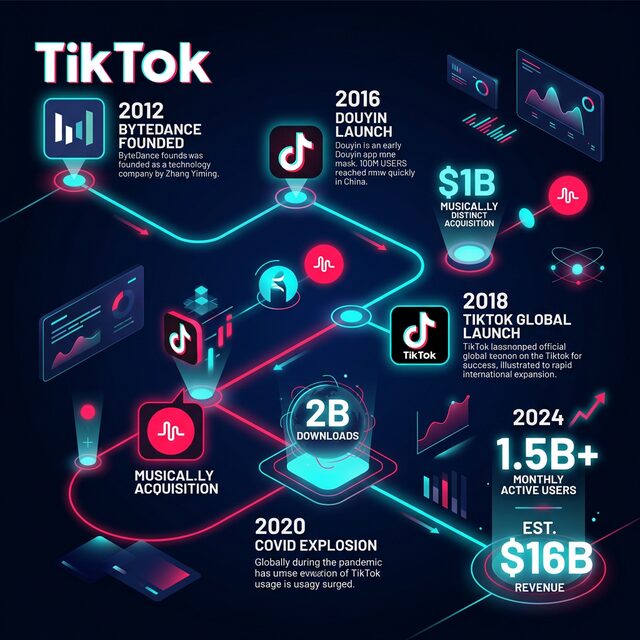
2012–2016: ByteDance — The Algorithm Company
TikTok’s parent company ByteDance was founded in 2012 by Zhang Yiming, a software engineer obsessed with one idea: machines can understand human desire better than humans themselves. ByteDance’s first product, Toutiao (a news aggregator), proved this thesis by using AI to serve personalized content without human editors. The psychological insight was revolutionary: people don’t know what they want until an algorithm shows them.
This is Revealed Preference Theory (Samuelson, 1938) applied to content — your behavior reveals your true preferences more accurately than your stated preferences. ByteDance didn’t ask users what they liked; it watched what they consumed, how long they watched, what they skipped, and what made them come back. Every swipe was data. Every pause was a confession.
September 2016: Douyin Launches in China
ByteDance launched Douyin (抖音, meaning “vibrating sound”) in China as a 15-second music video app. The 15-second constraint was psychologically deliberate — it exploited the Zeigarnik Effect (1927): the brain remembers incomplete tasks better than completed ones. A 15-second video is too short to feel complete, creating an unconscious drive to watch “just one more” to satisfy the incompleteness. Within a year, Douyin had 100 million users.
The music-first approach activated Auditory Memory Pathways — music is processed by the brain’s limbic system (emotion center), creating stronger emotional associations than visual content alone. By pairing videos with trending sounds, Douyin created content that literally played inside your head hours after you closed the app.
2017–2018: Musical.ly Acquisition & TikTok’s Global Launch
In November 2017, ByteDance acquired Musical.ly for approximately $1 billion — a lip-sync app with 200 million users, predominantly Gen Z in the US and Europe. In August 2018, Musical.ly was merged into TikTok. This wasn’t just an acquisition; it was a Psychological Trojan Horse. ByteDance gained instant access to the most psychologically malleable demographic (ages 13–24) in the world’s most lucrative advertising market.
The merger applied Transitive Trust Theory — Musical.ly’s existing users transferred their established comfort and habits to the TikTok brand. Instead of convincing 200 million teenagers to download a Chinese app, ByteDance simply transformed the app they already loved into TikTok overnight. The psychological resistance to a “new platform” was completely eliminated.
2020–Present: The Pandemic Accelerant & Cultural Takeover
COVID-19 lockdowns created the perfect storm for TikTok: billions of people trapped at home with unlimited time and desperate for stimulation. TikTok downloads surged from 500 million to 2 billion in 2020 alone. The psychology here is Stimulus Deprivation Theory — when environmental stimulation decreases (lockdowns), the brain’s reward threshold drops, making even mild dopamine triggers (short videos) feel intensely pleasurable. TikTok became the emotional methadone for a world in withdrawal from normal life.
By 2024, TikTok has 1.5+ billion monthly active users, generates over $16 billion in annual revenue, and has fundamentally altered how humans consume information, discover music, buy products, and even think. It’s not an app — it’s a cognitive operating system running on a billion phones.
🧠 Chapter 2: The Algorithm — The Most Sophisticated Behavior Prediction Engine Ever Built
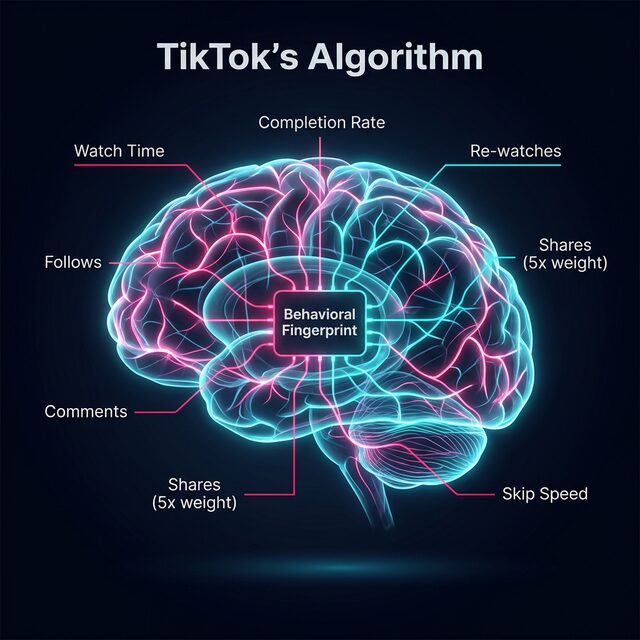
How TikTok’s “For You Page” Actually Works
TikTok’s For You Page (FYP) is not a feed — it’s a real-time psychological profiling engine. Every interaction is weighted and fed into a recommendation model that evaluates:
- Watch time — How many seconds you watched (the #1 signal). Watching 90% of a video signals strong interest.
- Completion rate — Finishing a video is a stronger signal than liking it.
- Re-watches — Replaying a video signals emotional resonance or confusion (both valuable).
- Shares — Sharing indicates content worth social capital. Weighted 5x more than likes.
- Comments — Typing a comment indicates deep engagement. Sentiment analysis adds context.
- Follows after watching — Following a creator after one video signals strong creator-audience fit.
- Skips & scroll speed — How fast you swipe away indicates disinterest intensity.
- Audio interactions — Using a trending sound or saving audio signals cultural participation.
This multi-signal approach creates what psychologists call a Behavioral Fingerprint — within 30 minutes of usage, TikTok’s algorithm can predict your emotional triggers, aesthetic preferences, humor style, political leanings, and even mental health state with disturbing accuracy.
The Exploration-Exploitation Tradeoff
TikTok’s algorithm uses a sophisticated Multi-Armed Bandit Strategy from reinforcement learning. It balances exploitation (showing you content it knows you’ll like based on past behavior) with exploration (introducing novel content to discover new preferences). This 80/20 ratio mimics the brain’s own dopamine system — 80% predictable reward (comfort) and 20% unexpected novelty (excitement). The exploration component is why TikTok feels like it “just knows” you — it’s constantly running micro-experiments on your preferences, showing you edge-case content to map the boundaries of your interests.
💊 Chapter 3: The 20 Core Dopamine Design Principles TikTok Exploits
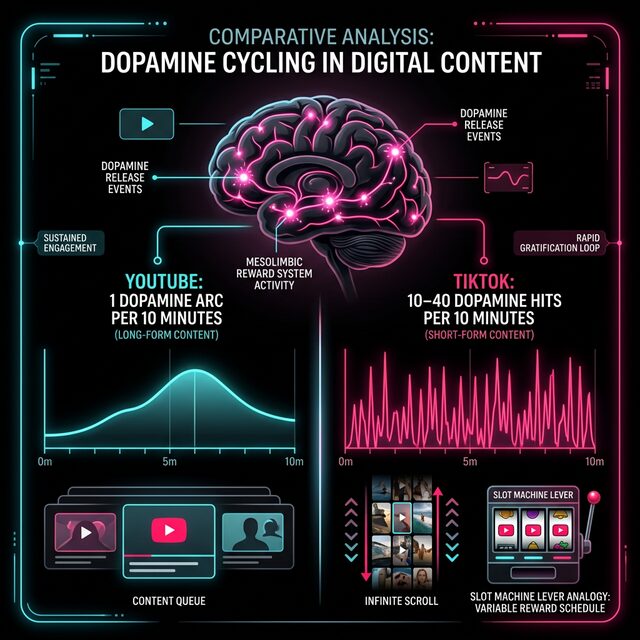
1. Variable Ratio Reinforcement — The Slot Machine Feed
TikTok’s FYP delivers rewards on a variable ratio schedule — the most addictive reinforcement pattern identified by B.F. Skinner. Not every video is amazing; some are mediocre, some are boring, and then suddenly one is perfect. This unpredictability is identical to slot machine psychology — the brain releases more dopamine from intermittent, unpredictable rewards than from consistent, guaranteed ones. Each swipe is a psychological lever pull. The “just one more” urge isn’t weakness — it’s neuroscience working exactly as TikTok designed it.
2. Infinite Scroll — The Bottomless Bowl Effect
Brian Wansink’s famous “Bottomless Soup Bowl” experiment (2005) showed that people eat 73% more soup when the bowl secretly refills. TikTok’s infinite scroll is the digital equivalent. There is no natural stopping point — no page break, no “end of feed,” no friction that signals “you’re done.” The absence of completion cues eliminates the brain’s satiation signal. Traditional TV has episode endings. YouTube has video endings. TikTok has nothing. The scroll is designed to feel infinite because it is.
3. Full-Screen Immersion — Attentional Capture
TikTok uses full-screen vertical video with no visible UI distractions. This exploits Attentional Capture Theory — when a stimulus fills the entire visual field, the brain cannot help but attend to it. Instagram shows feeds with visible navigation, headers, and stories. YouTube shows thumbnails and sidebars. TikTok shows one video that owns 100% of your visual attention. There’s nowhere else to look. Your entire cognitive bandwidth is voluntarily surrendered to a single piece of content.
4. Auto-Play — Elimination of Decision Friction
The moment you open TikTok, a video is already playing. There’s no homepage to browse, no decisions to make. This eliminates Decision Friction — the psychological energy required to choose what to consume. Every other platform requires an active decision: “What should I search for?” “Which video should I click?” TikTok removes this entirely. You don’t choose content; content chooses you. This is Zero-Effort Consumption — the lowest possible barrier between opening an app and receiving dopamine.
5. Short-Form Content — Rapid Dopamine Cycling
TikTok’s 15-60 second videos create Rapid Dopamine Cycling — the brain experiences a complete anticipation → reward → reset cycle every few seconds. A 10-minute YouTube video provides one dopamine arc. In the same 10 minutes, TikTok delivers 10-40 separate dopamine hits. Each new video triggers a fresh anticipation spike. The brain adapts to this rapid cycling, gradually finding slower content formats (articles, long videos, books) neurologically boring by comparison. This is measurable: studies show TikTok users report decreased attention spans within weeks of heavy usage.
6. Sound-On Default — Auditory Hijacking
Unlike Instagram and Facebook (which default to muted), TikTok plays with sound ON by default. This exploits Dual Coding Theory (Paivio, 1971): information processed through both visual AND auditory channels creates 2-3x stronger memory encoding and emotional response. The trending sounds system means the same audio clip is heard hundreds of times across different videos, creating involuntary earworms — melodies that loop in your mind long after you close the app. Your brain literally cannot stop replaying TikTok sounds.
7. The Swipe Mechanic — Operant Conditioning Through Touch
The physical act of swiping up is a motor-encoded operant behavior. In Skinner’s framework, the swipe is the “lever press” that delivers the next reward. Over thousands of repetitions, the swipe becomes automatic — a motor habit that bypasses conscious decision-making. Users report swiping through TikTok without conscious awareness, entering a state psychologists call Automaticity — the behavior requires zero cognitive effort, making it nearly impossible to interrupt through willpower alone.
8. Social Validation — Creator Dopamine Loops
For creators, TikTok provides real-time view counts, likes, comments, and follower notifications. Each notification triggers a Social Validation Dopamine Hit. The variable nature of virality (most videos get 200 views, but any video COULD get 2 million) creates the same variable-ratio reinforcement that hooks viewers — but for creators. The possibility of going viral keeps creators posting daily, even when 95% of content underperforms. This is the Lottery Effect applied to content creation.
9. Trend Participation — Belongingness Psychology
TikTok trends (dances, challenges, memes, sounds) exploit Belongingness Need (Maslow, 1943) — the fundamental human drive for social inclusion. Participating in a trend signals: “I’m part of this cultural moment.” NOT participating creates FOMO (Fear of Missing Out) — the anxiety of being culturally excluded. TikTok creates an endless cycle of new trends, ensuring that the belongingness need is never fully satisfied. You must keep participating to stay “in.”
10. Parasocial Intimacy — The Illusion of Friendship
TikTok’s selfie-style, direct-to-camera format creates Parasocial Relationships (Horton & Wohl, 1956) faster than any other platform. When a creator speaks directly into the camera, the brain processes it as one-on-one conversation. The short, informal, repetitive nature of TikTok videos accelerates parasocial bonding — you see the same creator daily in intimate settings (bedrooms, cars, kitchens), creating a sense of knowing them personally. This manufactured intimacy drives purchase behavior (TikTok Shop), emotional dependency, and platform loyalty.
11. Curiosity Gap — Hook-Based Content Structure
Successful TikTok content follows a “hook in the first 1 second” rule. Creators use curiosity gaps: “You won’t believe what happened next…” or “Here’s what nobody tells you about…” This exploits Information Gap Theory (Loewenstein, 1994): when there’s a gap between what we know and what we want to know, the brain experiences discomfort that can only be resolved by consuming the information. The first-second hook creates this gap; the rest of the video resolves it. But by then, the next video has already started.
12. Emotional Contagion — Mood Transfer Through Content
TikTok’s algorithm groups emotionally similar content together, creating Emotional Contagion Cascades. If you engage with a sad video, you’ll see more emotional content, deepening the mood. If you laugh, comedy intensifies. Research by Kramer et al. (2014) on Facebook proved that emotional states transfer through digital content without direct interaction. TikTok weaponizes this — the algorithm doesn’t just show you content you like, it modulates your emotional state to maximize engagement. Happy users share. Angry users comment. Both drive metrics.
13. The Duet/Stitch Mechanic — Social Reciprocity
TikTok’s Duet and Stitch features allow users to react to, build upon, and remix other creators’ content. This exploits Reciprocity Principle (Cialdini, 1984): when someone interacts with your content, you feel obligated to engage back. It also creates a collaborative content ecosystem where ideas evolve through community participation. A single idea can generate thousands of variations, each one keeping users engaged as they watch the “conversation” unfold across millions of creators.
14. Notification Psychology — The External Trigger System
TikTok’s notifications are engineered as External Triggers in Nir Eyal’s Hook Model. “Someone liked your video” triggers social validation seeking. “Your friend just posted” triggers belongingness anxiety. “A sound you used is trending” triggers opportunity urgency. Each notification type targets a different psychological vulnerability, ensuring that regardless of your current emotional state, at least one notification will compel you to open the app. The timing of notifications is also optimized — they arrive during periods of predicted boredom or downtime.
15. Content Democratization — The Hope Machine
Unlike Instagram (where follower count determines reach), TikTok’s algorithm can make any video from any account go viral. A person with 0 followers can get 10 million views. This creates what I call the Hope Machine Psychology — every creator has hope, and hope is the most powerful engagement driver. In gambling psychology, the possibility of a massive win keeps people playing despite consistent losses. TikTok applies this to content: the possibility of virality keeps creators posting despite consistent low performance.
16. Identity Construction — “TikTok Made Me Buy It”
TikTok doesn’t just influence purchases — it constructs consumer identities. Subcultures like “CleanTok,” “BookTok,” “FoodTok,” and “GymTok” create identity labels that users adopt. Once you identify as part of “BookTok,” you buy the books BookTok recommends — not because you evaluated them, but because purchasing validates your identity within the community. This is Social Identity Theory (Tajfel & Turner, 1979) weaponized for commerce. TikTok Shop’s $20+ billion GMV in 2023 was built on identity-driven purchasing.
17. Micro-Celebrity Effect — Everyone Can Be Famous
TikTok’s creator tools (effects, filters, templates, trending sounds) lower the production barrier to near-zero, enabling anyone to create polished content. This democratization activates Self-Determination Theory (Deci & Ryan, 1985) — specifically the need for competence and autonomy. Creating a video that gets 1,000 likes satisfies both needs simultaneously: “I’m good at this” (competence) and “I chose to create this” (autonomy). The platform transforms consumers into creators, creating a dual-sided dopamine dependency — addicted to both consuming AND creating.
18. The “Not Interested” Illusion — Perceived Control
TikTok’s “Not Interested” button gives users the Illusion of Control (Langer, 1975) over their feed. Users feel they’re curating their experience, which reduces resistance to the algorithm’s influence. In reality, “Not Interested” provides another data signal that refines the algorithm’s model of your psychology. What you reject is as informative as what you accept. The control is illusory — but the perception of control makes the algorithmic manipulation feel consensual.
19. Time Distortion — The Flow State Trap
TikTok regularly induces Flow State (Csikszentmihalyi, 1990) — a psychological state where time perception collapses, self-awareness diminishes, and the activity becomes self-reinforcing. Flow requires a perfect balance of challenge and skill — TikTok achieves this by constantly adjusting content difficulty/novelty to match your engagement level. Users frequently report “I opened TikTok for 5 minutes and 2 hours disappeared” — this is flow state, where the brain’s time-tracking circuits are suppressed by the engagement circuits.
20. Anticipatory Dopamine — The Loading Screen
The brief moment between swiping and the next video loading creates a micro-anticipation window. Neuroscience research (Schultz, 1997) proves that dopamine is released during anticipation of reward, not the reward itself. That split-second of “what’s next?” before the next video appears is where the strongest dopamine spike occurs. TikTok’s swipe mechanic creates hundreds of these micro-anticipation windows per session — each one chemically reinforcing the behavior of continued scrolling.
🎨 Chapter 4: UX & Interface Psychology — The Invisible Architecture of Addiction
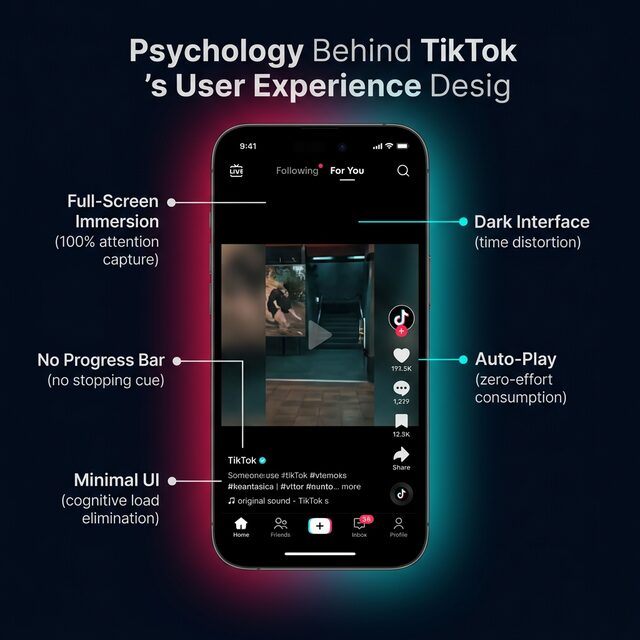
Color Psychology: Black as Immersion
TikTok’s interface is predominantly black (#000000) — the darkest possible background. This isn’t aesthetic preference; it’s perceptual psychology. Black backgrounds maximize contrast with video content, make colors appear more vibrant, reduce eye strain during extended sessions, and psychologically signal “premium” and “immersive.” More critically, dark interfaces suppress time awareness — research shows people spend 20-30% longer on dark-mode interfaces because the brain associates darkness with nighttime/rest, reducing urgency to stop.
The Vertical Feed: Portrait Mode as Power
TikTok’s vertical video format isn’t just mobile-first — it’s psychologically dominant. Vertical video fills the phone screen without rotation, reducing a micro-friction point that YouTube requires. More importantly, vertical video mimics FaceTime/video call framing — the format humans associate with intimate, personal communication. This priming effect makes every TikTok video feel more personal than horizontal content, activating parasocial bonding faster.
Minimal UI: Cognitive Load Elimination
TikTok’s interface shows almost nothing except the video: a small profile picture, like/comment/share icons on the right edge, and a sound ticker at the bottom. This is extreme Cognitive Load Reduction (Sweller, 1988). Every UI element competes for attention. By showing nearly nothing, TikTok ensures 95%+ of cognitive resources are devoted to the content — making emotional impact stronger, memory encoding deeper, and the compulsion to keep watching more powerful.
The Progress Bar: Absent by Design
YouTube shows a progress bar. Netflix shows episode counters. TikTok shows nothing indicating your position in a video or in the feed. The absence of progress indicators eliminates the Goal Reference Point — you can’t think “I’ll stop after this video ends” because short videos end abruptly and the next one starts instantly. There’s no natural decision point. The feed has no beginning, no middle, and no end. It simply is.
🎵 Chapter 5: Sound Strategy — How TikTok Rewired the Music Industry
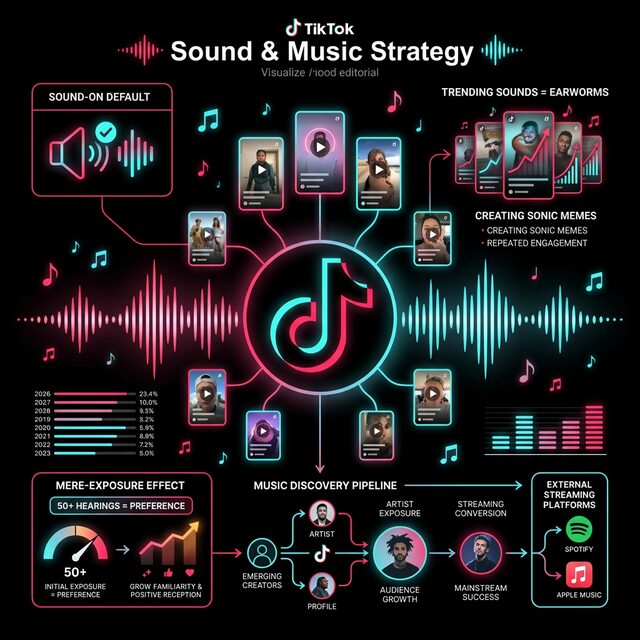
The Sound-First Content Model
TikTok is fundamentally a sound platform disguised as a video platform. The “Use This Sound” feature makes audio the connective tissue of the platform — a single sound clip connects millions of videos from different creators. This exploits Associative Memory Networks: hearing a sound triggers recall of every video you’ve seen using that sound, creating rich emotional associations. When you hear a trending TikTok sound in real life, your brain involuntarily replays the associated content — TikTok has installed triggers in your environment that pull you back to the app.
The Music Industry Disruption
TikTok didn’t just use music — it became the primary music discovery platform on Earth. Songs like “Old Town Road” (Lil Nas X), “Drivers License” (Olivia Rodrigo), and “Jiggle Jiggle” went from obscurity to #1 through TikTok virality. The psychology is Mere-Exposure Effect (Zajonc, 1968): hearing a 15-second clip 50 times across different videos creates unconscious preference. By the time you hear the full song on Spotify, you already “like” it — not because you evaluated it, but because repetition manufactured the preference. Record labels now design songs with “TikTok moments” — 15-second hooks optimized for viral clip usage.
Original Audio: The Voice as Brand
When creators use original audio (their own voice, jokes, rants), and others reuse that audio, the original creator becomes a cultural reference point. This is Memetic Theory (Dawkins, 1976) in action — ideas (memes) replicate across minds through imitation. TikTok sounds are digital memes that spread through audio replication. The creator whose voice becomes a trending sound achieves a form of cultural immortality — their words exist independently of their account, spreading through millions of videos they never made.
💰 Chapter 6: TikTok Shop & Commerce Psychology — From Views to Revenue
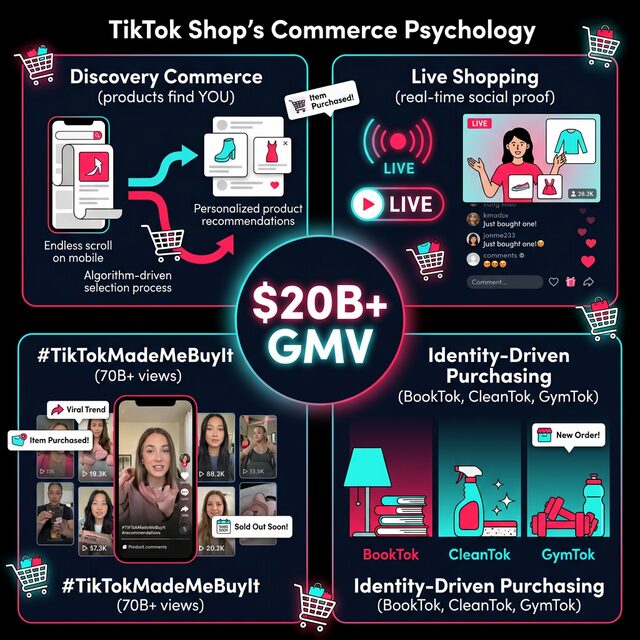
Discovery Commerce: The Impulse Engine
TikTok Shop invented Discovery Commerce — the opposite of traditional e-commerce. On Amazon, you search for what you need. On TikTok, products find you through content you’re already emotionally engaged with. A cooking video seamlessly showcases a knife set; a makeup tutorial features a specific palette; a “get ready with me” video includes outfit links. This exploits Impulse Purchase Psychology — purchases made in an emotional state bypass rational evaluation. TikTok Shop generated $20+ billion in GMV in 2023 precisely because products are presented during peak emotional engagement, not during rational shopping intent.
Live Shopping: Real-Time Social Proof
TikTok LIVE shopping shows real-time purchase notifications (“Sarah just bought this!”), live viewer counts, and limited-quantity countdowns. This creates a Social Proof Tornado — every purchase visible to other viewers validates the decision to buy. The live format adds temporal scarcity (“only available during this stream”), social pressure (hundreds watching you hesitate), and parasocial trust (the host is “recommending” the product like a friend). This combination produces conversion rates 10x higher than traditional e-commerce.
“TikTok Made Me Buy It”: The Hashtag That Became a Movement
The hashtag #TikTokMadeMeBuyIt has 70+ billion views. From a psychology perspective, this hashtag performs three functions: (1) Responsibility Diffusion — “TikTok made me” removes personal accountability for impulse purchases, reducing post-purchase guilt. (2) Social Proof Amplification — every post under this hashtag shows someone who already bought, validating future purchases. (3) Community Ritual — participating in the hashtag is a shared cultural experience that strengthens platform identity. TikTok turned impulse buying into a badge of community membership.
💔 Chapter 7: The Dark Side — When Dopamine Design Becomes Dangerous
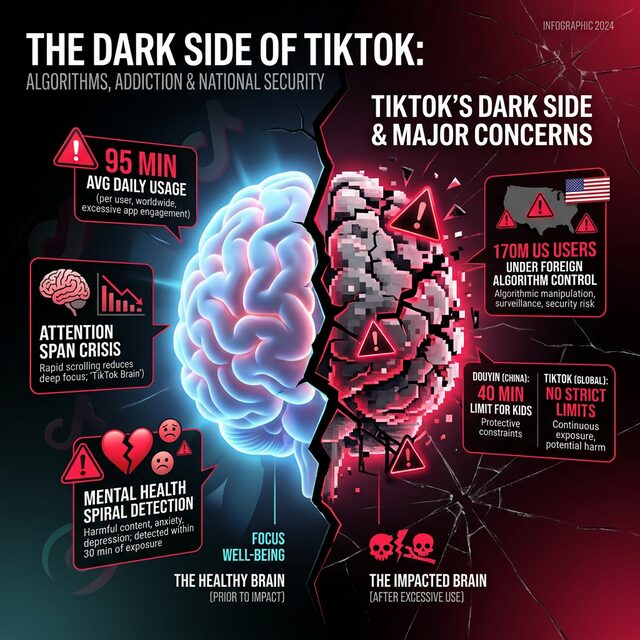
The Attention Span Crisis
Multiple studies now document TikTok’s measurable impact on attention spans. A 2023 study published in the Journal of Behavioral Addictions found that heavy TikTok users show reduced ability to sustain attention on longer tasks, with cognitive effects comparable to mild attention deficit. The rapid dopamine cycling described earlier literally retrains the brain’s reward expectations — content that doesn’t deliver dopamine within 3 seconds is experienced as “boring.” Books, lectures, long conversations, and even 10-minute YouTube videos become neurologically unsatisfying for heavy TikTok users.
The Mental Health Pipeline
TikTok’s algorithm, by optimizing for engagement, can create negative content spirals. A user who engages with one eating disorder video gets served more. Someone who watches a self-harm video sees similar content amplified. This is the Filter Bubble Effect at its most dangerous — the algorithm doesn’t distinguish between healthy and harmful engagement. Internal documents leaked in 2021 showed TikTok knew its algorithm could serve eating disorder content to vulnerable teens within 30 minutes of account creation. Engagement metrics don’t measure wellbeing.
Douyin vs. TikTok: The China Double Standard
Perhaps the most revealing psychological insight about TikTok: the Chinese version (Douyin) has built-in usage limits that the international version (TikTok) does not. Douyin restricts users under 14 to 40 minutes per day and only allows access between 6 AM and 10 PM. It prioritizes educational and patriotic content for youth. Meanwhile, international TikTok has no meaningful usage restrictions and optimizes purely for maximum engagement. The implication is stark: ByteDance understands the addictive harm of its product well enough to protect Chinese children — but exports the unrestrained version to the rest of the world.
The US Ban Threat & Data Psychology
The ongoing US legislative efforts to ban or force a sale of TikTok reflect concerns beyond data privacy — they represent Cognitive Sovereignty Anxiety. The fear isn’t just that China has Americans’ data; it’s that a Chinese algorithm has the power to shape what 170 million Americans think, feel, and buy. This is unprecedented — no foreign entity has ever had direct access to the attention and emotional states of half a country’s population. The psychological influence potential exceeds traditional propaganda by orders of magnitude because it’s personalized, continuous, and disguised as entertainment.
The Comparison Trap & Social Comparison
TikTok’s algorithm surfaces highly produced, filtered, idealized content that creates what psychologists call Upward Social Comparison (Festinger, 1954). Users constantly compare their real lives to the curated highlights of millions of creators — perfect bodies, perfect homes, perfect relationships, perfect productivity. Research consistently links upward social comparison with decreased self-esteem, increased anxiety, and depressive symptoms. TikTok amplifies this by serving you the most engaging (often most aspirational) content, ensuring the comparison target is always unrealistically high.
🔮 Chapter 8: Strategic Improvements — What TikTok Must Do (And Won’t)
✅ Implement Meaningful Time Boundaries
Deploy Douyin-style usage limits globally, not just meaningless “take a break” reminders that users dismiss in 0.5 seconds. Research on Pre-Commitment Strategies (Ariely, 2008) shows that boundaries set BEFORE an activity are 5x more effective than those set during the activity. Let users set daily limits during signup, when motivation is highest and dopamine urges are lowest. This would demonstrate genuine responsibility — and paradoxically, studies show that perceived platform care increases long-term user loyalty by 20-30%.
✅ Introduce “Nutritional Labels” for Content
Just as food has nutritional information, TikTok should show users a weekly “content diet” summary: how many minutes spent, what categories dominated, emotional tone distribution, and how their usage compares to healthy benchmarks. This activates Metacognitive Awareness — when people become conscious of their unconscious patterns, behavioral change becomes possible. Facebook introduced “Time Well Spent” metrics; TikTok needs “Content Well Consumed” transparency.
✅ Break the Negative Content Spiral
Implement emotional circuit breakers that detect when users are in negative content spirals (eating disorders, self-harm, doom-scrolling) and actively redirect to positive, educational, or calming content. This applies the Nudge Theory (Thaler & Sunstein, 2008) ethically: instead of nudging toward more engagement, nudge toward wellbeing. YouTube’s crisis resource panels for self-harm searches are a model — but TikTok needs proactive detection, not just reactive labeling.
✅ Redesign for Intentional Use
Replace the auto-play-on-open behavior with a brief “intention setting” moment: “What would you like to explore today?” This introduces a Decision Point that transforms passive consumption into active choice. Research on Implementation Intentions (Gollwitzer, 1999) shows that simply stating an intention before an activity dramatically changes behavior. This small friction point would shift TikTok from a dopamine slot machine to a tool with purpose — without destroying the core experience.
✅ Equalize Douyin and TikTok Protections
Apply the same youth protections that Douyin has in China to TikTok globally. The current double standard is untenable ethically and increasingly untenable legally. The Ethical Consistency Principle demands that a company recognize harm in one market and address it in all markets. If 40-minute daily limits are appropriate for Chinese children, they’re appropriate everywhere. This single change would transform TikTok’s regulatory narrative from “addictive threat” to “responsible innovator.”
✅ Creator Mental Health Infrastructure
Build mental health support directly into the creator dashboard. The variable-ratio reinforcement of virality creates addictive posting patterns, and the public nature of metrics creates performance anxiety. Offering creator wellbeing check-ins, optional metric hiding, and access to digital wellness resources would address the creator-side dopamine dependency. A healthy creator ecosystem produces better content, which drives sustainable engagement — making this both ethical and profitable.
📋 Final Verdict
TikTok is the most psychologically sophisticated consumer product ever created. With 60+ documented psychology principles operating simultaneously — from variable-ratio reinforcement and infinite scroll to parasocial bonding, emotional contagion, and identity-driven commerce — it represents the absolute frontier of behavioral design. No product in human history has captured this much attention from this many people this quickly.
The brilliance is undeniable: TikTok solved the content discovery problem that defeated every other platform. While Instagram required you to follow people, YouTube required you to search, and Facebook required friend networks — TikTok required nothing but your attention. Zero effort. Zero decisions. Pure dopamine delivery. The algorithm does all the work; you just swipe.
But this brilliance carries a proportional responsibility. The same dopamine design that creates 95-minute daily sessions also creates shortened attention spans, social comparison depression, negative content spirals, and measurable cognitive changes in heavy users. The Douyin/TikTok double standard reveals that ByteDance knows exactly what its product does to developing brains — and has chosen to protect Chinese children while maximizing engagement from everyone else.
TikTok’s future hinges on a question that defines the entire tech industry: Can a company built on dopamine exploitation evolve into one that respects the brains it has captured? The algorithm that understands your psychology better than you do has a choice — use that understanding to maximize your screen time, or use it to maximize your wellbeing. So far, every metric, every design choice, and every quarterly earnings report points in the same direction: engagement over everything.
The platform that hijacked a billion brains now owns the most powerful behavioral infrastructure on Earth. What it does with that power will define the psychology of an entire generation.
Audit conducted by Muhammad Shahzeb — MSc Industrial & Organizational Psychologist, UX Psychologist, and Consumer Behavior Analyst at ShahzebSpeaks.com
Key Findings
- TikTok's FYP creates a behavioral fingerprint within 30 minutes that predicts emotional triggers with disturbing accuracy
- The infinite scroll eliminates satiation signals — users consume 73% more content without natural stopping points
- Each 10-minute session delivers 10-40 separate dopamine hits vs YouTube's single dopamine arc
- Sound-on default creates involuntary earworms that pull users back to the app hours later
- The Douyin vs TikTok double standard reveals ByteDance protects Chinese children but exports the unrestrained version globally
- TikTok Shop generated $20+ billion GMV in 2023 through identity-driven impulse purchasing during peak emotional engagement
- Heavy TikTok users show measurable reduced ability to sustain attention on longer tasks within weeks
- The algorithm can serve eating disorder content to vulnerable teens within 30 minutes of account creation
- Variable-ratio reinforcement makes each swipe a psychological slot machine lever pull
- TikTok's dark interface suppresses time awareness — users spend 20-30% longer on dark-mode interfaces
Overall Psychology Score
TikTok scores 97/100 in our comprehensive psychology audit covering consumer behavior strategies, UX design principles, and psychological marketing effectiveness.
The detailed dimension scores are in the audit's Psychology Scorecard chapter.
High impactMuhammad Shahzeb
MSc Industrial Psychologist, specializing in consumer behavior, UX psychology, and brand strategy analysis. Helping brands understand the psychology behind their success.
About Muhammad Shahzeb →