Lexus Psychology Audit — December to Remember: The Child’s Eyes, the Snowball and the Gift of Feeling Seen
Lexus's 'Child's Eyes' turns December to Remember from a gift into a feeling — the giver, a mother, rediscovers her own childhood wonder. Our psychology audit of the nostalgia, the red bow and the record sales year scores Lexus 83/100.

83 / 100
Overall consumer behavior effectiveness
Brand Overview
- Brand nameLexus
- Founded1989
- HeadquartersToyota City, Japan
- IndustryAutomotive
- Websitewww.lexus.com ↗
Psychology Techniques Identified
- 01Nostalgia (Wildschut et al. 2006; Holbrook & Schindler 1991; the mother relives her own childhood Christmas while making her children's)
- 02Gift-giving as agapic love (Belk & Coon 1993; the giver, not the receiver, is the hero of both films)
- 03Reciprocity (Cialdini 2001; the giving creates warmth the viewer wants to return — by giving, and by buying)
- 04Identity / self-congruity (Sirgy 1982; Belk 1988; the Lexus as the picture of the generous, family-minded self)
- 05Mere exposure (Zajonc 1968; 27 years of the same red bow, the same jingle, the same December)
- 06Ritual (Vohs et al. 2013; the December Sales Event as a yearly ritual, the tree on the roof, the snowball fight)
- 07Peak-end rule (Kahneman et al. 1993; the reveal is the peak and the ending, and the ending is what the viewer remembers)
- 08Scarcity & seasonal urgency (Cialdini 2001; the event ends 4 January 2027, and December is the brand's biggest month)
- 09Mental time travel / episodic memory (Tulving 2002; the film stages the mother's return to her own childhood)
- 10Effort justification (Aronson & Mills 1959; the adults who do the work of Christmas value the season more — and the film honours the work)
- 11Social proof (Cialdini 2001; December as the month everyone buys a Lexus, the driveways full of red bows)
- 12Loss aversion (Kahneman & Tversky 1979; the event's end date frames what the buyer might miss, and the loss weighs more than the gain)
Full Psychology Audit Report
In this audit
A young girl skips down a snowy city street with her arms full of shopping bags. She stops at a shop window to gaze at a handbag, buys groceries, helps tie a Christmas tree to the roof of a Lexus GX, and then watches other children unwrap their presents — until the film quietly reveals that the girl is a grown woman, a mother, seeing the season through her younger self’s eyes. This Lexus psychology audit explains why the most famous “December to Remember” advertisement of Christmas 2026 barely shows a car at all — and why a 27-year-old campaign about giving is still the strongest thing a luxury brand owns.
I am an Industrial and Organizational Psychologist in Karachi, and I audit brands on the psychology of what they actually do — not on how much I like their products. This audit is of Lexus, the luxury division of Toyota Motor Corporation, and of its 2026 “December to Remember” campaign, unveiled on 4 November 2026 with the hero film “Child’s Eyes” and the companion spot “Snowball”. The campaign is three weeks old. No effectiveness score exists yet for it, no viewer count and no sales figure has been published for it, and this audit will not invent one. What it scores is the campaign’s psychology and the brand behind it: the nostalgia, the gift, the identity, the red bow — and the gap between a record sales year and a brand that is still working out what its electric future looks like.
Lexus scores 83/100 in our psychology audit. “Child’s Eyes” turns December to Remember from a gift into a feeling, as the giver rediscovers childhood wonder. It is the best Christmas idea in the car industry, built on 27 years of the same red bow — and it sits on top of a brand whose reliability record is the best in the business and whose engine recalls and lawsuits are the reason the trust score is not higher.
“There’s something special about seeing the season through the eyes of a child. The excitement, the wonder and the belief that anything is possible. In trying to make the holidays unforgettable for them, we often rediscover a little bit of that magic for ourselves.”
— Cynthia Tenhouse, Vice President, Lexus Marketing, 2026
📋 Brand Overview
| Field | Detail |
|---|---|
| Brand | Lexus — the luxury vehicle division of Toyota Motor Corporation |
| Founded / launched | Founded 1989; LS 400 debuted January 1989, US sales began 1 September 1989 |
| Headquarters | Toyota City, Aichi, Japan (global); Plano, Texas, USA (Lexus US operations) |
| Scale | Record global sales of 882,231 vehicles in 2025; US sales 370,260, also a record; sold in more than 90 countries and territories |
| Reliability | Highest-ranked brand overall in the J.D. Power 2026 US Vehicle Dependability Study, 151 problems per 100 vehicles, for a fourth consecutive year |
| Current campaign | “December to Remember” 2026, unveiled 4 November 2026; films “Child’s Eyes” and “Snowball”; Lexus December Sales Event runs through 4 January 2027 |
| Website | https://www.lexus.com |
| Psychology score | 83/100 |
📜 Chapter 1: History — a secret project, a billion dollars, and a car that had to be perfect
Lexus began with a challenge, not a car. In August 1983, Toyota chairman Eiji Toyoda asked a team of strategists, engineers and designers a single question: could Toyota build a luxury car to challenge the very best? The project was given the code name F1 — “Flagship One” — and it ran for six years. Sixty designers, 24 engineering teams, 1,400 engineers, 2,300 technicians and 220 support workers built around 450 prototypes and drove more than 4.3 million test kilometres in Japan, the United States and Europe, at a cost of more than $1 billion. The brief was not to build a better Toyota. It was to build a car that shared no major elements with any Toyota that had come before it, and to sell it to people who bought Mercedes-Benz and BMW.
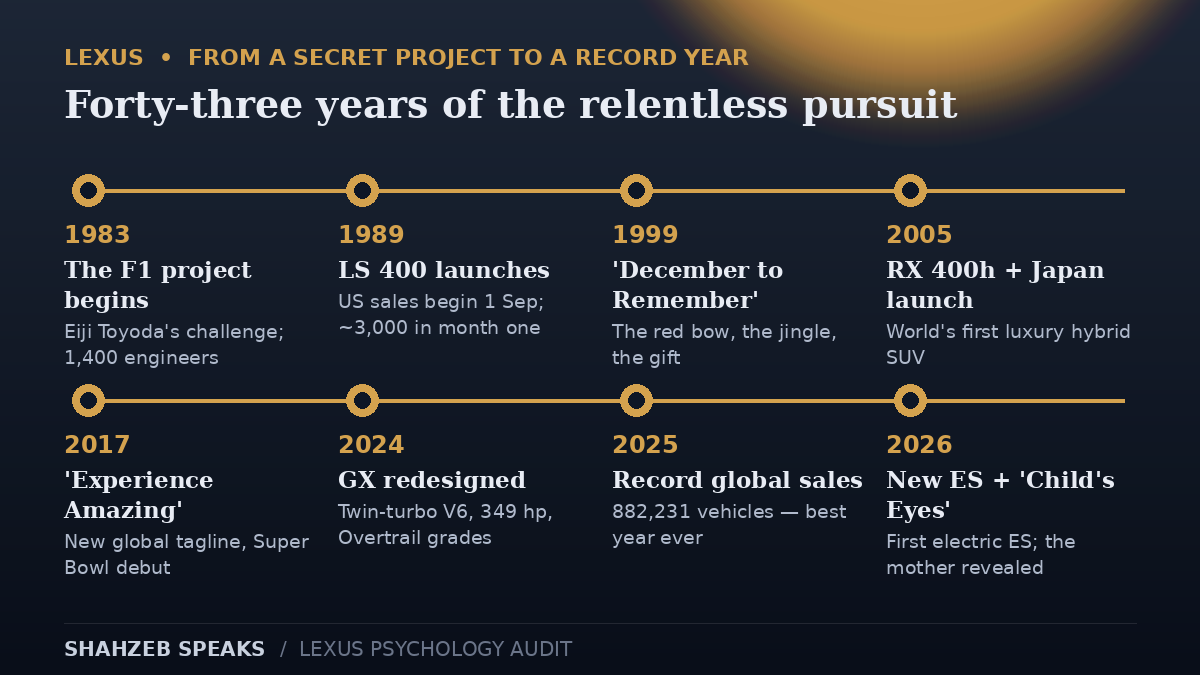
The result was the LS 400, which debuted in January 1989 at the North American International Auto Show in Detroit, with a new 4.0-litre V8 engine and a second model, the smaller ES 250, beside it. United States sales began on 1 September 1989 through 81 new Lexus dealerships, and almost 3,000 cars were sold in the first month. The brand’s first slogan, “The Relentless Pursuit of Perfection”, was not a piece of advertising copy. It was a description of how the car had been made, and it set the terms of the brand’s promise: Lexus would be judged on quality first, and everything else second. Europe followed in 1990 with the LS 400 alone.
Three months after the launch, Lexus showed the other side of that promise. In December 1989, it ordered a voluntary recall of the 8,000 LS 400s sold so far, after two customer complaints about defective wiring and an overheated brake light. A brand three months old, recalling every car it had sold, could have been a disaster. It became the opposite: the recall is still cited as the moment Lexus proved that its service promise was real, and it is the founding story of the ownership experience the brand sells today. The psychology of that decision is worth noting, because it runs through this whole audit: a company that admits a fault quickly is trusted more, not less, than one that hides it. Lexus learned that lesson in its first year, and the recalls in Chapter 11 test whether it still remembers it.
The brand grew the way its first car suggested it would: carefully, and in one direction. The RX arrived in 1998 and created the luxury crossover segment. In 2005, Lexus did two things that still define it: it launched the brand in its home market of Japan, becoming the first Japanese premium marque to sell under its own name at home, and it launched the RX 400h, the world’s first luxury hybrid SUV. The F performance division followed in 2007 with the IS F, and the LFA supercar in 2009, limited to 500 units. In 2017, Lexus replaced its original slogan with a new global tagline, “Experience Amazing”, first used in the Super Bowl spot “Man & Machine” — a deliberate shift from perfection as a product claim to experience as a brand promise. In 2024, the GX was redesigned from the ground up as the GX 550, with a twin-turbo 3.4-litre V6 producing 349 horsepower. In 2025, Lexus sold a record 882,231 vehicles worldwide, and in April 2025 it unveiled the eighth-generation ES, the first ES offered as a battery-electric car. The brand that began as a secret project to beat Mercedes-Benz now sells more cars than ever, in more than 90 countries — and its most famous advertisement is still the one about Christmas.
🎬 Chapter 2: “Child’s Eyes” — the 2026 campaign, and the mother in the snowball fight
The campaign at the centre of this audit is three weeks old, and it is the most emotionally ambitious version of “December to Remember” Lexus has made. The direct answer is that the 2026 campaign stops selling the car as a gift and starts selling the feeling of giving — and it does that by showing the giver as a child.
“December to Remember” 2026 was unveiled on 4 November 2026 from Plano, Texas, with two new films made by Team One, the agency that has handled Lexus advertising since 1986. The hero film, “Child’s Eyes”, is a 60-second spot that follows a young girl through a holiday city: her hands full of shopping bags, she skips down the street, stops in front of a shop window to gaze at a handbag, visits a cafe, shops for groceries, and helps secure a Christmas tree to the roof of a Lexus GX. Later, at home, she sips a hot drink while she watches other children unwrap presents. Then comes the reveal the whole film has been building towards: the girl is a grown woman, a mother, experiencing the season through her younger self. The film is set to Willie Nelson’s “Young at Heart”, and its point is stated in the release rather than left to guesswork: the campaign celebrates “the adults who bring the magic of the season to life”, and the wonder of the season “knows no age limit”.

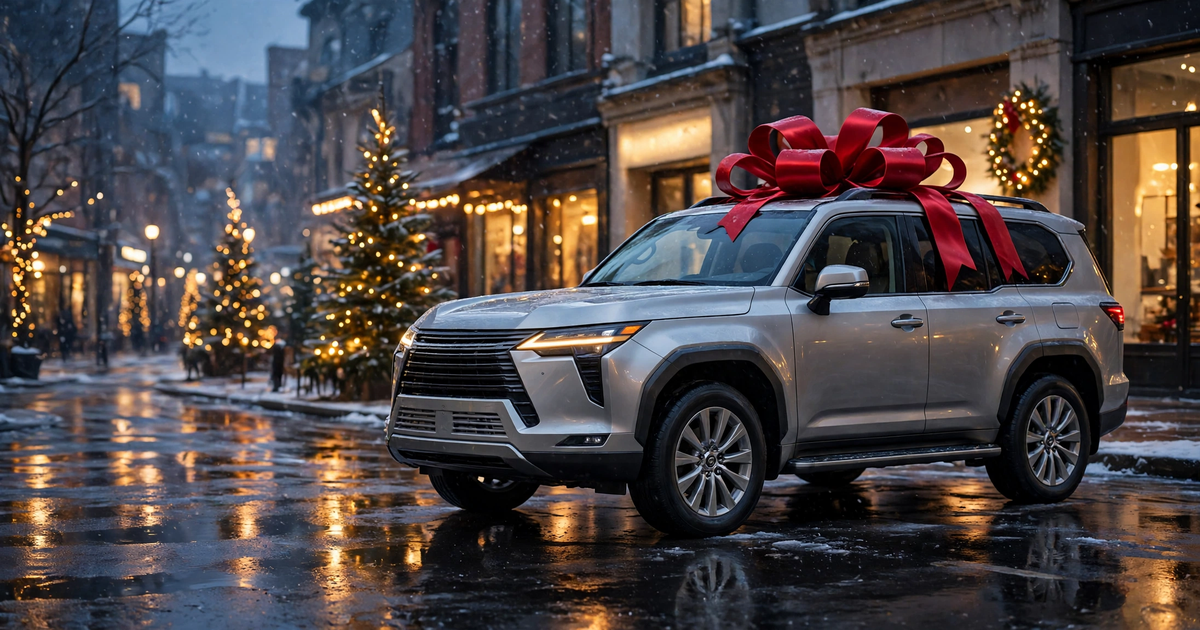
The companion spot, “Snowball”, tells the same story in fifteen seconds. The girl joins two children in a snowball fight outside a family home, with a Lexus GX parked in the driveway. As the three come together in a warm embrace, the transformation reveals that the girl was the mother all along, “rediscovering the uninhibited, childlike joy of the holidays”. The Lexus GX is the only vehicle featured in both new spots, which is a deliberate choice: the GX, redesigned in 2024 as a rugged family SUV with three rows and a 349-horsepower V6, is the car in the campaign because it is the car a family actually uses at Christmas — for the tree, the shopping, the drive home. Lexus is also bringing back two earlier spots, “Overnight Lexus” and “Over the Years”, so the 2026 campaign mixes new storytelling with familiar material.
The media plan is as deliberate as the films. The spots began airing on 4 November across cable, cable sports and connected TV, including ESPN College Football, Amazon Thursday Night Football and NBA coverage, with supporting media in cinemas and on Amazon Prime, Hulu, HBO Max and Netflix. That is a plan aimed at the family audience in the weeks when Christmas shopping is decided, and it supports the Lexus December Sales Event, which offers incentives through 4 January 2027. The campaign’s own language gives away its strategy: “At a time of year when the pressure to do more can overshadow what matters most, Lexus takes a fresh look at what makes the season special: how we make others feel.” The car is not the gift in these films. The feeling is.
🎄 Chapter 3: Nostalgia — seeing Christmas through a child’s eyes
The strongest psychology in this campaign is nostalgia, and it is the one the whole film is built on. The direct answer is that “Child’s Eyes” works because it does not ask the viewer to remember a Lexus. It asks the viewer to remember being a child at Christmas — and then tells them they can feel that way again.
The principle is nostalgia, and the research behind it is precise. Wildschut, Sedikides, Arndt and Routledge, writing in 2006 in the Journal of Personality and Social Psychology, ran seven studies on nostalgia and found that nostalgic narratives typically feature the self with close others — family and friends — or in momentous events; that nostalgia is triggered by negative mood and loneliness; and that it bolsters social bonds, increases positive self-regard and generates positive affect. Nostalgia, in other words, is not only a warm feeling. It is a social feeling. It makes people feel closer to the people they love, and better about themselves. “Child’s Eyes” runs on exactly that mechanism. The girl is alone for most of the film, but everything she does is for other people: the shopping, the groceries, the tree, the watching of children opening presents. The nostalgia is not about the past. It is about the people the past contained.
There is a second principle beside it, and it explains why the film’s twist lands rather than confuses. Tulving argued in 2002, in the Annual Review of Psychology, that episodic memory — memory of personally experienced events — involves mental time travel: the mind can re-experience a past moment as if it were happening now. The film stages that travel literally. The viewer watches a child, and then the child becomes the mother, and the viewer understands that the mother is remembering her own childhood while she creates her children’s. Holbrook and Schindler, writing in 1991, showed that people differ in how prone they are to nostalgia, and that the feeling is strongest for the objects and experiences of their own youth. The film is aimed squarely at that audience: adults old enough to have a childhood Christmas to remember, and young enough to be making one for their own children. Willie Nelson’s “Young at Heart” is not background music. It is the thesis, sung.
The risk is the one that applies to every nostalgia campaign. Nostalgia works when the memory is shared, and it fails when it is not. A viewer who did not have a childhood Christmas like the one in the film — the shopping bags, the cafe, the tree on the roof, the presents under it — may feel excluded rather than moved. A viewer outside the United States may not know the December to Remember tradition at all. The film answers by keeping its images ordinary: groceries, a cafe, a snowball fight, a driveway. There is no mansion, no champagne, no jewellery. The handbag in the shop window is the only luxury in the film, and it is the one thing the girl does not buy. The audit scores nostalgia 90, the highest in this audit, because the mechanism is real, the research supports it, and the execution is confident — but it notes the limit: the nostalgia is warmest for the viewer who already knows this Christmas.
🎁 Chapter 4: Gift-giving as agapic love — the giver is the hero
The second psychology in this campaign is the one that makes it different from every December to Remember film that came before it. The direct answer is that the 2026 campaign makes the giver the hero, not the receiver — and that change turns a car advertisement into a story about love.
The principle is gift-giving as agapic love. Belk and Coon argued in 1993, in the Journal of Consumer Research, that most research treats gift-giving as exchange — I give you something, you owe me something — but that their qualitative research among 110 college students revealed a second pattern: gifts given as an expression of agapic love, unselfish love marked by emotion, expressiveness and the singularisation of the recipient. An agapic gift is not a transaction. It is a statement: I know you, I thought about you, and this is for you alone. Sherry had made the same point a decade earlier, in 1983, arguing that gift-giving is a social process in which the gift carries the relationship between giver and receiver. The gift is never only the object. It is the care that chose it.
“Child’s Eyes” is built on that idea, and it is the reason the film’s twist matters. For the first minute, the viewer believes the film is about a child receiving Christmas: the shopping, the window, the presents. The reveal changes the meaning of everything that came before it. The shopping was not for the girl. The groceries were not for the girl. The tree was not for the girl. Every act in the film was an act of giving, performed by a mother, and the viewer has been watching the giver all along without knowing it. The campaign’s own release says it plainly: the films celebrate “how we make others feel”, and the hero is “the adults who bring the magic of the season to life”. The car is not the gift. The mother is the gift, and the car is what she drives while she gives it.
There is a second principle at work beside the love, and it explains why the giving feels good to watch. Cialdini, in Influence (2001), described reciprocity as one of the most reliable persuasion tools there is: people feel obliged to return a favour, and a gift creates a debt that the receiver wants to repay. But the reciprocity in this film runs the other way. The mother gives without expecting anything back, and the viewer — who is, in the film’s audience, very likely a giver themselves — recognises the feeling. The pleasure of giving is its own reward, and the film lets the viewer feel it twice: once as the child receiving, and once as the mother giving. That is a clever piece of psychology, because it flatters both halves of the audience at once. The audit scores gift-giving 88, because the reframe is clear, it is built on real research, and it is executed in the film rather than only claimed in the press release.
🪞 Chapter 5: Identity and self-congruity — the car you buy is the person you think you are
The third psychology in this audit is the one that explains why a luxury car needs a Christmas campaign at all. The direct answer is that nobody needs a Lexus, and everybody who buys one is buying a picture of themselves — so the campaign sells the picture, not the car.
The principle is self-congruity. Sirgy argued in 1982, in the Journal of Consumer Research, that people buy products whose image matches their own self-image, and that purchase intention rises as the distance between the two shrinks. A person who thinks of themselves as generous, thoughtful and family-minded will choose the product that looks generous, thoughtful and family-minded, because the product confirms the self. Belk made the same point more broadly in 1988, in “Possessions and the Extended Self”: possessions are not separate from identity, they are part of it, and the things we own extend the self into the world. A car is the largest, most public possession most people own. It is parked in the driveway, where the neighbours can see it. It says something about its owner every day, whether the owner wants it to or not.
“December to Remember” has always understood that, and the 2026 campaign understands it better than most years. The red bow on a Lexus in a driveway does not say “I bought a car”. It says “I am the kind of person who gives a car at Christmas”. The 2026 films say something quieter and more interesting: “I am the kind of person who makes Christmas magical for other people.” The mother in “Child’s Eyes” is not shown buying anything for herself. She is shown giving her time, her attention and her care, and the GX is simply the vehicle — in both senses — of that giving. A buyer who sees themselves in that mother is not buying horsepower. They are buying the picture of themselves as the person who makes the season special, and the car is the proof that the picture is true.
The risk is the one that applies to every identity campaign. A self-image that is too narrow excludes the buyer who does not recognise themselves in it, and a self-image that is too broad means nothing at all. The 2026 films are narrow in a specific way: the giver is a mother, the family is a conventional one, and the Christmas is an American suburban one. A buyer without children, or without that Christmas, may not see themselves in the film. Lexus answers by keeping the car itself almost invisible — the GX appears in a driveway, on a street, under a tree — so that the identity on offer is the giving, not the vehicle. The audit scores identity and self-congruity 86, because the mechanism is real and the execution is restrained, but it notes the narrowing: the self the campaign offers is a generous parent, and not everyone buying a Lexus is one.
🎀 Chapter 6: Mere exposure and the red bow — twenty-seven years of the same image
The fourth psychology in this audit is the oldest one in the campaign, and it is the one that makes the campaign work at all. The direct answer is that the red bow is not a decoration. It is a memory device, built over 27 years, that tells the viewer what they are looking at before a word is spoken.
The principle is mere exposure. Zajonc showed in 1968 that repeated exposure to a stimulus increases liking, even without conscious recognition — that people come to prefer the things they have seen before, simply because they have seen them before. “December to Remember” is the longest-running application of that principle in car advertising. Since its inception in 1999, according to Lexus, the campaign has returned every December with the same signature jingle, the same big red bows and the same heartwarming gift-giving moments, and Lexus marked its 25th anniversary in November 2024 with two new commercials, “Forecast” and “Letter”. A viewer who has seen a Lexus with a red bow in a driveway for 27 Decembers does not need to be told what the image means. The image means Christmas, and it means Lexus, in a single glance.
That is why the 2026 films can afford to barely show the car. The bow has done the work already, and the new films are free to spend their 60 seconds on the story. The bow appears in the campaign’s history rather than in its foreground: the GX in “Child’s Eyes” carries a tree, not a bow, and the GX in “Snowball” sits in a driveway, unadorned. The campaign trusts that the viewer already knows the bow, and that knowledge is the asset. A rival carmaker launching a Christmas campaign this year would have to explain itself. Lexus only has to remind the viewer of something they already know, and the reminder is the advertisement.
There is a limit, and it is the one that applies to every familiar image. Exposure creates liking, but it also creates blindness: a picture seen 27 times can stop being seen at all. The 2026 campaign answers that risk by changing the story while keeping the frame — the same December, the same event, the same jingle, but a mother instead of a recipient, a snowball fight instead of a driveway reveal. The audit scores mere exposure and the red bow 87, because the asset is real, it is 27 years old, and it is the reason the campaign can spend its time on a story instead of a sales pitch. It also notes the dependence: a campaign that relies on a memory is only as strong as the memory, and the memory belongs to viewers old enough to have 27 Decembers behind them.
🕯️ Chapter 7: Ritual and the December event — the ending is the product
The fifth psychology in this audit is ritual, and it is the one that turns a sales event into a tradition. The direct answer is that the Lexus December Sales Event is not a discount. It is a date on the calendar, and the date is the point.
The principle is ritual. Vohs, Wang, Gino and Norton showed in 2013, in Psychological Science, that rituals enhance consumption: people who performed a small ritual before eating or drinking — stirring, unwrapping, waiting — enjoyed the food or drink more, valued it more highly, and were willing to pay more for it, than people who consumed it without the ritual. The ritual did not change the product. It changed the experience of the product, and the experience is what people remember. December to Remember is a ritual in exactly that sense. It happens every year, at the same time, with the same jingle, the same bows and the same kind of story, and the repetition is the value. A buyer does not wait for December because the cars are cheaper. They wait because December is when a Lexus becomes a gift, and a gift is worth more than a purchase.
There is a second principle beside the ritual, and it explains why the films end the way they do. Kahneman, Fredrickson, Schreiber and Redelmeier showed in 1993 that people judge an experience by its peak and by its ending, not by the whole — the peak-end rule. The ending of “Child’s Eyes” is the peak and the end at once: the reveal that the girl is the mother, and the mother’s quiet moment watching the children open their presents. The film is engineered so that the last thing the viewer feels is the warmest thing in it, and the warmth is what the viewer remembers when they think about Lexus. The snowball fight in “Snowball” ends the same way: an embrace, and a transformation. The campaign does not end on a price, a model name or a call to action. It ends on a feeling, and the feeling is the advertisement.
The risk is the one that applies to every ritual. A ritual that never changes can start to feel old, and a brand that owns one occasion can find itself trapped by it. Lexus has felt that trap: the campaign is so associated with December that the brand must work hard to be chosen in the other eleven months. The 2026 films are an attempt to widen the ritual without breaking it — the story is about giving, not about the car, and giving happens all year. The audit scores ritual and the December event 85, because the ritual is real, owned, and proven by 27 years of repetition, but it notes the dependence: a brand with one occasion is a brand with one month, and the other eleven still need a reason.
⏳ Chapter 8: Scarcity and seasonal urgency — the event ends on 4 January
The sixth psychology in this audit is scarcity, and it is the one that turns the feeling into a decision. The direct answer is that “December to Remember” works as a sales event because it ends — on 4 January 2027 — and the ending is what makes the buyer act.
The principle is scarcity. Cialdini, in Influence (2001), described scarcity as one of the most reliable persuasion tools there is: people value what is limited, and they value it more when the limit is a deadline. The Lexus December Sales Event is built on that mechanism. The campaign begins in early November, it runs through December, and it ends on 4 January 2027. The date is printed in the release, and it is the only hard fact in a campaign otherwise made of feelings. A buyer who has watched “Child’s Eyes” and imagined themselves as the giver has until 4 January to act on the feeling, and after that the event — and the excuse — is gone.
There is a second pressure beside the deadline, and it is the one the campaign does not need to state. Team One’s chief creative officer, Chris Graves, has said that December has been the biggest sales month for Lexus since the campaign’s launch. That is the campaign’s own account of its success, reported by Fast Company, and it matters for a simple reason: if December is the month everyone buys a Lexus, then December is the month to buy one. Cialdini called that social proof — people look to what others are doing to decide what to do themselves — and the December event is social proof with a calendar attached. The neighbours’ driveways, the red bows, the December rush: the campaign does not need to say that everyone is doing it, because the month itself says it.
The limit is the one that applies to every deadline. A deadline that is real creates urgency, and a deadline that is repeated every year creates the opposite: the buyer learns that the event will be back next December, and the urgency fades. Lexus answers by making the event feel like a tradition rather than a sale — the same jingle, the same bows, the same kind of story — so that missing it feels like missing Christmas, not missing a discount. The audit scores scarcity and seasonal urgency 83, because the deadline is real and the December peak is documented, but it notes the softening: a 27-year-old annual deadline is a tradition, and traditions do not hurry anyone.
🛡️ Chapter 9: Trust and the ownership promise — the most dependable brand, and the reason to believe it
The seventh psychology in this audit is trust, and it is the one that makes the rest of the campaign believable. The direct answer is that Lexus can sell a feeling about giving because it has spent 37 years proving that the car underneath the feeling will not let the buyer down — and the proof is in the numbers, not in the advertising.
The strongest number in this audit comes from J.D. Power. In the 2026 US Vehicle Dependability Study, Lexus ranked highest overall for a fourth consecutive year, with 151 problems per 100 vehicles, against an industry average of 204 and a premium-segment average of 217. The Lexus IS was named the most dependable model in the study, and Toyota Motor Corporation took the most model-level awards, with eight. The study is based on responses from 33,268 original owners of 2023 model-year vehicles after three years of ownership, so it measures the cars people actually live with, not the cars they test-drive. A brand that tops that study four years running is not selling a promise. It is selling a record, and the record is the reason the campaign’s emotional claim is credible: a giver who buys a Lexus is giving something that will still be working in three years’ time.
The second half of the trust promise is the ownership experience, and Lexus built it into the brand from the start. The L/Certified programme, launched in 1996, puts every certified pre-owned Lexus through a 161-point inspection and covers it with a two-year unlimited-mileage warranty, and it has been named the best certified pre-owned programme five years in a row by U.S. News & World Report. The programme matters for a reason that has nothing to do with used cars: it tells the new-car buyer that the brand stands behind its product after the sale, and it tells the second owner that the brand’s quality is not a claim but a guarantee. A luxury brand that inspects a six-year-old car 161 times is a brand that believes its own quality story, and the buyer can tell.
The limit is the one taken up in Chapter 11. Trust is a record, and a record can be damaged by the same thing that built it: the cars themselves. The V35A engine recalls, the LX600 transmission recall and the UA80 transmission lawsuits all sit on the other side of the dependability award, and they are the reason this dimension scores 76 rather than 90. A buyer who reads the J.D. Power result and then reads the recall notices will ask a fair question: how can the most dependable brand in America be recalling its flagship SUV’s engine? The audit’s answer is that both things are true at once, and that the trust Lexus has built is strong enough to survive the recalls — but only if the recalls are handled the way the 1989 LS 400 recall was handled: quickly, openly, and at the brand’s own expense.
🔌 Chapter 10: The gap — a record year, and a future that has not arrived yet
This is the chapter the rest of the audit has been building towards, and it is the one that explains the score. The direct answer is that Lexus is having the best sales year in its history while selling a future it has not yet delivered — and the gap between the two is the brand’s central problem.
The sales figures are on record, and they are worth stating plainly. In 2025, Lexus sold a record 882,231 vehicles worldwide, 104% of the previous year’s total, with North America leading at a record 408,070. In the United States, Lexus sold 370,260 vehicles, its best-ever full-year result, up 7.1% on 2024. The GX, the car in the Christmas films, had its best-ever year in the United States, as did the NX Hybrid, the TX and the RX Plug-in Hybrid. Those are the numbers of a brand at the top of its market, and they are the reason the campaign can afford to be gentle: a brand selling this well does not need to shout.
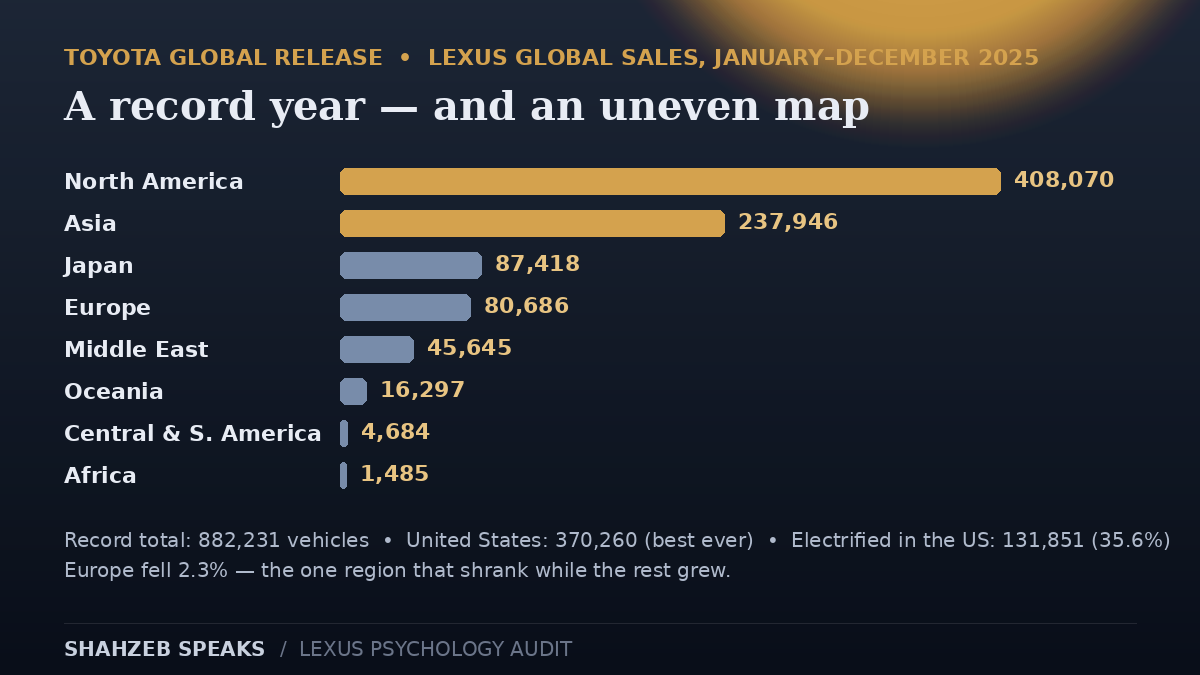
The other half of the picture is quieter, and it is the reason this chapter exists. Lexus’s electrified sales in the United States in 2025 were 131,851 vehicles — an all-time best, up 7.2%, but only 35.6% of the brand’s American volume, and almost all of it hybrid rather than battery-electric. The fully electric ES, the eighth generation of the brand’s core sedan, was unveiled in April 2025 and only begins its phased rollout in the middle of 2026, with the ES 350e offering a manufacturer-estimated range of 300 miles. In Europe, where electric cars are a larger share of the luxury market, Lexus sales fell 2.3% in 2025, to 80,686. The brand’s own president, Takashi Watanabe, described 2025 as the year Lexus introduced “new experiential value” through the redesigned ES and the new RZ, and unveiled a new brand message, “DISCOVER”, at the Japan Mobility Show — the language of a brand still introducing its electric future, not yet living in it.
The principle behind the gap is the one that has run through this whole audit: the effort of changing is justified by the value of what changes. Aronson and Mills showed in 1959 that people value an outcome more when they have worked hard to reach it, and Lexus has worked hard for 27 years to make December its month. The brand’s challenge is that the work it needs to do next is different: not a better Christmas film, but a better electric car, sold to buyers who compare it with Tesla, BYD and the German brands on range, charging and software rather than on the quiet of the cabin. The 2026 ES is the first step, and it is a real one — the first ES with a battery-electric version, on a platform built for both hybrid and electric power. But a first step is not a lead, and the audit scores future readiness 72, the lowest in this audit, because the sales are at a record and the electric range is still arriving. The campaign is beautiful. The future is late.
⚠️ Chapter 11: The dark side — the $1.2 billion admission, three engine recalls, and the lawsuits that are still only allegations
Every audit on this site carries a dark-side chapter, and this one is heavier than most. The direct answer is that Lexus’s parent company admitted to misleading American consumers about safety, has recalled more than 270,000 Lexus and Toyota vehicles for the same engine defect in three waves, and faces consolidated class actions over its eight-speed transmission — and all of it must be stated at its exact status, as of 21 November 2026.
The first item is the oldest and the most serious, and it is a matter of public record. On 19 March 2014, the United States Department of Justice announced a criminal wire-fraud charge against Toyota Motor Corporation and a deferred prosecution agreement under which Toyota admitted that it misled United States consumers by concealing and making deceptive statements about two safety issues affecting its Toyota and Lexus vehicles, each of which caused a type of unintended acceleration: floor-mat entrapment, in which an improperly secured or incompatible all-weather floor mat could trap a depressed gas pedal, and the “sticky pedal”, in which accelerators could get stuck at partially depressed levels. The agreement required Toyota to pay a $1.2 billion financial penalty — described by the Department of Justice as the largest penalty of its kind ever imposed on an automotive company — and imposed an independent monitor to review the company’s safety-related public statements and reporting. Prosecution was deferred for three years, and then to be dismissed if Toyota complied with the agreement. That is a settled matter, with an admission, not an allegation, and it is the reason this audit treats Toyota’s safety record with care: the company has, once, been found to have hidden a safety problem from its regulator and its customers.
The second item is the engine recalls, and they come in three waves for the same defect. On 30 May 2024, Toyota filed recall 24V-381 with the National Highway Traffic Safety Administration, covering 102,092 vehicles — 2022–2023 Toyota Tundra and Lexus LX600 models with the V35A twin-turbo V6 engine. Manufacturing debris may contaminate the engine and cause the main bearings to fail, which can result in an engine stall and a loss of drive power. The remedy is the replacement of the engine assembly, free of charge, and owner letters were mailed on 17 December 2024. On 6 November 2025, Toyota filed recall 25V-767, covering 126,691 vehicles — 2022–2024 Tundra, 2022–2024 Lexus LX and 2024 Lexus GX — for the same defect, with the same possible consequences: engine knocking, rough running, engine no start and loss of motive power. At filing, the remedy was still being developed; the National Highway Traffic Safety Administration’s record lists owner notification on 28 August 2026, with dealers inspecting the No. 1 main bearing using inspection software and drive data, and replacing the engine where needed. In May 2026, a third recall, 26V320, covered about 43,566 2024 Tundras built at Toyota’s Alabama plant for the same issue, with interim owner letters mailed on 23 July 2026 and a final remedy not yet announced. Three recalls, one defect, and a remedy that changed from full engine replacement to inspection: that is the pattern a buyer should know about, and it is the reason the trust dimension in this audit is marked down.
The third item is the newest recall, and it touches the brand’s best-selling models. On 18 February 2026, Toyota filed recall 26V094, covering 4,374 Lexus LX600 vehicles from the 2025 and 2026 model years: a transmission solenoid failure may break communication between the transmission electronic control unit and the engine control unit, damaging the transmission, causing a loss of drive power and a possible transmission-fluid leak that increases the risk of fire. The remedy is a free software update, with owner letters expected on 25 April 2026. Toyota said in its filing that it was not aware of any field reports or warranty claims related to the issue. A month later, on 18 March 2026, Toyota filed recall 26V162, covering 144,200 vehicles including the 2024–2026 Lexus TX350 (3,843 vehicles), the 2023–2026 Lexus RX350 (71,084) and the 2022–2025 Lexus NX350 and NX250: a specific multimedia system and in-cabin USB charger can cause the backup-camera image to appear as a blank screen when the vehicle is placed in reverse.
The fourth item is the lawsuits, and their status must be stated with particular care. Four proposed class actions over Toyota’s UA80 eight-speed automatic transmission — Natale, Pallaya, LeBoutheller and Pszwaro v. Toyota Motor Sales — were filed in United States federal courts between December 2025 and February 2026, alleging that the transmission overheats, burns its fluid and fails prematurely in Toyota and Lexus models including the Lexus RX, ES, NX and TX. The four suits were consolidated into a single action in 2026, with Natale v. Toyota as the master case. No class has been certified, and no settlement or payout has been reported as of October 2026. These are allegations, not findings, and Toyota has not been found liable. This audit prints them because a buyer who searches for the transmission will find them, and should know that they are unproven claims at an early stage — not because the audit has reached a view on them.
The fifth item is the oldest, and it is the one that shows the brand at its best. In December 1989, three months after the LS 400 went on sale, Lexus voluntarily recalled the 8,000 cars sold so far, after two customer complaints about defective wiring and an overheated brake light. It was a voluntary recall, by a brand three months old, of every car it had sold. That is the standard the 2024, 2025 and 2026 recalls should be measured against, and it is the reason the audit does not write Lexus off: the company has, once, done the right thing quickly, at its own expense, before anyone forced it to. The question the record asks is whether it still does. The trust and legal record dimension is scored 76: not because Lexus has been found against in the recent cases, but because a $1.2 billion admission, three waves of the same engine recall, and consolidated transmission lawsuits sit on the same record as the best dependability score in the industry, and the two halves do not reconcile themselves.
Finally, one absence, stated with the same care as the findings. No Lexus-specific advertising-enforcement action, fine or upheld ruling was found in the searches run for this audit. That is a statement about the searches run, not a certified clean record, and this audit does not claim more than it found.
🇵🇰 Chapter 12: What Pakistani brands should — and shouldn’t — copy
Pakistani brands should copy the giver. The best idea in “Child’s Eyes” is not the snow, the tree or the car. It is the decision to make the person who gives the hero of the film, instead of the person who receives. A Pakistani brand that sells at Eid, at a wedding, or at a family gathering should build its advertising the same way — around the person doing the giving, not the person doing the receiving. Show the mother cooking while everyone else eats. Show the father carrying the shopping while everyone else walks ahead. Show the effort, not the reward. The agapic gift is not a trick. It is a fact about how people understand love, and a brand that shows the giver will be remembered more warmly than one that only shows the gift.
Pakistani brands should copy the bow. Lexus has spent 27 years teaching its audience that a red bow on a car means Christmas, and it now owns that image so completely that it does not need to explain it. A Pakistani brand that has a symbol — a colour, a shape, a sound, a phrase — should protect it and repeat it until it becomes the brand. Do not change the symbol every season. A symbol that is repeated becomes a memory, and a memory is the most valuable thing a brand can own, because it is the thing the customer carries without thinking. Lexus has owned its bow for 27 years. A Pakistani brand that owns one for ten will have an advantage its competitors cannot copy, because a symbol cannot be bought. It has to be earned, one December — or one Eid — at a time.
Pakistani brands should copy the honesty about the gap. Lexus is having its best sales year ever, and it is honest — through its own reporting — about the fact that its electric future is still arriving, and that its European sales fell while its American sales rose. A Pakistani brand that is doing well should measure the same gap: where it is strong, and where it is behind. The answer is often uncomfortable, and it is the most useful number a brand can have, because it tells the brand whether it needs more advertising or a better product. Lexus is spending its Christmas campaign on a feeling while its engineers build the electric ES. A Pakistani brand that knows its own gap should do the same, and spend on the product as well as on the story.
And Pakistani brands should not copy the recall pattern. Three recalls for the same engine defect, with the remedy changing from full replacement to inspection, is the shape of a problem that was not solved the first time. A Pakistani brand that finds a defect in its product should fix it once, properly, and tell its customers what it did — the way Lexus did in December 1989, when it recalled every LS 400 it had sold. A recall handled quickly and openly builds trust. A recall handled in three waves, over three years, spends it. The cheapest time to fix a defect is the first time you find it.
📊 Psychology Scorecard — the Lexus December to Remember audit verdict
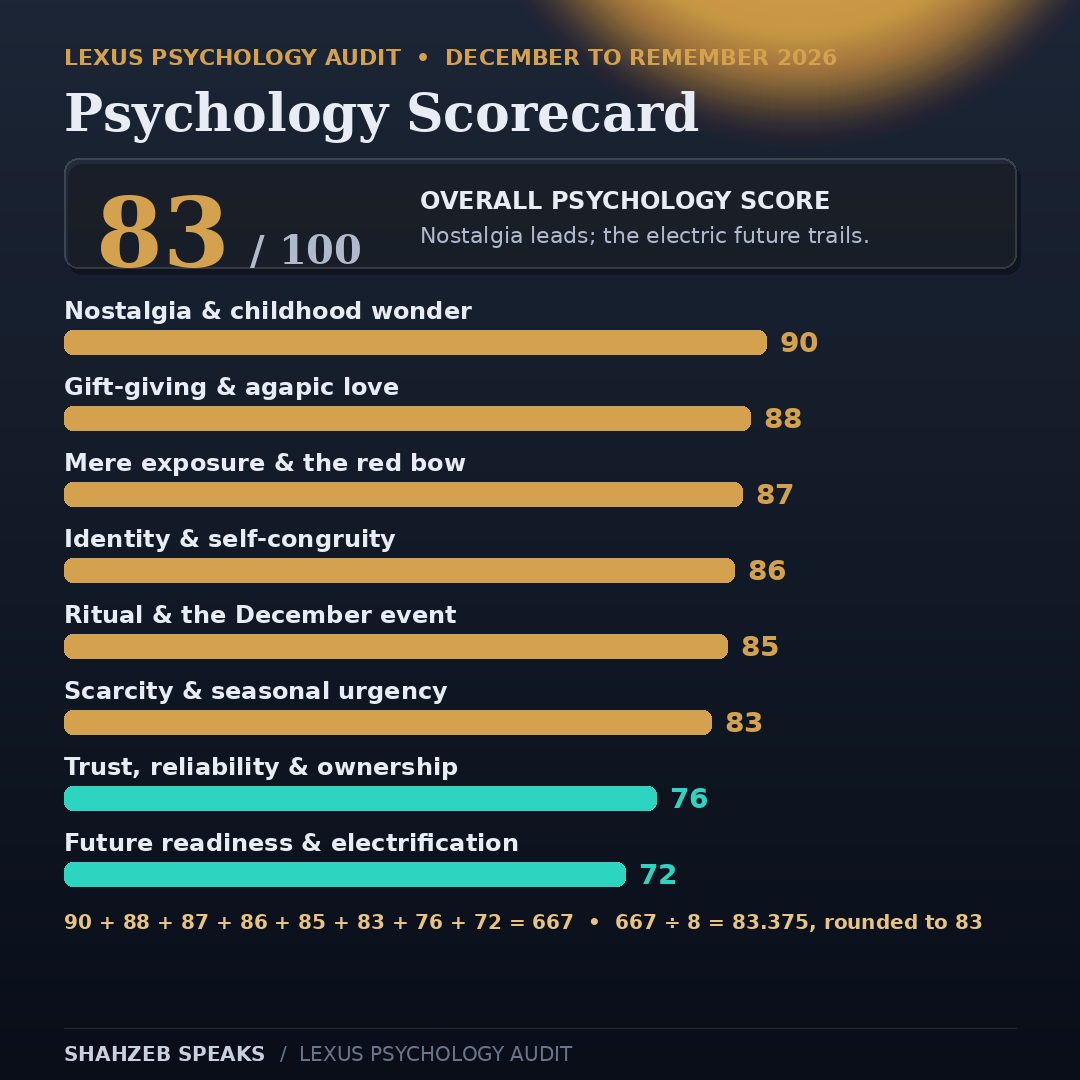
The scorecard below scores the campaign’s psychology and the brand behind it, not its outcome. No effectiveness data exists yet for the 2026 campaign, and none is claimed. The eight dimensions are scored out of 100, and the overall score is their rounded average.
| Dimension | Score | Verdict |
|---|---|---|
| Nostalgia & childhood wonder | 90 | The mother who becomes the girl she was — the campaign’s clearest idea, built on real nostalgia research |
| Gift-giving & agapic love | 88 | The giver is the hero, not the receiver — the film’s twist turns a car ad into a story about love |
| Mere exposure & the red bow | 87 | Twenty-seven Decembers of the same image — the bow tells the viewer what they are watching before a word is spoken |
| Identity & self-congruity | 86 | The car as the picture of the generous self — the GX is the vehicle of the giving, in both senses |
| Ritual & the December event | 85 | The same jingle, the same bows, the same kind of story — and an ending that is the peak of the film |
| Scarcity & seasonal urgency | 83 | The event ends on 4 January 2027, and December is the brand’s biggest month — but a 27-year-old deadline is a tradition, not a hurry |
| Trust, reliability & ownership | 76 | The best dependability score in the industry, 151 problems per 100 vehicles — held back by the recalls and lawsuits behind it |
| Future readiness & electrification | 72 | Record sales, but electrified cars are only 35.6% of US volume and the electric ES only arrives in mid-2026; Europe fell 2.3% |
| Overall | 83/100 | 90 + 88 + 87 + 86 + 85 + 83 + 76 + 72 = 667; 667 ÷ 8 = 83.375, rounded to 83 |
🧠 Psychology Techniques Identified
- Nostalgia (Wildschut et al. 2006; Holbrook & Schindler 1991; the mother relives her own childhood Christmas while making her children’s)
- Gift-giving as agapic love (Belk & Coon 1993; the giver, not the receiver, is the hero of both films)
- Reciprocity (Cialdini 2001; the giving creates warmth the viewer wants to return — by giving, and by buying)
- Identity / self-congruity (Sirgy 1982; Belk 1988; the Lexus as the picture of the generous, family-minded self)
- Mere exposure (Zajonc 1968; 27 years of the same red bow, the same jingle, the same December)
- Ritual (Vohs et al. 2013; the December Sales Event as a yearly ritual, the tree on the roof, the snowball fight)
- Peak-end rule (Kahneman et al. 1993; the reveal is the peak and the ending, and the ending is what the viewer remembers)
- Scarcity & seasonal urgency (Cialdini 2001; the event ends 4 January 2027, and December is the brand’s biggest month)
- Mental time travel / episodic memory (Tulving 2002; the film stages the mother’s return to her own childhood)
- Effort justification (Aronson & Mills 1959; the adults who do the work of Christmas value the season more — and the film honours the work)
- Social proof (Cialdini 2001; December as the month everyone buys a Lexus, the driveways full of red bows)
- Loss aversion (Kahneman & Tversky 1979; the event’s end date frames what the buyer might miss, and the loss weighs more than the gain)
✅ Balance sheet & prescription
What works: the nostalgia, which is the campaign’s clearest idea and is built on real research into what nostalgia does to people; the gift-giving, which makes the giver the hero and turns a car advertisement into a story about love; the red bow, which is 27 years of mere exposure in a single image and lets the films spend their time on a story instead of a sales pitch; the ritual, which makes December a date on the calendar rather than a discount; the reliability record, which is the best in the industry and makes the emotional claim credible; and the sales, which are at a record — 882,231 vehicles worldwide in 2025, 370,260 in the United States.
What does not: the electric future, which is still arriving — electrified cars are only 35.6% of Lexus’s American volume, the battery-electric ES only reaches showrooms in mid-2026, and European sales fell 2.3%; the legal record, where a $1.2 billion admission, three waves of the same engine recall and consolidated transmission lawsuits sit beside the dependability award; the narrowing of the identity on offer, which is a generous parent’s Christmas and not every buyer’s; and the absence of any effectiveness data for the 2026 campaign, which means this score is a judgement of psychology and craft, not of outcome.
The prescription: keep the giver as the hero, and keep the car in the background — it is the campaign’s best idea, and it is the one that makes a car advertisement worth watching. Protect the bow and the jingle, and change the story every year, so that the familiarity never becomes blindness. Fix the engine defect once, properly, and tell owners what was done — the 1989 LS 400 recall is the standard, and three waves of the same recall is not it. And make the electric future real before the next December: a Christmas campaign about giving is only as strong as the car it is giving, and the buyers of 2027 will compare the ES on range, charging and software, not on the quiet of the cabin.
📝 Final Verdict
“Child’s Eyes” is the best Christmas idea in the car industry, and it is the best idea Lexus has had in years. The brand understood that the most valuable thing it owned this December was not a new car but a new point of view — the season seen through a child’s eyes, by the mother who makes it — and it spent its annual campaign on saying that clearly, in two films and a song, with 27 years of red bows behind them. The nostalgia is genuine, the gift is real, the ritual is owned, and the reveal is the kind of ending people repeat to each other. The campaign’s weakness is that it is selling a feeling about giving while the brand is still working out what it is giving next: a record sales year, a dependability award, and an electric range that has not yet arrived. It is a very good Christmas campaign. It is not yet proof that the future is ready — and the difference between the two is a year of electric sales figures that do not exist yet.
Psychology Score: 83/100 — a mother who becomes the girl she was, a bow that has meant Christmas for 27 years, and a brand at record sales with its electric future still arriving. The feeling is real; the future is late.
— Brand Psychology Analysis, ShahzebSpeaks
🔑 Key Findings
- Nostalgia is the campaign’s strongest psychology, scoring 90/100: “Child’s Eyes” stages mental time travel — the mother relives her own childhood Christmas while making her children’s — and Wildschut, Sedikides, Arndt and Routledge (2006) showed that nostalgia bolsters social bonds, positive self-regard and positive affect.
- Gift-giving is the campaign’s most original move, scoring 88/100: the giver, not the receiver, is the hero of both films, and Belk and Coon (1993) showed that gifts given as agapic love — unselfish, expressive, singular — are a different act from exchange, not a variant of it.
- The red bow is 27 years of mere exposure in a single image, scoring 87/100: Lexus says “December to Remember” began in 1999 and marked its 25th anniversary in November 2024, and the bow lets the 2026 films spend their time on a story instead of a sales pitch.
- The sales are at a record and the future is late: Lexus sold a record 882,231 vehicles worldwide in 2025, including 370,260 in the United States, but electrified cars were only 35.6% of its American volume, the battery-electric ES only arrives in mid-2026, and European sales fell 2.3%. Future readiness scores 72/100.
- Legal record: Toyota admitted in a 19 March 2014 deferred prosecution agreement that it misled US consumers about two safety issues in Toyota and Lexus vehicles, and paid a $1.2 billion penalty. Three V35A engine recalls (24V-381, 102,092 vehicles; 25V-767, 126,691 vehicles; 26V320, about 43,566 Tundras) cover the same defect, plus the LX600 transmission recall 26V094 (4,374 vehicles) and the backup-camera recall 26V162 (144,200 vehicles). Four proposed UA80 transmission class actions were consolidated in 2026 with Natale v. Toyota as the master case; no class has been certified and no settlement has been reported as of October 2026 — allegations only.
- No effectiveness data exists for the 2026 campaign: no viewer count, no System1 score and no sales figure has been verified as of 21 November 2026, so 83/100 is a judgement of psychology and craft, not of outcome. No media-spend figure and no December Sales Event incentive amount is printed in this audit, because none was disclosed.
❓ Questions I am asked most often
What is Lexus’s “December to Remember” 2026 campaign about?
It is Lexus’s annual holiday campaign, unveiled 4 November 2026, built around the hero film “Child’s Eyes” and the companion spot “Snowball”. Both films follow a young girl who turns out to be a mother, reliving her own childhood Christmas while making the season for her children. The campaign celebrates the adults who make the holidays magical, set to Willie Nelson’s “Young at Heart”.
How good is the campaign, psychologically?
Our audit scores it 83/100. It is strongest on nostalgia and childhood wonder (90) and gift-giving and agapic love (88), and weakest on future readiness and electrification (72) and trust, reliability and ownership (76), where the dependability award sits beside the engine recalls and the transmission lawsuits.
How old is the “December to Remember” campaign?
Lexus says the campaign began in 1999, and it marked its 25th anniversary in November 2024 with the spots “Forecast” and “Letter”. The big red bow, the signature jingle and the gift-giving stories have been part of it since its earliest years, which is why a Lexus with a bow in a driveway reads as Christmas in a single glance.
How well is Lexus actually selling?
Very well. Lexus sold a record 882,231 vehicles worldwide in 2025, including a record 370,260 in the United States, up 7.1%. Electrified cars were 131,851 of the American total, 35.6% of volume. North America is nearly half of global sales at 408,070, while Europe fell 2.3% to 80,686.
Is Lexus really the most dependable car brand?
By the J.D. Power 2026 US Vehicle Dependability Study, yes: Lexus ranked highest overall for a fourth consecutive year, at 151 problems per 100 vehicles, against an industry average of 204, and the Lexus IS was the most dependable model. The study is based on 33,268 owners of 2023 model-year vehicles after three years of ownership.
What is the legal record behind the brand?
Toyota admitted in 2014 that it misled US consumers about two safety issues in Toyota and Lexus vehicles, paying a $1.2 billion penalty under a deferred prosecution agreement. Three recalls cover the same V35A engine defect, plus a 2026 LX600 transmission recall and a backup-camera recall. Four UA80 transmission class actions were consolidated in 2026; no class has been certified and no settlement has been reported as of October 2026.
If your brand is selling well and still has a story it has not told — a record year, a future that has not arrived, a gap between what people feel and what they buy — the problem is not awareness. It is the reason to choose. I help organisations build evidence-based brand strategy — get in touch here.
If this audit helped, you may also like Baileys — Bring on the Baileys, Tesla — The Psychology Audit, and BYD — The Psychology Audit. For the wider field, the homepage of this site covers industrial psychology in Pakistan and beyond.
📚 References & Sources
- Lexus / Toyota, “Lexus ‘December to Remember’: Celebrating the Makers of Holiday Magic” (pressroom.lexus.com, 4 November 2026): campaign unveiling, films “Child’s Eyes” and “Snowball”, Willie Nelson’s “Young at Heart”, GX featured, returning spots, sales event through 4 January 2027: https://one.toyota.com/articles/lexus-december-to-remember-celebrating-the-makers-of-holiday-magic
- Lexus, “Lexus Marks 25 Years of Its Iconic ‘December to Remember’ Campaign” (pressroom.lexus.com, 18 November 2024): inception in 1999, signature jingle, big red bows: https://pressroom.lexus.com/?generate_pdf=72041
- Lexus, “Lexus Announces Global Sales Results for 2025” (global.toyota, January 2026): record 882,231 units, regional breakdown, new ES and RZ, “DISCOVER” brand message: https://global.toyota/en/newsroom/lexus/43928789.html
- Toyota Motor North America, “Toyota Motor North America Reports 2025 U.S. Sales Results” (pressroom.toyota.com, 5 January 2026): Lexus 370,260, best-ever full-year result, electrified 131,851, December 38,233, best-ever year for GX: https://pressroom.toyota.com/toyota-motor-north-america-reports-2025-u-s-sales-results/
- Lexus, “A New Legend Is Born: The All-New 2024 Lexus GX” (pressroom.lexus.com, 13 December 2023): redesigned GX, twin-turbo 3.4L V6, 349 hp, 479 lb-ft, GA-F platform: https://pressroom.lexus.com/?generate_pdf=69269
- Lexus, “Lexus Unveils the All-New ES at the World Premiere in Shanghai” (global.toyota, 23 April 2025): eighth-generation ES, hybrid and first ES battery-electric models, ES 350e 300-mile estimated range: https://global.toyota/en/newsroom/lexus/42650696.html
- Lexus, “Lexus Brand Takes Center Stage in Super Bowl Spot” (pressroom.lexus.com, 23 January 2017): first official use of the global tagline “Experience Amazing”: https://pressroom.lexus.com/lexus-super-bowl-2017-jan23/
- Lexus, “L/Certified by Lexus: Helping Put Dream Cars in Driveways” (pressroom.lexus.com, 8 September 2022): programme launched 1996, 161-point inspection, two-year unlimited-mileage warranty: https://pressroom.lexus.com/l-certified-by-lexus-helping-put-dream-cars-in-driveways/
- Lexus UK, “The Lexus Timeline” (media.lexus.co.uk): F1 project 1983, 1,400 engineers, 450 prototypes, LS 400 launch 1989, almost 3,000 sold in the first month, Europe launch 1990: https://media.lexus.co.uk/the-lexus-timeline/
- Lexus Europe, “The Technology Revolution: Four Generations of Self-Charging Hybrid Electric Power” (newsroom.lexus.eu): RX 400h, the world’s first luxury hybrid vehicle, launched 2005: https://newsroom.lexus.eu/the-technology-revolution-four-generations-of-self-charging-hybrid-electric-power/
- United States Department of Justice, “Justice Department Announces Criminal Charge Against Toyota Motor Corporation and Deferred Prosecution Agreement with $1.2 Billion Financial Penalty” (19 March 2014): https://www.justice.gov/archives/opa/pr/justice-department-announces-criminal-charge-against-toyota-motor-corporation-and-deferred
- National Highway Traffic Safety Administration, Recall 24V-381 (30 May 2024): 102,092 vehicles, V35A engine debris, engine replacement remedy: https://static.nhtsa.gov/odi/rcl/2024/RCAK-24V381-9859.pdf
- National Highway Traffic Safety Administration, Recall 25V-767 (6 November 2025): 126,691 vehicles, V35A engine debris, remedy in development at filing: https://static.nhtsa.gov/odi/rcl/2025/RCLRPT-25V767-3307.pdf
- National Highway Traffic Safety Administration, Recall 26V094 (18 February 2026): 4,374 Lexus LX600, transmission solenoid and ECU fault: https://www.nhtsa.gov/file-downloads/download?p=odi/rcl/2026/RCAK-26V094-4382.pdf
- National Highway Traffic Safety Administration, Recall 26V162 (18 March 2026): 144,200 vehicles, backup-camera blank screen: https://static.nhtsa.gov/odi/rcl/2026/RCLRPT-26V162-6517.pdf
- Fast Company, “Those ridiculous holiday car commercials with giant bows, explained” (2023): campaign debuted 1999; December the biggest sales month for Lexus since the campaign’s launch (Team One’s Chris Graves): https://www.fastcompany.com/90983896/giant-bow-car-commercials-explained
- Media Marketing, “Holidays without adults in Lexus’s new ads” (November 2026): 60-second hero film, Team One, mother reveal: https://www.media-marketing.com/en/news/holidays-without-adults-in-lexuss-new-ads/
- J.D. Power 2026 U.S. Vehicle Dependability Study, reported by CarPro and Jalopnik (February 2026): Lexus highest overall, 151 PP100, fourth consecutive year; Lexus IS most dependable model; 33,268 owners of 2023 model-year vehicles: https://www.carpro.com/blog/j.d.-power-2026-vehicle-dependability-study-results
- Autoblog, “Toyota’s 8-Speed Transmission Troubles Are Getting Harder To Ignore” (November 2026): four UA80 lawsuits consolidated, Natale v. Toyota as master case: https://www.autoblog.com/news/toyotas-8-speed-transmission-troubles-are-getting-harder-to-ignore
- Lawfold, “Toyota Transmission Lawsuit” (updated October 2026): no class certified, no settlement or payout reported: https://lawfold.com/toyota-transmission-defects-lawsuit/
- Wildschut, T., Sedikides, C., Arndt, J. & Routledge, C. (2006). Nostalgia: Content, triggers, functions. Journal of Personality and Social Psychology, 91(5), 975–993.
- Holbrook, M. B. & Schindler, R. M. (1991). Echoes of the dear departed past: Some work in progress on nostalgia. Advances in Consumer Research, 18, 330–333.
- Tulving, E. (2002). Episodic memory: From mind to brain. Annual Review of Psychology, 53, 1–25.
- Belk, R. W. & Coon, G. S. (1993). Gift giving as agapic love: An alternative to the exchange paradigm based on dating experiences. Journal of Consumer Research, 20(3), 393–417.
- Sherry, J. F., Jr. (1983). Gift giving in anthropological perspective. Journal of Consumer Research, 10(2), 157–168.
- Sirgy, M. J. (1982). Self-concept in consumer behavior: A critical review. Journal of Consumer Research, 9(3), 287–300.
- Belk, R. W. (1988). Possessions and the extended self. Journal of Consumer Research, 15(2), 139–168.
- Zajonc, R. B. (1968). Attitudinal effects of mere exposure. Journal of Personality and Social Psychology, 9(2), 1–27.
- Vohs, K. D., Wang, Y., Gino, F. & Norton, M. I. (2013). Rituals enhance consumption. Psychological Science, 24(9), 1714–1721.
- Kahneman, D., Fredrickson, B. L., Schreiber, C. A. & Redelmeier, D. A. (1993). When more pain is preferred to less: Adding a better end. Psychological Science, 4(6), 401–405.
- Cialdini, R. B. (2001). Influence: Science and Practice. Scarcity, social proof and reciprocity.
- Kahneman, D. & Tversky, A. (1979). Prospect theory: An analysis of decision under risk. Econometrica, 47(2), 263–291.
- Aronson, E. & Mills, J. (1959). The effect of severity of initiation on liking for a group. Journal of Abnormal and Social Psychology, 59(2), 177–181.
- McAlister, L. & Pessemier, E. A. (1982). Variety seeking behavior: An interdisciplinary review. Journal of Consumer Research, 9(3), 311–322.
- Tajfel, H. & Turner, J. C. (1979). An integrative theory of intergroup conflict. In W. G. Austin & S. Worchel (Eds.), The Social Psychology of Intergroup Relations.
Key Findings
- Nostalgia is the campaign's strongest psychology, scoring 90/100: 'Child's Eyes' stages mental time travel — the mother relives her own childhood Christmas while making her children's — and Wildschut, Sedikides, Arndt and Routledge (2006) showed that nostalgia bolsters social bonds, positive self-regard and positive affect.
- Gift-giving is the campaign's most original move, scoring 88/100: the giver, not the receiver, is the hero of both films, and Belk and Coon (1993) showed that gifts given as agapic love — unselfish, expressive, singular — are a different act from exchange, not a variant of it.
- The red bow is 27 years of mere exposure in a single image, scoring 87/100: Lexus says 'December to Remember' began in 1999 and marked its 25th anniversary in November 2024, and the bow lets the 2026 films spend their time on a story instead of a sales pitch.
- The sales are at a record and the future is late: Lexus sold a record 882,231 vehicles worldwide in 2025, including 370,260 in the United States, but electrified cars were only 35.6% of its American volume, the battery-electric ES only arrives in mid-2026, and European sales fell 2.3%. Future readiness scores 72/100.
- Legal record: Toyota admitted in a 19 March 2014 deferred prosecution agreement that it misled US consumers about two safety issues in Toyota and Lexus vehicles, and paid a $1.2 billion penalty. Three V35A engine recalls (24V-381, 102,092 vehicles; 25V-767, 126,691 vehicles; 26V320, about 43,566 Tundras) cover the same defect, plus the LX600 transmission recall 26V094 (4,374 vehicles) and the backup-camera recall 26V162 (144,200 vehicles). Four proposed UA80 transmission class actions were consolidated in 2026 with Natale v. Toyota as the master case; no class has been certified and no settlement has been reported as of October 2026 — allegations only.
- No effectiveness data exists for the 2026 campaign: no viewer count, no System1 score and no sales figure has been verified as of 21 November 2026, so 83/100 is a judgement of psychology and craft, not of outcome. No media-spend figure and no December Sales Event incentive amount is printed in this audit, because none was disclosed.
Overall Psychology Score
Lexus scores 83/100 in our comprehensive psychology audit covering consumer behavior strategies, UX design principles, and psychological marketing effectiveness.
The detailed dimension scores are in the audit's Psychology Scorecard chapter.
High impactMuhammad Shahzeb
MSc Industrial Psychologist, specializing in consumer behavior, UX psychology, and brand strategy analysis. Helping brands understand the psychology behind their success.
About Muhammad Shahzeb →