Baileys Psychology Audit — Bring on the Baileys: Permission, Nostalgia and the 52-Year-Old Brand
Baileys' 'Bring on the Baileys' reframes Christmas indulgence as a treat now, not a reward after the work — and the Matt Rogers fake holiday album wraps the same idea in nostalgia. Our psychology audit of the permission, the invented Irish heritage and the 86%-familiar, 53%-considered gap scores Baileys 82/100.

82 / 100
Overall consumer behavior effectiveness
Brand Overview
- Brand nameBaileys
- Founded1974
- HeadquartersDublin, Ireland
- IndustryFood & Beverage
- Websitewww.baileys.com ↗
Psychology Techniques Identified
- 01Permission / indulgence licensing (Khan & Dhar 2006; the treat moves from a reward after the work to a pleasure taken during it)
- 02Effort justification (Aronson & Mills 1959; the picture-perfect Christmas trap — the harder the preparation, the more the day must feel worth it)
- 03Invented heritage / invented tradition (Hobsbawm & Ranger 1983; the fictional R&A Bailey, the fabricated Dairy Distillery address, the pastoral label)
- 04Sensory priming (Krishna 2012; “Let your senses guide you” and the coupe glasses, pearls and gems of the 2026 films)
- 05Ritual (Vohs et al. 2013; Baileys over ice as the simple and iconic serve, repeated the same way every time)
- 06Social proof & belonging (Cialdini 2001; Tajfel & Turner 1979; the ‘Witches’ campaign, the Book Bar and the Treat Bars as group invitations)
- 07Novelty / variety-seeking (McAlister & Pessemier 1982; seven flavours, Dubai Chocolate for one city, the fake album)
- 08Nostalgia (Wildschut et al. 2006; the Matt Rogers holiday album parody, reviving the classic Christmas album commercial)
- 09Scarcity & seasonal urgency (Cialdini 2001; limited-time Candy Cane packs, the December tour activations, a Christmas peak)
- 10Mere exposure (Zajonc 1968; fifty-two years of the same bottle and the same label, until the invented heritage feels traditional)
- 11Benign violation humour (McGraw & Warren 2010; the fake album is wrong and harmless at the same time — a comedian as a crooner)
- 12Loss aversion (Kahneman & Tversky 1979; the limited editions are framed by what the buyer might miss, and the loss weighs more than the gain)
Full Psychology Audit Report
In this audit
Three ice skaters glide across a frozen lake carrying Baileys in stemmed coupe glasses, the rims dressed with pearls and red gems. In a busy hair salon, a woman unscrews a miniature bottle of Baileys she has been wearing as an earring and pours it over ice for the women around her. A comedian records a fake Christmas album about a cream liqueur. This Baileys psychology audit explains why a drink invented in 45 minutes in a Soho kitchen in 1973 now sells itself as Irish tradition — and why the world’s bestselling liqueur is also a brand whose sales have fallen for two years running.
I am an Industrial and Organizational Psychologist in Karachi, and I audit brands on the psychology of what they actually do — not on how much I like their products. This audit is of Baileys Original Irish Cream, owned by Diageo, and of its new global platform “Bring on the Baileys”, launched on 20 October 2026, with the Matt Rogers extension that followed on 17 November. It is one month old. No effectiveness score exists yet for this campaign, no viewer or sales figure has been published for it, and this audit will not invent one. What it scores is the campaign’s psychology and the brand behind it: the permission, the invented heritage, the ritual, and the gap between how famous Baileys is and how often people actually choose it.
Baileys scores 82/100 in our psychology audit. “Bring on the Baileys” is a clever reframing of Christmas indulgence — a treat now, not a reward after the work — built on 52 years of invented Irish heritage. The brand is famous, but sales have fallen for two years and only 53% of Americans who know it would consider buying it.
“The holidays could use a little less fuss and a little more playfulness. With Bring on the Baileys, we’re bringing a bolder, cheekier energy to the indulgence people already love us for.”
— Olivia Kupfer, Director, Liqueurs at Diageo, 2026
📋 Brand Overview
| Field | Detail |
|---|---|
| Brand | Baileys Original Irish Cream — owned by Diageo plc; produced by R&A Bailey & Co. |
| Created / launched | Created May 1973 in London; first launched November 1974 |
| Headquarters | Dublin, Ireland — produced in Dublin (Nangor Road) and Belfast (Mallusk) |
| Scale | World’s bestselling liqueur: 8.4 million nine-litre cases in 2024; sold in 180 markets; ranked 7th among all distilled spirits |
| Brand value | $1.1 billion (Brand Finance, 2026), down 16%; 86% of US consumers familiar, only 53% would consider it |
| Current campaign | “Bring on the Baileys”, launched 20 October 2026; Matt Rogers extension launched 17 November 2026 |
| Website | https://www.baileys.com |
| Psychology score | 82/100 |
📜 Chapter 1: History — 45 minutes, £3,000, and a tradition that was invented on purpose
Baileys was not discovered. It was invented, quickly, in an office kitchen, by two men who were paid very little to do it. In May 1973, consultants David Gluckman and Hugh Seymour-Davies, hired by Tom Jago of International Distillers & Vintners, bought a small bottle of Jameson Irish whiskey and a tub of single cream from a supermarket, mixed them in their office kitchen, added sugar and Cadbury’s powdered drinking chocolate, and had a working prototype in about 45 minutes. The fee for the creation of what became the world’s bestselling liqueur was £3,000, all in. That is the whole origin story, and it is worth holding in mind, because everything Baileys has done since — the pastoral label, the fictional producer, the Christmas nostalgia — was built on a product that began as a supermarket experiment in Soho.
The idea itself was older than the prototype. It originated in 1971, when blending Irish whiskey and Irish cream was first proposed, and it was possible because Grand Metropolitan — the company that became part of Diageo — owned both W&A Gilbey & Co, a wine and spirits merchant with surplus whiskey, and Express Dairies, with surplus cream. The hard part was keeping cream and whiskey in the same bottle without the two separating, and that problem was solved by Gluckman and Matt (Mac) McPherson, who borrowed a process from the ice-cream industry: remove the protein from the cream and replace it, giving the cream a positive charge so it combines with the negatively charged alcohol. The result is a drink that is 17% alcohol by volume, in which cream makes up half of every bottle, alongside triple-distilled pot-still Irish whiskey, neutral spirit, vanilla, cocoa and sugar. There are no artificial preservatives, the shelf life is two years once opened, and it is best served cold over ice.
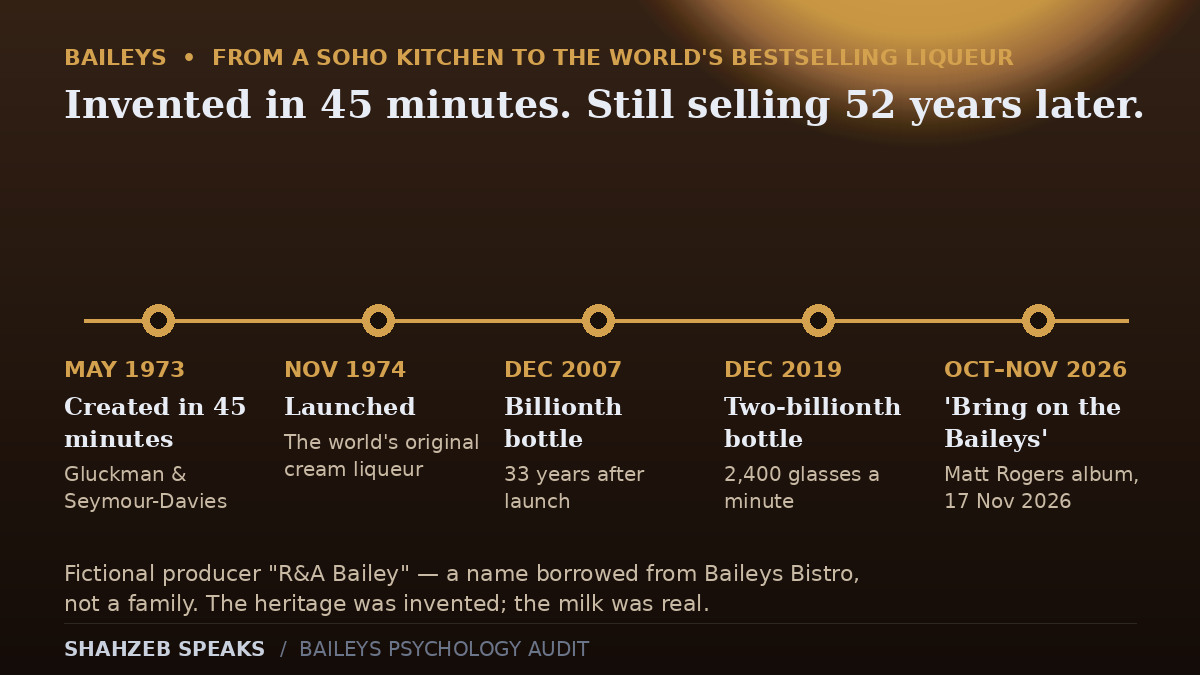
The brand was launched in November 1974, and the launch came with a piece of fiction that was never meant to be true. The bottle has always proclaimed its producer as “R&A Bailey”. There never was a real R.A. Bailey. The name came from Baileys Bistro, a restaurant near the creators’ Soho office, and the “R&A” was inspired by the Royal and Ancient Golf Club. The first label carried a fabricated address, “The Dairy Distillery, County Monaghan”, and the designer, Bob Wagner, was briefed to give the bottle the Kerrygold look — contented cows and green pastures, the visual language of Irish dairy. A drink invented in London by two consultants was dressed, from its first day on a shelf, as the product of a rural Irish dairy that did not exist. The heritage was a design decision, not an inheritance.
The launch itself was uneven. Baileys kicked off in the UK and, in Gluckman’s own account, “perhaps less enthusiastically” in Ireland during 1975 — the 1974 launch was followed by the UK and Ireland rollout the next year. The American distributor, Abe Rosenberg of the Paddington Corporation, reportedly said on tasting it that it would never sell, and then launched it in the United States later that year with the advertising line “The Impossible Cream”. The scepticism did not last. On 3 December 2007, Diageo announced the sale of the billionth bottle of Baileys since its introduction, and the two-billionth bottle was sold in December 2019, 45 years after launch. By then, Diageo was reporting that 2,400 glasses of Baileys were consumed every minute of every day, and that the cream came from 40,000 cows on 1,500 farms, jointly supplying 275 million litres of milk each year. More than 80% of the ingredients and packaging used to make Baileys are sourced from Ireland, and 99% of all Baileys produced is exported. A kitchen experiment had become one of Ireland’s largest food exports.
The scale is worth stating plainly, because it frames everything that follows. Baileys is the world’s bestselling liqueur: 8.4 million nine-litre cases sold in 2024, up 1.7% on the year before, according to Brand Champions data published by The Spirits Business. Diageo’s own release for the 2026 campaign says it is “currently ranked 7th among all distilled spirits sold worldwide”, and sold in 180 markets. Those are the numbers of a brand at the top of its category — and the reason two years of falling sales, taken up in Chapter 11, is a problem worth taking seriously rather than a footnote.
🎬 Chapter 2: “Bring on the Baileys” — the 2026 platform, and the research behind it
The campaign at the centre of this audit is one month old, and it is the biggest Christmas spend Baileys has made in years. “Bring on the Baileys” launched on 20 October 2026 as a new global platform, introduced through two films, “Skater” and “Earrings”, made by AMV BBDO and rolling out across social and digital channels, out-of-home, and radio through the holiday season. MediaPost reports that the platform “represents parent company Diageo’s largest seasonal media investment for the brand this year” — Diageo’s own description, and no spend figure was disclosed, so this audit prints it as a company claim, not as a number. The platform is described as year-round, not a Christmas-only burst, which matters: Baileys is trying to escape the seasonal trap taken up in Chapter 11.
The two films are worth describing, because the psychology of the campaign is in the scenes, not in the tagline. “Skater” is a festive lakeside gathering, in which three ice skaters deliver Baileys in stemmed coupe glasses adorned with pearls and red gems. “Earrings” is set in a busy hair salon, where a woman unscrews miniature Baileys bottles she has been wearing as earrings and pours Baileys over ice for her fellow salon-goers. Both films put the same serve at the centre: Baileys Original Irish Cream over ice, which Diageo calls “the brand’s simple and iconic serve”. The other serves named in the campaign are the Baileys Espresso Martini and the Baileys Gingerbread Martini. Around the films sit limited-time holiday offerings: Baileys Candy Cane packs featuring 50mL bottles, festive bottle bows, and a set pairing Baileys Original with a cocktail glass.
The research behind the platform is the most honest part of it, and it is the reason this audit takes the campaign seriously. Diageo’s consumer research found that adults love making Christmas special, but that the pressure to curate a picture-perfect festive season had turned celebration into hard work. The platform’s answer is a shift in timing: Baileys moves from a reward saved for after the work to an effortless, immediate indulgence, taken in the middle of the preparation rather than at the end of it. Olivia Kupfer, Director of Liqueurs at Diageo, put it this way: “Part treat, part booze, our creamy, smooth liquid over ice delivers the familiar taste fans count on while introducing a new generation of Baileys drinkers to this beloved ritual.” That sentence does two jobs at once: it tells the existing drinker that nothing has changed, and it tells a younger drinker that the ritual is theirs to join. The campaign is trying to do what every 52-year-old brand must do at Christmas: keep the old customer and recruit the new one with the same film.
Three weeks after the platform launched, Baileys extended it in a direction no one would have predicted from the first two films. On 17 November 2026, the brand teamed up with comedian, actor and singer Matt Rogers for “Bring on the Holidays, Bring on the Baileys”, a fictional holiday album giving seasonal favourites “the Baileys treatment” and reviving the classic holiday album commercial. The album’s songs include “Irish Cream, Irish Cream, Baileys All the Way” and “Deck the Halls with Baileys Martinis”. Rogers, who released the holiday LP “Have You Heard of Christmas?” in 2023, said: “I take holiday music very seriously, so naturally I had to make an entire album about Baileys, my go-to drink for the holidays.” His other line from the release sets the tone: “All holiday magic is final, no returns, refunds or exchanges accepted.” The film debuted across social and digital channels on 17 November 2026, and in December Baileys is bringing festive surprises and cocktails to select stops on Rogers’ “This Time It’s Really Christmas” tour. The Rogers film is the third release under “Bring on the Baileys”, and it turns the platform from a pair of films into a world with a joke running through it.
🎟️ Chapter 3: Permission — the treat you take now, not the reward you earn later
The strongest psychology in this campaign is also the simplest: it gives the drinker permission. The direct answer is that “Bring on the Baileys” changes the timing of indulgence — from a reward you earn after the work is done to a treat you take while the work is still going on — and that change in timing is the whole campaign.
The principle is the licensing effect. Khan and Dhar showed in 2006, in the Journal of Marketing Research, that people who have done something virtuous feel licensed to indulge afterwards — a good deed earns a treat, and the treat feels justified because the deed came first. Christmas runs on that logic: the shopping is done, the house is decorated, the turkey is in the oven, and then, at last, you may pour yourself a drink. Baileys has sold that logic for decades — the cream liqueur as the reward at the end of the effort. What the 2026 platform does is move the reward forward. Its research says the pressure to curate a picture-perfect Christmas has turned celebration into hard work, and the campaign answers by saying the treat does not have to wait for the work to finish. The skater pours the Baileys in the middle of the gathering. The woman in the salon pours it in the middle of the working day. The permission is not “you have earned this”. It is “why not now?”
That is a bigger change than it looks, because it changes who the drinker is. A reward-after-work drink belongs to the person who did the work — traditionally, at Christmas, the person who cooked, cleaned and hosted. A treat-now drink belongs to anyone in the room. The salon scene makes the point plainly: the women getting their hair done are not being rewarded for anything. They are being given a moment of pleasure in the middle of an ordinary afternoon, and the Baileys earrings — miniature bottles worn as jewellery, unscrewed and poured — make the giving feel playful rather than indulgent. The campaign is widening the occasion from “after the work” to “during the day”, and the drinker from the host to the guest. That is how a brand grows an occasion without growing a bottle.
There is a limit to the permission, and it is the one the campaign cannot say out loud. Baileys is 17% alcohol, and a treat taken in the middle of the day is a drink taken in the middle of the day. The campaign handles that by keeping the serve small and social — a glass over ice, shared, in company — and by keeping the tone light rather than heavy. It never shows anyone drinking alone, and it never shows anyone drinking a lot. The permission is for a small pleasure, taken with other people, and that restraint is part of why the licensing works: a licence that feels modest is easier to accept than one that feels like an excuse. The audit scores this dimension 88, the highest in the scorecard, because the reframe is clear, it is built on the campaign’s own research, and it is executed in the films rather than only claimed in the press release.
🛠️ Chapter 4: Effort justification — the perfect-Christmas trap the campaign names
The second psychology in the campaign is the one its own research names, and it is the one that makes the platform feel honest. The direct answer is that Christmas has become a project, and the more work people put into the project, the more they need it to feel worth it — and Baileys is selling the feeling that the work was worth it, in a glass.
The principle is effort justification. Aronson and Mills showed in 1959 that people who go through a difficult initiation value the group they join more highly than people who join easily — the effort itself raises the value of the outcome, because the mind does not like to think it worked hard for nothing. Christmas works the same way. The shopping, the cooking, the decorating, the wrapping, the hosting: the more of it a person does, the more the day has to feel special, because otherwise the work was wasted. That is the trap the campaign’s research names — the pressure to curate a picture-perfect festive season turned celebration into hard work — and it is a trap that Baileys knows well, because Baileys has spent decades as the drink at the end of that work, the glass that says the effort paid off.
There is a second principle beside it, and it explains why the trap is so hard to escape. Kruger, Wirtz, Van Boven and Altermatt showed in 2004, in the Journal of Experimental Social Psychology, that people judge a thing’s quality by how much effort they believe went into making it — the effort heuristic. A Christmas that took three days to prepare feels more valuable than one that took an afternoon, even if the two days feel the same on the day. The campaign’s answer is not to tell people to do less. It is to tell them to enjoy more of what they are already doing. “Bring on the Baileys” does not argue against the perfect Christmas. It argues that the perfect Christmas is allowed to be fun, and that the fun can start before the work is finished. The skaters are not working. The salon is not working. The album is not working. The campaign shows people enjoying the season in the middle of it, and the Baileys is the prop that marks the moment as pleasure rather than preparation.
The risk is that the campaign names a problem it cannot solve. The pressure to curate a perfect Christmas does not come from Baileys, and a glass of cream liqueur does not remove it. A viewer exhausted by the preparation may hear “bring on the Baileys” as another instruction — another thing to buy, another thing to serve — rather than as permission to stop. The campaign answers by making the serve simple: Baileys over ice, nothing to mix, nothing to learn, nothing to get right. A drink that needs no preparation cannot add to the preparation, and a brand that sells simplicity at Christmas is selling the one thing the season is short of. The audit counts that as a genuine strength — but it also notes that the relief, taken in a glass, is temporary by design.
🏰 Chapter 5: Invented heritage — the Irish dairy that never existed
The third psychology in this audit is the one that runs underneath the whole brand, and it is the one Baileys would rather you did not notice. The direct answer is that Baileys sells Irish heritage, and the heritage was invented in London, in 1973, by two consultants who had never run a dairy.
The principle has a name, and it comes from history rather than psychology. Hobsbawm and Ranger argued in The Invention of Tradition (1983) that many traditions presented as ancient are in fact recent inventions, created to give a new institution the authority of the past. Baileys is a textbook case. The drink was created in May 1973 in a Soho office kitchen. The bottle it was sold in proclaimed a producer, “R&A Bailey”, who never existed. The label carried a fabricated address, “The Dairy Distillery, County Monaghan”. The designer was briefed to give it the look of contented cows and green pastures — the visual language of Irish dairy, borrowed from Kerrygold. A product invented in London, from a supermarket bottle of Jameson and a tub of single cream, was dressed as the output of a rural Irish dairy with a family name and a county address. It worked so well that half a century later, most drinkers would be surprised to learn any of it.
There is a second principle at work beside the invention, and it explains why the invention stuck. Zajonc showed in 1968 that repeated exposure to a stimulus increases liking, even without conscious recognition — the mere exposure effect. Baileys has been on shelves, in Christmas advertising and in the drinks cabinets of two generations for half a century, always in the same bottle, always with the same pastoral label, always with the same name. The label invented in 1973 has now been seen so often, for so long, that it feels traditional, and the feeling of tradition is real even though the tradition is not. A brand that has been around for fifty-two years does not need a real history. It has become its own history, and the invented label is now the genuine article, because it is the label everyone recognises.
That is not a criticism. Every heritage brand invents part of its story; Baileys invented more of it than most, and did it better than most. The milk is real — 275 million litres a year from 40,000 cows on 1,500 farms, processed in County Cavan — and the whiskey is real, and the production is real, in Dublin and Belfast. What was invented was the framing: the family, the dairy, the county address, the pastoral past. The invention matters because it is the brand’s most valuable asset, and also its most fragile one: a heritage that is invented can be questioned. Baileys has been careful: it does not claim a family recipe, and it does not claim a founding date for R&A Bailey, because there is none to claim. The fiction is in the design, not in the claims, and that restraint is the reason the audit scores this dimension 87 rather than marking it down. The heritage is invented. It is also, by now, true in the only way that matters to a drinker: it is the label they have always known.
👃 Chapter 6: Sensory priming — “Let your senses guide you”, and the growth it bought
The fourth psychology in this audit is the one Baileys used to grow from a Christmas drink into a year-round one, and it is worth remembering now, because the 2026 platform is trying to do the same thing again. The direct answer is that Baileys sells a sensation — cream, cold, sweetness, the weight of the glass — and it has always sold the sensation before the drink.
The principle is sensory priming. Krishna argued in a 2012 review in the Journal of Consumer Psychology that engaging the senses shapes perception, judgement and behaviour — that what a product feels, smells and sounds like changes how people judge it, often before they have tasted it. Baileys understood that earlier than most drinks brands. In the early 2000s, the agency JWT repositioned Baileys with the line “Let your senses guide you”, moving it from a drink for intimate occasions to a main drink enjoyed with friends. The repositioning worked, and the numbers are on record: the campaign led to growth of 7.9% in 2003 and 6.8% in 2004, outstripping the growth of the liqueur market and dominating its rival Kahlúa, and the Canadian campaign that started it was adopted globally. Diageo’s own preliminary results for the year ended 30 June 2002 record “continued investment behind the successful ‘Let Your Senses Guide You’ campaign for Baileys”.
The 2026 campaign is built on the same sense, with new pictures. The skaters carry the Baileys in stemmed coupe glasses, the rims dressed with pearls and red gems — the glass is part of the sensation. The salon scene is built around the miniature bottles worn as earrings: the drink is jewellery before it is a drink, something to be seen and touched before it is poured. The campaign’s own language keeps returning to the same words — “creamy, smooth liquid”, “the familiar taste” — and the serve it puts at the centre, Baileys over ice, is the serve that makes the sensation most obvious: cold, thick, sweet, slow. A cream liqueur over ice is a drink you cannot rush, and a drink you cannot rush is a drink that makes you stop for a moment. That is the sensory trick, and the reason the serve has survived fifty-two years of changing fashion.
🥃 Chapter 7: Ritual — Baileys over ice, and the serve that never changes
The fifth psychology in this audit is the ritual, and it is the one that makes Baileys hard to copy. The direct answer is that Baileys owns a serve — the cream liqueur over ice, in a glass, at Christmas — and it has owned that serve for so long that the serve now sells the brand.
The principle is ritual. Vohs, Wang, Gino and Norton showed in 2013, in Psychological Science, that rituals enhance consumption: people who performed a small ritual before eating or drinking — stirring, unwrapping, waiting — enjoyed the food or drink more, valued it more highly, and were willing to pay more for it, than people who consumed it without the ritual. The ritual did not change the product. It changed the experience of the product, and the experience is what people remember. Baileys over ice is a ritual in exactly that sense. It is a small, repeatable sequence: the bottle from the fridge, the ice in the glass, the slow pour, the first sip. It takes a minute. It is the same every time. And because it is the same every time, it is the thing that marks the moment — the end of the day, the start of the evening, the glass at Christmas — as different from the rest of the day.
The 2026 campaign is built around that ritual, deliberately. Both films put the same serve at the centre, and Diageo calls it “the brand’s simple and iconic serve”. The skaters deliver it. The salon-goers receive it. The Matt Rogers album is, in its own way, a ritual too: the holiday album, the songs everyone knows, given “the Baileys treatment”. The campaign’s other serves — the Baileys Espresso Martini and the Baileys Gingerbread Martini — are variations on the same ritual, not replacements for it. They give the ritual a cocktail form for drinkers who want something more elaborate, and they give the brand a way to be present in bars as well as in living rooms. But the core is the glass over ice, and the core has not changed since the early 1990s, when Baileys was already pushing large measures over ice and a Häagen-Dazs ice-cream tie-up. A ritual that has lasted thirty years is not a fashion. It is a habit, and a habit is the most valuable thing a drinks brand can own.
There is a risk in a ritual. One that never changes can start to feel old, and a brand that owns one ritual can find itself trapped by it. Baileys has felt that trap: the drink is so associated with Christmas, and with the glass over ice, that it struggles to be chosen at other times of year. The 2026 platform is described as year-round, and its language — “a bolder, cheekier energy”, “introducing a new generation of Baileys drinkers to this beloved ritual” — is the language of a brand trying to widen a ritual without breaking it. The audit counts the ritual as a strength, because it is real, owned, and proven by the research. It also counts the dependence: a brand with one ritual is a brand with one occasion, and the occasion is Christmas.
🤝 Chapter 8: Social proof and belonging — the drag queens, the book bar and the treat bar
The sixth psychology in this audit is belonging, and it is the one Baileys has used most creatively in the last decade. The direct answer is that Baileys does not sell a drink for drinking alone. It sells a drink for being with people, and it has spent years building the places and the moments where that happens.
The principle is social proof. Cialdini, in Influence (2001), described social proof as one of the most reliable persuasion tools there is: people look to what others are doing to decide what to do themselves, and a behaviour that is visibly shared feels safe, normal and desirable. Baileys has applied that principle in three different forms, each reaching a different audience. The first is the “Witches” Halloween campaign of 2021, which featured the UK drag queens Tia Kofi, Veronica Green and Asia Thorne, ran live in more than ten countries, and in Great Britain was recognised as The Grocer’s Top Spirits Campaign of 2021. It was developed with Diageo’s LGBTQ+ employee group, the Rainbow Network. The second is the Baileys Book Bar, a pop-up with the Women’s Prize for Fiction at Waterstones Tottenham Court Road in London, which ran for four days from 30 April 2019, after sell-out pop-ups over the previous three years, and was strictly for over-18s. The third is the Baileys Treat Bar, which first appeared in London in 2017 as the Covent Garden “Treat Stop”, returned in December 2018, ran at Skate at Somerset House from 13 November 2019 to 12 January 2020, and was taken to Canadian shopping malls in December 2019, serving customisable hot chocolates, lattes and cocktails.
There is a second principle beside social proof, and it explains why these three very different activities belong to the same brand. Tajfel and Turner argued in 1979 that people derive part of their identity from the groups they belong to, and that they favour the groups they identify with. The “Witches” campaign, the Book Bar and the Treat Bar are all group invitations: join the drag queens, join the readers, join the people queuing for a hot chocolate at Somerset House. Each one says the same thing in a different register — Baileys is for people like you, in a place like this, with people like these — and each one makes the drink a badge of belonging rather than a bottle on a shelf. The Book Bar is the clearest example: a drinks brand sponsoring a literary prize, in a bookshop, for readers, is not selling alcohol. It is selling membership of a group that reads, and the drink is the price of admission.
The limit is the one that applies to every belonging strategy. A brand that invites everyone can end up belonging to no one, and a brand that invites specific groups can be accused of using them. Baileys has been careful: the “Witches” campaign was developed with its own LGBTQ+ employee group, and the Book Bar was a partnership with a real literary prize, not a borrowed logo. The audit counts that care in the brand’s favour, and scores social proof and belonging at 84. But it also notes the gap: the belonging in the 2026 films is narrower than the belonging in the brand’s history. The skaters and the salon are both scenes of women together at Christmas, and the Rogers album is a joke for people who already know what a holiday album is. The campaign is warm, but warm for a particular audience, and the brand’s wider invitations do not appear in it. That is a choice, and probably the right one for a Christmas campaign. It is also a narrowing, and the audit records it.
✨ Chapter 9: Novelty and variety-seeking — the flavour pipeline, from Salted Caramel to Dubai Chocolate
The seventh psychology in this audit is novelty, and it is the one that keeps a 52-year-old brand from tasting old. The direct answer is that Baileys stays new by changing the flavour, not the drink — and it has been doing that for years, most recently with a flavour made for one city.
The principle is variety-seeking. McAlister and Pessemier argued in 1982, in the Journal of Consumer Research, that people seek variety in their consumption not because they are dissatisfied with what they have, but because the change itself is rewarding — a new flavour, a new version, a new experience breaks the routine and makes the familiar feel fresh again. Baileys has built its portfolio on that principle. The current range, listed in Diageo’s own release for the 2026 campaign, is Original Irish Cream, Chocolate, Salted Caramel, Espresso Crème, Strawberries & Cream, Coffee Toffee Non-Dairy Made with Oat Milk, and Cookies & Creamy Non-Dairy Made with Oat Milk, with the core variants priced at $24.99 in the United States. Alongside them sits Baileys Deliciously Light, described by the brand as “the same wonderfully creamy taste you love, now with fewer calories”, made with 40% less sugar and 40% fewer calories than Baileys Original, and launched with Neil Patrick Harris. Each new flavour is a reason to buy the same brand again, and a reason to talk about it again: a new flavour is a news story, and a news story is free advertising. The confectionery follows the same logic: Baileys Chocolate, made by Lir Chocolates in Navan, launched new Tiramisu Truffles for Christmas 2026, announced on 19 November 2026.
The most recent flavour is also the most revealing. Baileys Dubai Chocolate launched on 24 October 2026, exclusively at African + Eastern stores in Dubai, with a launch at Dubai Mall, at Dhs99, as a limited edition — the first Baileys flavour created specifically for the United Arab Emirates market. A flavour made for one city, sold in one retail chain, at a stated price, for a limited time: that is variety-seeking and scarcity in the same bottle, and a sign of a brand learning to be local as well as global. The same logic sits behind the non-alcoholic Baileys Coffee Creamers, sold in the United States by H.P. Hood, which added three flavours in May 2013 — mudslide, vanilla brown sugar and white chocolate raspberry swirl — alongside the existing toffee almond cream, crème brûlée, brown butter pecan and Irish cream. The creamers take the Baileys flavour into the morning, into the coffee, into a place where alcohol cannot go, and they do it under the same name.
There is a limit. Variety-seeking works when the new flavour varies something people already love, and it fails when the variations pile up faster than the drinker can follow them — seven flavours, a light version, the creamers, the Dubai Chocolate limited edition and the confectionery. The audit scores novelty at 83, because the pipeline is real and recent. It also notes that a new flavour is a short-term answer to the long-term question in Chapter 11: a famous brand that people do not always choose.
🎄 Chapter 10: Nostalgia — the fake Christmas album, and why it works
The eighth psychology in this audit is nostalgia, and it is the one the Matt Rogers extension is built on. The direct answer is that the fake holiday album works because it is not really about Baileys. It is about the Christmas albums people already remember, and Baileys has simply put its name on the memory.
The principle is nostalgia, and the research behind it is precise. Wildschut, Sedikides, Arndt and Routledge, writing in 2006 in the Journal of Personality and Social Psychology, ran seven studies on nostalgia and found that nostalgic narratives typically feature the self with close others — family and friends — or in momentous events; that nostalgia is triggered by negative mood and loneliness; and that it bolsters social bonds, increases positive self-regard and generates positive affect. Nostalgia, in other words, is not only a warm feeling. It is a social feeling. It makes people feel closer to the people they love, and better about themselves. The Rogers album runs on exactly that mechanism. It revives the classic holiday album commercial — the format in which a singer, in a studio, in a jumper, tells you that this record will make your Christmas — and it gives the songs Baileys titles: “Irish Cream, Irish Cream, Baileys All the Way” and “Deck the Halls with Baileys Martinis”. The joke is that the album is fake. The feeling is that the Christmas it describes is real, and it is a Christmas the viewer has already lived.
There is a second principle at work in the same film, and it explains why the joke lands rather than falls flat. McGraw and Warren argued in 2010, in Psychological Science, that humour arises when something is both wrong and harmless at the same time — a benign violation. A fictional album about a cream liqueur is wrong: albums are not about liqueurs, and a comedian is not a crooner. It is also harmless: nobody is mocked, nothing is at stake, and the line “All holiday magic is final, no returns, refunds or exchanges accepted” is a joke about the small print of Christmas, not about anyone in particular. The film lets the violation run — the songs, the studio, the earnest delivery — and the audience laughs because the format is familiar and the content is absurd. The humour is gentle, and the gentleness is the point: a Christmas campaign that mocked its own audience would fail, and this one does not.
There is a limit to the nostalgia. It works when the memory is shared, and it fails when it is not: a viewer who has never seen a holiday album commercial will not recognise the format being parodied, and a viewer outside the United States and Britain may not know Matt Rogers at all. The album is, by design, a joke for people who already like Baileys. That is the right choice for a third release under a platform that has already introduced itself twice — and it is also a narrowing. The score for nostalgia and invented heritage is 87, the second-highest in this audit, because the mechanism is real, the research supports it, and the execution is confident. The limit is the reach, and the reach is narrower than the brand.
📉 Chapter 11: The familiarity–consideration gap — famous, but not always chosen
This is the chapter the rest of the audit has been building towards, and it is the one that explains the score. The direct answer is that Baileys is one of the most famous drinks brands in the world, and a large number of the people who know it do not buy it — and that gap, between knowing and choosing, is the brand’s central problem.
The numbers come from Brand Finance, published on 18 March 2026, and they are unusually clear. Baileys is the strongest Irish brand among consumers in the United States: 86% of American consumers are familiar with it, but only 53% say they would consider it. Thirty-three points separate knowing and considering, and that is a large gap for a brand of this size. Brand value tells the same story in a different form: $1.1 billion in 2026, down 16% on the previous year, making Baileys the ninth most valuable Irish brand, with the decline attributed partly to softening global demand for spirits. Fame is not the problem. Choice is.
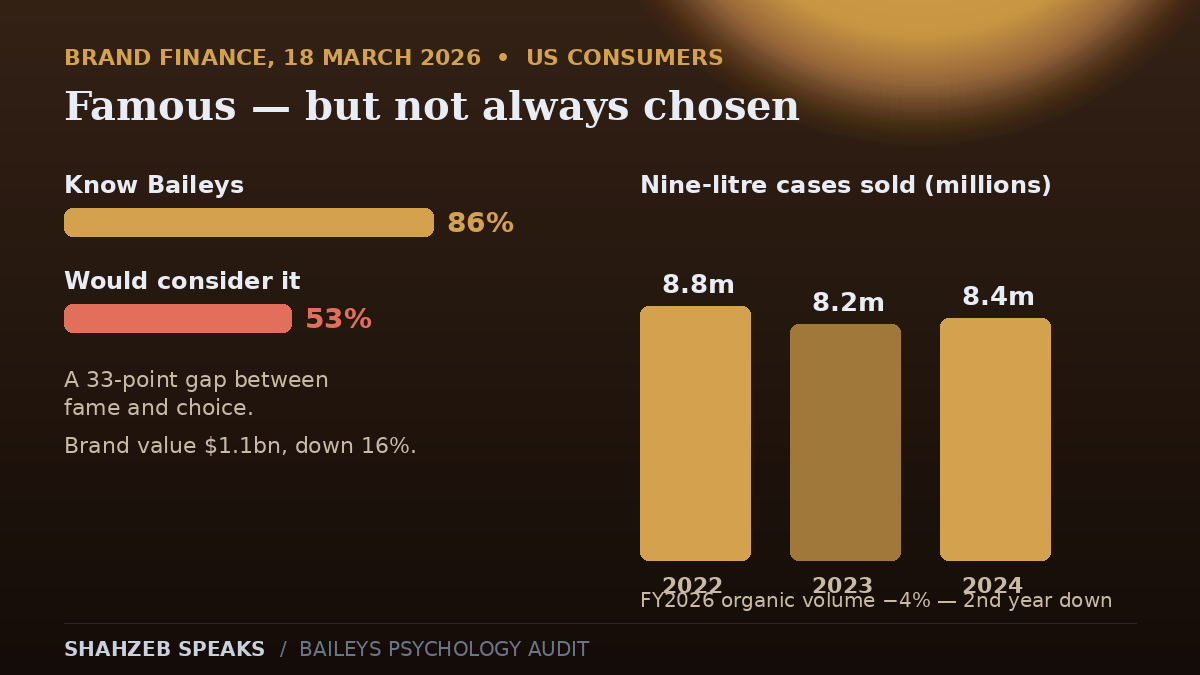
The sales figures behind the gap are on record, and they are worth stating plainly, because they are the reason this audit marks the brand down. In Diageo’s fiscal year 2026, the year ended 30 June 2026, Baileys’ organic volume fell 4%, organic net sales fell 4%, and reported net sales fell 1%. In fiscal year 2025, the year ended 30 June 2025, organic volume fell 1%, organic net sales fell 4%, and reported net sales fell 3%. Two years of decline, in volume and in sales, for the world’s bestselling liqueur. The volume data published by The Spirits Business tells the same story in cases: 8.8 million nine-litre cases in 2022, 8.2 million in 2023, and 8.4 million in 2024 — a recovery in 2024, up 1.7%, but still below the 2022 level. In the United States, volume in 2025 was 1.27 million nine-litre case depletions, down 10.8%, according to NielsenIQ and IMPACT Databank figures reported by Shanken News Daily in August 2026. Diageo does not publish an absolute net-sales figure for Baileys — it reports only growth rates for the brand, not a standalone sales number — so this audit prints no Baileys revenue figure, and none should be inferred from the percentages here.
The principle behind the gap is the oldest one in this audit. Zajonc showed in 1968 that repeated exposure increases liking, and Baileys has had fifty-two years of exposure. But exposure creates familiarity, not preference, and familiarity without preference is a brand that people recognise and pass by. The 2026 campaign is a direct answer to the gap: the permission in Chapter 3, the ritual in Chapter 7 and the novelty in Chapter 9 are all ways of turning a familiar brand into a chosen one, by giving the drinker a new reason to pick it up. The question is whether a new reason is enough, when the old reason — Christmas, the glass over ice, the treat at the end of the day — is the one that made the brand famous in the first place.
There is one more figure that belongs in this chapter, because it explains why the gap is so hard to close. Baileys is, by the brand’s own history, a Christmas drink. The only seasonal share found in the sources read for this audit is a dated one, and it must be attributed exactly: 66% of total annual sales in the UK off-trade were made in October to December, according to Nielsen Scantrack figures reported around 2015. That is a UK off-trade figure from about 2015, not a current global figure, and no current global Christmas share could be verified. But even as a dated figure it explains the shape of the problem: a brand that sells two-thirds of its British supermarket volume in three months spends nine months being famous and three months being bought. The 2026 platform is described as year-round, and that description is the brand’s answer to the figure. The audit scores this dimension at 74, the second-lowest in the scorecard, because the gap is large, the sales have fallen for two years, and the brand value has fallen 16% — and because a campaign, however clever, is not yet evidence that the gap is closing.
⚠️ Chapter 12: The dark side — the complaints that were not upheld, the breach that was not Diageo’s, and the group matters that are not Baileys’
Every audit on this site carries a dark-side chapter, and this one is quieter than most. The direct answer is that no complaint against a Baileys advertisement has been upheld in the cases found, and no Baileys-specific enforcement action was found in the searches run for 2024 to 2026 — but the record is not empty, and it is not a proven clean record either. This chapter states what was found, at its exact status, as of 20 November 2026.
The first item is the oldest complaint found, and it was not upheld. In 2014, the UK Advertising Standards Authority considered complaints that Baileys’ Nutcracker-themed Christmas advertisements promoted alcohol through violent and aggressive behaviour — a woman kicking and slapping a man in a retelling of the Nutcracker ballet. The ASA ruled that the advertisements were a “fictional and stylised retelling” of the ballet and were “not in breach of the Code”. The complaint was NOT UPHELD, and the ruling was reported on 29 January 2014.
The second item is similar, and it was also not upheld. On 28 January 2016, the Portman Group’s Independent Complaints Panel considered a complaint by Alcohol Concern that a Baileys countertop unit, and the press release that accompanied it, encouraged irresponsible or immoderate consumption under paragraph 3.2(f) of the Portman Group Code. The complaint was NOT UPHELD. The panel’s decision is published on the Portman Group’s website, and the audit prints it as such.
The third item is the only breach found, and it is important to state exactly who it was against. In 2007, an Asda gift pack called “Chocolate & Cream”, containing a mug, hot chocolate, a cuddly toy and a miniature bottle of Baileys, was found IN BREACH of the Portman Group Code after a complaint from a member of the public, and Asda removed it from shelves — 30,000 had been sold over Christmas. The breach was against Asda and The Gift Company, the third party that made the pack, not against Diageo. Diageo said it was “disappointed one of its products had been used in this way” and that it had “limited control over the sale of [its] miniatures once they have been sold to an unlicensed third party”. That distinction matters: a Baileys product was in a pack that breached the code, and the company that breached it was not Baileys’ owner. The lesson is practical — a miniature sold to a third party can end up in a product the brand never approved — and the audit counts it as a real, if limited, mark against the brand’s control of its own product.
The fourth and fifth items come from Australia, and both were dismissed. The Advertising Standards Board dismissed a complaint about a Baileys television advertisement on 8 February 2000 (case 428/99), which had alleged a breach of the code on sex, sexuality and nudity. It dismissed a second complaint on 12 August 2003 (case 232/03), which alleged that Baileys Minis television advertisements discriminated on gender. That is the whole of the Baileys-specific regulatory record found in the searches run for this audit: two complaints not upheld in Britain, one breach by a third party, and two complaints dismissed in Australia.
The sixth item is an absence, and it must be stated with the same care as the findings. No Baileys-specific enforcement action, fine or upheld ruling was found in the searches run for 2024, 2025 or 2026 — no ASA ruling upholding a complaint against a Baileys advertisement, no US Federal Trade Commission or Alcohol and Tobacco Tax and Trade Bureau action, and no European Union alcohol-advertising action. That is a statement about the searches run, not a certified clean record, and this audit does not claim more than it found.
Finally, three group matters that must be labelled clearly, because they are not Baileys matters. In October 2025, the COMESA Competition Commission announced that Diageo had agreed to pay a $750,000 settlement after a four-year investigation, begun in June 2021, into alleged market allocation and resale price maintenance in its African distribution agreements, with commitments made “on a non-admission liability basis”. In 2025 and 2026, the Ontario Superior Court of Justice ruled that members of Spirits Canada — including Diageo, Campari and Bacardi — must refund the Liquor Control Board of Ontario more than $35 million Canadian dollars after breaching a most-favoured-customer pricing clause; Diageo was one member of the trade body, not the sole defendant. In 2024, Moët Hennessy Diageo, a Diageo and LVMH joint venture, was fined €15,000 in France under the Loi Évin over Dom Pérignon celebrity promotion with Lady Gaga. And in 2011, the US Securities and Exchange Commission charged Diageo with Foreign Corrupt Practices Act violations, which Diageo settled. This audit records them because a reader who searches for Diageo’s legal record will find them, and should know they are not Baileys’ record. The trust and legal record dimension is scored 70, the lowest in this audit: not because Baileys has been found against, but because the 2007 breach shows the brand’s control of its miniatures has limits, and because the absence of recent action is a finding about searches rather than a proven record.
🇵🇰 Chapter 13: What Pakistani brands should — and shouldn’t — copy
Pakistani brands should copy the permission. The best idea in “Bring on the Baileys” is not the skaters or the earrings or the fake album. It is the shift in timing: the treat does not have to wait for the work to finish. A Pakistani brand that sells at Eid, at a wedding, or at a family gathering should build its advertising the same way — around the pleasure in the middle of the preparation, not only the reward at the end of it. Show the sweet being eaten while the cooking is still going on. Show the new clothes being tried on before the guests arrive. Show the moment of enjoyment that happens during the effort, not after it. The licensing effect is not a trick. It is a fact about how people justify pleasure to themselves, and a brand that gives permission at the right moment will be remembered more warmly than one that only promises a reward later.
Pakistani brands should copy the ritual. Baileys owns a serve — the cream liqueur over ice — and the serve is the same every time, in every country, in every year. A Pakistani brand that has a ritual — the way its tea is poured, the way its sweet is served, the way its product is opened — should protect it and repeat it until it becomes the brand. Do not change the serve every season. A ritual that is repeated becomes a habit, and a habit is the most valuable thing a brand can own, because it is the thing the customer does without thinking. Baileys has owned its ritual for thirty years. A Pakistani brand that owns one for ten will have an advantage its competitors cannot copy, because a ritual cannot be bought. It has to be lived.
Pakistani brands should copy the honesty about the gap. Baileys is famous, and it is honest — through Brand Finance, through Diageo’s own reporting — about the fact that fame is not the same as choice. A Pakistani brand that is well known should measure the same gap: how many people know the name, and how many would actually buy it. The answer is often uncomfortable, and it is the most useful number a brand can have, because it tells the brand whether it needs more advertising or a better reason to be chosen. Baileys is spending its largest seasonal media investment on giving people a reason. A Pakistani brand that knows its own gap should do the same, and spend on the reason rather than on the reminder.
And Pakistani brands should not copy the invented heritage. Baileys invented a dairy, a family and a county address, and it got away with it because it did it in 1973, when no one could check, and because the product was good enough to carry the story. A Pakistani brand that invents a heritage today will be checked, and it will be caught, and the catching will cost more than the heritage was worth. Pakistan has real heritage — real recipes, real crafts, real places, real families — and a brand that tells the true story of a real thing will always be stronger than one that invents a story about a thing that never existed. Baileys’ fiction worked because the milk was real. A Pakistani brand should start with the milk, and let the story follow it.
📊 Psychology Scorecard — the Baileys Bring on the Baileys audit verdict
The scorecard below scores the campaign’s psychology and the brand behind it, not its outcome. No effectiveness data exists yet for the 2026 campaign, and none is claimed. The eight dimensions are scored out of 100, and the overall score is their rounded average.
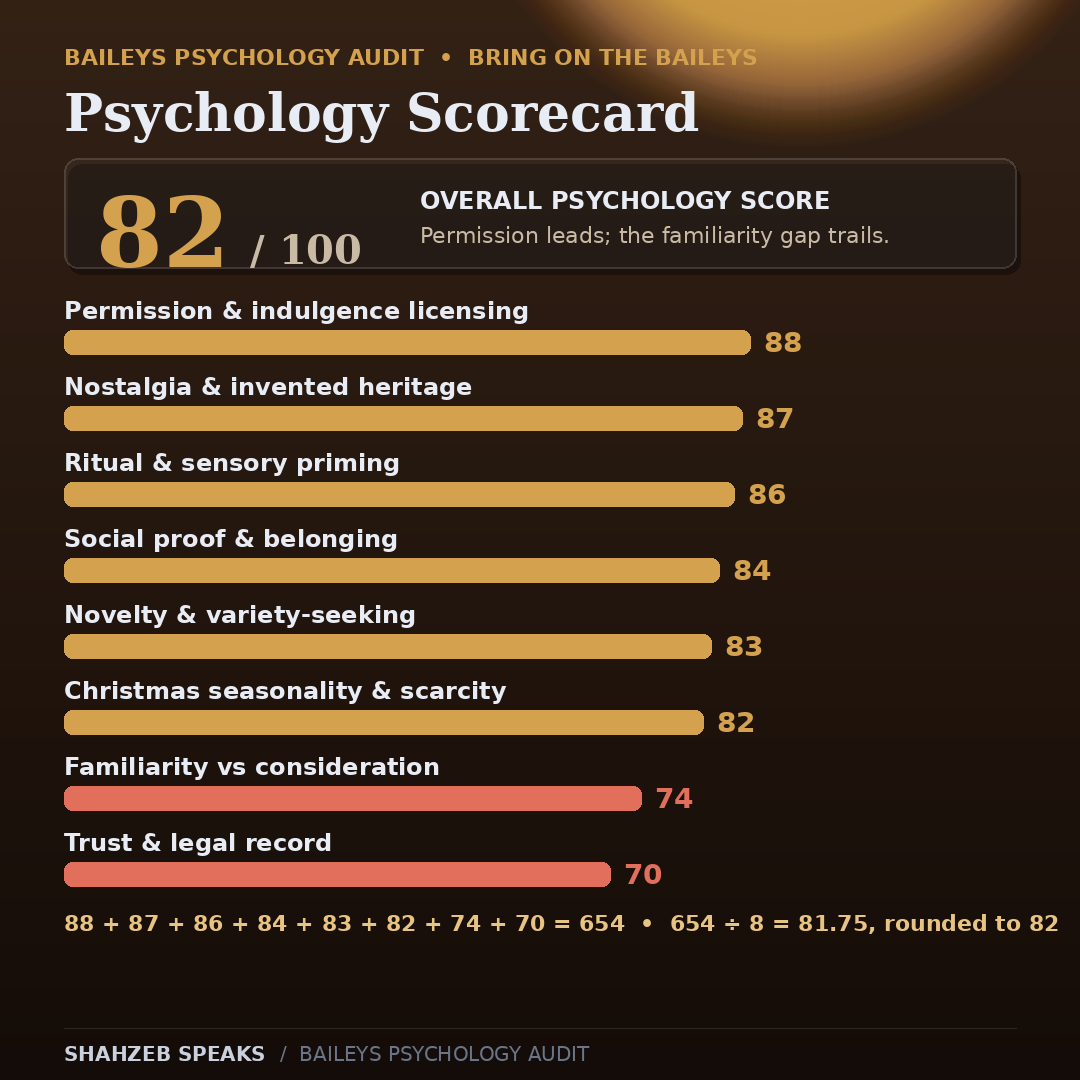
| Dimension | Score | Verdict |
|---|---|---|
| Permission & indulgence licensing | 88 | The treat moves from after the work to during it — the campaign’s clearest idea, built on its own research |
| Nostalgia & invented heritage | 87 | A fake album and a fictional dairy, both executed with confidence — the heritage is invented, and it works |
| Ritual & sensory priming | 86 | Baileys over ice, unchanged for thirty years, with 7.9% growth in 2003 to prove the senses sell |
| Social proof & belonging | 84 | Drag queens, a book bar and treat bars — belonging built in three registers, though the 2026 films narrow it |
| Novelty & variety-seeking | 83 | Seven flavours, a Dubai Chocolate made for one city, and a fake album — a 52-year-old brand still inventing |
| Christmas seasonality & scarcity | 82 | Candy Cane packs and a December tour create real urgency, but the Christmas dependence is the problem, not the answer |
| Familiarity vs consideration | 74 | 86% of Americans know Baileys, only 53% would consider it; brand value down 16%, volume down 4% in FY2026 |
| Trust & legal record | 70 | No complaint against Baileys upheld, but the 2007 third-party breach and the group matters behind the name count |
| Overall | 82/100 | 88 + 87 + 86 + 84 + 83 + 82 + 74 + 70 = 654; 654 ÷ 8 = 81.75, rounded to 82 |
🧠 Psychology Techniques Identified
- Permission / indulgence licensing (Khan & Dhar 2006; the treat moves from a reward after the work to a pleasure taken during it)
- Effort justification (Aronson & Mills 1959; the picture-perfect Christmas trap — the harder the preparation, the more the day must feel worth it)
- Invented heritage / invented tradition (Hobsbawm & Ranger 1983; the fictional R&A Bailey, the fabricated Dairy Distillery address, the pastoral label)
- Sensory priming (Krishna 2012; “Let your senses guide you” and the coupe glasses, pearls and gems of the 2026 films)
- Ritual (Vohs et al. 2013; Baileys over ice as the simple and iconic serve, repeated the same way every time)
- Social proof & belonging (Cialdini 2001; Tajfel & Turner 1979; the ‘Witches’ campaign, the Book Bar and the Treat Bars as group invitations)
- Novelty / variety-seeking (McAlister & Pessemier 1982; seven flavours, Dubai Chocolate for one city, the fake album)
- Nostalgia (Wildschut et al. 2006; the Matt Rogers holiday album parody, reviving the classic Christmas album commercial)
- Scarcity & seasonal urgency (Cialdini 2001; limited-time Candy Cane packs, the December tour activations, a Christmas peak)
- Mere exposure (Zajonc 1968; fifty-two years of the same bottle and the same label, until the invented heritage feels traditional)
- Benign violation humour (McGraw & Warren 2010; the fake album is wrong and harmless at the same time — a comedian as a crooner)
- Loss aversion (Kahneman & Tversky 1979; the limited editions are framed by what the buyer might miss, and the loss weighs more than the gain)
✅ Balance sheet & prescription
What works: the permission, which is the campaign’s clearest idea and is built on the brand’s own research into the perfect-Christmas trap; the nostalgia, which runs on two channels at once — the fake album and the invented heritage — and is executed with confidence; the ritual, which has not changed in thirty years and does not need to; the sensory claim, which has a growth figure behind it from 2003 and 2004; the belonging, from the drag queens to the book bar to the treat bars; and the novelty pipeline, which is still producing new flavours and new jokes fifty-three years after the brand was invented in a kitchen.
What does not: the familiarity–consideration gap, where 86% of Americans know Baileys and only 53% would consider it, with brand value down 16% and volume down 4% in fiscal year 2026; the Christmas dependence, which the year-round platform is trying to escape but has not yet escaped; the narrowing of the belonging in the 2026 films, which are warm for a particular audience and less warm for the wider one the brand has courted; and the absence of any effectiveness data for the 2026 campaign, which means this score is a judgement of psychology and craft, not of outcome.
The prescription: keep the permission, and keep it in the middle of the day rather than at the end of it — it is the campaign’s best idea, and it is the one that widens the occasion. Measure the gap every year, and publish the number: a brand that is honest about the distance between knowing and choosing will be trusted when it says the distance is closing. Build one occasion outside Christmas that belongs to Baileys as firmly as Christmas does, so that the year-round platform is a fact and not only a description. And keep the miniatures under control: the 2007 breach was a third party’s, but it was Baileys’ bottle in the pack, and a brand that cannot control where its smallest bottle ends up cannot control its own story.
📝 Final Verdict
“Bring on the Baileys” is a clever campaign for a brand with a real problem. Baileys understood that the most valuable thing it owned this Christmas was not a new concept but a new timing — the treat taken now, in the middle of the preparation, rather than the reward saved for the end of it — and it spent its largest seasonal media investment on saying that clearly, in two films and a fake album, with a ritual that has not changed in thirty years behind them. The permission is genuine, the nostalgia is earned, the ritual is owned, and the joke about the album is the kind of joke people repeat. The campaign’s weakness is that it is selling a reason to choose a brand that people already know and do not always choose, and the audit’s score reflects both halves of that judgement: the psychology is strong, and the sales are falling. It is a very good Christmas platform. It is not yet proof that the gap is closing — and the difference between the two is a year of sales figures that do not exist yet.
Psychology Score: 82/100 — a treat taken now, a heritage invented in 1973, and a brand famous enough to be recognised and not always chosen. The permission is real; the gap is real too.
— Brand Psychology Analysis, ShahzebSpeaks
🔑 Key Findings
- The permission is the campaign’s strongest psychology: “Bring on the Baileys” moves indulgence from a reward earned after the work to a treat taken during it, built on Diageo’s own research that the pressure to curate a picture-perfect Christmas had turned celebration into hard work. Permission and indulgence licensing score 88/100.
- Nostalgia and invented heritage are the second-strongest dimension at 87/100: the Matt Rogers fictional holiday album parodies the classic Christmas album commercial, while the brand itself was invented in 45 minutes in May 1973 and sold from its first day with a fictional producer, “R&A Bailey”, and a fabricated “Dairy Distillery, County Monaghan” address.
- The ritual is real and owned: Baileys over ice is the brand’s simple and iconic serve, at the centre of both 2026 films, and the sensory claim behind it has a growth figure — “Let your senses guide you” led to growth of 7.9% in 2003 and 6.8% in 2004. Ritual and sensory priming score 86/100.
- The familiarity–consideration gap is the audit’s central tension: Brand Finance (18 March 2026) found 86% of US consumers familiar with Baileys but only 53% would consider it, with brand value of $1.1 billion, down 16%. Diageo reported Baileys organic volume down 4% and organic net sales down 4% in fiscal year 2026, the second consecutive year of decline.
- Legal record: the ASA (UK) complaint about the 2014 Nutcracker Christmas advertisements was NOT UPHELD, and the Portman Group complaint about the 2016 countertop unit was NOT UPHELD. The only breach found was the 2007 Asda gift pack, found IN BREACH against Asda and The Gift Company, not against Diageo. Australian complaints were DISMISSED in 2000 and 2003. No Baileys-specific enforcement action, fine or upheld ruling was found in the searches run for 2024–2026 — a statement about the searches run, not a proven clean record.
- No effectiveness data exists for the 2026 campaign: no System1 score, no viewer count and no sales figure has been verified as of 20 November 2026, so 82/100 is a judgement of psychology and craft, not of outcome. No absolute Baileys net-sales figure is published by Diageo, and none is printed in this audit.
❓ Questions I am asked most often
What is Baileys’ “Bring on the Baileys” campaign about?
It is Baileys’ new global platform, launched 20 October 2026, built on research that the pressure to curate a picture-perfect Christmas had turned celebration into hard work. It reframes indulgence from a reward saved for after the work to an effortless, immediate treat — Baileys over ice, taken now. The films “Skater” and “Earrings” were made by AMV BBDO.
How good is the campaign, psychologically?
Our audit scores it 82/100. It is strongest on permission and indulgence licensing (88) and nostalgia and invented heritage (87), and weakest on trust and the legal record (70) and the familiarity-versus-consideration gap (74), where 86% of Americans know Baileys but only 53% would consider it.
When was Baileys invented, and who invented it?
Baileys was created in May 1973 by David Gluckman and Hugh Seymour-Davies, hired by Tom Jago of International Distillers & Vintners, who mixed Jameson whiskey and single cream in an office kitchen in about 45 minutes for a £3,000 fee. It was first launched in November 1974. The producer named on the bottle, “R&A Bailey”, never existed.
Is Baileys really the world’s bestselling liqueur?
Yes, by volume. Brand Champions data published by The Spirits Business records 8.4 million nine-litre cases sold in 2024, up 1.7%, with 8.2 million in 2023 and 8.8 million in 2022. Diageo’s own release says Baileys is ranked 7th among all distilled spirits sold worldwide and is sold in 180 markets.
Has Baileys ever been found in breach of advertising rules?
No complaint against a Baileys advertisement has been upheld in the cases found. The ASA complaint about the 2014 Nutcracker advertisements was NOT UPHELD, and the Portman Group complaint about the 2016 countertop unit was NOT UPHELD. The only breach found was a 2007 Asda gift pack, found IN BREACH against Asda and The Gift Company, not Diageo. No Baileys-specific action was found in the searches run for 2024–2026.
Why are Baileys sales falling if the brand is so famous?
That is the audit’s central question. Diageo reported Baileys organic volume down 4% and organic net sales down 4% in fiscal year 2026, after falls in fiscal year 2025, and Brand Finance found brand value down 16% to $1.1 billion. Fame is not the problem — 86% of Americans know Baileys. Choice is: only 53% would consider it. The 2026 campaign is built to close that gap.
If your brand is famous and not always chosen — known by almost everyone, picked by barely half — the problem is not awareness. It is the reason to choose. I help organisations build evidence-based brand strategy — get in touch here.
If this audit helped, you may also like Marks & Spencer — The Home of Christmas, Waitrose — The Perfect Gift 2, and Barbour — Warm Wishes. For the wider field, the homepage of this site covers industrial psychology in Pakistan and beyond.
📚 References & Sources
- Baileys / Diageo, “Bring on the Baileys” (Multivu, 20 October 2026): campaign launch, films “Skater” and “Earrings”, AMV BBDO, consumer research on the picture-perfect Christmas: https://www.multivu.com/baileys/9427651-en-bring-on-the-baileys-original-irish-cream-campaign-holiday-indulgence
- MediaPost, “Baileys Debuts ‘Bring on the Baileys’ Holiday Platform” (2026): Diageo’s largest seasonal media investment for the brand this year: https://www.mediapost.com/publications/article/419045/baileys-debuts-bring-on-the-baileys-holiday-plat.html
- Baileys / Diageo, “Baileys and Matt Rogers Hit All the Right Festive Notes” (PR Newswire, 17 November 2026, 14:30 UTC): fictional holiday album, songs and Rogers quotes: https://www.prnewswire.com/news-releases/baileys-and-matt-rogers-hit-all-the-right-festive-notes-this-holiday-season-with-bring-on-the-holidays-bring-on-the-baileys-302942269.html
- Difford’s Guide, “Baileys Original Irish Cream Liqueur” (launched November 1974; 275 million litres of milk a year; 40,000 cows; 1,500 farms; 17% ABV; protein process from the ice-cream industry; fictional R&A Bailey): https://www.diffordsguide.com/beer-wine-spirits/526/baileys-original-irish-cream-liqueur
- David Gluckman, account of the creation of Baileys (Irish Times, 2 October 2017): May 1973, 45 minutes, £3,000 fee, fabricated “Dairy Distillery, County Monaghan” address, “The Impossible Cream”: https://assets.content-delivery-one.com/oJiY2xj0HPhkqab645RFG2FfGB7AKFwtyca08e77.pdf
- The Spirits Business, “Top 10 Best-Selling Liqueurs — Brand Champions” (2025): 8.4 million nine-litre cases in 2024 (+1.7%), 8.2 million in 2023, 8.8 million in 2022; 3% sales drop in the second half of 2024: https://www.thespiritsbusiness.com/2025/07/top-10-best-selling-liqueurs-brand-champions/
- The Spirits Business, “Top Nine Best-Selling Liqueur Brands” (2020): two-billionth bottle in December 2019; 2,400 glasses a minute: https://www.thespiritsbusiness.com/2020/07/top-nine-best-selling-liqueur-brands-2/5/?edition=asia
- Brand Finance, “Americans Recognize Irish Brands — But Baileys Is Strongest Among US Consumers” (18 March 2026): 86% familiar, 53% would consider, brand value $1.1 billion, down 16%: https://brandfinance.com/press-releases/americans-recognize-irish-brands-but-baileys-is-strongest-among-us-consumers
- Diageo, Preliminary Results for the year ended 30 June 2026 (FY2026: Baileys organic volume -4%, organic net sales -4%, reported net sales -1%): https://www.diageo.com/~/media/Files/D/Diageo-V2/Diageo-Corp/press-release/2026/f26-preliminary-results-press-release.pdf
- Diageo, Annual Report 2026 (published 18 August 2026; group reported net sales $19,643 million, down 3.0%): https://www.sec.gov/Archives/edgar/data/835403/000162828026057527/dia045-arax2026annualrep.htm
- Diageo, “Diageo Ireland Unlimited Company” (more than 80% of ingredients and packaging sourced from Ireland; 99% of Baileys produced is exported): https://www.diageo.com/en/our-business/where-we-operate/europe/diageo-ireland-unlimited-company
- WARC, “Baileys — Let Your Senses Guide You” (growth 7.9% in 2003, 6.8% in 2004): https://www.warc.com/en/article/baileys-%E2%80%93-let-your-senses-guide-you-9d2cc165abf64c9590973038a9c8d28c
- Convenience Store, “Baileys Launches Counter-Unit and £4.3m Campaign” (2015): 66% of UK off-trade annual sales in October–December (Nielsen Scantrack): https://www.conveniencestore.co.uk/products/baileys-launches-counter-unit-and-43m-campaign/526840.article
- Diageo, “Baileys Puts Inclusivity at the Heart of a Global Campaign” (2022): ‘Witches’ Halloween campaign, drag queens, 10+ countries, Grocer’s Top Spirits Campaign of 2021: https://www.diageo.com/en/news-and-media/stories/2022/baileys-puts-inclusivity-at-the-heart-of-a-global-campaign
- Strategy Online, “Baileys Hits Malls With Treat Bars” (11 December 2019): Treat Bar history, Somerset House, Canadian malls: https://strategyonline.ca/2019/12/11/baileys-hits-malls-with-treat-bars/
- All About London, “The Baileys Book Bar Is Back” (March 2019): Waterstones Tottenham Court Road, 30 April 2019, four days, Women’s Prize for Fiction: https://www.all-about-london.com/2019/03/the-baileys-book-bar-is-back.html?m=0
- Food Business News, “Baileys Coffee Creamers Adds Three Flavors” (May 2013): H.P. Hood creamers, three flavours added: https://www.foodbusinessnews.net/articles/2164-baileys-coffee-creamers-adds-three-flavors
- Caterer Middle East, “Baileys Dubai Chocolate Flavour to Launch Exclusively in Dubai” (24 October 2026): first Baileys flavour for the UAE market, Dhs99, African + Eastern: https://www.caterermiddleeast.com/news/baileys-dubai-chocolate-flavour-to-launch-exclusively-in-dubai-tomorrow
- Shelf Life, “Baileys Chocolate Christmas Collection” (19 November 2026): Tiramisu Truffles launched for Christmas 2026: https://www.shelflife.ie/baileys-chocolate-christmas-collection-now-more-indulgent-than-ever-with-the-launch-of-delicious-new-baileys-tiramisu-truffles/
- Portman Group, Independent Complaints Panel decision, Baileys countertop unit (28 January 2016): complaint NOT UPHELD: https://www.portmangroup.org.uk/baileys-countertop-unit/
- The Grocer, “Asda Alcohol Gift Falls Foul of Code — Again” (3 March 2007): Asda gift pack found IN BREACH; breach against Asda and The Gift Company, not Diageo: https://www.thegrocer.co.uk/news/asda-alcohol-gift-falls-foul-of-code—again/117637.article
- Drinks Retailing News, “Diageo Dodges Rap Over Violent Baileys Ad” (29 January 2014): ASA Nutcracker complaint NOT UPHELD: https://drinksretailingnews.co.uk/diageo-dodges-rap-over-violent-baileys-ad/
- Ad Standards Australia, Case 428/99 (8 February 2000): complaint DISMISSED: https://adstandards.com.au/case/case-428-99/
- Ad Standards Australia, Case 232/03 (12 August 2003): complaint DISMISSED: https://adstandards.com.au/case/case-232-03/
- Just Drinks, “Diageo to Pay Settlement After Africa Anti-Competition Probe” (October 2025): COMESA $750,000 settlement, non-admission basis: https://www.just-drinks.com/news/diageo-to-pay-settlement-after-africa-anti-competition-probe/
- Vinepair, “Major Spirits Brands Owe Ontario Liquor Group Millions” (2025–2026): Spirits Canada members, including Diageo, to refund the LCBO more than $35 million CAD: https://vinepair.com/booze-news/major-spirits-brands-owe-ontario-liquor-group-millions/
- Just Drinks, “Diageo-LVMH Fined in France for Celebrity Alcohol Promotion” (2024): MHD €15,000 Loi Évin fine over Dom Pérignon: https://www.just-drinks.com/news/diageo-lvmh-fined-in-france-for-celebrity-alcohol-promotion/
- Shanken News Daily, “Diageo Posts Sales Down 2%, Sees U.S. Spirits Recovery Two Years Out” (6 August 2026): US Baileys volume 1.27 million nine-litre case depletions in 2025, down 10.8%: https://www.shankennewsdaily.com/2026/08/06/40630/diageo-posts-sales-down-2-sees-u-s-spirits-recovery-two-years-out/
- Khan, U. & Dhar, R. (2006). Licensing effect in consumer choice. Journal of Marketing Research, 43(2), 259–266.
- Aronson, E. & Mills, J. (1959). The effect of severity of initiation on liking for a group. Journal of Abnormal and Social Psychology, 59(2), 177–181.
- Hobsbawm, E. & Ranger, T. (Eds.) (1983). The Invention of Tradition. Cambridge University Press.
- Krishna, A. (2012). An integrative review of sensory marketing: Engaging the senses to affect perception, judgment and behavior. Journal of Consumer Psychology, 22(3), 332–351.
- Vohs, K. D., Wang, Y., Gino, F. & Norton, M. I. (2013). Rituals enhance consumption. Psychological Science, 24(9), 1714–1721.
- McAlister, L. & Pessemier, E. A. (1982). Variety seeking behavior: An interdisciplinary review. Journal of Consumer Research, 9(3), 311–322.
- Wildschut, T., Sedikides, C., Arndt, J. & Routledge, C. (2006). Nostalgia: Content, triggers, functions. Journal of Personality and Social Psychology, 91(5), 975–993.
- Zajonc, R. B. (1968). Attitudinal effects of mere exposure. Journal of Personality and Social Psychology, 9(2), 1–27.
- McGraw, A. P. & Warren, C. (2010). Benign violations: Making immoral behavior funny. Psychological Science, 21(8), 1141–1149.
- Kahneman, D. & Tversky, A. (1979). Prospect theory: An analysis of decision under risk. Econometrica, 47(2), 263–291.
- Kruger, J., Wirtz, D., Van Boven, L. & Altermatt, T. W. (2004). The effort heuristic. Journal of Experimental Social Psychology, 40(1), 91–98.
- Belk, R. W. (1988). Possessions and the extended self. Journal of Consumer Research, 15(2), 139–168.
- Tajfel, H. & Turner, J. C. (1979). An integrative theory of intergroup conflict. In W. G. Austin & S. Worchel (Eds.), The Social Psychology of Intergroup Relations.
- Cialdini, R. B. (2001). Influence: Science and Practice. Scarcity, social proof and reciprocity.
- Kahneman, D., Fredrickson, B. L., Schreiber, C. A. & Redelmeier, D. A. (1993). When more pain is preferred to less: Adding a better end. Psychological Science, 4(6), 401–405.
Key Findings
- The permission is the campaign's strongest psychology: “Bring on the Baileys” moves indulgence from a reward earned after the work to a treat taken during it, built on Diageo's own research that the pressure to curate a picture-perfect Christmas had turned celebration into hard work. Permission and indulgence licensing score 88/100.
- Nostalgia and invented heritage are the second-strongest dimension at 87/100: the Matt Rogers fictional holiday album parodies the classic Christmas album commercial, while the brand itself was invented in 45 minutes in May 1973 and sold from its first day with a fictional producer, “R&A Bailey”, and a fabricated “Dairy Distillery, County Monaghan” address.
- The ritual is real and owned: Baileys over ice is the brand's simple and iconic serve, at the centre of both 2026 films, and the sensory claim behind it has a growth figure — “Let your senses guide you” led to growth of 7.9% in 2003 and 6.8% in 2004. Ritual and sensory priming score 86/100.
- The familiarity–consideration gap is the audit's central tension: Brand Finance (18 March 2026) found 86% of US consumers familiar with Baileys but only 53% would consider it, with brand value of $1.1 billion, down 16%. Diageo reported Baileys organic volume down 4% and organic net sales down 4% in fiscal year 2026, the second consecutive year of decline.
- Legal record: the ASA (UK) complaint about the 2014 Nutcracker Christmas advertisements was NOT UPHELD, and the Portman Group complaint about the 2016 countertop unit was NOT UPHELD. The only breach found was the 2007 Asda gift pack, found IN BREACH against Asda and The Gift Company, not against Diageo. Australian complaints were DISMISSED in 2000 and 2003. No Baileys-specific enforcement action, fine or upheld ruling was found in the searches run for 2024–2026 — a statement about the searches run, not a proven clean record.
- No effectiveness data exists for the 2026 campaign: no System1 score, no viewer count and no sales figure has been verified as of 20 November 2026, so 82/100 is a judgement of psychology and craft, not of outcome. No absolute Baileys net-sales figure is published by Diageo, and none is printed in this audit.
Overall Psychology Score
Baileys scores 82/100 in our comprehensive psychology audit covering consumer behavior strategies, UX design principles, and psychological marketing effectiveness.
The detailed dimension scores are in the audit's Psychology Scorecard chapter.
High impactMuhammad Shahzeb
MSc Industrial Psychologist, specializing in consumer behavior, UX psychology, and brand strategy analysis. Helping brands understand the psychology behind their success.
About Muhammad Shahzeb →