Nvidia Psychology Audit — How a Component Nobody Sees Became a Cult Consumer Brand
The deepest psychology audit of Nvidia ever written. How a company selling a component buried inside a metal box built a consumer cult, why the leather jacket is a real brand asset, how CUDA created the most underrated switching cost in technology, why GPU shortages accidentally manufactured luxury psychology, and the honest case that Nvidia's brand is now carrying risk its engineering cannot control.

91 / 100
Overall consumer behavior effectiveness

Brand Overview
- Brand nameNvidia
- Founded1993
- HeadquartersSanta Clara, California, USA
- IndustrySemiconductors & AI Infrastructure
- Websitewww.nvidia.com ↗
Psychology Techniques Identified
- 01Ingredient Branding (Making the Invisible Visible)
- 02Founder as Distinctive Brand Asset
- 03Identity Signalling Among Builders and Gamers
- 04Switching Cost Lock-In Through Ecosystem Investment
- 05Prototype Status (Becoming the Category Noun)
- 06Scarcity Psychology Through Supply Constraint
- 07Ritualised Keynote as Cultural Event
- 08Category Framing Through Invented Language
- 09Distinctive Colour Ownership
- 10Effort Justification in Self-Built Machines
- 11Narrative Economics & Story-Driven Valuation
- 12In-Group Formation and Tribal Rivalry
Full Psychology Audit Report
In this audit
Think about how strange this is. Somewhere in your computer, if you have a decent one, there is a rectangular board you have probably never looked at, sitting inside a case you rarely open, doing work you cannot observe. It is a component. And yet millions of people can name its manufacturer, argue about it online, feel loyalty toward it, wait in queues for it, and experience real emotion when a new one is announced.
That is not how components work. Nobody has a favourite power supply brand. Nobody queues for RAM. The overwhelming majority of parts inside a computer are invisible in every sense that matters, bought on price and specification by people who forget the brand immediately. Nvidia broke that rule so thoroughly that by the quarter ending April 2026 the company was reporting around $81.6 billion in quarterly revenue, with roughly $75 billion, about 92%, coming from data centres, at a market capitalisation in the region of $5.1 trillion.
Here is the part that interests me most as a psychologist. Almost none of that money comes from the consumers who made the brand famous. Nvidia is now overwhelmingly a business-to-business infrastructure company, and yet its consumer cult keeps growing. That combination is rare enough to be worth taking apart properly: how an invisible part became an identity, how a keynote became an event, how a leather jacket became a brand asset, and why the biggest risk facing this company has nothing to do with its chips.
“Every other company in this industry sells a component and hopes the customer never thinks about it. Nvidia sold the same component and convinced people it said something about who they are. That is not semiconductor strategy. That is what luxury houses do, executed on a circuit board.”
— Brand Psychology Analysis, ShahzebSpeaks
📋 Brand Overview: Nvidia at a Glance
| Company Name | NVIDIA Corporation |
| Founded | 1993, by Jensen Huang, Chris Malachowsky and Curtis Priem |
| Headquarters | Santa Clara, California, USA |
| Quarterly Revenue | ~$81.6 billion (quarter ending April 2026) |
| Data Centre Share | ~$75 billion, roughly 92% of revenue, up about 92% year over year |
| Market Capitalisation | Around $5.1 trillion (volatile; treat as a snapshot, not a constant) |
| Consumer Line | GeForce RTX graphics cards; the origin of the cult, now a minority of revenue |
| Core Moat | CUDA software ecosystem, plus networking and full-stack systems |
| Signature Assets | The green, the eye logo, the leather jacket, the keynote |
| Psychological Code | Power, mastery, belonging, and the future arriving early |
| Psychology Score | 91 / 100 — ⚡ Extreme Impact |
📜 Chapter 1: The History — Three Decades of Being Early (1993–2026)
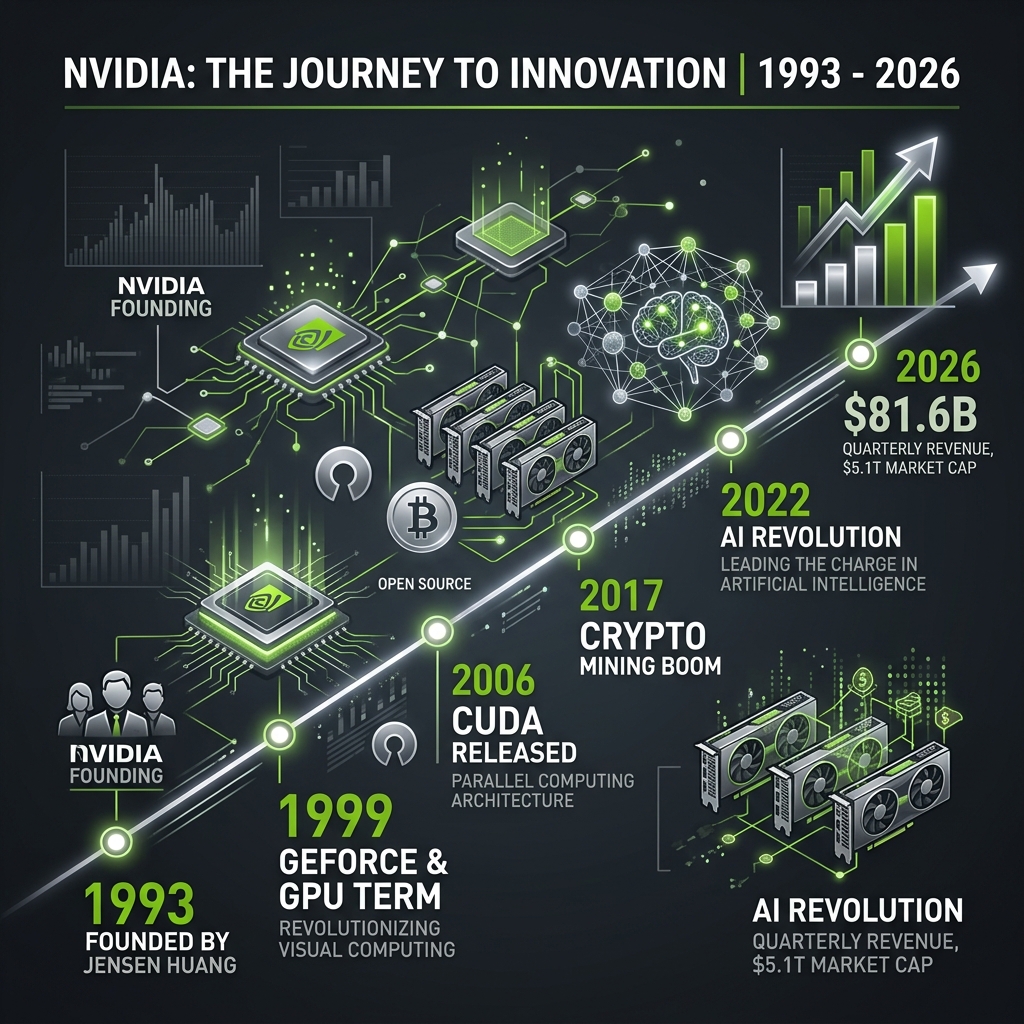
🎮 1993–2006: Graphics, and Naming the Thing
Nvidia was founded in 1993 by Jensen Huang, Chris Malachowsky and Curtis Priem, in a category that was crowded and brutal. Dozens of graphics chip companies existed. Most died.
Two decisions from this era mattered far beyond their technical merit. The first was GeForce, launched in 1999 and marketed as a “GPU”, a term Nvidia pushed hard. Naming a category is one of the most powerful branding moves available, because whoever names it is assumed to have invented it, and Chapter 9 covers how deliberately Nvidia has kept doing this ever since. The second was building a consumer-facing identity in a component category, which almost nobody else attempted seriously.
⚙️ 2006–2016: CUDA, or Building a Moat Before Anyone Needed One
In 2006 Nvidia released CUDA, letting developers use graphics processors for general computation. Commercially this looked like a distraction for years. Strategically it was the most important thing the company ever did, and Chapter 5 argues it is a psychological asset as much as a technical one.
⛏️ 2017–2022: Crypto, Shortages and Accidental Luxury
Cryptocurrency mining, then pandemic supply disruption, then AI demand turned graphics cards into scarce goods. Prices rose far above list. Scalping became routine. Ordinary buyers waited months. As Chapter 7 explains, this period did something to the brand that no marketing department would have dared to plan, and it cut in both directions.
🤖 2022–2026: The AI Reordering
When large language models became the centre of the technology industry, Nvidia was already the default hardware, already had the software ecosystem, and already had the developer base. By the quarter ending April 2026, data centre revenue was around $75 billion, roughly 92% of the company, having grown about 92% year on year. Jensen Huang’s public framing has been consistent and enormous: he has projected global data centre capital expenditure reaching around $4 trillion by 2030, up from an estimated $800 billion in 2026, and argues the semiconductor industry needs to be five to ten times its current size.
Whether that is prophecy or salesmanship is genuinely uncertain, and Chapter 10 treats it as the central risk rather than the central proof.
👁️ Chapter 2: The Improbable Achievement — Making an Invisible Part Visible
Everything else in this audit is downstream of one accomplishment, and I want to establish how unusual it is.
Component suppliers are structurally invisible. The customer buys a finished product, the component is a specification, and the buyer typically cannot evaluate it and does not care. Marketing calls this the ingredient branding problem, and it has exactly one famous solution before Nvidia: Intel Inside, launched in 1991, which paid manufacturers to display a sticker and drilled a five-note sound into a generation’s memory.
Intel’s approach was to make the invisible visible through the finished product. Nvidia did something harder and more durable: it made the component visible through the customer. Someone who buys a laptop with an Intel chip is a laptop owner. Someone who buys a GeForce card is, in his own mind, a person who chose a GeForce card, and that difference is the entire brand.
Three conditions made it possible, and they are worth naming because they explain why this is hard to copy in other categories.
The performance is observable. Unlike most components, a graphics card produces an outcome the user directly experiences: frame rates, resolution, whether a game looks the way it looked in the trailer. Observable outcomes allow real preference to form, and real preference is the raw material of loyalty.
The choice is made by the user, not the manufacturer. PC builders select this part personally. That single fact converts a specification into a decision, and decisions get defended.
The purchase is discretionary and expensive. Costly optional purchases require justification, and justification produces attachment. This is the mechanism I documented in my article on the IKEA effect: people who assemble something themselves value it far beyond its objective worth. A self-built PC is the IKEA effect at industrial strength, and Nvidia’s product sits at the emotional centre of it.
🧥 Chapter 3: Jensen Huang and the Leather Jacket
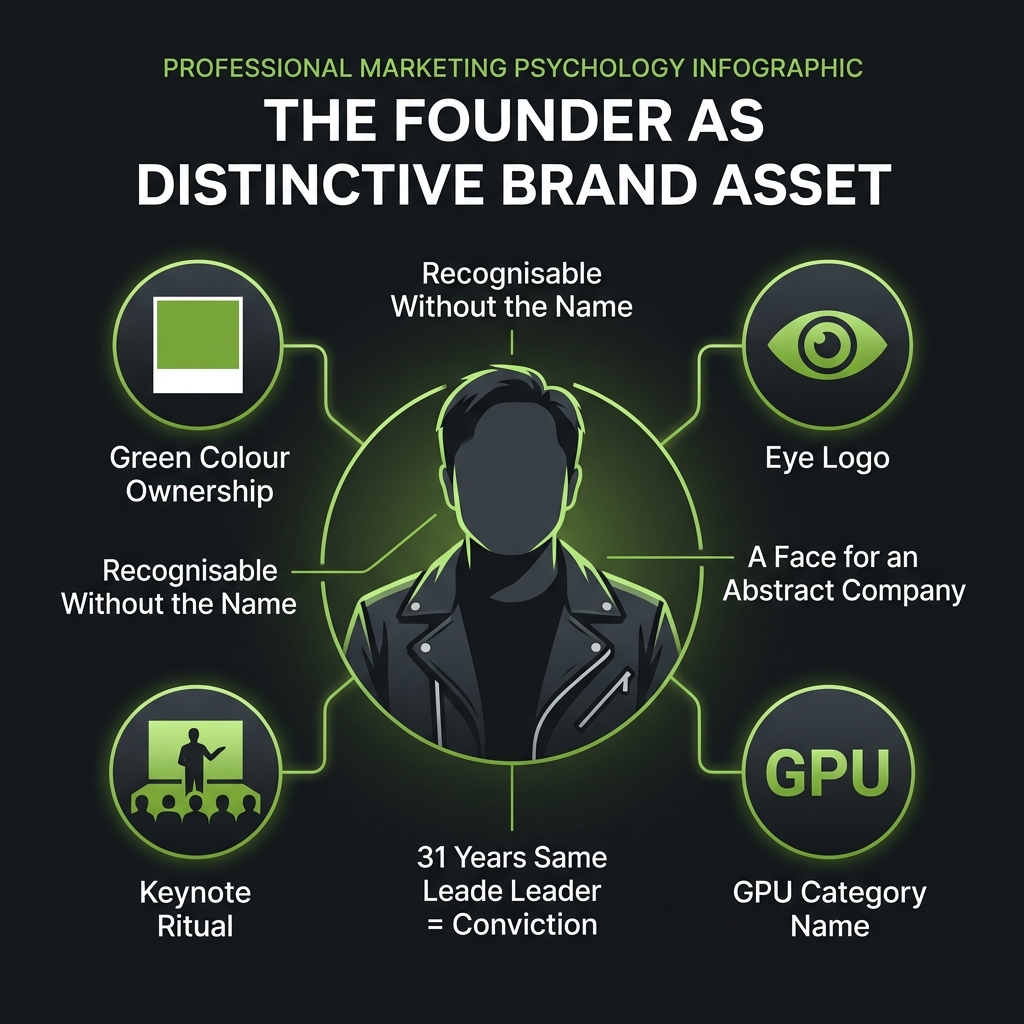
People treat the leather jacket as a running joke. It is a functioning brand asset, and dismissing it misses something real about how recognition works.
Jenni Romaniuk’s framework for distinctive brand assets defines them as elements that trigger identification of the brand without the name being present. A colour, a shape, a sound, a character. Their value is not persuasion; it is speed of recognition in a crowded environment, and speed compounds because familiar things are processed more easily and easy processing is experienced as liking. Reber, Schwarz and Winkielman documented this as processing fluency, and it is one of the most reliable effects in the field.
A consistent founder silhouette does several things at once for Nvidia. It gives an abstract company a face, and humans process faces with dedicated neural machinery while processing corporate logos with none. It provides continuity across three decades, since the same person has run this company since 1993, which is close to unheard of at this scale and quietly signals that the strategy is a conviction rather than a quarter. And it makes an infrastructure company legible to consumers who will never buy a data centre GPU but will absolutely watch a keynote.
There is an important limit worth stating, because founder-as-asset always carries the same liability. When the founder is the brand, the brand inherits the founder’s mortality, mistakes and eventual succession. Companies that build recognition on a person face a transition problem that companies built on abstract identity do not, and Nvidia has not yet had to solve it.
🎮 Chapter 4: GeForce and the Tribe
The consumer business is now a minority of revenue. It remains, in my view, the most valuable thing the company owns, because it is where the brand’s meaning is manufactured.
PC gaming culture has an unusual property: the equipment is part of the identity. In most hobbies the tools are private. Here, the build is discussed, photographed, posted, compared and defended. Component choices are public statements, and public statements about taste become part of the self.
Henri Tajfel and John Turner’s social identity theory explains what follows. People derive self-esteem from group membership, and having established a group, they favour it and denigrate rivals, often on remarkably thin grounds. The Nvidia versus AMD argument, running for over two decades, is a textbook in-group rivalry, and it is enormously valuable to both companies because tribal argument is free distribution. Every thread defending a purchase is unpaid advertising written by someone who believes they are winning.
There is a second mechanism here that most analysts miss. Nvidia’s consumer positioning is not really about gaming. It is about mastery. The customer is someone who understands specifications, researches, optimises and knows what he is doing, and the product is the visible proof of that competence. Deci and Ryan identify competence as a basic psychological need, and a brand that lets people demonstrate competence to an audience that recognises it has attached itself to something far more durable than product preference.
🔒 Chapter 5: CUDA — The Moat People Cannot See
This is the most important chapter for understanding why Nvidia is difficult to displace, and the standard explanation is incomplete.
The usual account is technical: CUDA is a mature software platform, competitors’ equivalents are less developed, so developers stay. That is true and it is only half the story. The switching cost is not paid in money. It is paid in human capital, and that is what makes it so sticky.
An engineer who has spent five years building expertise in an ecosystem has invested something that cannot be transferred by a purchasing decision. Switching means becoming a beginner again in a discipline where your competence is your professional identity. Three well-documented mechanisms then work against moving.
Sunk cost. Arkes and Blumer’s classic work shows people continue investing in a direction because of what they have already put in, even when a fresh evaluation would favour switching. Years of accumulated skill is one of the largest sunk costs a professional holds.
Status quo bias. Samuelson and Zeckhauser demonstrated a robust preference for the current option under uncertainty. When the alternative might work and the current one definitely works, and your project deadline is real, the decision makes itself.
Loss aversion applied to competence. Moving ecosystems is experienced as losing expertise, and losses loom roughly twice as large as equivalent gains. The rational calculation is symmetric. The felt calculation is not.
The strategic consequence is worth stating plainly. Nvidia’s competitors are not really competing against a chip. They are competing against the accumulated professional identity of a generation of engineers, and a faster or cheaper product does not address that. This is the same structural insight I applied in my Anthropic audit: in professional markets, the deepest moats are made of habits, not features.
🟩 Chapter 6: Owning a Colour
Nvidia’s green is a genuine distinctive asset, and colour ownership in technology is rarer than it looks.
The category’s palette is famously narrow: blue for trust and enterprise, black for premium, grey for serious. Intel is blue. IBM is blue. Dell, HP, Samsung, Facebook, LinkedIn, all blue. Choosing a saturated yellow-green in that environment was a decision to be visually incompatible with the category, which is exactly the strategy I argued for in my article on the von Restorff effect. Distinctiveness in a uniform category is nearly free memorability.
The asset is unusually powerful here because of an accident of product design. Enthusiast PCs are built with transparent side panels and lighting, meaning the components are on display in the owner’s room. A brand colour that literally glows in the customer’s home, in a machine the customer chose to make visible, is a level of brand presence most companies would pay enormous sums to achieve.
The eye-like logo does complementary work. It is abstract enough to survive at any size, it does not depend on reading the name, and it works as a small mark on a fan shroud, which is where most people actually encounter it.
⏳ Chapter 7: The Shortage Years — Accidental Luxury Psychology
Between roughly 2017 and 2022, buying a new Nvidia graphics card at list price became genuinely difficult. Crypto mining absorbed supply, pandemic disruption constrained production, scalpers automated purchasing, and prices in the secondary market ran far above official pricing.
Nvidia did not design this, and I want to be careful not to describe an accident as a strategy. But the psychological consequences were substantial and they ran in both directions.
Scarcity raised desire. Worchel, Lee and Adewole’s 1975 study established that objects become more desirable when they are scarce, and most desirable when they were previously plentiful and then became scarce. That is exactly what happened to a product previously available on demand. I covered the full spectrum of this in my article on scarcity marketing.
Acquisition became achievement. Getting a card stopped being a purchase and became a small victory worth announcing. Effort justification does the rest: something obtained with difficulty is valued more, which is Aronson and Mills’ 1959 finding applied to a queue.
A utility good acquired status. When something is hard to get, owning it signals resources, timing or persistence. A component became a Veblen-adjacent status object, which is an odd thing to happen to a circuit board.
And the cost, which was real. Scarcity that feels engineered produces resentment, and years of unavailable products at inflated prices left a durable current of consumer anger toward pricing and value in the gaming segment that has not fully dissipated. Reactance theory predicts this precisely: restricted access increases desire, and it also increases hostility toward whoever is perceived to be doing the restricting. Nvidia gained mystique and lost goodwill, and I do not think the trade was in its favour with the audience that built the brand.
🎤 Chapter 8: The Keynote as Ritual
Nvidia’s GTC keynotes have become events rather than announcements, and the mechanism is one I have written about in a completely different context: ritual.
Vohs, Wang, Gino and Norton’s research on consumption rituals found that ritualised behaviour before consuming something measurably increases enjoyment and perceived value. The build-up is part of the experience. A predictable annual moment, a consistent presenter, a familiar visual language and a room full of people who care converts a product launch into something people schedule around, and I made the same argument about lawn launch season in my Khaadi audit, which is a strange sentence to write about a chip company and an entirely accurate one.
Two further effects are running. Anticipation is itself pleasurable, so the weeks of speculation before a keynote are not idle time but free engagement. And collective attention creates significance: watching something simultaneously with a large group makes it feel important, independent of content, which is why live events retain power in an on-demand world.
The honest limitation is that ritual raises expectations every year. An event people treat as a landmark must produce landmarks, and a keynote that lands as incremental is judged far more harshly than a press release saying the same thing would be.
🗣️ Chapter 9: Inventing the Language
This chapter covers Nvidia’s most underrated capability, and it is one I would advise almost any brand to copy.
Nvidia consistently names things. It pushed “GPU” as a category term. It has promoted framings like “accelerated computing”, and Jensen Huang has repeatedly described data centres as “AI factories”, a phrase doing an enormous amount of quiet persuasive work.
George Lakoff’s work on framing establishes that the language used to describe something determines which inferences feel natural. Consider “AI factory” specifically. A data centre is a cost: something you build reluctantly, minimise, and depreciate. A factory is productive capacity: something you invest in, expand, and measure by output. Same building, same machines, completely different budget conversation. Framing an expense as an asset is possibly the single most valuable sentence a supplier can put into a customer’s head.
Naming a category also confers prototype status. Eleanor Rosch’s research shows that categories are organised around a most-typical example, and the prototype becomes the default against which others are judged. When a company names the category, it is assumed to define it, and everyone else is positioned as an alternative to the real thing. This is the same asset ChatGPT holds in consumer AI, and it is why I scored Anthropic low on consumer mindshare in that audit while scoring Nvidia high here.
⚠️ Chapter 10: The Dark Side — What Actually Threatens This Brand
This is the chapter that matters most, and the risks are not the ones usually discussed.
📖 Narrative dependence
A valuation of this magnitude is not supported by current earnings alone. It is supported by a story about the future: that AI infrastructure spending continues expanding for years, that Huang’s projection of roughly $4 trillion in annual data centre capital expenditure by 2030 is directionally right, and that the semiconductor industry really does need to be several times larger.
Robert Shiller’s work on narrative economics argues that economic outcomes are substantially driven by stories that spread and are believed. The uncomfortable corollary is that a company priced on a narrative can be repriced by a change in the narrative without anything happening to its products. Nvidia’s chips do not get worse if sentiment turns. Its valuation does, and its brand is now entangled with its valuation in a way most brands are not.
I am not predicting a decline, and I have no basis to. I am pointing out that a story is a different kind of asset from a factory, and it is managed differently.
🎯 Customer concentration
With around 92% of revenue from data centres, an enormous share flows from a small number of very large buyers, all of whom are simultaneously designing their own chips. That is an unusual commercial position: your biggest customers are also your most motivated future competitors, and they have every incentive to reduce dependence on you. This is a business risk, but it is also a brand risk, because a supplier whose customers are actively working to replace it eventually faces a positioning problem.
😠 Consumer resentment in the founding audience
The gaming community built this brand’s meaning and has spent years feeling deprioritised: high pricing, constrained supply, and a clear sense that the company’s attention has moved to buyers with larger budgets. Brand equity built through identity is durable but not unconditional. When a group that defined itself partly through a brand feels the relationship has become one-sided, the switch to hostility is faster than most companies expect, because betrayal by an in-group brand is felt personally.
🌍 Geopolitics as a brand exposure
Export controls, national security scrutiny and supply chain concentration mean Nvidia’s business is shaped by decisions no executive controls. For brand purposes the issue is that geopolitical friction attaches meanings the company did not choose, and a brand that becomes a proxy in a state-level dispute has lost some authorship of what it stands for.
🔄 Ecosystem lock-in as reputational liability
CUDA is a moat, and moats look different depending on which side you are standing on. To Nvidia it is an ecosystem investment. To a growing number of developers, regulators and customers it looks like lock-in, and lock-in generates reactance over time. The open-source and open-standards pressure in this space is not primarily technical; it is a reaction against dependence, and dependence is psychologically uncomfortable even when the product is excellent.
⚔️ Chapter 11: Competitive Positioning
| Competitor | Psychological Position | Where Nvidia Wins or Loses |
| AMD | The value challenger; the underdog people want to like | Loses on goodwill and price perception; wins on ecosystem and default status |
| Intel | The incumbent institution; trusted, slower, recovering | Wins decisively on momentum and category ownership in AI |
| Google TPU, Amazon in-house silicon | Vertical integration; independence from a supplier | The real long-term threat: customers with the resources and motive to leave |
| AI chip startups | Specialised performance; a fresh alternative | Wins on software maturity, which is where nearly all of them stall |
| Open standards movements | Freedom from lock-in; a values argument, not a product one | The hardest to fight, because it competes on principle rather than performance |
The pattern is that Nvidia’s product competitors are the least dangerous group, and its customers and the anti-dependence movement are the most dangerous. That is an unusual competitive map, and it argues for a brand strategy focused on being wanted rather than merely being necessary, because necessity generates resentment while preference does not.
📊 Chapter 12: Psychology Scorecard — Detailed Ratings
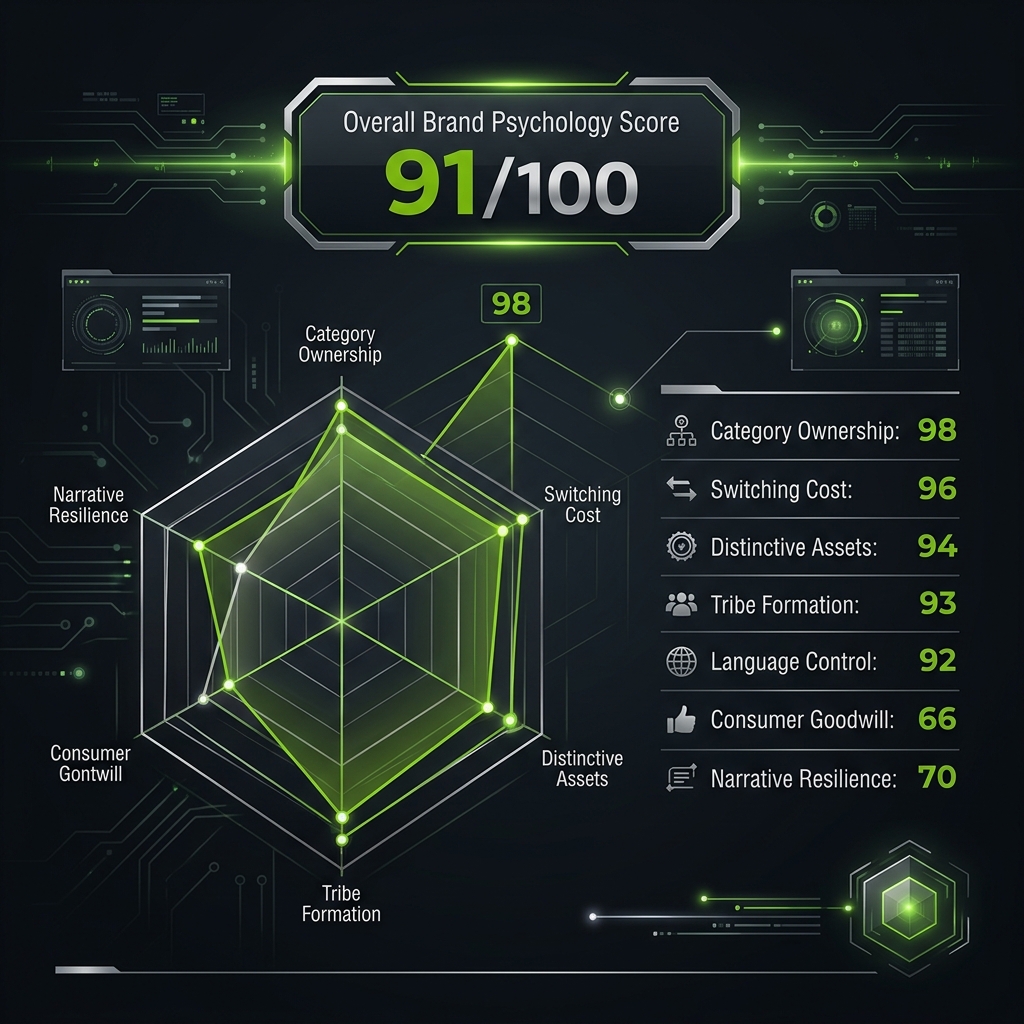
| Psychology Dimension | Score | Verdict |
| Category Ownership | 98/100 | Named the category and became the prototype; near-total mindshare. |
| Switching Cost Psychology | 96/100 | A moat made of professional identity, which money cannot cross. |
| Distinctive Brand Assets | 94/100 | A colour, a logo, a founder and a jacket; recognised without the name. |
| Identity & Tribe Formation | 93/100 | Turned a component into a statement about the buyer. |
| Framing & Language Control | 92/100 | “AI factory” reframes a cost as an asset; elite persuasion work. |
| Consumer Goodwill | 66/100 | The founding audience feels expensive and deprioritised, and says so. |
| Narrative Resilience | 70/100 | Priced on a story; a story can be revised without any product changing. |
| Dependence Risk Perception | 68/100 | Being necessary breeds reactance; customers are building alternatives. |
| OVERALL PSYCHOLOGY SCORE | 91/100 | ⚡ Extreme Impact — an extraordinary brand carrying non-product risk. |
✅ Chapter 13: Balance Sheet & A Psychologist’s Prescription
💪 Psychological Strengths
- Solved the ingredient branding problem: made an invisible component into an identity
- Named the category: prototype status means rivals are positioned as alternatives
- A moat made of habits: switching costs paid in expertise, not money
- Recognisable without the name: colour, logo, founder and silhouette all working
- Tribal energy as free distribution: arguments about the brand are advertising for it
- Language control: “AI factory” changes a customer’s budget category, not just their vocabulary
⚠️ Psychological Weaknesses
- Narrative dependence: valuation and brand are entangled with a forecast
- Founding audience resentment: gamers built the meaning and feel abandoned
- Customer concentration: the biggest buyers are the most motivated future rivals
- Lock-in reactance: being necessary generates pressure to escape
- Founder concentration: a brand built on a person inherits a succession problem
- Geopolitical meaning: the brand no longer fully controls what it stands for
🔮 The Prescription
- Repair the relationship with gamers, and do it visibly. That audience is not a revenue line, it is the factory where the brand’s meaning is produced. A company earning most of its money elsewhere can afford to make the consumer segment feel prioritised again, and the cost of doing so is trivial against the cost of losing the group that tells everyone else what to think.
- Separate the brand narrative from the market narrative. When identity is tied to a valuation, every correction becomes a story about decline. Building meaning around what the technology enables, rather than around how large the market will be, insulates the brand from a repricing it cannot control.
- Treat openness as reputation management, not charity. Lock-in resentment compounds quietly and then arrives all at once, usually with a regulator attached. Voluntary interoperability gestures made from strength read as confidence; the same gestures made under pressure read as retreat, and the difference is entirely timing.
- Begin building institutional identity alongside the founder. The jacket is an excellent asset with one flaw: it is attached to a person. Companies that survive founder transitions start distributing recognition years before they need to, not during the announcement.
- Keep naming things, but name honestly. Framing is legitimate and enormously powerful. It becomes a liability the moment the frame outruns what the product delivers, and a company that names the category is judged against the expectations its own vocabulary created.
📝 Final Verdict
Nvidia achieved something that should not be possible. It took a component nobody sees, sold it into a category with no emotional history, and produced genuine identity, real tribal loyalty and cultural presence, then converted that position into what became one of the most valuable companies on earth. Around $81.6 billion in a single quarter, roughly 92% of it from data centres, from a business that started by selling graphics cards to teenagers who wanted better frame rates.
The brand work underneath that is genuinely elite, and mostly invisible even to people who admire the company. Naming the category. Building an ecosystem before anyone needed it and letting habit do the defending. Owning a colour in a blue industry. Turning a founder into a recognisable silhouette. Reframing a cost centre as a factory. Each of those is a lesson a brand in any category could apply.
What gives me pause is the shape of the risk. Nvidia’s dangers are almost entirely outside its engineering: a narrative that can be revised, customers with the resources and reasons to leave, a founding audience that feels used, dependence that generates its own opposition, and geopolitics assigning meanings nobody at the company chose. This is a brand that has solved every problem it can solve with excellence, and is now exposed to the class of problems excellence does not address.
Psychology Score: 91/100 — Nvidia scores at an elite level for category ownership (98), switching cost psychology (96), distinctive assets (94), tribe formation (93) and framing (92), pulled down by consumer goodwill (66), dependence risk perception (68) and narrative resilience (70). One of the great brand-building achievements in technology, now carrying risks that no product roadmap can fix.
🧠 Want a Psychology Audit for Your Brand?
I’m Muhammad Shahzeb, an MSc Industrial Psychologist and Full-Stack Developer. I audit positioning, category framing and customer psychology using behavioral science, including the part where I tell you which of your strengths is quietly becoming a liability. Let’s look at yours.
📚 References & Sources
- NVIDIA Corporation. Investor relations and product information. nvidia.com
- The Motley Fool. “Data Center Sales Make Up 92% of Nvidia’s Revenue.” August 2026.
- The Motley Fool. “Jensen Huang’s $4 Trillion Artificial Intelligence Projection.” July 2026.
- StartupHub.ai. “Jensen Huang’s Nvidia: $81.6B Q1 Revenue.” 2026.
- IndexBox. “Nvidia CEO Jensen Huang Forecasts Sustained AI Chip Demand in 2026.”
- Axis Intelligence. “Nvidia Statistics 2026: Revenue and AI Dominance Data.”
- Romaniuk, J. (2018). Building Distinctive Brand Assets. Oxford University Press.
- Tajfel, H., & Turner, J. C. (1979). “An integrative theory of intergroup conflict.” In The Social Psychology of Intergroup Relations.
- Arkes, H. R., & Blumer, C. (1985). “The psychology of sunk cost.” Organizational Behavior and Human Decision Processes, 35(1), 124-140.
- Samuelson, W., & Zeckhauser, R. (1988). “Status quo bias in decision making.” Journal of Risk and Uncertainty, 1(1), 7-59.
- Kahneman, D., & Tversky, A. (1979). “Prospect theory: An analysis of decision under risk.” Econometrica, 47(2), 263-291.
- Rosch, E. (1975). “Cognitive representations of semantic categories.” Journal of Experimental Psychology: General, 104(3), 192-233.
- Lakoff, G. (2004). Don’t Think of an Elephant! Know Your Values and Frame the Debate. Chelsea Green.
- Worchel, S., Lee, J., & Adewole, A. (1975). “Effects of supply and demand on ratings of object value.” Journal of Personality and Social Psychology, 32(5), 906-914.
- Aronson, E., & Mills, J. (1959). “The effect of severity of initiation on liking for a group.” Journal of Abnormal and Social Psychology, 59(2), 177-181.
- Vohs, K. D., Wang, Y., Gino, F., & Norton, M. I. (2013). “Rituals enhance consumption.” Psychological Science, 24(9), 1714-1721.
- Reber, R., Schwarz, N., & Winkielman, P. (2004). “Processing fluency and aesthetic pleasure.” Personality and Social Psychology Review, 8(4), 364-382.
- Shiller, R. J. (2019). Narrative Economics: How Stories Go Viral and Drive Major Economic Events. Princeton University Press.
- Deci, E. L., & Ryan, R. M. (2000). Self-determination theory and the need for competence.
- Brehm, J. W. (1966). A Theory of Psychological Reactance. Academic Press.
Audit conducted by Muhammad Shahzeb, MSc Industrial & Organizational Psychology | Brand Psychology Specialist | Full-Stack Web Developer
Learn more about my approach →
Key Findings
- Nvidia reported roughly $81.6 billion in revenue for the quarter ending April 2026, with data centre sales at about $75 billion or 92% of total, on a market capitalisation around $5.1 trillion
- The brand's core achievement is making consumers care intensely about a component they cannot see, which almost no other supplier in computing history has managed at this scale
- CUDA is the most underrated moat in technology — a psychological one as much as technical, because the switching cost is paid in skills and habits rather than money
- Jensen Huang functions as a genuine distinctive brand asset, and the leather jacket is a textbook recognition device competitors cannot replicate
- GPU shortages during the crypto and AI booms accidentally manufactured luxury psychology, generating both intense desire and lasting consumer resentment
- The largest risk is narrative dependence: a valuation built on a story about the future is repriced by changes in the story rather than changes in the chips
Overall Psychology Score
Nvidia scores 91/100 in our comprehensive psychology audit covering consumer behavior strategies, UX design principles, and psychological marketing effectiveness.
The detailed dimension scores are in the audit's Psychology Scorecard chapter.
High impactMuhammad Shahzeb
MSc Industrial Psychologist, specializing in consumer behavior, UX psychology, and brand strategy analysis. Helping brands understand the psychology behind their success.
About Muhammad Shahzeb →