Nestlé Brand Psychology Audit — How the World’s Largest Food Corporation Engineers Consumer Behavior Through Trust, Habit & Emotional Anchoring
A comprehensive brand psychology audit of Nestlé — the world's largest food & beverage corporation. We analyze how Nestlé leverages trust psychology, habit formation, emotional anchoring, nostalgia marketing, and portfolio diversification to maintain global dominance across 186 countries — while navigating decades of ethical controversies from the baby formula scandal to water privatization.

74 / 100
Overall consumer behavior effectiveness
Brand Overview
- Brand nameNestlé
- Founded1866
- HeadquartersVevey, Switzerland
- IndustryFood & Beverage
- Websitewww.nestle.com ↗
Psychology Techniques Identified
- 01Trust Architecture & Authority Bias
- 02Habit Loop Engineering (Cue-Routine-Reward)
- 03Nostalgia & Childhood Memory Anchoring
- 04Portfolio Diversification Psychology
- 05Loss Aversion & Brand Switching Costs
- 06Cultural Localization & In-Group Identity
- 07Health Halo Effect
- 08Mere-Exposure Effect at Scale
- 09Reciprocity Through CSR Narratives
- 10Cognitive Dissonance Exploitation
Full Psychology Audit Report
In this audit
There is no brand on Earth that touches more human lives — more frequently, more intimately, more invisibly — than Nestlé. From the moment you wake up and reach for your Nescafé, to the KitKat you snap during your break, to the Maggi noodles you boil at midnight — you are participating in a behavioral system that was engineered over 158 years to make you a lifelong consumer.
Nestlé is not merely a food company. It is the world’s most sophisticated consumer behavior engineering machine — a corporation that has mastered the psychology of trust, habit, memory, and cultural identity across 186 countries and 2,000+ brands.
But behind the warm logos and comforting products lies a history stained with some of the most devastating corporate scandals in modern history — from baby formula deaths in Africa to water privatization to child labor in cocoa farming. And yet, Nestlé’s market cap continues to grow. Its products continue to sell. Its consumers continue to trust.
In this comprehensive brand psychology audit, I’ll dissect every psychological mechanism that makes Nestlé simultaneously one of the most loved and most controversial corporations on Earth — from its founding in 1866 to June 2026.
“Nestlé doesn’t sell food. It sells familiarity. And familiarity is the most powerful drug in consumer psychology.”
— Brand Psychology Analysis, ShahzebSpeaks
📋 Brand Overview: Nestlé at a Glance
| Official Name | Nestlé S.A. |
| Type | Société Anonyme (Public Company — SIX: NESN) |
| Founded | 1866 — Vevey, Switzerland (158 years ago) |
| Headquarters | Vevey, Vaud, Switzerland |
| CEO (2026) | Laurent Freixe (since September 2024) |
| Revenue (2025) | ~CHF 89+ billion (~USD 100+ billion) |
| Employees | ~270,000 globally |
| Global Presence | 186 countries — 354 factories worldwide |
| Number of Brands | 2,000+ brands (34 generate over CHF 1 billion annually) |
| Tagline | “Good Food, Good Life” |
| Brand Colors | Red (#E3000B), White, Dark Blue |
| Website | www.nestle.com |
🏭 Key Brands Under the Nestlé Umbrella
| ☕ Beverages | Nescafé, Nespresso, Milo, Nestea, S.Pellegrino, Perrier, Nesquik |
| 🍫 Confectionery | KitKat, Smarties, Aero, Quality Street, After Eight, Milkybar |
| 🍜 Culinary | Maggi, Stouffer’s, Lean Cuisine, Hot Pockets, Buitoni |
| 🍼 Infant Nutrition | NAN, Cerelac, Lactogen, Gerber, S-26 |
| 🐾 Pet Care | Purina, Felix, Friskies, Fancy Feast, Dog Chow, Pro Plan |
| 🏥 Health Science | Boost, Nutren, Peptamen, Optifast, Garden of Life |
| 💧 Water (Historic) | Pure Life (sold most water brands in 2021 — now focusing on premium S.Pellegrino & Perrier) |
📜 Chapter 1: The Complete History of Nestlé (1866–2026)
🏔️ 1866–1905 — The Origin: From Baby Formula to Global Ambition
Nestlé’s founding story is, ironically, rooted in saving children’s lives — the very thing the company would later be accused of endangering. In 1866, German-born pharmacist Henri Nestlé developed “Farine Lactée” — a combination of cow’s milk, wheat flour, and sugar designed to provide nutrition for infants who couldn’t breastfeed.
The product reportedly saved the life of a premature infant who had been refusing all other food. This origin story isn’t just historical fact — it’s a psychological asset. In branding, we call this a “founding narrative” — a story that shapes how consumers perceive a brand’s fundamental purpose. Nestlé’s founding narrative says: “We exist to nourish.”
In 1905, Nestlé merged with the Anglo-Swiss Condensed Milk Company, creating one of the world’s first multinational food corporations. This merger taught Nestlé a lesson it would apply for the next 120 years: growth through acquisition is faster and psychologically safer than organic growth — consumers already trust brands they know, so acquiring trusted brands transfers that trust to the parent company.
⚔️ 1914–1945 — War Profiteering & Global Expansion
Both World Wars were devastating for humanity — but commercially transformative for Nestlé. During World War I, Nestlé secured massive government contracts to supply condensed milk and chocolate to troops. During World War II, the launch of Nescafé instant coffee (1938) coincided perfectly with military demand — the U.S. military became one of its biggest customers.
From a psychology perspective, this era established something critically important: soldiers who consumed Nescafé during the war returned home with pre-formed brand habits. This is a textbook example of what psychologists call “mere-exposure effect” — the more we’re exposed to something, the more we prefer it. Millions of men returned from war already habituated to Nestlé products, seeding post-war consumer markets across the globe.
Psychological Note: Nestlé’s wartime expansion wasn’t just business strategy — it was unintentional mass-scale habit formation. The company didn’t just sell coffee; it created ritualized morning behavior patterns that persist to this day in over 180 countries.
💀 1970s–1984 — The Baby Formula Scandal: Nestlé’s Darkest Chapter
This is, without question, the most significant ethical failure in Nestlé’s history — and one of the most devastating corporate scandals of the 20th century.
In the 1970s, Nestlé aggressively marketed infant formula in developing countries across Africa, Asia, and South America. The marketing tactics included:
- Deploying saleswomen dressed as nurses (“milk nurses”) into hospitals to promote formula over breastfeeding
- Distributing free samples to new mothers — enough to last until the mother’s own milk supply dried up, creating forced dependency
- Advertising that implied formula was superior to breast milk — a scientifically false and dangerous claim
- Targeting illiterate populations who couldn’t read the preparation instructions, leading to formula being mixed with contaminated water
The consequences were catastrophic. An estimated 66,000 infant deaths per year were attributed to unsafe formula feeding practices in developing countries. The contaminated water used to mix formula caused severe diarrheal diseases. Families who couldn’t afford enough formula over-diluted it, causing malnutrition. Babies who were switched to formula lost the immunological protection of breast milk.
In 1977, the Infant Formula Action Coalition (INFACT) launched a boycott against Nestlé — which became the longest consumer boycott in history, lasting until 1984. In 1981, the World Health Organization adopted the International Code of Marketing of Breast-milk Substitutes, largely in response to Nestlé’s practices.
From a brand psychology perspective, this scandal should have destroyed the company. The fact that it didn’t reveals something profound about how cognitive dissonance works at scale — consumers can simultaneously know about a brand’s wrongdoing and continue purchasing its products, because the psychological cost of changing deeply ingrained habits is higher than the emotional discomfort of the knowledge.
🌊 1990s–2010s — Water Privatization & The “Blue Gold” Controversy
Nestlé’s water division became its second-most controversial business unit. Under former CEO Peter Brabeck-Letmathe, who famously stated in a 2005 documentary that the idea of water as a human right was “extreme,” Nestlé faced global backlash for:
- Extracting groundwater from communities in Michigan, California, and Ontario at minimal cost while selling it at premium prices
- Bottling water in drought-affected regions while local residents faced water restrictions
- Purchasing water rights in developing countries, effectively privatizing a public resource
- The Pure Life brand being positioned as “affordable hydration” while extracted from community water sources
In 2021, Nestlé sold its mainstream water brands (Pure Life, Poland Spring, etc.) to One Rock Capital Partners for $4.3 billion — keeping only the premium brands (S.Pellegrino, Perrier, Acqua Panna). This was a masterclass in reputation management psychology: divest the controversial product, keep the prestigious one, and let the controversy fade from public memory.
🍫 2010–2020 — The Cocoa & Child Labor Crisis
Nestlé’s chocolate supply chain became a lightning rod for ethical criticism:
- In 2001, Nestlé (along with other chocolate companies) signed the Harkin-Engel Protocol, pledging to eliminate the worst forms of child labor in cocoa farming by 2005. The deadline was missed. And extended. And missed again.
- A 2020 University of Chicago study found that approximately 1.56 million children were still working in hazardous conditions on cocoa farms in Ghana and Côte d’Ivoire
- In 2021, the U.S. Supreme Court ruled in Nestlé USA v. Doe that the company could not be held liable under the Alien Tort Statute for child slavery on overseas cocoa farms
Nestlé launched its “Nestlé Cocoa Plan” and later the “Income Accelerator Program” — paying cocoa-farming families cash incentives for practices like sending children to school. From a psychology standpoint, this is reciprocity-based reputation repair: “We’re giving something back, therefore we deserve forgiveness.”
🔄 2020–2026 — Restructuring, Health Pivot & AI Integration
The 2020s have been a period of strategic reinvention for Nestlé:
- 2020-2022: Massive portfolio pruning — selling water brands, Gerber Life Insurance, parts of the confectionery division, and underperforming regional brands
- 2023: Internal leaked document (reported by the Financial Times) revealed Nestlé’s own assessment that over 60% of its mainstream food products did not meet recognized health standards
- 2024: CEO Mark Schneider replaced by Laurent Freixe after declining organic growth and stock underperformance. Freixe launched a “back to basics” strategy focusing on operational efficiency
- 2025-2026: Heavy investment in AI-driven personalization, health science nutrition, and premium product positioning. Launch of AI-powered Nescafé machines, expansion of Nestlé Health Science through acquisitions, and sustainability commitments for 2030
🧠 Chapter 2: Brand Identity Psychology — The Nest That Never Lets Go
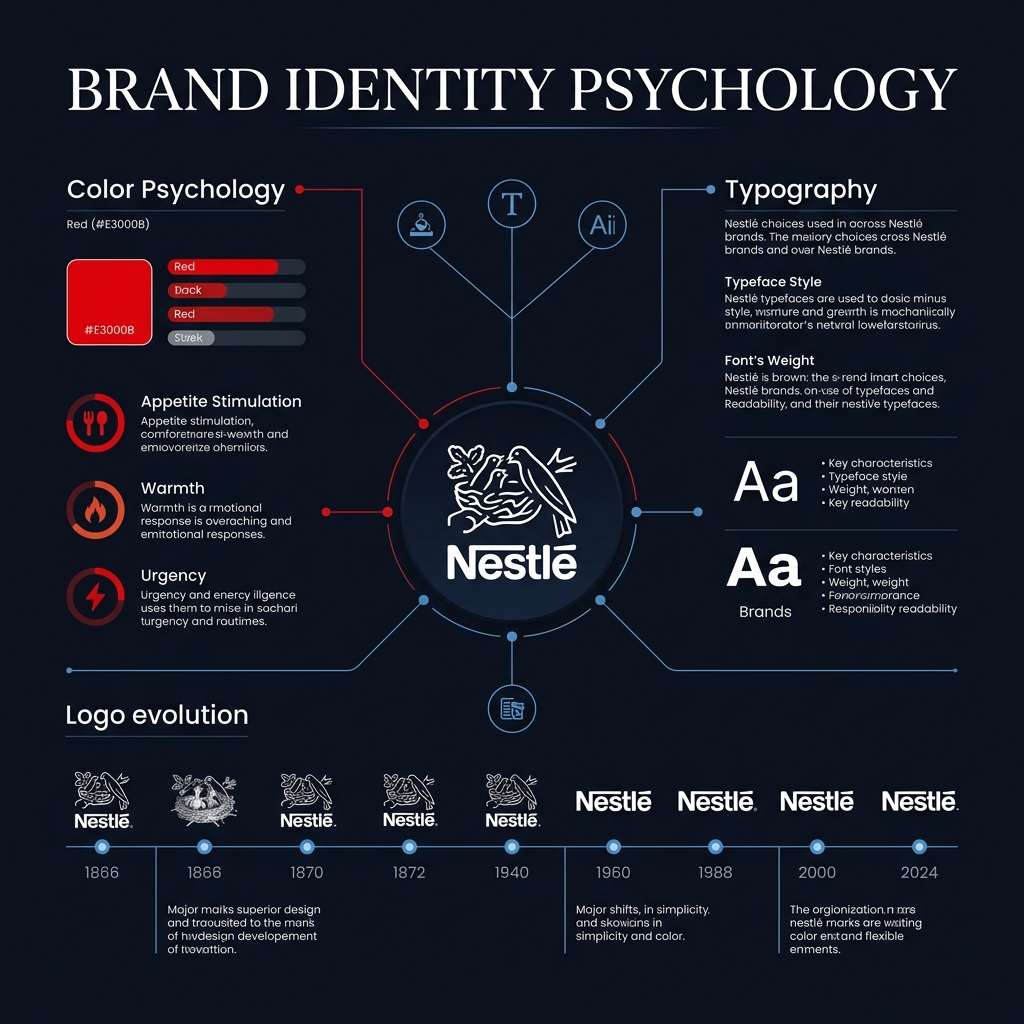
🪺 The Logo: A Masterclass in Maternal Symbolism
Nestlé’s logo — a bird feeding its chicks in a nest — is one of the most psychologically potent corporate symbols ever created. Here’s why:
- Maternal Instinct Activation: The image of a mother feeding her young triggers deep evolutionary circuits related to caregiving, safety, and nourishment. These are pre-rational responses — they happen before conscious thought
- “Nestlé” = “Little Nest”: The brand name itself (derived from the founder’s surname, which coincidentally means “little nest” in German) creates a powerful phonosemantic association — the sound of the word evokes warmth and protection
- Visual Permanence: The logo has remained fundamentally unchanged for over 150 years. This consistency triggers the familiarity principle — we trust what we recognize, and we recognize what hasn’t changed
- Cross-Cultural Universality: Unlike text-based logos, the nest symbol works across all languages and cultures — birds feeding their young is a universal image of care
The logo evolution is psychologically telling: in 1988, Nestlé reduced the number of chicks from three to two — officially to “modernize” the design, but also reflecting changing family size demographics. This subtle change ensured the logo continued to feel relatable and contemporary rather than idealized and outdated.
🎨 Color Psychology: The Power of Red
Nestlé’s primary brand color — deep red (#E3000B) — is not accidental. In food industry color psychology:
- Red stimulates appetite: Research consistently shows that red increases metabolic rate and triggers hunger signals — making it the most common color in food branding (McDonald’s, Coca-Cola, KFC, Heinz)
- Red signals urgency and excitement: It creates a subtle psychological push toward action — “buy now, eat now, enjoy now”
- Red conveys warmth and passion: It evokes feelings of comfort, love, and family — aligning perfectly with Nestlé’s “nourishment” positioning
- White as counterbalance: The white text on red creates a clean, clinical contrast that signals purity, hygiene, and trustworthiness
🔤 “Good Food, Good Life” — Linguistic Psychology
Nestlé’s tagline is deceptively simple, but psychologically layered:
- Repetition of “Good”: The word “good” appears twice, creating a phonological loop that reinforces the message in memory. It’s also the lowest-effort positive association — not “great” or “amazing” (which would invite scrutiny), but “good” (which feels honest and humble)
- Causal Implication: The structure implies that good food leads to a good life — a claim so broad it’s unfalsifiable, yet so intuitively appealing it becomes accepted as truth
- Health Halo Activation: By using “Good Food” rather than “Delicious Food” or “Tasty Food,” Nestlé positions itself as a health-conscious brand — even though many of its products are ultra-processed
- Emotional Anchoring: “Good Life” connects food consumption to life satisfaction — a massively powerful psychological frame that elevates eating from a biological necessity to a quality-of-life indicator
🧪 Chapter 3: The Psychology of Nestlé’s Product Empire — Habit Engineering at Scale
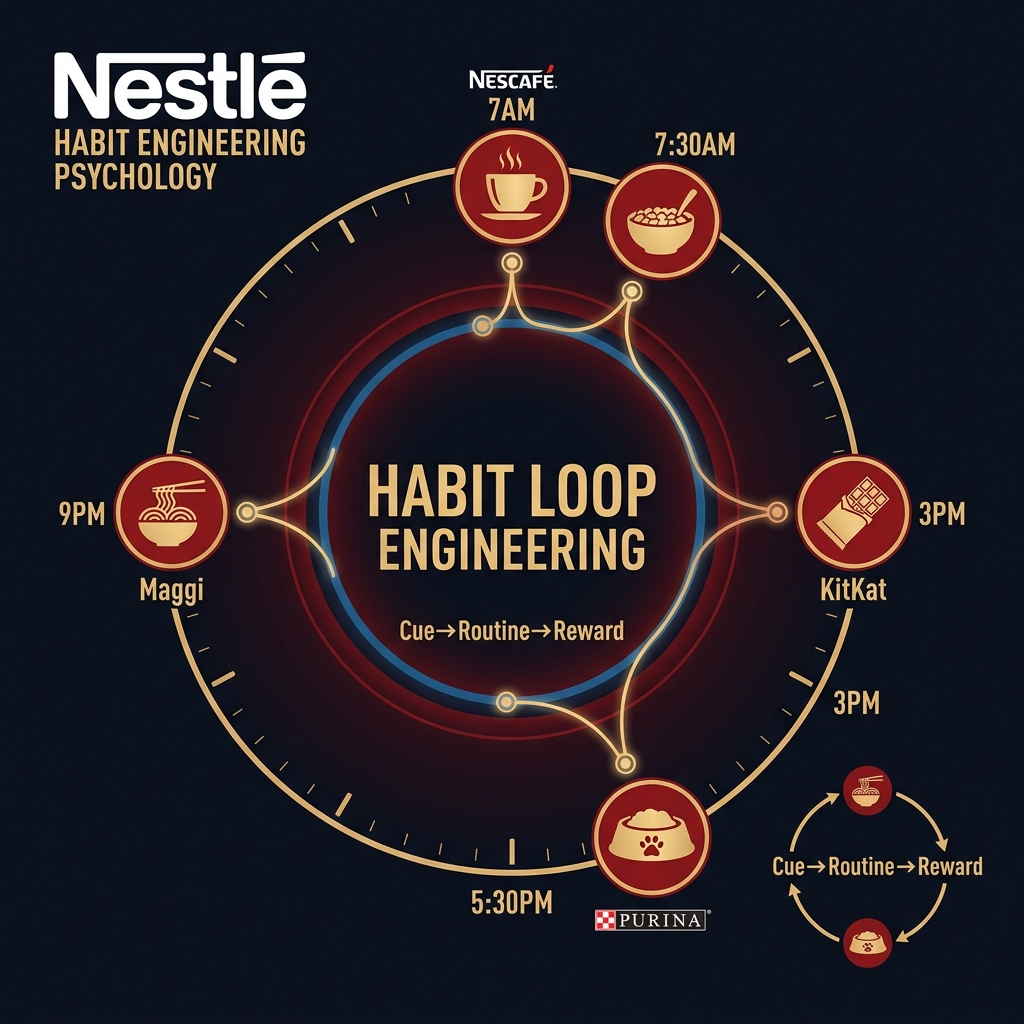
Nestlé’s 2,000+ brands aren’t random acquisitions. They represent a carefully architected behavioral system designed to capture every consumption moment of your day. Let me break this down:
☕ Nescafé: The Morning Ritual Hijack
Nescafé is the world’s most consumed coffee brand — over 5,800 cups consumed every second globally. But its psychological power goes far beyond taste:
- Habit Loop (Cue → Routine → Reward): The cue is waking up and feeling groggy; the routine is making Nescafé; the reward is the caffeine hit plus the comfort of ritual. This loop, performed daily for years, becomes almost impossible to break
- Identity Integration: “I’m a Nescafé person” becomes part of someone’s self-concept. Asking them to switch to another brand feels like asking them to change who they are
- Sensory Memory: The distinctive smell of Nescafé instant coffee triggers powerful olfactory memories — the brain’s most emotionally connected sense. Many consumers associate the smell with childhood mornings, creating deep nostalgia anchors
🍜 Maggi: The Emotional Comfort Food
In South Asia, Southeast Asia, and Africa, Maggi is more than a noodle brand — it’s a cultural institution. Psychologically:
- Childhood Anchoring: For hundreds of millions of people, Maggi was their first independently prepared meal. This creates what psychologists call a “primacy effect” — first experiences carry disproportionate emotional weight
- Comfort Food Psychology: Maggi triggers the release of serotonin and dopamine through its combination of carbohydrates, salt, and MSG (monosodium glutamate) — creating a genuine biochemical comfort response
- “2-Minute” Positioning: The “2-Minute Noodles” tagline is a masterclass in friction reduction. In behavioral economics, the lower the effort required, the higher the adoption rate. By emphasizing minimal preparation time, Maggi eliminates the primary barrier to consumption
- The 2015 India Ban: When India banned Maggi for excessive lead content, the resulting consumer mourning — people literally hoarding packets and posting emotional tributes — proved how deeply the brand was embedded in the national psyche. Maggi’s return was treated like the comeback of a beloved family member
🍫 KitKat: “Have a Break” — The Behavioral Pause Button
KitKat’s “Have a Break, Have a KitKat” is one of the most psychologically sophisticated taglines in advertising history:
- Behavioral Trigger: KitKat doesn’t position itself as a chocolate bar. It positions itself as a break. Every time you think “I need a break,” you’re being cued to think of KitKat. This association turns a universal human feeling into a purchase trigger
- The “Snap” Ritual: Breaking a KitKat finger from the bar is a tactile ritual that creates multisensory engagement. The sound, the feel, the visual break — all reinforce the “break” concept at a sensory level
- Japan Strategy: In Japan, KitKat became associated with exam success because “KitKat” sounds like “Kitto Katsu” (きっと勝つ — “you will surely win”). Nestlé leaned into this cultural coincidence, creating 400+ limited-edition flavors, and KitKat is now Japan’s number one selling confection. This is cultural identity anchoring at its finest
🐾 Purina: The Pet Parent Guilt Loop
Nestlé’s pet food division (Purina) generates over CHF 17 billion annually — making it one of the company’s largest and fastest-growing segments. The psychology here is powerful:
- Anthropomorphism Marketing: Purina ads consistently portray pets as family members with emotions. This triggers the endowment effect — pet owners feel their animals “deserve the best,” making price a secondary consideration
- Guilt-Based Premium: Products like Purina Pro Plan use veterinary endorsements and scientific language to create guilt in pet owners who buy cheaper alternatives: “Don’t you love your dog enough to buy them science-backed nutrition?”
- The Subscription Trap: Purina’s auto-delivery programs exploit the status quo bias — once set up, the psychological effort to cancel exceeds the effort to continue paying
🕸️ Chapter 4: The Invisible Empire — Portfolio Psychology & Choice Architecture
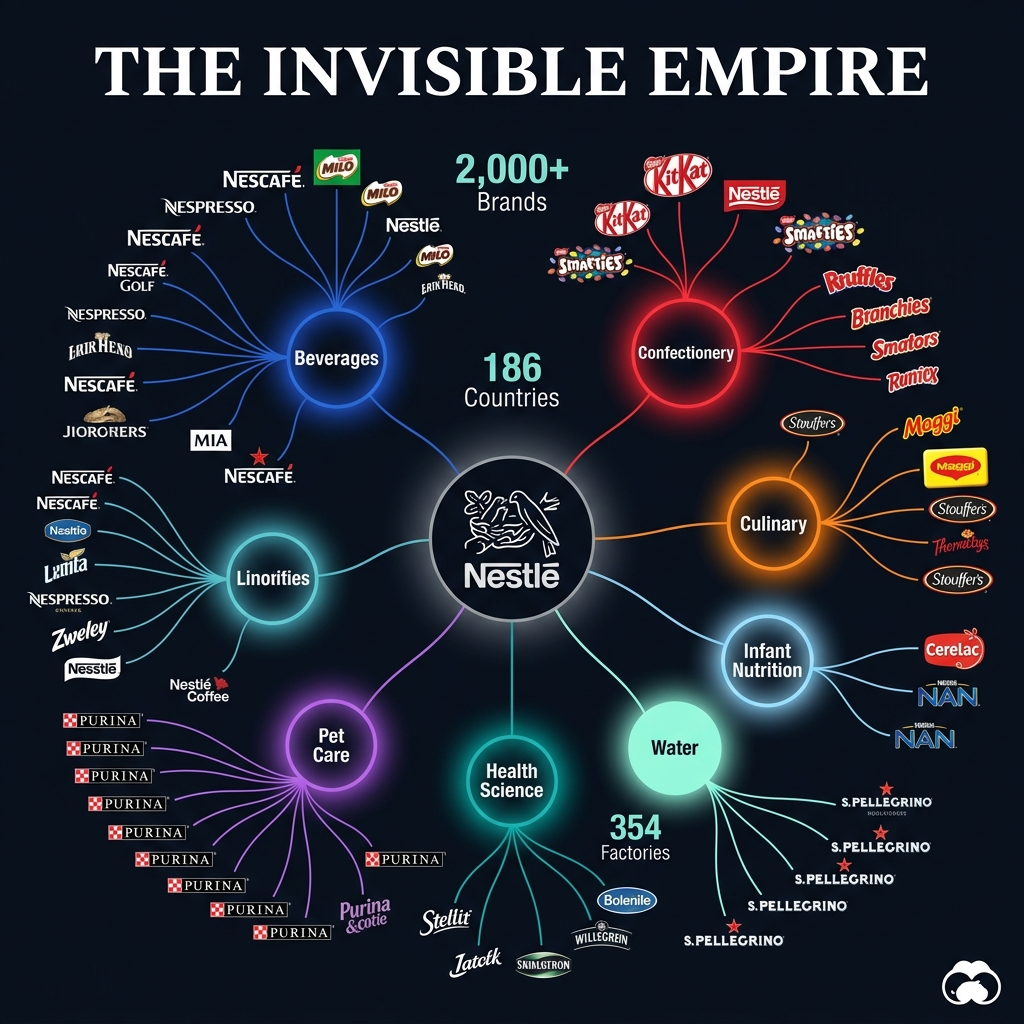
Perhaps the most powerful aspect of Nestlé’s psychology is what I call the “Invisible Empire” — the fact that most consumers don’t realize how many Nestlé products they consume daily.
🏗️ The “House of Brands” Strategy
Unlike companies like Apple or Nike that use a monolithic brand architecture (one brand name on everything), Nestlé uses a “house of brands” with endorsed endorsement” approach:
- Individual brands (KitKat, Maggi, Purina) have their own identities, personalities, and emotional associations
- The Nestlé corporate name appears as a subtle endorsement (usually on the back of packaging)
- This means consumers form emotional bonds with individual brands rather than with “Nestlé the corporation”
This is psychologically brilliant for several reasons:
- Scandal Containment: When controversy hits Nestlé the corporation, individual brands (like KitKat or Nescafé) are psychologically insulated. Consumers don’t connect their beloved KitKat with a Swiss corporation’s water policies
- Emotional Diversification: Each brand can have a different personality — Nescafé is sophisticated, Maggi is comforting, KitKat is playful, Purina is caring. This allows Nestlé to occupy multiple emotional territories simultaneously
- Competitive Illusion: On a supermarket shelf, multiple Nestlé brands can appear to compete with each other, giving consumers the illusion of choice while revenue flows to the same parent company
📊 A Day in a Consumer’s “Nestlé Life”
| ☀️ 7:00 AM | Wake up → Nescafé or Nespresso coffee (caffeine habit loop) |
| 🥣 7:30 AM | Cerelac for the baby, Nesquik for the kids (childhood anchoring begins) |
| ☕ 10:30 AM | Mid-morning Nescafé at the office (second hit of the habit loop) |
| 🍫 3:00 PM | KitKat break (behavioral pause trigger) |
| 🐕 5:30 PM | Feed the dog with Purina (pet parent guilt satisfaction) |
| 🍜 9:00 PM | Late-night Maggi noodles (comfort food craving) |
| 💧 Throughout | S.Pellegrino or Perrier (premium hydration identity) |
In this scenario, one consumer has interacted with 7 different Nestlé brands in a single day — likely without once thinking “I’m a Nestlé consumer.” This invisibility is not a bug; it’s the feature. It’s choice architecture at the highest level.
🔬 Chapter 5: Nestlé’s Advertising & Persuasion Psychology
🎭 The Multi-Personality Advertising Machine
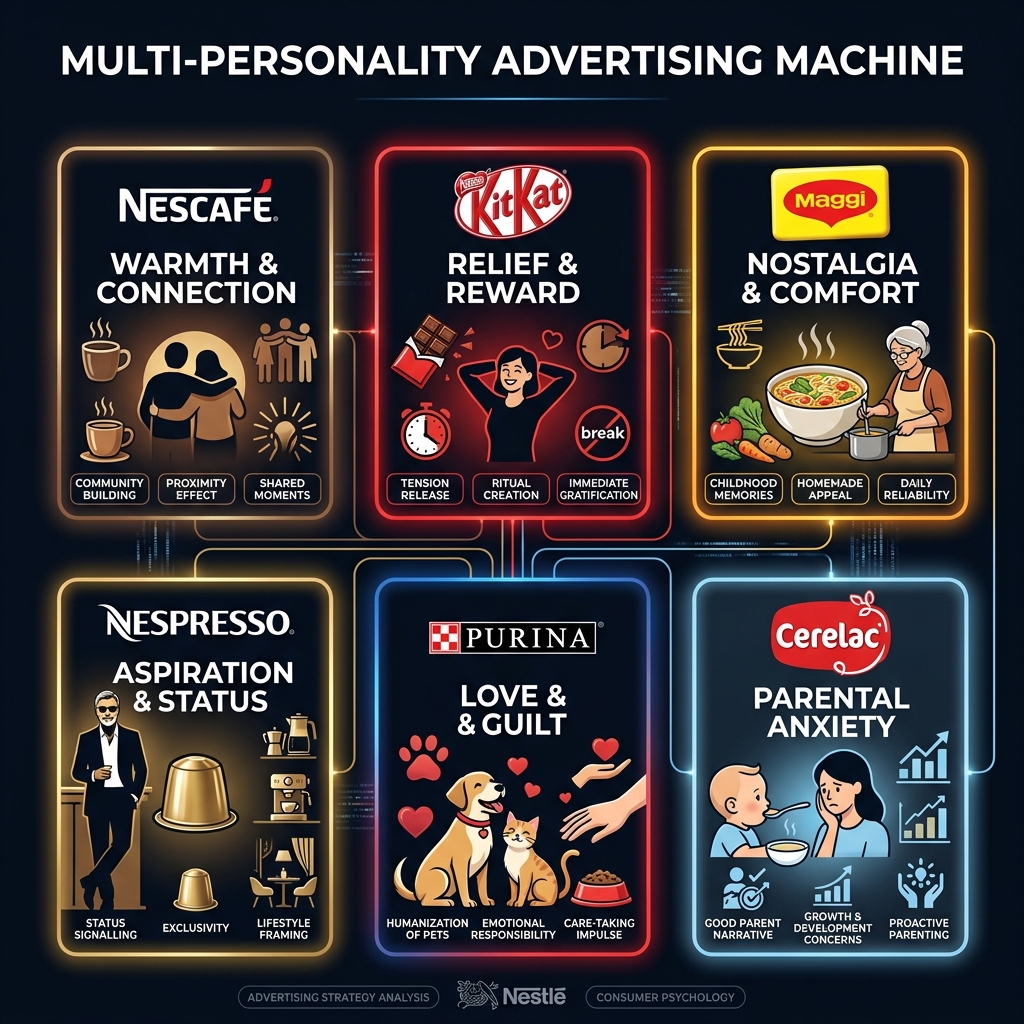
Unlike single-brand companies that need one consistent advertising voice, Nestlé operates a multi-personality advertising machine — each brand has its own psychological persuasion strategy:
| Brand | Primary Emotion | Psychological Technique |
| Nescafé | Warmth & Connection | Social bonding over coffee — “relationships are brewed” |
| KitKat | Relief & Reward | Behavioral trigger — every break = KitKat opportunity |
| Maggi | Nostalgia & Comfort | Childhood memory activation — “taste of growing up” |
| Cerelac | Parental Anxiety | Fear appeal — “is your baby getting enough nutrition?” |
| Purina | Love & Guilt | Anthropomorphism — “your pet deserves the best” |
| Nespresso | Aspiration & Status | Social class signaling — George Clooney endorsement |
| S.Pellegrino | Sophistication | Cultural capital — “the water of fine dining” |
🧲 The Nespresso Effect: Celebrity Authority & Aspirational Identity
Nespresso’s use of George Clooney as a brand ambassador since 2006 is one of the most successful celebrity endorsements in history. Here’s the psychology:
- Authority Bias: Clooney’s sophistication, intelligence, and charm transfer to the brand through the halo effect
- Aspirational Identity: Consumers don’t just buy a coffee machine — they buy a lifestyle signal. The Nespresso machine on your kitchen counter says: “I have refined taste”
- The “What Else?” Campaign: The tagline “What Else?” (spoken with Clooney’s signature wry smile) implies that choosing anything other than Nespresso would be absurd — a subtle form of social pressure disguised as humor
- Razor-and-Blade Model: The relatively affordable machine (the “razor”) locks consumers into buying proprietary capsules (the “blades”) — creating a switching cost that goes beyond taste preference into financial commitment
🌍 Cultural Localization: The Same Psychology, Different Languages
Nestlé’s advertising is hyper-localized, but the underlying psychology remains consistent:
- Pakistan/India: Maggi ads feature mothers preparing food for children — activating maternal guilt and love simultaneously
- Brazil: Nescafé campaigns emphasize social gatherings — tapping into Brazil’s communal culture
- Japan: KitKat campaigns lean into seasonal exclusivity with limited-edition flavors — triggering scarcity psychology and FOMO
- Africa: Milo campaigns associate the drink with athletic performance and childhood energy — positioning it as necessary for growth
- Europe: Corporate campaigns emphasize sustainability and heritage — addressing the more ethically conscious European consumer
⚖️ Chapter 6: The Psychology of Surviving Scandals — Cognitive Dissonance Management
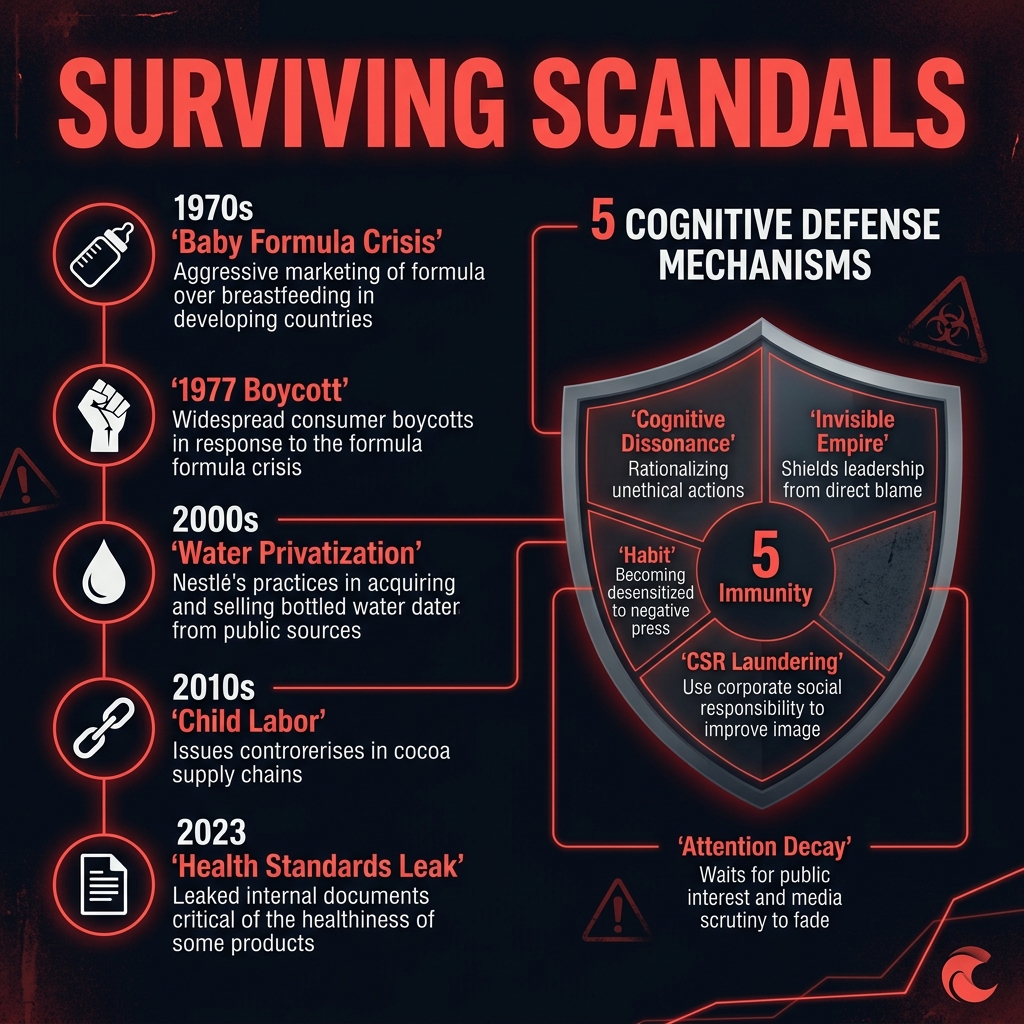
This is, from a psychological perspective, the most fascinating aspect of Nestlé’s brand: how does a company survive decades of deadly scandals and remain one of the world’s most valuable brands?
🧠 The 5 Psychological Defense Mechanisms Nestlé Exploits
1. Cognitive Dissonance Reduction
When consumers learn about Nestlé’s scandals but continue buying its products, they experience cognitive dissonance — the psychological discomfort of holding contradictory beliefs. To reduce this discomfort, consumers unconsciously employ several strategies:
- “Every company does bad things” — Normalization of corporate wrongdoing
- “But their products are really good” — Elevating the positive to outweigh the negative
- “That was in the past, they’ve changed” — Temporal distancing
- “I can’t avoid them anyway, they’re everywhere” — Learned helplessness
2. The Invisible Empire Defense
Because most consumers don’t realize that KitKat, Maggi, and Purina are all Nestlé products, boycotting Nestlé requires an active, informed effort that most people simply won’t make. The house-of-brands strategy isn’t just marketing — it’s scandal insurance.
3. Habit Immunity
Products like Nescafé and Maggi are so deeply embedded in daily routines that abandoning them feels like losing part of one’s identity. The psychological cost of change exceeds the emotional cost of the knowledge. This is why habit-forming products are the most scandal-resistant.
4. CSR as Reputation Laundering
Nestlé invests billions in Corporate Social Responsibility (CSR) programs — clean water initiatives, cocoa sustainability programs, nutrition education. From a psychology perspective, CSR serves as moral licensing — it gives consumers permission to continue purchasing: “They’re doing good things now, so it’s okay to buy from them.”
5. Attention Economy Decay
In the modern media environment, no scandal holds public attention for more than a few weeks. Nestlé has learned to weather controversies through patience — simply waiting for the next news cycle to shift public attention away. This is the “attention decay” strategy — the most reliable defense in the digital age.
📱 Chapter 7: Digital Presence & Modern Consumer Engagement
🌐 The Decentralized Digital Strategy
Unlike tech companies with unified digital experiences, Nestlé’s digital presence mirrors its brand architecture — decentralized and brand-specific:
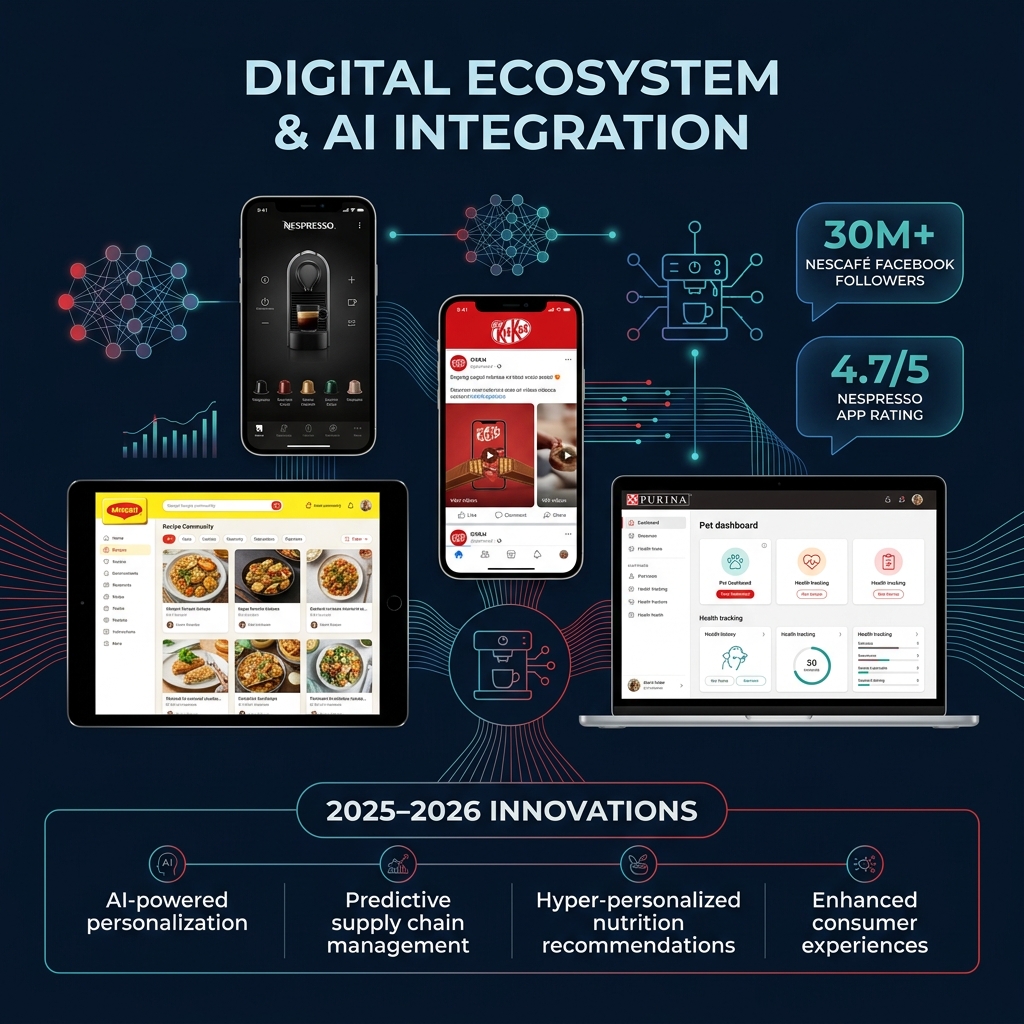
- Nespresso App: Premium UX with machine integration, subscription management, and personalized recommendations — rated 4.7/5 on app stores. This is Nestlé’s digital crown jewel
- Nestlé Corporate Website: Primarily investor-facing and B2B — not consumer-focused. The “Nestlé” brand itself doesn’t have a consumer digital presence
- Individual Brand Sites: Each major brand (Maggi, KitKat, Purina) has its own website, social media, and digital campaigns — maintaining the house-of-brands separation
📱 Social Media Psychology
Nestlé’s social media strategy varies dramatically by brand:
- KitKat (10M+ followers globally): Humor-forward, meme-friendly content that reinforces the “break” positioning. Heavy use of cultural moment marketing (hijacking trending topics with KitKat-related humor)
- Nescafé (30M+ Facebook followers): Emotional storytelling around coffee and human connection. UGC (User-Generated Content) campaigns that leverage social proof
- Maggi (7M+ followers in South Asia alone): Recipe content that turns consumers into brand co-creators. The Maggi recipe community is one of the most engaged food brand communities globally
- Purina: Pet content that exploits the cute animal effect (research shows cute animal content gets 2-3x more engagement than other content types)
🤖 AI & Future Tech (2025-2026)
Nestlé is investing heavily in AI across multiple dimensions:
- AI-Powered Product Development: Using machine learning to predict flavor trends and optimize formulations — reducing new product development from 18 months to 6 months
- Personalized Nutrition: Nestlé Health Science is developing AI-driven nutritional assessment tools that recommend specific Nestlé products based on individual health data — a powerful form of personalized persuasion
- Smart Nespresso Machines: Connected machines that learn user preferences and automatically reorder capsules — turning the subscription into a zero-friction automated habit
- Supply Chain AI: Predictive analytics for demand forecasting, reducing waste and ensuring product availability (because out-of-stock products break habit loops)
🌍 Chapter 8: Nestlé in Pakistan — A Localized Psychological Deep Dive
Nestlé Pakistan deserves special attention in this audit, as it demonstrates how the company’s global psychology adapts to local conditions:
🇵🇰 Market Overview
| Entity | Nestlé Pakistan Limited (PSX: NESTLE) |
| Established | 1988 (as Nestlé Milkpak Ltd — merged with Nestlé in 1998) |
| Revenue (2025 est.) | ~PKR 180+ billion (~USD 600+ million) |
| Key Brands | Nescafé, MAGGI, Everyday, MILKPAK, NIDO, KitKat, Cerelac, NAN, PURE LIFE |
| Factories | 3 major plants (Sheikhupura, Kabirwala, Islamabad) |
| Employees | ~4,000+ direct employees |
🥛 MILKPAK & Everyday: Trust in a Packet
In Pakistan, where fresh milk adulteration is a widespread concern, Nestlé MILKPAK and Everyday tea whitener have become trust signals. The psychology:
- Fear-Based Adoption: Pakistani consumers switched to packaged milk not because of brand loyalty, but because of fear of adulterated loose milk. Nestlé positioned itself as the safe alternative, leveraging negative motivation
- The “Everyday” Naming Strategy: Calling a product “Everyday” ensures it becomes associated with daily necessity rather than occasional purchase. It’s a linguistic anchor that normalizes daily consumption
- Chai Culture Integration: By becoming essential to Pakistan’s chai ritual, Nestlé Everyday has achieved what behavioral psychologists call “habit stacking” — attaching itself to an existing powerful habit (chai drinking) rather than creating a new one
📺 Pakistan Advertising Strategy
Nestlé Pakistan’s advertising consistently leverages:
- Family values and maternal imagery — aligning with Pakistan’s family-centered culture
- Religious seasonal marketing — Ramadan, Eid campaigns that position Nestlé products as integral to celebrations
- Celebrity endorsements — using cricket stars and drama actors to transfer trust and appeal
- Health and nutrition claims — Cerelac and NIDO ads emphasize “growth” and “development,” targeting parental anxiety
📊 Chapter 9: Psychology Scorecard — Detailed Ratings
🧠 Overall Psychology Score: 74/100
| Brand Identity & Visual Psychology | 90/100 ⭐⭐ |
| Advertising & Persuasion Psychology | 88/100 ⭐ |
| Habit Engineering & Behavioral Design | 95/100 ⭐⭐⭐ |
| Portfolio Strategy & Choice Architecture | 92/100 ⭐⭐ |
| Cultural Localization & Identity Anchoring | 88/100 ⭐ |
| Digital UX & Modern Consumer Engagement | 65/100 |
| Ethical Perception & Trust Integrity | 38/100 ⚠️ |
| Scandal Recovery & Crisis Psychology | 82/100 ⭐ |
| Nostalgia & Emotional Memory Anchoring | 91/100 ⭐⭐ |
| Innovation & Future-Readiness | 72/100 |
✅ Chapter 10: Strengths & Weaknesses — The Psychological Balance Sheet
💪 Psychological Strengths
- Unmatched Habit Engineering: No corporation on Earth has more deeply embedded itself into daily human behavior. From morning coffee to midnight snacks, Nestlé products are woven into the behavioral fabric of billions of lives. This creates switching costs that are psychological, not just financial.
- The Invisible Empire: The house-of-brands strategy means consumers can feel good about boycotting “Nestlé” while unknowingly continuing to buy Nestlé products. This structural invisibility is the most powerful brand defense mechanism in corporate history.
- 158 Years of Trust Accumulation: Every year of existence adds another layer of authority and credibility. “If they’ve been around for 158 years, they must be doing something right” — this is the survivorship bias working in Nestlé’s favor.
- Cultural Chameleon Ability: Nestlé can be Swiss (heritage), Japanese (KitKat innovation), South Asian (Maggi comfort), African (Milo energy), or American (Gerber trust) — depending on what the local market needs. This cultural fluidity is unprecedented in FMCG.
- Emotional Portfolio Diversification: By owning brands across every emotional territory — comfort, aspiration, care, indulgence, health — Nestlé ensures it captures consumer spending regardless of their emotional state.
⚠️ Psychological Weaknesses
- Ethical Debt: The baby formula scandal, water privatization, child labor — these aren’t just PR problems, they’re moral injuries that create a permanent credibility gap with ethically conscious consumers. Every new controversy compounds the existing damage.
- The Health Credibility Crisis: The 2023 internal document leak revealing that 60%+ of products fail to meet health standards directly contradicts the “Good Food, Good Life” positioning. This creates cognitive dissonance within the brand itself.
- Gen Z Vulnerability: Younger consumers are more likely to research corporate ethics, engage in boycotts, and choose transparent brands. Nestlé’s scandal-laden history is permanently searchable on the internet — the attention decay strategy is less effective with this generation.
- Digital Experience Fragmentation: While the decentralized brand strategy works for marketing, it creates a fragmented and inconsistent digital experience. There’s no unified Nestlé digital ecosystem comparable to what tech companies offer.
- Over-Dependence on Developing Markets: Much of Nestlé’s growth comes from developing countries where regulatory oversight is weaker. As these markets mature and regulations tighten, some of Nestlé’s more aggressive marketing tactics will face increasing resistance.
🔮 Chapter 11: Strategic Recommendations — A Psychologist’s Prescription
Based on this comprehensive psychological analysis, here are my evidence-based recommendations for Nestlé’s brand strategy through 2026 and beyond:
1. Radical Transparency Initiative (Highest Priority)
Nestlé must recognize that the era of “wait for the scandal to blow over” is ending. Gen Z consumers demand proactive transparency, not reactive damage control. The company should:
- Publish real-time supply chain tracking for all major products
- Create an independent Ethics Dashboard with third-party auditing
- Address historical scandals directly and specifically — not through vague CSR statements, but through concrete reparative actions
- Redesign the “Good Food, Good Life” tagline to reflect genuine nutritional improvements
2. Accelerate the Health Transformation
The leaked health document created an existential threat to Nestlé’s brand promise. The company must rapidly reformulate products to align marketing claims with nutritional reality:
- Reduce sugar content across the portfolio by 25-30%
- Invest in genuinely healthy products (not just “healthier versions” of unhealthy ones)
- Partner with public health organizations for credibility transfer
- Use the Health Science division as the credibility anchor for the broader portfolio
3. Build a Unified Digital Ecosystem
Nestlé should create a “Nestlé Life” super-app that connects all brand interactions:
- Unified loyalty program across all Nestlé brands
- AI-powered personalized nutrition recommendations
- Recipe integration (Maggi) + Coffee subscriptions (Nespresso/Nescafé) + Pet care (Purina) in one ecosystem
- This would make the invisible empire visible and valuable — turning brand ubiquity from a liability into a loyalty asset
4. “Heritage + Innovation” Dual Positioning
Nestlé’s 158-year heritage is an asset, but only if combined with genuine innovation:
- Launch a “1866 Collection” — premium heritage products that celebrate the founding story
- Simultaneously invest in future-forward products — AI-personalized nutrition, sustainable packaging, plant-based alternatives
- This dual positioning addresses both nostalgia-driven older consumers and innovation-seeking younger ones
5. Localized Ethical Repair
Rather than global CSR campaigns, Nestlé should implement market-specific ethical repair:
- Africa: Establish permanent breastfeeding support infrastructure as reparation for the formula scandal
- Water-affected communities: Create community water purification programs in every region where Nestlé has extracted water
- Cocoa farming: Guarantee minimum income for all farming families in the supply chain — with independent verification
- Pakistan: Invest in dairy farmer support programs and food safety education — aligning corporate interests with national public health
📝 Final Verdict
Nestlé is, without question, the most psychologically sophisticated consumer goods company in human history. No other corporation has achieved such deep behavioral integration across so many markets, categories, and cultural contexts. The company’s ability to engineer habits, anchor memories, localize emotions, and survive scandals represents a 158-year masterclass in applied consumer psychology.
But this psychological sophistication comes with a profound moral responsibility — one that Nestlé has repeatedly failed to meet. The baby formula deaths, the water privatization, the child labor — these aren’t footnotes in Nestlé’s story. They are central to understanding how unchecked corporate psychology can cause real human harm.
The paradox of Nestlé is this: the same psychological mechanisms that make its products comforting, habitual, and beloved are the same mechanisms that allow consumers to look away from its ethical failures. Trust, habit, nostalgia, identity — these are not just marketing tools. They are shields against accountability.
As we move into 2026 and beyond, Nestlé faces a choice: continue relying on psychological inertia and hope that consumers never collectively demand change, or genuinely transform — not just its marketing, but its practices — to match the warmth and nourishment that its founding story promises.
Psychology Score: 74/100 — Nestlé scores exceptionally high on habit engineering (95/100), portfolio strategy (92/100), and nostalgia anchoring (91/100) — making it one of the highest-scoring brands in pure behavioral psychology. However, the ethical perception score (38/100) creates a weighted drag that reflects the growing gap between psychological effectiveness and moral integrity. Nestlé is proof that a brand can be psychologically brilliant and ethically compromised at the same time.
🧠 Want a Psychology Audit for Your Brand?
I’m Muhammad Shahzeb — an MSc Industrial Psychologist & Full-Stack Developer. I apply behavioral science to branding, web design, and conversion optimization. Let’s analyze your brand’s psychological impact.
📚 References & Sources
- Nestlé S.A. “Annual Review 2024–2025.” nestle.com
- Nestlé Pakistan Limited. “Annual Reports 2020–2025.” nestle.pk
- World Health Organization. “International Code of Marketing of Breast-milk Substitutes (1981).” who.int
- Muller, M. (1974). The Baby Killer. War on Want.
- Skenazy, P. “The Nestlé Boycott: The Story of the WHO Code.” International Baby Food Action Network (IBFAN).
- Financial Times. “Nestlé Admits Most of Its Food Portfolio Is Unhealthy (2023).” ft.com
- Duhigg, C. (2012). The Power of Habit. Random House.
- Cialdini, R. B. (2006). Influence: The Psychology of Persuasion. Harper Business.
- Kahneman, D. (2011). Thinking, Fast and Slow. Farrar, Straus and Giroux.
- Thaler, R. H. & Sunstein, C. R. (2008). Nudge: Improving Decisions About Health, Wealth, and Happiness. Yale University Press.
- Aaker, D. (2004). Brand Portfolio Strategy. Free Press.
- U.S. Supreme Court. Nestlé USA, Inc. v. Doe (2021). 593 U.S. 628.
- University of Chicago/NORC. “Assessing Progress in Reducing Child Labor in Cocoa Production (2020).”
- ProPakistani. “Pakistan FMCG Market Reports 2024–2026.”
- Pakistan Stock Exchange. “Nestlé Pakistan Limited — Financial Filings.”
Audit conducted by Muhammad Shahzeb — MSc Industrial & Organizational Psychology | Brand Psychology Specialist | Full-Stack Web Developer
Learn more about my approach →
Key Findings
- Nestlé's portfolio of 2,000+ brands creates an inescapable "choice architecture" where consumers unknowingly interact with Nestlé products 8-12 times daily
- The company's 158-year heritage is weaponized as an authority signal — "if they've survived this long, they must be trustworthy"
- Nestlé's localization strategy (Maggi in South Asia, Milo in Southeast Asia, Nescafé globally) triggers deep cultural identity anchoring
- Despite decades of scandals (baby formula, water privatization, child labor), Nestlé maintains market dominance through cognitive dissonance management
- The "Good Food, Good Life" repositioning represents a masterclass in health halo psychology — reframing processed food as wellness
- Nescafé's morning ritual positioning has created one of the most powerful habit loops in global consumer behavior
Overall Psychology Score
Nestlé scores 74/100 in our comprehensive psychology audit covering consumer behavior strategies, UX design principles, and psychological marketing effectiveness.
The detailed dimension scores are in the audit's Psychology Scorecard chapter.
High impactMuhammad Shahzeb
MSc Industrial Psychologist, specializing in consumer behavior, UX psychology, and brand strategy analysis. Helping brands understand the psychology behind their success.
About Muhammad Shahzeb →