Instagram Psychology Audit — The Three-Billion-User Comparison Machine
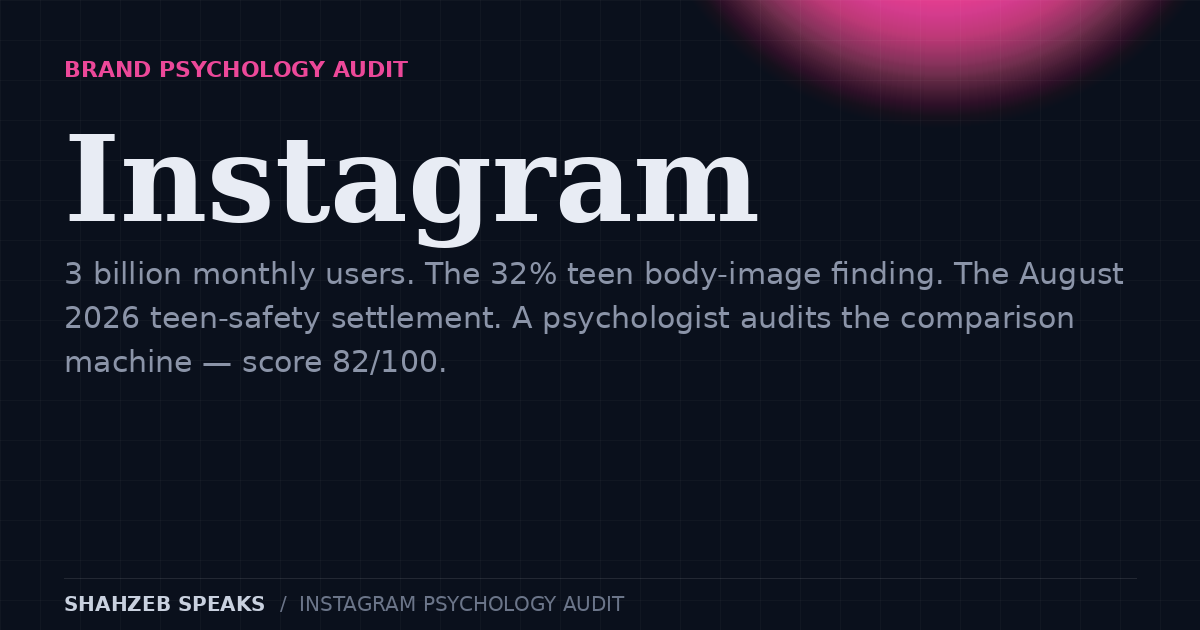
Instagram turned social comparison into a 3-billion-user habit: variable rewards, quantified approval, and the curated self. This audit examines the twelve documented psychological mechanisms — and carries the full legal record at its exact status, from a settled ~$17–18B US teen case to a €200M EU fine under appeal.

82 / 100
Overall consumer behavior effectiveness
Brand Overview
- Brand nameInstagram
- Founded2010
- HeadquartersMenlo Park, California
- IndustrySocial Media
- Websitewww.instagram.com ↗
Psychology Techniques Identified
- 01Variable-Reward Scheduling (Algorithmic Feed, 15 Mar 2016)
- 02The Hook Loop (Trigger → Action → Variable Reward → Investment)
- 03Social Comparison by Design (Curated Feeds, Explore)
- 04Quantified Approval (Like Counts — and the 2019–2021 Hiding Experiment)
- 05Ephemerality & FOMO (Stories, 2 Aug 2016)
- 06Identity Curation (Filters, Grids, Highlights)
- 07Network-Effect Lock-In (3 Billion MAUs; Threads Tie-In, 5 July 2023)
- 08Creator Status Ladder (Verification; Reels vs TikTok, 5 Aug 2020)
- 09Reciprocity Infrastructure (DMs — Credited for 3B Growth)
- 10Trust-Repair Rituals (Take a Break 2021; Quiet Mode 2023; Teen Accounts 2024)
- 11Default Architecture (Private-by-Default Teen Accounts; Parental Permission Under 16)
- 12Compliance as Product (Aug 2026 AG Agreement; School Partnerships)
Full Psychology Audit Report
In this audit
Three billion people open the same app to find out, several times a day, whether their life measures up. The holiday photos, the engagement announcements, the bodies, the breakfasts — each one a small referendum on the viewer. Instagram is the most successful comparison machine ever built: a product that turned human beings’ oldest psychological reflex — measuring ourselves against each other — into a $200-billion-a-year advertising business.
The numbers are difficult to absorb. Instagram launched on 6 October 2010 as an iPhone-only photo app built by two men, Kevin Systrom and Mike Krieger. Facebook announced it would buy the 13-person company on 9 April 2012 for approximately $1 billion in cash and shares. On 24 September 2025, Mark Zuckerberg announced the app had reached 3 billion monthly active users — and by mid-2026 Meta said it had crossed 2 billion daily users. Analysts estimate Instagram now generates more than half of Meta’s US advertising revenue. It is, by the only metric that matters in Silicon Valley, one of the most effective products ever shipped.
I am an Industrial and Organizational Psychologist in Karachi. I audit brands the way I audit workplaces: by asking which psychological mechanisms a system rewards, and what those rewards cost the humans inside it. Instagram rewards comparison, curation, and compulsive checking — and the bill, as the courts and regulators are now itemising, arrives in adolescent mental health, attention, and trust. This audit maps the twelve documented mechanisms, carries the full legal record at its exact status, and scores the machine honestly.
“Instagram did not invent social comparison. It industrialised it — put it in every pocket, refreshed it algorithmically, and sold the resulting attention to advertisers at a scale no psychologist’s laboratory could ever simulate.”
— Brand Psychology Analysis, ShahzebSpeaks
📋 Brand Overview
| Brand | |
| Parent | Meta Platforms, Inc. (Facebook, Inc. until October 2021) |
| Founded | 6 October 2010 (App Store, iOS-only), by Kevin Systrom and Mike Krieger |
| Acquired | Announced 9 April 2012, ~$1B cash and shares; FTC cleared 22 Aug 2012; closed 6 Sept 2012 |
| Headquarters | Menlo Park, California, USA |
| Scale (as of 19 Oct 2026) | 3 billion monthly active users (announced 24 Sept 2025); ~2 billion daily users (Q2 2026) |
| Revenue context | Meta FY2025 revenue $201B (reported 28 Jan 2026); analysts estimate Instagram is over half of Meta’s US ad revenue |
| Website | https://www.instagram.com/ |
📜 Chapter 1: History — from a check-in app to three billion users
Instagram began as Burbn, a location check-in app Systrom built in San Francisco from late 2009. A $500,000 seed round closed on 5 March 2010 — then the photo-sharing pivot that became Instagram, launched 6 October 2010. The growth was violent: 25,000 users in the first 24 hours, roughly a million within two months, 10 million in the first year. Facebook’s $1 billion acquisition announcement came just eighteen months after launch — a price that looked absurd in April 2012 and looks like theft in retrospect.
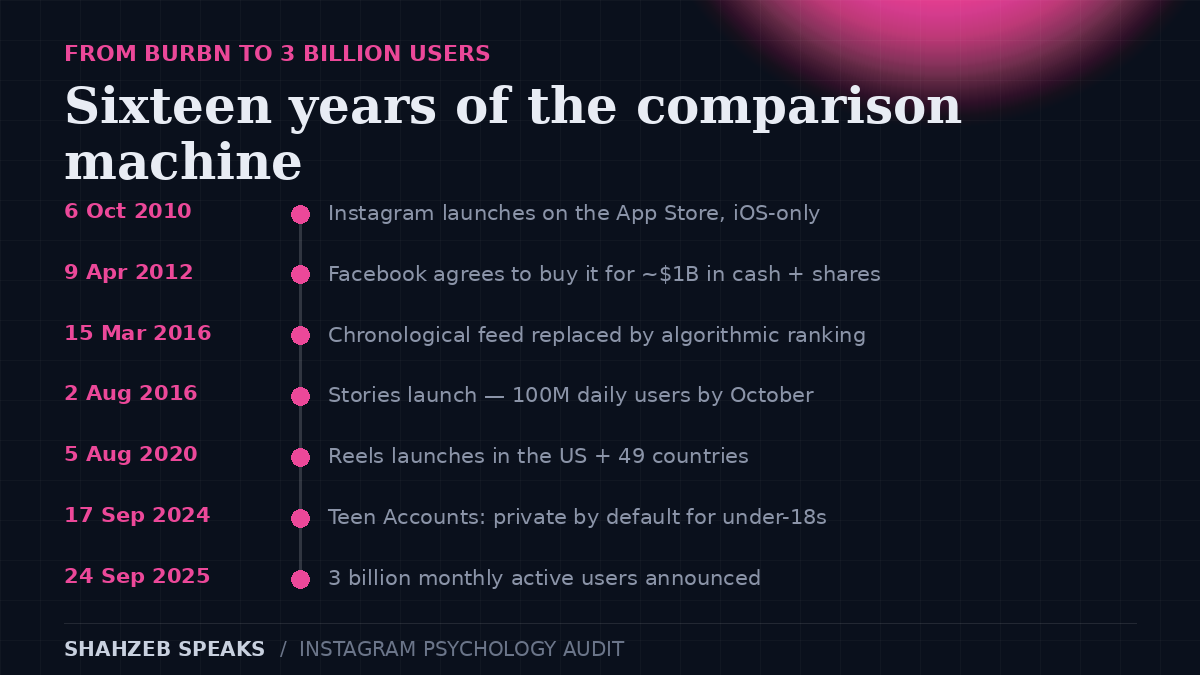
The product milestones after the acquisition read like a catalogue of applied psychology. On 15 March 2016 Instagram abandoned the chronological feed for algorithmic ranking — “the likelihood you’ll be interested in the content, your relationship with the person posting and the timeliness of the post” — telling users they had been missing roughly 70% of their feed (a company claim, but the strategic logic needs no verification: whoever controls the order controls attention). On 2 August 2016 came Stories — 24-hour ephemeral slideshows openly modelled on Snapchat — reaching 100 million daily users by October 2016 (company claim). Reels followed on 5 August 2020, a direct TikTok rival. The founders, Systrom and Krieger, had departed on 24 September 2018, with Adam Mosseri named head a week later. By the time Zuckerberg announced 3 billion monthly users on 24 September 2025, Mosseri credited three things: direct messages, Reels, and algorithmic recommendations. Note what is missing from that list: the chronological feed, the like count, the founders.
🎰 Chapter 2: Variable rewards — the feed that never pays out the same twice
The most powerful schedule of reinforcement in behavioural psychology is the variable-ratio schedule: rewards delivered unpredictably, which produces the highest and most persistent rates of responding. It is why slot machines work. Instagram’s algorithmic feed is a slot machine that pays out in social information — sometimes a like from a crush, sometimes nothing, sometimes a video you cannot stop watching — and the unpredictability is the point. You cannot learn when the reward is coming, so you check constantly.
Practitioner Nir Eyal’s Hooked (2014) gives this a useful four-step vocabulary — Trigger, Action, Variable Reward, Investment — and Instagram runs the loop flawlessly. The trigger is the push notification or the idle moment; the action is the pull-to-refresh; the variable reward is whatever the algorithm serves; the investment is the follow, the like, the posted photo — each one making the next loop more personalised and harder to leave. (Eyal’s model is a business framework, not a peer-reviewed finding; I use it here as an analytical lens, which is all it claims to be.) The March 2016 shift to algorithmic ranking was the moment Instagram took manual control of the reward schedule. A chronological feed pays out in order; an algorithmic feed pays out for maximum engagement. The house always sets the odds.
🪞 Chapter 3: Social comparison — the engine under the hood
In 1954, Leon Festinger proposed social comparison theory: humans evaluate themselves not against absolute standards but against other people — and we are drawn, relentlessly, to upward comparison against those doing better. Instagram is Festinger’s theory with three billion subjects and no ethics board. Every scroll is a forced march past curated excellence: bodies, holidays, careers, relationships, all filtered, all simultaneous, all implicitly ranked against your own unfiltered life.
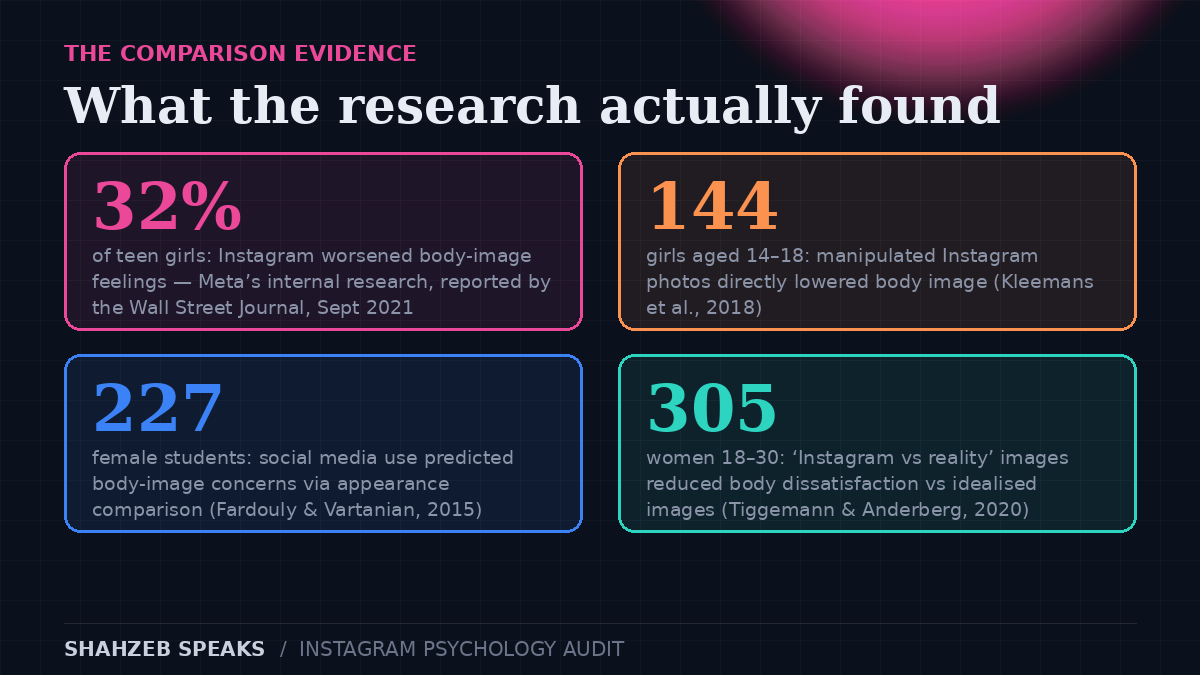
The experimental evidence is unusually direct for this kind of claim. Fardouly and Vartanian (2015) surveyed 227 female university students and found that time spent on social media predicted body image concerns — mediated by appearance comparisons, especially upward comparisons to distant peers and celebrities. Women did not feel worse because they were online; they felt worse because they were comparing. Kleemans and colleagues (2018) went further experimentally: 144 girls aged 14–18 were randomly shown original or manipulated (retouched and reshaped) Instagram selfies, and exposure to the manipulated photos directly lowered body image — most sharply among girls with a high tendency to compare. The manipulated photos were rated more positively even though the reshaping was barely noticed: the ideal is both irresistible and invisible.
Then came the internal confirmation. In September 2021, the Wall Street Journal‘s “Facebook Files” reported Meta’s own research slides, including the finding that “thirty-two percent of teen girls said that when they felt bad about their bodies, Instagram made them feel worse” (from a March 2020 presentation), and a 2019 slide stating “we make body image issues worse for one in three teen girls.” Meta’s response is worth recording precisely: on 26 September 2021, VP of Research Pratiti Raychoudhury argued it was “simply not accurate” to call Instagram “toxic” for teen girls — noting that on 11 of 12 well-being issues more struggling teens said Instagram made things better, that body image was the one issue where more said worse, that the “one in three” figure applied to girls already experiencing body image issues, and that the research did not establish causation. Both statements can be true: the product is not poison, and it measurably worsens the specific wound of body image among the already vulnerable. That is exactly what a comparison machine would do.
❤️ Chapter 4: The like as currency — quantified approval
Before Instagram, approval was vague — a compliment, a laugh, a feeling. Instagram made it a number, public, and attached to everything you publish. The like count turned social approval into currency: countable, comparable, and spendable as status. Teenagers learned to delete photos that “flopped”; adults learned to read their own worth in double-taps. This was not an accident of design. A quantified metric that updates in real time is the purest variable reward ever deployed at scale — and the anxiety it produced became one of the product’s most documented harms.
What makes this chapter interesting is that Instagram noticed — and partially retreated. At Facebook’s F8 conference in April–May 2019, Adam Mosseri announced a pilot hiding like counts, starting in Canada, to shift focus from popularity to content quality. The test expanded globally on 14 November 2019, and on 26 May 2021 Meta gave everyone the option to hide public like counts on all posts. Psychologically, this was a genuine intervention: remove the number and you weaken both the reward (no public score) and the comparison (no visible ranking). But note the compromise — hiding is optional, and the default kept the counts visible. A company fully convinced the metric was harmful would have removed it. Instagram treated the like count the way a casino treats a smoking section: acknowledge the harm, contain it, keep the revenue.
⏳ Chapter 5: Ephemerality — Stories and engineered FOMO
On 2 August 2016, Instagram launched Stories: photos and videos that vanish after 24 hours, openly modelled on Snapchat Stories. The psychology here is scarcity applied to attention. A permanent post can be viewed tomorrow; a Story disappearing at midnight must be viewed now. Ephemerality manufactures urgency where none exists, converting casual users into daily checkers. It reached 100 million daily users within about two months of launch (company claim) — the fastest-adopted format in the app’s history at that point.
Stories also solved a problem the main feed had created. The permanent, curated grid had become a performance space where posting felt high-stakes — the comparison pressure of Chapter 3 made casual sharing feel risky. Stories lowered the stakes: blurry, unfiltered, gone tomorrow. The result was more posting, more viewing, and more daily sessions — a second variable-reward loop stacked on top of the first. Instagram had learned to sell both the museum (the grid) and the street (Stories), and to collect attention at both.
🎭 Chapter 6: The curated self — identity as a product
In 1959, sociologist Erving Goffman proposed that social life is a performance: we manage impressions the way actors manage a stage, with a “front region” for the audience and a “back region” for ourselves. Instagram is Goffman’s front region, industrialised. Filters, grids, Highlights, captions — the entire toolkit exists to help users stage-manage identity, and the audience’s quantified applause (Chapter 4) tells them which performance works.
The cost of the performance is documented. Tiggemann and Anderberg (2020) randomly assigned 305 women aged 18–30 to view “Instagram vs reality” image pairs, the “ideal” side alone, or the “real” side alone. Viewing the paired or real images decreased body dissatisfaction relative to the idealised images, and appearance comparison predicted harm only in response to the ideal images. The mechanism is not photography; it is the gap between the staged ideal and the unstaged self. Instagram’s genius was making the staging tools free and the audience infinite — then letting the gap do the work. Every user is simultaneously performer and audience, which means everyone is both inflicting and receiving the same wound.
🔒 Chapter 7: The lock-in — why nobody leaves
Three billion monthly users is not a user base; it is a moat. Social products exhibit network effects — each new user makes the product more valuable for every existing user — and at Instagram’s scale the effect becomes coercive. Leaving means abandoning the archive of your own life, the audience you built, and the social graph through which invitations, jobs, and relationships now flow. The switching cost is not technical. It is biographical.
Meta has reinforced the walls deliberately. Threads, launched 5 July 2023 and tied to Instagram accounts, converted the social graph into a multi-product asset: your followers, your identity, and your verification now span apps, making departure from any single one costlier. And Mosseri’s own account of the 3-billion milestone is revealing — he credited direct messages alongside Reels and recommendations. DMs are the stickiest feature a social app can own: they convert a public stage into a private utility, and nobody deletes their messaging history lightly. The comparison machine keeps you scrolling; the messaging graph keeps you from leaving.
🏆 Chapter 8: The creator ladder — status as a retention tool
Reels, launched 5 August 2020 as a TikTok rival, added a second economy to Instagram: not just social status among friends, but creator status among strangers. Verification badges, follower counts, algorithmic amplification — the ladder is visible, climbable, and almost entirely luck-and-timing-dependent, which is precisely the reinforcement schedule that keeps people pulling the lever. For the tiny fraction who climb it, the rewards are real (careers, sponsorships, fame). For everyone else, the ladder functions as what psychologists call an intermittent reward: just enough winners, just visible enough, to keep millions of losers posting.
The cruelty is structural, not personal. A platform that paid every creator fairly would go bankrupt; a platform that paid none would lose supply. The ladder pays a few spectacularly and the rest in hope — and hope, refreshed by every viral outlier on the Explore page, is the cheapest content-acquisition strategy ever devised.
🛡️ Chapter 9: Trust repair as strategy — the apology cycle
Read Instagram’s teen-safety timeline as a psychologist and a pattern emerges: each wave of criticism produces a feature, and each feature produces a press release. “Take a Break” launched 7 December 2021, nudging users (teens especially) to pause after a set time. “Quiet Mode” followed on 19 January 2023, muting notifications and auto-replying to DMs. Teen Accounts arrived 17 September 2024 — under-18 accounts private by default, messaging restricted, under-16s needing parental permission to loosen the defaults — expanded in April 2025 (no Live without parental approval, suspected nude images auto-blurred in DMs) and again in June 2026, when Meta said 97% of 13–15-year-olds remain within the built-in restrictions (company claim).
Are these genuine protections or reputation management? The honest answer is both, and the distinction matters less than the mechanism: trust repair is now part of the product strategy. In August 2026 Meta announced an agreement with 52 bipartisan US state attorneys general introducing further teen restrictions — advocacy reporting describes a shared two-hour daily limit across Facebook and Instagram, night access blocked from midnight to 6 a.m., and school-hour notification muting (figures per advocacy reporting, not Meta’s wording). In October 2026 Meta expanded its School Partnership Program to nearly 17,000 schools (company claim). Each announcement converts a liability (regulatory pressure) into an asset (a “safety leadership” narrative). Cynical? Partly. Effective? The August 2026 settlement suggests regulators accepted the trade. The apology cycle is not a bug in Instagram’s psychology — it is the final mechanism: when the machine is caught harming people, it performs care, and the performance itself retains users.
⚠️ Chapter 10: The dark side — the legal record at its exact status
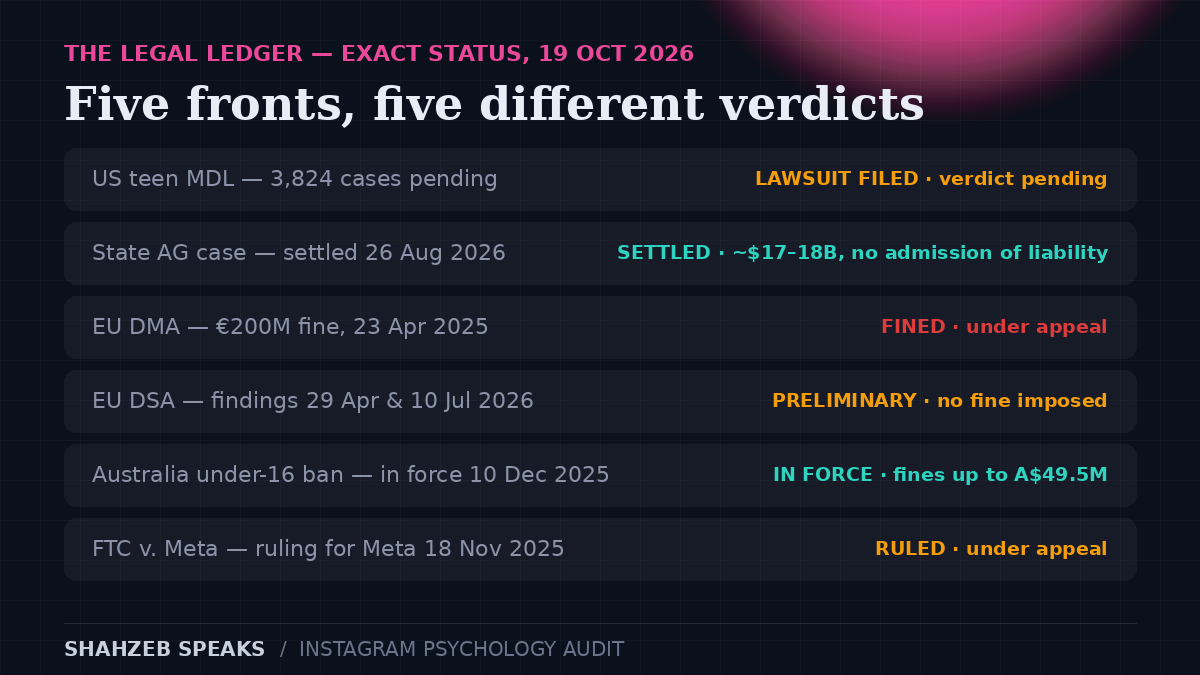
Every claim below carries its precise legal status as of 19 October 2026. I do not upgrade allegations to findings or settlements to admissions — the difference matters, and the record is serious enough without embellishment.
United States — the teen mental-health litigation
The federal multidistrict litigation (MDL No. 3047, Northern District of California) is still pending: the Judicial Panel’s 1 October 2026 report counted 3,824 pending cases (4,009 filed in total). No federal personal-injury bellwether has been decided. School-district bellwether trials are set for February 2027, and a consolidated personal-injury trial in the parallel California state coordination was set to begin 28 October 2026. Status: lawsuit filed — verdict pending.
Separately, the state attorneys general case filed in October 2023 over youth-addictive design went to trial in Oakland on 18 August 2026 and was settled on 26 August 2026: the court entered a consent judgment under which Meta pays the states up to roughly $17–18 billion over ten years (about $12–12.7 billion guaranteed, the rest contingent on rivals adopting similar reforms), alongside ten years of teen-safety changes to Facebook and Instagram — including daily limits and night-time blocks. No admission of liability. Florida and New Mexico did not join the deal. Status: settled (without admission), court-approved.
European Union — fines and findings
On 23 April 2025 the European Commission found Meta in non-compliance with the Digital Markets Act over its “consent or pay” advertising model on Facebook and Instagram and fined Meta €200 million. Meta is challenging the decision in the EU courts. Status: fined — under appeal.
Under the Digital Services Act, the Commission opened formal proceedings against Facebook and Instagram in May 2024, then issued preliminary findings on 29 April 2026 (failure to assess risks of under-13s accessing the platforms) and 10 July 2026 (“addictive design”: infinite scroll, autoplay, push notifications, personalised recommenders). Status: preliminary findings — not final determinations; no fine imposed as of 19 October 2026.
Australia — the under-16 ban
The landmark law passed in November 2024 took effect on 10 December 2025, requiring major platforms including Instagram to block under-16s from holding accounts, with penalties of up to A$49.5 million for non-compliance. Status: in force.
FTC v. Meta — the antitrust case
After a six-week bench trial beginning April 2025 over the 2012 Instagram and 2014 WhatsApp acquisitions, Judge James Boasberg ruled in Meta’s favour on 18 November 2025, holding the FTC had not proved Meta holds monopoly power in social networking. The FTC announced its appeal in January 2026 and filed its opening brief in May 2026. Status: final ruling at trial level for Meta — under appeal.
🇵🇰 Chapter 11: What brands should — and shouldn’t — copy
Copy the craft, not the cruelty. Instagram’s onboarding, its progressive disclosure of features, its investment in creator tools — these are legitimate lessons in reducing friction and rewarding participation. Any brand, in Pakistan or anywhere else, can learn from the Hook loop’s structure: trigger, action, reward, investment is a fine way to build a useful habit (a fitness app, a learning platform) as well as a compulsive one. The mechanism is neutral; the reward decides the ethics.
Do not copy the comparison architecture. Public like counts, follower counts as status, algorithmic amplification of idealised bodies — these are the specific design choices now itemised in court filings and preliminary EU findings. A brand that builds its growth on making customers feel inadequate is renting its revenue from their self-esteem, and regulators on three continents have started collecting. The Teen Accounts episode is the template for what “responsible” looks like under pressure: private-by-default for young users, parental gates on the riskiest features, and defaults that protect rather than expose. Build those defaults before the attorneys general call — it is cheaper than $17 billion.
📊 Chapter 12: Psychology Scorecard
| Habit Engineering — variable rewards, the Hook loop, algorithmic control of the payout schedule | 94/100 |
| Social Comparison Engine — the core product is upward comparison at planetary scale | 91/100 |
| Self-Presentation Toolkit — filters, grids, Stories: Goffman’s stage, free of charge | 89/100 |
| Network Effects & Lock-In — 3B users, DMs, Threads: the moat is biographical | 93/100 |
| Format Innovation — Stories (2016) and Reels (2020) each opened a new attention surface | 87/100 |
| Trust & Safety Credibility — real reforms, but after years of documented harm and under legal duress | 55/100 |
| Creator Monetisation — the status ladder converts hope into content at near-zero cost | 84/100 |
| Regulatory Resilience — survives rulings and settles strategically, but the fronts keep multiplying | 61/100 |
Score arithmetic: 94 + 91 + 89 + 93 + 87 + 55 + 84 + 61 = 654. 654 ÷ 8 = 81.75, rounded to 82/100.
✅ Balance sheet & prescription
Assets: the strongest habit loop in consumer technology; a network effect that borders on infrastructure; a format-innovation record (Stories, Reels) that repeatedly absorbed competitive threats; and — credit where due — the most extensive teen-safety apparatus any social platform has built, however belatedly.
Liabilities: a core mechanism (social comparison) that peer-reviewed research and the company’s own slides link to body-image harm among vulnerable teens; a legal ledger with a ~$17–18 billion settlement, a €200 million fine under appeal, and multiplying regulatory fronts; and a trust deficit that no feature launch fully closes.
Prescription: make like-count hiding the default, not the option — the 2019 experiment conceded the harm, the 2021 compromise kept the revenue. Publish the teen well-being research proactively instead of via leaks; the 2021 response was legally careful and reputationally catastrophic. And separate the comparison surfaces from the messaging utility: Instagram the messenger is infrastructure worth defending; Instagram the arena is the liability.
📝 Final Verdict
Instagram is a masterpiece of applied psychology in the service of an old human weakness. It took Festinger’s comparison reflex, Skinner’s reinforcement schedules, and Goffman’s stage, wrapped them in world-class design, and scaled them to three billion people. The business result is one of the great acquisitions in history — $1 billion for what became the majority of Meta’s US ad revenue. The human result is a generation that photographs its life through a filter and measures its worth in metrics. Both results are real, both are documented, and neither cancels the other.
Psychology Score: 82/100 — The most effective comparison machine ever built, now paying the bill for what comparison costs.
Want a psychologist’s view on your brand’s own mechanisms?
I audit the psychology behind products, campaigns, and workplaces — what drives behaviour, and what it costs. Get in touch here.
Related audits and analysis: the dopamine design strategy of TikTok, the psychology of social media addiction, and the full archive at brand psychology audits.
📚 References & Sources
- Festinger, L. (1954). A theory of social comparison processes. Human Relations, 7(2), 117–140.
- Goffman, E. (1959). The Presentation of Self in Everyday Life. Anchor Books.
- Eyal, N. (2014). Hooked: How to Build Habit-Forming Products. Portfolio. (Practitioner framework — used as an analytical lens.)
- Fardouly, J., & Vartanian, L. R. (2015). Negative comparisons about one’s appearance mediate the relationship between Facebook usage and body image concerns. Body Image, 12, 82–88.
- Kleemans, M., Daalmans, S., Carbaat, I., & Anschütz, D. (2018). Picture perfect: The direct effect of manipulated Instagram photos on body image in adolescent girls. Media Psychology, 21(1), 93–110.
- Tiggemann, M., & Anderberg, I. (2020). Social media is not real: The effect of “Instagram vs reality” images on women’s social comparison and body image. New Media & Society, 22(12), 2183–2199.
- Wells, G., Horwitz, J., & Seetharaman, D. (2021, September 14). Facebook knows Instagram is toxic for teen girls, company documents show. The Wall Street Journal (“Facebook Files”).
- Raychoudhury, P. (2021, September 26). What our research really says about teen well-being and Instagram. Meta Newsroom. (Company response.)
- Meta Platforms, Inc. (2026, January 28). Meta reports fourth quarter and full year 2025 results. (FY2025 revenue $200.97B.)
- Reuters (2025, September 24). Meta CEO Zuckerberg says Instagram has grown to 3 billion monthly active users.
- European Commission (2025, April 23). Press release IP/25/1085 — DMA non-compliance decision, €200M fine on Meta.
- Reuters/SRN News (2026, August 26). Factbox: what Meta agreed to in US teen safety settlement.
- Meta Newsroom (2016, March 15). See the moments you care about first. (Company announcement — algorithmic feed.)
- Meta Newsroom (2024, September 17). Introducing Instagram Teen Accounts. (Company announcement.)
- Meta Newsroom (2021, May 26). Giving people more control. (Company announcement — like-count controls.)
Key Findings
- Scale: 3B MAUs (announced 24 Sept 2025); ~2B DAUs (Q2 2026 call); analysts estimate Instagram is over half of Meta's US ad revenue; Meta FY2025 revenue $201B (reported 28 Jan 2026)
- Founded 6 Oct 2010 by Systrom & Krieger; Facebook announced acquisition 9 Apr 2012 (~$1B cash + shares); FTC cleared 22 Aug 2012; closed 6 Sept 2012; founders departed 24 Sept 2018; HQ Menlo Park, California; parent Meta Platforms
- Internal research reported by the Wall Street Journal (14 Sept 2021): 32% of teen girls said that when they felt bad about their bodies, Instagram made them feel worse; Meta disputed the ‘toxic’ characterisation (26 Sept 2021, company response)
- US teen litigation: MDL 3,824 pending cases (1 Oct 2026) — LAWSUIT FILED, verdict pending; Oct 2023 state AG case SETTLED 26 Aug 2026 (consent judgment, up to ~$17–18B over 10 years, NO admission of liability)
- EU: DMA €200M FINE 23 Apr 2025 (UNDER APPEAL); DSA PRELIMINARY FINDINGS 29 Apr & 10 Jul 2026 (NO FINE imposed); Australia under-16 ban IN FORCE since 10 Dec 2025 (penalties up to A$49.5M)
- FTC v. Meta: FINAL RULING at trial level for Meta 18 Nov 2025 — UNDER APPEAL (D.C. Circuit; FTC opening brief May 2026)
Overall Psychology Score
Instagram scores 82/100 in our comprehensive psychology audit covering consumer behavior strategies, UX design principles, and psychological marketing effectiveness.
The detailed dimension scores are in the audit's Psychology Scorecard chapter.
RevolutionaryMuhammad Shahzeb
MSc Industrial Psychologist, specializing in consumer behavior, UX psychology, and brand strategy analysis. Helping brands understand the psychology behind their success.
About Muhammad Shahzeb →