Red Bull Psychology Audit — How an Undrinkable Syrup Became the World’s Most Brilliant Identity Machine
The deepest psychology audit of Red Bull ever written. How a Thai cough-syrup derivative that lost every blind taste test built the most valuable beverage brand of the 21st century — not by advertising a drink, but by becoming the world's largest extreme sports media company, buying Formula 1 teams, sending a man to the edge of space, and selling identity so effectively that the can became a costume you drink.

94 / 100
Overall consumer behavior effectiveness
Brand Overview
- Brand nameRed Bull
- Founded1987
- HeadquartersFuschl am See, Austria
- IndustryBeverages & Media
- Websitewww.redbull.com ↗
Psychology Techniques Identified
- 01Identity-Based Positioning (You Are What You Drink)
- 02Category Creation (Inventing the Energy Drink Market)
- 03Anti-Marketing & Mystique Building
- 04Content-First Brand Architecture (Media Company Model)
- 05Extreme Sports Association (Borrowed Excitement)
- 06Premium Pricing as Quality Signal (Veblen Positioning)
- 07Scarcity Seeding & Exclusivity Rituals
- 08Tribal Belonging Through Lifestyle Codes
- 09Event Ownership (Owning the Moment, Not the Ad Break)
- 10Aspirational Self-Concept Activation
- 11Sensory Branding (Slim Can, Metallic Blue-Silver)
- 12Halo Transfer From Athletes to Product
Full Psychology Audit Report
In this audit
Here is a question that should bother every marketer who thinks about it long enough: what does Red Bull taste like? Not “good” or “bad.” Describe the actual flavour. Most people cannot, and among those who try, the descriptions are rarely enthusiastic. Blind taste tests have consistently failed to produce a preference for Red Bull over cheaper alternatives. The flavour is, by most consumer accounts, somewhere between medicinal and tolerable.
And yet Red Bull sells more than 12 billion cans per year, generated over €10 billion in revenue in 2024, commands a price per litre roughly double that of Coca-Cola, and has built one of the most valuable beverage brands on earth. The question is not how a drink this unremarkable sells this well. The question is whether Red Bull is a drink at all, or whether the drink is simply the revenue model for something else entirely.
As an Industrial and Organizational Psychologist, my answer is clear: Red Bull is a media company, a sports entertainment empire, and an identity-construction machine that finances itself by selling caffeinated liquid in a slim blue can. The can is the ticket. The product is the identity. And this audit takes apart, chapter by chapter, how a Thai cough-syrup derivative became the most sophisticated case of lifestyle branding ever executed — and whether the machine can keep running as the energy drink market fragments, health scrutiny intensifies, and a generation raised on the brand’s content starts asking what is actually in the can.
“Coca-Cola sells happiness. Pepsi sells youth. Monster sells rebellion. Red Bull sells a version of yourself — the one that stays up later, goes faster, jumps higher, and lives in a highlight reel. Nobody drinks Red Bull for the taste. They drink it because holding the can is a costume.”
— Brand Psychology Analysis, ShahzebSpeaks
📋 Brand Overview: Red Bull at a Glance
| Brand Name | Red Bull GmbH |
| Founders | Dietrich Mateschitz (Austrian entrepreneur, d. 2022) & Chaleo Yoovidhya (Thai businessman, d. 2012); adapted from Krating Daeng, a Thai energy tonic |
| Headquarters | Fuschl am See, Austria |
| Revenue | €10.55 billion (2024); privately held, no public shareholders |
| Volume | 12.14 billion cans sold (2024), up 4.3% YoY |
| Market Position | Global energy drink market leader (~30-35% share); main challenger is Monster Energy |
| Empire Beyond the Can | 2 Formula 1 teams (Red Bull Racing, RB), football clubs (NY Red Bulls, RB Leipzig, RB Salzburg), Red Bull Media House, Servus TV, extreme sports events worldwide |
| Signature Move | Red Bull Stratos: Felix Baumgartner’s 128,000-foot space jump, watched live by 8 million on YouTube (2012) |
| Psychology Score | 94 / 100 — ⚡ Extreme Impact |
📜 Chapter 1: The Complete History — From a Thai Tonic to the Planet’s Coolest Brand (1987–2026)
🧪 1962-1984: The Thai Original
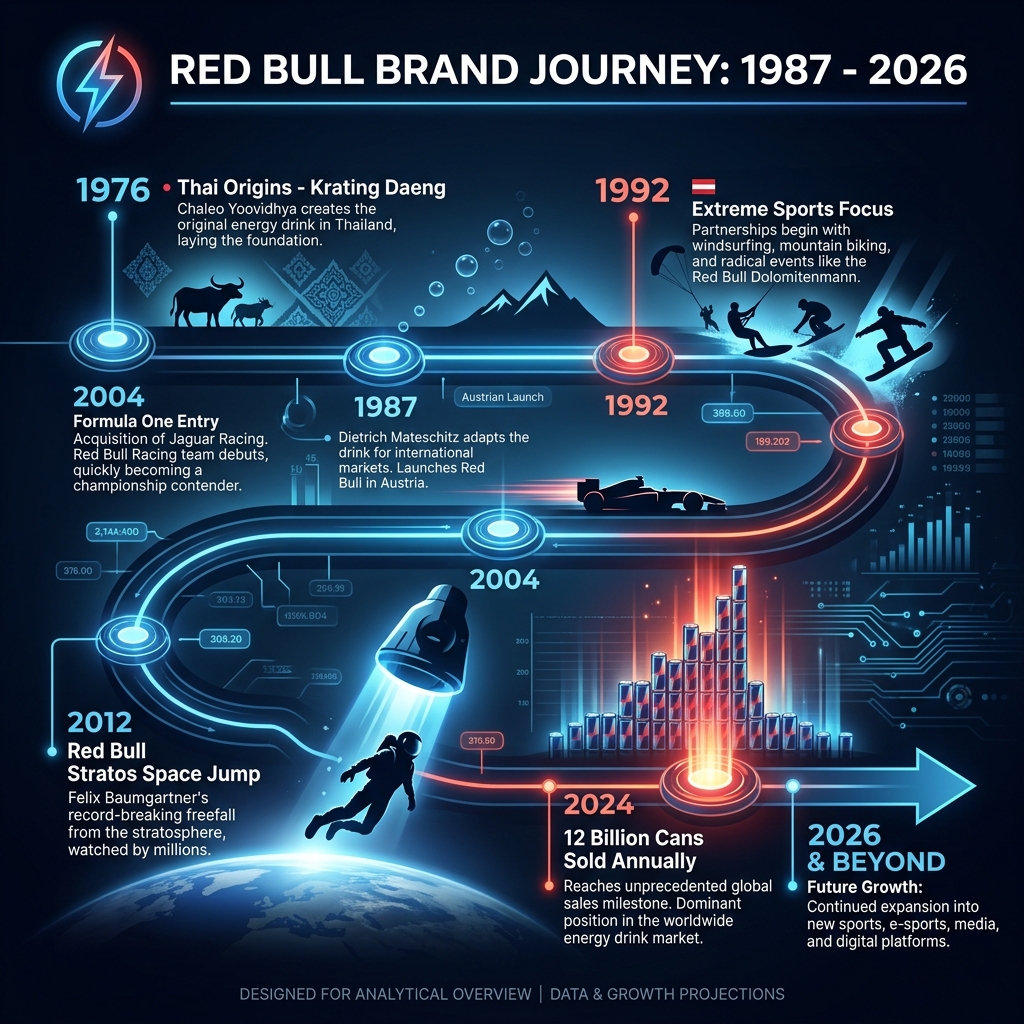
The story begins not in Austria but in Thailand, where Chaleo Yoovidhya created Krating Daeng (“Red Bull” in Thai) in 1976 — a sweet, uncarbonated energy tonic sold to truck drivers, factory workers and labourers. It was a working-class pick-me-up with taurine and caffeine, sold in small brown bottles for a few baht. There was nothing aspirational about it. It was functional, cheap, and positioned for people who needed to stay awake during manual labour. Remember this origin, because the psychological distance between a Thai trucker’s tonic and a Formula 1 paddock is the entire story of what branding can do.
🇦🇹 1984-1987: The Austrian Reinvention
Dietrich Mateschitz, an Austrian marketing executive for Blendax toothpaste, discovered Krating Daeng during a business trip to Thailand and noticed it cured his jet lag. He approached Chaleo with a proposition: adapt the formula for Western palates, carbonating it, adjusting the sweetness, and — this is the crucial part — repositioning it entirely. The two formed a partnership (each taking 49%, with the remaining 2% going to Chaleo’s son) and spent three years reformulating and strategising before launching Red Bull Energy Drink in Austria in 1987.
The three-year delay is itself psychologically significant. Mateschitz was not perfecting the liquid. He was perfecting the meaning. The product he launched was not a better energy tonic. It was an entirely new category — the “energy drink” — positioned not for tired workers but for young, active, adventurous people who chose to need energy because they lived at high intensity. The same caffeine. The same taurine. Completely different identity. That repositioning, from necessity to aspiration, from function to lifestyle, is the founding act of everything that follows.
🎯 1987-1997: The Seeding Years
Red Bull’s early marketing in Austria was deliberately unconventional. No television ads. No supermarket distribution. Instead, Mateschitz deployed student brand managers who drove around university towns in branded cars, handing out cans at parties, libraries and sports events. The product appeared in nightclubs before it appeared in shops. It was whispered about before it was advertised. Bartenders were trained to use it as a mixer, and the Red Bull Vodka became an early signature drink in European nightlife.
This was not budget constraint. It was anti-marketing by design. Mateschitz understood that a conventional product launch would position Red Bull as “just another soft drink,” and the category he was creating needed mystique, not familiarity. The scarcity and word-of-mouth created the perception that Red Bull was something underground, exclusive, discovered rather than sold. By the time it reached shelves, demand already existed, and that is the ideal sequence: desire before availability, not the reverse.
🏔️ 1988-2004: Extreme Sports and the Identity Pivot
The genius move came early and compounded for decades. Red Bull began sponsoring extreme sports athletes and events — cliff diving, motocross, BMX, snowboarding, surfing, paragliding — activities that mainstream brands avoided because the audiences were too small and the risk too high. This was not sponsorship in the traditional sense. Red Bull did not put its logo on someone else’s event. It created and owned the events: Red Bull Cliff Diving, Red Bull Rampage, Red Bull Air Race, Red Bull Crashed Ice. Each event was a branded experience, and each broadcast was content that the audience chose to watch, not advertising they tolerated.
The psychological transfer was precise: the qualities of extreme sports — adrenaline, courage, boundary-pushing, living on the edge — became the qualities of the brand, and by extension, the qualities available to anyone holding the can. You did not need to jump off a cliff. You only needed to drink what the cliff-jumper drank, and a small part of that identity attached itself to you. This is associative learning at its most elegant, and Chapter 3 treats it in full.
🚀 2005-2012: The Media Empire and the Space Jump
Red Bull established Red Bull Media House in 2007, formalising what was already true: the company was producing more content than most media companies. It launched a magazine (The Red Bulletin), a TV channel (Red Bull TV, later Servus TV), a music academy (Red Bull Music Academy), and began producing feature-length documentaries, short films and series. The content was never about the drink. It was about the lifestyle the drink represented, and that distinction is critical: Red Bull’s content works because it entertains rather than sells, which means the audience does not deploy the psychological defences they raise against advertising.
The apex was Red Bull Stratos in October 2012. Felix Baumgartner ascended in a helium balloon to 128,100 feet — the edge of space — and jumped, breaking the sound barrier during freefall. Eight million people watched live on YouTube, a then-record. The total media coverage generated an estimated billions of dollars in equivalent advertising value at a project cost of roughly $30 million, a fraction of a single Super Bowl campaign. Stratos was not a stunt. It was the logical endpoint of a brand strategy that said: we do not interrupt content with ads; we are the content.
🏎️ 2004-2026: Formula 1 Domination
Red Bull bought the Jaguar F1 team in 2004 (renaming it Red Bull Racing) and Minardi in 2005 (initially Scuderia Toro Rosso, now RB). With aerodynamic genius Adrian Newey and driver Max Verstappen, Red Bull Racing won six consecutive Constructors’ Championships (2010-2013 with Sebastian Vettel, 2022-2024 with Verstappen), dominating the most technologically prestigious sport on earth.
The F1 investment is psychologically brilliant beyond the trophy count. Formula 1 is watched by hundreds of millions globally, concentrated among the young, affluent male demographic that is Red Bull’s sweet spot. Every race is a two-hour Red Bull content piece. Every podium celebration sprays Red Bull’s brand alongside champagne. And the performance narrative — engineering excellence, speed, winning against established giants — mirrors exactly the brand identity Red Bull sells with the can: if you choose Red Bull, you are choosing to compete at the highest level.
🌍 2022-2026: Post-Mateschitz and the Scale Question
Dietrich Mateschitz died in October 2022 at 78, and the company entered its first era without its visionary founder. Revenue continued to climb — €10.55 billion in 2024 — and the cans kept selling, which answered the founder-dependency question more reassuringly than Tesla has managed (see my Tesla audit for the comparison). Red Bull’s brand was always less founder-fused than Tesla’s because Mateschitz was deliberately invisible; the brand’s face was always the athletes, not the owner. But the strategic question remains: can a company built on maverick instinct continue to make maverick decisions under corporate governance? The answer in 2026 appears to be yes, but the next Stratos-scale bet has not yet arrived.
🎭 Chapter 2: Category Creation — How Red Bull Invented a Market That Did Not Exist
This is the most underappreciated element of Red Bull’s psychology, and it deserves its own chapter because the strategic advantage it creates is nearly permanent.
When Red Bull launched in 1987, the energy drink category did not exist. There were soft drinks (Coca-Cola, Pepsi), there were sports drinks (Gatorade), and there were coffee and tea. Nobody had a mental category called “energy drink” with a prototype example sitting in it. Mateschitz did not enter a market; he built one, and he placed Red Bull at the centre of it.
Eleanor Rosch’s prototype theory explains why this matters permanently. Categories in memory are stored not as definitions but as prototypes — central examples that define what the category “is.” The first entrant that defines a new category becomes the prototype by default, and every subsequent entrant is compared to it. Coca-Cola is the prototype of cola. Google is the prototype of search. And Red Bull is the prototype of energy drink, globally, still, nearly four decades later, despite hundreds of competitors.
Prototype status confers a specific psychological benefit: automatic mental availability. When someone thinks “I need energy,” the brand that surfaces first is the prototype, and in most of the world, that is Red Bull. Competitors must fight for the same mental real estate that Red Bull occupies by default. Monster, Rockstar, and the newer wave (Celsius, Prime, Sting) are all defined in relation to Red Bull — “bigger than Red Bull,” “healthier than Red Bull,” “cheaper than Red Bull” — which means every competitor’s positioning strategy mentions Red Bull by implication, reinforcing the prototype with every comparison.
This is why Red Bull has maintained roughly 30-35% of the global energy drink market despite charging more, offering less liquid, and losing taste tests: the brand is the category, and you cannot dethrone a category. You can only fragment it, which is what the market is slowly doing, but even fragmentation leaves the prototype standing at the centre.
⚡ Chapter 3: The Identity Machine — You Are Not Buying Energy, You Are Buying a Self-Concept
Here is the mechanism that makes Red Bull different from every other beverage on earth, and it is worth stating precisely because most analyses get it wrong.
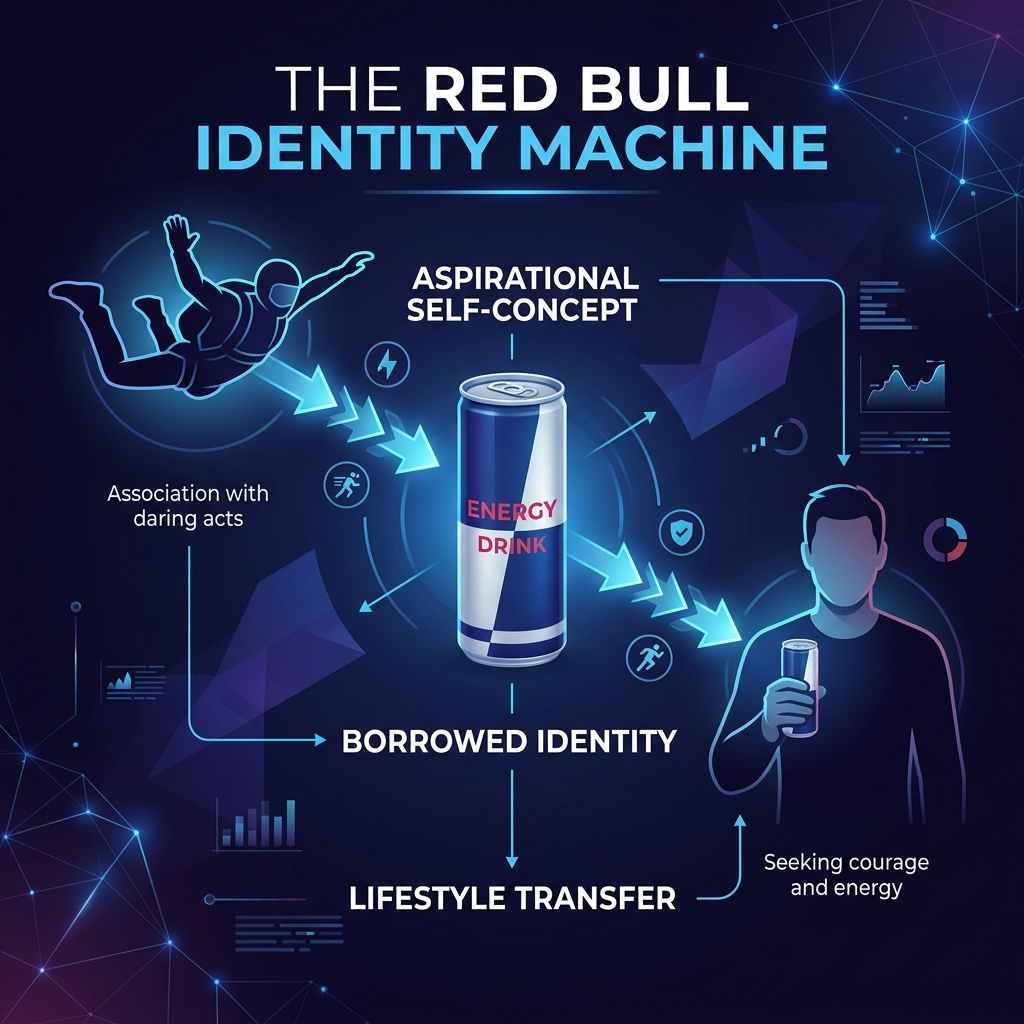
The standard explanation is that Red Bull “associates itself” with extreme sports. That is true but incomplete. Association is what Nike does with athletes: “these people use our product, therefore the product is good.” Red Bull goes deeper. It does not associate with extreme sports. It produces, owns, and is extreme sports, and that structural ownership changes the psychological transfer from endorsement to identity availability.
🧠 The Self-Concept Mechanism
Social psychologist Hazel Markus distinguished between the actual self (who you are) and the possible self (who you could become). Consumer behaviour research shows that people choose brands that bridge the gap — products that let you feel closer to a desired possible self without requiring the effort of actually becoming it. Red Bull is the most efficient bridge in consumer goods.
Nobody who buys Red Bull at a petrol station at 2am is about to go cliff diving. They know this. Red Bull knows this. But the can still carries the associative residue of every cliff dive, every F1 victory, every space jump. Holding it activates the possible self — adventurous, energetic, boundary-pushing — at the cost of a few dollars and zero physical risk. It is the cheapest identity upgrade available in a convenience store, and that is not an insult. It is the entire business model, understood correctly.
🏆 The Athlete Pipeline
Red Bull sponsors over 900 athletes across more than 80 sports disciplines, and the sponsorship model is structurally different from a Nike or Adidas deal. Red Bull athletes are not hired to wear a logo. They are supported, often from youth level, equipped with training facilities, media production and career management. The athlete becomes a Red Bull athlete in identity, not just in contract, and the content produced from their activities belongs to Red Bull’s media library permanently.
This creates a self-reinforcing loop: Red Bull produces the content → the content defines the brand’s identity → the identity attracts athletes who want to be associated with it → the athletes produce more content. The loop runs on talent rather than advertising spend, and it generates a content library that appreciates in value rather than depreciating like a TV campaign. As of 2026, Red Bull Media House’s archive is arguably the most valuable branded content library in the world.
🎵 Beyond Sports: Music, Culture, Dance
The identity machine extends beyond sports into music (Red Bull Music Academy ran for 20 years), dance (Red Bull BC One is the world’s most prestigious breakdancing competition), esports (multiple team ownerships and tournaments), and art. Each domain adds a facet to the brand identity: Red Bull is not just extreme sports; it is extreme anything, the patron saint of people who push limits in any field. This breadth prevents the brand from being boxed into “adrenaline junkie” territory and opens it to creative professionals, musicians, gamers and anyone who identifies with intensity.
🚀 Chapter 4: Red Bull Stratos — The Greatest Marketing Event in History
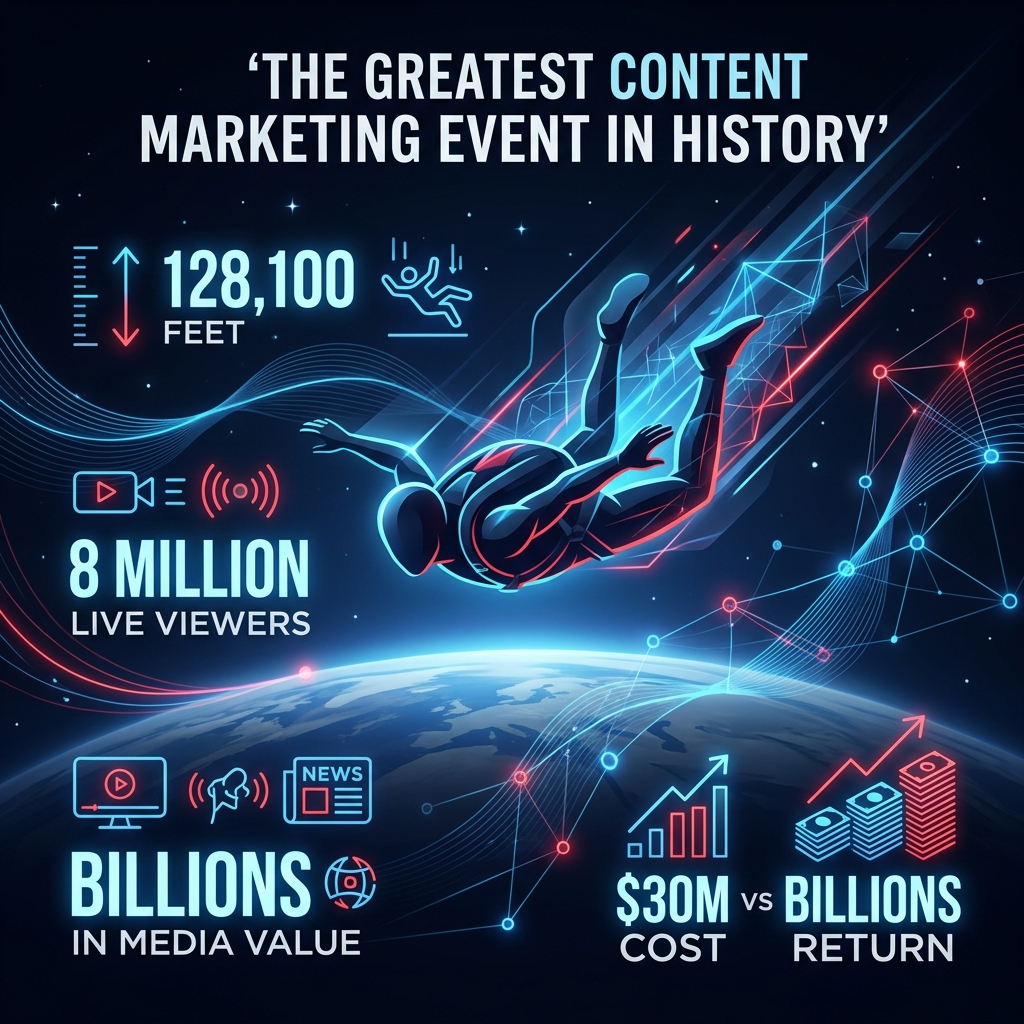
On October 14, 2012, Felix Baumgartner stood on the edge of a capsule hanging from a helium balloon at 128,100 feet — roughly 24 miles above the earth, at the boundary of space — and jumped. He fell for four minutes and nineteen seconds, reaching a speed of Mach 1.25 (843.6 mph), becoming the first human to break the sound barrier without a vehicle. He landed safely in the New Mexico desert.
Eight million people watched the live stream on YouTube, the largest live-viewed event in the platform’s history at that time. The total media coverage was estimated in the billions of dollars of equivalent advertising value. The project, called Red Bull Stratos, cost approximately $30 million — less than the cost of a single 30-second Super Bowl ad when you account for the production and media buy.
📡 Why Stratos Worked as Psychology
Several mechanisms converged. First, the spectacle itself bypassed advertising resistance. Nobody watched Stratos because Red Bull told them to. They watched because a human being was doing something genuinely unprecedented, and the fact that Red Bull made it possible was embedded in the experience rather than interrupting it. The brand was the enabler, not the advertiser, and enablers earn gratitude where advertisers earn resistance.
Second, the event physically embodied the tagline. “Red Bull Gives You Wings” stopped being a metaphor and became a literal fact: Red Bull gave a man the technology to fall from space and survive. The cognitive resonance between tagline and event was so complete that the brand message required zero explanation. No voice-over. No call to action. Just a man in a spacesuit, falling, with a logo on his chest.
Third, Stratos created a permanent reference point. Every future Red Bull campaign exists in the shadow of “the company that sent a man to the edge of space,” which elevates every smaller activation by association. The cliff dive is more impressive when the same company funded a space jump. The F1 victory is cooler when the same company broke the sound barrier with a human body. Stratos raised the ceiling of what the brand was perceived as capable of, and that ceiling has not come down.
Fourth, and most subtle: Stratos proved the brand’s promises were real. Every brand claims to push boundaries. Red Bull actually pushed one — the boundary of space — and documented it live. In a world of marketing hyperbole, a real, verifiable, physically dangerous demonstration of brand values is psychologically devastating to competitors. You cannot match it with a campaign. You can only match it with another act, and nobody has.
💰 Chapter 5: The Slim Can Strategy — Why Charging More for Less Is Genius
Red Bull’s pricing psychology is counterintuitive enough to deserve its own chapter, because it violates everything that conventional pricing strategy teaches and it works because of the violation, not despite it.
📏 The 250ml Signal
Red Bull’s original format is a 250ml slim can, roughly half the size of a standard soft drink can and significantly smaller than the 500ml or 473ml cans that Monster and other competitors use. The price per litre is roughly double that of Coca-Cola. By every rational consumer metric, Red Bull is a terrible deal: less liquid for more money in a smaller container.
And that is precisely why it works. The pricing operates as a Veblen signal: the premium communicates quality, exclusivity and seriousness. If Red Bull cost the same as Pepsi and came in the same size can, it would feel like a soft drink, and the identity positioning would collapse. The premium price says: this is different, this is special, this is not for people who count pennies on their beverages. The small can reinforces the message: this is concentrated, potent, functional — a tool, not a refreshment.
🧪 Functional Framing
The pricing is supported by a functional-benefit frame that separates Red Bull from the soft drink aisle. You do not drink Red Bull because you are thirsty. You drink it because you need to perform — study, drive, work, party, compete. That functional frame changes the reference price: the comparison is not Coca-Cola at $1.50 but a coffee at $5 or an espresso shot at $3, against which Red Bull is competitively priced. By controlling the category frame, Red Bull controls the comparison set, and the comparison set determines whether the price feels fair.
📦 Format Extension Without Cannibalisation
Red Bull has carefully extended its range — sugar-free, tropical, coconut, watermelon, larger 355ml and 473ml cans — without abandoning the original slim 250ml format. The extensions capture price-sensitive and variety-seeking consumers without diluting the premium signal of the original. The 250ml Blue-Silver can remains the brand’s distinctive asset, and its continued presence at the premium tier protects the brand meaning even as the range broadens. This is format management as brand management, and Red Bull executes it better than any beverage company I have audited.
🏎️ Chapter 6: Formula 1, Football and the Ownership Model
Most brands sponsor sports. Red Bull owns sports, and the difference is not semantic. It is the difference between renting a billboard and owning the building.
🏆 The F1 Investment
Red Bull Racing has won six Constructors’ Championships and seven Drivers’ Championships (four with Vettel, three with Verstappen). The team is not a sponsorship exercise; it is a fully owned, fully operated racing team that competes at the pinnacle of motorsport. The psychological impact is layered:
- Credibility transfer: a brand that can win Formula 1 is perceived as competent, engineering-driven and serious, qualities that transfer to the product
- Content generation: every race weekend produces hours of broadcast content featuring the Red Bull brand, at a cost that would be prohibitive through conventional advertising
- Employee and athlete magnetism: the most talented engineers, drivers and professionals want to work for a winning team, creating a talent flywheel
- Cultural integration: F1’s global expansion, particularly through the Netflix Drive to Survive series, has brought millions of new fans who associate Red Bull with winning before they ever consider the drink
⚽ The Football Empire
Red Bull owns RB Leipzig (Bundesliga), Red Bull Salzburg (Austrian Bundesliga), New York Red Bulls (MLS), and Red Bull Bragantino (Brazilian Serie A). The football clubs serve a different psychological function than F1: they embed the brand in local community identity, the most durable form of brand attachment. A fan of RB Leipzig encounters the Red Bull brand not as advertising but as a tribal affiliation, which is the deepest level of brand relationship possible.
The controversy is instructive. Traditional football fans in Germany have fiercely criticised RB Leipzig as a “plastic club” — a corporate creation without authentic community roots. This criticism is valid and also paradoxically useful: it generates attention, debate and media coverage that a mid-table club would never earn, and the on-pitch success (Champions League qualification, Bundesliga contention) gradually converts controversy into grudging respect. Red Bull’s willingness to absorb criticism in exchange for brand presence is itself a psychological strategy: they would rather be argued about than ignored.
🎨 Chapter 7: Anti-Marketing — The Strategy of Not Looking Like a Strategy
Red Bull’s marketing is brilliant partly because it does not look like marketing, and that camouflage is itself the most sophisticated marketing technique in the playbook.
🚫 The Absence Strategy
Red Bull spent zero on traditional TV advertising for years after launch. No billboards. No celebrity endorsements in the conventional sense. No mass-market PR campaigns. Instead: student brand managers, car-top cans, nightclub seeding, event creation, and content production. The brand arrived in each market as a discovery, something you heard about from a friend, encountered at a party, or saw in a video — never something you were told to buy by an advertisement.
The psychology is reactance theory: people resist being told what to do, and advertising is inherently a directive. By removing the directive and replacing it with experiences, Red Bull bypassed the resistance. You cannot rebel against a cliff-diving video you chose to watch. You cannot dismiss a space jump you watched with genuine awe. The brand message enters through the experiential door, which has no bouncer, rather than the persuasion door, which is guarded by scepticism.
✏️ The Cartoon Ads
When Red Bull did eventually run advertising, it chose hand-drawn cartoon spots with a deliberately amateur aesthetic and dry humour, ending with the tagline “Red Bull Gives You Wings.” These ads are stylistically the opposite of every other energy drink commercial: no athletes, no explosions, no aggression. They are understated, witty and slightly absurd, which communicates confidence. A brand that does not try to look impressive in its advertising is implicitly saying “I do not need to try,” and that confidence reads as authenticity in a market of try-hards.
📖 Content vs Advertising
Red Bull’s estimated marketing spend is 25-35% of revenue, among the highest ratios in consumer goods. But the spend goes almost entirely to content production, event creation and athlete support rather than media buying. The distinction matters psychologically: content is chosen by the audience; advertising is tolerated. Chosen content generates positive affect and voluntary attention, both of which are preconditions for deep brand encoding. Red Bull understood this before “content marketing” was a phrase, and its execution remains the standard against which every subsequent content strategy is measured.
⚠️ Chapter 8: The Dark Side — Health, Regulation and the Energy Drink Debate
🏥 The Health Question
An honest audit must address the health dimension, because the energy drink category carries genuine regulatory and reputational risk. A standard 250ml can of Red Bull contains approximately 80mg of caffeine (comparable to a cup of coffee), taurine, B-vitamins and sugar (or artificial sweeteners in the sugar-free variant). At one-can consumption, the health profile is broadly similar to coffee. The concern is with overconsumption, particularly among young people, and particularly when mixed with alcohol.
Medical case reports and public health warnings have linked excessive energy drink consumption to cardiac events, particularly in individuals with pre-existing conditions. Several countries and jurisdictions have restricted sales to minors. The UK considered and debated an outright ban on sales to under-16s. France initially banned Red Bull entirely (2004-2008) before the European Court of Justice overruled the ban.
Red Bull’s response has been consistent: the product is safe at recommended consumption levels, it is regulated as a food product in most jurisdictions, and its caffeine content per serving is comparable to coffee. These claims are factually defensible. The psychological issue is that the brand’s identity positioning encourages excess by its very nature: if the brand says “push harder, go further, never stop,” the implicit message about consumption is not moderation. The brand’s values and the product’s health requirements are in tension, and this tension is the category’s long-term vulnerability.
⚖️ The Sugar Tax and Regulatory Environment
Sugar taxes in the UK, Middle East and parts of Asia have hit energy drinks, and Red Bull’s sugar-free variant has become strategically important as a result. Health-focused competitors (Celsius, positioned as a “fitness drink”) are growing rapidly in the US market, suggesting a segment of consumers is migrating toward energy with a health permission structure. Red Bull’s brand positioning does not currently include a strong health narrative, and adding one risks diluting the extreme-sports identity. This is the strategic tension: the identity that built the brand may limit its ability to adapt to a health-conscious market.
👥 Youth Marketing Scrutiny
Energy drinks marketed to minors is an active regulatory front, and Red Bull occupies an uncomfortable position: its content appeals strongly to teenagers (extreme sports, gaming, music), its caffeine content is not appropriate for young children, and its brand identity is aspirationally attractive to exactly the age group most concerning to regulators. Red Bull has voluntarily committed to not marketing to under-12s, but the line between marketing to teenagers and creating content teenagers choose to consume is the exact line that regulators are trying to draw, and Red Bull’s content strategy straddles it.
⚔️ Chapter 9: Competitive Positioning — The King of a Crowded Can
| Competitor | Their Psychological Play | Red Bull’s Defence |
| Monster Energy | Bigger can, lower price, heavier aesthetic, rebellious “claw” identity | Monster is Red Bull’s shadow: it wins on volume but concedes the premium and the cultural prestige |
| Celsius | Health-forward positioning: “fitness fuel,” no sugar, thermogenic claims | Captures the health-conscious defector; Red Bull has no credible health narrative to counter with |
| Prime Energy | Influencer-driven (Logan Paul & KSI), youth viral marketing, collectibility | Flash-in-the-pan vs institutional brand; Red Bull outlasts hype cycles with owned assets |
| Sting / local brands | Price leadership in emerging markets (South Asia, Africa, Southeast Asia) | Red Bull concedes the mass-market price tier; competes on aspiration and occasion |
| Coffee culture (Starbucks, speciality coffee) | Socially acceptable caffeine, ritual, customisation, “adult” positioning | Different occasion and identity; Red Bull is performance, coffee is comfort — they coexist rather than compete |
The competitive landscape is fragmenting, and Red Bull’s ~30-35% global share is slowly eroding as the category splinters into sub-segments (health, gaming, fitness, influencer-driven). But fragmentation does not dethrone a prototype; it surrounds it. Red Bull remains the reference point, the brand competitors define themselves against, and that mental position is more durable than market share. The risk is not that one competitor replaces Red Bull. The risk is that the category eventually becomes as commoditised as soft drinks, at which point Red Bull’s premium pricing becomes harder to defend. The defence against that commoditisation is exactly the media-and-sports empire: those assets create brand meaning that no beverage formula can replicate.
📊 Chapter 10: Psychology Scorecard — Detailed Ratings
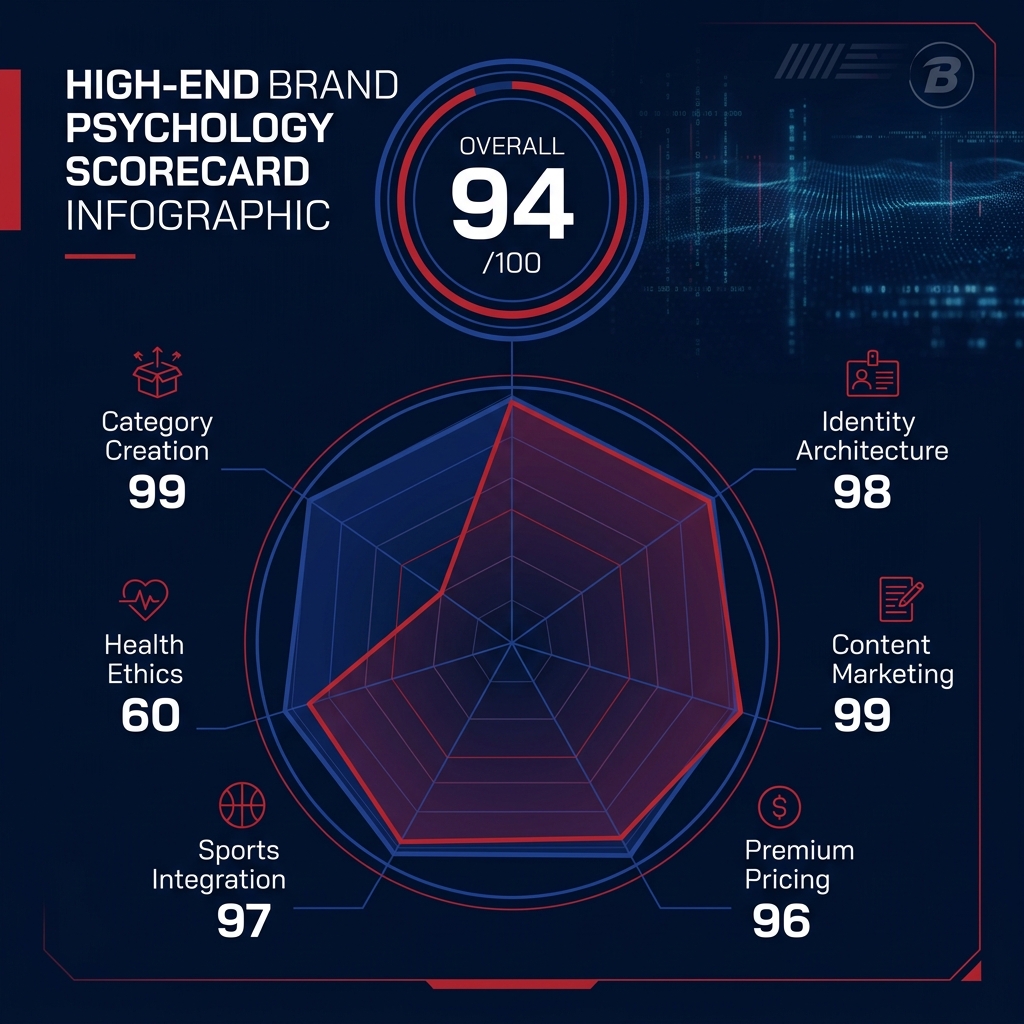
| Psychology Dimension | Score | Verdict |
| Category Creation & Prototype Status | 99/100 | Invented the energy drink category and remains its global prototype nearly four decades later. |
| Identity-Based Brand Architecture | 98/100 | The can is a costume. Nobody drinks it for the taste; everyone drinks it for what it says about them. |
| Content Marketing & Media Ownership | 99/100 | The most successful content marketing operation in history, crowned by a space jump. |
| Premium Pricing Psychology | 96/100 | Charging double for half the liquid — and making the premium feel like a benefit rather than a cost. |
| Distinctive Brand Assets (Can, Colour, Tagline) | 95/100 | The slim blue-silver can and “Gives You Wings” are instantly recognisable worldwide. |
| Sports & Cultural Integration | 97/100 | Owns the sports it sponsors rather than renting presence — a structural advantage no competitor can copy. |
| Brand Resilience & Independence | 88/100 | Survived the founder’s death, which Tesla has not yet been tested on. Privately held, no Wall Street pressure. |
| Health & Ethical Psychology | 60/100 | Caffeine-meets-youth-marketing tension is the long-term vulnerability. Adequate but not proactive on health messaging. |
| OVERALL PSYCHOLOGY SCORE | 94/100 | ⚡ Extreme Impact — the most complete brand-as-lifestyle machine ever built. |
✅ Chapter 11: Balance Sheet & A Psychologist’s Prescription
💪 Psychological Strengths
- Category prototype permanence: Red Bull will be the first energy drink people think of for as long as the category exists, and prototype status is the most durable competitive advantage in consumer psychology
- Owned media and sports assets: two F1 teams, multiple football clubs, the world’s largest extreme sports content library, and a TV channel — these are not marketing expenses, they are appreciating assets that generate brand meaning autonomously
- Identity architecture beyond product: Red Bull sells a self-concept, and self-concepts are more durable than product preferences because they are tied to who the customer believes they are
- Founder-independence achieved: unlike Tesla, the brand survived its founder’s death without crisis, because Mateschitz built the brand around athletes and events rather than around himself
- Private ownership: no quarterly earnings pressure, no activist investors, no stock price to manage — the company can make long-term bets (Stratos took years) that public companies cannot
- Premium pricing defended: nearly four decades of charging more for less, maintained through brand meaning rather than product superiority
⚠️ Psychological Weaknesses
- Health vulnerability: the brand identity encourages intensity and the product contains caffeine and sugar, a combination that health-conscious consumers and regulators are increasingly scrutinising
- No credible health narrative: competitors like Celsius are capturing the health-performance segment that Red Bull’s brand positioning cannot credibly enter without diluting its core identity
- Youth marketing tension: the content appeals to teenagers, the product is not recommended for young children, and the regulatory line is tightening
- Taste vulnerability: if the energy drink market ever commoditises to the point where taste matters as much as brand, Red Bull loses, because the liquid is not the advantage
- Post-Mateschitz innovation risk: the founder’s instinct produced Stratos, the F1 bet, and the anti-marketing philosophy; can corporate governance replicate maverick judgment?
- Category fragmentation: as energy drinks splinter into health, gaming, fitness and influencer sub-categories, the prototype’s share of the total market slowly erodes even if the prototype itself stays strong
🔮 The Prescription
- Build a health-forward sub-brand without compromising the mothership. Red Bull needs an answer to Celsius that does not dilute the extreme-sports identity. A separate brand or clearly distinct product line — positioned as functional performance fuel with clean ingredients — would capture the health segment without forcing Red Bull itself to pretend it is a wellness product.
- Commission the next Stratos. The space jump was 14 years ago. The brand needs a new defining moment of equivalent ambition — something that makes the world stop and watch, reminds everyone what Red Bull means, and resets the cultural clock. Deep-sea exploration, extreme altitude aviation, human-powered flight records — the brief is simple: do something nobody thought possible and film it.
- Proactively lead on youth-consumption guidelines. Self-regulation that arrives before legislation earns credibility; compliance after regulation earns nothing. Visible age-gating, responsible-consumption content, and school-focused education programs would cost little and build regulatory goodwill.
- Protect the 250ml slim can as a distinctive asset. Format extensions are commercially sensible but the original can must remain the brand’s visual signature. Every alternative format is a revenue line; the 250ml slim can is the brand.
- Continue the anti-marketing philosophy in the age of AI and ad fatigue. As consumers develop stronger resistance to conventional digital advertising, Red Bull’s content-first model becomes more valuable, not less. Double down on owned content, athlete stories and event production. The rest of the industry is trying to become what Red Bull already is.
📝 Final Verdict
Red Bull is the most complete brand-as-lifestyle machine ever built, and I award it the highest overall psychology score on ShahzebSpeaks — 94/100 — because no other brand in my audit library has achieved what Red Bull has achieved with what Red Bull had to work with.
Consider the raw materials. An unremarkable-tasting caffeinated beverage, adapted from a Thai workman’s tonic, in a can too small for its price, in a category that did not exist until the company invented it. Every rational analysis says this product should have been a fad. Instead, it sells 12 billion cans per year, generates over €10 billion in revenue, funds two Formula 1 teams, owns football clubs on four continents, operates a media company with the world’s most valuable extreme sports library, and sent a human being to the edge of space on live television. And it did all of this while spending less on traditional advertising than most brands spend on a single campaign.
The mechanism underneath is the cleanest identity play in consumer history. Red Bull does not sell energy. It does not sell taste. It does not sell caffeine (coffee does that cheaper). It sells a self-concept — the version of you that is adventurous, awake, limitless, and performing at the edge. The slim blue can is a costume you put on for a few dollars, and while you are holding it, you are borrowing the identity of every cliff diver, Formula 1 driver and space jumper who held it before you. Nobody needs that identity to get through the day. But identity, not necessity, is what makes a brand worth more than its ingredients, and Red Bull’s ingredients were never the point.
The honest caveat is the one the scorecard reflects: the brand’s health and ethical dimensions are its weakest areas, and they sit exactly where the next decade’s regulatory and cultural trends are heading. The energy drink sold to adults by choice is defensible. The energy drink whose content pipeline reaches teenagers who cannot yet evaluate caffeine is a regulatory target, and the targeting will intensify. Red Bull’s response to this will determine whether the next chapter of the story is growth or constraint, and the brand’s instinct for maverick self-regulation rather than corporate defensiveness will be the test.
But as a pure exercise in building an identity machine from commodity ingredients, Red Bull is the masterpiece. It proved that you do not need a better product. You do not need a cheaper product. You need a product that makes the buyer feel like a better version of themselves, and then you need to build an entire world — sports, music, content, spectacle — that makes that feeling real enough to be worth the price of a slim blue can.
Psychology Score: 94/100 — Red Bull earns the highest overall psychology score in ShahzebSpeaks history, with near-perfect ratings for category creation (99), content marketing (99), identity architecture (98), and sports integration (97). It is held back only by health and ethical concerns (60) that the brand has not yet proactively addressed. The most brilliant identity machine ever built, running on commodity caffeine and aspirational genius.
🧠 Want a Psychology Audit for Your Brand?
I’m Muhammad Shahzeb, an MSc Industrial Psychologist and Full-Stack Developer. I apply behavioral science to branding, identity architecture and content strategy — including showing you where your brand’s lifestyle positioning ends and your product’s reality begins. Let’s audit yours.
📚 References & Sources
- Red Bull GmbH. Company milestones, financial releases and company history. energydrink.redbull.com, redbull.com
- Fürweger, W. (2008). Die Red Bull Story: Der unglaubliche Erfolg des Dietrich Mateschitz. Ueberreuter. (Company history.)
- Sharp, B. (2010). How Brands Grow. Oxford University Press. (Distinctive brand assets, mental availability, category prototype.)
- Romaniuk, J. (2018). Building Distinctive Brand Assets. Oxford University Press.
- Rosch, E. (1975). “Cognitive representations of semantic categories.” Journal of Experimental Psychology: General, 104(3), 192-233. (Prototype theory.)
- Markus, H., & Nurius, P. (1986). “Possible selves.” American Psychologist, 41(9), 954-969. (Self-concept and brand choice.)
- Tajfel, H., & Turner, J. C. (1979). “An integrative theory of intergroup conflict.” (Social identity theory, tribal belonging.)
- Veblen, T. (1899). The Theory of the Leisure Class. (Veblen goods and conspicuous consumption.)
- Brehm, J. W. (1966). A Theory of Psychological Reactance. Academic Press. (Anti-marketing and reactance.)
- Reber, R., Schwarz, N., & Winkielman, P. (2004). “Processing fluency and aesthetic pleasure.” Personality and Social Psychology Review, 8(4), 364-382.
- Red Bull Stratos mission summary and media impact data. redbullstratos.com; YouTube viewership records, October 2012.
- Formula 1 official records: Red Bull Racing championship history. formula1.com
- Euromonitor International. Global energy drinks market data and Red Bull market share estimates, 2020-2026.
- Seifert, S. M., et al. (2011). “Health effects of energy drinks on children, adolescents, and young adults.” Pediatrics, 127(3), 511-528.
- Cialdini, R. B. (2006). Influence: The Psychology of Persuasion. Revised edition. Harper Business.
- Aaker, D. A. (1996). Building Strong Brands. Free Press.
Audit conducted by Muhammad Shahzeb, MSc Industrial & Organizational Psychology | Brand Psychology Specialist | Full-Stack Web Developer
Learn more about my approach →
Key Findings
- Red Bull created the energy drink category from nothing — the product did not enter a market, it invented one, giving it permanent prototype advantage
- The company spends 25-35% of revenue on marketing but almost none looks like advertising — it looks like extreme sports, F1 racing, and a man jumping from the stratosphere
- Red Bull's premium pricing is not despite its small can but because of it — the 250ml format at 2x the price works as a Veblen signal
- The Stratos space jump was watched by 8 million live, generating billions in media value at a fraction of a Super Bowl cost
- Red Bull owns 2 F1 teams, football clubs, and the largest extreme sports media library on earth — it is a media company using a beverage as its revenue model
- Nobody drinks Red Bull for the taste — they drink it because holding the can says something about who they are or who they want to be
Overall Psychology Score
Red Bull scores 94/100 in our comprehensive psychology audit covering consumer behavior strategies, UX design principles, and psychological marketing effectiveness.
The detailed dimension scores are in the audit's Psychology Scorecard chapter.
High impactMuhammad Shahzeb
MSc Industrial Psychologist, specializing in consumer behavior, UX psychology, and brand strategy analysis. Helping brands understand the psychology behind their success.
About Muhammad Shahzeb →