
Think of a song you hated the first time you heard it. Three weeks of radio plays later, you caught yourself humming it — and admitting, reluctantly, that it wasn’t so bad. Nothing about the song changed. Only your exposure to it did. That is the mere exposure effect: the tendency to like something more simply because you have met it more often — and it is one of the most heavily replicated findings in social psychology.
This guide covers what the effect actually is, the experiments that established it — from Robert Zajonc’s 1968 study through two large meta-analyses — how brands and advertisers use repetition, and where repetition turns against them. I will also tell you plainly where the evidence is thin, because on this topic it sometimes is.
I am an Industrial and Organizational Psychologist based in Karachi. Familiarity is my day job in one sense: in organisations, the same exposure dynamics shape how people are evaluated and which brands they trust. The research below is the reason repetition is one of the cheapest tools in marketing — and one of the most overused.
“Liking is not always an evaluation. Sometimes it is just a memory of having met before, wearing the costume of a judgment.”
— Consumer Psychology Analysis, ShahzebSpeaks
⚡ Chapter 1: The short answer
The mere exposure effect means repeated, unreinforced contact with a person, product, idea or image makes it feel more likeable — even when nothing about it has improved. Zajonc formalised this in 1968 after showing that liking rises with exposure frequency along a positive, decelerating curve: the first few encounters do most of the work, and later ones add progressively less.
The effect is real and widely replicated. A 1989 meta-analysis of roughly 200 experiments confirmed the exposure–liking relationship; a 2017 meta-analysis of 268 curve estimates from 81 articles showed the true shape is an inverted-U — liking rises, peaks, then declines when repetition goes too far. It works below conscious awareness, it works without any interaction at all, and it is strongest for things that are new, complex and hard to recognise.
For marketers this means repetition builds liking cheaply — but only up to a point, and only when the message is varied rather than hammered. The rest of this article is the evidence, the explanations, and the limits.
🔬 Chapter 2: The 1968 experiment that found the mere exposure effect
Robert Zajonc’s 1968 paper, “Attitudinal effects of mere exposure,” published in the Journal of Personality and Social Psychology, is the landmark. His hypothesis was strikingly simple: repeated exposure to a stimulus is sufficient, on its own, to improve a person’s attitude toward it. He called it “mere” exposure because the exposure needs no accompanying condition — no reward, no argument, no interaction. Simply making the stimulus perceptible is enough.
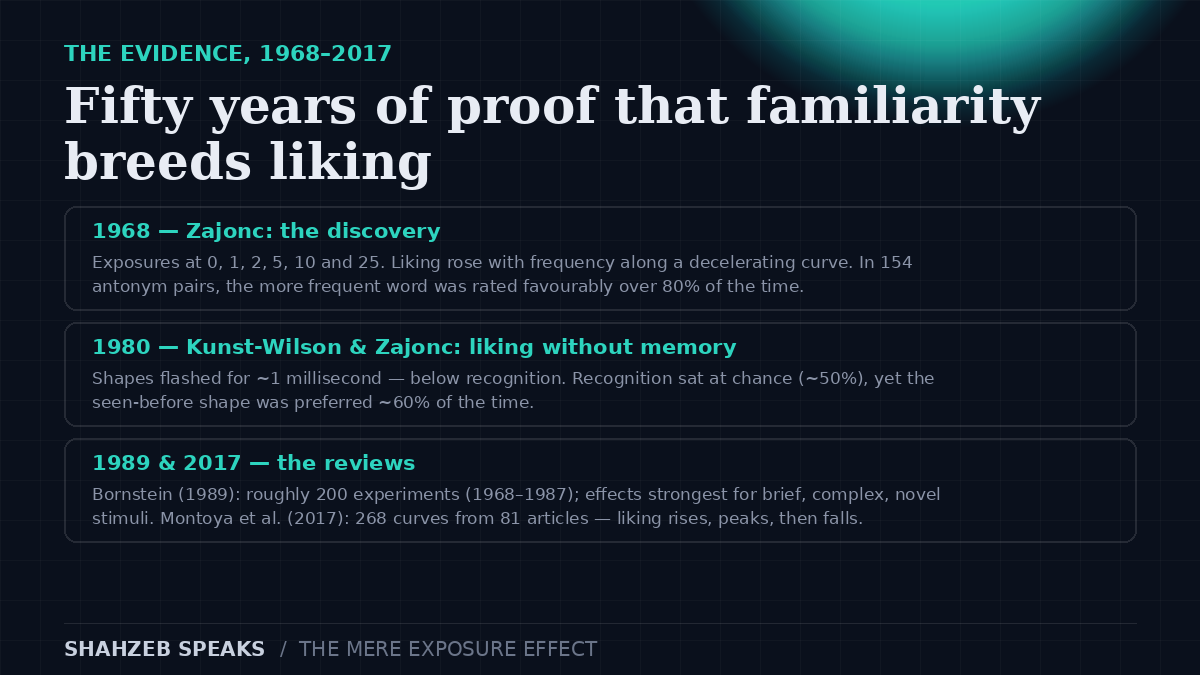
To support the hypothesis, Zajonc discussed three lines of evidence: word frequency and word evaluation, interpersonal contact and attraction, and musical familiarity and liking. The experimental core was straightforward. English-speaking participants were shown unfamiliar stimuli — nonsense words, Chinese-like ideographs, photographs of men’s faces — each at a different frequency: 0, 1, 2, 5, 10 or 25 times. Afterwards they rated how favourably they felt about them. In every stimulus type, liking rose with frequency along a positive, decelerating curve.
He also ran a neat correlational test. He asked students which word of each of 154 antonym pairs sounded more favourable, then compared their choices with how frequently each word was actually used. The more frequent member of the pair won over 80% of the time. One caveat, which the literature is honest about: this particular finding admits an alternative reading — perhaps people simply use pleasant words more often, rather than frequency causing the liking. The experimental evidence, where nothing but exposure varied, is the stronger leg of the argument.
The theoretical claim was as bold as the data. Zajonc argued that preference can grow without knowledge — that people can like something they cannot describe, remember, or evaluate. That idea cut against the prevailing view of attitude formation and set off decades of research.
📊 Chapter 3: What the big reviews confirmed
An effect found in one laboratory in 1968 would not be worth your attention. What makes the mere exposure effect worth it is how stubbornly it survived attempts to test it. Two meta-analyses, 28 years apart, mapped its boundaries.
Bornstein (1989): roughly 200 experiments, one clear verdict
Robert Bornstein’s 1989 synthesis, “Exposure and affect,” appeared in Psychological Bulletin and meta-analysed roughly 200 experiments published across the field’s first twenty years, from 1968 to 1987. The exposure–liking relationship was robust overall — a genuine, substantial phenomenon, not a laboratory artefact.
The headline findings about when the effect is strongest matter more than the headline finding that it exists:
| Condition | Effect on the exposure–liking relationship |
|---|---|
| Brief or subliminal presentation (under one second) | Stronger effect than for clearly seen stimuli |
| Complex stimuli | Stronger effect than for simple stimuli |
| Novel stimuli | Stronger effect than for already-familiar ones |
| Heterogeneous (varied) presentation sequences | More reliable effect than homogeneous repetition of one stimulus |
| Low stimulus recognition | Stronger effect — an inverse relationship between recognition and liking |
Two of these deserve emphasis. First, the effect was stronger when stimuli were presented briefly or subliminally than when they were clearly seen — pointing to a mechanism that does not require conscious recognition. Second, mixed, varied sequences beat hammering the same stimulus over and over, which is directly relevant to anyone running a campaign.
Montoya and colleagues (2017): the true shape of the curve
The most important recent evidence revises Zajonc’s original picture. Montoya, Horton, Vevea, Citkowicz and Lauber (2017), in “A re-examination of the mere exposure effect” in Psychological Bulletin, fitted the exposure–liking curve directly. They meta-analysed 268 curve estimates drawn from 81 articles — note this figure belongs to the 2017 review, not to Bornstein’s 1989 work — and estimated both a straight-line and a curved component.
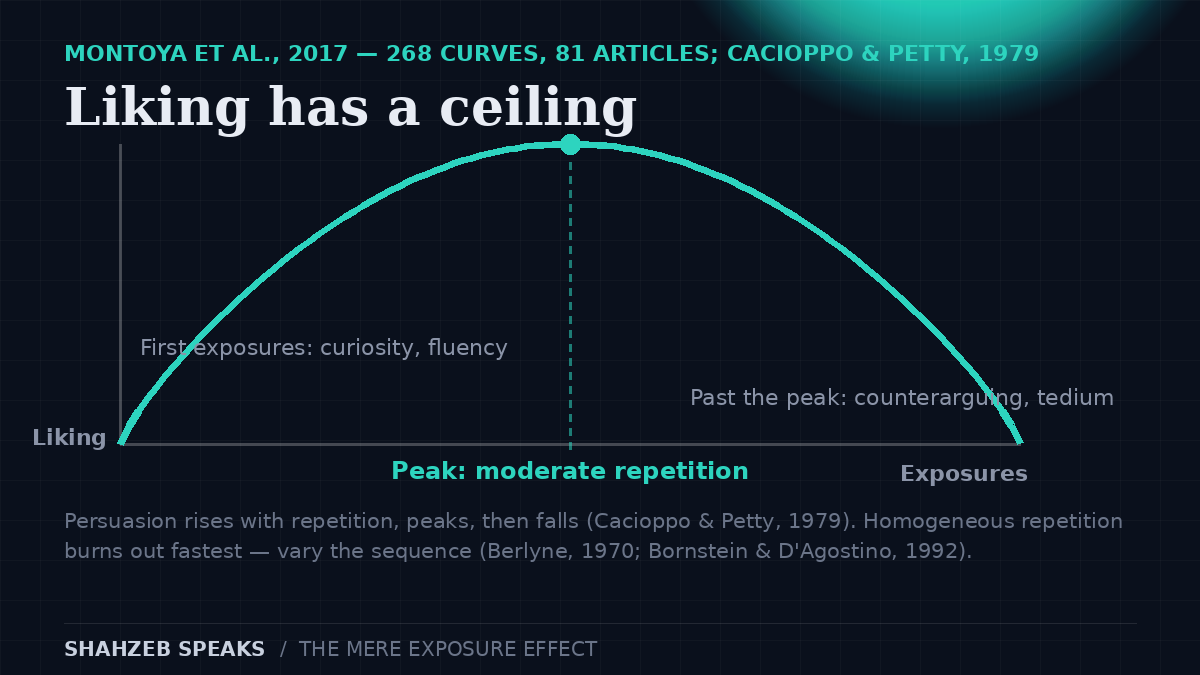
The result was a positive slope combined with a downward curve: an inverted-U. Liking rose with exposure, peaked, and then declined. The pattern held for visual stimuli shown very briefly or for over a minute. The conclusion was blunt: the effect is real, but it is fundamentally an inverted-U rather than an ever-rising line. Repetition helps, up to a point — and then it hurts. This is the finding advertisers should have taped to their walls.
👥 Chapter 4: Real people, zero interaction
The laboratory is one thing; a crowded lecture hall is another. Richard Moreland and Scott Beach took the effect into the real world in 1992. Four similar-looking women acted as confederates in a university lecture across a semester, attending 0, 5, 10 or 15 sessions. They did not speak to a single student. They did not draw attention to themselves. They simply sat there.
At term’s end, students were shown photographs of the four women and rated each one’s attractiveness, familiarity and similarity to themselves. Ratings rose with attendance. The confederate seen 15 times was rated most attractive, most familiar and most similar; the one never seen was rated lowest. Mere presence — visibility without interaction — increased liking, perceived attractiveness and even felt similarity.
A later field test sharpened the mechanism further. Back, Schmukle and Egloff (2008) randomly assigned students to seats on the first day of a class, so that some pairs simply saw each other more often than others by pure chance. That bare seating exposure predicted who had become friends a year later.
There is a telling detail in the recognition research too. Moreland and Zajonc (1977) showed participants Japanese ideographs at frequencies of 0, 1, 3, 9 or 27, then asked them both how much they liked each one and how confident they were that they had seen it before. When both measures were used to predict liking together, objective exposure frequency still predicted liking. Subjective recognition did not. The rise in liking runs on a track that conscious memory cannot see.
🧠 Chapter 5: Why familiarity feels like liking
Psychologists agree the effect is real. They disagree on why it happens, and three explanations compete — they are not mutually exclusive.
1. Perceptual fluency: ease mistaken for liking
Each time you encounter a stimulus, it becomes easier and faster to process. That growing ease is called perceptual fluency. Fluency carries a faint positive feeling with no obvious source, and because people cannot trace it back to processing ease, they misattribute it to the stimulus itself: this feels good, so I must like it.
The account explains the strangest pattern in the data — that exposure effects are often strongest when people cannot recognise the stimulus at all. With no memory of a prior encounter to explain the good feeling away, people attribute it to liking instead. That is exactly what Kunst-Wilson and Zajonc’s (1980) subliminal-shape result showed, and what Bornstein’s (1989) meta-analysis confirmed across the literature.
2. Affective primacy: liking before thought
Zajonc drew a bolder conclusion. In “Feeling and thinking” (1980) and with Hazel Markus in the Journal of Consumer Research (1982), he argued that affect is a partly independent system able to generate preference before any cognitive appraisal — “preferences need no inferences.” On this view, liking is a direct emotional response tuned by repetition, not a judgment about processing ease. The claim launched a long debate over whether emotion can precede thought.
3. Conditioning and uncertainty reduction: safety learned by repetition
A third account treats repeated exposure as a small learning experience. Each encounter with something new carries a little uncertainty; an encounter that passes without harm signals safety. Zajonc (2001) framed this as a form of classical conditioning, in which the absence of anything bad happening acts as the reinforcing event. This explains why the effect is strongest for genuinely new stimuli, where uncertainty is highest — and why it fades once a stimulus is already familiar.
No single account yet explains every known moderator of the effect. In practice, all three probably operate at once, and for the marketer the practical lesson is the same: early, varied repetition builds a quiet positive pull that the audience cannot explain.
📢 Chapter 6: How brands and advertisers use it
If repetition builds liking without persuasion, then advertising is, in part, a repetition business. Marketing researchers have built mere-exposure findings into contemporary advertising practice. Janiszewski (1993) found that mere exposure to a brand name or product package can make consumers view the brand more favourably — with no need for memory of the exposure, and even when the exposure was incidental, with no deliberate effort to process the brand information at all.
Think about where repetition lives in modern marketing. Sonic branding — the same audio signature at the start of every advert. Packaging that repeats the same visual system across every shelf. Out-of-home boards on a commuter’s daily route. Sponsorship logos visible in the corner of a broadcast for ninety minutes. None of these asks the viewer to think; they ask only to be seen again. For how other quiet levers shape buying, see the research on anchoring in marketing and the triggers behind every purchase.
Krugman’s three exposures
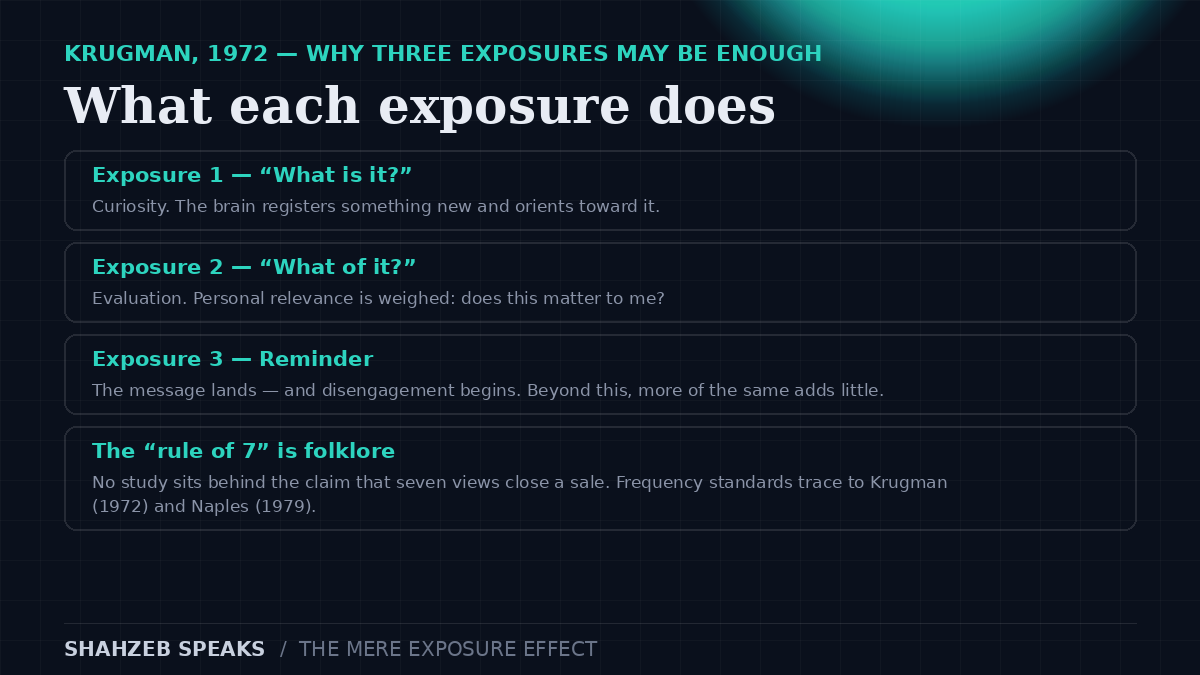
The most influential account of repetition in advertising came from Herbert Krugman in 1972, in the Journal of Advertising Research: “Why Three Exposures May Be Enough.” Krugman’s account, based on his reading of how people respond to television advertising, proposed three distinct responses across the first three exposures. The first exposure elicits curiosity — what is it? The second elicits an evaluative, personal response — what of it, what does it mean for me? The third acts as a reminder. And the third is also the point at which disengagement begins to occur; beyond it, further exposures add little.
Michael Naples later assembled supporting evidence in Effective Frequency for the Association of National Advertisers in 1979, and three exposures per purchase cycle became television’s planning default. Erwin Ephron challenged it in the same journal in 1997, arguing that continuous broad reach beats accumulated exposures, since the moment of purchase readiness cannot be predicted. The dispute was never settled, and both positions remain visible in platform defaults today.
The “rule of 7” is folklore, not research
You will see it repeated endlessly in marketing blogs: a prospect must see your message seven times before buying. This “rule of 7” has no attributable empirical study behind it. It is folklore. The documented research — Krugman’s three exposures, the inverted-U curve, Bornstein’s finding that varied sequences beat hammering — all points the other way: what matters is not a magic count but frequency, variety and timing relative to the decision. Never let anyone sell you the number seven as science.
A cousin effect worth knowing: repetition and perceived truth
Repetition does not only shape liking; it shapes belief. Hasher, Goldstein and Toppino (1977) presented participants with 60 plausible trivia statements across three sessions, two weeks apart. Some statements repeated each time; others appeared once. The repeated statements received higher truth ratings over time, although repetition added no evidence. This is the illusory truth effect — a cousin of mere exposure, and a reminder that repetition in marketing also quietly builds credibility, not just familiarity. It is one reason honest repetition is a serious discipline: the same mechanism that sells a good product can launder a bad claim. That is also why deceptive familiarity belongs in the same conversation as dark psychology in marketing.
⚠️ Chapter 7: Where repetition turns against you
Everything above has a ceiling, and this chapter is the one marketers usually skip. Here is what the research says about when exposure stops helping.
The inverted-U is non-negotiable
Montoya and colleagues’ (2017) meta-analysis of 268 curve estimates is the decisive finding: liking rises with exposure, peaks, then declines. Cacioppo and Petty (1979) found the same curvilinear pattern in persuasive messages — moderate repetition produced the greatest message acceptance, while heavier repetition reduced it, with the decline mediated by cognitive responses such as counterarguing. Past a point, the audience stops processing the message and starts arguing with it.
Simple stimuli bore faster than complex ones
Bornstein’s (1989) review found stronger exposure effects for complex than simple stimuli, and Berlyne’s work showed that simple stimuli decline in pleasantness more quickly under repetition. A simple jingle or a static banner exhausts its liking potential far sooner than a rich, layered brand world that reveals something new on the tenth encounter.
Hammering the same stimulus is the worst way to repeat
Exposure in a homogeneous sequence — the same advert, unchanged, again — is less effective than the same stimulus embedded in a heterogeneous, varied sequence. High-frequency stimuli decline in judged pleasantness more rapidly under homogeneous repetition. The practical translation: vary the creative, rotate the format, change the context. Repetition of the brand, not of the identical unit, is what the evidence supports.
Repetition cannot fix a bad first impression
Zajonc and colleagues (1974) labelled photographs of people as either “criminals” or “contributors.” When the label was reinforced, repeated exposure pulled ratings apart: contributors grew more likeable, criminals less so. Exposure amplifies the direction of what is already there. If your product, creative or brand is disliked to begin with, more exposure deepens the dislike. This is also why the effect is strongest for genuinely new, neutral stimuli — and why it shrinks or disappears for things people already know well.
✅ Chapter 8: Using repetition honestly — a decision guide
Everything in this article reduces to a small set of practical rules. These are my recommendations as a psychologist, built on the evidence above rather than on marketing habit.
| Rule | Evidence behind it |
|---|---|
| Front-load variety, not volume | The first few exposures do most of the work (Zajonc, 1968); varied sequences beat identical repetition (Bornstein, 1989) |
| Watch for the peak | The inverted-U (Montoya et al., 2017; Cacioppo & Petty, 1979) — measure liking, not just reach, and refresh creative before the decline |
| Pair repetition with a good product | Exposure amplifies the existing direction of liking (Zajonc et al., 1974); repetition cannot rescue a disliked stimulus |
| Use brief, incidental contact | Brief exposures produce stronger effects than long ones; incidental brand contact works (Janiszewski, 1993) |
| Keep claims checkable | Repetition raises perceived truth as well as liking (Hasher et al., 1977); repeat only claims you can defend |
One more honesty rule. The mere exposure effect is a lever, not a strategy. It explains why consistency builds a quiet advantage — the same logo, the same voice, the same presence, week after week. It does not replace quality, service or price. Brands that treat repetition as a substitute for substance get the inverted-U they deserve: a brief lift, then the long, public slide. For the broader picture of how purchase psychology fits together, my guides to the psychology of purchase decisions and social proof pick up where this one ends.
❓ Questions I am asked most often
What is the mere exposure effect in simple terms?
It is the tendency to like things more simply because you have encountered them before. Repeated contact with a person, product, song or image makes it feel more likeable, even when nothing about it has changed. Robert Zajonc formalised it in 1968 after showing that liking rises with exposure frequency.
Who discovered the mere exposure effect?
Polish-American social psychologist Robert Zajonc, in his 1968 paper “Attitudinal effects of mere exposure” in the Journal of Personality and Social Psychology. He showed participants unfamiliar stimuli at frequencies from 0 to 25 times; liking rose with frequency along a positive, decelerating curve for every stimulus type.
Is the mere exposure effect real?
Yes. Robert Bornstein’s 1989 meta-analysis of roughly 200 experiments confirmed the exposure–liking relationship as robust and substantial. A 2017 meta-analysis by Montoya and colleagues of 268 curve estimates confirmed the effect again and established its true shape: an inverted-U, with liking rising, peaking, then declining under heavy repetition.
How do advertisers use the mere exposure effect?
Through consistent, repeated brand contact: sonic branding, repeated visual systems, out-of-home boards on commuter routes, sponsorship logos. Janiszewski (1993) found that mere exposure to a brand name or package makes consumers view the brand more favourably — even when they cannot recall the exposure. The evidence favours varied repetition over identical hammering.
How many times does someone need to see an ad for it to work?
There is no magic number. Herbert Krugman (1972) proposed three distinct responses across the first three exposures — curiosity, evaluation, reminder — after which disengagement begins. The famous “rule of 7” has no attributable empirical study behind it and is advertising folklore, not research. Frequency, variety and timing matter more than any count.
Can the mere exposure effect backfire?
Yes, in two ways. First, the inverted-U: past a peak, further repetition reduces liking (Montoya et al., 2017; Cacioppo & Petty, 1979). Second, exposure amplifies what is already there — Zajonc and colleagues (1974) found that repeated exposure made labelled “criminals” less likeable. Repetition deepens dislike as readily as liking.
📬 Want me to look at your brand’s repetition?
If your brand is spending on repetition — ads, content, sponsorships — and you are not sure whether it is building familiarity or buying fatigue, I can audit how the psychology of your marketing actually lands. I am an I/O psychologist who studies exactly these mechanisms.
For context on the field behind this work, my writing on industrial psychology in Pakistan explains what an I/O psychologist actually does — and if repetition is your lever, the decoy effect examples guide shows another quiet force shaping the same buying decisions.
Sources
- Bornstein, R. F. (1989). Exposure and affect: Overview and meta-analysis of research, 1968–1987. Psychological Bulletin, 106(2), 265–289.
- Cacioppo, J. T., & Petty, R. E. (1979). Effects of message repetition and position on cognitive response, recall, and persuasion. Journal of Personality and Social Psychology, 37(1), 97–109.
- Harrison, A. A. (1977). Mere exposure. Advances in Experimental Social Psychology, 10, 39–83.
- Hasher, L., Goldstein, D., & Toppino, T. (1977). Frequency and the conference of referential validity. Journal of Verbal Learning and Verbal Behavior, 16(1), 107–112.
- Janiszewski, C. (1993). Preattentive mere exposure effects. Journal of Consumer Research, 20(3), 376–392.
- Krugman, H. E. (1972). Why three exposures may be enough. Journal of Advertising Research, 12(6), 11–14.
- Kunst-Wilson, W. R., & Zajonc, R. B. (1980). Affective discrimination of stimuli that cannot be recognized. Science, 207, 557–558.
- Montoya, R. M., Horton, R. S., Vevea, J. L., Citkowicz, M., & Lauber, E. A. (2017). A re-examination of the mere exposure effect. Psychological Bulletin, 143(5), 459–498.
- Moreland, R. L., & Beach, S. R. (1992). Exposure effects in the classroom: The development of affinity among students. Journal of Experimental Social Psychology, 28(3), 255–276.
- Moreland, R. L., & Zajonc, R. B. (1977). Is stimulus recognition a necessary condition for the occurrence of exposure effects? Journal of Personality and Social Psychology, 35(4), 191–199.
- Zajonc, R. B. (1968). Attitudinal effects of mere exposure. Journal of Personality and Social Psychology Monograph Supplement, 9(2), 1–27.
- Zajonc, R. B. (1980). Feeling and thinking: Preferences need no inferences. American Psychologist, 35(2), 151–175.
- Zajonc, R. B., & Markus, H. (1982). Affective and cognitive factors in preferences. Journal of Consumer Research, 9(2), 123–131.