Added to cart
 Tools & Software · Tool
Most bias lists are definitions with a stock photo. They tell you what anchoring is and leave you where you started, because knowing the name of a mechanism is not the same as knowing how to build one or how it breaks. Every entry here does four things: names the bias, names a company actually […]
Download link by email · valid 30 days
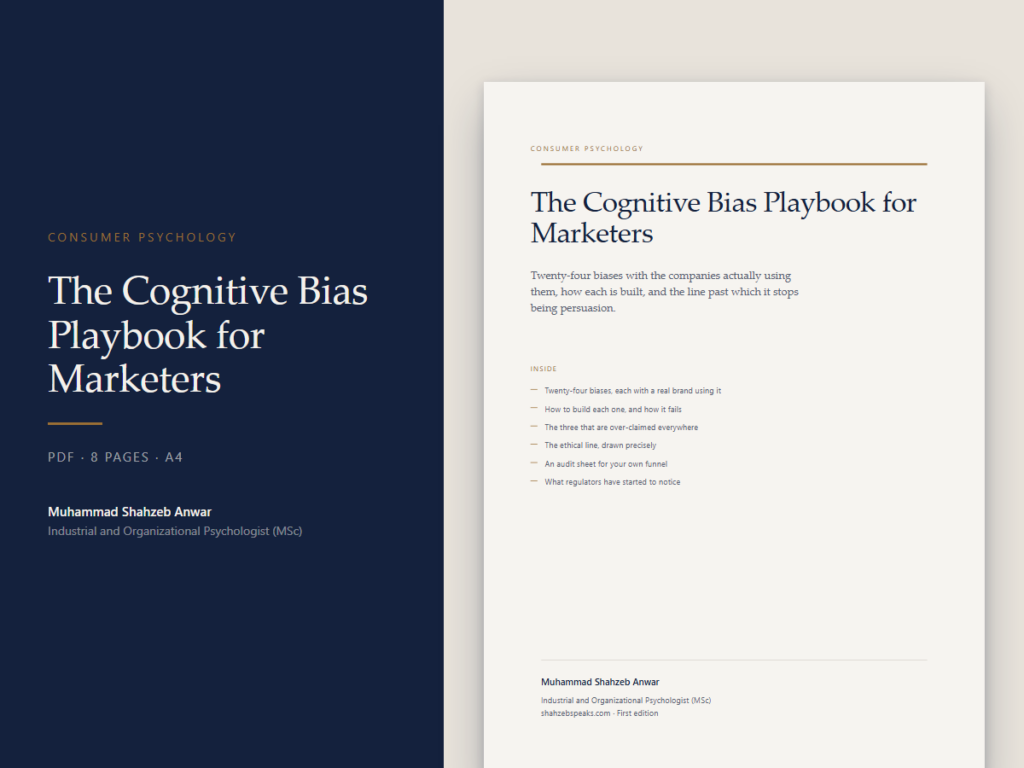
Most bias lists are definitions with a stock photo. They tell you what anchoring is and leave you where you started, because knowing the name of a mechanism is not the same as knowing how to build one or how it breaks.
Every entry here does four things: names the bias, names a company actually running it, describes how it is constructed, and says what makes it stop working. That last part is missing everywhere else and it is the part that saves money. Twenty-four biases in total, drawn from thirty-one published brand teardowns rather than from hypotheticals.
It opens with the three that are over-claimed everywhere, including colour psychology and the paradox of choice, and it explains what actually survives scrutiny in each case.
What it is not: a list of effect sizes. The honest ones are smaller and far more context-dependent than marketing writing implies, and a percentage quoted without its conditions is how the folklore started. There is also a precise test for the line between persuasion and manipulation, and a note on where regulators have moved from guidance to enforcement.
8 pages, A4, formatted for printing. Delivered as a PDF immediately after payment.
Our psychology templates and tools are highly versatile—equally effective for licensed clinical professionals, wellness coaches, and individuals committed to personal mental health growth.
Yes, our therapeutic templates, worksheets, and intervention guides are strictly grounded in established, empirically supported psychological frameworks like CBT, DBT, and ACT.
Yes, all our psychology tools are intentionally engineered in high-resolution, print-ready monochrome and color formats tailored for standard A4 and US Letter sizes.
No. While these are excellent supplementary resources, they are educational diagnostic aids and therapeutic exercises, NOT substitutes for professional medical or psychiatric treatment.
Added to cart
Your cart is empty
Browse Shop Tools & Software · Tool
 Tools & Software · Tool