
It is 9:05 on a Tuesday morning. The laptop is open, the inbox is full, and the employee at the desk is doing everything right: she arrived on time, she answered the first email, she nodded in the stand-up. But her mind is somewhere else entirely — on the hospital appointment her mother has on Thursday, on the rent that went up last month, on the school run she still has to arrange for Friday. She will be at her desk all day. She will not be fully there for much of it. New research on personal stress at work puts a number on how common that is: 44% of employed Americans say stress from their personal lives affects their work at least once a month — and when it does, nearly two in three say their productivity falls.

I am an Industrial and Organizational Psychologist in Karachi, and I write about work and behaviour for a global reader. This article is built on a new American survey released on 17 November 2026 — the Humankind Quality of Life Report, conducted by NORC at the University of Chicago — and on the psychology of stress spillover, which has studied exactly this pattern for more than thirty-five years. One warning belongs up front: Humankind paid for the survey, and Humankind sells employer wellbeing services. That does not make the numbers wrong — NORC ran the survey on a probability panel, which is the gold standard for this kind of work — but it means the finding that employer support matters suits the sponsor. I will say so where it matters, and I will keep the survey’s claims separate from what the older, independent psychology shows.
“Most employers can see whether people show up for work. Far fewer can see how much capacity those people have once they’re there.”
— Brian Edds, Chief Product Officer, Humankind, on the 2026 Quality of Life Report
This guide covers the short answer, the numbers behind the trend, what the report calls “cognitive risk”, the psychology of why stress crosses the boundary between home and work, the thin safety net underneath it all, and what employers and employees can honestly do with the evidence.
🎯 Chapter 1: The short answer — personal stress at work, explained
Personal stress at work means the pressures of life outside the job — money, caregiving, housing, health, relationships — following an employee into the working day and shrinking what they can actually do there. The short answer from the new research is that this is normal, frequent and mostly invisible. In the Humankind survey of 1,272 employed American adults, 44% said personal stress affects their work at least once a month, and 28% said it happens at least weekly. Four in five employees (80%) experience personal stress at least weekly in the first place, so the surprise is not that it reaches work. The surprise is how rarely anyone at work notices: the employee is present, polite and answering emails, while their focus, motivation and judgement are running at reduced capacity.
The report gives this a name: cognitive risk. It means the risk that personal pressures reduce the mental and emotional capacity available for work. That framing matters, because it moves the conversation away from attendance and toward capacity. A manager can see who is absent. A manager cannot see who is sitting at a desk with half their working memory occupied by a problem they cannot solve from that desk. The survey found that when personal stress reaches work, 64% of affected employees said their productivity fell the most recent time it happened, and 32% said it fell quite a bit or more. Those are self-reported falls, not measured output — the survey asked people what happened, and people answered honestly about themselves. What it proves is narrower than a laboratory finding and still important: workers themselves say the effect is real, repeated and large enough to notice.
Two cautions belong at the start. First, this survey cannot prove that personal stress causes the productivity fall. It is a snapshot: people reported their stress and their productivity at the same time, so the arrow could run the other way — a bad week at work could make home feel harder too — or both could come from the same hard period of life. The older psychology in Chapter 4 helps here, because diary studies that follow the same people day by day do show stress travelling from one part of life into the other. Second, this is an American survey. The numbers describe American workers. But the mechanism — a mind that cannot switch off a worry because the working day started — is not American. It is human, and it is the same mechanism in Karachi, London or Lahore as it is in Chicago.
📊 Chapter 2: The numbers — what 1,272 American workers told NORC
The survey behind the trend is a serious one. NORC at the University of Chicago surveyed 1,272 employed American adults between 23 July and 6 August 2026, using its probability-based AmeriSpeak panel — meaning participants were selected by chance from the population, not recruited from a website or a mailing list. The margin of sampling error is ±3.6 percentage points at the 95% confidence level. The report was released on 17 November 2026, and the release was carried by BusinessWire and syndicated widely the same week. Humankind funded it; NORC ran it. That combination — a commercial sponsor, an independent survey house — is the honest way to read the numbers that follow.
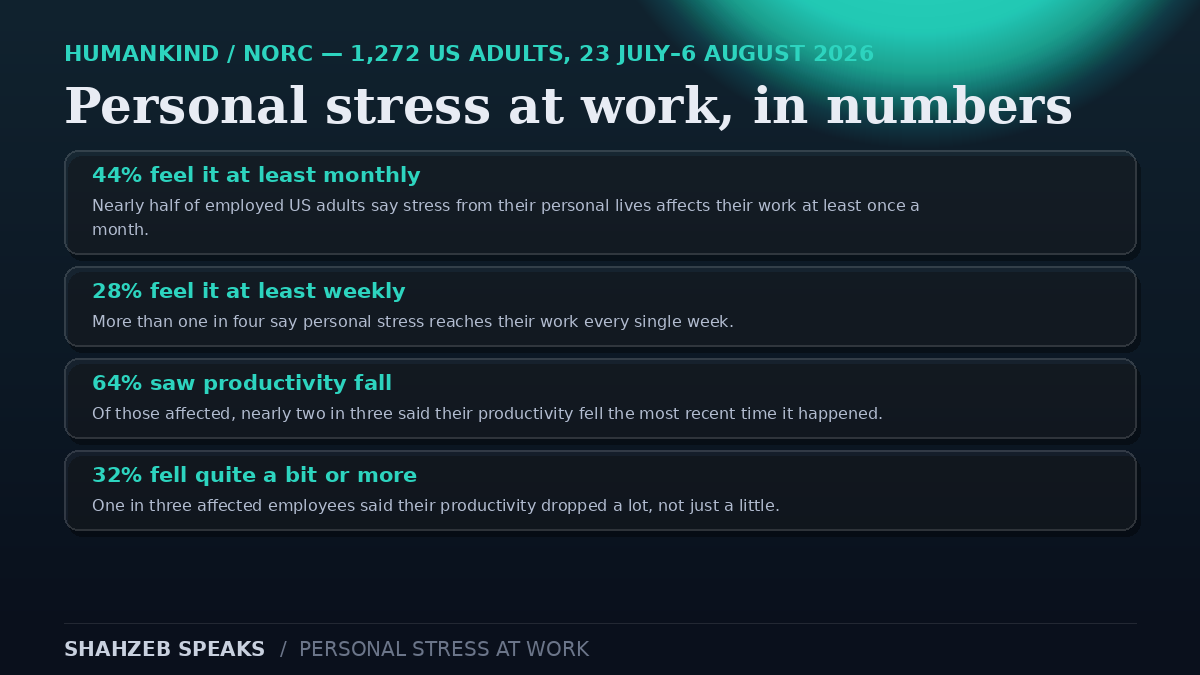
The headline figure is the 44%. Nearly half of employed Americans say stress from their personal lives affects their work at least monthly, and more than one in four (28%) say it happens at least weekly. The base rate is higher still: 80% of employees experience personal stress at least weekly, and 79% say life stress distracts them at work. Put those together and the picture is of a workforce that is stressed most weeks, with that stress crossing into the working day for a large minority every single week and for nearly half at least once a month. The effects show up first in the two things work depends on most: in the past month, 47% of employees felt less motivated or engaged on multiple days, and 42% lost focus or concentration on multiple days. Motivation goes first, focus second, output third — and that order is worth remembering, because it tells a manager where to look. The employee who has gone quiet in meetings is not necessarily disengaged. She may be distracted, and distraction has a cause.
| What the Humankind / NORC survey found | Share |
|---|---|
| Experience personal stress at least weekly | 80% |
| Say life stress distracts them at work | 79% |
| Personal stress affects work at least monthly | 44% |
| Personal stress affects work at least weekly | 28% |
| Felt less motivated or engaged on multiple days (past month) | 47% |
| Lost focus or concentration on multiple days (past month) | 42% |
| Of those affected: productivity fell the most recent time | 64% |
| Of those affected: productivity fell quite a bit or more | 32% |
Read the table carefully and one detail stands out: the 64% and the 32% are percentages of the people whose work was affected, not of all workers. That is the honest way to report them, and the report does. It also means the overall share of the workforce that has felt a productivity fall is smaller than 64% — but the share that has felt a large one, one in three of those affected, is the figure that should worry an employer. A third of the affected group is not having a slightly off day. They are having a bad one, repeatedly, and nobody can see it from the attendance register.
🧠 Chapter 3: Cognitive risk — what stress does to a working mind
To understand why personal stress cuts productivity, it helps to say what productivity actually depends on. Most modern work runs on three mental resources: attention (staying with the task in front of you), working memory (holding several pieces of information at once while you use them), and judgement (choosing well between options). Stress competes for all three. A worry is, in effect, a second task running in the background: it takes up working memory, it pulls attention away in small jerks, and it makes decisions feel heavier because the mind is already loaded. That is what the report means by cognitive risk — not that stressed people are lazy or careless, but that the capacity they bring to work has shrunk while their attendance has not.
This is the old idea of presenteeism, given a sharper name. Presenteeism means being present at work while unwell or unable to function fully, so that output falls even though nobody is absent. The full Humankind report models how presenteeism adds up across a workforce, though its cost figures sit inside the full report and I have not verified them, so I will not print them here. The global context is public and verified: the World Health Organization estimates that 12 billion working days are lost every year to depression and anxiety, at a cost of US$ 1 trillion a year in lost productivity, and that 16% of working-age adults were estimated to have a mental disorder in 2023. Those are not the same as personal stress — depression and anxiety are clinical conditions, and personal stress is a normal part of life — but they measure the same blind spot. The cost of a struggling workforce is mostly not in the days people take off. It is in the days they show up and cannot do their best work. For more on how stress changes what employees do at work, see my earlier article on why stressed employees ignore cybersecurity warnings.
There is a second reason managers miss it. Stress does not announce itself the way absence does. A stressed employee often works harder, not less — staying late, answering faster, taking on more — because effort feels like the way to compensate. The output still falls, because effort is not the bottleneck. Attention is. An employee who re-reads the same paragraph three times, who double-checks an email she already sent, who sits in a meeting and realises she has not heard the last five minutes, is not slacking. She is working with a smaller share of her own mind available, and no amount of extra hours fixes that. The fix is not more effort. It is less load, or a mind freed from the worry — which is why the rest of this article is about the worry, not the workload.
🔄 Chapter 4: The psychology — why stress crosses the boundary
The idea that stress travels between home and work is not new, and the Humankind report did not invent it. Psychologists call it spillover: the moods, strain and habits of one part of life carry over into another, within the same person. The first direct quantitative evidence came from Bolger, DeLongis, Kessler and Wethington in 1989, who studied 166 married couples and showed that stress travelled from work to home for both husbands and wives — and, against the expectations of the time, that husbands were more likely than wives to bring their home stresses into the workplace. The boundary between home and work was never a wall. It was a membrane, and stress passes through it in both directions.

Four years earlier, Greenhaus and Beutell had given the field its map. In a 1985 paper in the Academy of Management Review, they described work-family conflict as coming from three sources: time (hours given to one role are not available to the other), strain (the tension and fatigue of one role make the other harder), and behaviour (the way you have to act at work does not fit the way you want to be at home). Personal stress at work is mostly the second of these — strain. The employee in the opening scene is not short of hours. She is short of calm. The hospital appointment, the rent, the school run: each is a small demand on the same pool of attention, and by 9:05 the pool is already half empty.
The clearest evidence of how it works day by day comes from a diary study. Du, Derks and Bakker (2018) followed 108 working parents in China across 366 daily surveys, and found that family hassles on one day weakened the link between job resources and flourishing at work the next day — and that daily rumination carried the effect. Rumination is the mechanism worth naming: the worry does not stay in its own box. It replays. A parent who lies awake thinking about a bill is not only tired the next morning; the same thoughts keep returning during the working day, each return taking a small piece of attention with it. That is why “just focus” is useless advice. Focus is not a switch. It is a resource, and rumination is already spending it. The same pattern runs in the other direction too — work stress comes home, and in couples it can cross over to the partner — but the Humankind numbers are about the home-to-work direction, and that direction has been the less studied one for most of the field’s history.
🕸️ Chapter 5: The thin safety net — who has help, and who cannot reach it
The most troubling part of the report is not the stress. It is the gap between the stress and the help. More than half of workers (53%) have no more than two reliable people outside their household to turn to for help, and one in ten (10%) say there is nobody outside their household they can rely on at all. That is a thin safety net for a problem this common. When the people around you are few, a single crisis — a parent falling ill, a partner losing a job, a landlord raising the rent — has nowhere to go except into the working day, because there is nobody else to carry any part of it.
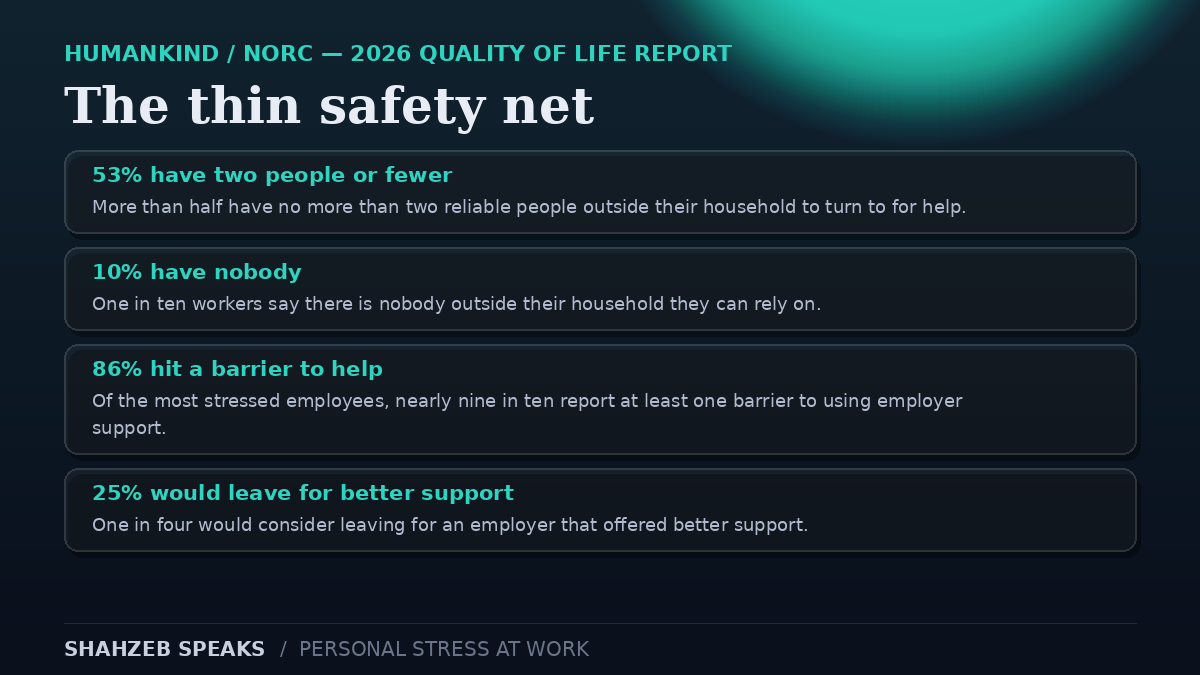
And the help that does exist is often hard to reach. Among employees who experience stress daily or several times a week — the most stressed group in the survey — 86% report at least one barrier to using employer support. The report does not publish which barriers, in the release at least, but the pattern is familiar from a decade of workplace research: people do not know the support exists, or they do not trust it to stay confidential, or it is buried behind a portal and a form, or using it feels like admitting a weakness to the same organisation that decides promotions. The result is a cruel pattern the report states plainly: the employees carrying the most are the least able to go looking for help. As Humankind’s Brian Edds put it, “You can’t rely on demand to reveal need.”
Workers themselves see the link between support and performance. Just over half (51%) believe greater employer support would improve their work performance at least moderately, and one in four (25%) would consider leaving for an employer that offered better support. That second figure is the one a chief executive should read twice. A quarter of the workforce is telling a survey — anonymously, with no incentive to exaggerate — that support is worth changing jobs for. That is not a wellbeing preference. That is a retention signal, and it is cheaper to hear it in a survey than to hear it in a resignation letter. I wrote about the same dynamic from the other side in my article on GenAI technostress and work loneliness, where new technology added a different kind of strain to the same stretched workforce.
✅ Chapter 6: What employers should do — my advice, grounded in the findings
The full Humankind report closes with four practical steps for employers, but the release does not publish what they are, so I will not present any list as the report’s. What follows is my own advice as an I/O psychologist, drawn from the findings above — and I will say which finding each point answers, so you can judge it.
First, stop relying on demand to reveal need. The 86% barrier figure is the reason: if the most stressed employees face the most friction, then a support system that waits to be asked will systematically miss the people who need it most. Reach out instead. That means managers trained to notice a change — the employee who has gone quiet, whose work has slipped, who is staying late but producing less — and to ask a simple, private question: “Is something going on outside work that we can help with?” It does not mean prying. It means making the offer before the crisis, when it is easy to accept, rather than after it, when pride and exhaustion make it hard.
Second, make support findable in one place, with no maze. If the employee assistance programme, the flexible-working request, the carer’s leave policy and the financial wellbeing helpline live in four different portals, each behind its own login, then the barrier is the design. One page, one named contact, one phone number — and the same information repeated in onboarding, in team meetings and in the places people actually look. Confidentiality must be stated plainly and kept: if employees believe a call to a helpline reaches their manager, they will not call. The 53% with two people or fewer outside the household are the test case. If the system works for them, it works for everyone.
Third, protect focus rather than demanding more hours. The 47% who felt less motivated and the 42% who lost focus are telling you the resource that is short. When someone is carrying a heavy week at home, the useful response is a lighter week at work where the job allows it: a deadline moved by two days, a meeting-light day, a task swapped for one that needs less concentration. This is not lowering standards. It is matching the load to the capacity available that week, so that the work that does get done is good work — and so the employee does not burn the rest of their capacity pretending to be fine. For the wider question of how remote and hybrid work change this picture, see my article on remote work and company culture.
Fourth, measure capacity, not just attendance. If your dashboard tracks absence, turnover and engagement scores, add the question the report raises: how much capacity do people actually have once they are here? A short, anonymous monthly pulse — two or three questions about focus, energy and whether personal pressures are affecting work — will tell you more than an absence rate ever will, and it costs almost nothing. The point is not surveillance. It is seeing the problem while it is still small, in the quarter when it can still be fixed, rather than in the exit interview when it cannot.
💼 Chapter 7: What employees can do — when life shows up at your desk
If you are the person in the opening scene, the advice is different, and it starts with naming what is happening. Stress spillover is easier to manage once you can see it: the reason you re-read the same paragraph three times is not that you have lost your ability. It is that part of your attention is somewhere else, and it will keep going there until the worry has somewhere to land. Write the worry down — literally, on paper, in one sentence — and then write the next step, however small. The research on rumination in Chapter 4 is the reason: a worry that has a next step attached to it replays less than a worry that is only a feeling. A phone call to book, a form to fill in, a conversation to have on Friday — any concrete step gives the mind something to do with the worry other than repeat it.
Next, ask for a specific adjustment, not for “support” in general. Managers respond far better to a concrete request than to a vague one. “Can we move the Thursday deadline to Monday? My mother has a hospital appointment and I will be short of focus this week” is a request a manager can grant in ten seconds. “I am stressed” is a problem a manager does not know how to solve. You do not owe your manager the details of your private life — a sentence is enough — but a specific ask, tied to a specific week, is the fastest way to protect both your work and your week.
Third, protect the basics that stress erodes first. Sleep, food and a short walk are not luxuries when you are under strain; they are the resources your working memory runs on. A twenty-minute walk at lunch will not solve a money problem, but it will return some attention to the afternoon, and that is a real gain on a hard day. And if the stress is constant — if it is affecting your sleep, your appetite or your mood for weeks rather than days — speak to a doctor. That is not a failure of coping. It is what medical help is for, and it is the one step that belongs outside the workplace entirely.
❓ Questions I am asked most often
What is personal stress at work?
Personal stress at work is when pressures from life outside the job — money, caregiving, housing, health or relationships — follow you into the working day and reduce what you can do there. Psychologists call the mechanism spillover: strain from one part of life carries into another. You are present and working, but part of your attention and energy is still on the problem at home.
How common is personal stress at work?
Very common. In the 2026 Humankind survey of 1,272 employed American adults, 44% said personal stress affects their work at least monthly and 28% said it happens at least weekly. Four in five employees experience personal stress at least weekly in the first place, and 79% say life stress distracts them at work. It is a normal experience, not a rare one.
Does personal stress really lower productivity?
According to the people it happens to, yes. Of the employees whose work was affected, 64% said their productivity fell the most recent time, and 32% said it fell quite a bit or more. But this is self-reported, from a survey taken at one point in time, so it shows workers experience a real fall — not proof stress caused it. Diary studies support the same direction.
What is cognitive risk?
Cognitive risk is the term the Humankind report uses for the risk that personal pressures reduce the mental and emotional capacity available for work. Attention, working memory and judgement all draw on the same limited pool, and a worry running in the background spends from that pool. The employee is still at their desk, but less of their mind is available for the job.
Why don’t stressed employees use the support their employer offers?
Because the most stressed face the most friction. In the survey, 86% of employees who experience stress daily or several times a week reported at least one barrier to using employer support. Common barriers are not knowing the support exists, not trusting it to stay confidential, and support buried behind portals and forms. As Humankind’s Brian Edds put it, you cannot rely on demand to reveal need.
What can I do if personal stress is affecting my work?
Name it, give it a next step, and ask for one specific adjustment. Write the worry down in one sentence with the next action attached — that alone reduces rumination. Then ask your manager for something specific, such as moving one deadline by a few days. Protect sleep, food and a short walk, which are what your attention runs on. If stress is constant for weeks, speak to a doctor.
If personal stress is quietly cutting your team’s output, and you want the cause understood with evidence rather than another wellbeing poster, I can help. I am an Industrial and Organizational Psychologist, and I work with teams on work design, workload and the support systems that actually reach people. Get in touch here.
If you want to understand the wider context, start with my guide to industrial psychology in Pakistan and my earlier articles on why stressed employees ignore cybersecurity warnings, GenAI technostress and work loneliness, remote work and company culture and employee engagement at a 15-year low, which cover the other ways pressure outside work changes what happens inside it.
Sources
- Humankind (2026). 2026 Quality of Life Report: When Life Shows Up at Work. https://www.humankindforall.com/2026-quality-of-life-report
- Humankind (2026, 17 November). Personal Stress Affects Work for 44% of U.S. Employees, Quietly Reducing Productivity, New Humankind Study Finds. BusinessWire. https://www.businesswire.com/news/home/20261117324273/en/Personal-Stress-Affects-Work-for-44-of-U.S.-Employees-Quietly-Reducing-Productivity-New-Humankind-Study-Finds
- World Health Organization (2026). Mental health at work. https://www.who.int/news-room/fact-sheets/detail/mental-health-at-work
- Bolger, N., DeLongis, A., Kessler, R. C., & Wethington, E. (1989). The contagion of stress across multiple roles. Journal of Marriage and the Family, 51(1), 175–183. https://doi.org/10.2307/352378
- Greenhaus, J. H., & Beutell, N. J. (1985). Sources of conflict between work and family roles. Academy of Management Review, 10(1), 76–88.
- Du, D., Derks, D., & Bakker, A. B. (2018). Daily spillover from family to work: A test of the work–home resources model. Journal of Occupational Health Psychology, 23(2), 237–247. https://doi.org/10.1037/ocp0000073