
It is 6:40 in the evening. The inbox is still full, a deadline moved forward an hour ago, and a small red warning has just appeared on the screen. The employee glances at it, decides it can wait until morning, and keeps typing. Nothing malicious happened in that moment. Nobody cut a corner on purpose. But a study published this month says that exact moment — a stressed person, a warning, and a decision to carry on — is where most security failures begin. Stress and cybersecurity collide in ordinary working days, and stressed employees are more than twice as likely to walk past a security problem and assume someone else will fix it.
I am an Industrial and Organizational Psychologist in Karachi, and I write about work and behaviour for a global reader. This article is built on a study released on 11 November 2026 by Mindtools Kineo, called Cybersecurity’s Tipping Point: What makes people act securely, or not at all. One limit up front, and it matters: this is a company-conducted study by a learning and development provider that sells cybersecurity training. It is not a peer-reviewed academic paper, and it was not published in a journal. Its headline finding is also cross-sectional, which means it shows an association between stress and insecure behaviour, not proof that stress causes it. I will say so wherever the finding appears, and I will put it next to peer-reviewed evidence — on attention, on phishing, and on psychological safety — so you can see what holds up and what does not.
“Cybersecurity is usually discussed as a technology, policy or training problem. Our research shows that it is also a workload and management problem.”
— Dr Anastasia Voronkova, Insights Analyst, Mindtools Kineo
This guide covers the short answer, the study behind it, the “not me” gap that makes most of us feel safe, why stress narrows attention, what experiments show about phishing under pressure, the point at which even a psychologically safe team stops speaking up, the scale of the human element in breaches, what actually helps — and what the evidence cannot tell us yet.
🎯 Chapter 1: The short answer — stress and cybersecurity
Yes — stress and cybersecurity are linked, and the link is stronger than most managers assume. In the Mindtools Kineo study of 296 employees across 33 countries, 17.7% of stressed employees said they would continue working after discovering a security problem, because they expected somebody else to resolve it. Among employees who were not stressed, that figure was 8.2%. In other words, stressed employees were more than twice as likely to walk past a problem. The same study found that greater stress was also associated with poorer password habits and lower online vigilance, though it gave no numbers for those two findings.
Two things make this finding hard to dismiss. First, the people in the study were not careless by nature: 86% of them recognised that a security incident could seriously damage their professional reputation, and 84% understood it could cost their employer serious money. They knew the stakes. Second, 80% of them had access to sensitive business data and 57% handled sensitive personal information. The risk was not theoretical, and it was not somebody else’s. The gap between knowing and acting is the story of this article — and stress is what widens it.
The practical conclusion is blunt. If your team is under sustained pressure, another annual training course will not fix your security behaviour. The study’s lead researcher, Dr Anastasia Voronkova, puts it plainly: managers need to treat overload as an early warning of security risk, check team capacity before adding new security demands, and model secure behaviour themselves rather than delegating it entirely to IT or compliance. The rest of this article explains the psychology behind that advice, and where the evidence for it is strong and where it is thin.
📊 Chapter 2: The study — 296 people, 33 countries, one clear pattern
The study behind this article is Cybersecurity’s Tipping Point, released by Mindtools Kineo in November 2026. Data were collected from 296 participants across 33 countries between June and July 2026, spanning North and South America, Europe, and South and East Asia, across nine industries and organisations of different sizes. Participants completed the company’s Cybersecurity Skills Assessment — task-based and scenario-based assessments with knowledge checks — followed by a survey covering psychometric factors linked to cybersecurity behaviour and self-reported workplace practices. The analysis used descriptive statistics and inferential tests, including t-tests, analysis of variance, multiple regression and moderation analysis, with a significance threshold of p < .05.
That method has real strengths and real limits, and both should be stated. On the strengths side, the study did not rely only on asking people how secure they are: the skills assessment put them through tasks and scenarios. On the limits side, the sample is small — 296 people spread across 33 countries is about nine people per country — and the behavioural measures were largely self-reported. The report’s own sources do not state how “stressed” was measured or where the line was drawn between stressed and not stressed, so I cannot describe that method here. And because the study is cross-sectional, it captures one moment in time: it shows that stress and insecure behaviour travel together, not that one causes the other. Treat the headline as a strong association with a plausible mechanism, not as a proven cause.
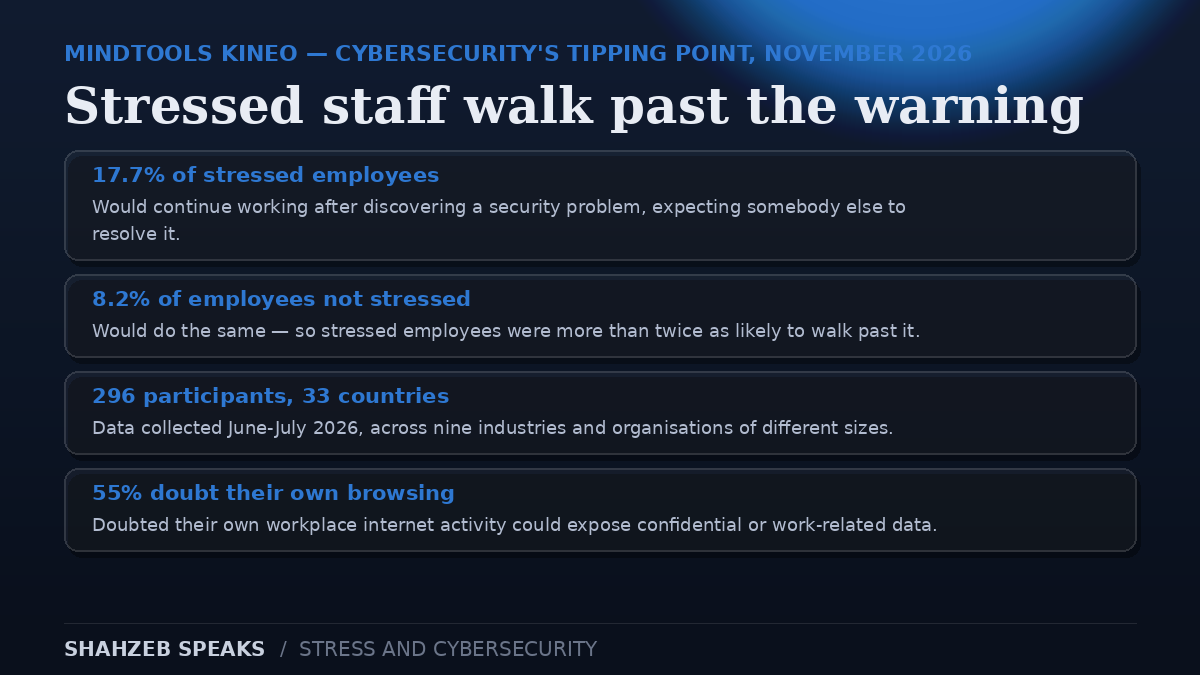
The headline numbers are worth reading slowly, because they are easy to misread. The question was not whether employees would click a phishing link or reuse a password. It was what they would do after discovering a security problem: 17.7% of stressed employees would continue working, expecting somebody else to resolve it, against 8.2% of those who were not stressed. That is a ratio of about 2.16 — the arithmetic from the two percentages, not a statistic the study itself reported — and the study describes it as “more than twice as likely”. No effect size or p-value for this specific comparison was given in the sources I read, so I will not print one.
There is a second finding in the same study that is arguably more important than the headline. Employees who felt safe admitting mistakes, asking questions and raising concerns generally showed better cybersecurity behaviour: they were more likely to report suspicious activity, flag possible errors and follow secure practices. But that benefit weakened as stress increased, and at high stress levels the link between a safe team and better security behaviour was no longer statistically significant. In plain terms, a good team culture helps — until pressure gets high enough to cancel it out. Chapter 6 looks at why that happens.
One more piece of context before the mechanisms. Mindtools Kineo sells cybersecurity training, and the report argues that traditional awareness training alone is not enough. That is a finding that happens to suit the company’s own position, which is exactly why the company-conducted flag matters. The honest way to read the study is alongside independent evidence — and the next chapters do that, starting with the strange gap between what employees know and what they believe about themselves.
🙈 Chapter 3: The “not me” gap — why we think breaches happen to someone else
The Mindtools Kineo study found something that every security team will recognise: employees understand the danger in general and discount it in particular. More than half of the participants — 55% — doubted that their own workplace internet activity could expose confidential or work-related data. Almost one in four — 24% — believed security incidents were more likely to happen elsewhere in the organisation than in roles like theirs. And one in five did not believe their own device could realistically be targeted by a phishing attempt.
Set those figures against the knowledge figures from the same study, and the gap becomes visible. The same people who doubted their own exposure mostly understood the consequences: 86% recognised that an incident could seriously damage their professional reputation, and 84% understood it could result in significant financial costs for their employer. Employees generally rated the potential severity of an incident at least 15% higher than their own vulnerability to one. They know how bad a breach would be. They do not believe it would be theirs.
| What employees believe | Share of participants |
|---|---|
| Doubt their own browsing could expose company data | 55% |
| Think incidents happen elsewhere, not in roles like theirs | 24% |
| Do not believe their device could realistically be phished | 1 in 5 |
| Recognise an incident could damage their reputation | 86% |
| Understand an incident could cost their employer seriously | 84% |
| Have access to sensitive business data | 80% |
| Handle sensitive personal information | 57% |
The study’s most useful finding here is about what actually predicts secure behaviour. Feeling personally vulnerable was a much stronger predictor of secure behaviour than understanding the potential consequences. That turns the usual security message upside down. Most awareness training spends its energy on consequences: the fines, the headlines, the cost. The evidence says consequences are already understood — 84% to 86% of people get that part. What is missing is personal vulnerability: the belief that my inbox, my device, my click is the one that matters. A message that raises perceived personal risk without raising fear to the point of paralysis is more useful than another slide about the size of the fine.
There is a name for this pattern in psychology, and it is older than cybersecurity: people routinely rate their own risk as lower than other people’s, even when the risk is identical. It shows up in driving, in health, and in information security. What the Mindtools data add is a workplace twist — the gap survives even when the person holds the keys. Four out of five participants had access to sensitive business data, and more than half handled sensitive personal information, yet a majority doubted their own browsing could expose any of it. The gap is not ignorance. It is a specific, measurable blind spot, and it is the first thing a good security programme should try to close.
🧠 Chapter 4: Why stress narrows attention — the mechanism
If the Mindtools finding is the pattern, the mechanism comes from older, peer-reviewed work on what stress does to attention. The classic account is Easterbrook’s cue-utilisation hypothesis, published in 1959 in Psychological Review: as emotional arousal rises, the range of cues a person uses narrows. Some cues are dropped because they are irrelevant, which can help. More often, the narrowing cuts out cues that matter — and a security warning is exactly the kind of peripheral cue that gets dropped when the mind is locked onto the task in front of it.
A later review makes the picture more honest. Starcke and Brand, writing in Neuroscience & Biobehavioral Reviews in 2012, reviewed human studies of acute laboratory stress and decision-making and found that stress changes decisions, but not in one direction. The effect depends on the type of decision, its timing relative to the stressor, and the individual. That matters, because it stops us from turning the Mindtools finding into a slogan. Stress does not always make people reckless. What the review supports is narrower: under stress, people tend to make riskier decisions, show impaired strategic reasoning, adjust automatic responses insufficiently, and consider fewer of the available options. A warning that requires a pause, a check, and a judgement call is precisely the kind of task that suffers when options are not fully considered.
Put the two together and the 17.7% figure starts to make sense as psychology rather than carelessness. The stressed employee is not deciding that security does not matter. Their attention has narrowed to the deadline, the client, the message that must go out now — and the warning falls outside the narrowed field. The decision to “carry on and let someone else deal with it” is, in that moment, not a decision at all. It is the path of least resistance for a mind that has run out of spare capacity. That is also why the problem gets worse as pressure rises: the more the workload demands, the narrower the field gets, and the more warnings fall outside it.
This is where the link to decision fatigue matters. Earlier research on this site showed that our evening selves make worse choices than our morning selves, because decision quality degrades as mental resources drain. Stress works the same way, faster. A security warning at 6:40 in the evening, after a day of decisions, lands on a mind with almost nothing left to give it. The fix, then, is not to make the warning louder. It is to reduce the load on the person who has to notice it — which is where Chapter 8 comes in.
🎣 Chapter 5: Phishing under pressure — what the experiments show
The Mindtools study measured self-reported behaviour and scenario responses, not phishing clicks. So the claim that stressed people click more phishing links needs separate evidence — and that evidence exists, in peer-reviewed studies that ran real phishing emails on real employees.
The most direct is Fallon and colleagues, published in the Journal of Information Warfare in 2023. They sent one of four different phishing emails, during regular business hours, to 153 employees at a National Laboratory, without telling them a test was coming. The significant predictors of susceptibility included how suspicious participants were of the email — and their reported level of work-related distress. People who reported a high level of distress were significantly more likely to follow the phishing link: every one-point increase in self-reported distress raised the likelihood of responding to the simulated phishing email by 15%. The sample is small — 153 people — and the authors say so themselves, noting that it limited their ability to separate out all the relationships between variables. But the direction is clear, and it matches the Mindtools pattern: distressed people respond more, not less.
A second study isolates the mechanism. Lu and colleagues, published in the European Journal of Information Systems in 2025, ran two online experiments with 977 participants in total. Participants had to memorise either two or eight digits — a light or a heavy working-memory load — while evaluating emails, four of which were phishing attempts. Higher working-memory load reduced phishing detection accuracy. The useful part is what helped: brief goal-activation reminders — an explicit reminder to focus on phishing detection — improved detection performance and lessened the negative impact of cognitive load. No single percentage drop in accuracy was verified from the sources I read, so I will not print one. But the shape of the result is what matters for practice: load hurts detection, and a short reminder at the moment of decision helps.
A third study adds a caution. Zhuo, Biddle and Betts, at the 2024 Symposium on Usable Security and Privacy, ran a small in-lab experiment with only 26 participants, who managed 45 emails in 30 minutes, including four phishing emails. Under high workload, participants showed higher physiological arousal and longer fixations, and spent half as much time reading email as under low workload. But there was no main effect of workload on phishing clicking. A post-hoc analysis found participants were more likely to click on task-relevant phishing emails — messages that looked related to their work — than non-relevant ones during high workload. With 26 people, that is suggestive, not conclusive. It does, however, point to something important: under pressure, the dangerous email is not the obvious one. It is the one that looks like the work you are already doing.
Read together, the three studies draw a consistent line. Distress predicts responding to phishing. Working-memory load impairs detection. Under high workload, people spend half as much time reading email, and the phishing messages that get through are the ones that look like the job. None of this proves that the Mindtools 17.7% figure is caused by stress. But it does show that the mechanism the Mindtools finding implies — stressed attention, narrowed cues, skipped checks — is real, and it has been demonstrated in experiments, not only in surveys.
🛡️ Chapter 6: When psychological safety stops working
There is a hopeful finding in the Mindtools study, and a limit on it that deserves equal attention. Employees who felt safe admitting mistakes, asking questions and raising concerns generally demonstrated better cybersecurity behaviour: they were more likely to report suspicious activity, flag possible errors and follow secure practices. That is psychological safety doing what the research says it does.
Psychological safety is a precise idea, not a vague feeling of being liked. Amy Edmondson defined it in 1999, in Administrative Science Quarterly, as “a shared belief held by members of a team that the team is safe for interpersonal risk taking” — speaking up, asking for help, admitting mistakes, and proposing ideas without fear of embarrassment or punishment. It is distinct from trust, cohesion or team satisfaction. In her early hospital-team work, Edmondson found that better-performing teams reported more errors, not fewer — because they felt safe enough to surface them. Reporting more was a sign of health, not of failure. The same logic applies to security: a team that reports a suspicious message quickly is a team that works, even though its incident count looks higher.
Here is where the Mindtools finding turns. The benefit of that supportive team environment weakened as stress increased, and at high stress levels the relationship between team safety and better cybersecurity behaviour was no longer statistically significant. A speak-up culture, in other words, has a ceiling. Voronkova’s second verified quote makes the point directly: “There is also a psychological safety matter, as people need to know they can admit a mistake without being blamed or punished. Yet, a speak-up culture may offer limited protection if employees are too stretched to stop working, investigate a concern or report a mistake.”
That ceiling is the most actionable finding in the whole study, and it is the one most likely to be missed. Many organisations have spent the last few years building psychological safety — and rightly so; earlier writing on this site, on psychological safety at work, sets out what the evidence actually supports. But safety is a belief about what will happen if you speak up. It does not create time. A person who knows they will not be blamed, but who also knows they have four deadlines before lunch, still has to stop, investigate, and report — and stopping is the part that costs time. At high stress, the cost wins. The implication is uncomfortable for managers: you cannot culture your way out of overload. Safety and capacity have to be built together, or the safety does not survive the busy week.
📈 Chapter 7: The scale of the problem — 62% of breaches, $4.99 million
Stress is a human factor, and the human factor is most of the problem. Verizon’s 2026 Data Breach Investigations Report — its 19th edition, analysing more than 31,000 real-world security incidents, of which more than 22,000 were confirmed data breaches, across 145 countries, with data from October 2024 through November 2025 — found that the human element was present in 62% of breaches, up slightly from 60% the previous year. Social engineering was the third most common breach pattern, representing 16% of all breaches. And in phishing simulations, the median click rate in mobile-centric vectors — voice and text messaging — was 40% higher than via email.
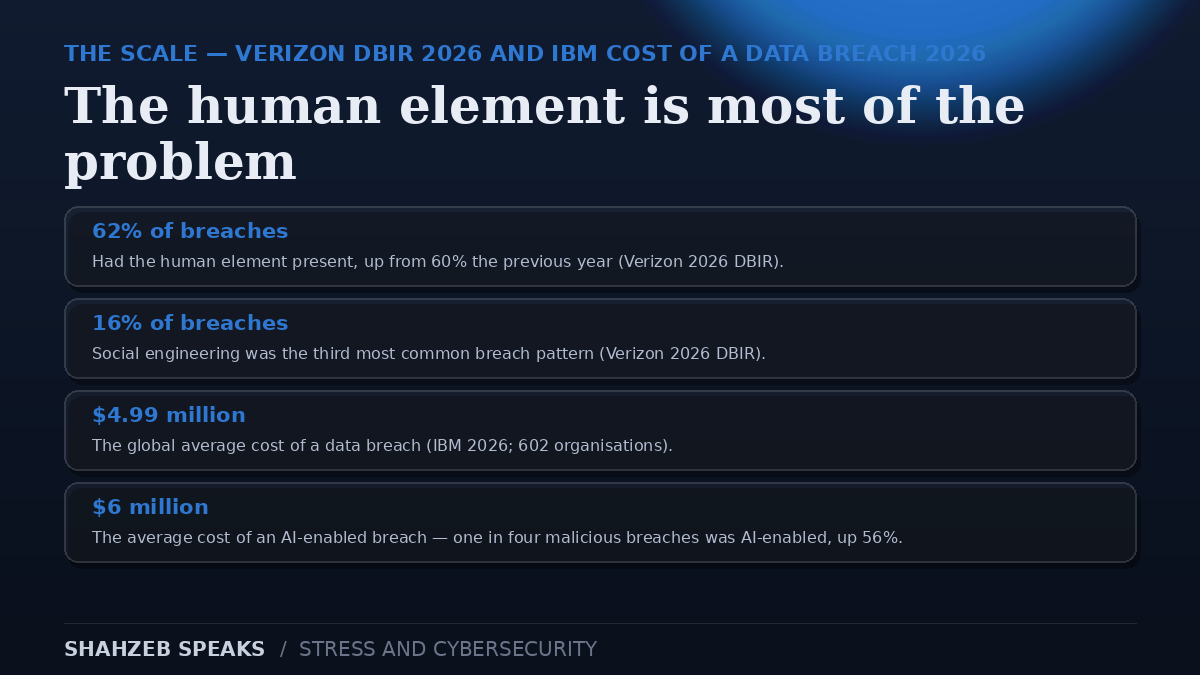
The cost side comes from IBM’s Cost of a Data Breach Report 2026, released on 29 July 2026 and based on breaches at 602 organisations between March 2025 and February 2026. The global average cost of a data breach was $4.99 million. Breaches enabled by artificial intelligence averaged $6 million, roughly $1 million more than the global average, and one in four malicious breaches were AI-enabled — a 56% increase on the previous year. The AI figure matters for this article because AI makes phishing cheaper to produce and harder to spot: the messages that reach a stressed employee are increasingly well written, well targeted, and well timed.
Two cautions belong here. First, do not repeat the figure you have probably seen quoted — that 95% of breaches are caused by human error. It traces to IBM’s 2015 Cyber Security Intelligence Index, and Mindtools Kineo’s own report page cites it with that footnote. It is eleven years old. The current figure, from Verizon’s 2026 report, is 62%, and “human element present” is not the same as “caused by human error”. Second, the $4.99 million is a global average across 602 organisations. It is not what a breach costs a small business, and it is not a prediction for any single company. It is a measure of scale, and the scale is large enough that the behaviour of one stressed employee at 6:40 in the evening is a board-level matter.
✅ Chapter 8: What actually helps — and what does not
The evidence in this article points in one direction: reduce the load first, then make the secure action the easy action. That order matters, because most security programmes do it the other way round — they add demands (more training, more checks, more warnings) to people who are already overloaded, and then wonder why behaviour does not change. The Mindtools recommendations follow the same order: check team capacity before introducing new security demands, identify unsustainable workloads, and treat overload as an early warning of security risk.
Make reporting take seconds, not minutes. The strongest practical evidence in this article comes from Lain, Kostiainen and Čapkun, who ran a 15-month field experiment with more than 14,000 employees at a partner company, each receiving simulated phishing emails in their normal working context, with a reporting button in the email client. Two findings stand out. First, warnings on suspicious emails sharply cut clicks. Second, employees kept reporting for the full 15 months with no sign of reporting fatigue, and employees who received positive feedback after reporting reported even more frequently. A one-click report button, a visible warning, and a thank-you when someone reports — those three things did more than the training did.
Stop relying on voluntary post-click training. The same Lain study found that voluntary embedded training during simulated phishing exercises, as commonly deployed, did not make employees more resilient to phishing — and could have unexpected side effects that made employees even more susceptible. That is a specific finding about a specific format: the training was voluntary, nobody had to read the page, and completion was not measured. It does not show that all training is useless, or that mandatory training fails. But it does show that the most common response to a failed phishing test — sending the person a page to read — is not evidence-based. A short reminder at the moment of decision works better: Lu and colleagues found that brief goal-activation reminders improved phishing detection even under heavy multitasking.
Put the reminder where the decision happens. The Lu study’s practical lesson is about timing. A reminder delivered once a year, in a training module, is not present when the suspicious message arrives. A reminder delivered at the moment of decision — a short line on the message itself, a banner, a prompt before an external link opens — is. This is also the lesson of the Zhuo study: under high workload, people spend half as much time reading email. If the check has to happen in the message, it has to be visible in the seconds a stressed person actually gives it.
Managers model the behaviour, and protect the capacity. Voronkova’s advice to managers is direct: model secure behaviour themselves, demonstrate how to resolve problems, and keep cybersecurity visible in everyday work rather than delegating it entirely to IT or compliance. That includes the unglamorous part — checking team capacity before adding new security demands. Earlier writing on this site, on the AI productivity paradox, showed that tools meant to save hours often raise expectations instead, so workloads grow even as output rises. Security demands land on the same overloaded week. A manager who adds a new security check without removing something else is not improving security; they are adding to the load that makes security fail.
Do not punish people who fail phishing tests. No study I read directly measured the effect of a punishment policy on reporting, so I present this as an inference from the reporting evidence, not as a tested fact. But the inference is strong: Edmondson’s work shows that teams report more errors when they feel safe, and the Mindtools data show that safe teams behave more securely. Punishing an employee who clicks a simulated phishing link teaches the team to hide mistakes, not to report them. A blame-free route to report — one click, no lecture, a thank-you — is what makes people speak up, and speaking up is the behaviour that stops a breach.
⚠️ Chapter 9: What the evidence cannot tell us
Honesty about limits is part of the article, not an afterthought. First, the anchor study is company-conducted, small, and cross-sectional. Mindtools Kineo sells cybersecurity training, the sample was 296 people across 33 countries, and the design captures one moment in time. It shows that stress and insecure behaviour travel together. It does not prove that stress causes the behaviour, and it cannot rule out the reverse — that people who behave less securely end up more stressed, or that a third factor, such as workload, drives both.
Second, the sources I read do not state how “stressed” was measured or where the line was drawn. Without that, the 17.7% and 8.2% figures cannot be reproduced or compared with other studies, and no effect size or p-value for the comparison was given. The numbers are real, but they are less precise than they look. Third, the phishing evidence is strong on mechanism and thin on scale: Fallon’s study had 153 people, Zhuo’s had 26. Lu’s had 977, which is the most robust of the three, and it was an online experiment, not a workplace field test. Fourth, the Lain study’s finding about training applies to voluntary embedded training after a simulated failure. It says nothing about mandatory training, about training delivered well, or about training combined with workload reduction.
Finally, the costs and breach figures are averages across large organisations. Verizon’s 62% and IBM’s $4.99 million describe the wider picture; they do not describe your organisation. The right response to this article is not to quote its numbers at your team. It is to look at your own week: how many warnings does a stressed employee have to notice, how long does reporting take, and what happens when someone admits a mistake. The research says those three questions matter more than the next training course. It does not say they are the only questions.
❓ Questions I am asked most often
Are stressed employees really more likely to ignore cybersecurity warnings?
Yes, according to Mindtools Kineo’s November 2026 study: 17.7% of stressed employees would continue working after finding a security problem, against 8.2% of those not stressed — more than twice as likely. The study is company-conducted and cross-sectional, so it shows an association, not proof of causation.
Why do employees ignore security warnings they understand?
Because understanding consequences is not the same as feeling personally vulnerable. In the same study, 86% recognised the reputational damage and 84% the financial cost, yet 55% doubted their own browsing could expose company data. Feeling personally vulnerable predicted secure behaviour far more strongly than understanding consequences.
Does stress make people click phishing links?
The evidence points that way. In a 2023 field study of 153 employees, each one-point rise in self-reported work distress raised the likelihood of responding to a phishing email by 15%. A 2025 experiment with 977 people found heavier working-memory load reduced phishing detection. Both studies are small or experimental, so treat the link as supported, not settled.
Does psychological safety help with cybersecurity?
Yes, up to a point. Employees who felt safe admitting mistakes and raising concerns showed better security behaviour. But at high stress levels the benefit disappeared — the link between a safe team and secure behaviour was no longer statistically significant. Safety helps only when people also have time to act on it.
What is the human element in data breaches?
Verizon’s 2026 Data Breach Investigations Report found the human element present in 62% of breaches, up from 60% the year before, with social engineering the third most common pattern at 16%. Do not use the older “95% of breaches are human error” figure — it comes from IBM in 2015.
What actually reduces security mistakes at work?
Reduce workload first, then make the secure action easy: a one-click reporting button, warnings on suspicious emails, short reminders at the moment of decision, positive feedback when someone reports, and managers who model secure behaviour. Voluntary post-click training did not improve resilience in a 15-month study of more than 14,000 employees.
If your team’s security behaviour is slipping under pressure, the fix starts with workload, not with another training course. I help organisations build healthier, evidence-based working practices — get in touch here.
If this article helped, you may also like Psychological Safety at Work, Decision Fatigue: Why Your Evening Self Makes Worse Choices Than Your Morning Self, and The Psychology of Workplace Burnout. For the wider field, the homepage of this site covers industrial psychology in Pakistan and beyond.
Sources
- Mindtools Kineo (November 2026). Cybersecurity’s Tipping Point: What makes people act securely, or not at all. Report listed 10 November 2026; press coverage 11 November 2026. https://mindtools-kineo.com/reports-guides/cybersecurity-tipping-point/ and https://tech-user.co.uk/2026/11/12/stressed-employees-more-than-twice-as-likely-to-ignore-cybersecurity-problems/
- Verizon (2026). 2026 Data Breach Investigations Report: Executive Summary. https://www.verizon.com/business/resources/executivebriefs/dbir-2026-executive-summary.pdf
- IBM (29 July 2026). IBM Study: One in Four Malicious Breaches Are AI-Enabled, Costing Companies $6 Million on Average. https://newsroom.ibm.com/2026-07-29-ibm-study-one-in-four-malicious-breaches-are-ai-enabled,-costing-companies-6-million-on-average
- Easterbrook, J. A. (1959). The effect of emotion on cue utilization and the organization of behavior. Psychological Review, 66(3), 183–201. DOI: 10.1037/h0047707. (PsycNet abstract, https://psycnet.apa.org:443/doi/10.1037/h0047707)
- Starcke, K. & Brand, M. (2012). Decision making under stress: A selective review. Neuroscience & Biobehavioral Reviews, 36(4), 1228–1248. DOI: 10.1016/j.neubiorev.2012.02.003. (PubMed abstract, https://pubmed.ncbi.nlm.nih.gov/22342781/)
- Edmondson, A. (1999). Psychological Safety and Learning Behavior in Work Teams. Administrative Science Quarterly, 44(2), 350–383. DOI: 10.2307/2666999. (Summarised via https://psychologyfanatic.com/psychological-safety-team-learning/ — secondary source.)
- Fallon, C. K., Baweja, J. A., et al. (2023). Phishing in the Wild: An Ecologically Valid Study of the Phishing Tactics and Human Factors that Predict Susceptibility to a Phishing Attack. Journal of Information Warfare, 22(2), 67–85. (PNNL summary, https://www.pnnl.gov/publications/phishing-wild-ecologically-valid-study-phishing-tactics-and-human-factors-predict)
- Lu, X., Jiang, J., Head, M. & Yang, J. (2025). Phishing detection in multitasking contexts: the impact of working memory load, goal activation, and message framing cue on detection performance. European Journal of Information Systems. DOI: 10.1080/0960085X.2025.2548543. (Summarised via https://phys.org/news/2025-10-multitasking-fall-phishing-emails.html — secondary source.)
- Zhuo, S., Biddle, R. & Betts, L. (2024). The Impact of Workload on Phishing Susceptibility: An Experiment. Symposium on Usable Security and Privacy (USEC) 2024. https://dev.ndss-symposium.org/wp-content/uploads/usec2024-24-paper.pdf
- Lain, D., Kostiainen, K. & Čapkun, S. (2022). Phishing in Organizations: Findings from a Large-Scale and Long-Term Study. 2022 IEEE Symposium on Security and Privacy (SP), 842–859. DOI: 10.1109/SP46214.2022.9833766. (ETH Zurich publication page, https://syssec.ethz.ch/publications/2022-05-22-phishing-in-organizations-findings-from-a-large-scale-and-long-term-study-20-500-11850-588856/)