
A final-year student I know spent a year hunting for her purpose. She read the books, took the quizzes, rewrote her five-year plan four times — and grew more miserable with each version. Then she stopped. She fixed her sleep, started walking with a friend every evening, and took a small part-time job she actually liked. Six months later she knew exactly what she wanted to do next. She had not found her purpose by searching for it. She had become happy first, and the purpose followed. Happiness leads to purpose — not the other way round — and a two-year study of 303 adults has now shown the arrow runs in that direction.

I am an Industrial and Organizational Psychologist in Karachi, and I write about work and behaviour for a global reader. This article is built on primary sources read directly: the study itself, published in The Journal of Positive Psychology in 2025, and the detailed report of it published on 26 November 2026. It is written for the student who cannot find their direction, the employee who has been told to find their passion, and the manager who keeps prescribing purpose to an unhappy team.
“Feeling happy offers an opportunity to redirect attention toward opportunities to take risks and grow as a person.”
— Patrick E. McKnight and Todd B. Kashdan, The Journal of Positive Psychology, 2025
This guide covers the short answer, the study behind the headline, why almost everyone had the order backwards, the numbers that show the arrow runs one way, why happiness comes first, the one exception where purpose does bring happiness, a short playbook for work and study, and the limits you should know before you act on any of it.
🎯 Chapter 1: The short answer — happiness leads to purpose
Happiness leads to purpose. That is the finding, in five words. In a two-year study of 303 adults, people who were happier at the start developed a stronger sense of purpose six months later, and people who were happier at six months had a stronger sense of purpose at two years. The reverse did not happen: having a strong sense of purpose at the start did not predict any rise in happiness later. The link from happiness to purpose was small but consistent (r ≈ 0.15). The link from purpose to happiness was essentially zero (r ≈ −0.04).
That matters because the advice most of us receive runs the other way. Find your purpose, we are told, and happiness will follow. Choose the right mission and the good feelings will come. The study says the sequence is reversed: feeling good gives you the footing to find a mission worth pursuing, and chasing the mission while you feel bad is a poor way to get there. Happiness is the foundation. Purpose is what gets built on it.
📊 Chapter 2: The study in numbers — 303 adults, two years
The study, by Patrick E. McKnight and Todd B. Kashdan of George Mason University with Amie MacKay, Kerry Kelso and Madeleine Gross, was published in The Journal of Positive Psychology in 2025 under the title “Purpose and happiness: a comparison”. Its strength is its design. Most research on happiness and purpose asks people about both at a single moment, which can show that the two go together but cannot show which comes first. This team followed the same people over time.
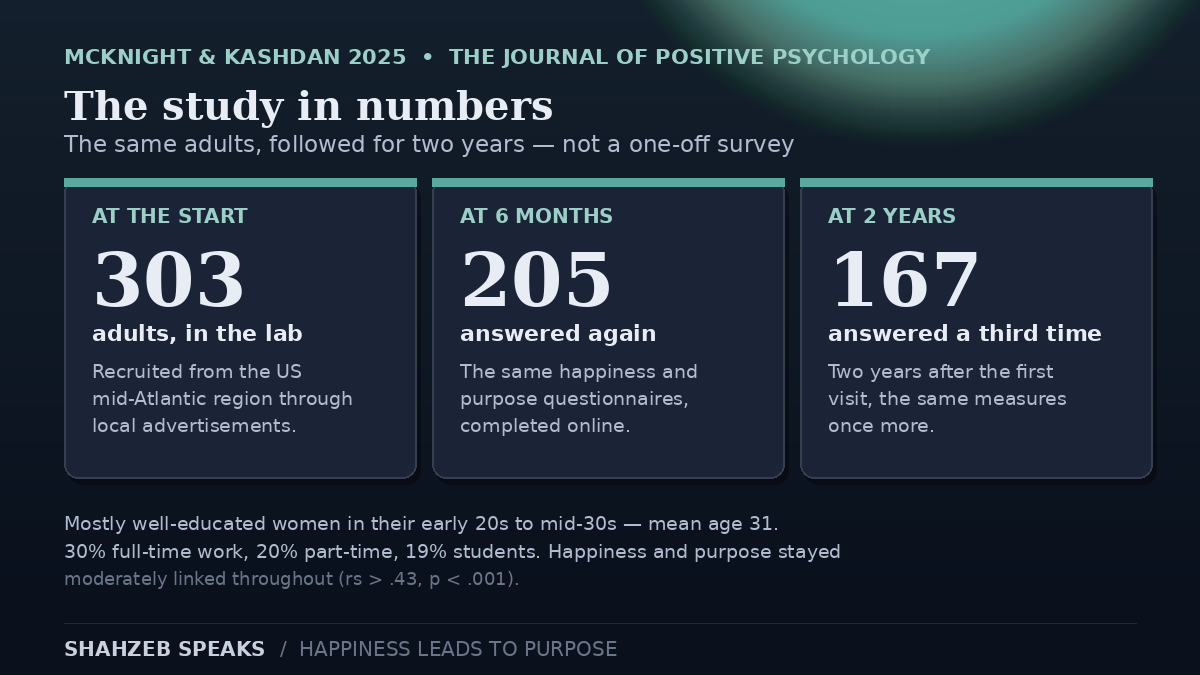
The researchers recruited 303 adults from the mid-Atlantic region of the United States through local advertisements. At the start, participants visited a laboratory and completed two short questionnaires: a four-item Subjective Happiness Scale, which asks people to rate their happiness on their own terms, and a four-item Brief Measure of Purpose in Life, which asks whether their future plans match their true interests and values. Six months later, 205 of them completed the same surveys online. Two years after the first visit, 167 did so a third time. The sample was mostly well-educated women in their early twenties to mid-thirties — average age 31, 59.4% women, 45% well-educated — with 30% in full-time work, 20% in part-time work and 19% students, and a median household income between US$20,000 and US$30,000.
Two details of the method are worth knowing, because they decide how much to trust the result. First, the two questionnaires were equally reliable (alpha 0.881 for happiness, 0.872 for purpose), so the direction of the finding cannot be blamed on one measure being noisier than the other. Second, the researchers checked that the questionnaires measured the same thing at each wave before comparing scores across time. Both happiness and purpose turned out to be relatively stable — people who were happy tended to stay happy, and people with a sense of purpose tended to keep it — and the two stayed moderately linked throughout (rs > .43, p < .001). The stability is part of the point: happiness in this study was more stable over time than earlier research had suggested, with prior one-year test–retest figures for happiness running from .55 to .75.
🔄 Chapter 3: Why everyone had it backwards
The reason this finding surprises people is that the standard story feels so obviously right. A person with a purpose has something to get up for. They endure hardship because the hardship means something. Surely that must make them happier — and surely the unhappy person is unhappy because they lack a purpose. The logic is tidy, and it is the logic behind a whole industry of purpose-finding books, courses and corporate mission statements.
The problem is that the evidence for that logic was mostly cross-sectional: happy people with a purpose, measured once, at the same time. A single snapshot cannot tell you whether the purpose made them happy, the happiness made the purpose possible, or something else — good health, a steady income, a kind partner — produced both. As the authors put it, the temporal sequence between the two states had remained an open question. This study was designed to close it, and the answer went against the standard story.
There is also an older distinction that helps explain why the confusion lasted so long. Roy Baumeister and colleagues, writing in 2013, showed that a happy life and a meaningful life are not the same thing: happiness tracks feeling good and having present needs met, while meaning tracks the past and the future — connecting events across time, and often involving stress and effort. A meaningful life can be a hard life. That is consistent with what McKnight and Kashdan found: purpose and happiness are related, but they are separable, and the traffic between them runs one way.
One careful nuance belongs here. Earlier work has found that purpose does predict rises in life satisfaction over 18 months (Chen & Cheng, 2020). Life satisfaction is a judgement about your life as a whole, and it is not the same measure as the happiness scale used in this study. So the honest statement is narrower than the headline: purpose did not predict later happiness in this study. It may still predict other good outcomes. The study does not say purpose is useless. It says purpose is not the route to happiness that it is sold as.
➡️ Chapter 4: The one-way street
The heart of the study is a cross-lagged panel model — a statistical approach that asks, at each step, whether happiness then predicts purpose later, and whether purpose then predicts happiness later, while accounting for the fact that each tends to stay stable. The result was a one-way street.
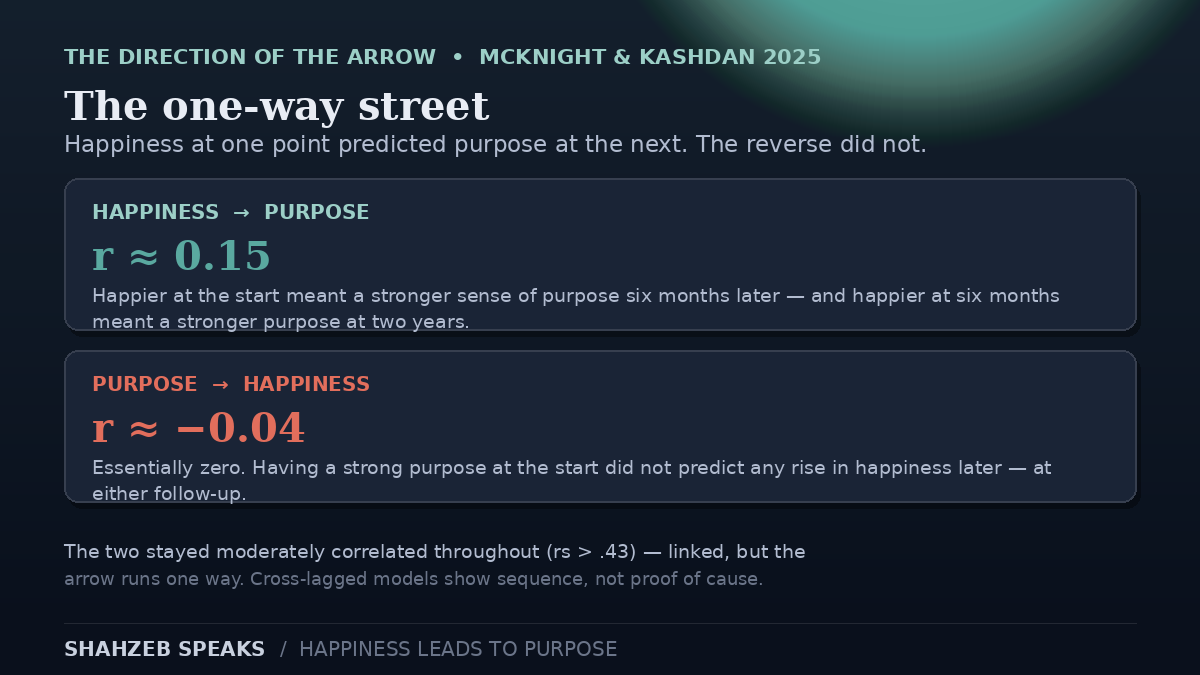
| Direction tested | Result |
|---|---|
| Happiness at the start → purpose at 6 months | Predicted it (part of r ≈ 0.15) |
| Happiness at 6 months → purpose at 2 years | Predicted it (part of r ≈ 0.15) |
| Purpose at the start → happiness later | Did not predict it (r ≈ −0.04) |
| Purpose at 6 months → happiness at 2 years | Did not predict it (r ≈ −0.04) |
| Happiness and purpose, measured together | Moderately correlated throughout (rs > .43) |
Two things about these numbers deserve emphasis. First, r ≈ 0.15 is small. Happiness is not a magic switch that produces purpose; it is a nudge, repeated across two time gaps, in the same direction both times — and it was statistically significant at both steps (standardised coefficients 0.19, p = .002, and 0.17, p = .028). The reverse links were not significant at either step (standardised −0.04 both times, p = .53 and p = .56). Second, r ≈ −0.04 is not a small positive effect — it is no effect at all, slightly negative. The authors’ conclusion is plain: the evidence supports happiness as the predictor of purpose, with no evidence for the alternative direction. Cross-lagged models show sequence, not proof of causation — unmeasured events could still influence both — but sequence is exactly what the old advice got wrong, and this is the first study to test it over two years with measures this clean.
🌱 Chapter 5: Why happiness comes first
The authors offer an explanation that fits the numbers, and it is the most useful part of the paper for anyone deciding what to do on Monday morning. Happiness, they argue, gives a person psychological security. A person who feels basically alright can afford to look outward: to explore, to take a risk, to spend time and energy on something larger than the next bill. That is the soil in which a purpose grows. Purpose, by contrast, is expensive. It demands sacrifice and trade-offs, resisting tempting rewards today for a more gratifying existence later. It brings obstacles and setbacks, and working through them can motivate you — but often at the expense of momentary and longer-term happiness.
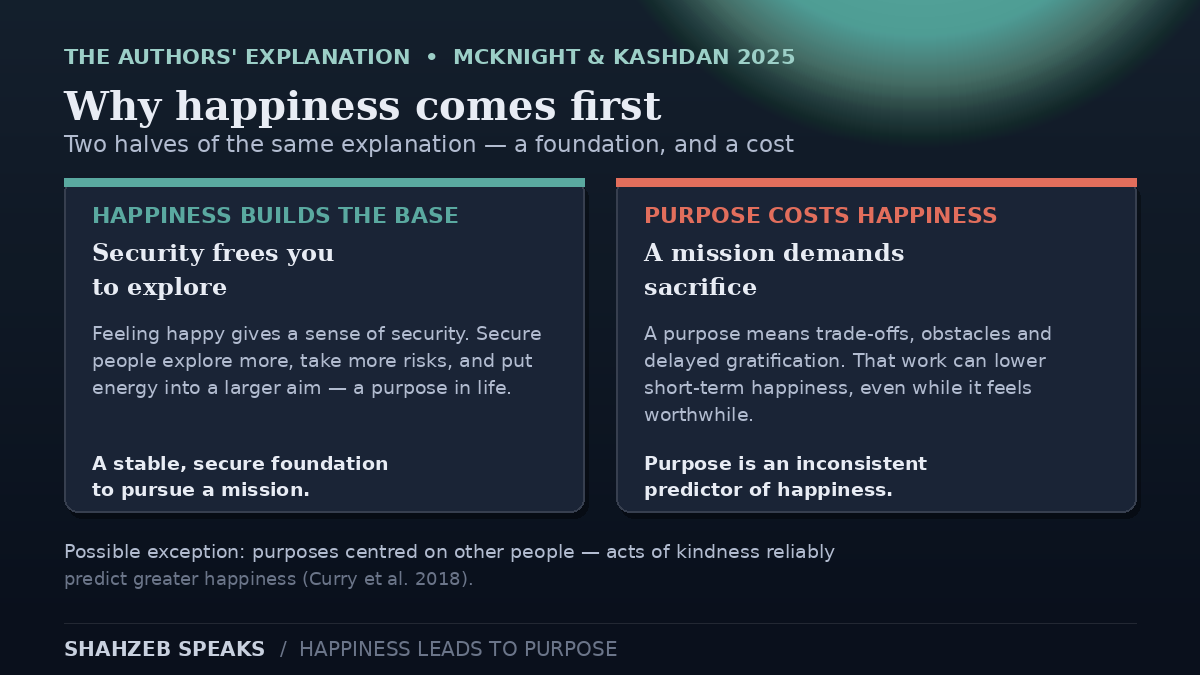
That account is supported by older work the paper cites. Positive affect predicts striving for career and educational goals (Haase et al., 2012) — feeling good makes people reach further, not sit still. And people with a strong purpose are better at tolerating distress to reach their goals, viewing stressful events as challenges rather than threats, which lessens the strain in the moment without necessarily raising overall happiness. Purpose makes hardship bearable. It does not make life feel good. Those are different jobs, and confusing them is the mistake.
Think of it in practical terms. A graduate who is sleeping badly, broke and lonely is in no position to choose a life mission wisely — every option looks like an escape route. The same graduate, rested, connected and a little more secure, can afford to ask what actually matters to them, and to turn down the wrong mission. The study does not prove that story, but it is consistent with it, and it explains why the arrow runs the way it does: happiness buys the freedom to choose a purpose, and a purpose spends that freedom.
💛 Chapter 6: The exception — when purpose does bring happiness
There is one exception the authors flag, and it is important enough to get its own chapter. The study measured purpose in general, not the content of people’s purposes. The authors note that future work may find subgroups of people for whom purpose regularly does produce happiness — and the most likely candidate is a purpose centred on other people.
The evidence for that hunch is real. Relationships are among the most highly regarded sources of purpose in people’s lives, and a meta-analysis by Curry and colleagues (2018) found that performing acts of kindness reliably predicts greater happiness for the person doing the kind act. A purpose built around helping others may be the one kind that pays happiness back, because kindness itself is a happiness builder. The authors make the same point in reverse: a purpose built only around personal accumulation may be the kind that costs the most.
A separate 2026 study, led by Dr Steve Taylor at Leeds Beckett University and reported in September 2026, points the same way. Taylor’s team described seven types of life purpose, from having no purpose at all, through survival and the pursuit of wealth and status, to self-expansive purposes centred on growth and learning, and transpersonal purposes — a sense of something larger than the individual, often with a spiritual cast. People with a transpersonal purpose were the happiest overall. People with no purpose, and people focused on survival, were the least happy. And people whose purpose was personal accumulation — wealth, career success, status, achievement — reported lower happiness than those oriented toward growth, contribution or connection. Taylor’s own summary is blunt: making accumulation and achievement the central organising purpose of life does not provide the same psychological benefits as growth, contribution or a sense of connection.
Put the two studies together and the advice sharpens. If you are going to choose a purpose, choose one with other people in it. And if your current purpose is a promotion, a salary band or a status marker, do not be surprised if reaching it leaves you flat. That is not a failure of ambition. It is the wrong kind of purpose for the job you are asking it to do. For the wider evidence on what makes work itself feel worthwhile, see my guide to meaningful work.
🛠️ Chapter 7: What to do with this — at work and in study
The study does not hand out a prescription, and this article will not invent one. But the direction of the arrow suggests a different order of operations from the one most careers advice assumes, and that order is practical.
If you are a student or an early-career employee
Fix the foundation before you choose the mission. Sleep, food, movement, one steady relationship, one small thing you are good at. None of that is a purpose, and all of it is what makes choosing a purpose possible. The students in this study were not chasing a grand mission; they were living ordinary lives, and the ones who felt better were the ones who found direction later.
Try small purposes, not one big one. A purpose does not have to be a calling. Help one colleague properly. Finish one project well. Mentor one junior. Small, other-focused aims are testable in a week, and the kindness evidence says they are the kind most likely to return happiness as well.
Stop treating unhappiness as proof you lack a purpose. The study says the arrow runs the other way: unhappiness is often the reason a purpose has not appeared yet, not the result of its absence. Searching harder for a mission while you feel bad is like searching for a house while you are lost. Get found first. For the research on what protects mental health at work more broadly, see my article on psychological capital at work.
If you are a manager
Do not sell purpose to an unhappy team. A mission statement does not fix exhaustion, unfair pay or a manager who does not care. The study suggests the order is reversed: a team that feels secure and fairly treated is the team that can take a purpose seriously. Fix the load and the basics first, then talk about meaning — in that order. For how overload and restlessness actually play out, see my articles on workplace burnout and languishing at work.
Give people something kind to do, not something grand to believe. If the exception in Chapter 6 is right, the fastest route from purpose to happiness runs through other people. A team that helps each other, and can see the people its work helps, gets both halves of the bargain. A team handed a poster gets neither.
🔍 Chapter 8: What the study cannot tell us
An honest article ends with the limits, and this study has several that the authors state plainly. First, the sample is narrow: 303 adults from one region of the United States, mostly well-educated, mostly women, mostly in their early twenties to mid-thirties, with a median household income of US$20,000 to US$30,000. People in later life stages, with established routines and greater financial stability, might show a different pattern. Research with adolescents has already found that searching for a purpose is linked to happiness in that age group but not in emerging adults, and developing a purpose is harder for people who are marginalised. This is one sample, not a universal law.
Second, the sample shrank. From 303 people at the start to 205 at six months and 167 at two years is a large drop, and although the authors used statistical adjustments for the missing data and found no strong predictors of who dropped out, a smaller final sample is a weaker final sample. Third, the design is observational. Cross-lagged models can show that happiness came first, but they cannot rule out unmeasured life events — a job loss, a health problem, a new relationship — influencing both happiness and purpose. The authors say this themselves.
Fourth, the study did not test the content of people’s purposes, so the exception in Chapter 6 is a hypothesis, not a finding of this study. And fifth, the effect is small. Happiness nudges purpose; it does not determine it. None of these limits makes the study weak — a two-year longitudinal design with clean measures and public methods is a solid piece of work. But they decide what it can be used for. It can tell you to build happiness first and choose a purpose second. It cannot tell you which purpose to choose, and it cannot promise that happiness will deliver one. Use it that way.
❓ Questions I am asked most often
Does happiness lead to purpose, or purpose lead to happiness?
Happiness leads to purpose, according to a two-year study of 303 adults published in The Journal of Positive Psychology in 2025. Happier people developed a stronger sense of purpose at six months and at two years. The reverse did not happen: a strong sense of purpose did not predict any rise in happiness later.
What study found that happiness comes before purpose?
“Purpose and happiness: a comparison”, by Patrick E. McKnight, Todd B. Kashdan and colleagues at George Mason University, published in The Journal of Positive Psychology in 2025. It followed 303 US adults for two years, measuring happiness and purpose at the start, at six months and at two years.
Does having a purpose make you happier?
Not reliably, on this evidence. In the McKnight and Kashdan study, purpose at one time point did not predict happiness later (r ≈ −0.04). Earlier work suggests one exception: purposes centred on other people — helping, contributing, connecting — may bring happiness, because acts of kindness reliably predict it.
Can you be happy without a sense of purpose?
Yes. Happiness and purpose are related but separable: they stayed moderately correlated (rs > .43) in the study, yet many people report being happy without a clear mission. The study suggests happiness may be what lets a purpose form later, rather than the other way round.
What kind of purpose makes people happiest?
A separate 2026 study by Dr Steve Taylor at Leeds Beckett University found people with a transpersonal purpose — a sense of something larger than themselves — were the happiest, while people focused on wealth, career success and status reported lower happiness. Purposes built on growth, contribution and connection scored better than accumulation.
How can I build happiness first, practically?
The study does not prescribe a method, but the evidence it cites points to the basics: sleep, steady relationships, small wins, and kind acts toward other people, which a 2018 meta-analysis found reliably predict happiness. Fix the foundation, try small other-focused aims, and let a larger purpose emerge from that — rather than hunting for the purpose first.
If the way purpose, happiness and pressure interact in your own work is something you want to understand better, that is what I do. I am an Industrial and Organizational Psychologist, and I work with people and teams on leadership, work design and the measurement of behaviour. Get in touch here.
If you want the wider context, start with my guide to industrial psychology in Pakistan and my article on meaningful work. For the pressures around wellbeing at work in more depth, see psychological capital at work, workplace burnout and languishing at work.
Sources
- McKnight, P. E., Kashdan, T. B., MacKay, A., Kelso, K., & Gross, M. (2025). Purpose and happiness: a comparison. The Journal of Positive Psychology. DOI: 10.1080/17439760.2025.2515942.
- PsyPost (26 November 2026). Happiness appears to lead to a sense of purpose, but not the other way around, according to new psychology research. https://www.psypost.org/happiness-may-lead-to-a-sense-of-purpose-but-not-the-other-way-around/
- Lyubomirsky, S., & Lepper, H. S. (1999). A measure of subjective happiness: Preliminary reliability and construct validation. Social Indicators Research, 46, 137–155.
- Hill, P. L., Edmonds, G. W., Peterson, M., Luyckx, K., & Andrews, J. A. (2016). Brief Measure of Purpose in Life (four-item scale). European Journal of Psychological Assessment.
- Baumeister, R. F., Vohs, K. D., Aaker, J. L., & Garbinsky, E. N. (2013). Some key differences between a happy life and a meaningful life. The Journal of Positive Psychology, 8, 505–516.
- Haase, C. M., Poulin, M. J., & Heckhausen, J. (2012). Happiness as a motivator: Positive affect predicts primary control striving for career and educational goals. Personality and Social Psychology Bulletin, 38(8), 1093–1104.
- Curry, O. S., Rowland, L. A., Van Lissa, C. J., Zlotowitz, S., McAlaney, J., & Whitehouse, H. (2018). Happy to help? A systematic review and meta-analysis of the effects of performing acts of kindness on the well-being of the actor. Journal of Experimental Social Psychology, 76, 320–329.
- Chen, C.-T., & Cheng, Y.-Y. (2020). The role of hope and grit in life satisfaction and school adjustment among second-chance alternative school students in Taiwan. International Journal of Environmental Research and Public Health, 17(3), 889.
- Holding, A. C., St-Jacques, A., Verner-Filion, J., Kachanoff, F., & Koestner, R. (2020). Sacrifice — but at what price? A longitudinal study of young adults’ sacrifice of basic psychological needs in pursuit of career goals. Motivation and Emotion, 44, 99–115.
- Cotton Bronk, K., Hill, P. L., Lapsley, D. K., Talib, T. L., & Finch, H. (2009). Purpose, hope, and life satisfaction in three age groups. The Journal of Positive Psychology, 4(6), 500–510.
- Leeds Beckett University (9 September 2026). Is choosing the right life purpose the key to happiness? https://www.leedsbeckett.ac.uk/news/2026/09/is-choosing-the-right-life-purpose-the-key-to-happiness/