
Picture a Monday team meeting. The manager announces that from now on, everyone will use the new AI tool for every draft and every client email — and usage will be tracked. Nobody objects. Nobody asks how it works, or what happens when the tool gets something wrong. By Friday, half the team is staying late, not to do their jobs, but to check the AI’s work and learn the tool on their own time. They are not working less. They are working differently, under a new kind of watch. The pressure to use AI — not the AI itself — is now the single strongest predictor of employee strain, according to a study of 5,021 workers across ten countries.
I am an Industrial and Organizational Psychologist in Karachi, and I write about work and behaviour for a global reader. This article is built on primary sources read directly: The Well Minds Report 2026, published by the Project Healthy Minds Workforce Lab with Wellhub; Wellhub’s own release on the same survey; and a Harvard Business Review report on a Boston Consulting Group study of 1,488 American workers. It is written for the employee who feels the pressure but cannot name it, and for the manager who introduced the tool with good intentions and wonders why the team looks more tired than before.
“AI has enormous potential to make people and companies more productive, but technology alone won’t create sustainable performance.”
— Cesar Carvalho, CEO and Co-Founder of Wellhub, 2 November 2026
This guide covers the short answer, the study behind the headline, why pressure — and not the tool — does the damage, the ladder of what drives strain, the paradox of the employees who are best at AI, the cognitive cost researchers are calling “brain fry”, what actually helps, and the limits you should know before you act on any of it.
🎯 Chapter 1: The short answer — pressure to use AI
Pressure to use AI is the strongest predictor of employee strain. That is the finding, in one sentence. The Well Minds Report 2026, based on 5,021 full-time employees in ten countries, ranked 70 characteristics of workers and workplaces by how strongly each predicts mental strain. Pressure from leadership to use AI came first — ahead of pay, ahead of job security, ahead of sleep. Employees who feel a lot of that pressure are 15 percentage points more likely to be under strain than otherwise identical colleagues who feel none, and 82% of them are under strain. The tool itself is not the problem. How it is introduced is.
That distinction is the whole story. People who use AI heavily can be fine. What tracks with strain is the pressure: being told to use it, being measured on it, and having no clear policy, no training and no honest answer about what it means for your job. The same study shows the way out. Employees who feel equipped to work with AI are far more likely to feel resilient (87% against 45%), and where a company has a clear, well-communicated AI policy, 77% feel able to adapt, against 39% of those unsure a policy even exists. Pressure without support strains people. Pressure with support is a different experience entirely.
📊 Chapter 2: The study in numbers — 5,021 workers, ten countries
The Well Minds Report 2026 comes from the Project Healthy Minds Workforce Lab and Wellhub, and it is based on Wellhub’s Work Life Wellness 2027 survey: 5,021 full-time employees in the United States, the United Kingdom, Brazil, Argentina, Chile, Spain, Italy, Germany, Mexico and Romania, surveyed online in June 2026. The researchers ranked 70 characteristics of the employee and the workplace by how strongly each predicts mental strain, using a model that holds all 70 constant at once — so each figure below is the effect of that factor on its own.
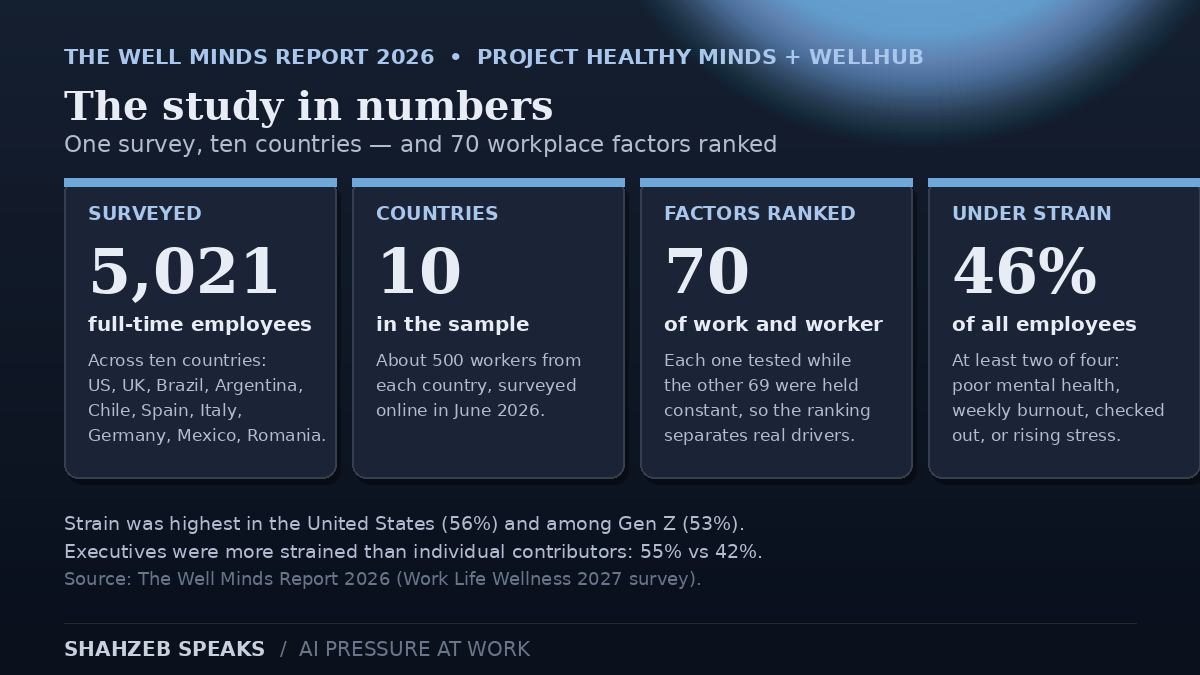
First, what “under strain” means, because the report uses a strict definition. An employee counts as under strain when at least two of four things are true: they rate their mental health as poor or worse; they experience burnout at least weekly; they have felt emotionally checked out of work in the past year; or their work stress has risen over the past twelve months. By that measure, 46% of full-time employees are under strain, and 20% meet three of the four criteria. Strain reaches every level: 42% of individual contributors, 55% of executives. It was highest in the United States (56%), and Gen Z had the highest rate of any generation (53%), while Gen X, at 37%, was the only generation below 45%.
The cost is not abstract. Employees under strain are far more likely to say they would consider leaving a company that does not focus on wellbeing, and 23% say their mental health has reduced their work performance — almost twice the rate of their colleagues. Nearly half the workforce is already under strain, and the way the tool is rolled out is now the largest single lever on that figure.
🔬 Chapter 3: Why pressure, not the tool — the psychology underneath
The obvious suspicion is that AI itself is wearing people down. The data points somewhere more useful, and two old theories in occupational psychology explain why.
The first is the job demands–resources model of Bakker and Demerouti (2007). A job demand is anything that costs sustained effort: workload, time pressure, emotional demands. A job resource is anything that helps you meet those demands or grow: autonomy, support, feedback, training. Demands drain you; resources protect you. Pressure to use AI is a demand — a new one, laid on top of the old ones, often with a deadline attached and a metric watching. Training, a clear policy and a manager who answers questions are resources. The report’s numbers fit the model exactly: the demand is the strongest predictor of strain in the study, and the resources are what separate the employees who cope from those who do not.
The second is Karasek’s demand–control model (1979). Karasek showed that mental strain comes not from high demands alone, but from high demands combined with low control — little say over how the work is done. A worker who chooses to use AI, on their own terms, for tasks they pick, has high demands and high control: an “active” job, which Karasek found produces learning. A worker told to use AI for everything, with usage tracked and no say in how, has high demands and low control: a high-strain job. Same tool, same worker, different design — and the strain follows the design, not the technology.
There is a third channel, and the report names it directly. Roughly 40% of the AI pressure effect runs through four things: job insecurity, psychological safety, isolation and attitudes toward AI. Psychological safety, in Amy Edmondson’s (1999) definition, is the shared belief that a team is safe for interpersonal risk-taking — that you can say “I don’t know how this works” without being punished for it. Pressure to use AI, delivered without explanation, does the opposite: it tells employees that admitting they cannot keep up is risky, that the tool may replace them (38% already fear it will), and that the safe move is to pretend. Pretending is exhausting, and it is lonely: 1 in 8 employees feel isolated, rising to 27% on teams that lost people and never replaced them, and 21% among fully remote workers.
One distinction matters, because this site has covered neighbouring ground. My earlier article on GenAI technostress looked at a different pathway: AI stress leading to work loneliness and then to lower effort. This report asks a different question — among 70 possible drivers, which predicts strain most strongly — and the answer is the pressure itself. The two findings describe the same workplace from two angles: the tool can isolate you, and the pressure to use it can strain you. For the earlier piece, see GenAI technostress and work loneliness.
📈 Chapter 4: The strain ladder — what pushes it up, what pulls it down
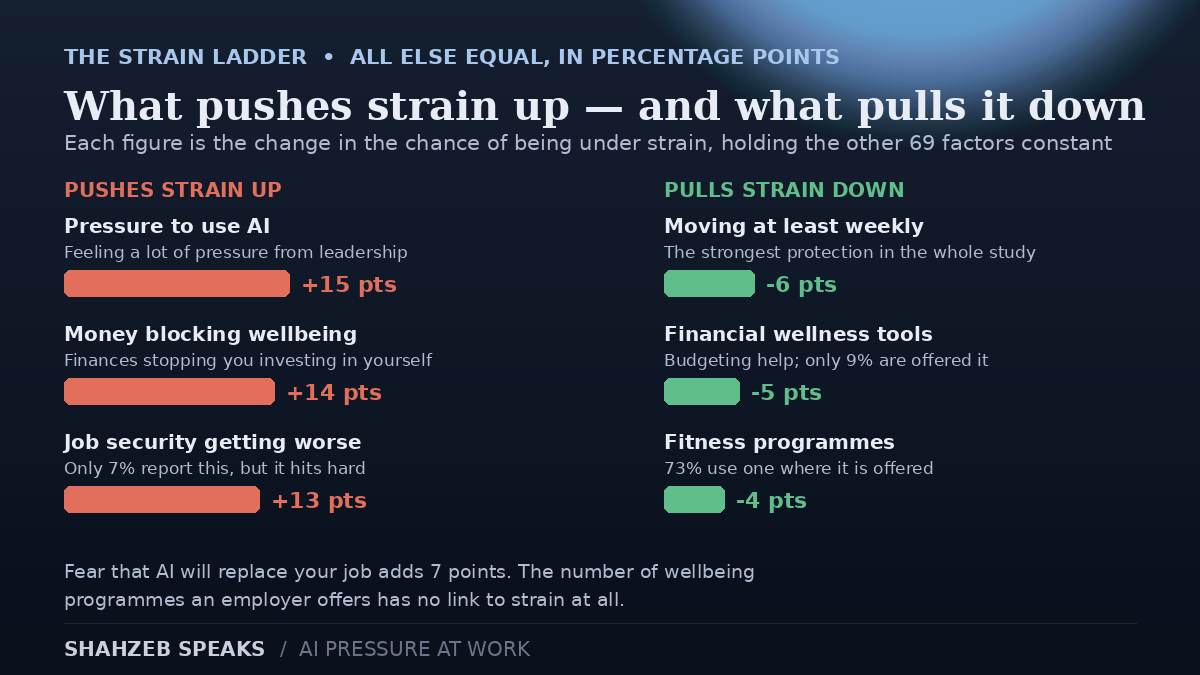
The report’s most useful output is the ranking itself: a ladder of what drives strain, with each rung measured in percentage points, all else equal. Here is what sits at the top and the bottom of it.
| Factor | Effect on strain |
|---|---|
| Pressure to use AI (a lot, from leadership) | +15 points — the largest risk in the study |
| Finances stopping you investing in your wellbeing (47% of staff) | +14 points |
| Job security getting worse (7% of staff) | +13 points |
| Fear that AI will replace your job (38% of staff) | +7 points |
| Physical activity at least weekly | −6 points — the strongest protection measured |
| Financial wellness tools (offered to 9%) | −5 points |
| Fitness programmes (offered to 18%; 73% use where offered) | −4 points |
| Healthy eating; seven hours of sleep | −4 points each |
| Number of wellbeing programmes offered | No link to strain at all |
Three things in that table deserve a second look. First, the effect of AI pressure does not differ by generation, gender, country, role, work setting, company size or level of AI usage. Heavy users can be fine; light users can be strained. What tracks with strain is the pressure, not the usage — which is why telling people to “just use it more” misses the point entirely.
Second, the strongest protection in the entire study is not a programme at all. It is moving at least once a week (−6 points), ahead of any manager behaviour or culture feature measured. Healthy eating and seven hours of sleep each protect by 4 points. Employees already know this: asked what stops them exercising, they name time (52%) first, and asked what hurts their mental health, insufficient sleep (39%) comes first. The most effective wellbeing investment may not be a programme. It may be protected hours, limits on after-hours work, and a culture where leaving on time is not read as slacking.
Third, the number of wellbeing programmes an employer offers has no link to strain once everything else is held constant. Two programmes or ten, the model cannot tell them apart. Only two register as protective at all — fitness programmes and financial wellness tools — and what they share is that each removes a practical barrier, of time or money. A long benefits menu is not a wellbeing strategy. Removing a real barrier is.
🤖 Chapter 5: The pioneers’ paradox — the best at AI carry the most strain
The same survey contains a second story, and it is the one managers should worry about most. Wellhub’s release splits employees by AI fluency: Pioneers (41%), who have made AI a core part of how they work; Adopters (32%), who use it regularly; and Beginners (26%), who have barely started. The Pioneers are the people every company says it wants to keep — and they report the best job security of any group, and the highest daily burnout.
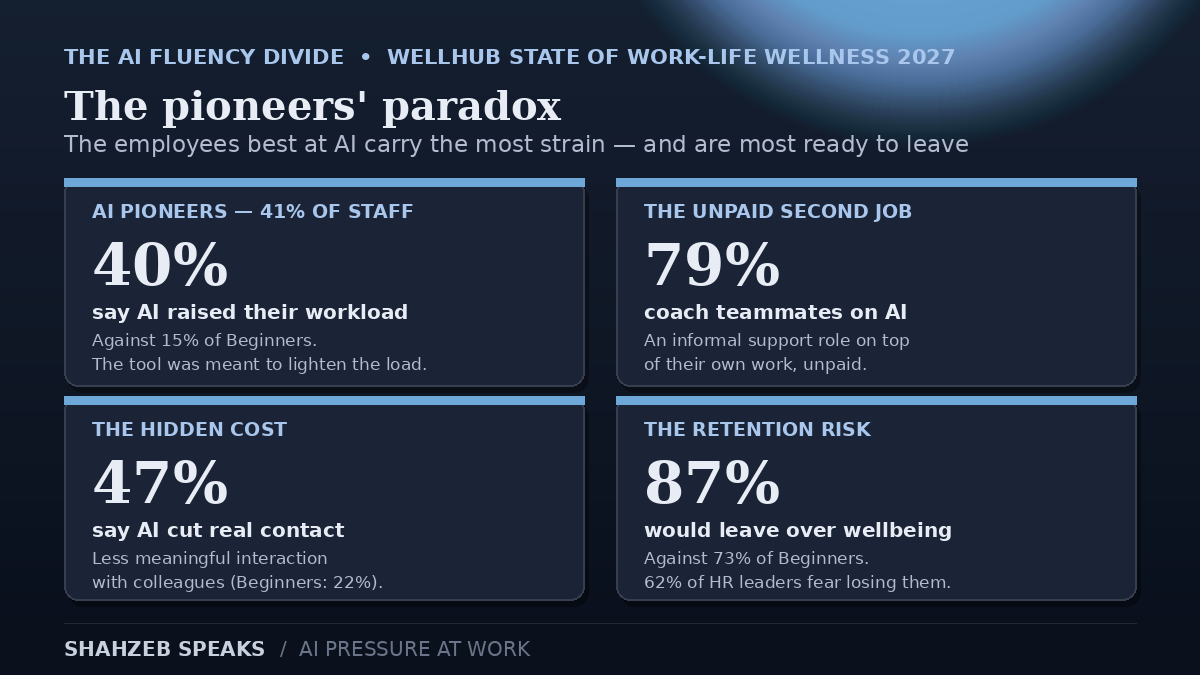
AI was supposed to lighten the load. For the employees most fluent in it, the opposite has happened. Forty percent of Pioneers say AI has increased their workload rather than reduced it, against 15% of Beginners — the same pattern I wrote about in AI is saving you hours, so why is your workload growing? Nearly half (47%) say AI has reduced meaningful interaction with colleagues, more than double the 22% of Beginners. And 79% of Pioneers coach teammates on AI: an informal support role, layered on top of their own responsibilities, with no time allocated for it.
What saves the Pioneers is support, and the gap is stark. Sixty percent of Pioneers say their manager actively supports their wellbeing, against 31% of Beginners — which helps explain why Pioneers can carry more pressure and still report stronger overall wellbeing. But the retention risk is real: 83% of employees say they would consider leaving a company that does not prioritise their wellbeing, rising from 73% of Beginners to 87% of Pioneers, and 62% of HR leaders say they are concerned about losing employees with in-demand AI skills. The workers with the strongest AI capabilities are also the most willing to walk away when their wellbeing needs are not met. A company that pushes AI hard and supports its people weakly is training its best people to leave.
🧠 Chapter 6: “Brain fry” — the cognitive cost of supervising the machine
There is a second, independent piece of evidence, and it explains the mechanism in a way the survey cannot. In March 2026, researchers at Boston Consulting Group and the University of California, Riverside reported a study of 1,488 full-time American workers in Harvard Business Review. They gave a name to something workers had been describing in online posts for months: “AI brain fry” — mental fatigue from excessive use or oversight of AI tools beyond one’s cognitive capacity.
The finding is precise about what hurts. It is not using AI. It is supervising it. Workers whose AI work required a high degree of oversight — checking, correcting, coordinating the output of several tools at once — expended 14% more mental effort, reported 12% more mental fatigue and 19% greater information overload than those whose AI work required little oversight. Fourteen percent of AI-using workers said they had experienced brain fry: a buzzing feeling, mental fog, difficulty focusing, slower decision-making, headaches. It was least common in legal roles (6%) and most common in marketing (26%).
The costs are concrete. Workers who reported brain fry experienced 33% more decision fatigue, made minor errors 11% more often and major errors 39% more often, and were more likely to want to leave: 34% showed an active intent to quit, against 25% of those without brain fry. But the study also found the other side. When AI was used to replace routine or repetitive tasks, burnout scores were 15% lower — the tool doing the dull work, freeing people for better work, is exactly what was promised. The difference is the design of the work, not the tool. Brain fry is an acute, cognitive strain: it arrives within hours and clears with rest. Burnout, as the World Health Organization defines it in ICD-11, is a chronic occupational phenomenon — exhaustion, cynicism and reduced efficacy from workplace stress that has not been managed. Confusing the two is why so many AI rollouts treat a cognitive problem as a motivation problem.
The same study found what managers can do about it. Workers whose managers took the time to answer their questions about AI had 15% lower mental fatigue; workers whose managers expected them to figure it out on their own had 5% higher fatigue. Team pressure to use AI raised mental fatigue; organised, team-wide integration of AI into real processes lowered it. And when employees felt their organisation would expect them to accomplish more work because of AI, mental fatigue was 12% higher — a warning about every message that celebrates “productivity gains” without saying what happens to workload. Employees who felt their organisation valued work-life balance had 28% lower mental fatigue. None of this requires a new budget — just a manager who answers questions, a team that agrees how the tool fits the work, and a leader who says out loud whether more output is expected.
🛠️ Chapter 7: What actually helps — for managers and for employees
The evidence points to a short list, and it is striking how little of it costs money.
If you lead a team
Write the AI policy down, and make sure people know where it is. A clear, well-communicated policy is linked to resilience: 77% of employees at companies with one feel able to adapt, against 39% of those unsure a policy exists. A third of employees (34%) say their company has no formal AI policy at all — and among Beginners, the people who need it most, that figure is 44%. The policy does not need to be long. It needs to say which tasks AI may be used for, who checks the output, what happens when the output is wrong, and whether using AI changes how much work is expected.
Train before you expect, not after. Employees who feel equipped to work with AI are far more likely to feel resilient (87% against 45%). Training first is the difference between an expectation and an invitation. The same applies to measurement: do not measure token consumption or lines of generated code as a proxy for performance — the Harvard Business Review piece notes that some firms already do, and it is exactly the kind of pressure the data says strains people.
Say what AI means for jobs, early and honestly. Only 7% of employees say their job security got worse this year, but those who do are 13 points more likely to be under strain, and 38% fear AI will replace their job. Silence does its own damage: when leadership pushes adoption without saying what it means for roles, employees fill the silence themselves, usually with the worst version. You do not need promises you cannot keep — just say what you know, say it early, and be clear about how AI will and will not change people’s jobs.
Protect the basics before buying another programme. The strongest protection in the study is weekly movement, then sleep and food. The only two programmes that registered as protective were fitness programmes and financial wellness tools — both of which remove a practical barrier. If your wellbeing budget buys a tenth meditation app while nobody has time to eat lunch, the data says you are spending it in the wrong place.
If you are the employee feeling it
You are not behind; the path is unclear for nearly half the workforce. A separate survey by Resume Now of 1,020 American workers, conducted in May 2026, found 44% feel overwhelmed by the pressure to learn and use AI at work, 42% are not confident integrating AI into their workflow, and 44% say they do not have a clear path for building AI skills. Three in ten say they are likely to spend their own money learning AI skills because they worry about falling behind. That is not a personal failure. It is an organisational gap, and it is shared by almost half the people around you.
Ask for the three things that help most. A written policy you can actually find. Training before the expectation lands. And a manager who answers questions instead of assuming you will work it out alone — the study found that alone is worth 15% less mental fatigue. If you are the person everyone asks for help with AI, say so, and ask for the time to be recognised: 79% of the most fluent employees are already doing that job for free.
Use AI for the dull work, not the thinking work. The clearest finding in the brain fry study is that replacing routine, repetitive tasks with AI lowers burnout, while supervising several tools at once raises mental fatigue. Let the tool draft the summary. Keep the judgement, the relationship and the decision for yourself — and if the tool is making you check more than it is saving you, say that out loud. For the wider picture of how AI pressure connects to exhaustion, see my articles on workplace burnout and workplace burnout statistics 2026.
🔍 Chapter 8: What the study cannot tell us
An honest article ends with the limits, and this one has several that the report itself states plainly. First, the survey is a snapshot from June 2026. It shows what goes together, not what causes what. Pressure to use AI is the strongest predictor of strain in a model that holds 69 other factors constant — but a snapshot cannot prove that the pressure caused the strain. It is possible, for instance, that workplaces already under strain are the ones that push AI hardest. The ranking was stress-tested five ways, including a machine-learning model that reproduced the same ordering, and the AI pressure effect held throughout — which makes the finding sturdy, but still not proof of cause.
Second, the AI questions measure how pressure and policy are perceived, not what leaders actually did. Two employees in the same team can report different pressure, and both can be right about their own experience. Third, respondents came from an online panel with equal country quotas and no weighting, so country comparisons — including the finding that strain is highest in the United States — are comparisons between survey samples, not national workforces. No UK-specific figures were published in the sources I read, so this article prints none.
Fourth, the funding matters. Wellhub is a corporate wellness platform that sells wellbeing subscriptions to employers; the survey is its own annual study, and the findings serve its commercial interest. Project Healthy Minds, its partner, is a non-profit. Resume Now, whose survey I cite for corroboration, is an AI resume builder, and BambooHR, whose write-up supplied some of the figures here, sells HR software. None of that makes the numbers wrong — the method is published and the limits are stated — but it is why every figure in this article carries its source, and why the brain fry study, from a different team entirely, gets its own chapter as independent support.
Fifth, two timing cautions. The Well Minds Report was released for World Mental Health Day 2026, and its survey was fielded in June 2026 — this is new analysis, not new data. And the Resume Now release that circulated on 24 November 2026 is a re-distribution of a report first released in September 2026, based on a May 2026 survey: corroboration, not a fresh November finding. Finally, I read the report’s own pages and two detailed write-ups, but not the full report PDF, so I print only the ranking positions those sources name. None of these limits makes the headline weak. They decide what it can be used for: pressure to use AI is the strongest predictor of strain we have measured, and the fixes — a written policy, training before expectation, honest words about jobs, protected time for the basics — are within any employer’s reach. Use it that way.
❓ Questions I am asked most often
Does pressure to use AI cause employee stress?
Pressure to use AI is the strongest predictor of strain in The Well Minds Report 2026, a study of 5,021 workers in ten countries. Employees who feel a lot of it are 15 points more likely to be under strain, all else equal. But the study is a snapshot, so it shows association, not proof of cause — though the ranking held up under five checks, including a machine-learning model.
Is AI itself bad for mental health at work?
No — the evidence says the opposite. AI use itself does not predict strain; the pressure around it does. When AI replaces routine, repetitive tasks, burnout scores were 15% lower in a Boston Consulting Group study of 1,488 workers. The problem is pressure without support: no clear policy, no training, and no honest word about what AI means for your job.
What is “AI brain fry”?
It is the name Boston Consulting Group researchers gave to mental fatigue from excessive use or oversight of AI tools beyond one’s cognitive capacity. In their study of 1,488 American workers, 14% of AI users had experienced it — a buzzing feeling, mental fog, slower decisions and headaches — most often when supervising several AI tools at once.
What percentage of employees are under strain?
Forty-six percent of full-time employees, according to The Well Minds Report 2026. An employee counts as under strain when at least two of four things are true: poor mental health, burnout at least weekly, feeling emotionally checked out of work in the past year, or work stress rising over the past year.
What helps employees cope with AI pressure at work?
Three things help most. A clear, well-communicated AI policy: 77% of employees with one feel resilient, against 39% of those unsure one exists. Feeling equipped to use AI: 87% resilient, against 45%. And a manager who answers questions about AI: 15% lower mental fatigue in their team. Training before expectation, not after, is the difference.
Why do the employees best at AI burn out the most?
Because fluency brings a second, unpaid job. In Wellhub’s survey, 40% of AI Pioneers — the most fluent group — say AI raised their workload, 79% coach teammates on AI, and 47% say it cut meaningful contact with colleagues. They also report the best job security, and 87% would consider leaving over wellbeing, so they are the most likely to walk away.
If the way AI, pressure and strain interact in your own team is something you want to understand better, that is what I do. I am an Industrial and Organizational Psychologist, and I work with people and teams on leadership, work design and the measurement of behaviour. Get in touch here.
If you want the wider context, start with my guide to industrial psychology in Pakistan and my articles on the psychology of AI anxiety and employee–AI collaboration. For the pressures around wellbeing at work in more depth, see workplace burnout, work-life balance overtaking salary and quiet quitting.
Sources
- The Well Minds Report 2026. Project Healthy Minds Workforce Lab and Wellhub. Based on Wellhub’s Work Life Wellness 2027 survey of 5,021 full-time employees in ten countries, June 2026. https://www.projecthealthyminds.com/workforcelab-notes/the-well-minds-report
- Wellhub (2 November 2026). Your Best AI Talent Is Also Your Biggest Flight Risk. https://wellhub.com/en-us/blog/press-releases/ai-talent-burnout-retention-wellhub-study/
- BambooHR (25 November 2026). Nearly Half the Workforce Is Under Strain. Pressure to Use AI Is the Biggest Reason. https://www.bamboohr.com/blog/well-minds-report-wellhub
- Bedard, J., Kropp, M., Hsu, M., Karaman, O. T., Hawes, J., & Kellerman, G. R. (2026). When Using AI Leads to “Brain Fry”. Harvard Business Review, 5 March 2026. https://hbr.org/2026/03/when-using-ai-leads-to-brain-fry
- Resume Now (2026). The AI-Whelmed Worker. Survey of 1,020 employed US adults, conducted by Pollfish, May 2026; first released September 2026. https://www.prnewswire.com/news-releases/the-ai-whelmed-worker-44-feel-overwhelmed-by-the-pressure-to-learn-and-use-ai-at-work-302948516.html
- Bakker, A. B., & Demerouti, E. (2007). The Job Demands-Resources model: State of the art. Journal of Managerial Psychology, 22(3), 309–328. DOI: 10.1108/02683940710733115.
- Karasek, R. A. (1979). Job demands, job decision latitude, and mental strain: Implications for job redesign. Administrative Science Quarterly, 24(2), 285–308.
- Edmondson, A. (1999). Psychological safety and learning behavior in work teams. Administrative Science Quarterly, 44(2), 350–383.
- World Health Organization (2019). Burn-out an “occupational phenomenon”: International Classification of Diseases (ICD-11).
- TroopHR (2026). The Strongest Predictor of Employee Strain in 2026? Pressure to Use AI. https://www.troophr.com/blog/the-strongest-predictor-of-employee-strain-in-2026-pressure-to-use-ai