
Two cups of coffee sit on a café table, still warm, and two phones lie face down beside them. The chair opposite is empty. Nobody left in a hurry — the meeting simply never happened, because a message took its place. That small scene repeats itself millions of times a day now, and a 2026 study has put a number on what it adds up to. We are speaking fewer words every year — about 338 fewer words a day, every year — and the quiet cost is bigger than you think.

I am an Industrial and Organizational Psychologist in Karachi, and I write about work and behaviour for a global reader. This article is built on a peer-reviewed paper published in Perspectives on Psychological Science in 2026, by Valeria A. Pfeifer of the University of Missouri–Kansas City and Matthias R. Mehl of the University of Arizona. The paper itself sits behind a paywall, so the details below come from the journal record and from full reporting of the study — the University of Arizona question-and-answer session with Mehl (1 April 2026), Shayla Love’s piece in The New Yorker (8 July 2026), and Valerie Fridland’s report in Psychology Today (8 November 2026). One limit up front: this study is observational. It documents a decline in spoken words over time; it does not prove what caused the decline. Social media, smartphones, self-checkouts and texting are the authors’ suggested explanations, not proven causes.
“These 338 words are not one long conversation we stopped having. They are spread across small moments throughout the day.”
— Matthias R. Mehl, University of Arizona, on the Pfeifer & Mehl (2026) findings
This guide covers what the study found and how it was discovered by accident, the numbers behind the decline, who is falling quiet fastest, what is actually disappearing from our days, why it matters for loneliness and well-being, what experiments show about voice versus text, the honest limits of the evidence, and small habits that can rebuild the habit of speaking.
🎯 Chapter 1: The short answer — speaking fewer words
Yes, we are speaking fewer words every year — about 338 fewer spoken words a day, every year. That is the short answer from Pfeifer and Mehl (2026), published in Perspectives on Psychological Science, volume 21, issue 4, pages 447–449 (DOI: 10.1177/17456916261425131). The researchers pooled data from 22 studies conducted between 2005 and 2019, covering 2,197 participants aged 10 to 94. Across that period, the average person went from speaking around 16,000 words a day in 2005 to around 12,700 words a day by 2019 — about a fifth fewer. The rate of decline works out at roughly 338 fewer words spoken each day, every year, which adds up to more than 120,000 fewer spoken words over a full year.
Be precise about what was measured. The study counted spoken words — words said out loud, in real life, captured by a recorder. It did not count typed words, messages, emails or social media posts, so it cannot tell us whether we are communicating less in total. As Mehl put it: “Total word count across all channels may not have dropped, and it may have even increased. But that is a separate question from whether it leaves us socially whole. Spoken words carry something that typed words often don’t — presence, tone, the spontaneity of a real exchange.” The finding is about speech, not about communication as a whole.
The study also does not show why the decline happened. The authors suggest that screens, self-checkouts, GPS navigation and digital messaging have quietly removed the small, incidental conversations that used to fill a day — asking a cashier for help, getting directions from a stranger, chatting with a neighbour. Those are suggestions, and I will present them as suggestions. The decline itself is measured, not guessed: 22 studies, 2,197 people, and a pattern that held up when the researchers checked it again.
📖 Chapter 2: The study that found it by accident
The most striking thing about this finding is that nobody set out to look for it. Pfeifer and Mehl were replicating an earlier paper — Mehl’s own 2007 study, published in Science, which asked whether women really are more talkative than men. The replication was meant to settle a gender debate. Instead, Pfeifer noticed that everyone — men and women alike — was speaking far less than in 2007: the old estimate had been about 15,900 words a day, and the new one came in at around 12,700. Mehl’s reaction was disbelief: “I told her there had to be a mistake. But she rechecked everything, and the number held.”
The words were counted by naturalistic audio sampling, using a device known as the Electronically Activated Recorder — the EAR. Participants wear it through ordinary life, and it captures short snippets of sound, about 30 seconds at a time, several times an hour, from which researchers estimate total daily word counts. The 2007 study used the same method: 396 university students — 210 women and 186 men, in the United States and Mexico — wore EAR recorders for two to ten days, capturing about 30 seconds of sound every 12.5 minutes.
The 2007 study is the baseline against which the decline was measured — and it killed a myth that still circulates today. The popular claim, from Louann Brizendine’s 2006 book The Female Brain, held that women speak 20,000 words a day and men only 7,000 — a figure with no peer-reviewed source. Mehl’s team tested it properly. The result: women averaged 16,215 words a day and men 15,669 — a difference of 546 words that was not statistically significant. Both sexes averaged roughly 16,000 a day. The range was enormous: the quietest participant spoke about 500 to 700 words a day, the most talkative up to 47,000 — and the three biggest talkers were men.
The 2026 paper builds on that foundation in a particular way. Its 22 source studies were not designed to track talkativeness at all — they were run for entirely different purposes, from coping with breast cancer to adjustment after divorce — and the participants had no idea their word counts would be analysed this way. That is both a strength and a weakness: nobody was performing for the study, but the samples were never chosen to represent the whole population. They came mostly from the United States, with some from Mexico, Australia and Europe. A second, independent replication strengthens the picture: Tidwell and colleagues (2025), in the Journal of Personality and Social Psychology (DOI: 10.1037/pspp0000534), used 631,030 recordings from 2,197 participants across four countries and found the same decline — daily words fell from about 16,000 in 2005 to about 13,000 in 2018. Two different teams, two different datasets, the same direction of travel.
📉 Chapter 3: The numbers — from 16,000 to 12,700
The headline numbers are simple enough to hold in your head. In 2005, the average person in these studies spoke about 16,000 words a day. By 2019, that figure had fallen to about 12,700 — about a fifth fewer, a drop of roughly 3,300 words a day over fourteen years. The average rate of decline was about 338 fewer words spoken each day, every single year, which adds up to more than 120,000 fewer spoken words over twelve months. These are averages, and averages hide wide variation — in the Tidwell replication, daily word counts ranged from fewer than 100 to over 120,000 words a day — but the average moved steadily downward across the whole period.
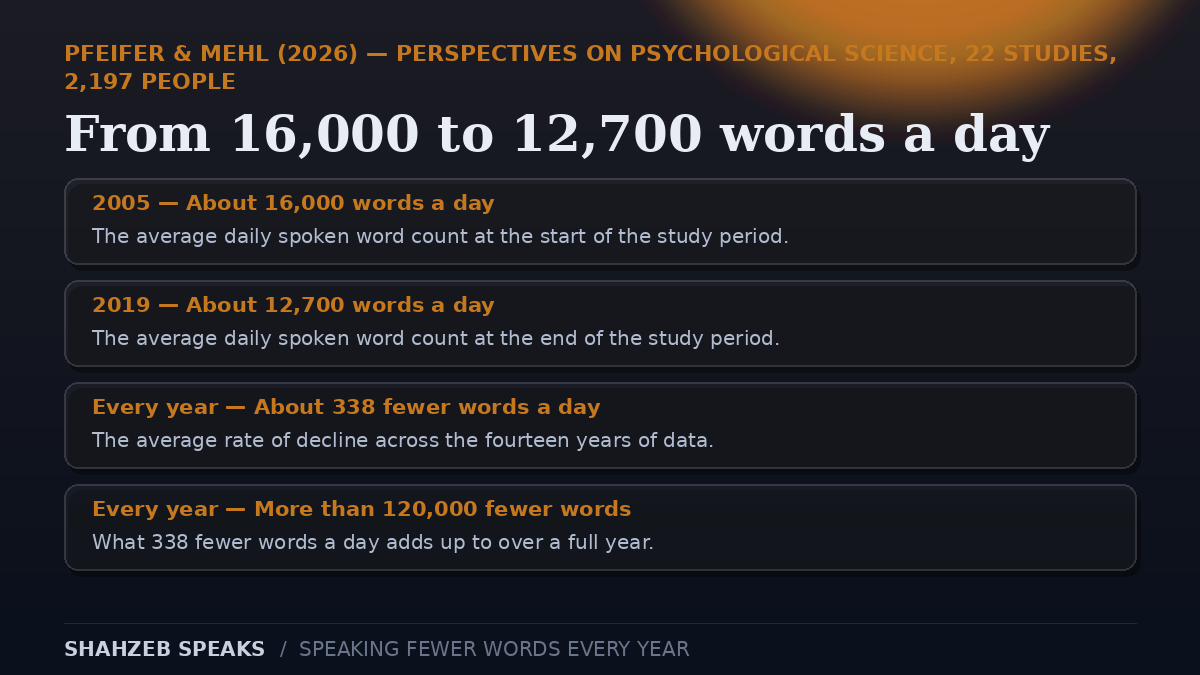
It is worth pausing on the arithmetic, because a misleading percentage has circulated alongside the real figures. Some coverage described the decline as close to a third. That figure comes from a different calculation in the paper’s reporting — the regression slope of 338 words a year, multiplied across fourteen years, measured against a different baseline — and it does not match the endpoint estimates the study itself reports. The endpoints are about 16,000 and about 12,700, and the fall between them is about a fifth. I am using the endpoint figures here, because they are the numbers the study reports most directly, and because a reader should be able to check the arithmetic: 16,000 minus 12,700 is 3,300, and 3,300 out of 16,000 is roughly a fifth. When a percentage and the raw numbers disagree, trust the raw numbers. The 2007 figure of about 15,900 sits neatly on the line between the endpoints, which is what you would expect if the decline was gradual rather than sudden. Nothing in the data suggests a single moment when speech fell off a cliff. The picture is a slow, year-by-year slide — and slow slides are easy to miss while they are happening, which is one reason the finding surprised even the researchers who found it.
| Figure | Value | What it means |
|---|---|---|
| Daily spoken words, 2005 | About 16,000 | Average at the start of the study period |
| Daily spoken words, 2019 | About 12,700 | Average at the end of the study period |
| Rate of decline | About 338 fewer words a day, every year | The steady year-by-year fall |
| Yearly total lost | More than 120,000 fewer words | What 338 a day adds up to over a year |
| Under-25s | Roughly 450 fewer a day, each year | Steeper than the 314 a year for those 25 and older |
| 2007 baseline (Mehl et al.) | About 15,900 a day | Women 16,215; men 15,669 — difference not significant |
| Replication endpoint (Tidwell et al., 2025) | About 13,000 a day in 2018 | 631,030 recordings, four countries |
Sources: Pfeifer & Mehl (2026), Perspectives on Psychological Science; Mehl et al. (2007), Science; Tidwell et al. (2025), Journal of Personality and Social Psychology. All figures are averages from observational data, not proof of cause.
👥 Chapter 4: Who is falling quiet fastest
The decline is not spread evenly. The steepest fall belongs to the youngest adults. Participants under 25 lost roughly 450 fewer words a day each year, compared with 314 a year for participants aged 25 and older. That gap matters: the youngest group is losing spoken words at a pace roughly half as fast again as the older group, year after year. I am giving the under-25 figure as “roughly 450” on purpose: the secondary sources that report it give slightly different exact numbers, and the paper itself is paywalled, so no exact figure can be verified from the primary source in this pass. The 314 figure for the older group is consistent across sources. What is consistent everywhere is the pattern — the young are falling quiet fastest — and that pattern is the finding worth carrying forward.
The gender story, meanwhile, is a story of a gap that never really existed, and then a small one that appeared. In 2007, women averaged 16,215 words a day and men 15,669 — a difference of 546 words that was not statistically significant, meaning it could easily have been chance. The study’s answer to its own question was plain: no, women are not really more talkative than men. The 2025 replication by Tidwell and colleagues found a modest difference: women averaged 13,349 words a day and men 11,950 — a gap of 1,073 words. But that gap was not spread across all ages. A significant gender gap appeared only for ages 25 to 64, where women averaged 21,845 words a day against 18,570 for men. Outside that age band, the gap faded. So the honest summary is this: the sexes speak roughly similar amounts, the gap that exists is modest and concentrated in the working-age years, and both sexes have been speaking less over time.
There is one more feature of the data that deserves attention, because it stops the averages from being misread. An average of 12,700 words a day describes no actual person; it describes the middle of a very wide spread. Some people barely speak at all on a given day, and some people talk almost without pause. The decline is a shift in the average, not a uniform experience. A reader who speaks 20,000 words a day has not suddenly become quiet, and a reader who speaks 3,000 words a day was not necessarily loud in 2005. What has changed is the centre of the distribution — and the centre has moved down by about a fifth. That wide spread also explains why the decline is so easy to miss in daily life. Nobody can feel an average. You can feel your own day — whether you talked to the cashier, whether you called a friend, whether the house was quiet — but you cannot feel a 338-word change spread across hundreds of small moments. The researchers could see it only because they had fourteen years of recordings to compare. The rest of us live inside the change, one quiet day at a time.
🛒 Chapter 5: What is actually disappearing — the small talk
If the decline is real, the next question is what, exactly, is disappearing. The answer the authors point to is not the long, meaningful conversation. It is the small one. Mehl put it directly: “These 338 words are not one long conversation we stopped having. They are spread across small moments throughout the day — the brief exchange at the checkout, the neighbor you used to run into, the stranger you once asked for directions.” The words being lost are the low-stakes, incidental kind: asking a cashier for help, getting directions from a stranger, chatting with a neighbour. Each one is worth only a handful of words. Together, across a day, a week, a year, they add up to thousands.

Consider the self-checkout, because it is the clearest example and the one Mehl himself names: “We don’t ask people for directions anymore. We take the self-checkout line at the grocery store, and we don’t talk to our neighbors.” A staffed checkout used to guarantee at least a greeting, often a short exchange about the weather, the queue, or the shopping itself — perhaps twenty or thirty words, several times a week. The self-checkout guarantees none of it. The machine speaks, in a recorded voice, and the shopper answers with a screen. Multiply that across every weekly shop, and a few hundred words a month quietly vanish. The same logic applies to GPS navigation, which removed the need to stop and ask a stranger for directions, and to touchscreen ordering kiosks, which removed the need to speak to the person taking your order. Each of these is a small convenience, and each of them is also a small subtraction from the day’s spoken words.
Digital messaging sits alongside these changes, and the authors suggest it has supplanted some spoken words — but the relationship is not a simple swap. Mehl is careful on this point: “Total word count across all channels may not have dropped, and it may have even increased.” We may be typing more than we used to, even as we speak less. The study cannot settle that question, because it did not measure written communication. What it can say is that the spoken part has shrunk, and that the authors suggest screens and messaging are part of the reason. As Mehl put it: “People immediately jump to social media and smartphones, and surely that’s part of it.” But he adds a caution that should be quoted in full, because it stops the story from becoming a simple blame game: older adults are declining too, “which points to something broader.” If the decline were only about young people and their phones, it would not show up in people who grew up without them. It does, so the explanation has to be wider than one generation or one device.
There is also a kinder reading of the same numbers, and it comes from a researcher who was not involved in the study. Joshua Smyth of Ohio State University suggested to The New Yorker that people may be “judiciously pruning” trivial communication to focus on what matters — in other words, that the decline is not necessarily bad. Perhaps some of the words we have lost were words we did not need: the forced pleasantries, the filler, the exchanges we made only because there was no alternative. That reading deserves space, because it is honest. Not every lost word was a meaningful one. But it also has a limit, which the next chapter takes up: the words being lost are disproportionately the ones that connect us to people outside our close circle, and those connections turn out to matter more than their word count suggests. My article on digital detox looked at the other side of this same shift — what happens when people step back from screens on purpose — and my piece on the psychology of social media addiction examined why the typed channel pulls so hard.
💔 Chapter 6: Why it matters — loneliness and the weak ties we lose
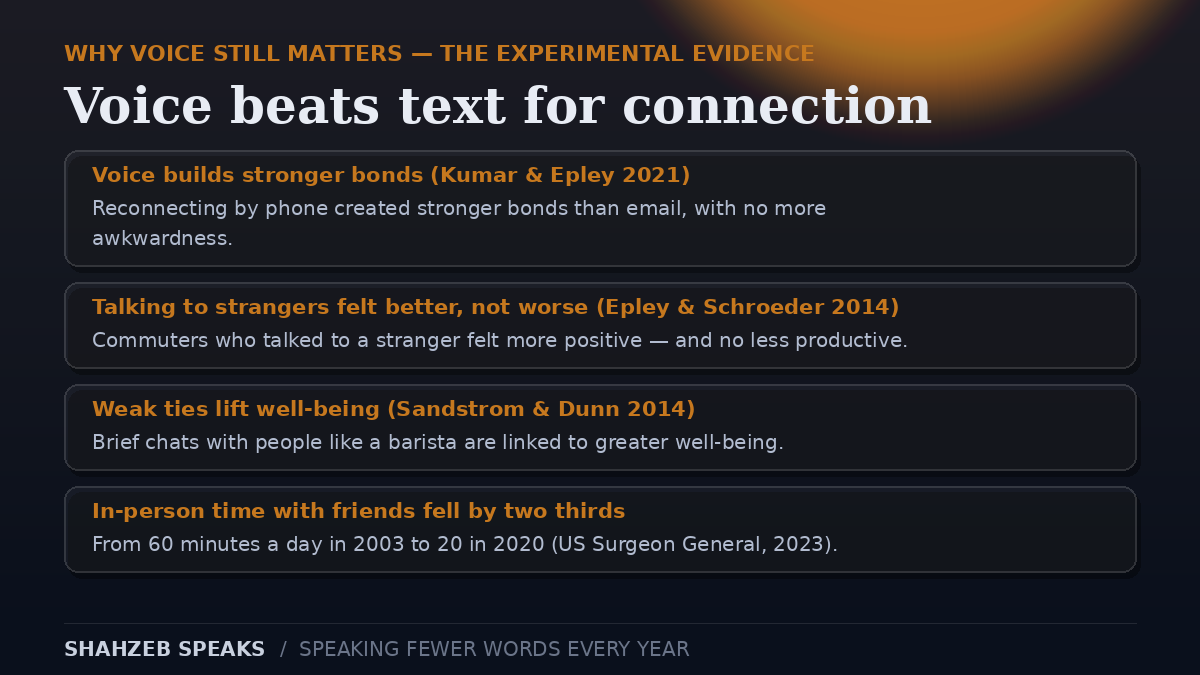
A decline of 338 words a day sounds small — less than three per cent of a 12,700-word day. The reason it matters is not the size of the number but the kind of words it represents. The words being lost are disproportionately the brief, everyday exchanges with people outside our close circle — the cashier, the neighbour, the stranger on the train. Psychologists call these connections “weak ties”: the acquaintances and strangers who are not our friends, but who fill our days with small moments of recognition. Research by Sandstrom and Dunn (2014), published in Personality and Social Psychology Bulletin, found that brief interactions with weak ties — a chat with a barista, for example — are linked to greater well-being. The link is an association, not proof of cause, but it is consistent: people who have more of these small exchanges report feeling better. Gillian Sandstrom, writing in her 2026 book Once Upon a Stranger, put the point plainly: speaking to people we don’t know “has been shown to teach us new things, to put us in a better mood, and to make our lives feel more satisfying. Failing to do so could make us isolated or distrustful of others.”
The weak-ties finding connects directly to the loneliness figures that frame this chapter. The US Surgeon General’s advisory on loneliness and isolation, published in May 2023, reported that approximately half of US adults experience loneliness. The same advisory drew on time-use data showing that in-person time with friends fell from 60 minutes a day in 2003 to 20 minutes a day in 2020 — and for ages 15 to 24, from about 150 minutes a day to about 40 minutes. The advisory also reported that loneliness is associated with a 26 per cent increased risk of premature death and social isolation with a 29 per cent increased risk, and that poor social connection is associated with a 29 per cent higher risk of heart disease and a 32 per cent higher risk of stroke. Those are associations from pooled observational studies, not proven cause and effect, and I am presenting them as associations. The World Health Organization’s Commission on Social Connection, reporting in June 2025, found that about one in six people worldwide experiences loneliness, and that loneliness and social isolation together are linked to an estimated 871,000 deaths a year — again, linked to, not proven to cause.
Mehl himself connects the word-count finding to this wider picture. In the University of Arizona question-and-answer session, he said: “The U.S. Surgeon General has written about a loneliness epidemic and a loss of social connection. What we may have here is a subtle but objectively measurable signal of that.” The word “signal” is well chosen. A decline in spoken words is not the same thing as loneliness, and it would be wrong to claim that speaking less causes loneliness, or that loneliness causes people to speak less. The study cannot separate those directions. But the two trends move together — fewer spoken words, less time face to face with friends, more people reporting loneliness — and the overlap is the reason this study matters beyond its own numbers. It gives researchers an objective measure, recorded by a device rather than reported in a survey, of something that surveys have been describing for years: daily life is becoming quieter between people.
The most hopeful evidence in this chapter comes from an experiment, not a survey. Epley and Schroeder (2014), in the Journal of Experimental Psychology: General, volume 143, issue 5, pages 1980–1999 (DOI: 10.1037/a0037323), randomly assigned Chicago commuters to one of three conditions on a train, bus or taxi: talk to a stranger, sit in solitude, or commute as normal. The commuters who talked to a stranger reported a more positive experience — and no less productive a commute — than those who sat in solitude. Separate groups, asked to predict the outcome before the experiment, expected the opposite: they thought talking would be unpleasant and unproductive. The same pattern appeared in the mechanism the researchers measured: commuters predicted that fewer than half of strangers would want to talk, yet nobody who tried to start a conversation was rebuffed. Schroeder, Lyons and Epley (2022) later replicated the result with London rail commuters. The lesson is practical and direct: the small talk we are losing is the kind we expect to dislike and actually enjoy, and we avoid it because we misjudge how the other person will respond. My article on GenAI technostress and work loneliness looked at how technology at work can leave people feeling isolated even while connected — the same quiet gap, in a different setting.
📞 Chapter 7: Voice beats text — what the experiments show
If spoken words are being replaced by typed ones, the obvious question is whether the replacement is equal. The experimental evidence says it is not — at least, not for connection. Kumar and Epley (2021), in the Journal of Experimental Psychology: General, volume 150, issue 3, pages 595–607 (DOI: 10.1037/xge0000962), tested the difference directly. In a field experiment, about 200 people were asked to reconnect with an old friend, and were randomly assigned to do it by phone or by email. The people who called reported a significantly stronger social bond than the people who wrote — with no more awkwardness, and with the call taking about the same time as reading and replying to an email. Lab studies in the same paper found the same pattern with strangers: interactions that included voice created stronger bonds and no increase in awkwardness compared with text-based interactions.
The striking part of the Kumar and Epley finding is not that voice won, but that people expected it to lose. Before the experiment, participants predicted that calling would be more awkward than writing, and they chose text for that reason. Their expectations were wrong in both directions: the call was not more awkward, and it produced a stronger bond. That misjudgement is the same one Epley and Schroeder found on the trains — people expect social contact to go badly, so they avoid it, and the avoidance is based on a prediction that the evidence does not support. The pattern repeats across the research in this article: we underestimate how much we will enjoy talking, we underestimate how much the other person wants to talk, and we choose the quieter option for reasons that turn out to be mistaken.
That misjudgement has a practical consequence for work as well as for daily life. As spoken words decline and typed messages replace calls, teams may be losing the bonding that voice carries — tone, timing, laughter, the small signals that tell you how someone actually feels — even though voice is not more awkward in practice. A typed thread can carry information, and it can carry it well. What it carries less well is the sense of being with another person. Mehl’s line from Chapter 1 is the summary: “Spoken words carry something that typed words often don’t — presence, tone, the spontaneity of a real exchange.” The point is not that text is bad. Text is fast, searchable, and useful across time zones. The point is that text and voice are not interchangeable, and a day that replaces voice with text loses something the text cannot give back. One short voice call a day, the research suggests, can do more for connection than a long typed thread — and it takes about the same time. My piece on meaningful work touched on the same theme from the other side: the parts of work people value most are rarely the efficient ones, and the human moments — a real conversation, a voice on the phone — are often what make a job feel worth doing.
⚠️ Chapter 8: What the study cannot tell us — the honest limits
A good study is honest about its limits, and this article should be too. The Pfeifer and Mehl paper has four limits that shape everything I have written above, and each of them deserves a plain statement.
First, the data end in 2019. The 22 studies ran from 2005 to 2019, and there is no word-count data in this series from 2020 onwards. The pandemic, which changed how much people spoke to each other in obvious ways, is not in the data at all — and the decline predates COVID-19, having been, in the words of The New Yorker, “happening far longer” than the pandemic. Mehl was asked what he expects happened after 2019, and his answer was an opinion, not a finding: “We don’t have data past 2019, so I can’t say for certain. But I would be surprised if the trend reversed. The pandemic accelerated many of the forces already pulling people socially apart. If we were at around 12,700 words a day going into 2019, I would not bet on things improving from there.” No claim about post-2019 word counts can be made from this study, and no 2026 follow-up dataset extending the series past 2019 was found in the research for this article. Any article that tells you how many words people speak today is guessing.
Second, the study cannot prove a cause. This is the limit I stated at the start, and it is worth stating again at the end, because it is the one most likely to be lost when the finding travels. The study shows that spoken words declined, steadily, over fourteen years. It does not show that social media, smartphones, self-checkouts or texting caused the decline. Those are the authors’ suggested explanations, and they are plausible — the timing fits, and the mechanism (lost small talk) fits — but the study’s design cannot test them. The coverage itself says so: as BBC Science Focus put it, Pfeifer said the study could not pinpoint why the spoken word was in decline. A study that watches a trend over time cannot tell you what made the trend happen, and any article that claims otherwise has stopped reporting the study and started inventing one.
Third, the samples are Western, and mostly American. The 22 studies drew their participants largely from the United States, with some from Mexico, Australia and Europe. Mehl’s own warning is direct: “We didn’t have data from more collectivistic cultures, so I wouldn’t extend these findings globally.” That matters for a global reader. In societies where daily life involves more extended family contact, more shared meals, more face-to-face exchange by custom, the trend may look different — or it may not exist at all. This article is written for a global reader, and the finding should be read as a finding about Western, individualistic societies, not as a fact about humanity.
Fourth, written words were not measured. The EAR records sound. It does not read screens. The study counted spoken words only, and it has nothing to say about how many words people type, message or post each day. Mehl is open about the gap: total word count across all channels “may not have dropped, and it may have even increased”. If it has, then the story is not that we communicate less, but that we communicate differently — more in writing, less out loud — and the question becomes whether that shift costs us something. The evidence in Chapters 6 and 7 suggests it does cost us something, because spoken words carry presence and tone that typed words often do not. But that argument is about quality, not quantity, and it should be made as an argument, not as a finding.
✅ Chapter 9: How to speak more — small habits that rebuild the habit
The recommendations in this chapter are practical suggestions grounded in the evidence above. They are not tested interventions, and I will not present them as such. But each one follows directly from what the studies found, so they are the best guidance the current evidence supports. The theme running through all of them is the same: the words being lost are small ones, so the habits that replace them can be small too. Nobody needs to add an hour of conversation to the day. A few dozen words, in a few brief exchanges, is already a meaningful reversal of the trend.
Make one voice call instead of sending one typed message. Pick one message a day — a check-in with a friend, a question for a colleague, a note to a family member — and call instead of typing. The Kumar and Epley experiment found that the call took about the same time as reading and replying to an email, produced a stronger bond, and was no more awkward than the participants expected. The expectation of awkwardness is the main obstacle, and the evidence says it is misplaced. Start with the easiest call on your list: the person you already like talking to.
Use the staffed checkout, and greet the cashier. The self-checkout is faster, and there are days when faster is the right choice. But the staffed lane is one of the few places in modern life where a brief exchange with a stranger is still built into the routine. A greeting, a short comment, a thank-you — twenty words, perhaps — is a small deposit in the habit the study found slipping away. The same applies to the coffee counter, the reception desk, and any other place where a person, rather than a screen, is still doing the job. The Epley and Schroeder finding is the reassurance here: nobody who tried to start a conversation in their experiment was rebuffed, and the commuters who talked felt better afterwards, not worse.
Ask one stranger one thing a day. Directions, the time, a recommendation — anything that turns a silent moment into a brief exchange. The point is not the information, which a phone could provide faster. The point is the exchange itself, and the small piece of social confidence it builds. Mehl has responded to his own study in exactly this way, consciously trying to chat with strangers more often. If the researcher who found the decline is changing his own habits because of it, the rest of us can afford to try the same.
Protect one face-to-face moment a day. The Surgeon General’s figures show in-person time with friends falling from 60 minutes a day in 2003 to 20 minutes in 2020, and the Psychology Today reporting on this study notes that digital contact alone contributes less to well-being than in-person contact. The habit here is not to add a new event to a crowded day, but to protect one that already exists: eat one meal with another person instead of alone with a screen, walk with a colleague instead of messaging them, sit with a neighbour for five minutes instead of waving from the doorway. A single protected moment, repeated daily, is worth more than an occasional grand gesture.
Talk to the people you already see. The neighbour, the colleague at the next desk, the person who serves your coffee — these are the weak ties whose brief exchanges the Sandstrom and Dunn research links to greater well-being. They do not need a deep conversation. They need a greeting, a name remembered, a short exchange about the day. Weak ties are cheap to maintain and easy to lose, and the study suggests we have been losing them without noticing. Rebuilding them takes seconds, not hours, and the evidence says the return — in mood, in a feeling of belonging, in a life that feels more satisfying — is larger than the effort.
The decline this study documents is gradual, and so is the response to it. Nobody can speak 338 extra words a day by deciding to. But anyone can make one call instead of typing, greet one cashier, ask one stranger one question, and protect one face-to-face moment. Those are small acts, and small acts are the right scale for a problem made of small moments. The study found that we are speaking fewer words every year. It did not find that we have to keep doing so.
❓ Questions I am asked most often
Are we really speaking fewer words every year?
Yes, according to Pfeifer and Mehl (2026). Across 22 studies from 2005 to 2019, covering 2,197 people, average daily spoken words fell from about 16,000 to about 12,700 — a decline of roughly 338 fewer words a day, every year, adding up to more than 120,000 fewer spoken words over a year.
How many words a day do people speak now?
The most recent figure in this study is about 12,700 words a day in 2019, down from about 16,000 in 2005. An independent replication by Tidwell and colleagues (2025) found about 13,000 a day in 2018. No data past 2019 exist in this series, so no reliable figure exists for today.
Who is speaking less the fastest?
People under 25, who lost roughly 450 fewer words a day each year, compared with 314 a year for those aged 25 and older. Men and women both declined; in 2007 there was no significant gender difference, and the small gap found in 2025 appeared only for ages 25 to 64.
Did social media cause the decline?
The study cannot say. It is observational, so it documents the decline without proving its cause. The authors suggest screens, self-checkouts, GPS and digital messaging removed small incidental conversations, but these are suggested explanations, not proven causes. Older adults declined too, which points to something broader.
Does talking to strangers actually help?
Yes, according to the experiments. Epley and Schroeder (2014) found Chicago commuters who talked to a stranger felt more positive and no less productive than those who sat in solitude, though they had predicted the opposite. The result was replicated with London rail commuters in 2022.
Is a phone call really better than a text?
For connection, the evidence says yes. Kumar and Epley (2021) found that reconnecting with an old friend by phone created a stronger bond than email, with no more awkwardness, and the call took about the same time as reading and replying to an email.
If your days have gone quiet — more messages, fewer conversations, less time face to face — the research says the fix is smaller than you think: one call, one greeting, one brief exchange at a time. I help organisations and individuals build healthier communication habits grounded in evidence — get in touch here.
Read more: industrial psychology in Pakistan is my home base, and my related pieces on digital detox, the psychology of social media addiction, GenAI technostress and work loneliness and meaningful work cover the neighbouring questions this research raises.
Sources
- Pfeifer, V. A. & Mehl, M. R. (2026). Sliding Into Silence? We Are Speaking 300 Daily Words Fewer Every Year. Perspectives on Psychological Science, 21(4), 447–449. DOI: 10.1177/17456916261425131. Open data via OSF: https://osf.io/wrtcz. (Journal record read directly on SAGE, 14 November 2026; paper paywalled, abstract not retrievable; details via the secondary sources below.)
- Phys.org / University of Arizona (1 April 2026). Q&A with Matthias Mehl: Are we talking less? https://phys.org/news/2026-04-people-spoken-words-year-years.html and https://news.arizona.edu/news/are-we-talking-less-qa-psychologist-matthias-mehl (Full text read directly, 14 November 2026; source of the Mehl quotes, the 22-study and 2,197-participant figures, the 16,000 to 12,700 endpoints, the 338-a-year rate, and the scope warning.)
- Love, S. (8 July 2026). What Scientists Learned by Eavesdropping on Thousands of People. The New Yorker. https://psychology.arizona.edu/sites/default/files/2026-07/What-Scientists-Learned-by-Eavesdropping-on-Thousands-of-People-The-New-Yorker.pdf (Read in full via the University of Arizona copy, 14 November 2026.)
- Fridland, V. (8 November 2026). Is Social Media Killing Conversation and Connection? Psychology Today. https://www.psychologytoday.com/us/blog/language-in-the-wild/202611/is-social-media-killing-conversation-and-connection (Read in full, 14 November 2026.)
- BBC Science Focus (12 April 2026, updated 6 November 2026). Losing spoken words. https://www.sciencefocus.com/news/losing-spoken-words
- Mehl, M. R., Vazire, S., Ramírez-Esparza, N., Slatcher, R. B. & Pennebaker, J. W. (2007). Are Women Really More Talkative Than Men? Science, 317, 82. DOI: 10.1126/science.1139940. (Via New Scientist, https://www.newscientist.com/article/1904436-men-the-other-talkative-sex/ and Futurity, https://www.futurity.org/do-women-talk-more-than-men-3268232/ — secondary sources.)
- Tidwell, N. D. et al. (2025). Are Women Really (Not) More Talkative Than Men? A Registered Report of Binary Gender Similarities/Differences in Daily Word Use. Journal of Personality and Social Psychology, 128(2), 367–391. DOI: 10.1037/pspp0000534. (Via Futurity and StudyFinds, https://studyfinds.com/talk-time-plummets-texting-takes-over/ — secondary sources.)
- Epley, N. & Schroeder, J. (2014). Mistakenly Seeking Solitude. Journal of Experimental Psychology: General, 143(5), 1980–1999. DOI: 10.1037/a0037323. (PsycNet abstract, https://psycnet.apa.org:443/doi/10.1037/e578192014-009)
- Sandstrom, G. M. & Dunn, E. W. (2014). Social Interactions and Well-Being: The Surprising Power of Weak Ties. Personality and Social Psychology Bulletin. (Cited via https://www.getpositive.app/blog/weak-ties-research — secondary source.)
- Sandstrom, G. (2026). Once Upon a Stranger. (Quoted via The New Yorker, 8 July 2026.)
- Kumar, A. & Epley, N. (2021). It’s Surprisingly Nice to Hear You. Journal of Experimental Psychology: General, 150(3), 595–607. DOI: 10.1037/xge0000962. (PsycNet abstract, https://psycnet.apa.org/record/2020-64844-001)
- Schroeder, J., Lyons, D. & Epley, N. (2022). Replication of the stranger-conversation result with London rail commuters. (Cited via https://www.getpositive.app/blog/weak-ties-research — secondary source.)
- U.S. Surgeon General (May 2023). Our Epidemic of Loneliness and Isolation: The U.S. Surgeon General’s Advisory on the Healing Effects of Social Connection and Community. https://www.hhs.gov/sites/default/files/surgeon-general-social-connection-advisory.pdf (Summary via https://mhstats.org/blog/loneliness-epidemic-statistics/ — secondary source.)
- World Health Organization, Commission on Social Connection (June 2025). Report on social connection. (Summary via https://www.mentalhealthtopics.com/loneliness-after-50-is-a-health-metric-now/ — secondary source.)
- Brizendine, L. (2006). The Female Brain. (Source of the 20,000-versus-7,000 claim, which Mehl et al., 2007, rebutted; the claim has no peer-reviewed source.)