
It is nine in the evening. She is still at the kitchen table, finishing a presentation that was due at six, while he puts the dishes away and asks whether she wants tea. He thinks he has been helpful today. She thinks he has been helpful too — mostly. What neither of them notices is the small thing he did at seven: the phone call that ran long, the errand that pulled her out of her flow, the twenty minutes she will never get back. A new study of 106 couples suggests that this is the normal shape of the problem. Partners hinder each other’s goals more than they realise — and they are much better at noticing the help they give than the friction they cause.

I am an Industrial and Organizational Psychologist in Karachi, and I write about work and behaviour for a global reader. This article is built on a study published in the Journal of Social and Personal Relationships by Emily Connard, Jenna L. Kilian, Judith Gere and Jessica E. LaBuda, covered by PsyPost on 14 November 2026. It is a study about accuracy, not about advice: it asks whether people know how they affect their partner’s goals, and it finds a clear asymmetry. People judge their helpfulness fairly accurately. They systematically underestimate how much they get in the way. I will say plainly where the evidence stops, because this study has real limits — a United States sample, self-reports only, and associations rather than proof of cause — and the article respects them throughout.
“Our results indicate that maintaining overly positive self-perceptions may be costly for the relationship.”
— Connard, Kilian, Gere & LaBuda, Journal of Social and Personal Relationships
This guide covers the short answer, the study behind it, the two blind spots it found, why the brain misses its own friction, the wider idea that two people’s goals form one shared system, what happens when goals clash, what the evidence cannot tell us, and what a couple — or a team — can actually do with this knowledge.
🎯 Chapter 1: The short answer — partners hinder each other’s goals
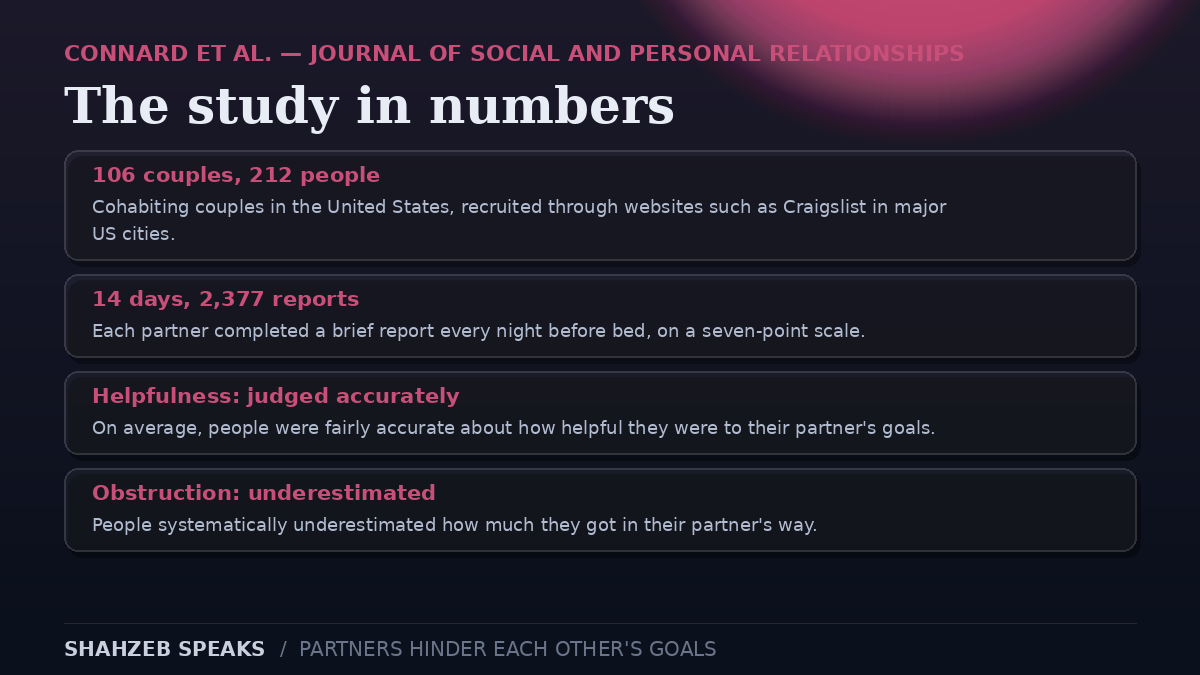
Yes — and the asymmetry is the point. In a 14-day diary study of 106 cohabiting couples in the United States, partners reported each day on how much they had helped and how much they had hindered each other’s goals. On average, people were fairly accurate about how helpful they were. But they systematically underestimated how much they obstructed their partner’s goals. The helpfulness they saw in themselves was roughly right. The hindrance they caused was smaller in their own eyes than in their partner’s.
Both mistakes were linked to worse outcomes, which is the part that should make us pause. Overestimating how helpful you are was associated with lower relationship satisfaction for both partners, and with lower closeness for the partner. Underestimating how much you get in the way was associated with less closeness for both partners, and with lower satisfaction for the partner. In other words, an overly flattering view of your own contribution was not harmless. The people who saw themselves most kindly were, on average, in the relationships that felt least close.
That is an association, not a proven cause, and this article will not pretend otherwise. It is possible that struggling relationships make people misjudge themselves, rather than the misjudgement causing the struggle. But the pattern is consistent with a wider body of research on how couples’ goals work — and it points to a practical habit that costs nothing: asking your partner what got in their way today, instead of assuming you already know.
📊 Chapter 2: The study — 106 couples, 14 days, 2,377 reports
The study behind this article was designed to answer three questions about the same daily reality: do people track their own impact on a partner’s goals accurately, do they project their own experience onto their partner, and do they systematically overestimate or underestimate what they do? The researchers recruited 106 cohabiting couples — 212 people — through websites such as Craigslist, with advertisements posted in major United States cities. Both partners had to be over 18, speak English, have daily internet access and live together. Couples moved into the diary phase only if both partners completed the intake questionnaires and passed attention checks.
For 14 days, each partner independently completed a brief report every night before bed. Each day they rated, on a seven-point scale from strongly disagree to strongly agree, whether their partner had made it easier for them to make progress toward their goals, and whether they themselves had made it easier for their partner. They answered the same questions about obstruction: whether their partner had made progress more difficult, and whether they themselves had done so. Daily relationship satisfaction was assessed with a modified item from the Investment Model Scale, and daily closeness with an item asking how close they felt to their partner that day. The final analyses used 2,377 daily reports.
That design has a real strength: it measures the same day from both sides, night after night, instead of asking people to remember a whole month at once. It also has a limit that the authors state directly and that this article will repeat wherever it matters. There were no observer reports. Without an outside view, it is difficult to know whether a gap between self-rating and partner-rating reflects self-misperception, partner over-reporting, or both. The study shows that the two views disagree in a systematic direction. It cannot prove which side is wrong.
A second limit is the sample. The couples were cohabiting, living in the United States, and predominantly White. The findings may not generalise across cultural or demographic groups, and they say nothing directly about couples who do not live together, or about goal friction at work — though the mechanism, as the later chapters show, is the same one that shows up in teams. No effect sizes or p-values for the headline findings were available in the sources I read, so this article prints none. The directions are verified; the sizes are not.
🪞 Chapter 3: Two blind spots, not one
The study found three patterns, and it helps to keep them separate, because they are not the same mistake.
The first is tracking accuracy, and it is the good news. On days when a partner reported that a participant had been more helpful to their goals, that participant also tended to rate themselves as more helpful. The same pattern appeared for obstruction: when partners reported more obstruction, participants tended to report that they had been more obstructive. People were not completely unaware of their daily impact. When the day went well or badly, both partners usually noticed, in the same direction. The tracking was there. The bias was in the average.
The second is projection. When participants felt their partner had helped their own goals, they were more likely to see themselves as helping their partner’s goals. When they felt obstructed by their partner, they were more likely to see themselves as obstructing their partner. In plain terms, people read their own behaviour through the lens of what they had just experienced. If your partner helped you today, you are more likely to believe you helped them. If your partner got in your way, you are more likely to believe you got in theirs. PsyPost notes that this may partly reflect real interdependence in cohabiting relationships — when two lives are intertwined, the same day often helps or hinders both people at once — rather than pure projection. Either way, the lens is real.
| What people judged | What the study found |
|---|---|
| Their own helpfulness | Mean-level accuracy — generally right, on average |
| Their own obstruction | Systematically underestimated |
| Overestimating helpfulness | Linked to lower satisfaction for both, lower closeness for the partner |
| Underestimating obstruction | Linked to less closeness for both, lower satisfaction for the partner |
| Day-to-day tracking | Present for both help and hindrance — people noticed the direction |
| Projection | Feeling helped or blocked coloured how people saw their own impact |
The third pattern is the one that matters most, and it is a bias in the average, not in the day-to-day tracking. People’s perceptions of how instrumental — how helpful — they were to their partner’s goals showed mean-level accuracy: on average, they got it about right. But they underestimated their obstruction of their partner’s goals. The help was seen clearly. The hindrance was seen through a kinder filter. And the partners in the study resembled each other in their levels of instrumentality and obstruction, which fits the picture of two lives running on the same schedule: when one person’s day is disrupted, the other’s usually is too.
Why would the two be judged differently? Help is usually deliberate and visible. You cook the dinner, you watch the children so your partner can study, you proofread the application. Obstruction is usually accidental and invisible to the person causing it. You take a call in the room where your partner is working. You change the plan at the last minute. You leave a task half done, and your partner picks it up. Nobody intends to obstruct. That is exactly why it is underestimated: the person doing it never registers it as an act at all.
🧠 Chapter 4: Why we miss our own friction
The study does not test why the bias exists, so this chapter is interpretation built on the study’s own findings and on related evidence, not a claim the study itself makes. But the interpretation is not guesswork. It follows from three things the study did establish: people track direction well, they project their own experience, and they are flattered by their own average view of their helpfulness.
First, help is counted and hindrance is not. A helpful act is usually a decision: I will do this for you. It has a beginning, an end, and a small sense of credit attached. An obstructive act is usually a side effect: I did my thing, and your thing got harder. Side effects do not get logged. Over a fortnight, the helpful acts accumulate in memory and the obstructive ones evaporate. The diary design of the study catches this because it asks about today, not about the year. Even so, the underestimation survived.
Second, projection cuts both ways and quietly protects the self-view. If your partner helped you today, you feel generous toward them, and that generosity spills into how you rate yourself. If your partner blocked you, you are more likely to notice your own blocking too — but the study suggests the self-protective direction wins on average. Seeing oneself too positively may protect against discomfort, as PsyPost notes in its coverage. The cost, the authors argue, is that people who miss their obstruction also miss the chance to adjust or repair it. You cannot fix a friction you have not noticed.
Third, there is a related finding from a separate study that makes the same point from a different angle. Körner and colleagues, writing in 2026 in Personality and Social Psychology Bulletin, found that people consistently underestimated how much influence — how much power — they had over their romantic partners and friends. The study covered 1,304 dyads across four samples in Germany and New Zealand, and the underestimation was stronger in people with high self-protection motives, such as attachment anxiety. In heterosexual couples, men underestimated their power significantly more than women. That is a different study, about power rather than goal obstruction, and its gender finding must not be transferred to the Connard study, which reported no gender split. But the shape is the same: we are systematically modest about our own impact on the people closest to us — and that modesty is not always harmless.
🔗 Chapter 5: One shared goal system
The reason this matters beyond one couple is that partners do not pursue their goals separately. The framework for this is Transactive Goal Dynamics, set out by Fitzsimons, Finkel and vanDellen in 2015 in Psychological Review. Their argument is that two or more interdependent people function as one single self-regulating system. Each person holds self-oriented goals, partner-oriented goals and system-oriented goals, and all of them are interdependent. When one partner’s goal advances or stalls, the system as a whole moves.
That is why a small obstruction is not a small thing. If two people are one system, then the friction one person causes is not a private cost to the other person. It is a cost to the system both of them live in. The partner who takes a long call in the shared room is not only interrupting the other person’s work. They are slowing the household’s evening, pushing the shared dinner later, and shrinking the time both of them have to recover. The obstruction is small. The system it lands in is not.

The same logic applies at work, which is where this site usually meets it. A colleague who books a meeting over your focus time, a manager who changes a deadline at the last minute, a teammate who leaves a task half done — these are the workplace versions of the same friction. Earlier writing on this site, on decision fatigue, showed how decision quality degrades as mental resources drain. Goal obstruction works the same way: it does not only cost the minutes it takes. It costs the recovery, the momentum and the attention that the interrupted person has to rebuild. And at work, as at home, the person causing it rarely notices, because the cost lands on someone else’s day.
This is also where the study’s finding about satisfaction and closeness connects to everyday life. The couples who overestimated their helpfulness and underestimated their obstruction were not the couples who fought most. They were the couples who felt least close. Closeness is not built by grand gestures. It is built by the accumulation of small, accurate adjustments — noticing the friction, naming it, and changing the routine. A self-view that is too flattering removes the reason to adjust. That is the authors’ point, and it is worth quoting again: maintaining overly positive self-perceptions may be costly for the relationship.
📈 Chapter 6: What the wider evidence says about goals in couples
The Connard study is one study, and a single study should never carry an article on its own. The wider evidence supports the same picture, and it is worth setting out, because it also gives the numbers the Connard study could not.
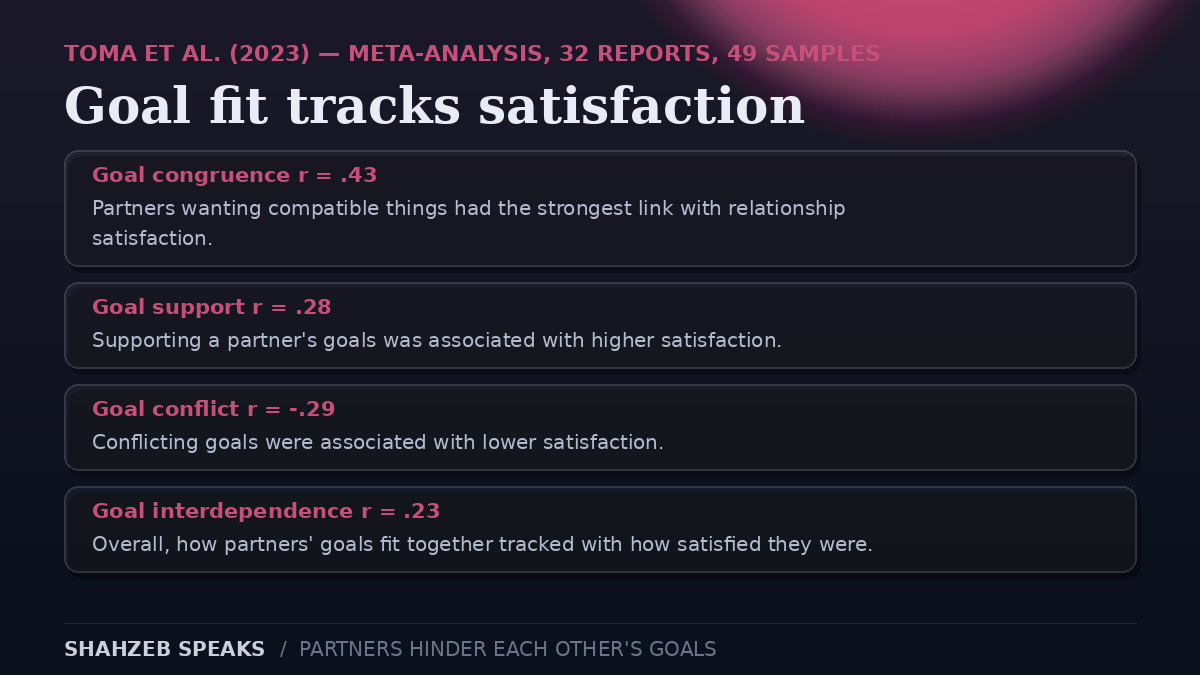
A meta-analysis by Toma, Rusu and Podina, published in 2023 in the Journal of Social and Personal Relationships, gathered 32 reports covering 49 independent samples on goal interdependence and relationship satisfaction. The pattern was clear. Goal interdependence overall was associated with satisfaction at r = .23. Goal congruence — partners wanting compatible things — was the strongest link, at r = .43. Goal support was associated at r = .28, and goal conflict at r = −.29. These are correlations, not proof of cause, and they come from many different studies with different measures. But they point in the same direction as Connard and colleagues: how partners’ goals fit together tracks closely with how satisfied they are.
A second line of evidence looks at what happens when goals do not fit. Vowels, Carnelley, Kumashiro and Rowe, writing in 2023 in Current Psychology, ran three studies — two experiments with 296 and 117 participants, and a dyadic daily diary with 267 participants — on non-harmonious goals. When goals were non-harmonious, partners were less likely to behave positively, less likely to provide support, less likely to view their partners as supportive, and less likely to report commitment. They also made less progress on their own goals. The mechanism is straightforward: when two people’s goals pull in different directions, each person’s progress becomes the other person’s obstacle, and the support that usually flows between partners dries up.
Read together, the three pieces of evidence form a coherent picture. Goals in a relationship are shared, whether the couple notices it or not. When they fit, satisfaction is higher. When they clash, support falls and progress slows. And when people misjudge their own contribution — overestimating the help, underestimating the hindrance — the relationship feels it. None of this is a prescription. It is a description of how the system behaves, and it is the description that makes the practical habits in Chapter 8 worth trying.
⚠️ Chapter 7: What the evidence cannot tell us
Honesty about limits is part of the article, not an afterthought. First, the anchor study is a diary study of self-reports, and it cannot prove causation. The associations between misjudgement and poorer outcomes could run in either direction: struggling couples may misjudge themselves more, or misjudgement may make couples struggle, or a third factor — stress, workload, a difficult week — may drive both. The study shows that the two travel together. It does not show which one causes the other.
Second, the sample is narrow. One hundred and six cohabiting couples, in the United States, predominantly White, recruited through websites such as Craigslist. That is a reasonable sample for a diary study, and 2,377 daily reports is a lot of data. But it is not a global sample, and it is not a sample of couples who live apart, or of couples in other cultures, or of older couples, or of couples without daily internet access. The findings should be read as a description of this group, not as a universal law about relationships.
Third, there were no observer reports. The study compares what people say about themselves with what their partner says about them. If the partner over-reports obstruction, the same gap appears. The authors are clear about this, and so is this article: the underestimation is a gap between two self-reports, not a measurement against an objective record.
Fourth, the sources I read gave no effect sizes or p-values for the headline findings, and no figure for how large the underestimation was on the seven-point scale. This article prints none, for that reason. The directions are verified. The sizes are not. And finally, nothing in this study tested an intervention. No couple was taught to ask better questions, and no outcome was measured after a change in behaviour. The habits in the next chapter are suggestions drawn from the cited research, not tested advice, and they should be read that way.
✅ Chapter 8: What to do with this — small habits, honestly framed
None of the habits below is a proven intervention. The study tested perceptions, not a programme. What follows is a practical reading of the evidence, framed as suggestions, not as therapy or medical advice. If a relationship is in serious difficulty, the right step is a qualified professional, not an article.
Ask what got in the way today — and listen to the answer as data. The study’s core finding is that people miss their own obstruction. The cheapest correction is to ask the person who feels it. A short nightly question — what got in your way today, and did I cause any of it — replaces assumption with information. The point is not to collect blame. It is to collect the friction that would otherwise stay invisible. Earlier writing on this site, on psychological safety at work, makes the same point about teams: people report problems only when they believe the report will be received as information, not as an accusation. A couple is a team of two, and the same rule holds.
Count the obstruction, not only the help. Help is easy to remember because it is deliberate. Obstruction is easy to forget because it is a side effect. A small weekly habit — each person naming one thing the other did that helped, and one thing that got in the way — makes the invisible half of the ledger visible. The aim is not a score. It is accuracy. The study found that people who overestimated their helpfulness felt less satisfied, not more. Accuracy, not flattery, is what the evidence rewards.
Protect the shared system, not just your own goal. Transactive Goal Dynamics says two people’s goals form one system. That changes the question from “did I get my work done?” to “did the system get its work done?” A partner who finishes their presentation at nine in the evening has still cost the household its evening. The practical version is unglamorous: agree on the hours when the shared room is quiet, agree on who takes the call elsewhere, and treat the other person’s focus time as part of your own plan. At work, the same habit applies: before booking over a colleague’s focus time, ask whether the meeting could be a message. Earlier writing on this site, on employee recognition, found that recognition works best when it is specific and timely. The same is true of noticing friction: specific, timely, and free of blame.
Do not turn the finding into a weapon. This is the easiest mistake to make with research like this. “You underestimate how much you hinder me” is a true sentence that will still make things worse if it is used as an accusation. The study’s finding is about a blind spot, and blind spots are shared: both partners underestimate their obstruction, and both project their own experience. The useful version of the conversation starts with your own friction, not your partner’s. “I realised I took that call in the room while you were working” opens a door. “You always interrupt me” closes one.
Finally, remember what the study actually measured: daily life, not crises. The couples were not in therapy. They were living together, working, and filling in a short report before bed. The lesson is correspondingly ordinary. Relationships do not usually break on a single large obstruction. They wear down on the small, unnoticed ones — the call, the changed plan, the errand at the wrong hour — repeated daily, and never counted. Counting them is a small act. The evidence suggests it is the act that matters most.
❓ Questions I am asked most often
Do partners really underestimate how much they hinder each other’s goals?
Yes, according to a 2026 diary study of 106 cohabiting couples in the United States. People judged their helpfulness fairly accurately on average, but systematically underestimated how much they obstructed their partner’s goals. The study used 2,377 daily reports over 14 days, and the pattern held for both partners.
How was the study done?
Each partner completed a brief report every night for 14 days, rating on a seven-point scale whether their partner had made progress easier or harder, and whether they themselves had done so. Satisfaction and closeness were measured daily. The design captures the same day from both sides, but it relied on self-reports only — there were no observer reports.
Why do people miss their own obstruction?
Help is usually deliberate and visible, so it is remembered. Obstruction is usually a side effect — a long call, a changed plan, an errand at the wrong hour — so it is never registered as an act. People also project: feeling helped makes them think they help, and feeling blocked makes them think they block.
Does overestimating your helpfulness actually harm a relationship?
The study found an association, not proof of cause. Overestimating helpfulness was linked to lower satisfaction for both partners and lower closeness for the partner; underestimating obstruction was linked to less closeness for both and lower satisfaction for the partner. It is possible the causation runs the other way, or that a third factor drives both.
What is transactive goal dynamics?
A framework by Fitzsimons, Finkel and vanDellen (2015) which treats two interdependent people as one self-regulating system. Each person holds self-oriented, partner-oriented and system-oriented goals, and all of them affect each other. When one partner’s goal stalls, the shared system slows with it.
Does this apply to work teams too?
The study itself was about couples, not workplaces, so the findings cannot be transferred directly. But the mechanism is the same: goal obstruction at work — a meeting over focus time, a deadline moved at the last minute — is usually invisible to the person causing it, and the cost lands on someone else’s day.
If your team keeps tripping over the same small frictions — meetings over focus time, deadlines moved at the last minute — the fix starts with noticing who pays the cost. I help organisations build healthier, evidence-based working practices — get in touch here.
If this article helped, you may also like Decision Fatigue: Why Your Evening Self Makes Worse Choices Than Your Morning Self, Psychological Safety at Work, and Meaningful Work: Why the Search for Purpose at Work Surged. For the wider field, the homepage of this site covers industrial psychology in Pakistan and beyond.
Sources
- Connard, E., Kilian, J. L., Gere, J. & LaBuda, J. E. (2026). Do people know how they impact their Partner’s goal pursuit? Accuracy, bias, and associations with relationship outcomes. Journal of Social and Personal Relationships. DOI: https://doi.org/10.1177/02654075261435648 (as linked from the PsyPost coverage; the DOI page returned 403 when opened on 16 November 2026, so volume, issue and page numbers were not confirmed). Covered in PsyPost, 14 November 2026: https://www.psypost.org/people-tend-to-underestimate-how-much-they-get-in-the-way-of-their-partners-goals/
- Fitzsimons, G. M., Finkel, E. J. & vanDellen, M. R. (2015). Transactive goal dynamics. Psychological Review, 122(4), 648–673. DOI: https://doi.org/10.1037/a0039654
- Toma, C., Rusu, P. P. & Podina, I. R. (2023). The role of goal interdependence in couples’ relationship satisfaction: A meta-analysis. Journal of Social and Personal Relationships, 40(6), 1740–1769. DOI: https://doi.org/10.1177/02654075221128994
- Vowels, L. M., Carnelley, K. B., Kumashiro, M. & Rowe, A. C. (2023). The impact of non-harmonious goals on partner support and taking on opportunities. Current Psychology, 42, 23166–23183. DOI: https://doi.org/10.1007/s12144-022-03463-7
- Körner, R. et al. (2026). People underestimate their power in close relationships. Personality and Social Psychology Bulletin. Covered in PsyPost: https://www.psypost.org/new-psychology-study-reveals-we-consistently-underestimate-our-power-in-close-relationships/