
It is late at night. She is on the sofa, scrolling through messages, and he is leaning in close, one hand on her arm, reading over her shoulder. Nothing suspicious has been said or found, but his eyes keep returning to the screen. New research on dark personality traits jealousy — how antagonistic traits connect with jealous feelings — suggests the tension in that room does not start with a rival. Part of the link between an aggressive personality and jealousy runs through how a person loves, and the obsessive, possessive style called Mania is the bridge.

I am an Industrial and Organizational Psychologist in Karachi, and I write about work and behaviour for a global reader. This article is built on a study published in Sexual and Relationship Therapy by Bruno Bonfá-Araujo and colleagues, covered by PsyPost on 15 November 2026. It is a study about a mechanism, not about a diagnosis: it asks whether the way a person loves sits between their personality and their jealousy, and it finds that it does — partly for one kind of jealousy, and entirely for another. I will say plainly where the evidence stops, because this study has real limits — two samples from Brazil only, self-reports only, and a single point in time — and the article respects them throughout. It also makes one distinction that matters more than any single finding: the study measured antisocial personality facets, not the Dark Triad, and the two must not be confused.
“Mania is an obsessive or possessive love, jealous and extreme.”
— John Alan Lee, Colours of Love (1973), on the Mania love style
This guide covers the short answer, the two studies behind it, the six love styles and where Mania sits among them, the bridge the researchers found, the two kinds of jealousy, what the study did and did not measure, what the wider evidence says, what the findings cannot prove, and what a reader can honestly do with them.
🎯 Chapter 1: The short answer — dark personality traits jealousy, explained
Yes, they are linked — and the link is more specific than the headline suggests. In two studies of Brazilian adults, 255 people in the first and 198 in the second, researchers found that aggression — one of four antisocial personality facets they measured — was the only trait reliably tied to threat-based jealousy, the kind that appears when a person believes a rival might take their partner. And the obsessive love style called Mania sat in the middle of that link. For threat-based jealousy, Mania partly carried the connection: part of the link from aggression to jealousy ran through Mania, while a direct association between aggression and jealousy remained. For non-threat jealousy — jealous feelings that appear even when no rival is plausibly involved — Mania carried the whole link. In the analysis, the connection between aggression and non-threat jealousy ran entirely through the obsessive love style.
That is a mediation finding, and it is worth understanding in plain language before anything else. A mediator is a bridge. The researchers were not asking whether aggressive people are jealous. They were asking how the two are connected — whether the connection passes through a third thing, the way a person loves. The answer was that it does, and that the bridge matters more for one kind of jealousy than for the other. When a rival is genuinely in the picture, aggression connects to jealousy both directly and through Mania. When no rival is in the picture, the connection runs through Mania alone.
Two warnings belong in the first chapter, not buried at the end. First, both studies were cross-sectional surveys: they measured personality, love style and jealousy at one point in time. That means the findings are associations, and the mediation is a statistical pattern, not proof of a causal chain. Nothing here shows that aggression produces Mania, or that Mania produces jealousy. Second, the samples were Brazilian adults, and the findings may not travel to other cultures. The way people understand romantic love and express jealousy varies widely around the world, and the study’s own coverage says so.
📊 Chapter 2: The study — 453 adults, two samples, one question
The study behind this article was designed to answer a question that earlier research had left open. Plenty of work had shown that dark or antagonistic traits are associated with jealousy. What was missing was the middle step: whether the way a person loves explains part of that connection. Bonfá-Araujo and colleagues, led by a psychology researcher at the Universidade Tuiuti do Parana in Brazil, ran two separate studies to test the idea, both built on self-report questionnaires.
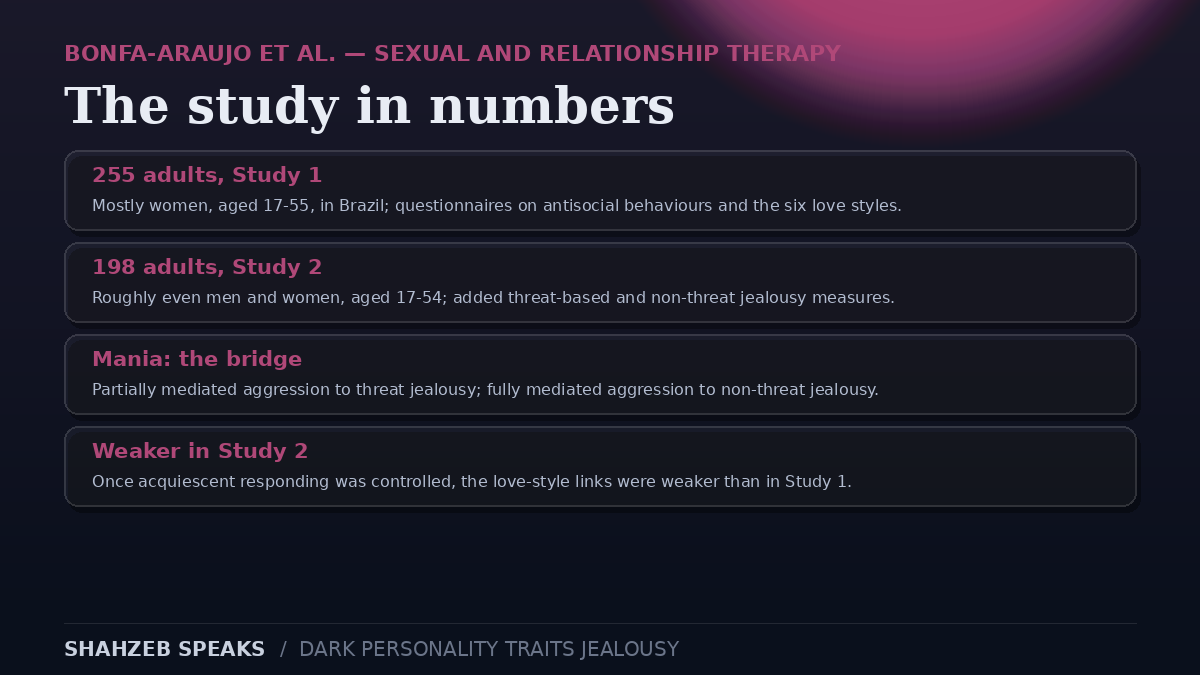
The first study recruited 255 adult participants in Brazil, mostly women, aged 17 to 55. They completed questionnaires measuring antisocial behaviours and their preferences among the six love styles. The pattern was clear enough to be worth a second look. Ludus and Mania — the game-playing style and the obsessive style — were positively associated with aggression, irresponsibility and manipulation. Both styles involve control, game-playing or emotional volatility, which matched what the researchers expected. Storge and Pragma, the friendship-based and practical styles, showed no statistically significant links to antisocial behaviours at all.
The first study also produced a surprise. Agape — the selfless love style, the one built on putting a partner’s needs first without expecting anything back — was also positively linked to select antisocial facets, including aggression and manipulation. That is not what a simple story about selfish traits would predict. As the PsyPost coverage put it, even a traditionally generous love style “might operate in complicated ways when expressed by individuals with antagonistic traits”. A selfless style in the hands of someone high in aggression does not necessarily look selfless. The study does not explain why, and this article will not invent a reason. But the finding is a useful warning against reading any single love style as a character verdict.
The second study recruited a new group of 198 Brazilian adults, roughly evenly split between men and women, aged 17 to 54. It added a questionnaire measuring threat-based and non-threat jealousy, and it used a slightly modified love-styles survey designed to control for acquiescent responding — the tendency of some participants to agree with survey statements regardless of their content. That control matters, and it changed the results. When the response bias was controlled, the associations between love styles and antisocial traits were weaker than in the first study. The headline pattern survived, but it was smaller once the researchers had stripped out the habit of saying yes to everything.
| What was measured | What the studies found |
|---|---|
| Study 1 — 255 adults, Brazil | Ludus and Mania linked to aggression, irresponsibility and manipulation; Agape linked to aggression and manipulation too; Storge and Pragma showed no significant links |
| Study 2 — 198 adults, Brazil | Links weaker once acquiescent responding was controlled; aggression the only antisocial trait reliably linked to threat-based jealousy |
| Mania and threat jealousy | Mania the only love style directly associated with threat jealousy; it partially mediated the aggression-to-threat-jealousy link |
| Mania and non-threat jealousy | Mania fully mediated the aggression-to-non-threat-jealousy link; Storge was also linked to non-threat jealousy |
| Design limits | Self-report only, one point in time, Brazil only — associations, not proof of cause |
The researchers then ran a statistical path analysis to test mediation: whether love style explains the process through which personality traits and jealousy are related. That is where the two findings in Chapter 1 come from. No effect sizes, path coefficients or p-values for these findings were available in the sources I read, so this article prints none. The directions and the mediation types — partial for threat jealousy, full for non-threat jealousy — are verified. The sizes are not.
💘 Chapter 3: The six love styles — and where Mania sits
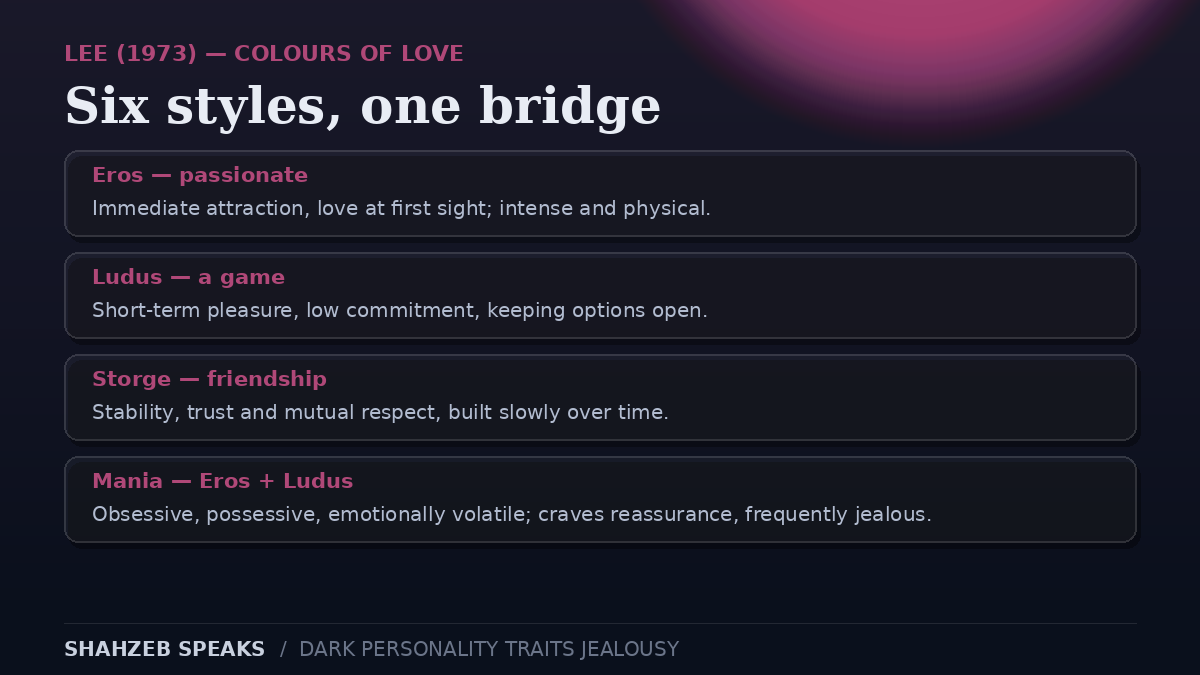
To understand the finding, it helps to know what the researchers meant by a love style. The framework comes from Canadian sociologist John Alan Lee, who proposed six styles in his 1973 book Colours of Love, drawn from an analysis of how people describe love. Three are primary styles. Eros is passionate, immediate attraction — love at first sight, intense and physical. Ludus is love as a game: short-term pleasure, low commitment, manipulation and keeping options open. Storge is friendship-based love: stability, trust and mutual respect, built slowly over shared experience. Then there are three secondary blends. Pragma combines Ludus and Storge: a practical love in which a partner must meet specific criteria. Agape combines Eros and Storge: selfless, compassionate love that puts a partner’s needs first without expecting a return. And Mania combines Eros and Ludus: obsessive, possessive and emotionally volatile love, in which a person craves repeated reassurance of being loved and is frequently jealous.
Mania is the style that matters here, and Lee’s own description of it is the clearest available: an obsessive or possessive love, jealous and extreme. People who love in this way tend to need constant proof that they are loved, and to swing between elation and despair depending on how much reassurance they have just received. Hendrick and Hendrick turned Lee’s styles into a questionnaire, the Love Attitudes Scale, in 1986, and that scale family is the standard way researchers have measured the styles since. The Bonfá-Araujo studies used questionnaires of this kind, though the sources I read did not name the exact scales used, so this article names none.
It is worth pausing on the fact that Mania is a style, not a diagnosis. A love style describes how a person tends to approach love — a preference, measured on a continuum in the general population. It is not a disorder, and scoring high on Mania does not mean someone has a personality disorder. The study’s participants were general-population adults, not patients. The same is true of the antisocial facets the study measured: they were questionnaire scores for traits such as aggression, irresponsibility, manipulation and recklessness, not clinical diagnoses. Keeping that distinction in mind is what stops an interesting finding from becoming a label.
The six styles also explain why the Agape surprise in Chapter 2 is less strange than it first looks. Love styles are not moral grades. A person can score high on a selfless style and still behave manipulatively, because a style describes the shape of the love, not the quality of the character behind it. Agape in someone high in aggression might look like intense devotion used as leverage — generous acts that create obligation, or self-sacrifice that is later held up as proof. The study does not test that reading. But it is consistent with the finding, and it is a better reading than the simple idea that generous love and antagonistic traits cannot coexist.
🌉 Chapter 4: Mania, the bridge between aggression and jealousy
The heart of the study is the mediation result, and it deserves a careful explanation, because mediation is easy to misunderstand. The researchers asked whether the connection between aggression and jealousy passes through Mania. In a path analysis, that question has three possible answers. There could be no mediation at all: aggression connects to jealousy directly, and Mania is irrelevant. There could be partial mediation: part of the connection runs through Mania, and part of it runs directly. Or there could be full mediation: the whole connection runs through Mania, and once Mania is accounted for, the direct link disappears.
For threat-based jealousy, the answer was partial mediation. Aggression was linked to threat jealousy, and part of that link ran through the obsessive and dependent characteristics of manic love — while a direct association between aggression and threat jealousy remained. In plain terms: aggressive people were more likely to feel threat-based jealousy, and some of that was because they were more likely to love in the manic style, which itself is tied to jealousy. But not all of it. Aggression still had its own direct line to jealousy, even after Mania was taken into account. The bridge carries some of the traffic, not all of it.
For non-threat jealousy, the answer was full mediation. The link between aggression and non-threat jealousy ran entirely through Mania. Once the researchers accounted for the obsessive love style, there was no remaining direct connection between aggression and this kind of jealousy. That is the more striking of the two findings, and it is worth thinking about what it means. Non-threat jealousy is jealousy without a rival: distress or suspicion in response to a partner’s ordinary interactions, the kind that do not plausibly threaten the relationship. The finding says that aggression on its own does not predict that kind of jealousy. It predicts it only insofar as it travels with an obsessive, possessive way of loving — the need for reassurance, the emotional volatility, the possessiveness that Lee described.

That distinction has a practical shape. Threat-based jealousy has a trigger in the world: a rival, a message, a late night. Non-threat jealousy has no trigger, or none that an outside observer would recognise. The study suggests the two are not the same mechanism wearing different clothes. One is partly a direct response to a perceived threat, filtered through personality. The other is, in this analysis, entirely a product of how a person loves. A person who loves obsessively does not need a reason to be jealous. The love style itself supplies the suspicion.
There is an important caveat to carry through this chapter. Mediation in a cross-sectional study is a statistical pattern, not a proven causal chain. The data were collected at one point in time, so the analysis cannot show that aggression comes first, Mania second and jealousy third. It is possible that the direction runs the other way — that the way a person experiences love brings out their darker traits, as the PsyPost coverage notes — or that a third factor drives all three. The mediation language in this article describes the pattern the researchers found, not a proven sequence of causes.
👀 Chapter 5: Two kinds of jealousy — and why the split matters
The study’s second distinction is between two kinds of jealousy, and it is the distinction that makes the mediation finding interesting. Threat-based jealousy arises when someone perceives a real or imagined risk of losing their partner to a rival. Non-threat jealousy describes situations where outside interactions do not provoke distress, or are viewed as benign — the jealousy, in other words, appears where no threat exists. The two are not points on a single scale. They are different responses, and the study found that they behave differently: aggression was the only antisocial trait reliably linked to threat-based jealousy, and Mania was the only love style directly associated with it, while Storge — the friendship-based style — was linked to non-threat jealousy, in a direction the sources did not state, so this article states none.
That split connects to an older and better-established way of sorting jealousy, which helps to explain why the distinction matters for relationships. Buunk proposed three types in 1997, and Barelds and Dijkstra tested them in 2007: reactive jealousy, the negative emotions that follow a partner’s actual infidelity; anxious jealousy, the worrying and ruminating about a partner’s possible infidelity; and preventive or possessive jealousy, the efforts to stop a partner from having contact with others. Across three studies totalling 961 couples, the two kinds behaved very differently. Both partners’ reactive jealousy was related positively to relationship quality — the kind of jealousy that follows a real betrayal is, in a sense, a healthy response. Both partners’ anxious jealousy was related negatively to relationship quality. The worrying kind, the kind that arrives without a trigger, is the one that wears a relationship down.
Read together, the two frameworks tell a consistent story. Jealousy that follows a real threat is a normal, even relationship-protecting response. Jealousy that arrives without a threat — the anxious, preventive kind — is the one linked to poorer outcomes, and it is the one that, in the Bonfá-Araujo study, ran entirely through an obsessive love style. That is not a moral judgement. It is a description of a pattern: the jealousy that causes the most damage is also the jealousy least connected to anything the partner actually did.
There is a workplace echo here too, which is where this site usually meets jealousy. Envy and suspicion at work follow the same split. A colleague who feels threatened by a rival’s promotion is experiencing something close to threat-based jealousy: there is a real event in the world. A colleague who monitors a teammate’s every interaction, who reads rivalry into ordinary collaboration, is experiencing something closer to the non-threat kind — and earlier writing on this site, on how partners underestimate the friction they cause each other, showed how invisible the costs of that kind of vigilance can be. In both settings, the jealousy that has no trigger is the one that is hardest to reason with, because there is nothing to disprove.
⚖️ Chapter 6: A necessary distinction — what the study did and did not measure
This chapter is the one the article’s title makes necessary. The PsyPost headline calls the research a study of “dark personality traits”, and this article’s own title uses the same phrase, because it is the phrase people search for. But the study did not measure the Dark Triad. It measured antisocial personality facets: aggression, irresponsibility, interpersonal manipulation and recklessness, as described by PsyPost — traits reflecting a disregard for the rights of others. The Dark Triad is a different framework, and it must be explained separately so the two are not confused.
The Dark Triad was coined by Paulhus and Williams in 2002, in the Journal of Research in Personality. It groups three overlapping but distinct subclinical traits: Machiavellianism, the manipulation and strategic exploitation of others, with a cynical disregard for morality; narcissism, grandiosity, a sense of entitlement and a need for admiration; and psychopathy, callousness, impulsiveness, thrill-seeking and low empathy. All three share self-promotion, emotional coldness, duplicity and aggressiveness. Some psychologists have since proposed adding sadism — enjoying others’ suffering — to make a Dark Tetrad. The Bonfá-Araujo paper did not measure sadism, as reported, and it did not measure the triad. Its participants answered questions about antisocial behaviours, and the four facets above are what the questionnaires captured.
Why does the distinction matter? Because a reader who thinks the study measured narcissism or psychopathy will draw conclusions the study does not support. Aggression is a facet that appears across several frameworks, and it is the only one of the four that was reliably linked to threat-based jealousy in the second study. Irresponsibility, manipulation and recklessness were not reliably linked to threat jealousy, as reported. If the study had measured the Dark Triad, the results might have looked different — or they might not have. The honest statement is that nobody knows from this study, because it was not what was measured.
The same care applies to the clinical language. Antisocial personality disorder, as described in the DSM-5, is a pervasive pattern of disregard for and violation of the rights of others since the age of 15, shown by at least three of a list that includes deceitfulness, impulsivity, irritability and aggressiveness, reckless disregard for safety, consistent irresponsibility and lack of remorse. Having some of these traits does not mean having the disorder. A diagnosis requires an enduring, pervasive and clinically significant pattern. The Bonfá-Araujo participants were general-population adults answering questionnaires, not diagnosed patients. Nothing in this article should be read as a way to diagnose a partner, a colleague or yourself.
📈 Chapter 7: What the wider evidence says
The Bonfá-Araujo study is one study, and a single study should never carry an article on its own. The wider evidence supports the same broad picture — that antagonistic traits track the worrying, controlling kinds of jealousy more than the reactive kind — and it is worth setting out, because it also shows how consistent the pattern is across different samples and measures.
Barelds and colleagues, writing in 2017 in Personality and Individual Differences, tested the Dark Triad directly against the three types of jealousy, in 439 men and women in romantic relationships, both heterosexual and homosexual. Their hypothesis was largely confirmed: the three Dark Triad traits related positively to the jealousy types with the potential to become delusional — anxious and preventive jealousy — but not to the relatively healthy reactive jealousy. The relationships were not moderated by participant sex or sexual orientation. That is the same split the Bonfá-Araujo study found, measured with a different framework and a different sample: the worrying kinds of jealousy, not the reactive kind, are the ones that travel with antagonistic traits.
Chin and colleagues, also in 2017 and in the same journal, tested cognitive, emotional and behavioural jealousy against the Dark Triad in 453 participants — 311 women, 140 men and 2 unidentified — aged 17 to 81, with a mean age of 33.19. The Dark Triad traits correlated with cognitive and behavioural jealousy, while only narcissism correlated significantly with emotional jealousy. The distinction matters: thinking jealous thoughts and acting on them tracked the traits more closely than simply feeling jealous did. A person can feel a pang of jealousy without checking a phone. It is the checking that the traits predict.
The same lead author has pursued the question further. Furtado and colleagues, in 2024 in Social Sciences, studied the Dark Triad, jealousy and infidelity intentions in 567 adult women aged 18 to 73, with a mean age of 31.91. The Dark Triad traits had strong links to the intention to commit infidelity and to jealousy, and both jealousy and infidelity intention predicted conflict tactics. The sample was women only, so the findings say nothing directly about men, but they extend the pattern: the traits are tied not only to feeling jealous, but to the behaviours that follow from it.
Two more studies complete the picture, from different angles. Brazil and colleagues, in 2023 in the Archives of Sexual Behavior, surveyed 143 heterosexual couples and found that men’s psychopathy was associated with higher suspicious jealousy and with partner sexual coercion — and that suspicious jealousy indirectly linked psychopathic traits with engaging in partner sexual coercion. That is a serious finding, and it should be stated plainly: in that study, jealousy was part of the pathway to coercive behaviour. And Costa and colleagues, in 2015 in the Journal of Affective Disorders, compared 32 people with pathological jealousy against 31 healthy volunteers, and found that those with pathological jealousy were predominantly categorised with anxious-ambivalent attachment and the Mania love style, with elevated impulsivity and trait anxiety and poor social adjustment. The sample was small and cross-sectional, so it is supportive context only — but it is the same love style, appearing again, at the extreme end of the same pattern.
Read together, the studies form a coherent picture. Antagonistic traits are tied to the worrying and controlling forms of jealousy, not to the reactive kind. The link runs, at least in part, through how a person loves — and the obsessive style is the one that keeps appearing. None of this is proof of cause. All of it is association, measured at one point in time, in samples that vary in size and culture. But the consistency across five studies, four journals and three countries is worth more than any single result.
⚠️ Chapter 8: What the evidence cannot tell us
Honesty about limits is part of the article, not an afterthought. First, the anchor study is cross-sectional. It measured personality, love style and jealousy at a single point in time, so it cannot show which comes first. The mediation is a statistical pattern: the data are consistent with the idea that aggression works through Mania to produce jealousy, but they are equally consistent with other orderings. The coverage of the study says this directly, and so does this article: it is impossible to know from these data whether certain personality traits prompt a specific love style, or whether the way a person experiences love brings out their darker traits.
Second, everything was self-reported. People do not always accurately judge or honestly report their own antisocial behaviours, manipulative tendencies or intense jealousy. A person high in manipulation may under-report their manipulation. A person high in jealousy may over-report their partner’s provocations. The second study’s control for acquiescent responding — the habit of agreeing with statements regardless of content — is a strength, and it made the associations weaker. That is how science should work. But no questionnaire can remove the basic problem: the study measures what people say about themselves, not what they do.
Third, the samples were Brazilian, and both were drawn from the general population of adults who were willing to complete online questionnaires. The findings may not generalise to other cultures, to older or younger groups, or to clinical samples. The way people conceptualise romantic love and express jealousy varies widely around the world, and a study of Brazilian adults cannot stand in for a global claim. The sources I read also gave no effect sizes, path coefficients or p-values, no mean ages and no exact gender percentages — so this article prints none of those. The directions are verified. The sizes are not.
Fourth, the study did not test an intervention. No participant was taught to recognise an obsessive love style, and no outcome was measured after a change in behaviour. The reflections in the next chapter are suggestions drawn from the cited research, not tested advice, and they should be read that way. And finally, the study did not measure the Dark Triad, did not measure sadism, did not name its questionnaires in the sources I read, and did not report any result for recklessness. Anything this article does not say about those things is deliberate, not an oversight.
✅ Chapter 9: What to do with this — honestly framed
None of the reflections below is a proven intervention. The study tested associations, not a programme. What follows is a practical reading of the evidence, framed as general information, not as therapy, diagnosis or medical advice. If jealousy is causing serious difficulty in a relationship — monitoring, controlling behaviour, or fear — the right step is a qualified professional, not an article. What follows is for the ordinary case: the suspicion that arrives without a clear reason, and the question of what to do with it.
Notice whether the jealousy has a trigger — or only a pattern. The study’s most useful distinction is between jealousy with a rival and jealousy without one. When a suspicion has a trigger — a message, a late night, a change in behaviour — it can be checked, discussed and resolved. When it has no trigger, only a pattern, the trigger is not in the world. It is in the way the jealous person loves: the need for reassurance, the emotional volatility, the possessiveness that Lee called Mania. Naming that difference does not fix anything on its own. But it changes the question from “what did my partner do?” to “what is this feeling actually about?” — and that is the question the evidence points to.
Count the reassurance, not only the suspicion. Obsessive love runs on reassurance: the repeated checking, the repeated asking, the repeated need to be told that the relationship is safe. Each act of reassurance feels like it solves the problem, and each one leaves the underlying need untouched. The practical version of the study’s finding is unglamorous: if the jealousy returns after every reassurance, the reassurance is not the cure. It is part of the cycle. Earlier writing on this site, on decision fatigue, showed how repeated small decisions drain the same mental resources all day. Reassurance-seeking works the same way: it costs the partner’s patience, the jealous person’s attention, and the relationship’s calm, a little at a time.
Do not use the finding to label a partner. This is the easiest mistake to make with research like this. “You have an obsessive love style” is a sentence that will make things worse, however true it feels. The study measured questionnaire scores in the general population, not diagnoses, and it measured them at one point in time. The useful version of the conversation starts with your own experience, not your partner’s traits. “I notice I feel suspicious even when nothing has happened” opens a door. “You are jealous because you are manipulative” closes one. Earlier writing on this site, on psychological safety at work, makes the same point about teams: people report problems only when they believe the report will be received as information, not as an accusation. A couple is a team of two, and the same rule holds.
Remember what the study actually measured: ordinary people, not crises. The participants were adults in Brazil answering questionnaires, not people in therapy. The lesson is correspondingly ordinary. Jealousy does not usually arrive as a dramatic accusation. It arrives as a small, repeated check — a glance at a phone, a question about a message, a suspicion that has no evidence and will not go away. The evidence suggests that this kind of jealousy is less about the partner and more about the way the jealous person loves. That is not a comforting thought, but it is a useful one: it puts the thing that can change — the pattern, not the partner — in the hands of the person who feels it.
Finally, remember the limit that frames the whole article. Nothing here proves that changing a love style would change jealousy, because no study has tested that. The mediation is a pattern in survey data, not a tested intervention. What the evidence does show, consistently across several studies, is that the worrying kinds of jealousy travel with antagonistic traits, and that the obsessive way of loving sits between them. That is enough to think differently about jealousy. It is not enough to prescribe a cure — and this article does not pretend otherwise.
❓ Questions I am asked most often
Do dark personality traits cause romantic jealousy?
No — the research shows a link, not a cause. A 2026 study of 453 Brazilian adults found aggression was associated with threat-based jealousy, and that the obsessive love style Mania partly carried that link. Both studies were cross-sectional surveys, so they cannot prove that a trait causes a love style, or that a love style causes jealousy.
What is Mania love?
Mania is one of John Alan Lee’s six love styles, from his 1973 book Colours of Love. It is the blend of Eros and Ludus: obsessive, possessive and emotionally volatile love, in which a person craves repeated reassurance of being loved and is frequently jealous. It is a style of loving, not a diagnosis.
What is the difference between threat and non-threat jealousy?
Threat-based jealousy arises when a person perceives a real or imagined risk of losing their partner to a rival. Non-threat jealousy appears where outside interactions do not provoke distress or are viewed as benign — the jealousy arrives without a plausible rival. In this study, Mania partly mediated the first link and fully mediated the second.
Did the study measure narcissism, Machiavellianism and psychopathy?
No. The study measured antisocial personality facets — aggression, irresponsibility, interpersonal manipulation and recklessness — in the general population. The Dark Triad is a different framework, coined by Paulhus and Williams in 2002. It is useful background, but it was not what this study measured.
Why did the second study find weaker links than the first?
The second study controlled for acquiescent responding — the tendency of some participants to agree with survey statements regardless of their content. Once that response bias was removed, the associations between love styles and antisocial traits were weaker. The headline pattern survived, but it was smaller, which is a sign the researchers took the measurement problem seriously.
What should I do if I recognise this pattern in myself?
Start by noticing whether your jealousy has a trigger or only a pattern — suspicion without a rival points to the love style rather than the partner. Do not use the research to label yourself or a partner; the study measured questionnaire scores, not diagnoses. If jealousy is causing serious difficulty, a qualified professional is the right step, not an article.
If suspicion without a trigger keeps showing up in your team — a colleague reading rivalry into ordinary collaboration — the fix starts with noticing the pattern, not the person. I help organisations build healthier, evidence-based working practices — get in touch here.
If this article helped, you may also like Why Partners Underestimate How Much They Hinder Each Other’s Goals, Decision Fatigue: Why Your Evening Self Makes Worse Choices Than Your Morning Self, and Employee Recognition: What Actually Works — and What Backfires. For the wider field, the homepage of this site covers industrial psychology in Pakistan and beyond.
Sources
- Bonfá-Araujo, B., Jesuíno, A. D. S. A., Macedo, V. H. F., Lima, R. K. A., da Cruz, D. S., Lima-Costa, A. R. & Schermer, J. A. (2026). Untying the knot: investigating the mediating role of love in the relationship between antisocial personality and jealousy. Sexual and Relationship Therapy. DOI: https://doi.org/10.1080/14681994.2026.2675622 (as listed in the Exaly citation report; the DOI page returned 403 when opened on 17 November 2026, so volume, issue and page numbers were not confirmed). Covered in PsyPost, 15 November 2026: https://www.psypost.org/how-aggressive-personality-traits-fuel-romantic-jealousy-through-obsessive-love/
- Lee, J. A. (1973). Colours of Love.
- Hendrick, C. & Hendrick, S. (1986). The Love Attitudes Scale, the standard questionnaire measure of Lee’s six love styles.
- Paulhus, D. L. & Williams, K. M. (2002). The Dark Triad of personality: narcissism, Machiavellianism and psychopathy. Journal of Research in Personality, 36(6), 556–563.
- Barelds, D. P. H. & Dijkstra, P. (2007). Types of jealousy and relationship quality. Clinical Psychology & Psychotherapy, 14, 176–188.
- Barelds, D. P. H., et al. (2017). Dark Triad and three types of jealousy. Personality and Individual Differences, 116, 6–10. DOI: https://doi.org/10.1016/j.paid.2017.04.017
- Chin, K., et al. (2017). The dark side of romantic jealousy. Personality and Individual Differences, 115, 23–29. DOI: https://doi.org/10.1016/j.paid.2016.10.003
- Furtado, et al. (2024). Dark Triad traits, jealousy and infidelity intentions. Social Sciences, 13(9), 474. DOI: https://doi.org/10.3390/socsci13090474
- Brazil, et al. (2023). Men’s psychopathy, jealousy and coercion. Archives of Sexual Behavior, 52(6), 2421–2432. DOI: https://doi.org/10.1007/s10508-023-02587-6
- Costa, et al. (2015). Pathological jealousy and Mania. Journal of Affective Disorders, 174, 38–44.
- Buunk, B. P. (1997). Three types of jealousy — reactive, anxious and preventive — as cited in Barelds & Dijkstra (2007).